

Prospecting Data: What It Is, Why It Decays, and How to Fix It
Bad data costs the average company $12.9 million per year. That's not a rounding error - it's wasted rep time, blown deliverability, and deals that never start because the email bounced. B2B contact data decays roughly 2.1% per month, which means about 22.5% of your records go stale annually. A list you built in January is missing a quarter of its viable contacts by December.
Your prospecting data is either an asset or a liability. The difference comes down to freshness, accuracy, and whether anyone's actually maintaining it.
Quick Recommendations
If your bounce rates are above 6%, your data is the problem - not your copy, not your subject lines.
- Prospeo - top pick for accuracy (98% email verification) and freshness (7-day refresh). Free tier: 75 emails/month + 100 Chrome extension credits/month.
- Apollo.io - broadest free database, easiest onboarding for teams just getting started.
- Clay - best for power users who want custom enrichment workflows.
The 7 Types You Should Track
Most teams think prospecting data means "name, email, phone number." That's contact data - one of seven categories you should be working with.
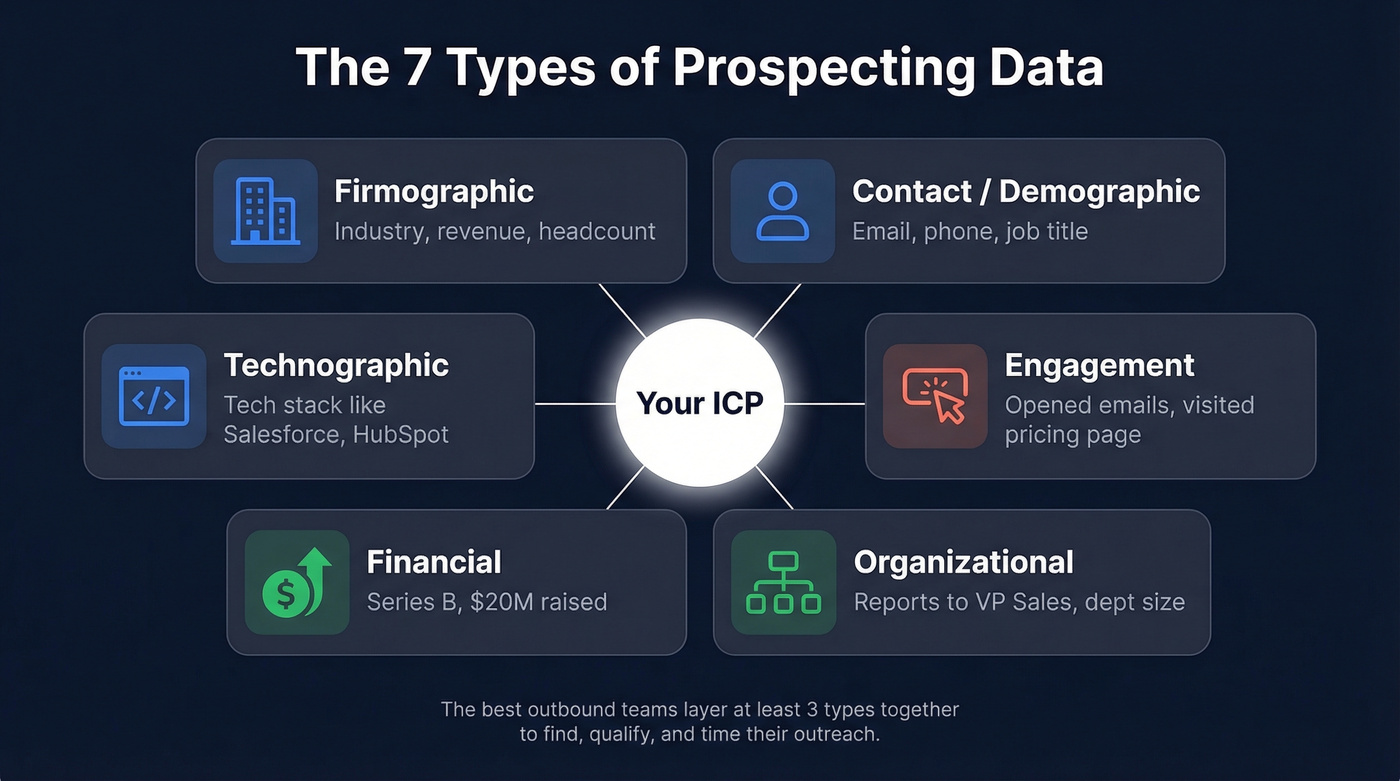
| Type | What It Covers | Example |
|---|---|---|
| Firmographic | Company attributes | Industry, revenue, headcount |
| Contact/Demographic | Individual details | Email, phone, job title |
| Technographic | Tech stack signals | Uses Salesforce, runs HubSpot |
| Intent | Buying signals | Researching "CRM migration" |
| Engagement | Behavioral activity | Opened 3 emails, visited pricing |
| Financial | Funding & revenue | Series B, $20M raised |
| Organizational | Hierarchy & structure | Reports to VP Sales, dept size |
The most effective outbound teams layer at least three of these together. Contact data gets you to the person. Firmographic and technographic data tell you if they're a fit. Intent signals tell you if they're ready. This shift from gut-feel outreach to data-layered prospecting is what separates teams booking meetings from teams burning lists - and it's a gap that widens every quarter as inboxes get noisier and spam filters get smarter.
Why Your Database Decays
People change jobs. Companies get acquired. Domains expire. 15-20% of professionals switch roles annually, and every change cascades through your database.
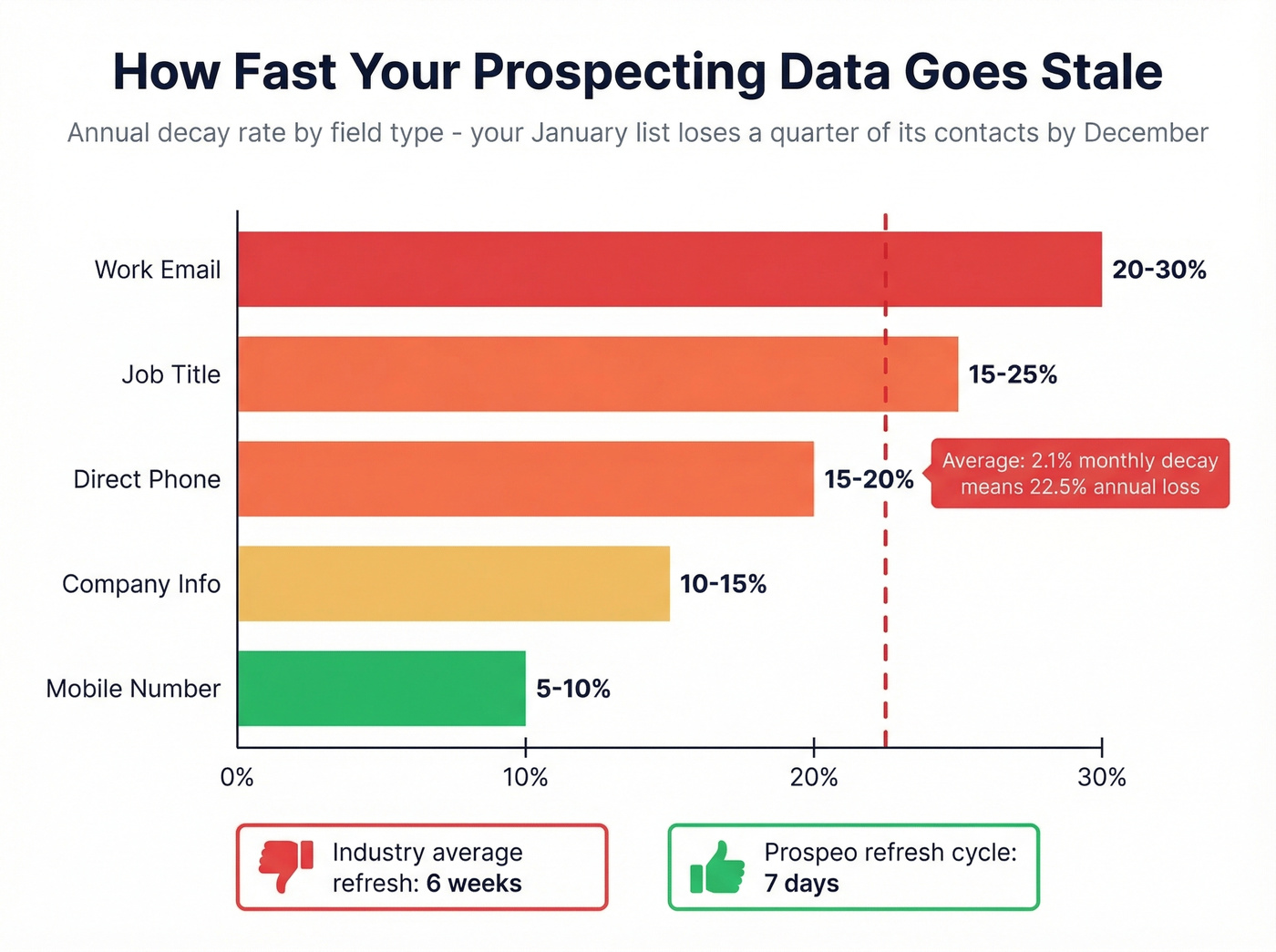
| Field | Annual Decay Rate |
|---|---|
| Work email | 20-30% |
| Job title | 15-25% |
| Direct phone | 15-20% |
| Company info | 10-15% |
| Mobile number | 5-10% |
Work emails decay fastest because they're tied to both the person and the company. Someone leaves, the email bounces, and your sender reputation takes the hit.
The industry-average refresh cycle is around 6 weeks. That means most databases are serving you contacts that changed jobs last month. A 7-day refresh cycle closes that gap, and the difference shows up directly in your email bounce rate. We've seen this firsthand across dozens of provider evaluations: teams that treat their prospect database as a living asset rather than a static spreadsheet consistently outperform those that don't.

A 7-day refresh cycle means your prospecting data stays accurate while competitors serve you contacts that changed jobs last month. Prospeo's 300M+ profiles, 98% email accuracy, and 30+ filters - including intent, technographics, and job changes - give you all 7 data types from one platform at ~$0.01/email.
Stop bleeding pipeline to stale data. Start with 75 free emails.
Benchmarks Worth Tracking
Here's the thing - most teams obsess over copy and sequences while ignoring the quality of the data underneath. These are the numbers that actually matter.
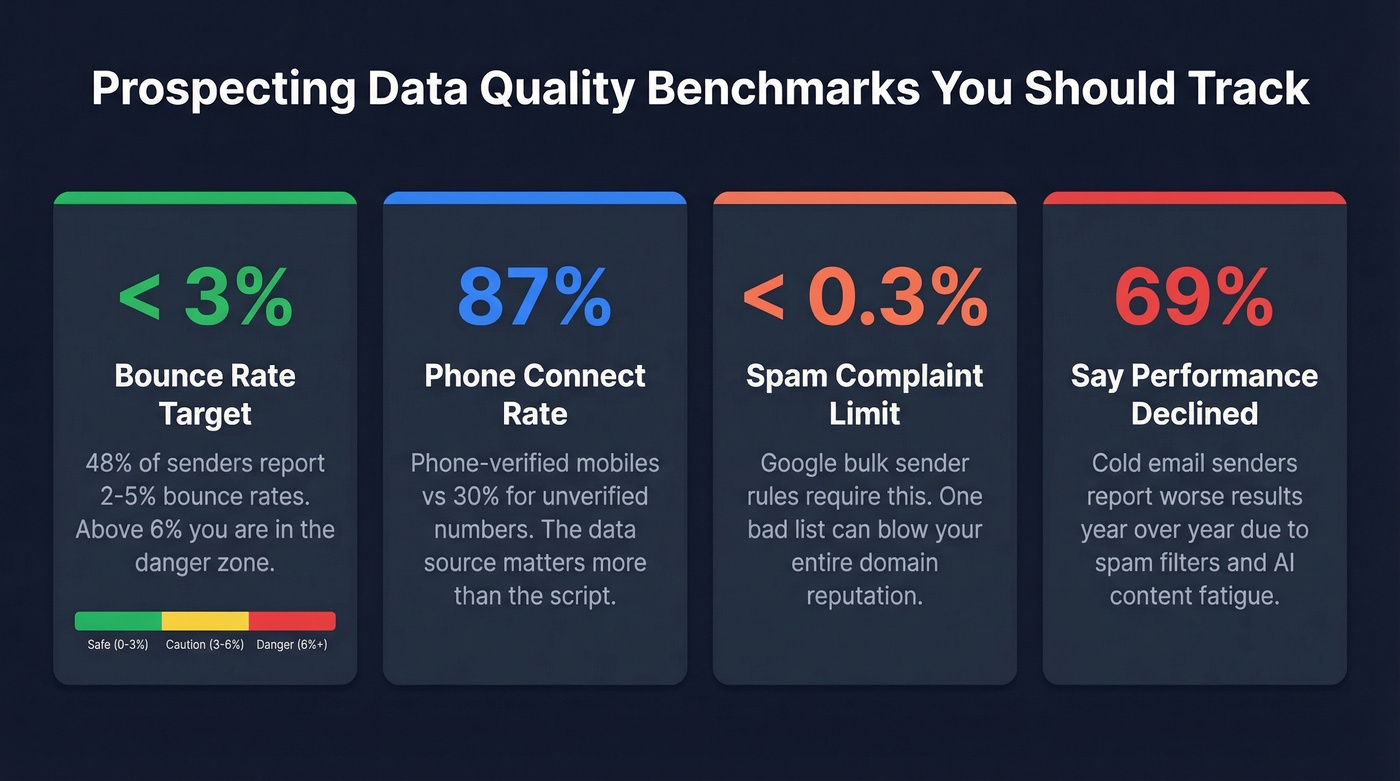
Bounce rate target: under 3%. Industry data shows 48% of cold email senders report 2-5% bounce rates, and 15% exceed 6%, which is the deliverability danger zone. On top of that, 69% of cold email senders say performance declined year-over-year due to spam filtering and AI content fatigue. Clean data has never mattered more.
Phone connect rate - phone-verified mobiles produce an 87% connect rate vs. 30% for unverified numbers. The data source matters more than the script.
Spam complaint threshold - Google's bulk-sender rules require complaints below 0.3%. One bad list can blow this for your entire domain.
Data freshness - if your provider can't tell you their refresh cycle, assume it's measured in months.
Best Tools for Data Prospecting
Let's be honest: most teams don't need more tools. A common complaint on r/sales is that many AI prospecting tools are just "LinkedIn wrappers with worse UI and worse data." The fix isn't stacking more software - it's getting better outbound data at the source.
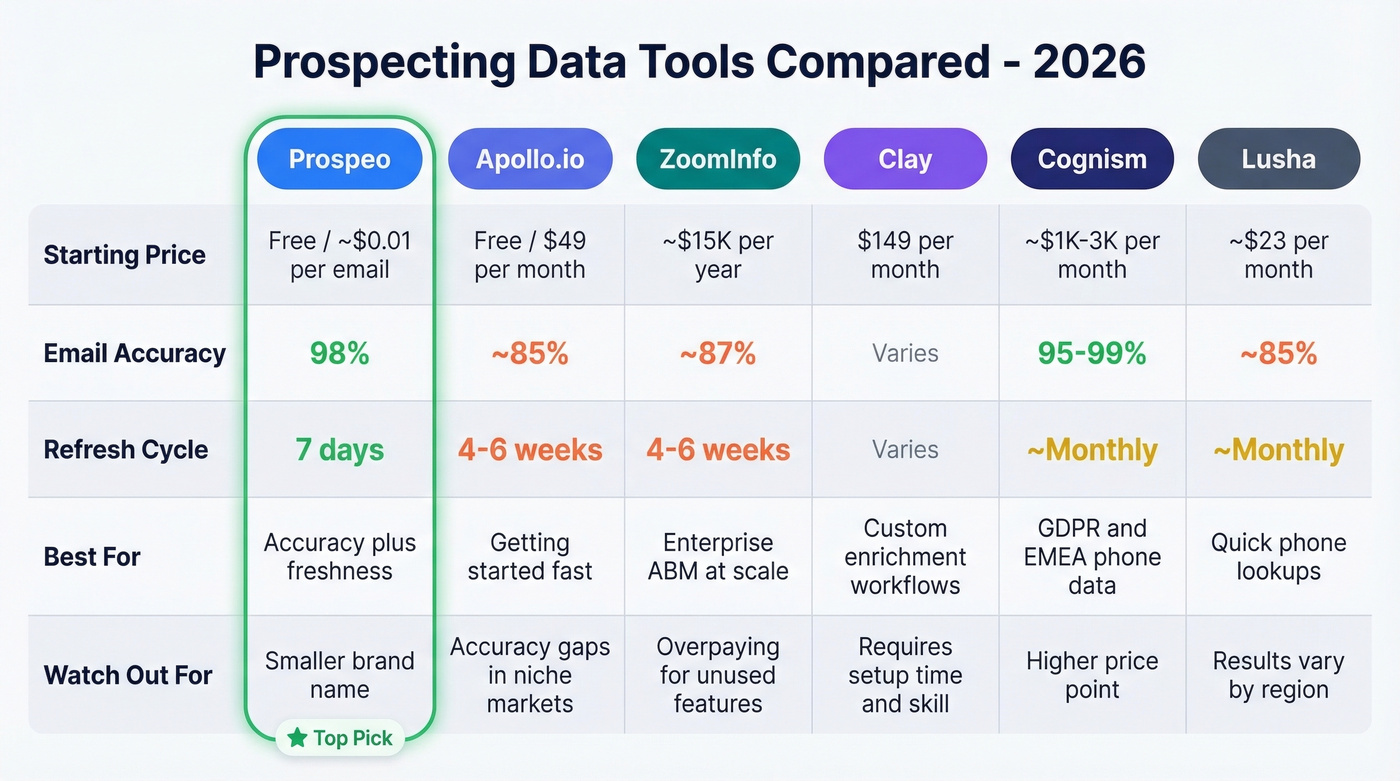
| Tool | Starting Price | Key Strength | Email Accuracy | Refresh |
|---|---|---|---|---|
| Prospeo | Free / ~$0.01/email | Accuracy + freshness | 98% | 7 days |
| Apollo.io | Free / $49/mo | Breadth + ease | ~85% | 4-6 weeks |
| ZoomInfo | ~$15K/year | Scale + intent | ~87% | 4-6 weeks |
| Clay | $149/mo | Custom workflows | Varies by source | Varies |
| Cognism | ~$1K-$3K/mo | GDPR + phone data | 95-99% | ~Monthly |
| Lusha | ~$23/mo | Quick phone lookup | ~85% | ~Monthly |

Prospeo
Use this if you care about data accuracy more than feature count and want a self-serve platform with no contracts.
The database covers 300M+ professional profiles, 143M+ verified emails, and 125M+ verified mobile numbers - all refreshed every 7 days. The 30+ search filters include buyer intent across 15,000 Bombora topics, technographic signals powered by live job posting data and technology detection, job changes, and funding events. At ~$0.01/email with a free tier, that's cheaper than most verification-only tools.
In head-to-head comparisons, teams using Prospeo book 26% more meetings than ZoomInfo users and 35% more than Apollo users. Snyk's 50-person AE team dropped bounce rates from 35-40% to under 5% after switching, and AE-sourced pipeline jumped 180%. The Chrome extension (40K+ users) lets you pull verified contacts from any website or CRM without switching tabs, and native integrations with Lemlist, Instantly, Salesforce, and HubSpot mean it slots into existing workflows without friction.
Apollo.io
Apollo is the obvious starting point for teams that want to move fast without spending much. The free tier is genuinely useful - you can build lists, run sequences, and test the data before committing. Paid plans start at $49/month.
Where Apollo falls short is data quality in niche verticals and smaller markets. Reddit threads consistently flag accuracy gaps once you move beyond large US companies. Great for getting started; just verify before you send.
ZoomInfo
ZoomInfo is the 800-pound gorilla: 600M+ contacts, 135M+ companies, and the deepest US database in the market. It's also the platform most teams realize they're overpaying for.
Mid-market contracts run $15-40K/year depending on seats and modules, and the pricing conversation requires a sales call. For enterprise orgs running ABM, intent, and outbound from one platform, ZoomInfo earns its price. For a 5-person SDR team that just needs accurate emails and phones? You're paying for features you'll never touch. Skip this if budget is tight and your team is under 20 reps.
Clay
Clay is the tool for people who think in workflows, not search bars. It chains enrichment steps from multiple data sources - Reddit users describe it as "LEGO pieces for data" - and lets you build weirdly specific lists no single database could produce.
Starting at $149/month, it requires real setup time. Skip this if you want plug-and-play. Choose it if your ICP is too nuanced for standard filters and you've got someone on the team who enjoys building automations.
Cognism & Lusha
Cognism is the go-to for GDPR-compliant prospecting with phone-verified mobiles. If you're selling into EMEA and need direct dials that actually connect, Cognism's verification process justifies the ~$1K-$3K/month price tag. Where ZoomInfo wins on US depth, Cognism wins on European compliance and mobile accuracy.
Lusha is a quick-lookup utility - fast phone numbers from a browser extension, starting around $23/month. Results vary by region, but for supplementing a primary database with direct dials, it fills a gap without a big commitment.
Compliance Essentials
GDPR fines run up to EUR 20M or 4% of global turnover. CCPA penalties hit $7,500 per intentional violation. These aren't theoretical - enforcement is active and growing.
The practical guidance: use GDPR-compliant providers, honor opt-outs immediately, and collect only the data you'll actually use. GDPR operates on an opt-in framework; CCPA is opt-out. When you're prospecting across both regions, default to the stricter standard. The European Data Protection Board and California AG's CCPA page are the authoritative references if you need specifics. HubSpot's GDPR guide is also a solid plain-English primer.
Building a Reliable Data Stack
The tool matters less than the process. In our experience, a $50K/year database with no verification workflow will underperform a $39/month tool with disciplined hygiene every single time.
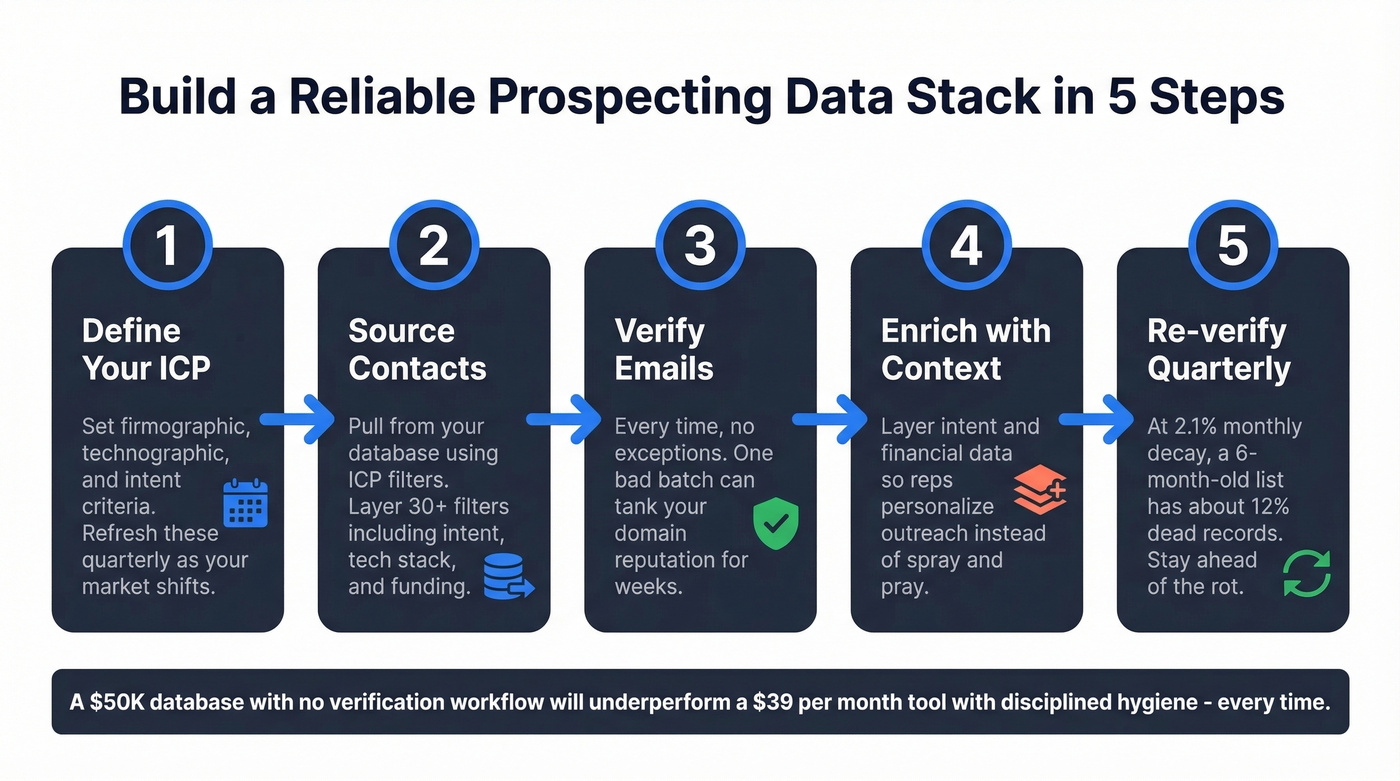
- Define your ICP - firmographic, technographic, and intent criteria. Refresh quarterly.
- Source contacts - pull from your database using those ICP filters.
- Verify emails before sending - every time, no exceptions. One bad batch can tank your domain for weeks.
- Enrich with context - layer intent and financial data so reps personalize instead of spray.
- Re-verify quarterly - at 2.1% monthly decay, a six-month-old list has ~12% dead records.
I'll put it bluntly: we've watched teams spend months perfecting their cold email sequences while sending to lists with 15% bounce rates. It doesn't matter how good your subject line is if the email never arrives. High-quality prospecting data is the foundation everything else sits on - your sequences, your deliverability, your pipeline. Get it right and the rest of your outbound motion gets easier. Ignore it and no amount of clever copywriting saves you.
Snyk dropped bounce rates from 35-40% to under 5% and saw AE-sourced pipeline jump 180%. Stack Optimize built a $1M agency with under 3% bounce rates and zero domain flags. The difference wasn't better copy - it was prospecting data that actually connected them to real buyers.
Layer intent, technographics, and verified contacts in one search.
Frequently Asked Questions
What's the difference between prospecting data and lead data?
Prospecting data is raw information used to identify and reach potential buyers - contact details, firmographics, intent signals. Lead data refers to contacts who've already engaged through form fills or demo requests. Prospecting data feeds the top of your funnel; lead data sits further down it.
How often should you refresh your database?
At minimum, quarterly. B2B contact data decays ~2.1% per month, so a six-month-old list carries ~12% bad records. Ideally, use a provider with a weekly refresh cycle so records stay current without manual re-verification.
What's a safe bounce rate for cold email?
Under 3% is the target. Industry data shows 48% of cold email senders see 2-5% bounce rates, and anything above 5-6% risks real deliverability damage. If you're consistently above 3%, your data source is the problem.
Is it legal to buy prospecting data?
Yes, in most jurisdictions, provided the data was collected compliantly. Under GDPR, you need a lawful basis - typically legitimate interest for B2B outreach. Under CCPA, consumers can opt out of data sales. Use providers that honor opt-out requests globally and offer DPAs on request.