

Psychographic Data: Collect, Segment & Activate in 2026
71% of consumers expect personalization, and 76% get frustrated when they don't get it. Yet most B2B teams still can't operationalize the "why" behind buyer behavior. They've got demographics nailed. Behavioral tracking is humming. But when it comes to understanding what actually motivates a prospect to pick up the phone or reply to an email, there's a gaping hole in the playbook. The gap isn't knowledge - it's execution.
We've seen this pattern dozens of times: a team builds beautiful psychographic personas, drops them into a Google Drive folder, and never connects them to a single campaign. This guide skips the theory-only approach. You'll get the definitions fast, a reusable survey question bank, the discrete-choice method that most resources ignore entirely, and the workflow for turning psychographic insights into prospect lists you can actually target.
What You Need (Quick Version)
One-sentence definition: Psychographic data describes the psychological attributes - values, personality, attitudes, interests, and lifestyle - that explain why people make the choices they do.
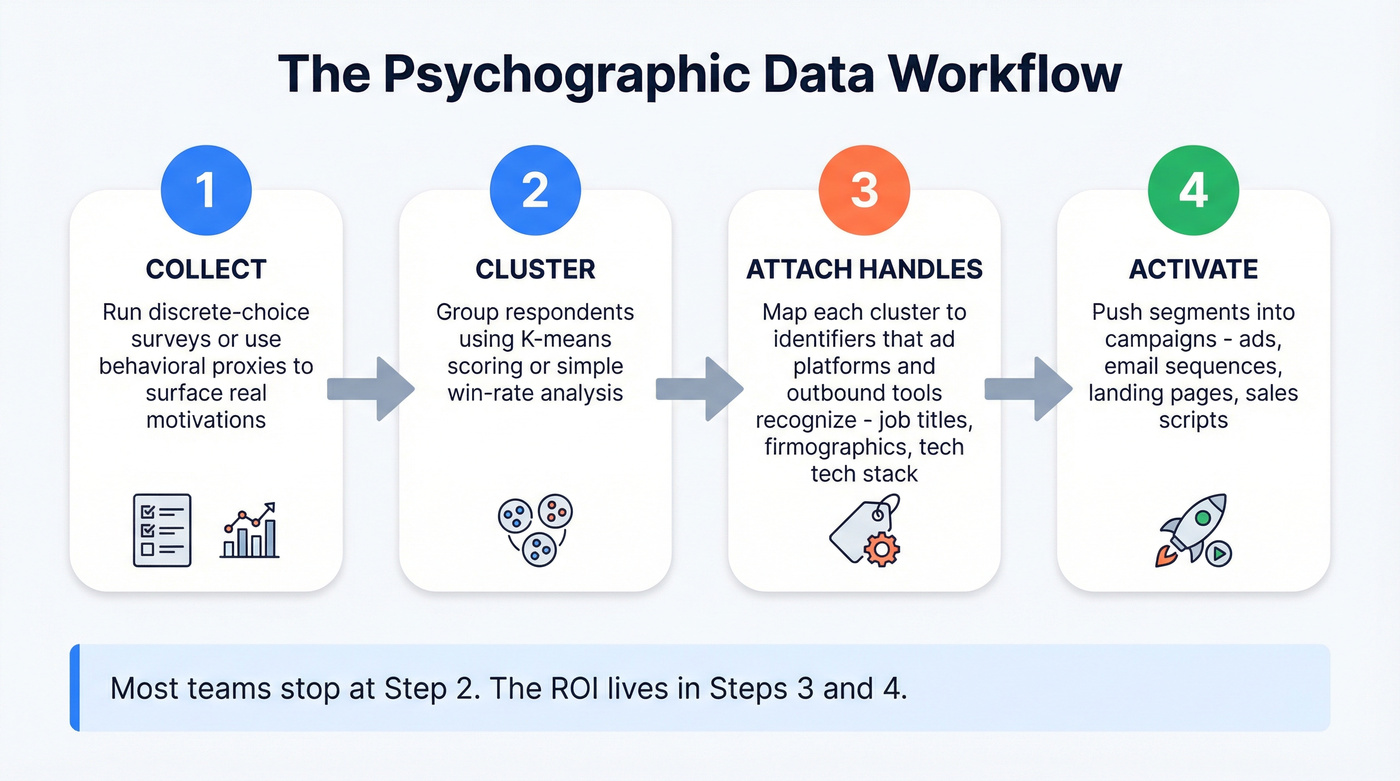
The 4-step workflow:
- Collect - Run discrete-choice surveys or use behavioral proxies
- Cluster - Group respondents using K-means or simple scoring
- Attach handles - Map each cluster to identifiers that ad platforms and outbound tools recognize
- Activate - Push segments into campaigns
If you already know what psychographics are and just need to make them actionable, jump straight to activation. That's where most guides fall apart.
What Is Psychographic Data?
Psychographic data captures the internal drivers behind human behavior. Demographics tell you who someone is. Behavioral data tells you what they do. Psychographics explain why they do it. It's the difference between knowing a prospect is a 38-year-old VP of Engineering who visited your pricing page three times and understanding that they value speed-to-market over cost savings and distrust enterprise vendors.
Five core variables define psychographic profiling:
- Personality - Risk tolerance, introversion/extroversion, openness to change. A risk-averse buyer needs ROI proof; a risk-tolerant one wants to see what's possible.
- Values - Environmental consciousness, family orientation, career ambition. These shape brand affinity at a deep level.
- Attitudes and opinions - Stance on remote work, AI adoption, industry regulation. These shift faster than values and are highly targetable.
- Interests - Media consumption, professional communities, hobbies. A CTO who reads Hacker News responds differently than one who reads Harvard Business Review.
- Lifestyle - Daily routines, work patterns, spending habits. The BLS American Time Use Survey reports Americans spend an average of 5.07 hours per day on leisure and sports - a measurable variable with real segmentation power.
No single variable is sufficient on its own. The real value emerges when you combine them into segments that predict behavior better than demographics alone.
Psychographic vs. Demographic vs. Behavioral
| Type | What It Measures | Example Variables | Data Sources | Best For |
|---|---|---|---|---|
| Demographic | Who they are | Age, income, title, company size | CRM, census, forms | Initial audience sizing |
| Behavioral | What they do | Page visits, purchases, email opens | Analytics, CRM logs | Predicting next actions |
| Psychographic | Why they act | Values, attitudes, motivations | Surveys, enrichment, proxies | Messaging and positioning |
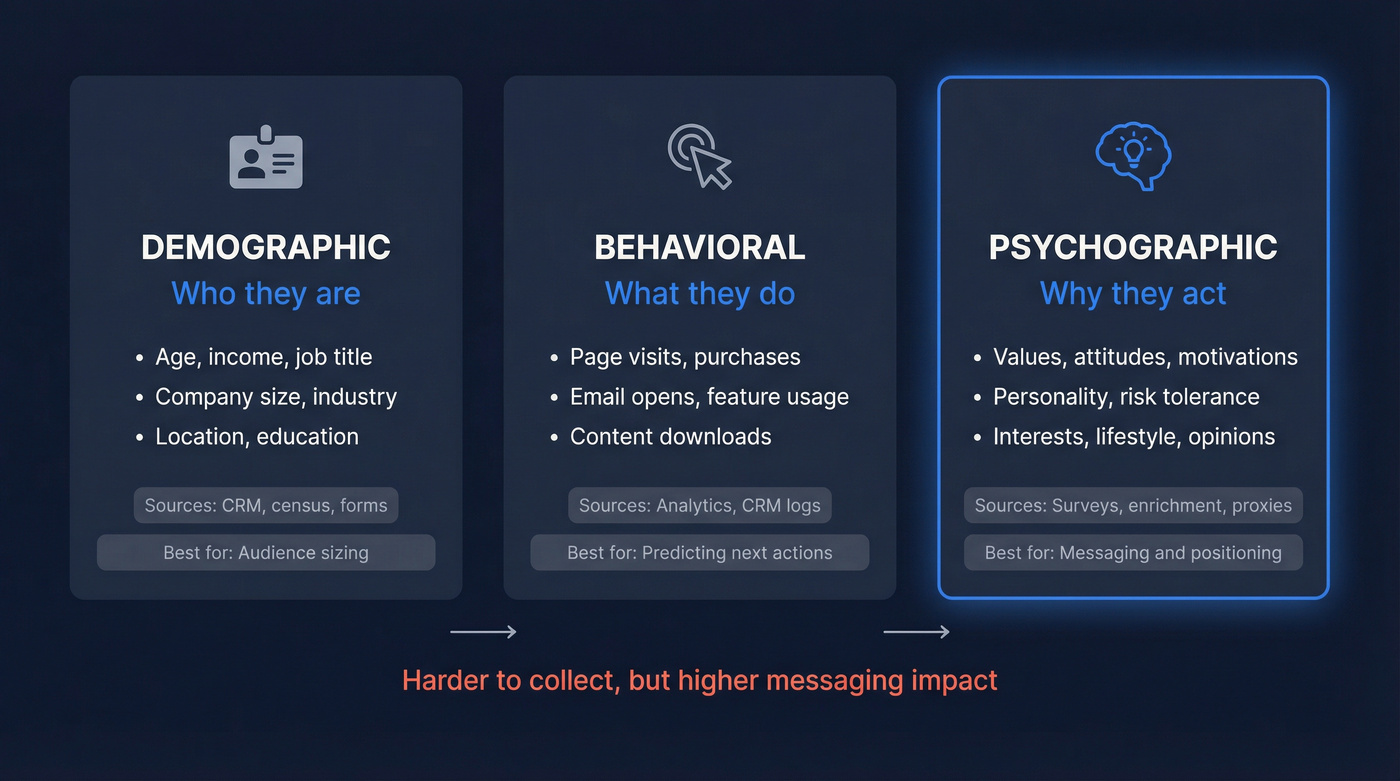
Here's the thing: demographics alone lead to stereotyping. Knowing someone is a 45-year-old CFO tells you almost nothing about whether they'll respond to a cost-savings pitch or a growth-acceleration pitch. Psychographic insights fill that gap. But they're also the hardest of the three to collect at scale, which is why most teams default to demographic + behavioral and call it a day.
Why It Matters in 2026
Does anyone actually use psychographic segmentation in practice? The consensus on r/marketing tends toward skepticism - psychographics get praised in theory, but execution rarely gets explained in a way that feels affordable or concrete. That skepticism is earned.
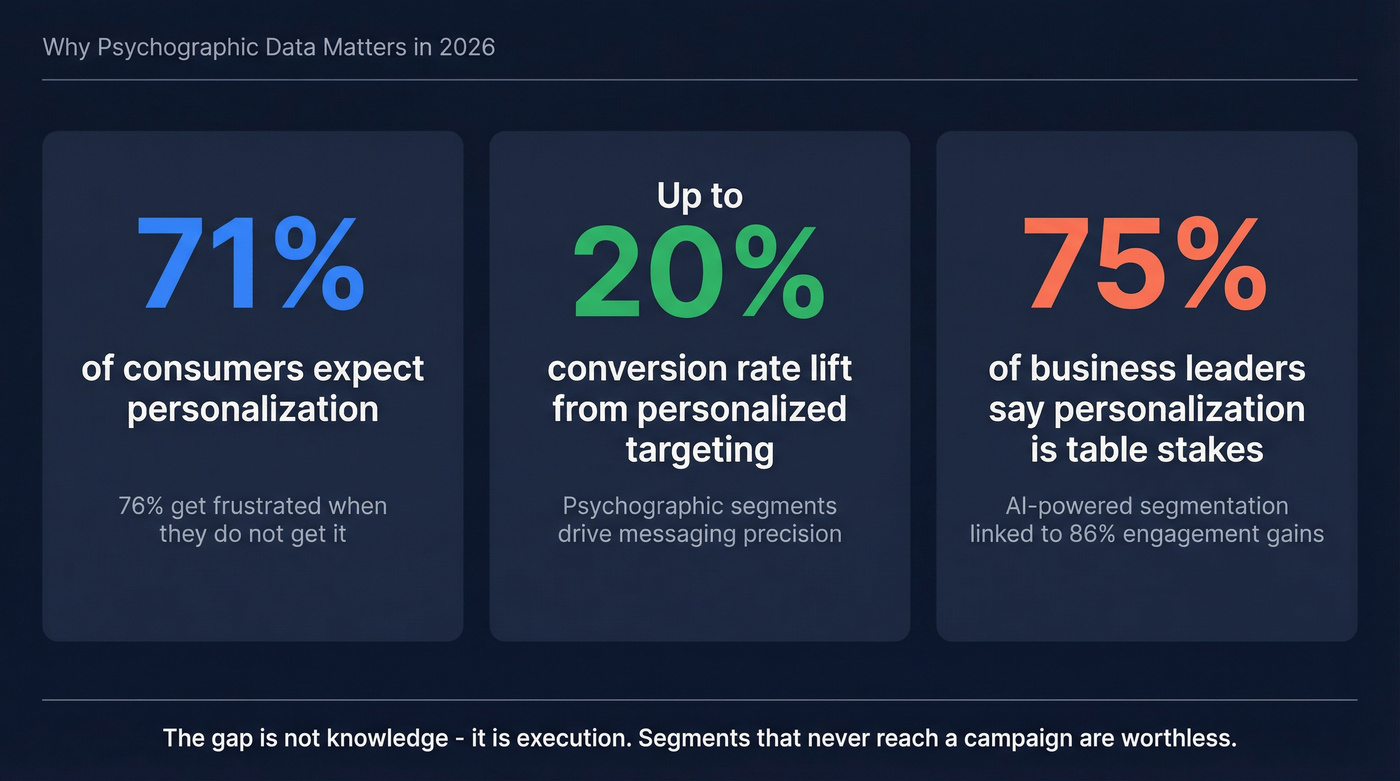
The performance data tells a different story, though. Personalized targeting can lift conversion rates up to 20%. 75% of business leaders say personalization is essential. And AI-powered segmentation has been linked to engagement improvements as high as 86%.
The disconnect isn't that psychographic segmentation doesn't work. It's that most teams don't know how to make segments targetable. They build persona documents that never touch a campaign. The collection and activation workflow matters more than the theory.
Let's be honest: if your average contract value sits below $15K, you probably don't need a formal psychographic research program. You need three good hypotheses about what motivates your buyers, behavioral proxies to test them, and messaging variants to validate them. Save the full-blown VALS analysis for enterprise plays where the ROI justifies the investment.

Psychographic segments are useless sitting in a Google Doc. Prospeo's 30+ search filters - including buyer intent across 15,000 topics, technographics, and job change signals - let you turn motivation-based personas into real prospect lists with 98% verified emails.
Stop building personas you never activate. Build lists you actually send to.
How to Collect Psychographic Data
Surveys and Interviews
Surveys remain the most direct path to understanding buyer motivations. The key is asking questions open-ended enough to surface real drivers but structured enough to analyze at scale. Here are 10 questions across the five psychographic categories, drawn from SurveyPlanet, GetSiteControl, and SightX:
Values and Beliefs
- What causes or issues matter most to you when choosing which companies to support?
- How important is sustainability in your purchasing decisions? (1-5 scale)
Personality and Decision Style 3. When evaluating a new tool, do you prefer to research independently or ask peers for recommendations? 4. How comfortable are you being an early adopter of unproven technology?
Interests and Media 5. What publications, podcasts, or communities do you follow regularly? 6. How do you prefer to learn about new products - webinars, blogs, peer conversations, or demos?
Lifestyle and Work Patterns 7. How many hours per week do you spend on strategic vs. operational work? 8. What's your biggest time sink in a typical workday?
Attitudes and Opinions 9. How do you feel about AI-driven automation in your workflow? 10. What would need to change for you to switch from your current vendor?
Always include an "Other" option on multiple-choice questions. The real insight comes from open-ended follow-ups, not qualifying yes/no answers.
Discrete-Choice Surveys
This is what separates theoretical articles from actionable ones. Discrete-choice measurement - pairwise comparisons, MaxDiff-style tradeoffs - forces respondents to reveal true priorities instead of rating everything 5 out of 5.
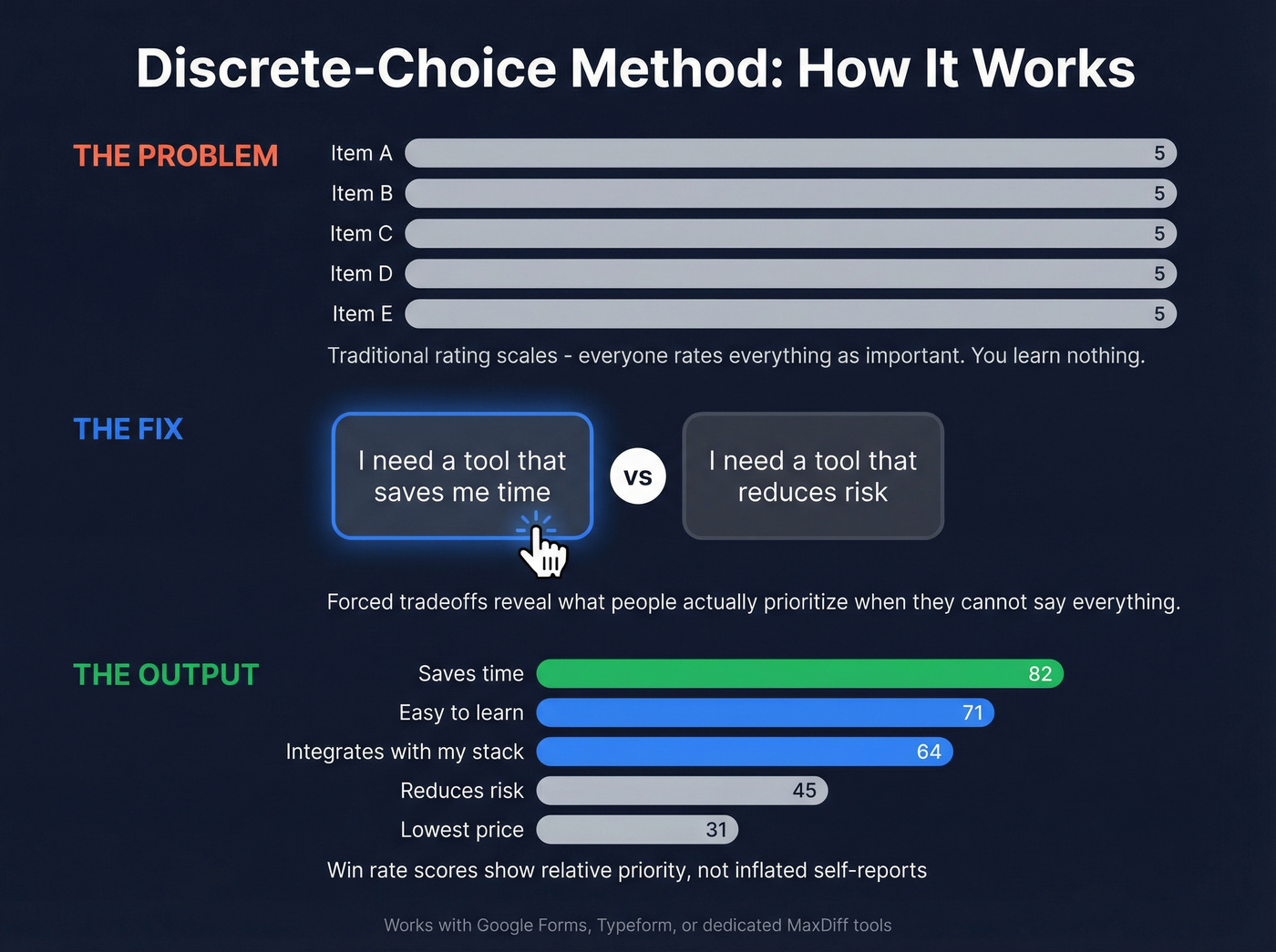
- Draft 10-15 problem or value statements relevant to your market - "I need a tool that saves time" vs. "I need a tool that reduces risk"
- Present them as pairwise comparisons: "Which matters more: A or B?" across all possible pairs
- Calculate a "win rate" score of 0-100 for each statement based on how often it was chosen
- Include demographic and behavioral multiple-choice questions in the same survey to create "handles"
- Analyze which statements score disproportionately high for specific subgroups
You don't need a data science team for this. MaxDiff and conjoint analysis tools exist, but even a simple Google Form with pairwise questions gets you 80% of the insight. The magic is measuring motivations relatively - forcing tradeoffs that reveal what people actually care about when they can't say "everything."
Behavioral Proxies and Enrichment
Sometimes you can't run surveys. Your audience is too small, response rates are too low, or you need segments yesterday. Behavioral clustering is a legitimate shortcut.
Cluster customers by what they do - purchase patterns, feature usage, content consumption - and label those clusters with psychographic-style names. A cluster of users who only buy during sales, use coupons, and compare three competitors before purchasing? That's your "value-conscious deliberators" segment. No survey required.
Web analytics and social listening add another layer. Track which content topics drive the most engagement, which pages have the longest dwell time, and which CTAs convert. These are behavioral signals with psychographic implications.
Public Data Sources
Don't overlook free, authoritative datasets:
- BLS American Time Use Survey - 2024 data shows that on days worked, 72.4% of employed people work at a workplace and 32.5% work from home. For workers with a bachelor's degree or higher, the work-from-home figure is 50.0%. These are lifestyle variables you can segment against.
- Pew Research Center - Ongoing surveys on attitudes toward technology, politics, work, and social issues. Excellent for grounding value-based segments in real population data.
- Acxiom's PersonicX - Combines demographic, behavioral, and psychographic data at the household level. Useful for B2C teams who need pre-built segments.
The VALS Framework (And Its Limits)
VALS (Values and Lifestyles) is the grandfather of psychographic segmentation. Developed at SRI International in the late 1970s and updated to VALS2 in 1989, it classifies consumers along two axes: primary motivation (Ideals, Achievement, or Self-Expression) and resources - a composite of income, education, confidence, and novelty-seeking.
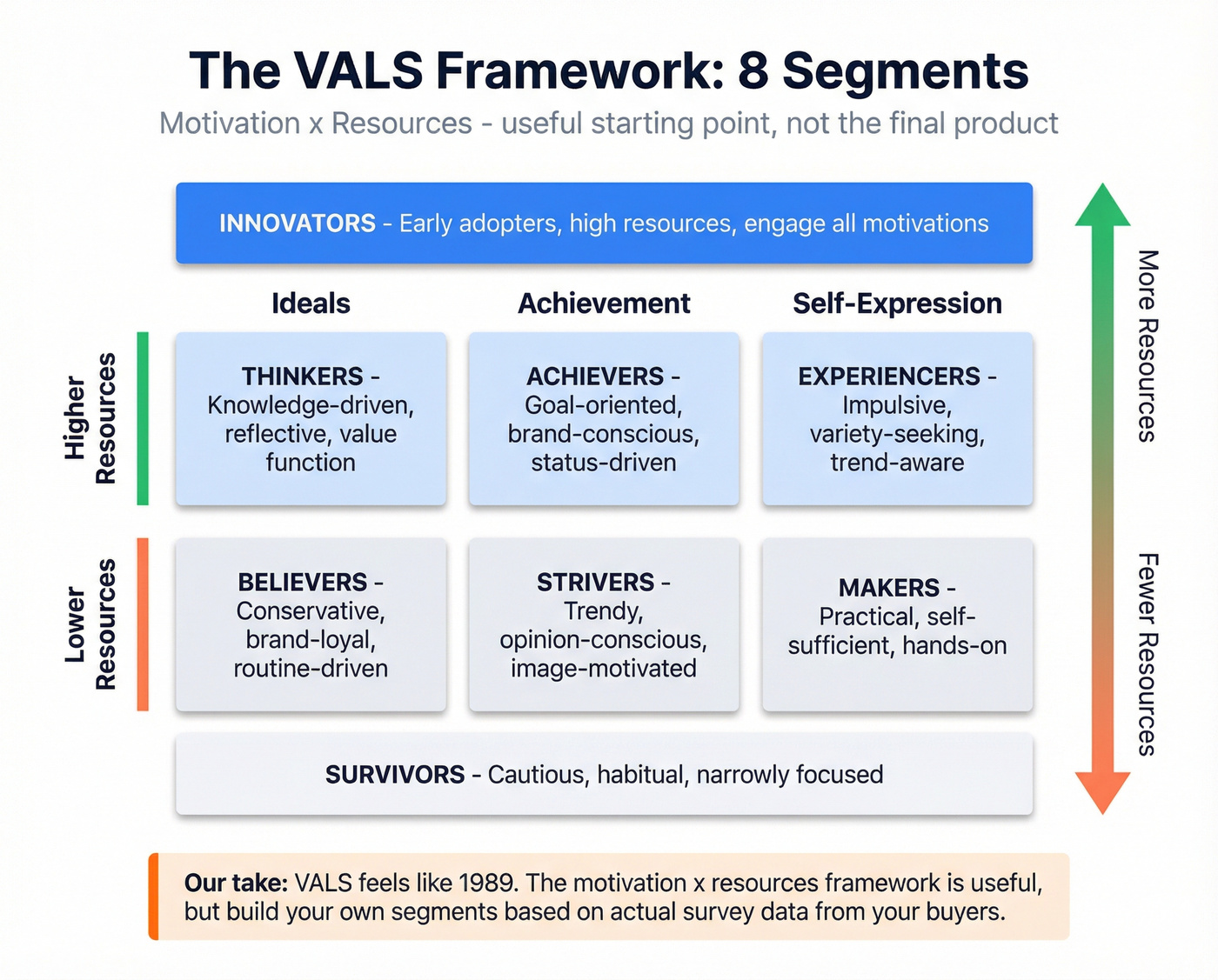
The framework produces eight segments. At the high-resource end, Innovators are early adopters who engage all three motivations, Thinkers are ideals-driven and value knowledge, Achievers are goal-oriented and brand-conscious, and Experiencers are impulsive variety-seekers. Their lower-resource counterparts are Believers (conservative, brand-loyal), Strivers (trendy, opinion-conscious), Makers (practical, self-sufficient), and Survivors (cautious, habitual).
Our take: VALS is dated. The segments feel like 1989 consumer archetypes, and applying them to B2B is a stretch. But the underlying framework - motivation x resources - remains a useful starting point for building your own segments. Think of VALS as training wheels, not the final product. For a more modern approach, Alexandra Samuel has shown how large-scale attitude data can build segments around beliefs and decision styles that predict purchasing behavior better than age or income. That's the kind of motivation-based segmentation worth emulating.
From Segments to Targets
This is where most psychographic guides end and where the actual work begins. Having segments is useless if you can't find and reach the people in them.
Step 1: Cluster your data. With discrete-choice survey scores in hand, apply K-means clustering to group respondents by motivation patterns. In a comparative study on customer segmentation, K-means produced silhouette scores of 0.29 vs. 0.25 for hierarchical clustering - modest but meaningfully better segment separation. For smaller datasets, manual grouping by top-scoring motivations works fine.
Step 2: Attach "handles." This is the concept that makes psychographic segments targetable. Each segment needs demographic and behavioral identifiers that platforms can filter on. Build a segment matrix with psychographic segments as rows and observable characteristics as columns - job title, company size, industry, tech stack, content engagement patterns. Look for where segments over-index on specific handles.
Step 3: Activate. For ad platforms, use the handles to build lookalike audiences and tailor creative to each segment's motivations. For outbound, translate those handles into search filters on a B2B data platform and build prospect lists that match each psychographic profile. If you're building outbound sequences, pair this with proven sales follow-up templates so each segment gets the right nudge at the right time.
Here's what this looks like in practice: you run a discrete-choice survey, discover two motivation clusters ("speed-first builders" vs. "risk-averse evaluators"), and then tailor outbound messaging to each. Speed-to-value messaging for one group, security and reliability messaging for the other. In our experience, aligning messaging to the dominant motivation lifts reply and conversion rates materially versus generic positioning.

The contrarian take worth internalizing: you don't need psychographic data - you need psychographic hypotheses validated by behavior. Start with a theory about what motivates your best customers, find observable proxies for that motivation, and test whether messaging aligned to that motivation outperforms generic messaging. That's the whole game - and it fits neatly into a modern lead generation workflow.
You've identified what motivates your buyers. Now you need handles your campaigns can target. Prospeo maps intent data from 15,000 Bombora topics to 300M+ profiles - so you can go from 'values speed-to-market' to a verified contact list in minutes, not weeks.
Layer psychographic insights onto real contacts at $0.01 per verified email.
Privacy and Compliance in 2026
Psychographic profiling sits squarely in the crosshairs of evolving privacy regulation. Skip this section at your own risk.
The 2026 CCPA timeline:
- January 1, 2026 - CPPA regulations take effect. Risk assessment duties begin for high-risk processing, including processing sensitive personal information and certain uses of automated decision-making technology (ADMT).
- January 1, 2027 - Full ADMT requirements kick in for covered "significant decisions," including consumer opt-out rights and pre-use notice obligations.
- April 1, 2028 - First risk assessment submissions due. Cybersecurity audit certifications also begin, tiered by revenue.
Risk assessments apply when ADMT is used for covered "significant decisions" like employment, education, housing, lending, and healthcare. They must evaluate potential for discrimination, economic harm, and interference with informed consumer choice.
To avoid your profiling being classified as "substantially replacing" human decision-making, three criteria for human review matter: the reviewer must know how to interpret the output, they must actually review and analyze it alongside other relevant information, and they must have authority to change the decision. The updated rules also require businesses to display confirmation when an opt-out preference signal has been honored.
If you target EU audiences, GDPR obligations apply - use an appropriate lawful basis, minimize what you collect, and honor data subject rights. The practical takeaway: document your methodology, offer opt-outs, and don't collect more than you need. If you're operationalizing this in RevOps, treat it like any other high-impact system change and align it with your sales operations metrics.
FAQ
What's the difference between psychographic and demographic data?
Demographics describe who someone is - age, income, job title, company size. Psychographics describe why they make decisions - values, attitudes, motivations, and lifestyle preferences. Demographics tell you a prospect is a VP of Marketing at a mid-market SaaS company; psychographics tell you they prioritize speed over cost and distrust enterprise vendors. You need both for effective segmentation.
How do you collect psychographic data without a big budget?
Use behavioral proxies from free tools like Google Analytics, run discrete-choice surveys via Google Forms, and tap public datasets like the BLS American Time Use Survey or Pew Research. For B2B enrichment, Prospeo's free tier includes intent data and technographics that serve as psychographic proxies - enough to validate initial segment hypotheses.
Are psychographic segments targetable in ad platforms?
Not directly - no ad platform has a "values speed over cost" filter. You need to attach demographic and behavioral "handles" to each segment: observable traits like job title, company size, tech stack, or content engagement that platforms can filter on. The psychographic insight shapes your messaging; the handles determine your targeting criteria.
How does B2B psychographic segmentation differ from B2C?
B2C segments typically revolve around lifestyle and personal values. B2B segmentation layers in professional motivations, organizational risk tolerance, and buying-committee dynamics. The discrete-choice survey method works especially well in B2B because it forces tradeoffs between business outcomes - speed vs. security, cost vs. flexibility - that reveal what a decision-maker truly prioritizes.
Does CCPA 2026 affect psychographic profiling?
Yes. CPPA regulations effective January 1, 2026 introduce risk assessment requirements for high-risk processing. ADMT obligations begin January 1, 2027 for covered "significant decisions" like employment and lending. If your psychographic profiling feeds automated decisions in those categories, you'll need documented risk assessments evaluating potential discrimination and economic harm.