

QuickEmailVerification: Pricing, Reviews, Pros and Cons
A Reddit user verifying about 6,000 emails a month called QuickEmailVerification "a bit too pricey" and started shopping for alternatives. That captures the core tension with QEV - competent and developer-friendly, but awkward at moderate volumes.
Here's a full breakdown so you can decide whether it fits your workflow in 2026.
30-Second Verdict
QuickEmailVerification holds a 4.5/5 on G2 across 26 reviews and 4.3/5 on Capterra across 13 reviews. It starts at just $4 for 500 credits, which is one of the lowest entry points in email verification. If you're a developer who needs a clean API and small-to-medium batch jobs, it's a solid pick.
But the "99% deliverability ensured" marketing line doesn't hold up against independent benchmarks - more on that below. Reviewers flag slow processing on larger lists, and the daily subscription model resets unused credits every 24 hours. Anything you don't use is gone.
What Is QuickEmailVerification?
QEV is a focused email verification and list-cleaning service. It supports bulk uploads via CSV/Excel, real-time single verification, and a REST API with libraries for PHP, Node.js, Ruby, Python, and more. The API also catches email typos in real time, which is useful for form validation on signup pages. It's ISO 27001 certified and GDPR compliant.

The product does one thing: tell you whether an email address is valid, invalid, disposable, role-based, or catch-all. No email finding, no enrichment, no prospecting database. That's fine if verification is all you need, but it means you're paying for another tool upstream to actually source those addresses.
Pricing Breakdown
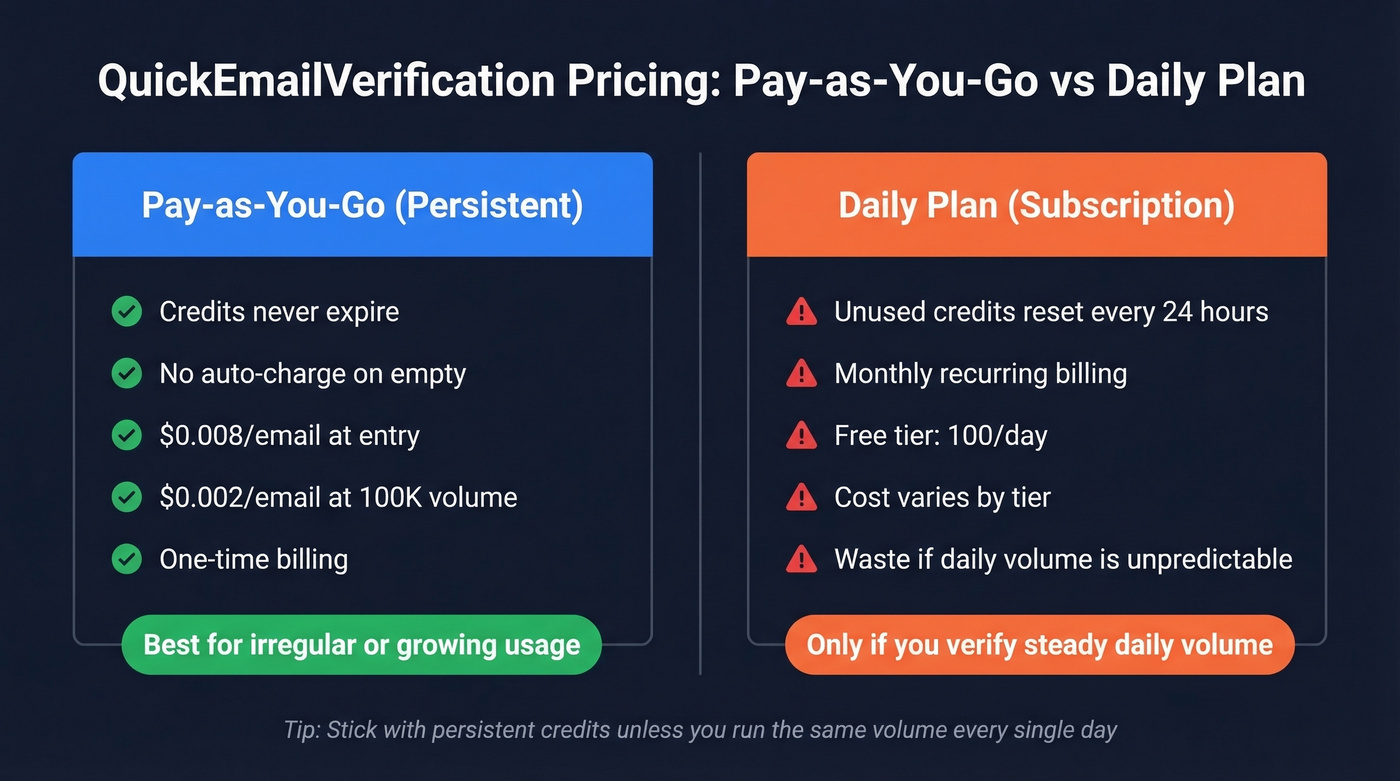
QEV runs two pricing models, and the difference matters more than most people realize. Third-party reviewers have called this dual structure confusing - and they're right.
| Feature | Pay-as-You-Go (Persistent) | Daily Plan (Subscription) |
|---|---|---|
| Entry price | $4 / 500 credits | $0/mo (100/day free) |
| Credit expiry | Never | Reset daily |
| Billing | One-time | Monthly recurring |
| Cost per email (entry) | $0.008 | Varies by tier |
| 50K list cost | $120 | - |
| 100K list cost | $200 | - |
The pay-as-you-go model is straightforward. Credits never expire, you aren't auto-charged when they run out, and the per-email cost gets competitive at scale - $200 for 100,000 verifications works out to $0.002/email.
Here's the thing about the daily plan: unused credits reset every 24 hours. If you're on a 500/day subscription and only verify 200 emails on Tuesday, the other 300 are gone. Stick with persistent credits unless you're running steady, predictable daily volume.
If you're trying to reduce bounces (not just "verify"), it helps to pair verification with an email deliverability checklist and basic sender reputation hygiene.

Paying $0.008/email just to verify addresses you sourced somewhere else? Prospeo finds, verifies, and enriches contacts from 300M+ profiles - with 98% email accuracy and a 5-step verification process built in. No second tool needed.
Ditch the standalone verifier. Get verified emails at the source.
Pros and Cons From Real Users
What users like:
The developer experience is QEV's strongest card. Rob B. called the API "clean, well documented and easy to set-up." Matthew F. on Capterra described it as the "easiest and quickest to implement" with ready-made modules across multiple languages. Review themes also highlight responsive customer service, and ease of use gets consistent praise. We've looked through the API documentation ourselves, and it's genuinely above average for this category. At volume, the per-email cost undercuts several competitors.
What users don't like:
Large lists expose QEV's weaknesses. Reviewers flag slow processing times on bigger batches, and Sterling F. reported timeout errors with no explanation - "it just says the system has timed out." A 2022 Capterra review called results "not consistent" with "high price, low quality." The Reddit sentiment is clear: for moderate monthly volumes of 5-10K emails, QEV feels expensive relative to what you get.
One caveat worth noting: QEV's review sample is small. Twenty-six reviews on G2 and 13 on Capterra is enough to spot patterns, not enough for statistical certainty.
Is the 99% Accuracy Real?
QEV's homepage claims "99% deliverability ensured." Let's be honest about what that means.
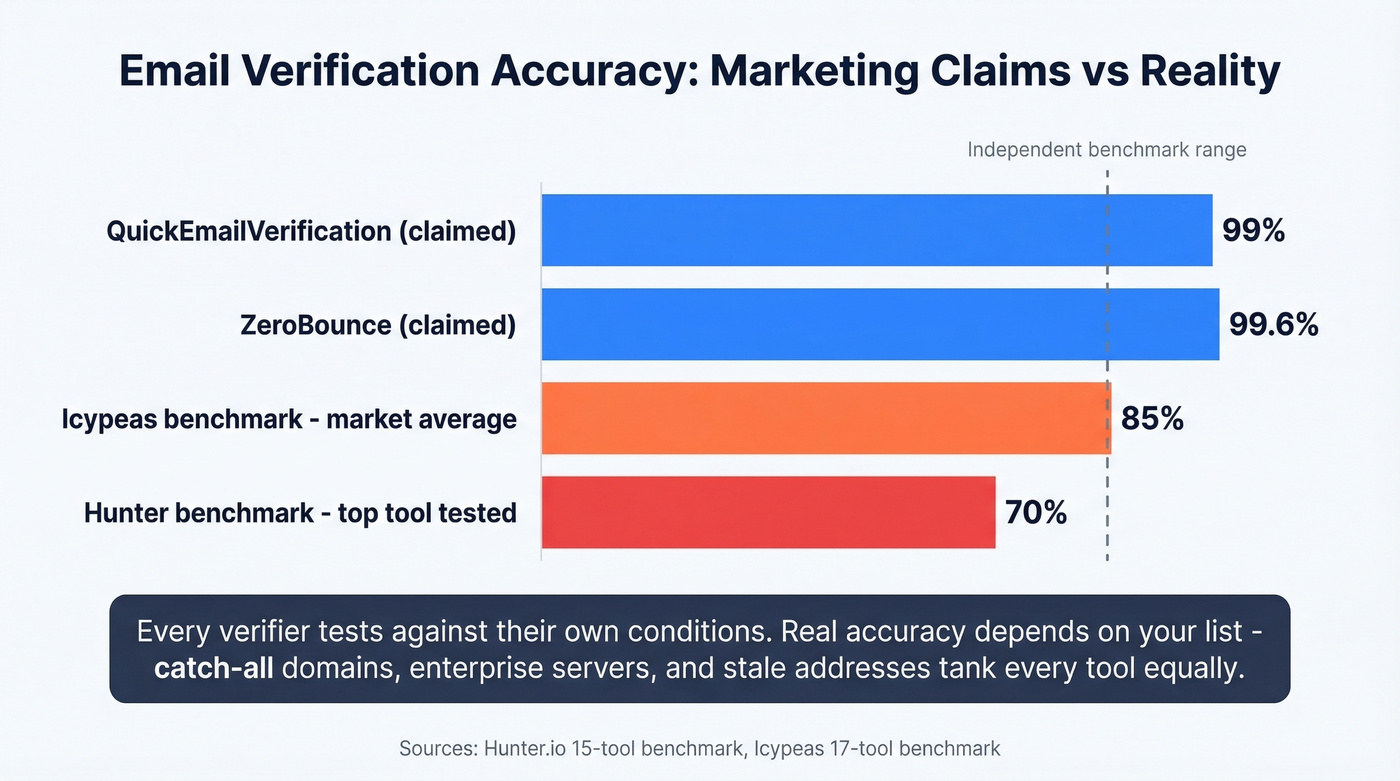
A Hunter benchmark tested 15 email verifiers against 3,000 real business emails. The top overall result was 70%. An Icypeas benchmark of 17 tools found a market average of 85%. Every verifier inflates accuracy numbers because they're measuring against their own test conditions. QEV isn't uniquely bad here, but it's not meaningfully better than the market just because a homepage says "99%."
Real-world accuracy depends on your list composition - catch-all domains, enterprise mail servers, and stale addresses will tank any tool's numbers.
If you're choosing a verifier based on who claims the highest accuracy percentage, you're optimizing for the wrong thing. Pick based on API reliability, credit policies, and whether unknown results cost you credits. (If you're troubleshooting list quality, this guide on email bounce rate is a good companion.)
How QEV Compares to Alternatives
| Feature | QEV | Prospeo | ZeroBounce | Clearout |
|---|---|---|---|---|
| Free tier | 100/day | 75 emails + 100 ext. credits/mo | 100/month | 100 credits |
| Entry price | $4/500 | ~$0.01/email | ~$0.008/email | ~$0.004-0.008 |
| Credits expire? | Never (PAYG) | Credit-based | Never | Never (rollover on sub) |
| Accuracy claim | 99% | 98% (verified) | 99.6% | Not stated |
| Compliance | ISO 27001, GDPR | GDPR | GDPR | ISO & SOC 2 Type II, GDPR |
| Email finding? | No | Yes (300M+ profiles) | Yes (20 credits/query) | No |
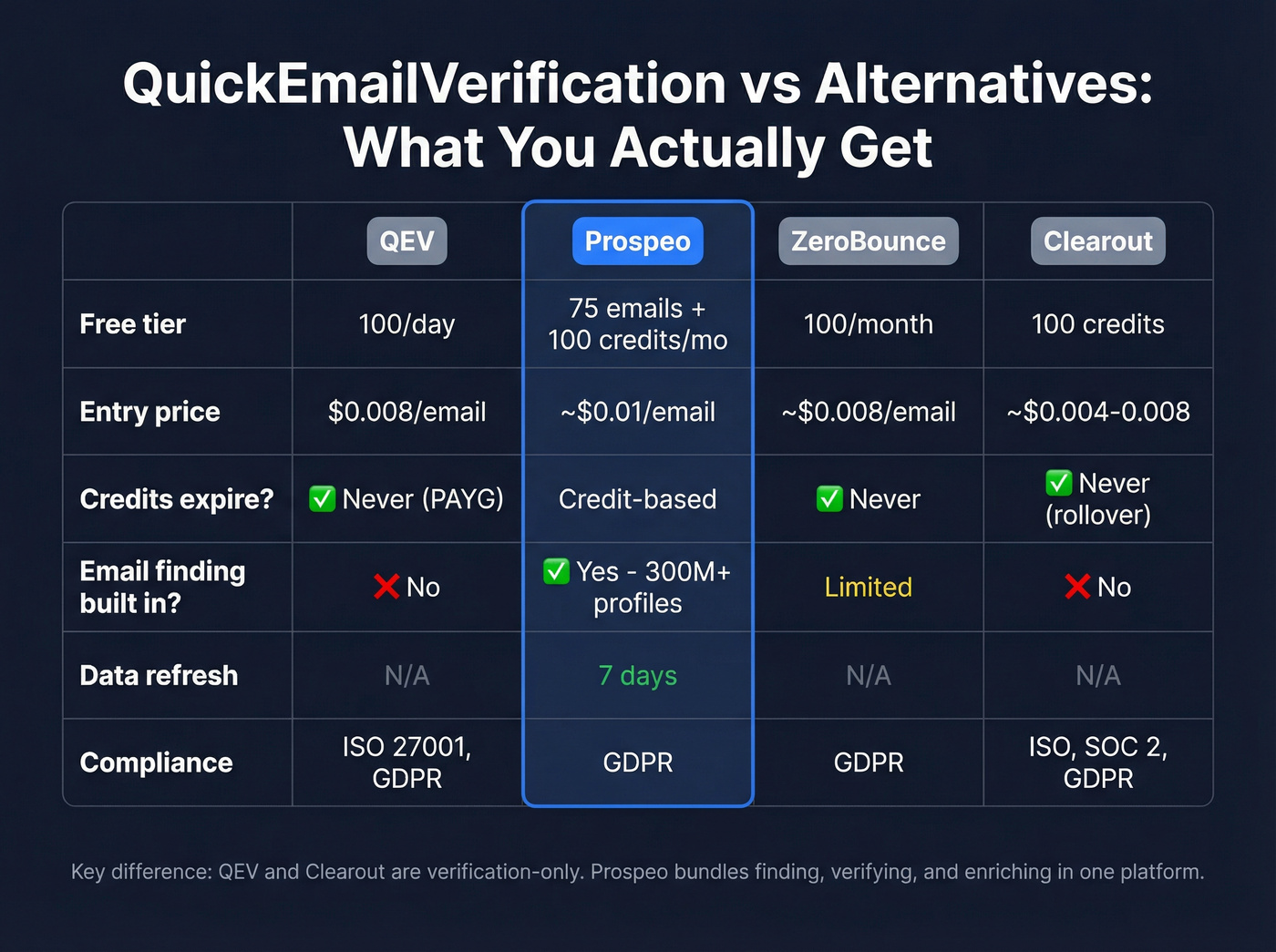
ZeroBounce edges QEV on one nice detail: unknown results don't cost credits. Clearout's rollover policy is more forgiving than QEV's daily reset. But the bigger distinction is that last row. QEV and Clearout are verification-only. Prospeo bundles verification into a full prospecting platform with a 5-step verification process that includes catch-all handling, spam-trap removal, and honeypot filtering. You aren't paying for two separate tools, and data refreshes every 7 days versus the 6-week industry average.
If you're evaluating more tools in this category, start with our roundup of email verification alternatives and then zoom out to outbound lead generation tools if you want sourcing + verification in one stack.
The Bottom Line
Use QEV if you're a developer who needs a clean verification API, you're running small-to-medium batches, and you're already sourcing emails elsewhere. The persistent-credit model is fair, and the documentation is genuinely good.
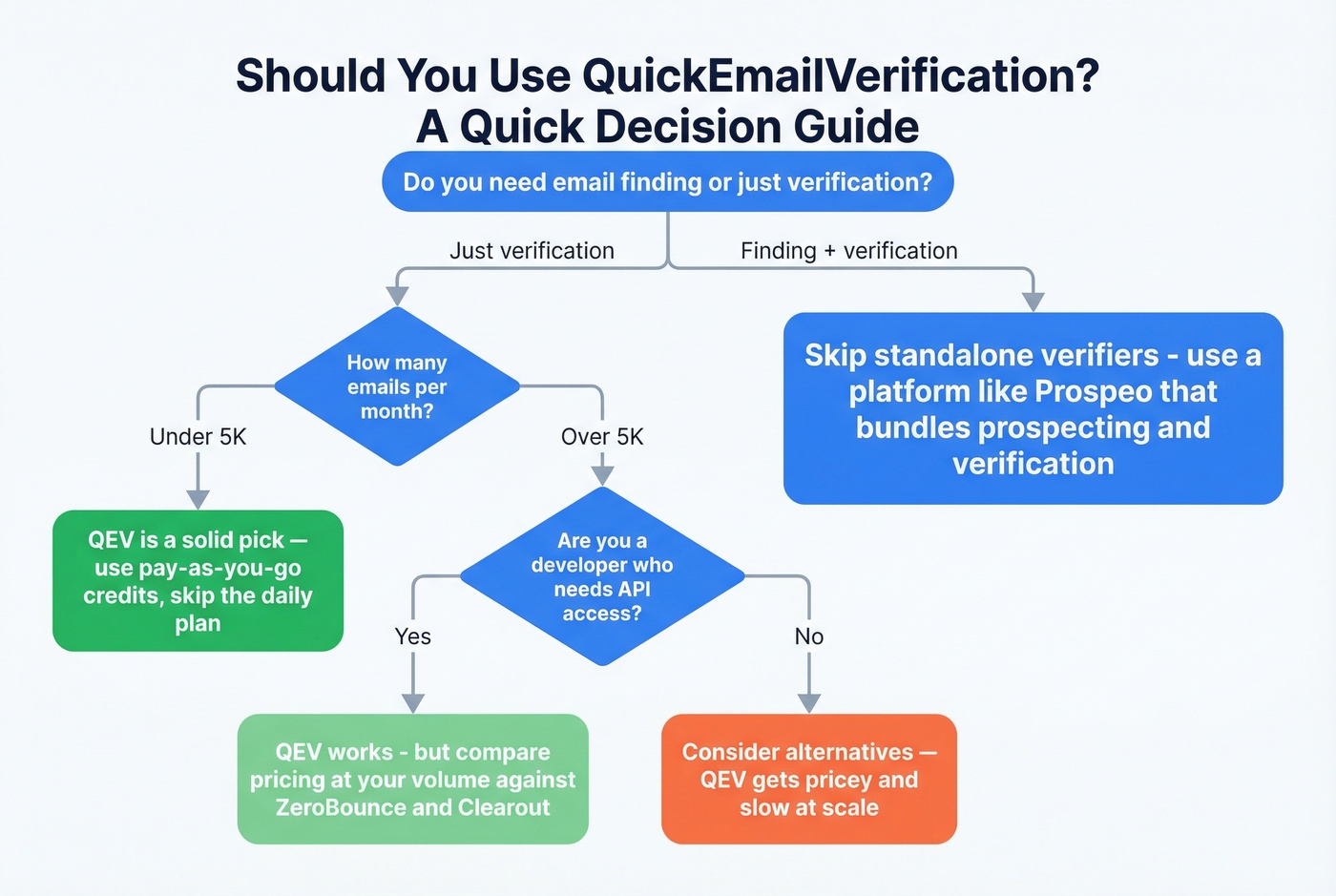
Skip QEV if you're verifying large lists regularly, you need email finding and verification in one workflow, or you're spending more than $50/month on verification alone. At that point, the cost of a standalone verifier plus a separate data provider starts to look silly.
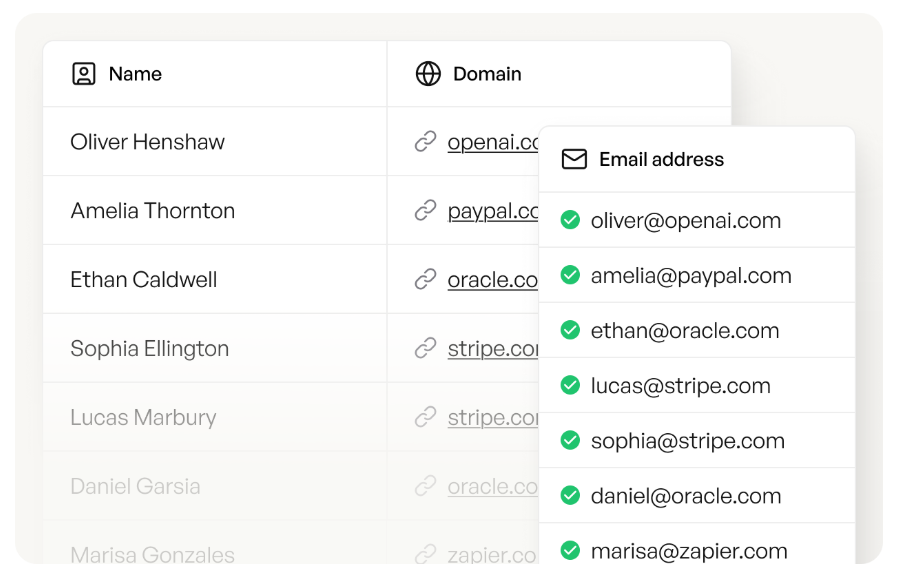
For that second group, Prospeo solves a different problem entirely. It's a full B2B data platform where verification is built into the prospecting workflow - 300M+ profiles, 98% email accuracy, 7-day data refresh. Instead of paying for a data provider plus a standalone verifier on top, you handle finding, verifying, and enriching contacts in one place. Teams like Snyk cut their bounce rate from 35-40% to under 5% after switching, and AE-sourced pipeline jumped 180%.
If you're building a repeatable outbound motion, it also helps to standardize your sales prospecting process and keep a short list of free lead generation tools for testing new channels.
Snyk's 50 AEs dropped their bounce rate from 35-40% to under 5% and grew AE-sourced pipeline 180% - because verification was already baked into their prospecting data. Prospeo refreshes every 7 days, not 6 weeks, so you're never verifying stale records.
Stop cleaning bad data. Start with clean data instead.
FAQ
Is QuickEmailVerification free?
QEV offers 100 free verifications per day - roughly 3,000 per month if you use it daily. Paid plans start at $4 for 500 persistent credits with no contracts or setup fees.
How accurate is QuickEmailVerification really?
QEV claims 99% deliverability, but independent benchmarks paint a different picture. Hunter's test of 15 tools found top overall accuracy around 70%, and Icypeas reported a market average of 85%. Your results depend heavily on list quality and how many addresses sit behind catch-all or enterprise mail systems.