

Real-Time Data Enrichment in 2026: The Complete Guide for Engineers and Sales Teams
You send 500 cold emails on Monday. By Tuesday, 120 have bounced - your sender domain takes the hit, and deliverability craters for the next two weeks. That's what stale "enriched" data does to you. B2B contact data decays at roughly 2.1% per month, which means about 25% of your database is wrong by year's end. Real-time data enrichment exists to fix this - but the term means wildly different things depending on whether you're a data engineer or a sales rep.
What You Need (Quick Version)
What Is Real-Time Data Enrichment?
It means appending, verifying, or updating data records as they flow through a system - not waiting for a nightly batch job or a monthly CSV export. But "real-time" is a spectrum, not a binary.
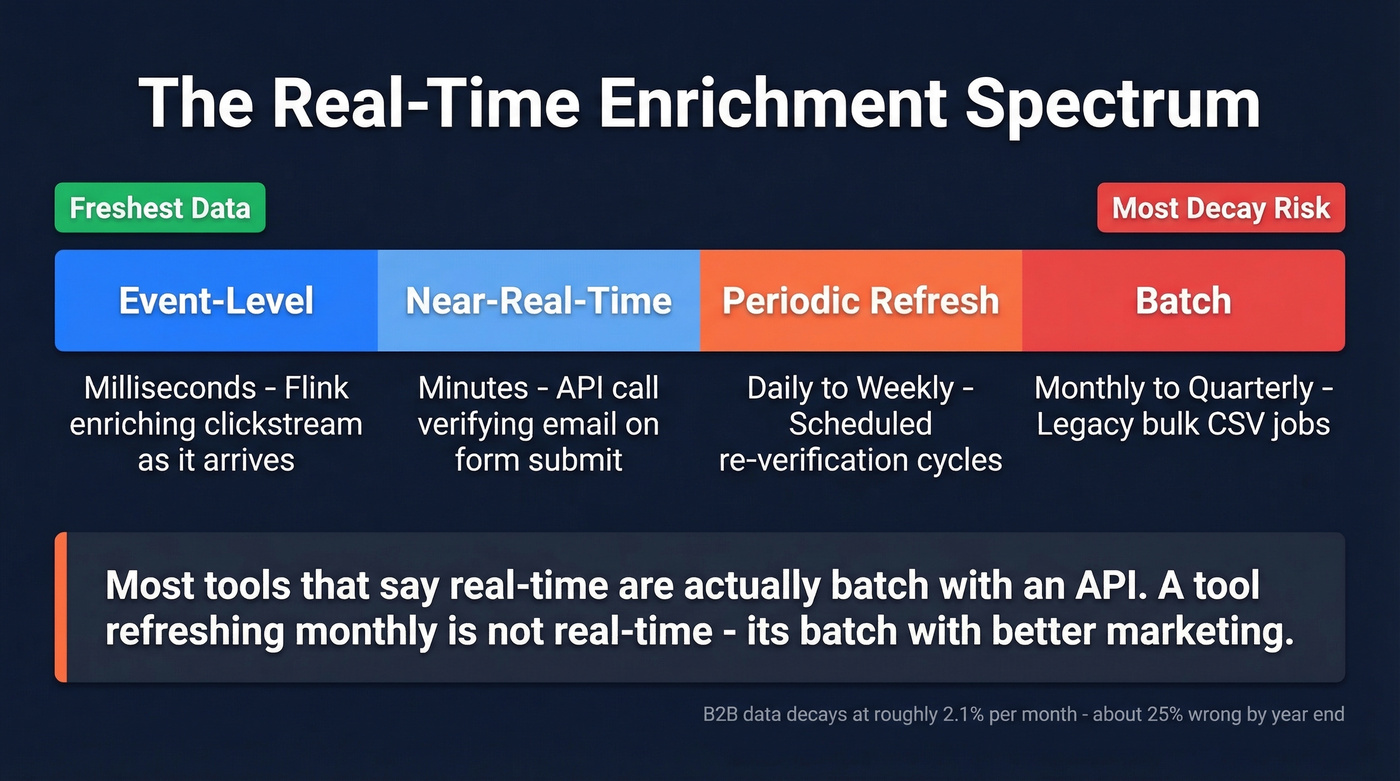
At one end, event-level processing handles records in milliseconds - a Flink job enriching clickstream data as it arrives. Near-real-time operates in minutes: an API call verifying an email the moment a lead fills out a form. Then there's periodic refresh on a daily or weekly cycle. And finally, batch - monthly or quarterly bulk jobs that most legacy tools still run under the hood.
Don't confuse enrichment (appending new fields like intent signals or firmographics) with enhancement (cleaning or updating existing records). Most tools do both, but they're different operations. And let's be honest - most "real-time" enrichment tools aren't real-time at all. A tool that refreshes monthly and calls it real-time because it has an API is just batch with better marketing.
Two Worlds: Engineering vs. Sales
If you're a data engineer building streaming pipelines - joining high-volume event streams against large reference datasets (one practitioner described enriching against a billion-row address file that changes over time) - skip to the architecture patterns section below.
If you're in sales, RevOps, or growth and you need your CRM contacts to have accurate emails, fresh firmographics, and working phone numbers - skip to the B2B sales section. You don't need Apache Flink. You need a tool with a fast refresh cycle and an API.

Stale data costs you more than bounced emails - it costs you domain reputation, pipeline, and quota. Prospeo's 7-day refresh cycle keeps 300M+ profiles current, returning 50+ data points per enrichment at a 92% API match rate. That's real-time enrichment without the enterprise invoice.
Stop enriching against data that's already six weeks old.
Architecture Patterns for Streaming Enrichment
For engineers building pipelines that enrich data in real time, the core decision is how you join your event stream against reference data. AWS's Flink patterns guide lays out six approaches with clear trade-offs:
| Pattern | Latency | Throughput | Accuracy on Change | Memory | Complexity |
|---|---|---|---|---|---|
| Pre-loaded state | Low | High | Low | High | Low |
| Partitioned state | Low | High | Low | Low-Med | Low |
| Periodic refresh | Low | High | Medium | High | Medium |
| Async lookup | Medium | Medium | High | Low | Low |
| Cached lookup | Low-Med | Medium-High | High | Medium | Medium |
| Table API join | Low | High | High | Low-Med | Low |
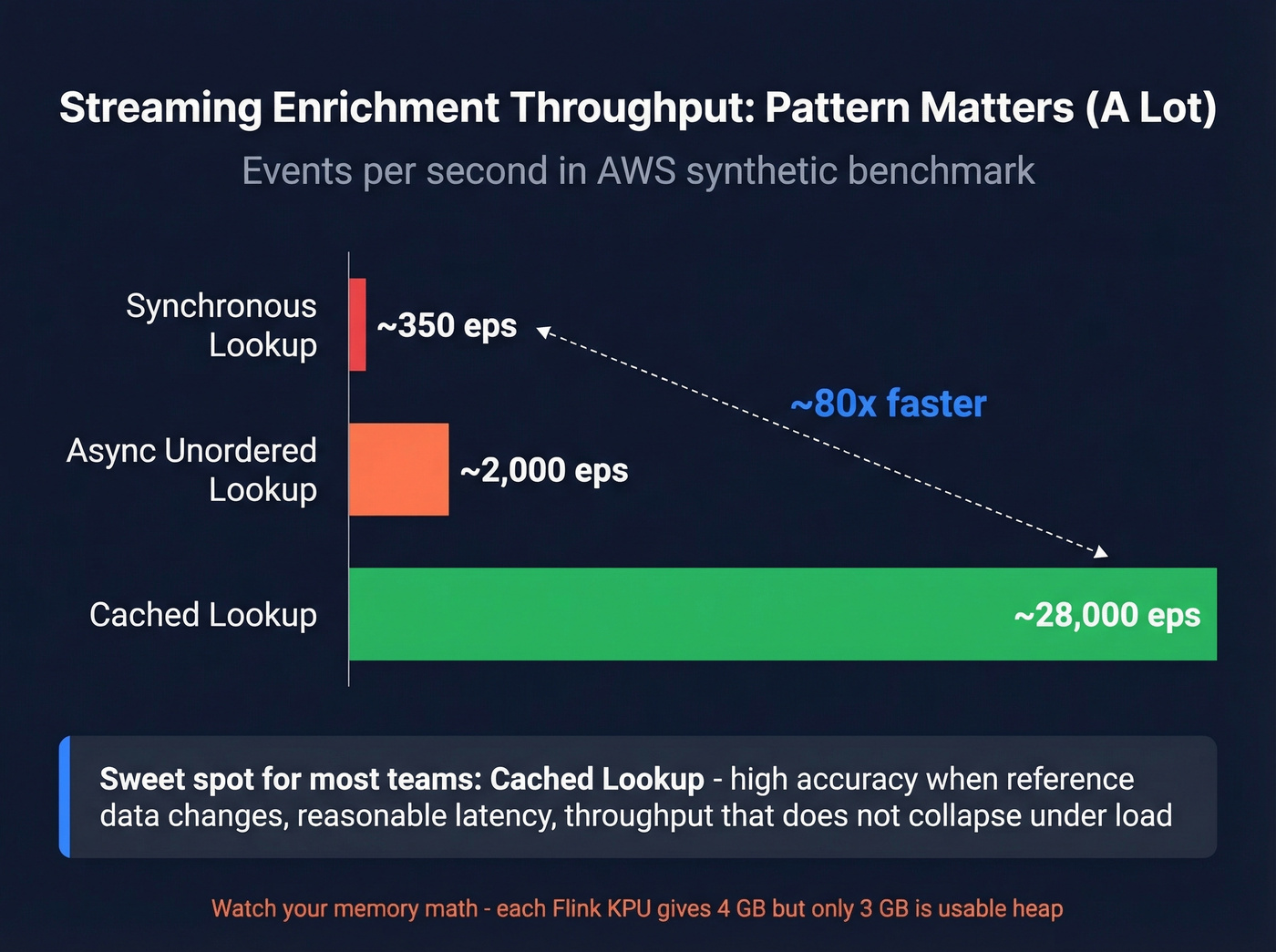
In AWS's synthetic benchmark, the throughput differences are dramatic. Synchronous lookups topped out at ~350 events per second. Async unordered lookups pushed ~2,000 eps. Cached lookups hit ~28,000 eps - nearly 80x the synchronous baseline. For most teams, cached lookup is the sweet spot: high accuracy when reference data changes, reasonable latency, and throughput that doesn't collapse under load.
This matters because 60% of data infrastructure projects exceed their initial budget by at least 30%, and picking the wrong pattern early is expensive. One sizing detail worth flagging: each Flink KPU gets 4 GB of memory, but only 3 GB is usable heap. If your reference dataset doesn't fit in that envelope, partitioned state or external cache patterns become mandatory.
We've seen teams burn weeks trying to force pre-loaded state on datasets that clearly need an external cache. Check your memory math before writing any code.
The key tools in this stack are Apache Flink, Kafka Streams, Materialize for SQL-native streaming, and Redis or RocksDB for caching reference data.
B2B Sales Enrichment Tools Compared
For sales and RevOps, enrichment means something specific: how often does the tool refresh its data, and how accurate are the emails and phone numbers it returns? The industry average refresh cycle is about 6 weeks. That's long enough for people to change jobs, companies to rebrand, and your bounce rate to climb.
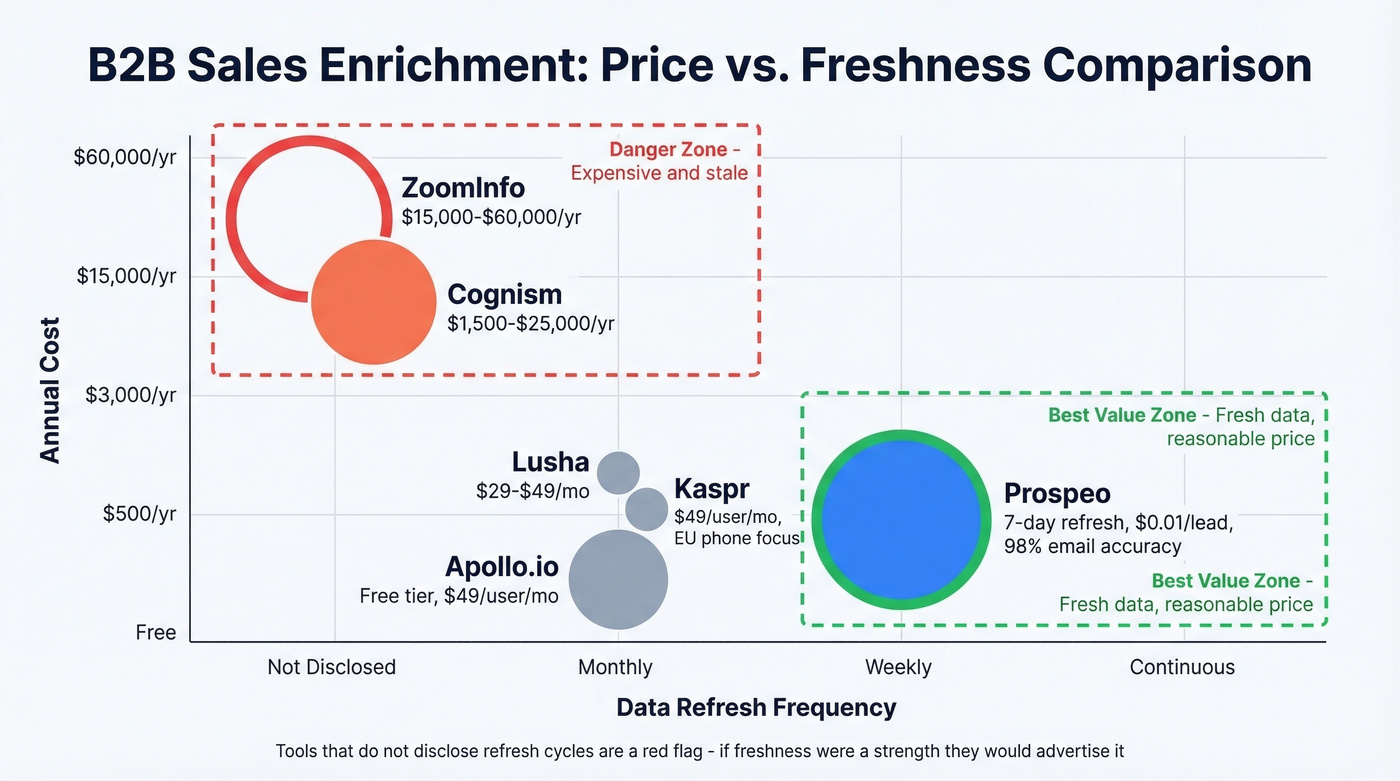
Any enrichment tool processing EU contacts must be GDPR compliant - check for DPA availability, opt-out enforcement, and data sourcing transparency before signing. Pricing falls into five models: monthly credits, per seat, flat fee, pay-as-you-go, and custom quote. The model matters as much as the sticker price.
| Tool | Starting Price | Refresh | Best For |
|---|---|---|---|
| Apollo.io | Free (100 credits/mo) / $49/user/mo | Auto-refresh in connected CRMs | Free-tier exploration |
| Lusha | $29-$49.90/mo | ~Monthly | Quick lookups, small teams |
| Kaspr | $49/user/mo | ~Monthly | European phone data |
| Breeze Intelligence | $30-$700/mo | ~Monthly | HubSpot-native workflows |
| Cognism | ~$1,500-$25,000/yr | Not public | EMEA-focused enterprise |
| ZoomInfo | $15,000-$60,000/yr | Not public | Enterprise with budget |
| Enricher.io | $279/user/mo | ~Monthly | Developer-first API use |
Tools that don't disclose refresh cycles are a red flag. If freshness were a strength, they'd advertise it.
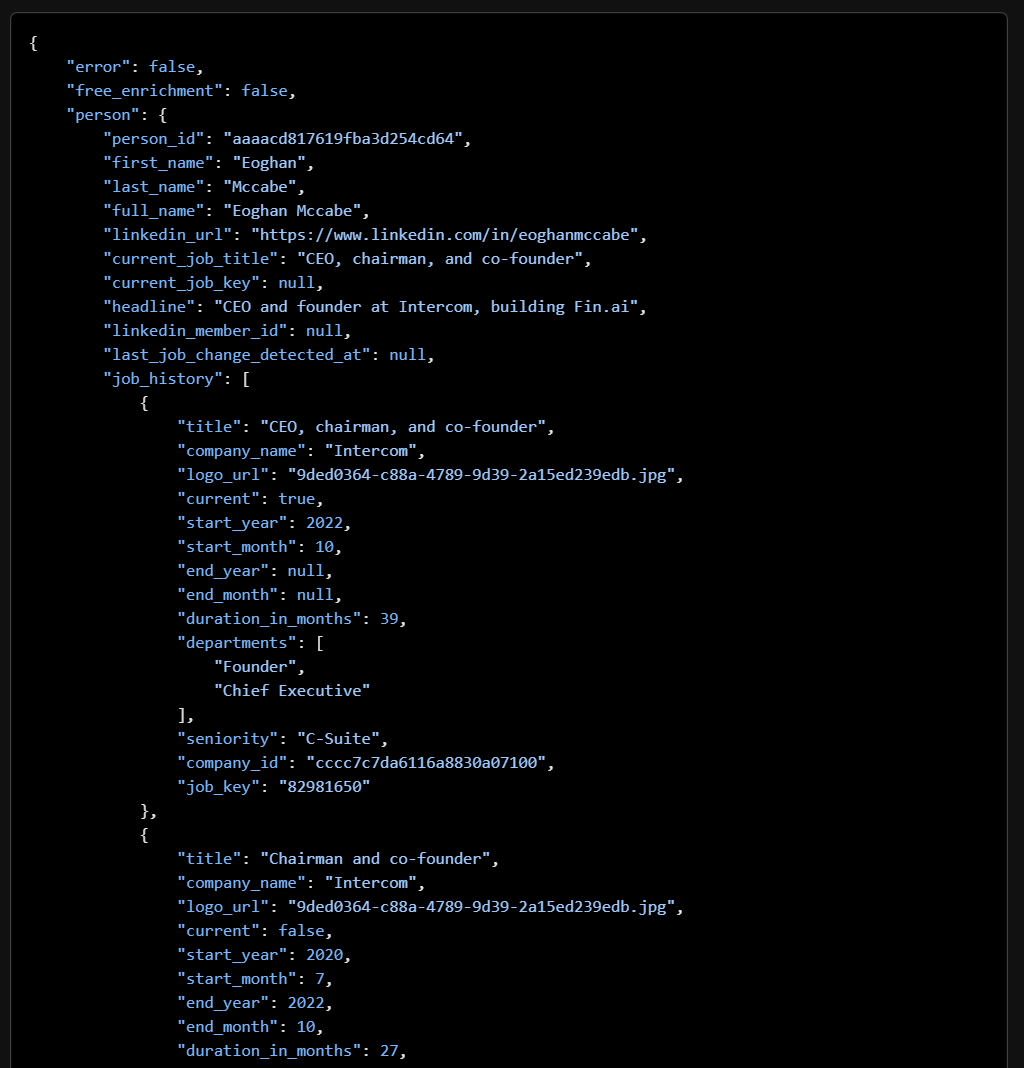
Prospeo runs a 7-day refresh cycle across 300M+ professional profiles, with 98% email accuracy and a 92% API match rate. Each enrichment returns 50+ data points - firmographics, technographics, intent signals tracking 15,000 Bombora topics, job change tracking, verified emails, and direct dials - with native integrations for Salesforce, HubSpot, and major outbound tools. At ~$0.01 per lead with a free tier, it's the closest thing to continuous enrichment at a non-enterprise price point.
In our testing, the 7-day refresh cycle catches job changes that monthly tools miss entirely. One of Prospeo's customers, Snyk, saw bounce rates drop from 35-40% to under 5% after switching - across 50 AEs prospecting 4-6 hours per week. ZoomInfo, by contrast, charges $15,000-$60,000/year. That's expensive data at a cadence you don't control.
Watch out for credit traps. The most common gotchas with credit-based enrichment aren't obvious until you do the math. Unused credits often expire monthly. A single "credit" doesn't always equal a full enrichment - some tools charge 3-5 credits per record. Failed lookups can still consume credits. Always ask what a credit actually buys before you sign.
When Real-Time Is (and Isn't) Worth It
Worth the investment:
- Outbound sales where domain reputation is at stake - bounced emails compound fast
- Fraud detection and scoring where stale data means missed signals
- Live personalization across website, chat, and ad targeting that depends on current firmographics
- Prospecting workflows where reps need verified contact info the moment they identify a target account
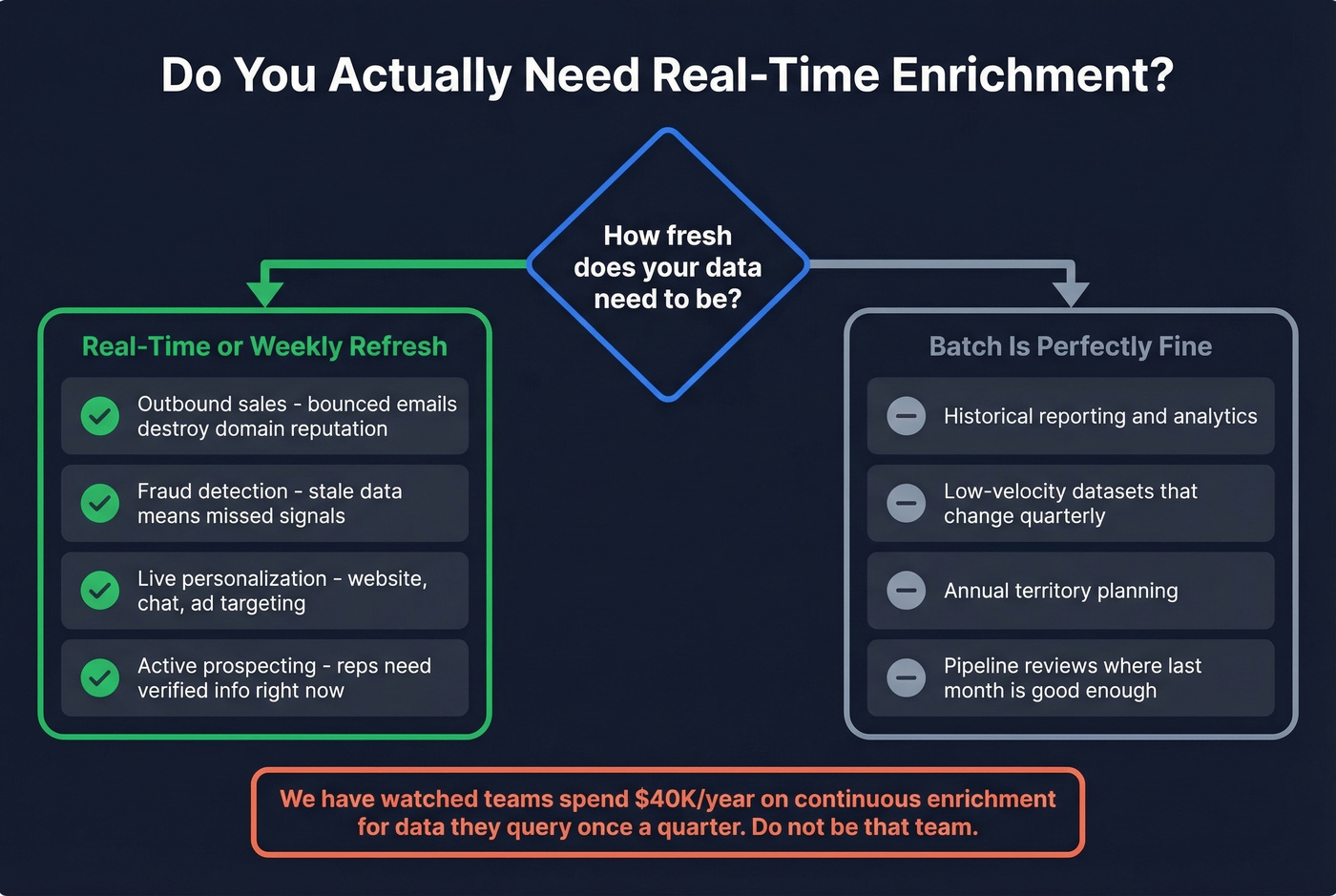
Batch is perfectly fine for:
- Historical reporting and analytics
- Low-velocity datasets that change quarterly
- Annual territory planning
- Pipeline reviews where last month's data is good enough
We've watched teams spend $40K/year on continuous enrichment for data they query once a quarter. Don't be that team.
The question isn't "do I need real-time?" It's "how fresh does my data actually need to be?" If your answer is "fresh enough that emails don't bounce and phone numbers connect," a 7-day refresh cycle handles it without building a streaming pipeline.
If you're evaluating vendors, start with a shortlist of data enrichment services and compare them against your CRM workflow and compliance needs.
Snyk's 50 AEs dropped bounce rates from 35-40% to under 5% with Prospeo's weekly-refreshed data - and grew AE-sourced pipeline 180%. At $0.01 per lead with 98% email accuracy, you get continuous enrichment that actually protects your sender domain.
Replace your monthly batch enrichment with a 7-day refresh cycle.
FAQ
What's the difference between real-time and batch enrichment?
Real-time enrichment processes records individually as they arrive - an API call when a lead submits a form, or a streaming join in Flink. Batch runs on a schedule, processing thousands at once. Real-time costs more per record but catches changes faster. Batch is cheaper and fine when freshness isn't critical.
How much does data enrichment cost per lead?
Costs range from ~$0.01/lead with Prospeo to $1+/lead with enterprise tools like ZoomInfo. Credit-based models dominate, but watch for failed lookups consuming credits, multi-credit charges per record, and monthly expiration. Calculate your effective cost per usable record, not per credit.
Do I need Apache Flink for real-time enrichment?
Only if you're building streaming data pipelines at scale - joining millions of events per hour against large, changing reference datasets. B2B sales teams don't need Flink. They need an enrichment tool with a fast refresh cycle, reliable verification, and API access.
How does real-time prospecting differ from static list building?
Static list building relies on one-time exports - you pull a list, enrich it once, and work it until the data decays. Real-time prospecting verifies and enriches contacts at the moment of outreach, so every email and phone number reflects the latest available information. This dramatically reduces bounce rates and improves connection rates compared to working aged lists.