

Buyer Intent Signals: Scoring Models, Tools, and Honest Limitations
91% of B2B marketers use intent data. Only 24% report exceptional ROI. That's a $4.49B market where roughly three out of four teams aren't seeing real returns from their buyer intent signals - and the gap isn't the data itself. It's the scoring, the speed, and the operational discipline around it.
Here's our take after watching dozens of teams implement intent programs: a scoring framework with response SLAs matters more than which vendor you pick. Build a scoring model before you buy a tool, and you're already ahead of most teams.
What Are B2B Intent Signals?
Buyer intent signals are behavioral indicators that a person or account is actively researching a solution you sell. They're distinct from intent data, which is the aggregated, packaged version vendors sell you. The signals break along two axes.
First-party vs. third-party. First-party signals come from your own channels - website visits, email engagement, product usage. Third-party signals are aggregated by external providers like Bombora from publisher networks and bidstream data.
Overt vs. covert. Overt signals are explicit actions like requesting a demo. Covert signals are passive behaviors - reading a competitor comparison page, downloading a whitepaper - that suggest interest without stating it. Each type demands a different scoring weight and response playbook, and confusing the two is one of the fastest ways to burn SDR trust in your intent program.
Signal Types Ranked by Strength
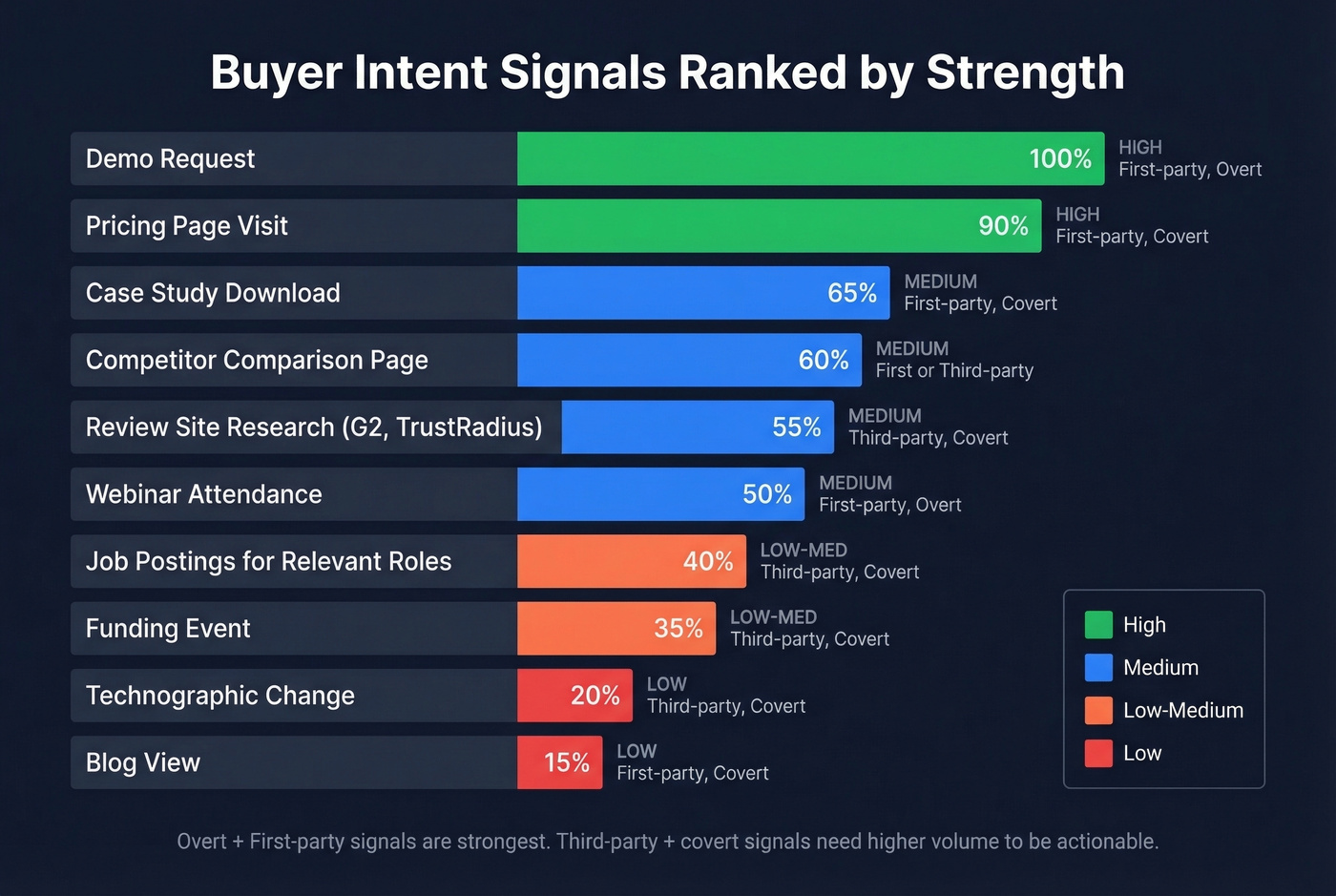
A demo request and a blog view are both "intent." They aren't remotely equal. Below are common examples organized by strength.
| Signal | Strength | Type |
|---|---|---|
| Demo request | High | First-party, overt |
| Pricing page visit | High | First-party, covert |
| Case study download | Medium | First-party, covert |
| Competitor comparison page | Medium | First/third-party |
| Review-site research (G2, TrustRadius) | Medium | Third-party, covert |
| Webinar attendance | Medium | First-party, overt |
| Job postings for relevant roles | Low-Medium | Third-party, covert |
| Funding event | Low-Medium | Third-party, covert |
| Technographic change | Low | Third-party, covert |
| Blog view | Low | First-party, covert |
The highest-strength signals are typically overt and first-party. The further you move toward covert and third-party, the noisier things get. That's not a reason to ignore third-party data - it's a reason to score it differently.
How to Score Intent Signals
This is where most intent programs fall apart. Teams buy a tool, get a firehose of "surging" accounts, and dump them on SDRs with no prioritization. We've seen it happen repeatedly, and the result is always the same: reps stop trusting the data within a month. Two models actually work in practice.
Multiplicative Model (Advanced)
This one's for teams with a RevOps function and clean CRM data.
Final Score = Base Score x Time Decay x Frequency Coefficient
Base score reflects signal strength. Time decay penalizes stale signals. Frequency rewards repeated engagement. Advanced teams also weight by seniority - a CTO visiting your pricing page scores higher than a junior analyst downloading a whitepaper, and the difference should be significant enough to change routing behavior.
| Tier | Score | Response SLA |
|---|---|---|
| Hot | 200+ | Call within 5 min |
| Warm | 100-199 | Personalized email within 1 hr |
| Cool | 50-99 | Nurture within 24 hr |
| Cold | <50 | No action |
Time-decay windows: 0-7 days = high value, 8-30 days = moderate, 31-45 days = cooling, 46+ days = expired. A pricing page visit three times in a week scores 180 on its own. That same visit 40 days ago? Basically zero.
Rule-Based Model (Starter)
This is the model we'd hand to any team just getting started:
| Action | Points |
|---|---|
| Demo request | +50 |
| Pricing page visit | +15 |
| Case study download | +10 |
| Webinar sign-up | +8 |
| Return visit within 7 days | +5 |
| Blog view | +2 |
| Decay (30 days inactive) | -20 |
Thresholds: 0-30 = Low (nurture), 31-60 = Medium (MQL), 61+ = High (route to sales). It's transparent, easy to explain to reps, and you can tune it monthly based on what actually converts.
The Three-Layer Stack
Both models above score intent in isolation. The smarter play combines three layers: ICP fit, intent signals, and brand engagement across your site, emails, and webinars. Intent without fit wastes SDR time. Fit without intent wastes timing.
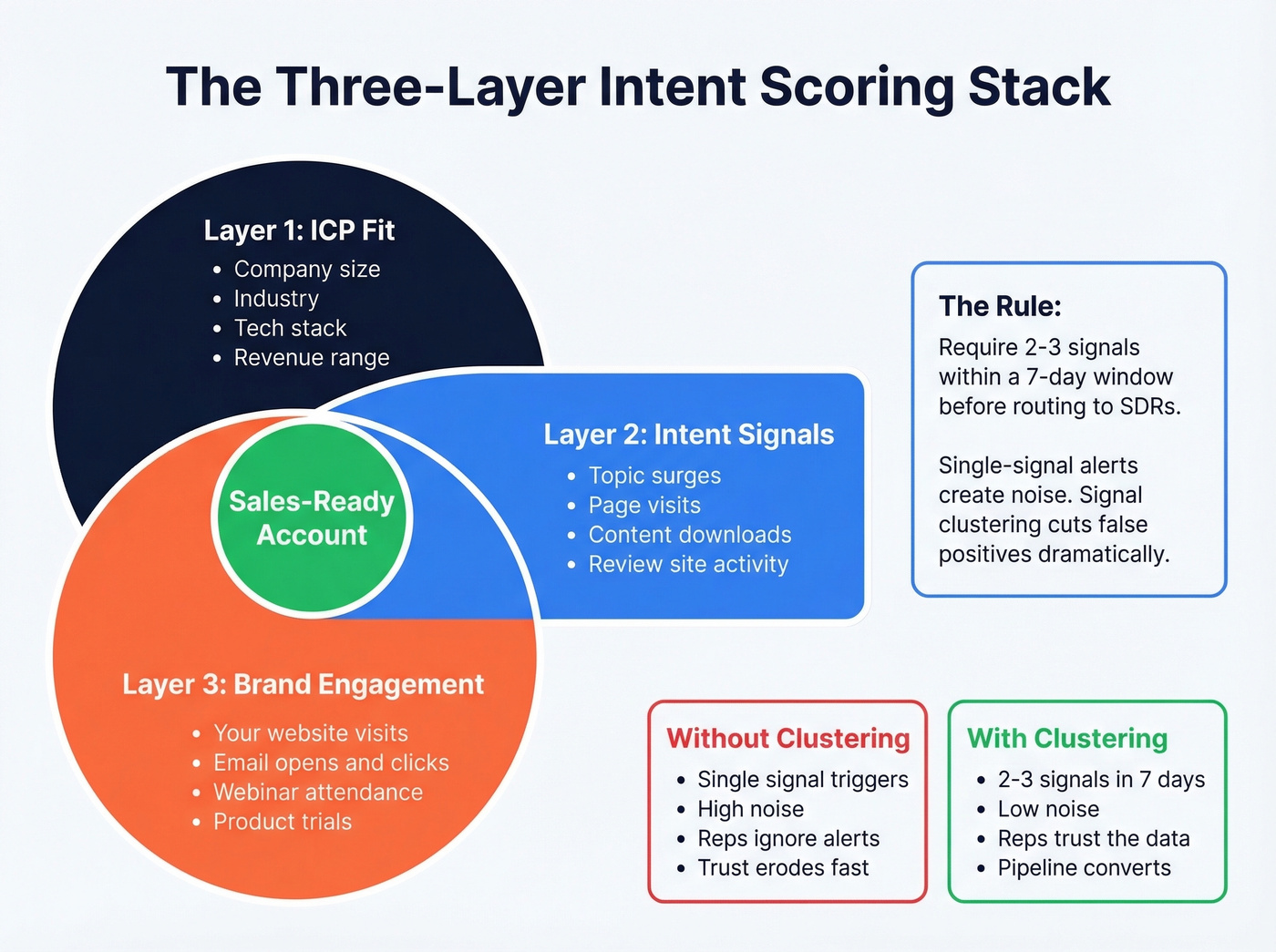
One pattern that separates strong RevOps teams from everyone else: require a cluster of 2-3 signals within a 7-day window before routing to SDRs. Single-signal alerts generate too much noise. The consensus on r/sales backs this up - threads about intent data consistently mention alert fatigue as the number-one reason reps ignore the data entirely. Signal clustering cuts false positives dramatically compared to single-signal triggers.

Scoring intent signals means nothing if you can't reach the right person fast. Prospeo layers 15,000 Bombora intent topics on top of 300M+ profiles with 98% email accuracy - so you go from "surging account" to verified decision-maker contact in one search, not three tools.
Stop scoring accounts you can't actually contact.
Mapping Signals to the Buying Journey
Speed is the variable most teams underestimate. Responding within 5 minutes makes you 21x more likely to qualify a lead versus waiting 30 minutes. And 78% of buyers purchase from the first vendor to respond.
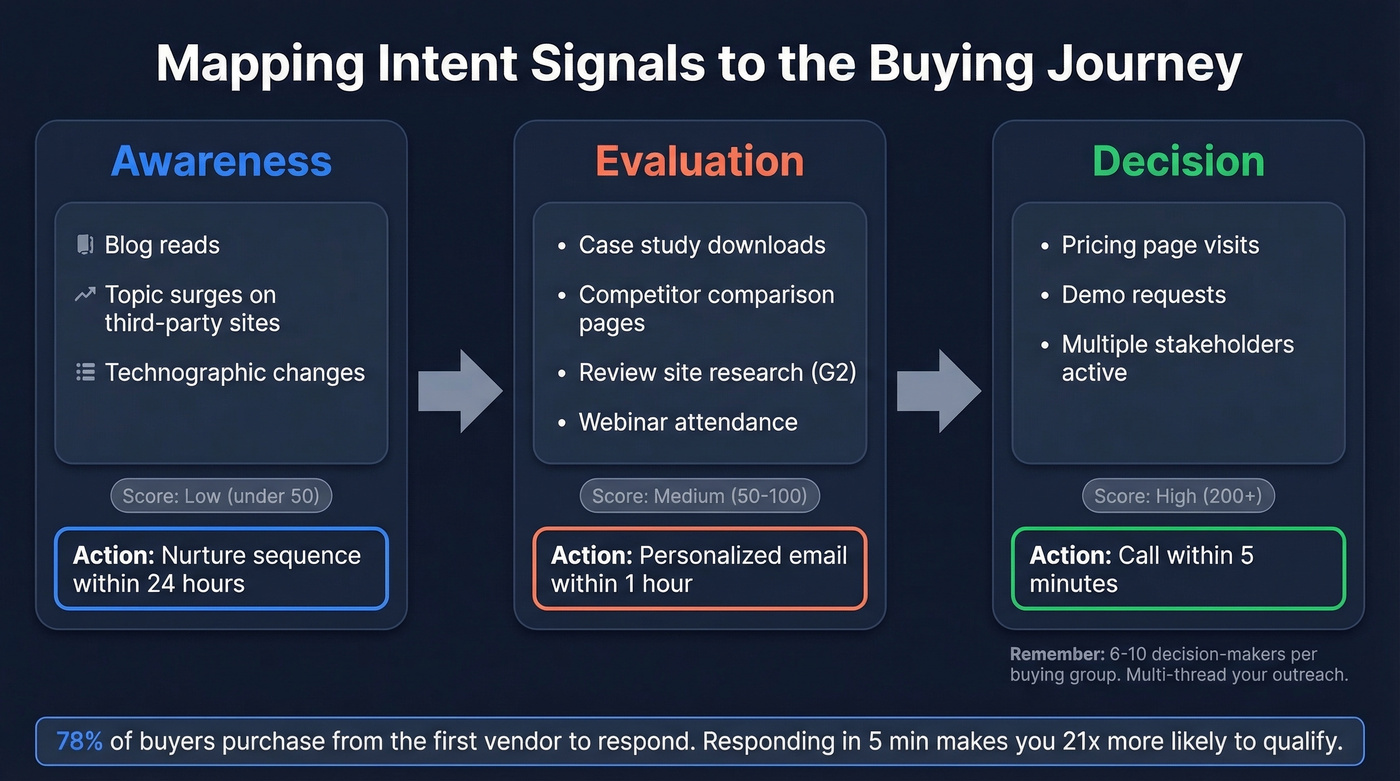
Different signals correspond to different funnel stages. Early-stage research - blog reads, topic surges on third-party sites - indicates awareness. Mid-stage signals like case study downloads and competitor comparisons suggest evaluation. Late-stage indicators such as pricing page visits and demo requests mean a decision is imminent, and your response needs to match the urgency. Matching your outreach to the stage matters just as much as matching it to the score.
The complication: 94% of buying groups have ranked preferred vendors before ever talking to sales, and the typical buying group involves 6-10 decision-makers. Acting on intent means multi-threading - reaching multiple stakeholders at a surging account simultaneously, not just pinging one contact.
The operational bottleneck is that most intent tools identify surging accounts but not the specific people researching. You need contact-level data to act. Prospeo bridges that gap with 15,000 intent topics layered on top of 300M+ professional profiles refreshed every 7 days, so you go from "surging account" to verified decision-maker email in one search.
Don't limit intent data to acquisition, either. Monitor existing customers researching competitors to flag churn risk early. It's a high-ROI use case and almost nobody does it.
Intent Data Tools and Pricing
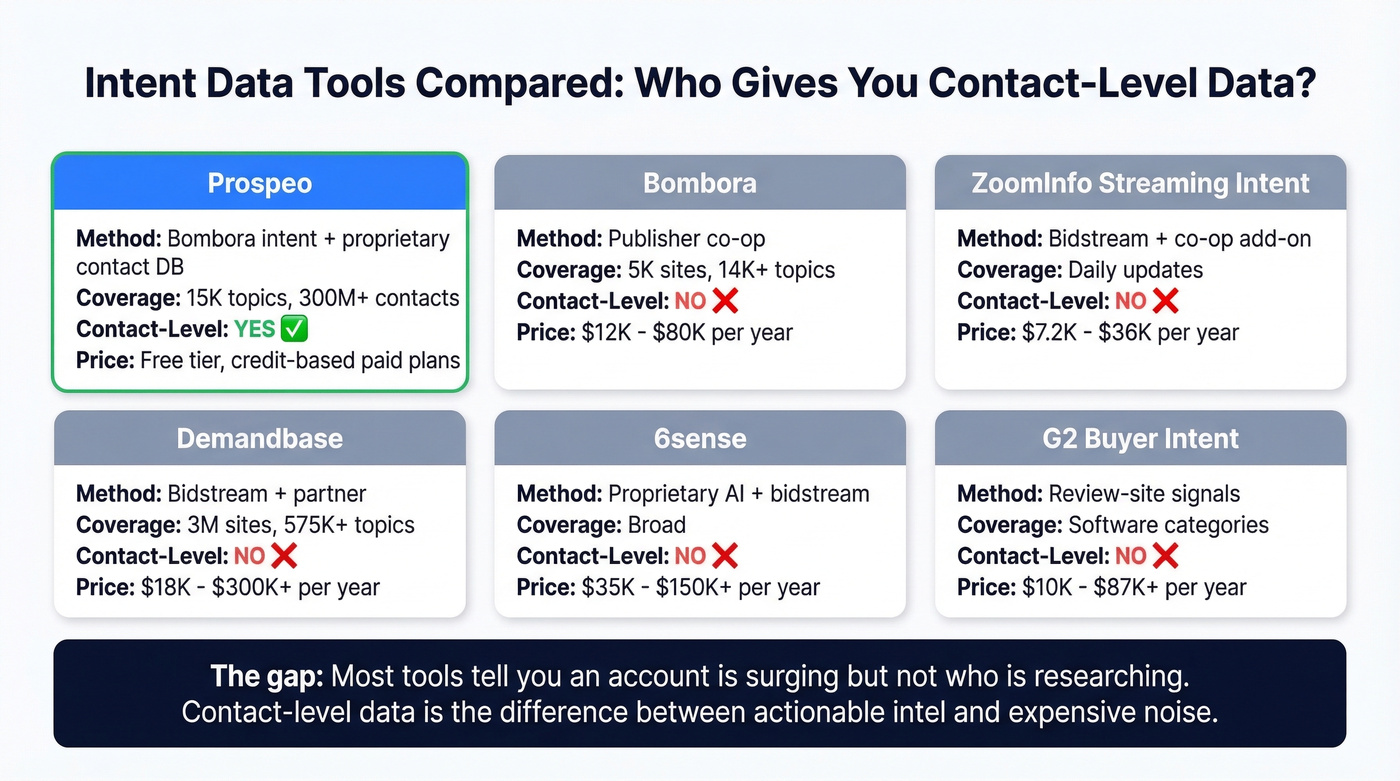
Look, here's the thing about intent tools: most give you account-level signals, not contact-level data. Neither Bombora nor Demandbase tells you who at the account is researching - just that the account is surging. That distinction matters enormously for sales execution, especially when you're trying to act on a signal before competitors do.
| Tool | Method | Coverage | Contact-Level? | Price/Year |
|---|---|---|---|---|
| Prospeo | Bombora intent + proprietary contact DB | 15K topics / 300M+ contacts | Yes | Free tier; credit-based paid plans |
| Bombora | Publisher co-op | ~5K sites, 14K+ topics | No | $12K-$80K |
| ZoomInfo Streaming Intent | Bidstream + co-op add-on | Daily updates | No | $7.2K-$36K |
| Demandbase | Bidstream + partner | ~3M sites, 575K+ topics | No | $18K-$300K+ |
| 6sense | Proprietary AI + bidstream | Broad | No | $35K-$150K+ |
| G2 Buyer Intent | Review-site signals | Software categories | No | $10K-$87K+ |
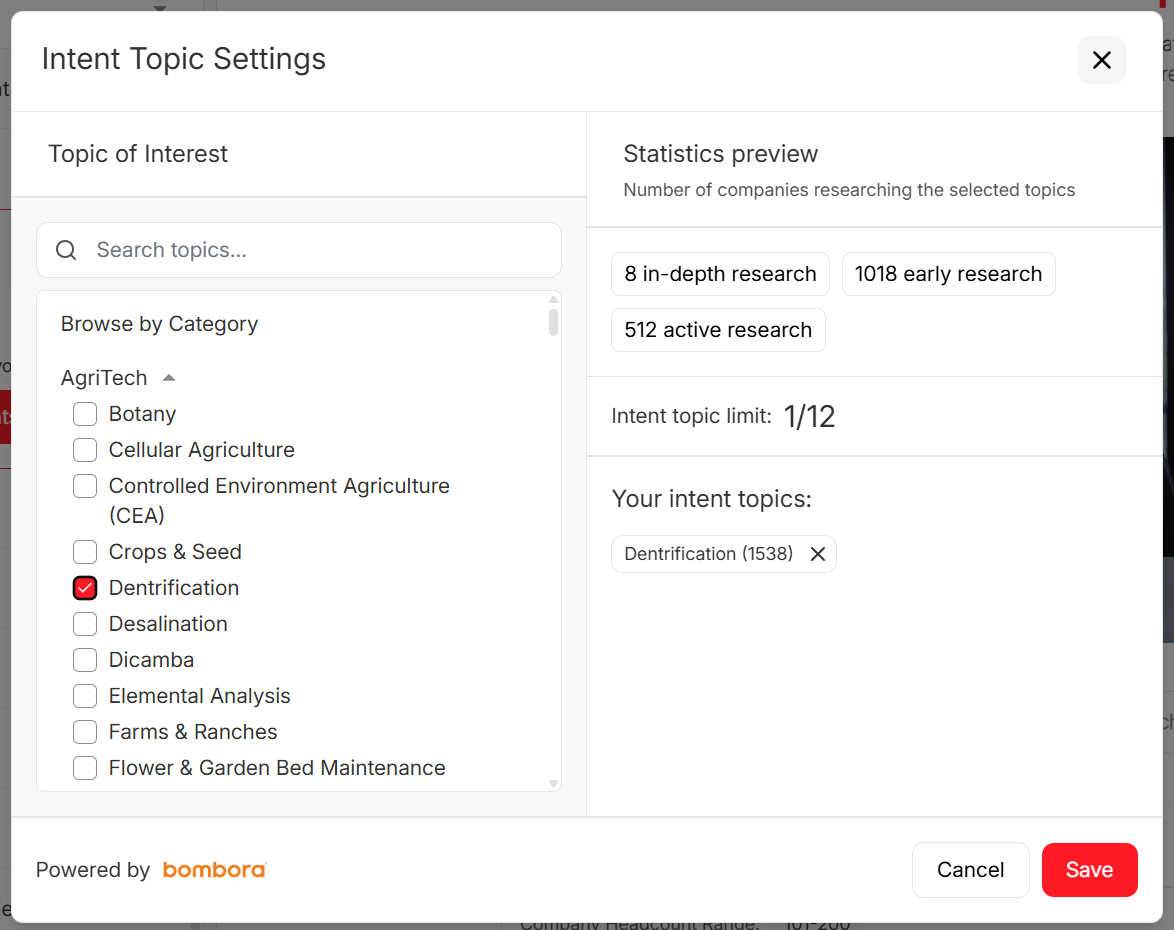
Most intent tools tell you an account is surging. Prospeo tells you who's researching, gives you their verified email and direct dial, and refreshes that data every 7 days - not 6 weeks. At $0.01 per email, your 5-minute response SLA finally has the contact data to back it up.
Act on intent signals before your competitors even see them.
Bombora is the standard for dedicated third-party topic-level intent. Its co-op model across ~5,000 publisher sites is well-established, and the $12K-$80K/yr range makes it accessible for mid-market teams. The limitation: English only, weekly updates, no historical data.
ZoomInfo Streaming Intent runs $7.2K-$36K/yr as an add-on. If you're already a ZoomInfo customer, it's the path of least resistance. If you're not, don't buy ZoomInfo just for intent - the base platform cost makes it hard to justify.
Demandbase and 6sense are enterprise ABM platforms where intent is one feature among many. Demandbase starts at $18K/yr but enterprise deployments hit $300K+. 6sense runs $35K-$150K+/yr. In practice, they're usually overkill for teams under 200 employees. Skip these if you're a lean team that just needs to know which accounts are in-market and who to contact there. The market is also consolidating - HubSpot absorbed Clearbit into Breeze Intelligence, HG Insights acquired TrustRadius - which means fewer independent options and more lock-in risk.
G2 Buyer Intent is narrow but high-fidelity. If you sell software and your buyers research on G2, the signal quality is strong. Pricing ranges from $10K to $87K+/yr depending on category coverage.
Five Mistakes That Kill Intent Programs
1. Treating all signals equally. A blog view and a demo request aren't the same. Use the scoring models above. If everything is "high intent," nothing is.
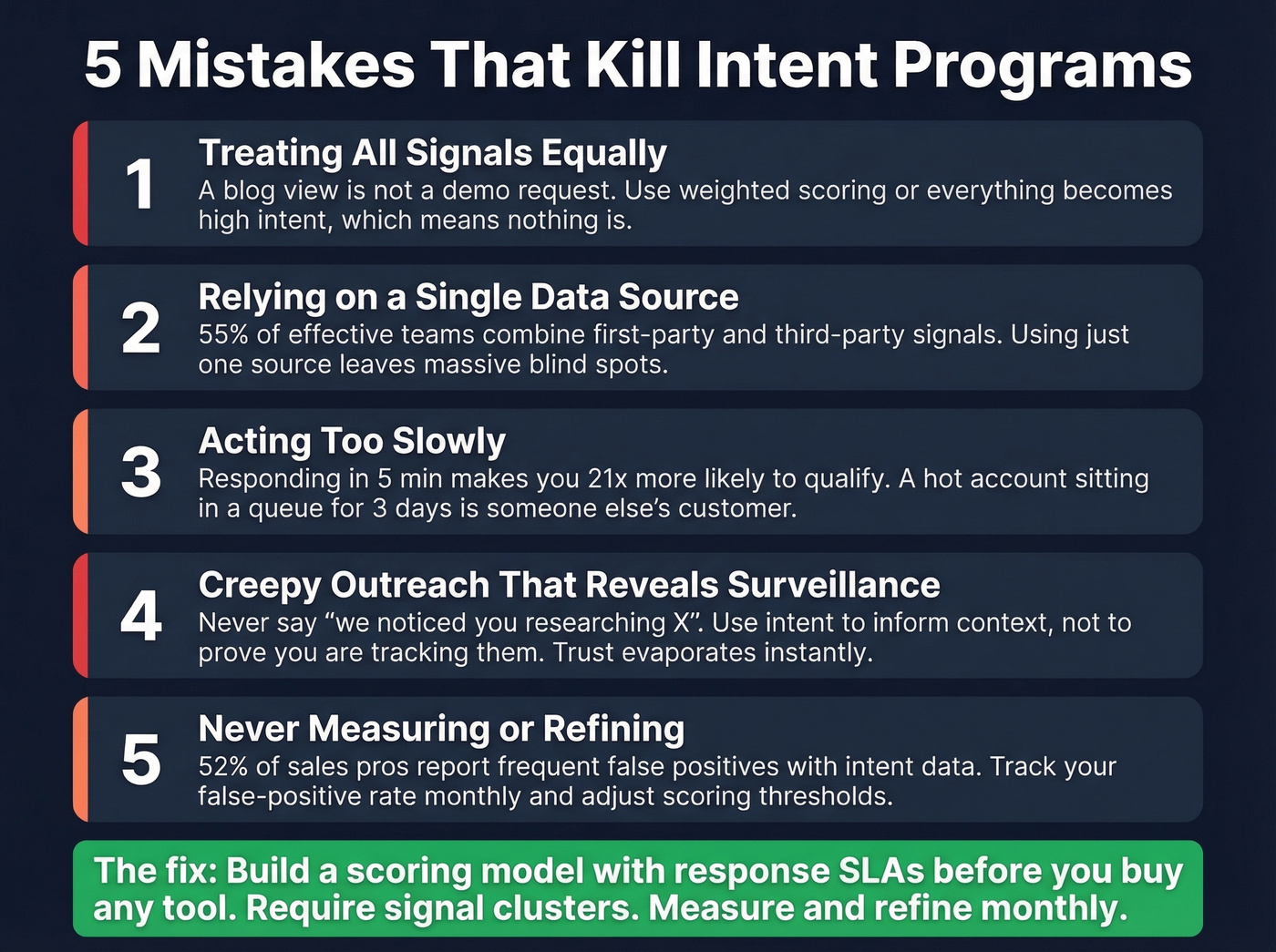
2. Relying on a single data source. First-party alone misses accounts researching elsewhere. Third-party alone is noisy. 55% of effective teams combine both, layering multiple signal sources to build a more complete picture of which accounts are genuinely in-market.
3. Acting too slowly. Intent has a shelf life. Set SLA tiers from the scoring model and enforce them. A "hot" account that sits in a queue for three days isn't hot anymore - it's someone else's customer.
4. Creepy outreach that reveals surveillance. Never say "we noticed you researching X." Use intent to inform context - reference the problem space, not the tracking. The moment a prospect feels watched, trust evaporates.
5. Never measuring or refining. 52% of sales professionals report frequent false positives with intent data, largely due to IP misattribution from remote work and VPNs. Track your false-positive rate monthly and adjust thresholds. There's also a real risk of echo-chamber effects: you target accounts showing intent, engagement rises, the vendor claims success, and nobody asks whether those accounts would've converted anyway.
Compliance and the Cookie Problem
GDPR fines run up to EUR 20M or 4% of global turnover. CCPA penalties hit $2,500-$7,500 per violation. These aren't theoretical - they shape how intent data gets collected and what you can legally act on.
The bigger structural shift: Safari blocked third-party cookies via ITP in 2017, Firefox followed with ETP in 2019, and Chrome's phased deprecation rolled through 2024-2025 under Privacy Sandbox. Third-party tracking is getting harder every year. First-party signals - your website, your email engagement, your product usage - are becoming the default foundation. Third-party intent data is a supplement, not the base layer.
Let's be honest: if your entire intent strategy depends on third-party cookies surviving, you're building on sand.
FAQ
What are buyer intent signals?
Behavioral indicators that a person or account is actively researching a solution you sell. They range from high-strength overt actions like demo requests to low-strength covert behaviors like blog views. In B2B, these signals help sales and marketing teams prioritize outreach toward accounts most likely to convert.
What's the difference between first-party and third-party intent data?
First-party comes from your own channels - website visits, email opens, product usage. Third-party is aggregated from publisher networks by providers like Bombora. First-party is higher fidelity; third-party gives broader market coverage but carries more noise and typically costs $12K-$80K/yr.
How accurate is third-party intent data?
Expect 30-60% of third-party intent alerts to require manual validation. 52% of sales professionals report frequent false positives from IP misattribution. Always cross-reference against first-party data and enforce signal clustering before routing to sales.
Can I get contact-level intent data without enterprise pricing?
Yes. Most standalone intent providers like Bombora only surface account-level surges. Prospeo combines Bombora's 15,000 intent topics with 300M+ professional profiles and verified emails, starting with a free tier - so you can identify both the surging account and the specific decision-makers to contact.