

Intent Data: What It Is, How It Works, and How to Use It in 2026
You just pulled a surge report showing 847 accounts "in-market" for your category. Your SDRs called 200 of them. Fourteen picked up. Three had any idea what you sell. The rest? Ghosts.
Intent data is one of the most powerful - and most misused - signals in B2B. The consensus on r/sales and r/b2bmarketing is brutal: practitioners call it "overpriced lists" and compare it to chasing phantoms. But when Unisys paired buyer intent signals with a real activation workflow, they grew pipeline 40% and closed a $48M deal. The difference isn't the data. It's the system around it.
Only 24% of teams report exceptional ROI from these signals. The other 76% are buying the wrong ones, acting too slowly, or skipping contact resolution entirely. This guide is about landing in the 24%.
The Short Version
Intent data is a signal, not the system. It tells you which accounts are researching topics related to what you sell. Everything else - who to contact, what to say, how fast to move - is on you.
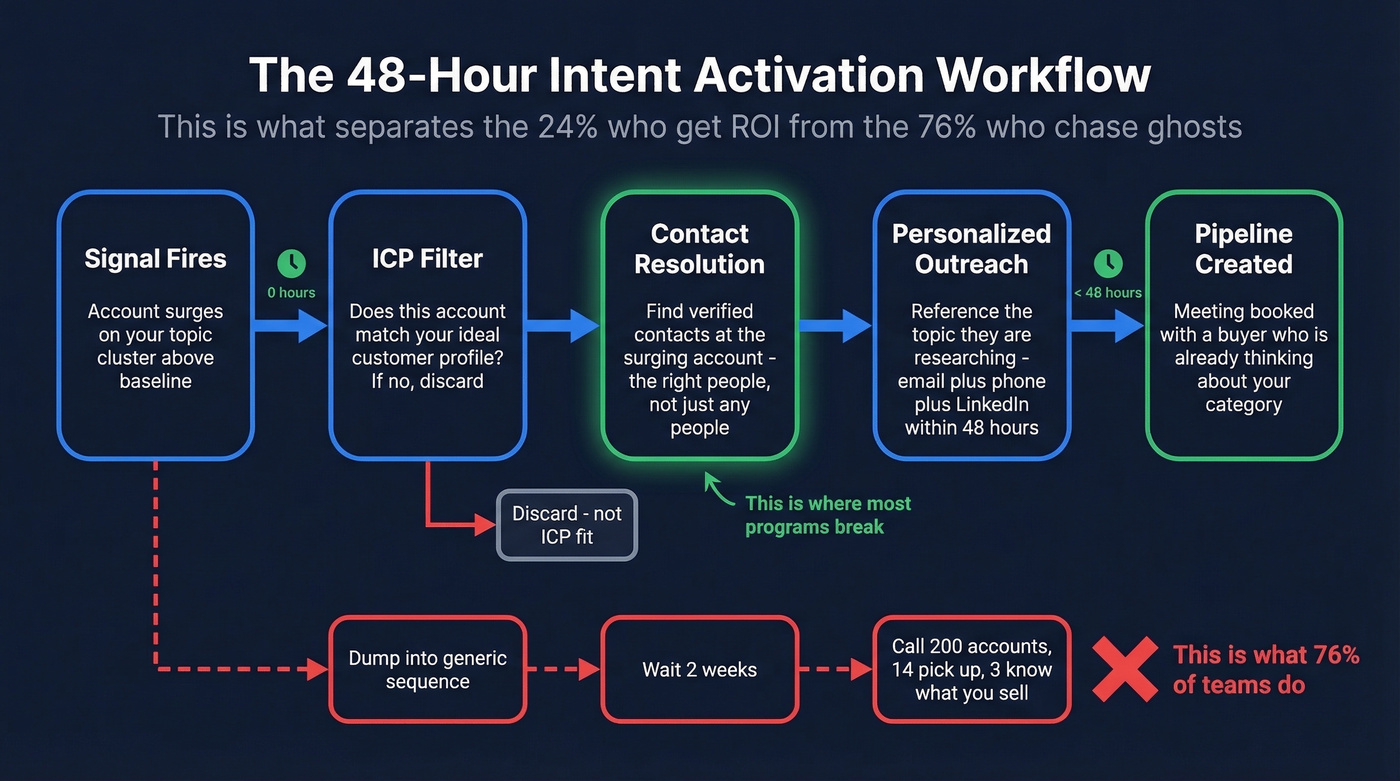
- It works when you have a defined ICP, a way to get verified contacts at surging accounts, and reps who act within 48 hours of a signal firing.
- It fails when you treat it as a lead list, skip contact-level resolution, or let signals sit in a dashboard for two weeks.
- The 48-hour rule is non-negotiable. A Tier 1 surge on day one is background noise by day eight. If your team isn't reaching out within 48 hours, you're losing deals to competitors who are.
What Is Intent Data, Exactly?
The simplest definition: it captures behavioral signals suggesting a company is actively researching a topic. When an account starts consuming content about "endpoint security solutions" at a rate well above their baseline, that's a surge - the core unit of measurement.
First-party intent comes from your own properties: website visits, content downloads, webinar registrations, CRM and marketing automation activity. You own this data, it's high-fidelity, and it's effectively free to collect once your tracking stack is set up. The limitation is reach - you only see accounts that already found you.
Third-party intent comes from external sources: content consumption across publisher networks, bidstream advertising data, review site activity, and other web behavior tracked across large networks of websites. This is where the money gets spent, because it reveals accounts researching your category before they ever visit your site - the "dark funnel" that third-party signals try to surface.
Most vendor pitches blur the two. When someone says "buyer intent," they almost always mean third-party. And third-party is where the accuracy problems, pricing complexity, and ghost-chasing frustration live.
Here's the thing: first-party tracking is table stakes. If you're not capturing it through your marketing automation platform, start there before spending $12K-$25K+ on a third-party provider.
The Market in 2026
The space has matured, but it's still messy.
Market size reached $4.49B in 2026, projected to hit $20.89B by 2035 at a 16.6% CAGR. More vendors, more noise, more confusing buyer decisions. Consolidation is accelerating - HG Insights acquired TrustRadius in June 2025, combining technographic data with review-site signals, and HubSpot has already absorbed Clearbit into "Breeze Intelligence." Standalone products are getting folded into broader platforms at a rapid clip.
AI agents are replacing dashboards. 6sense launched RevvyAI; ZoomInfo shipped Copilot. Instead of logging into a dashboard to check surge reports, AI agents push prioritized accounts directly into rep workflows.
Privacy regulation keeps tightening. IP addresses and cookie identifiers are explicitly classified as personal data under GDPR, and many US state privacy laws treat technical identifiers the same way. Bidstream-based collection faces active enforcement risk, pushing vendors toward consent-based co-op models.
91% of B2B marketers now use intent signals to prioritize accounts. But adoption doesn't equal ROI. With 94% of buying groups ranking preferred vendors before ever talking to sales and committees averaging 10+ people consuming 13+ content pieces, catching the signal early is only half the battle.
Types of Intent Signals
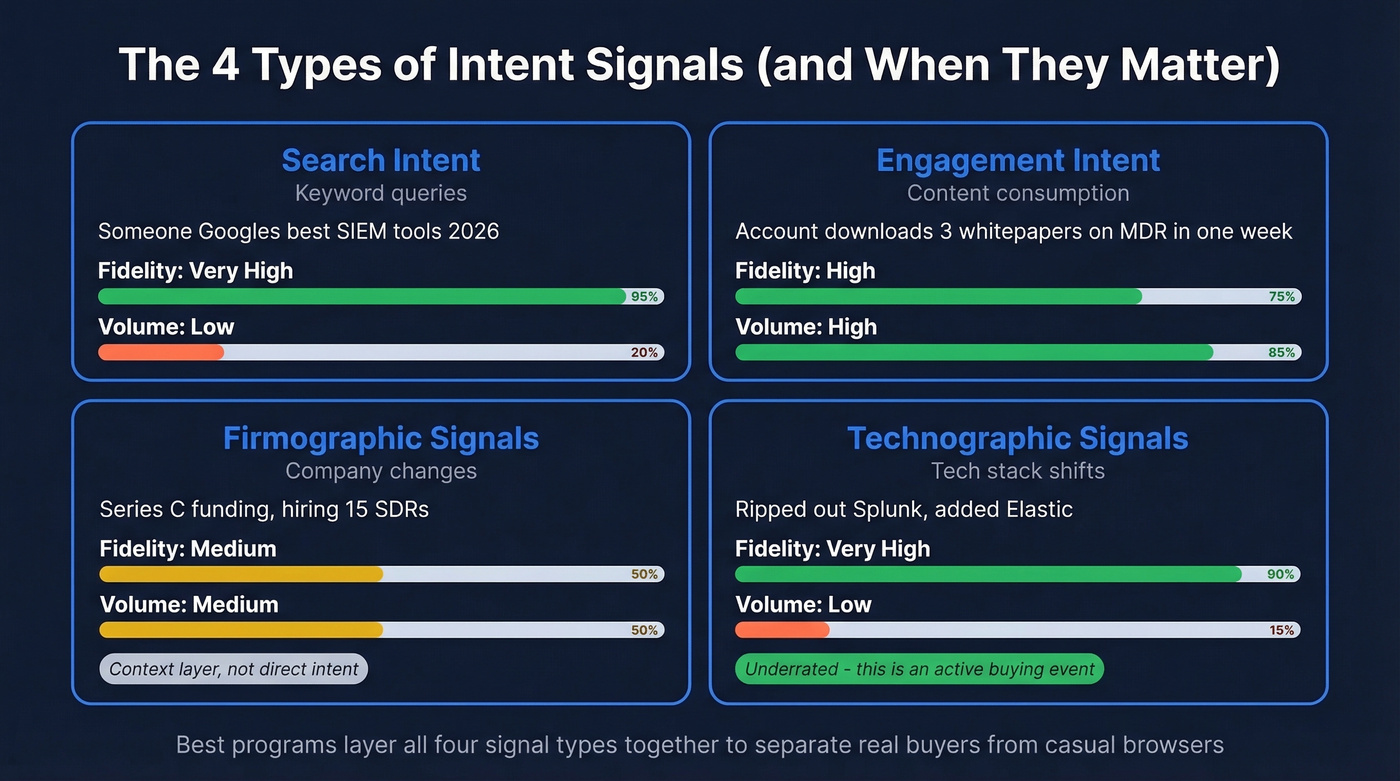
Gartner's taxonomy breaks these signals into four categories. Understanding the differences matters for how you weight and act on them.
| Signal Type | What It Captures | Example | Strength |
|---|---|---|---|
| Search | Keyword queries | "best SIEM tools 2026" | High intent, low volume |
| Engagement | Content consumption | Downloading 3 whitepapers on MDR | Volume + topic depth |
| Firmographic | Company changes | New funding, hiring spike | Context, not intent |
| Technographic | Tech stack shifts | Removed Splunk, added Elastic | Strong buying signal |
Search intent is the highest-fidelity signal - someone actively typing a query related to your category. It's also the hardest to capture at scale because it relies on partnerships with search data providers.
Engagement intent is the workhorse. When an account consumes multiple pieces of content on a topic cluster above their historical baseline, that's a surge. Most third-party providers - Bombora, Demandbase, 6sense - primarily track this type.
Firmographic signals aren't buying indicators in the traditional sense, but they're powerful context layers. A company that just raised a Series C and is hiring 15 SDRs is more likely to buy sales tools than one that's been flat for two years. Job changes deserve special attention: when a champion who used your product moves to a new company, that's among the strongest buying signals available.
Technographic signals are underrated. If an account rips out a competitor's product, that's not a vague "researching" signal - that's an active buying event. The best programs layer engagement surges with firmographic context and technographic changes to separate real buying activity from casual browsing.
How Collection Methods Work
The collection method determines both accuracy and compliance risk. Understanding how signals are gathered at the infrastructure level helps you evaluate providers and avoid overpaying for low-quality data.
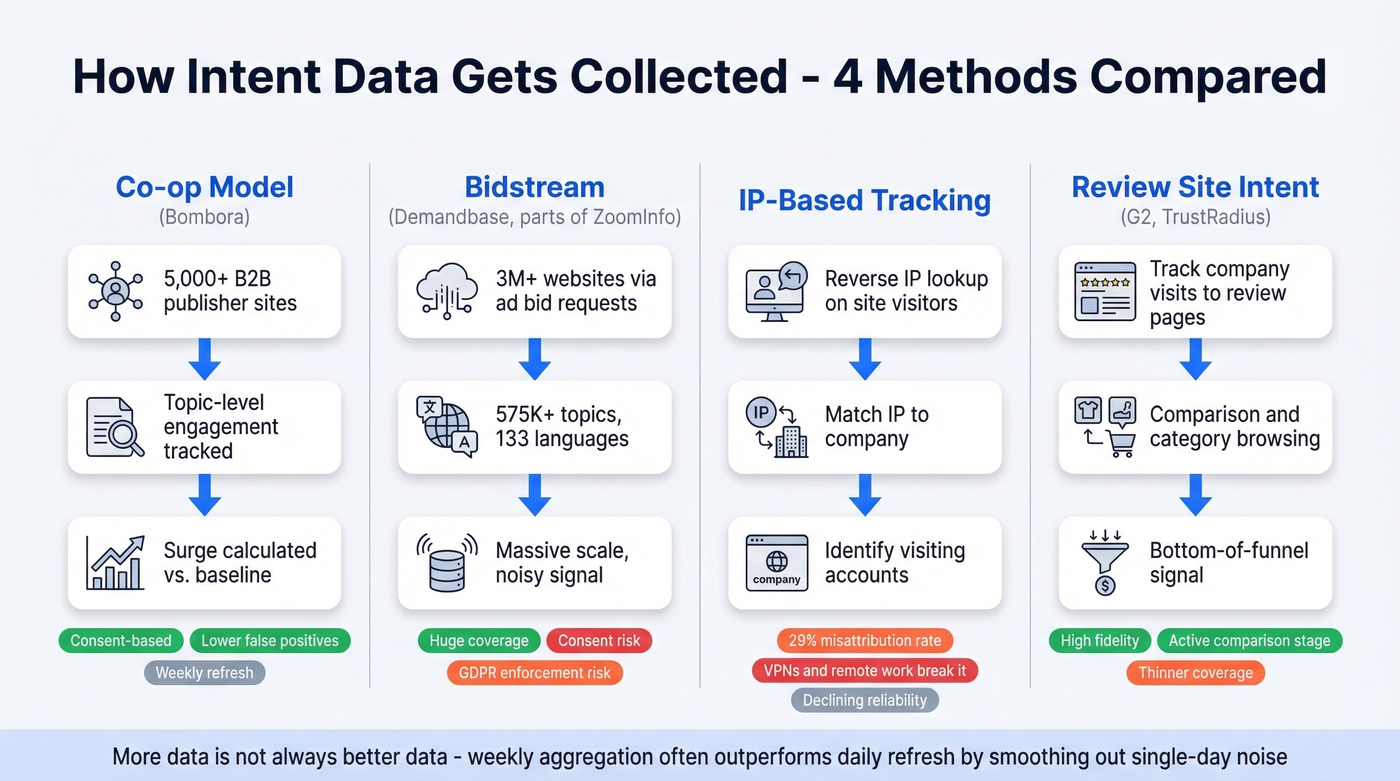
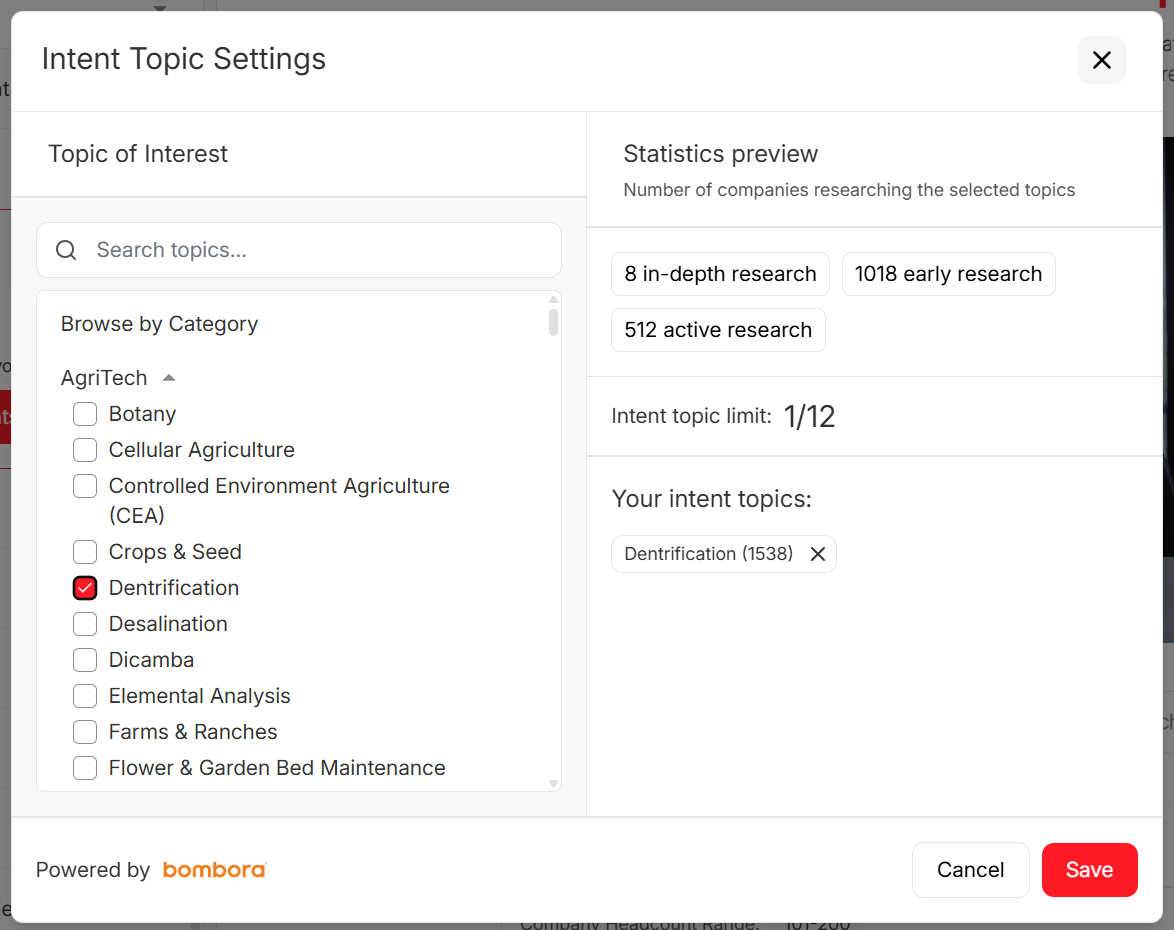
Co-op model (Bombora): A consent-based network of ~5,000 B2B sites. Bombora tracks topic-level engagement and identifies surges above baseline. The advantage is consent and lower false-positive rates. Updates are weekly, which actually reduces noise compared to daily refreshes.
Bidstream data (Demandbase, parts of ZoomInfo): Captures advertising bid requests across ~3M websites - Demandbase tracks over 575,000 topics across 133 languages. The scale is impressive, but bidstream data has a consent problem. Much of it is collected through programmatic ad infrastructure without explicit user agreement for B2B sales tracking.
IP-based tracking: Reverse IP lookup identifies which companies visit specific websites. Increasingly unreliable - remote work, VPNs, and shared IP addresses mean 29% of sales professionals cite misattributed IP data as a key challenge.
Review-site intent (G2, TrustRadius): Tracks which companies are actively comparing products on review platforms. High-fidelity, bottom-of-funnel signals, but coverage is thinner than web-wide sources.
We've seen daily refresh increase noise without improving outcomes. A company that surges on Monday and Tuesday looks the same whether you check daily or weekly. But daily refresh flags single-day blips that weekly aggregation smooths out. More data isn't always better data.

Intent data without contact resolution is just a dashboard you stare at. Prospeo layers Bombora intent signals across 15,000 topics directly into a database of 300M+ profiles with 98% verified emails - so you go from surge alert to rep outreach in minutes, not days.
Stop chasing surging accounts you can't actually contact.
Why Most Programs Fail
Let's be honest: these programs fail more often than they work. The failure modes are predictable.
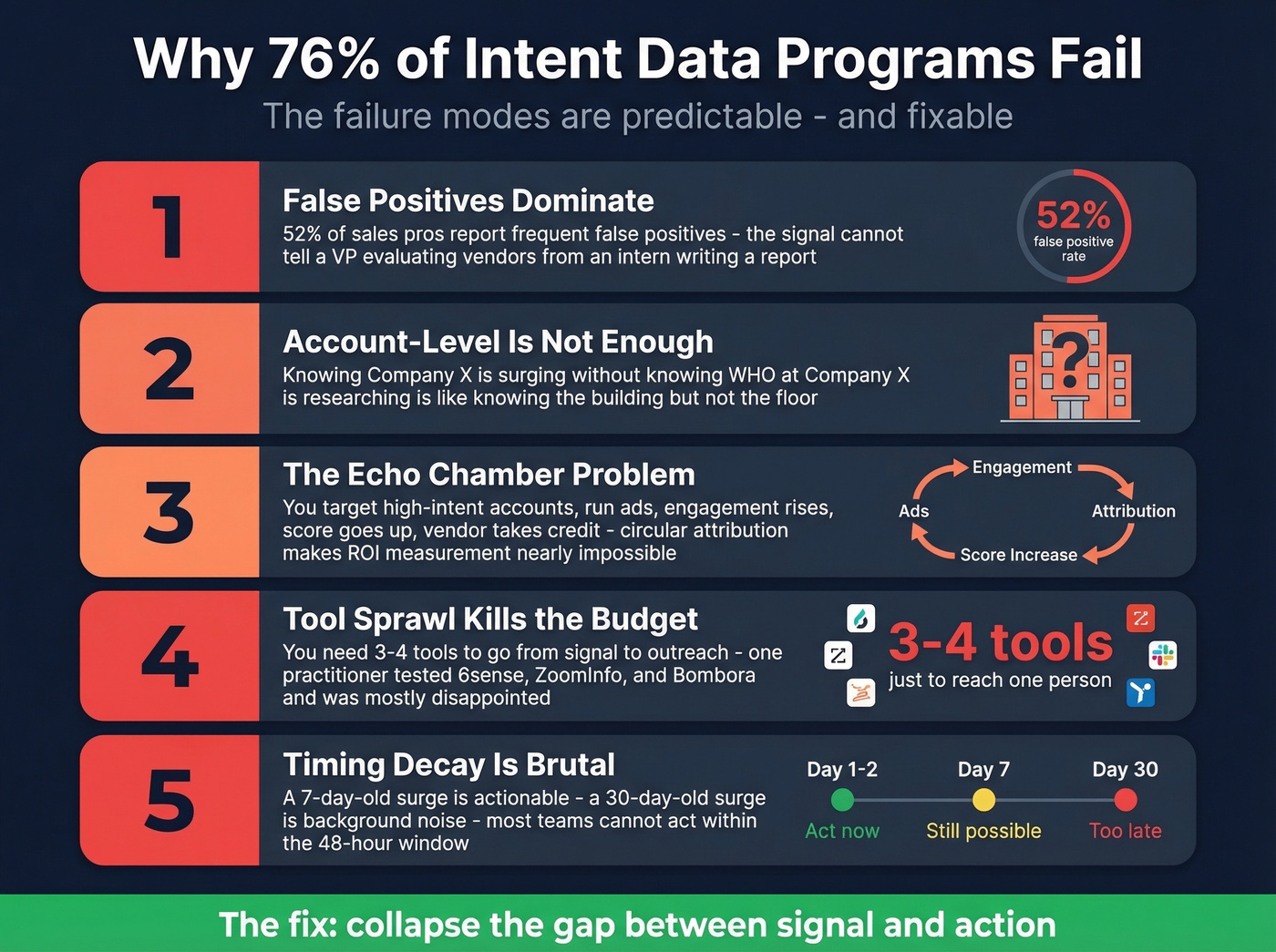
False positives dominate. 52% of sales professionals report frequent false positives. The signal doesn't distinguish between a VP evaluating vendors and an intern writing a report.
Account-level resolution isn't enough. Most providers tell you "Company X is surging on topic Y" but not who at Company X is doing the research. Knowing the account without knowing the contact is like knowing the building but not the floor.
The echo chamber problem. Intent signals can create circular attribution. You target "high intent" accounts, run ads, engagement increases, the score goes up, and the vendor takes credit for "identifying" accounts already in your pipeline. It's a self-fulfilling prophecy that makes ROI measurement nearly impossible.
Tool sprawl kills the budget. A meta-analysis of 1,100 practitioner posts found the same complaints: tools are too generic, signals are outdated by the time reps act, and you need 3-4 tools to go from signal to outreach. One practitioner on r/LeadGeneration reported testing 6sense, ZoomInfo, and Bombora over 2021-2022 and being "mostly disappointed" - they ultimately built custom trigger-event signals and tripled closed revenue.
Timing decay is brutal. A surge that's seven days old is actionable. A surge that's 30 days old is background noise. Most teams lack the operational discipline to act within the 48-hour window that separates winners from ghost-chasers.
The fix isn't abandoning these signals - it's collapsing the gap between signal and action so you skip the "we know the account but can't find the person" problem that kills most programs.
What It Actually Costs
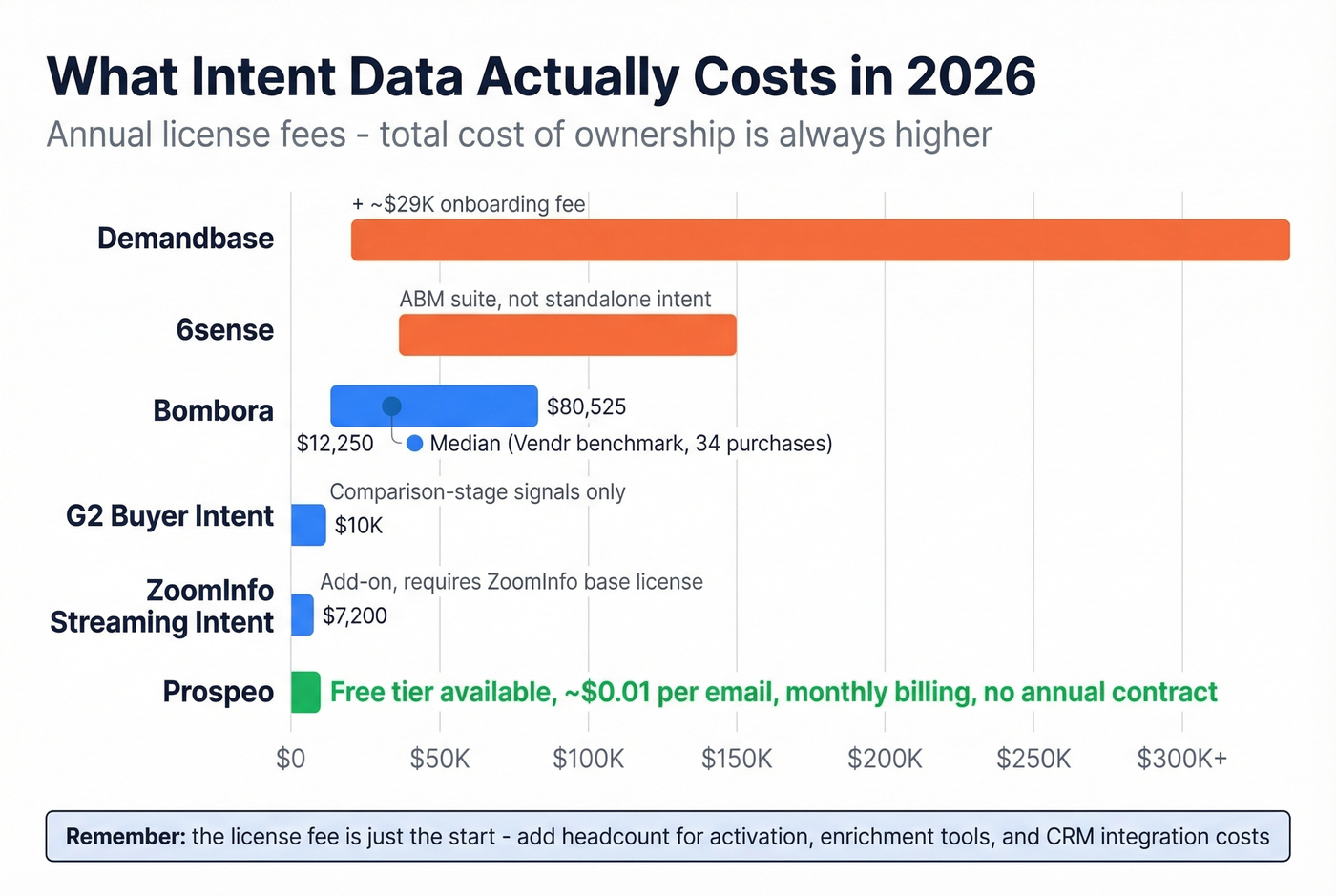
B2B intent data is expensive, and the total cost of ownership is almost always higher than the license fee.
| Provider | Annual Cost Range | Contract | Notes |
|---|---|---|---|
| Bombora | $12,250-$80,525 | Annual | Median $24,750/yr per Vendr |
| Prospeo | Free-paid tiers | Monthly | ~$0.01/email, no contract |
| Demandbase | $18K-$300K+ | Annual | ~$29K onboarding fee |
| 6sense | ~$35K+ | Annual | ABM suite, not standalone |
| ZoomInfo Streaming Intent | ~$7,200/yr | Add-on | Requires ZoomInfo base |
| G2 Buyer Intent | ~$10K/yr | Add-on | Comparison-stage only |
Vendr's benchmark across 34 Bombora purchases puts the median contract at $24,750/year, with a low of $12,250 and a high of $80,525. Demandbase starts at $18K-$24K for basic tiers but climbs to $70K-$300K+ at enterprise, plus ~$29K in onboarding fees.
But the license is just the beginning. You still need enrichment to resolve accounts to contacts, a verification layer to avoid bounces, and a sequencer to run outreach. One estimate puts the realistic stack cost with Bombora at $73,600-$200,000+ per year when you add everything up. Budget 15-25% above the license fee for implementation, integration, and topic configuration.
If your average deal size is under $15K, you probably don't need a $25K+ signal stack. The math just doesn't work. You're better off with a platform that bundles buying signals with verified contacts at a fraction of the cost, and spending the savings on reps who can actually work the leads.
Provider Comparison
Forrester evaluated 15 providers across 21 criteria in Q1 2025, naming Intentsify, 6sense, Bombora, Informa TechTarget, and Demandbase as leaders. But the Wave doesn't tell you what matters most day-to-day: sourcing method, refresh cadence, resolution level, and price.
| Provider | Sourcing | Refresh | Resolution | Best For |
|---|---|---|---|---|
| Bombora | Co-op (~5K sites) | Weekly | Account | Privacy-conscious orgs |
| Prospeo | Bombora-powered (15K topics) | 7-day | Contact-level | Self-serve activation |
| Demandbase | Bidstream (~3M sites) | Weekly + real-time | Account | Global/multilingual |
| 6sense | Multi-source | Varies | Account | Full ABM suite |
| ZoomInfo | Bidstream + IP + partners | Daily | Account | Existing ZI customers |
| G2 | Review-site activity | Real-time | Account | Bottom-funnel |
| Intentsify | Multi-source aggregation | Varies | Account | Enterprise custom |
| Cognism | Bombora-powered | Weekly | Account + contacts | EMEA teams |
The differentiator most buyers miss: account-level vs. contact-level resolution. Most providers tell you the company. Very few tell you the person. That gap is where deals die.
Bombora
The original co-op model, pulling consent-based signals from ~5,000 B2B sites. Bombora's "Company Surge" scoring detects research spikes above an account's historical baseline, reducing false positives compared to raw volume tracking. 14,000+ topics, English only, weekly updates. The Vendr median sits at $24,750/year, with enterprise deployments running past $80K.
Prospeo
Instead of selling signals as a standalone product, Prospeo builds 15,000 Bombora-powered topics directly into a contact-level data platform. Search by intent topic, filter by job title and company size, and export verified contacts - all in one workflow. The database covers 300M+ professional profiles with 143M+ verified emails at 98% accuracy and 125M+ verified mobile numbers, every record refreshed on a 7-day cycle. At ~$0.01 per email with a free tier and no contracts, it's the fastest path from surging account to live sequence.
Demandbase
Bidstream-powered with massive scale: ~3M sites, 575,000+ topics, 133 languages, one year of historical data. For teams running global ABM across multiple regions and languages, Demandbase's breadth is unmatched. Pricing starts at $18K-$24K/year for basic tiers, climbing to $70K-$300K+ at enterprise. The ~$29K onboarding fee catches buyers off guard.
6sense
The full ABM platform play - intent is one layer in a broader predictive engine that includes account scoring, orchestration, and advertising. Starting at ~$35K/year, 6sense is positioned for teams that want a single platform for everything. The tradeoff is complexity: implementation takes months, not days.
ZoomInfo Intent
ZoomInfo's Streaming Intent pulls from bidstream data, IP tracking, and third-party partnerships. At ~$7,200/year as an add-on, it's the cheapest entry point - but it requires an existing ZoomInfo contract ($15-40K+ for the base platform). When teams validate signals against first-party CRM data, results improve: one cybersecurity firm saw 32% more booked meetings, and a financial services team grew pipeline 19%.
G2 Buyer Intent
G2 captures something no other provider can: which companies are actively reading reviews and comparing products in your category. Bottom-of-funnel gold at ~$10K/year as an add-on. The limitation is coverage - only accounts that use G2 show up, skewing toward mid-market tech buyers.
Intentsify
Named a Forrester Wave leader with the highest score in current offering. Intentsify aggregates signals from multiple sources and layers in content syndication and activation. Enterprise custom pricing, typically $30K-$80K/year.
Cognism
Cognism bundles Bombora-powered signals with its own contact database, so teams can activate surging accounts with verified contacts. Particularly strong in EMEA with phone-verified mobile numbers. Expect ~$1,500-$3,000/month for small teams. Skip this if you're US-only and already have a solid contact data provider.
How to Activate Intent Data
Having buying signals and using them well are completely different things. In our experience, this is where the 24% separate themselves from everyone else.
Build Your Signal Tiers
Not all signals deserve the same response.
Tier 1 - immediate action: Pricing page research, "[your competitor] alternatives," demo/trial-related topics. These accounts are actively buying. Drop everything.
Tier 2 - nurture and monitor: Category-level research, repeated engagement across topic clusters, comparison content. These accounts are exploring but haven't committed.
Tier 3 - awareness only: Single-topic blips, general industry content. Log them but don't burn rep time.
Apply Decay Windows
| Days Since Surge | Priority | Action |
|---|---|---|
| 0-7 | High | Immediate outreach, SDR ownership |
| 8-30 | Moderate | Nurture sequence, ad retargeting |
| 31-45 | Cooling | Deprioritize, monitor for re-surge |
| 46+ | Expired | Remove from active lists |
A Tier 1 signal at day three is worth five Tier 2 signals at day twenty.
Map Topics to Funnel Stage
Follow Demandbase's best practice of bucketing topics by funnel stage. BOFU topics like "pricing" and "[competitor] alternatives" get Tier 1 treatment. TOFU topics like "what is [category]" get Tier 3. The mistake most teams make is treating all surges equally - a company researching "what is SIEM" is months away from buying, while one researching "CrowdStrike pricing" could close this quarter.
Route and Act in 48 Hours
Tier 1 surges should trigger a Slack alert to the assigned SDR plus an automatic CRM task. Tier 2 surges go into a weekly digest plus automated nurture enrollment. Tier 3 gets a monthly review, no immediate action.
If your CRM can't trigger alerts from these signals, you don't have a program - you have an expensive dashboard.
Close the Last Mile
The entire system breaks down when you know the account is surging but can't find verified contacts fast enough. By the time you've manually researched contacts, verified emails, and built a list, the 48-hour window is gone. We've watched teams lose winnable deals this way over and over.
The workflow should take minutes, not days: pull up the surging account, filter by job title and seniority, export verified emails and direct dials, and push them into your sequencer through native integrations.
If you need a tighter operational layer around this, start with lead scoring and a repeatable lead generation workflow so surges don't die in handoffs.
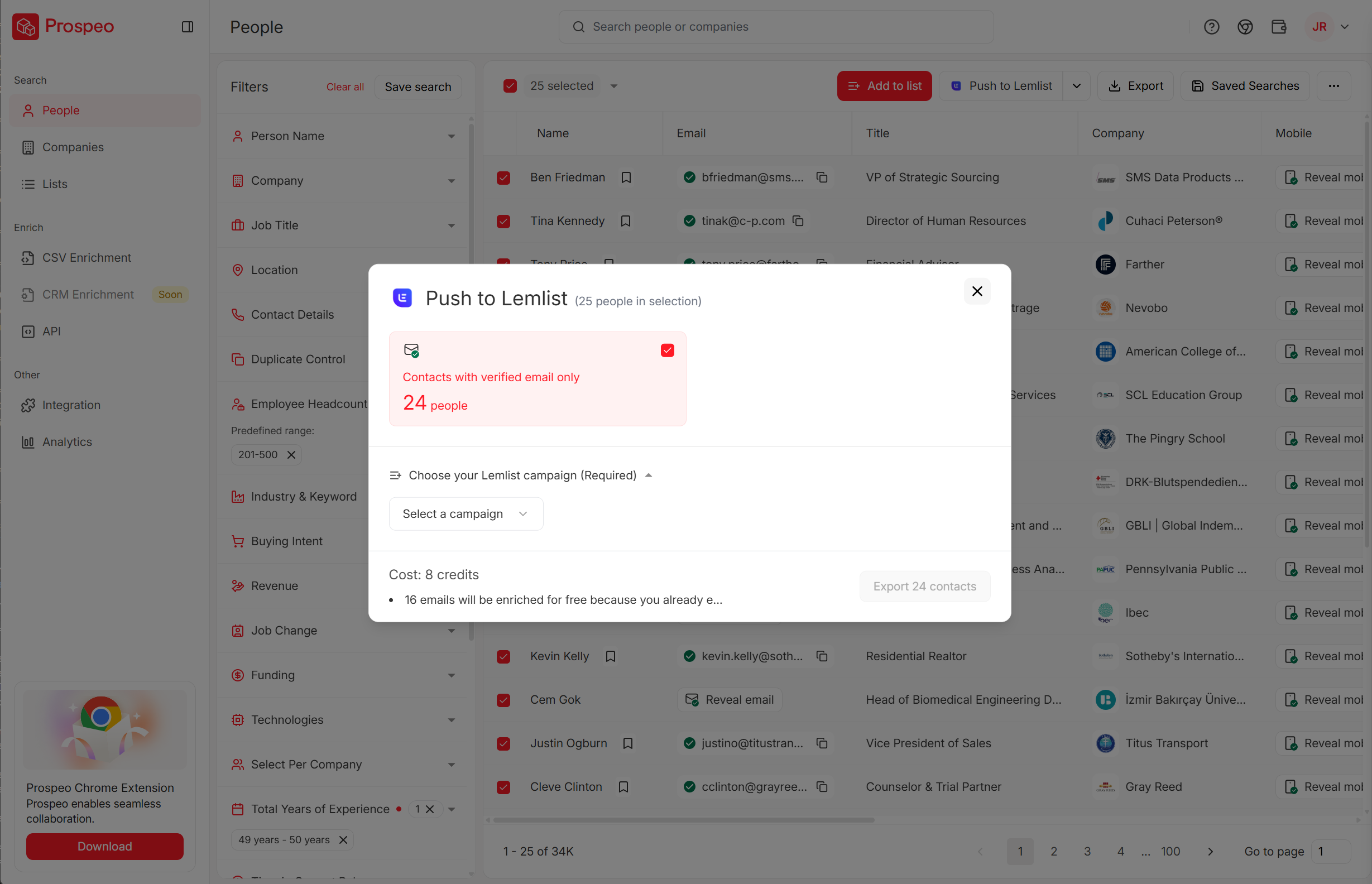
The 48-hour rule only works if you can resolve accounts to verified contacts instantly. Prospeo combines buyer intent with 30+ filters - technographics, job changes, headcount growth - and delivers emails at $0.01 each with 98% accuracy. No stale data: every record refreshes in 7 days.
Turn intent signals into booked meetings before your competitors even log in.
Intent Data FAQs
What is intent data in simple terms?
It's a set of behavioral signals - content consumption, search queries, review site visits - that indicate a company is actively researching a topic related to what you sell. It doesn't tell you someone wants to buy. It tells you someone is learning about the problem your product solves.
Is it worth the investment for SMBs?
If you're closing $20K+ annual contracts with a 60+ day sales cycle, buying signals can meaningfully prioritize your pipeline. For teams selling sub-$5K deals with short cycles, the ROI rarely works at $25K+/year. A free tier with intent topics and verified contacts is a practical entry point for smaller teams testing the waters.
What's the difference between first-party and third-party signals?
First-party comes from your own properties - website visits, content downloads. Third-party tracks behavior across external publisher networks and review sites. First-party is effectively free but limited to accounts that already found you. Third-party costs $12K-$300K+ annually with higher false-positive rates.
How fast should sales follow up?
Within 48 hours for Tier 1 signals. A high-priority surge loses most of its predictive value after seven days. Teams that act within 48 hours see measurably higher connect and conversion rates compared to those responding after a week.
How do you turn account-level signals into the right contacts?
Most providers only give you account-level resolution - you know the company but not the person. You need a contact data layer that lets you filter surging accounts by job title and seniority, then export verified emails and direct dials directly into your sequencer. That's the gap that separates signal from pipeline.