

Real-Time Email Verification: Why Most Tools Lie About Accuracy in 2026
A cold email practitioner on r/coldemail reported a bounce rate of 16%. After adding real-time email verification to their workflow, it dropped under 2%. That's the difference between a sender reputation circling the drain and one that actually lands in inboxes.
Every verification tool claims 99% accuracy. Hunter's benchmark shows the best tools hit around 70% overall. The gap comes from catch-all domains and enterprise mail servers that refuse to give a straight answer to SMTP probes - the distance between "verified" and truly verified is wider than most vendors want you to believe.
Quick picks: Prospeo if you want emails found and verified in one workflow with no separate verification step. ZeroBounce for standalone verification with the fairest credit policies in the market. NeverBounce for simple pay-as-you-go at scale.
What Real-Time Email Validation Actually Does
"Real-time" means verification fires at the point of data entry, not in a batch job you run on Tuesday nights. When a lead fills out a form, when you import a CSV, when you add a prospect to a sequence - the check runs immediately and returns a verdict before that email enters your system.
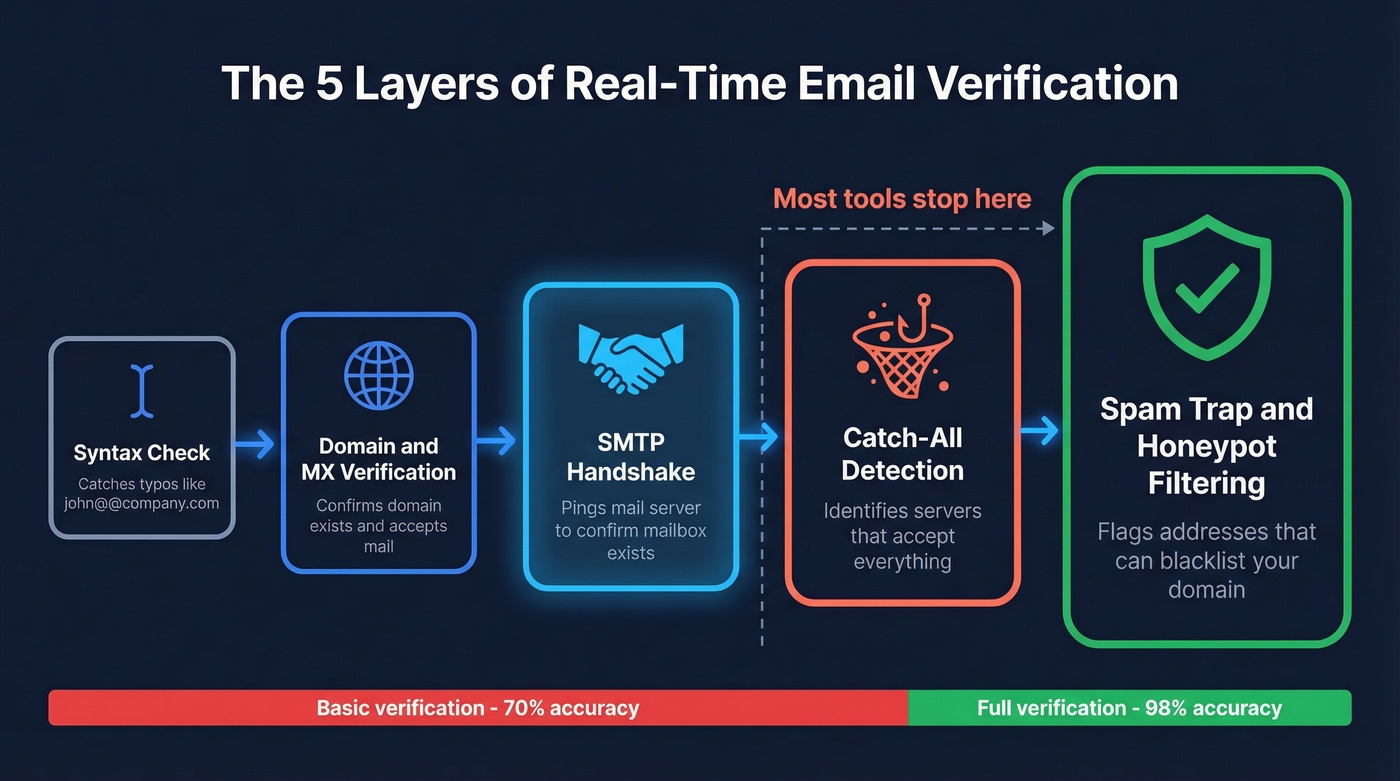
The verification chain runs through multiple layers. It starts with a syntax check that catches typos like "john@@company.com" or missing TLDs, then moves to domain and MX verification - confirming the domain exists, accepts mail, and has mail exchange servers configured. A domain can exist without having mail infrastructure, so both checks matter. The core of the process is the SMTP handshake, where the tool pings the mail server to confirm the specific mailbox exists. Most verification tools stop here.
The last two layers are where real differentiation happens:
- Catch-all detection - Is the domain configured to accept everything? If so, the SMTP check is meaningless and the tool needs secondary signals.
- Spam-trap and honeypot filtering - Is this address a trap set by ISPs or anti-spam organizations? Hitting one of these can blacklist your domain overnight.
Tools that stop at SMTP and call it "99% accurate" will leave you with a 10% bounce rate on enterprise domains.
Real-Time vs. Bulk Verification
These solve different problems. Confusing them leads to wasted spend or bad data slipping through.
| Real-Time | Bulk | |
|---|---|---|
| Timing | Instant, at data entry | Periodic batch jobs |
| Scale | One at a time | Thousands per run |
| Goal | Prevent bad data | Remove existing bad data |
| Integration | Forms, APIs, imports | CSV uploads, scheduled CRM jobs |
Use real-time checks on intake points - signup forms, Chrome extension captures, API-driven prospecting workflows. Use bulk verification for quarterly CRM hygiene and pre-campaign list cleaning. Most mature teams run both.
If you're only doing one, start with real-time. It's cheaper to prevent bad data than to clean it up later, and a live verifier at the point of entry eliminates the need to chase down bad records after they've already contaminated your CRM.
Why It Matters - The Numbers
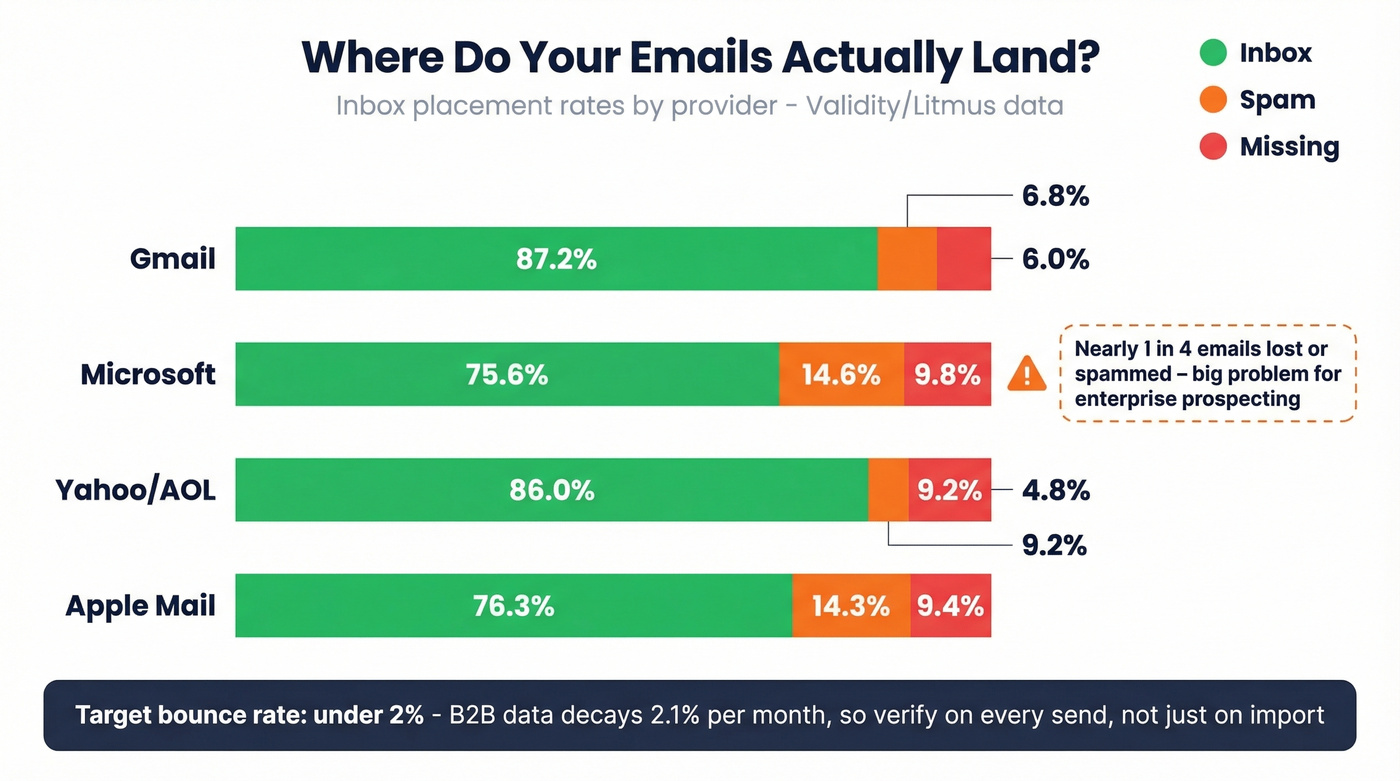
Roughly 1 in 6 emails never reach the inbox. Global inbox placement sits around 84% per Validity/Litmus data, and the breakdown by provider shows why Microsoft-heavy prospect lists are particularly punishing:
| Provider | Inbox | Spam | Missing |
|---|---|---|---|
| Gmail | 87.2% | 6.8% | 6.0% |
| Microsoft | 75.6% | 14.6% | 9.8% |
| Yahoo/AOL | 86.0% | 4.8% | 9.2% |
| Apple Mail | 76.3% | 14.3% | 9.4% |
If you're selling into enterprise - where Microsoft 365 dominates - nearly a quarter of your emails land in spam or vanish entirely. Bad verification makes this worse. Spam complaint rates above 0.3% trigger reduced inbox placement on Gmail per Google's postmaster guidelines. Bounces feed directly into that reputation score.
Industry bounce rate benchmarks put the target at under 2%, with under 1% being ideal. Business and finance averages sit at 0.55%, construction at 1.28%, consulting at 0.79%. If you're above 2%, your list has a quality problem that real-time verification should've caught (see email bounce rate benchmarks and fixes).
Here's the thing: B2B contact data decays at 2.1% per month. That's 22.5% annualized. A list you verified in January is 6% stale by April. Verifying on every send - not just on import - is the only way to stay ahead of that decay curve.
Why "99% Accuracy" Is Marketing
Every vendor's landing page says 98% or 99% accuracy. Hunter ran the most transparent multi-tool benchmark we've found - testing 15 email verifiers against 3,000 real emails segmented by company size.
The top-performing tool hit 70% overall accuracy. Not 99%. Not 95%. Seventy percent.

Hunter's benchmark used real emails across small, medium, and large companies, with roughly 900 valid and 100 invalid addresses per segment, plus 300 invalid emails added overall. Unknown results counted against accuracy - which is how it should be counted, since "unknown" doesn't help you make a send/don't-send decision.
Accuracy drops sharply on mid-market and enterprise domains. Stricter mail server configurations, secure email gateways, and catch-all setups all produce "unknown" results that most tools can't resolve. When a vendor tells you they're 99% accurate, ask them what happens with catch-all domains. That's where the real number lives.

Most tools stop at SMTP and call it done. Prospeo's proprietary 5-step verification handles catch-all detection, spam-trap removal, and honeypot filtering - all in real time, before bad data touches your CRM. 98% email accuracy, refreshed every 7 days.
Find and verify emails in one step - no separate verification tool needed.
The Catch-All Problem
Catch-all domains accept mail for any address at the SMTP level. Send to completely.fake@catchall-company.com and the server responds with a 250 OK. Your verification tool sees "valid." The mailbox doesn't exist. Your email bounces - or worse, gets silently dropped.
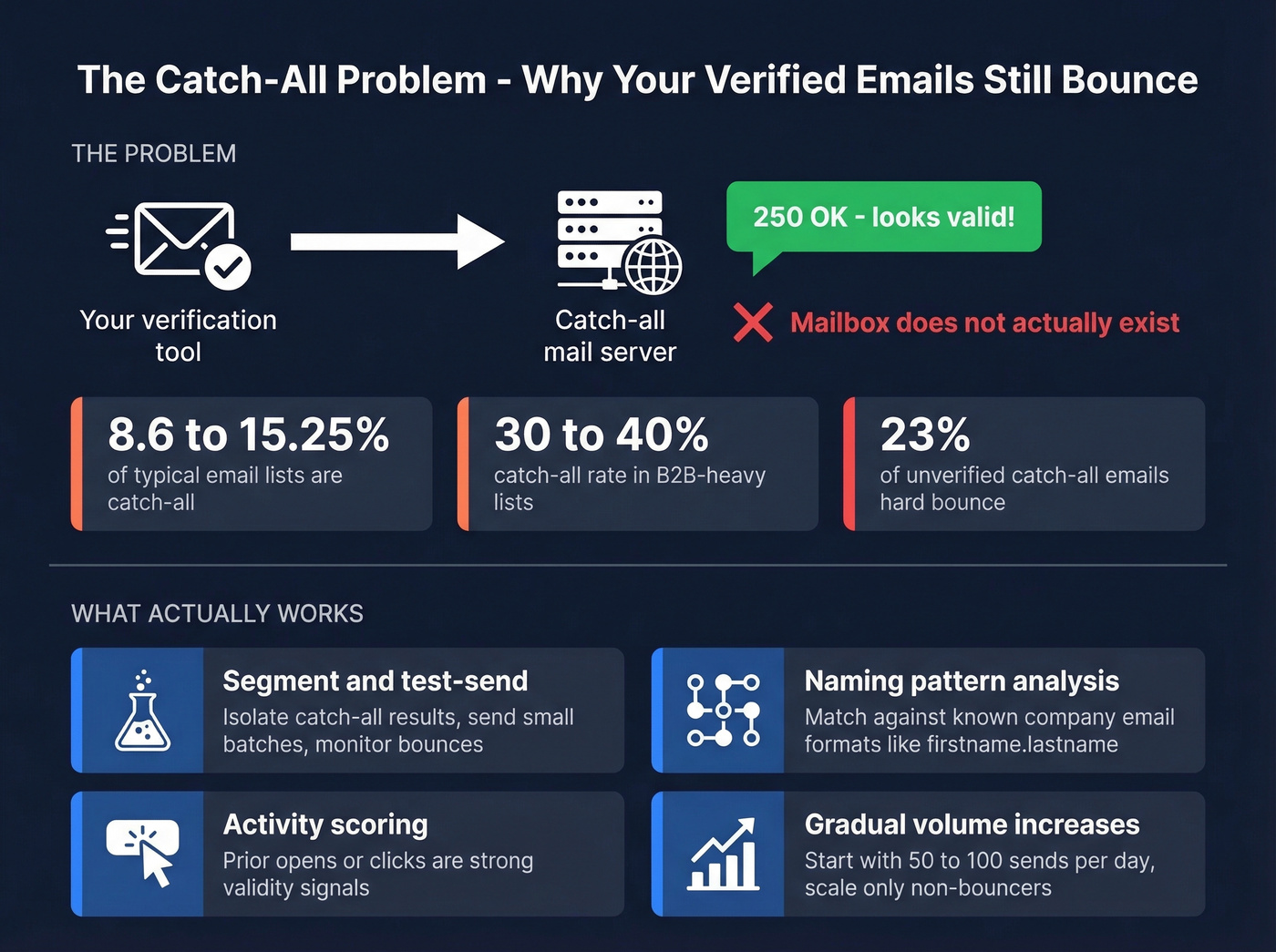
Catch-all addresses make up 8.6-15.25% of typical email lists, and in B2B-heavy lists that number can reach 30-40%. About 23% of unverified catch-all emails hard bounce when you actually send to them. That alone can push you past the 2% bounce threshold that damages sender reputation. Cold email practitioners on Reddit consistently flag catch-all domains as their single biggest verification headache - and they're right.
The problem compounds at enterprise scale. Secure email gateways like Proofpoint, Mimecast, and Barracuda actively block, greylist, or rate-limit SMTP verification probes. Even valid mailboxes behind these gateways return "unknown" because the gateway won't let the verification tool complete its handshake.
Several handling strategies actually work:
- Segment and test-send. Isolate catch-all results into a separate list and send in small batches, monitoring bounces closely before scaling.
- Naming-pattern analysis. If you know a company uses firstname.lastname@ and the address follows that pattern, confidence goes up (more on name to email workflows).
- Activity scoring. Has this address opened or clicked anything before? Prior engagement is a strong validity signal.
- Gradual volume increases. Start with 50-100 sends per day to catch-all addresses and scale only the ones that don't bounce.
In our testing, catch-all domains consistently produce the widest accuracy gaps between tools, which is why multi-signal verification matters more than raw SMTP speed.
Best Real-Time Email Verification Tools
If your average deal size is under $15k, you probably don't need a $500/month verification platform. A tool with solid catch-all handling and a pay-per-verification model will outperform an enterprise suite you're only using at 20% capacity.
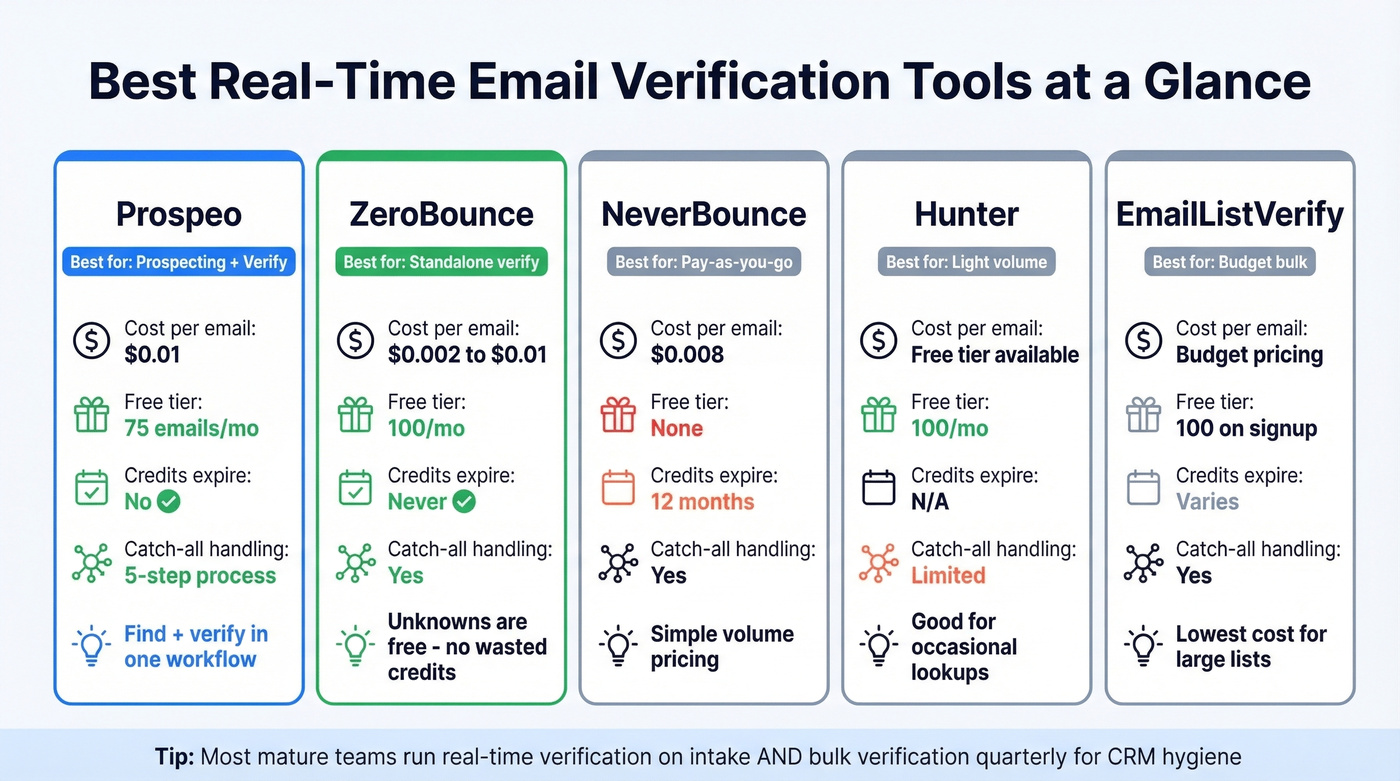
| Tool | Per-Email Cost | Free Tier | Credits Expire? | Catch-All | Best For |
|---|---|---|---|---|---|
| Prospeo | ~$0.01 | 75 emails/mo | No | Yes (5-step) | Prospecting + verify |
| ZeroBounce | $0.002-$0.01 | 100/mo | Never | Yes | Standalone verify |
| NeverBounce | $0.008 | None | 12 months | Yes | Pay-as-you-go |
| Hunter | Free tier | 100/mo | N/A | Limited | Light volume |
| EmailListVerify | N/A | 100 on signup | Varies | Yes | Budget bulk |
| Email Hippo | ~$0.005-$0.01 | 100/day | N/A | Yes | Quick free checks |
| Verifalia | $0.003-$0.01 | Free validator | Varies | Yes | API-focused |
| BriteVerify | Not public | None | N/A | Yes | Enterprise |
| InvalidBounce | ~$0.005-$0.01 | 139 credits | Unknown | Yes | New teams evaluating |
Prospeo
Most verification tools solve one problem: is this email valid? Prospeo solves two - finding the email and verifying it in a single workflow. No separate verification step, no exporting from one tool and uploading to another. It functions as both a prospecting engine and a verification layer, which eliminates the stitching problem most teams face when cobbling together a find-then-verify stack (see sales prospecting techniques that pair well with verification).
The 5-step verification process runs syntax, domain, MX, SMTP, and catch-all checks with spam-trap removal and honeypot filtering baked in. The 98% email accuracy shows up in customer results: Meritt dropped their bounce rate from 35% to under 4% after switching, and Stack Optimize maintains sub-3% bounce rates across all their clients with zero domain flags. Records refresh on a 7-day cycle versus the 6-week industry average, which matters when you're re-verifying contacts that changed jobs last month.
At ~$0.01 per email with a free tier of 75 emails and 100 Chrome extension credits per month, it's built for teams that want verified prospecting data without stitching together three different tools.
B2B data decays at 2.1% per month. Prospeo refreshes all 300M+ profiles every 7 days - not every 6 weeks like competitors. That means the email you pull today is verified against live data, not a stale cache from last quarter.
Kill bounce rates at the source for roughly $0.01 per verified email.
ZeroBounce
Use this if you need a dedicated verification tool with the fairest credit policies in the market. Credits never expire. Unknown results don't cost you anything. You get 100 free monthly verifications with a business email signup.
Skip this if you also need email finding - ZeroBounce's finder burns 20 credits per successful lookup, which gets expensive fast compared to dedicated prospecting tools.
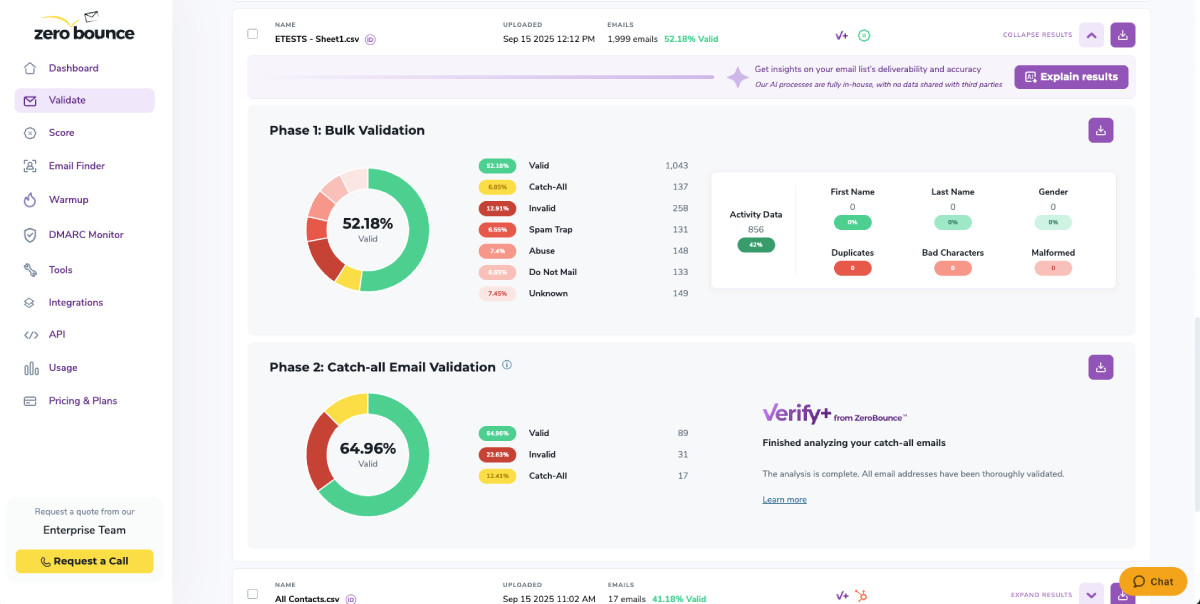
Per-email cost runs $0.002-$0.01 depending on volume. The "unknowns are free" policy is genuinely rare and means you're not paying for the tool's inability to resolve catch-all domains. For teams that already have emails and just need to validate them instantly, ZeroBounce is the cleanest standalone option we've seen.
NeverBounce
NeverBounce keeps it simple. Pay-as-you-go is $0.008 per email, or $49/month on the Growth plan for up to 10,000 verifications per month. Duplicates are free on the Growth plan, which matters if you're re-verifying overlapping lists. The tradeoff: credits expire after 12 months. For steady-volume operations running weekly campaigns, the pricing is competitive. Integrations with HubSpot, Mailchimp, Zapier, and n8n make it easy to wire into existing workflows without custom development (if you're building a stack, compare outbound lead generation tools).
Hunter
Hunter's biggest contribution to the verification space isn't their tool - it's their benchmark. They tested 15 verifiers with real methodology and published the results, including their own bias disclosure. That kind of transparency is rare. The free tier gives you 100 verifications per month, enough for light-volume prospecting. For serious outbound, you'll outgrow it quickly (alternatives: Hunter alternatives).
EmailListVerify
The budget play for high-volume list cleaning. You get 100 free verifications on signup to test quality. For teams processing six-figure email lists where cost per verification is the primary constraint, it's worth evaluating.
Quick Mentions
Email Hippo offers 100 free daily verifications - generous for quick spot-checks when you need to confirm an address before sending. Verifalia is API-first with a free validator for one-off checks; paid plans run $0.003-$0.01 per verification. BriteVerify (part of Validity) targets enterprise buyers with point-of-entry validation built for web forms and registration workflows. InvalidBounce is a newer entrant offering 139 free credits with 50+ integrations and no credit card required - the Reddit anecdote about dropping from 16% to under 2% bounce rate came from an InvalidBounce user.
How to Implement Verification
Getting the tool is the easy part. Implementing it without breaking your forms or slowing your workflows takes engineering thought.
Hit the latency target. Many verification APIs respond in 200-2,000ms depending on check depth. For signup forms, anything over 500ms feels broken to the user. Design an accept-and-requeue pattern: accept the form submission, queue the verification asynchronously, and flag the record for review if the result comes back unknown or invalid. Your target is under 300ms for form validation.
Cache intelligently for pre-send checks. A 24-72 hour cache TTL avoids redundant lookups while keeping decisions fresh. For stable outcomes like confirmed valid or confirmed invalid, extend the cache to 7-30 days. Uncertain outcomes - catch-all, unknown - should expire faster, within about 7 days.
Build for failure. Verification APIs go down. Implement retries with exponential backoff and jitter so you don't hammer a recovering service. Add circuit breakers that route to a fallback when the API is unresponsive. Dead-letter queues catch emails that fail verification entirely so nothing falls through the cracks.
Extend beyond email. Lead verification doesn't stop at the inbox - phone numbers, company data, and job titles decay at similar rates. Teams that layer data verification across all contact fields, not just email, see the biggest improvements in campaign performance and CRM hygiene (see data enrichment services).
One note on compliance: verification can be GDPR compliant when the tool processes data under legitimate interest and doesn't store emails beyond the check. Confirm your provider offers a Data Processing Agreement - any serious tool will have one ready.
Real-Time Email Verification FAQ
What's the difference between email validation and verification?
Validation checks syntax and format - is this structurally a real email address? Verification goes further with live SMTP-level mailbox confirmation, pinging the mail server to check if the mailbox exists. Real-time tools do both in sequence, but verification is the step that actually prevents bounces.
How often should I re-verify my email list?
Every 30-90 days for active lists. B2B data decays at 2.1% per month - a list verified three months ago has roughly 6% stale addresses. For high-volume outbound, re-verify before every major campaign.
Can verification catch all invalid emails?
No. Catch-all domains and enterprise security gateways prevent definitive results for 10-30% of B2B emails. Handle "unknown" results with segmented test sends at low volume, then scale up addresses that don't bounce.
Which tool handles catch-all domains best?
Multi-signal verification beyond basic SMTP produces fewer "unknown" results on catch-all domains. No tool eliminates the problem entirely, but pairing verification with naming-pattern analysis and gradual send-volume increases gets the best results.
Does my CRM handle verification natively?
Most CRMs don't include real-time SMTP-level checks. HubSpot and Salesforce offer basic format validation, but they won't run mailbox confirmation or catch-all detection. You need a dedicated verification API integration for accurate results at the point of data entry.
Verify at capture, not in batches. Real-time email verification is the single highest-impact investment for keeping bounce rates under 2% and your sender reputation intact - the rest is execution.