

Your Unsubscribe Rate Just Doubled. Here's How to Fix It.
Gmail made unsubscribing a single click in 2024. Your unsubscribe rate didn't spike because your emails got worse - it spiked because leaving got easier. Across 3.6 million campaigns tracked by MailerLite, the median unsubscribe rate jumped from 0.08% to 0.22% in a single year. That's a 2.75x increase, and it hit everyone.
Here's what we've found after helping thousands of outbound teams clean their lists: most of the damage isn't about content quality. It's about data quality, send frequency, and broken expectations. Below are benchmarks to diagnose your situation, then seven tactics to reduce email unsubscribes and keep your list healthy.
Is Your Rate Actually Bad?
Before you panic, check where you stand. Here are industry benchmarks from Mailchimp (last updated December 2023), plus the 2026 cross-industry median from MailerLite:
| Industry | Unsubscribe Rate | Source |
|---|---|---|
| Business & Finance | 0.15% | Mailchimp |
| Education | 0.18% | Mailchimp |
| Nonprofits | 0.18% | Mailchimp |
| Ecommerce | 0.19% | Mailchimp |
| All Users (2026) | 0.22% | MailerLite |
Anything under 0.5% is normal. Above that consistently? You've got a frequency, relevance, or data quality problem - and probably more than one. The average person is subscribed to 93 email lists, and 85-90% of those emails never get read. Inbox fatigue isn't the exception. It's the default.
Why People Unsubscribe
Three drivers account for the vast majority of email opt-outs:
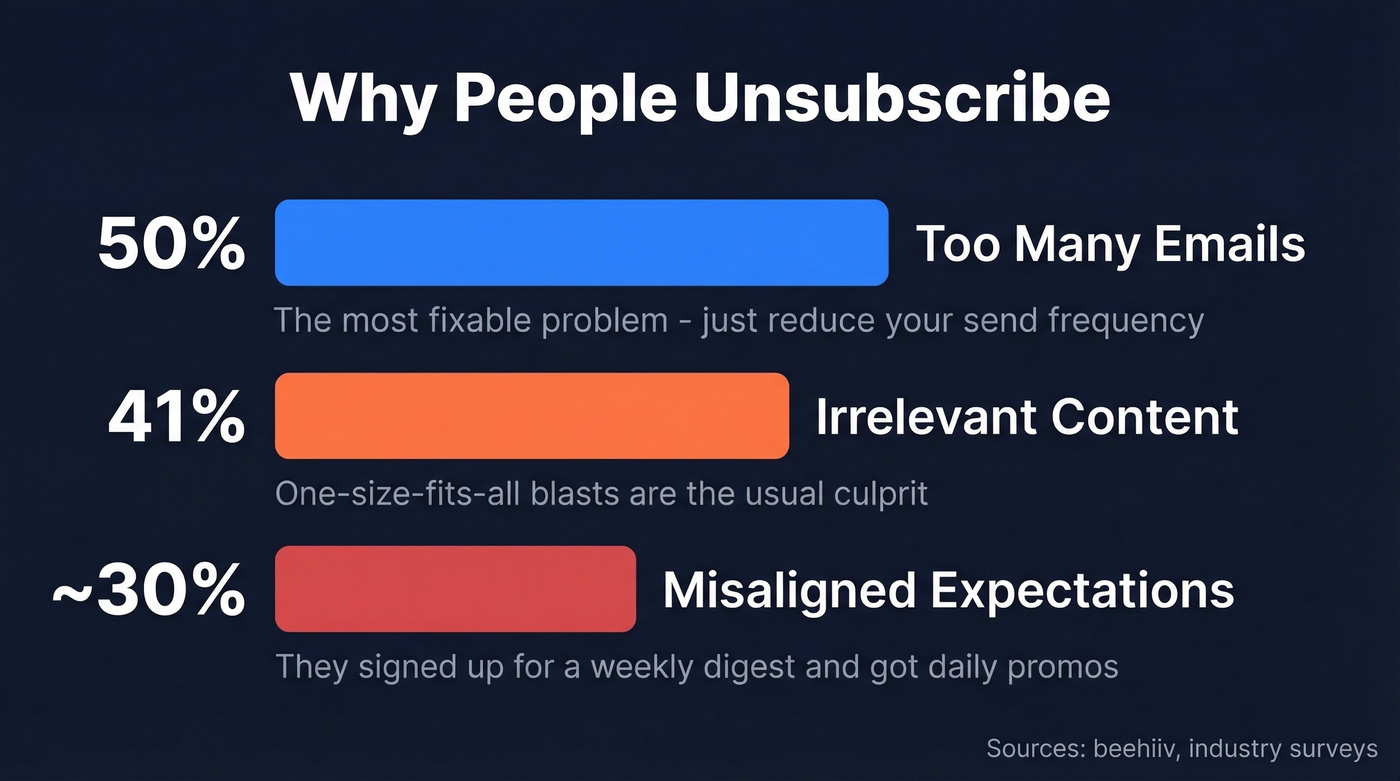
- Too many emails. 50% of unsubscribers cite frequency as the reason. This is the most fixable problem on the list.
- Irrelevant content. 41% say the emails aren't useful. One-size-fits-all blasts are the usual culprit.
- Misaligned expectations. They signed up for a weekly digest and got daily promos. That gap drives early email list churn hard.

Half of unsubscribes come from irrelevant emails - and irrelevant emails start with bad data. Prospeo's 300M+ profile database with 30+ filters lets you target by intent, job change, and technographics so every send reaches someone who actually cares.
Stop blasting. Start targeting the right people.
Gmail and Yahoo Rules for 2026
If you send more than 5,000 emails per day to Gmail or Yahoo recipients, these are requirements - not suggestions. They sit on top of existing CAN-SPAM and GDPR obligations obligations.
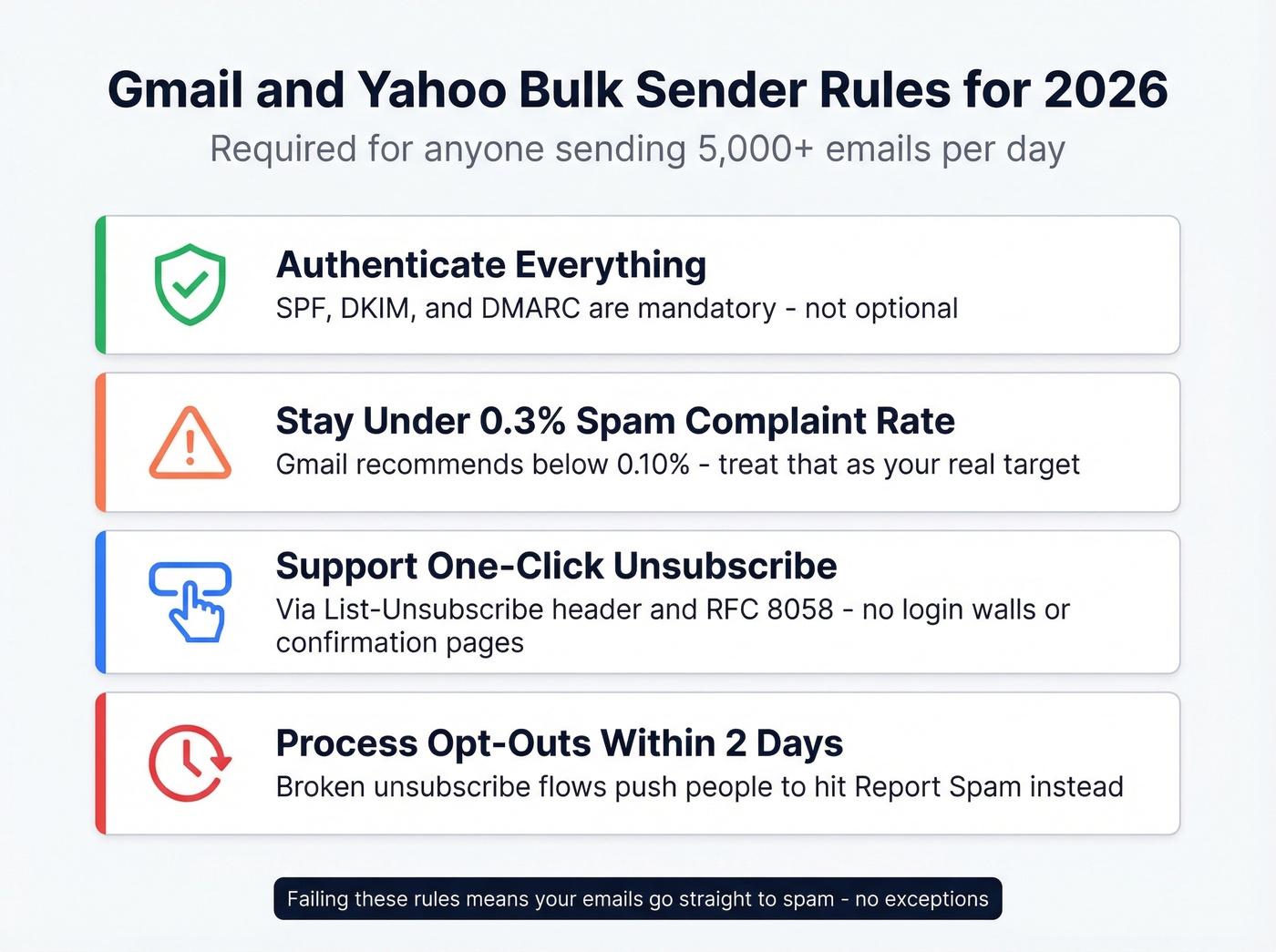
- Authenticate everything. SPF, DKIM, and DMARC are mandatory. (If you need a quick check, see DMARC alignment basics.)
- Stay under the complaint ceiling. Gmail's hard limit is 0.3% spam complaint rate; they recommend below 0.10%.
- Support one-click unsubscribe. Via the List-Unsubscribe header and RFC 8058 - no confirmation pages, no login walls.
- Process opt-outs within 2 days. A broken unsubscribe flow pushes people to hit "Report Spam" instead, which tanks your sender reputation far worse than any clean unsubscribe. Proper suppression list management ensures opt-outs are honored instantly across every sending platform you use.
Let's be honest: if your unsubscribe rate is above 1%, stop optimizing subject lines and fix your list hygiene first. No amount of clever copy rescues emails that land in spam.
7 Ways to Lower Your Unsubscribe Rate
1. Build a Preference Center
A preference center intercepts the unsubscribe flow and gives subscribers a middle ground - frequency options, topic selection, and a toggle between promotional and editorial content. The strategic win is zero-party data: every preference a subscriber sets is a segmentation input you didn't have to guess at.
Most email platforms and CRMs support preference centers out of the box, or let you build one with a hosted page and list logic. If you don't have one, that's your first project this week.
2. Offer an Opt-Down
This is the highest-leverage retention tactic most teams skip entirely. Instead of a binary subscribe/unsubscribe choice, offer a frequency reduction: "Too many emails? Switch to monthly instead."
Industry estimates put the save rate at 10-20% of unsubscribe-intent users when the option is offered clearly. That's list retention for free, and it takes minutes to implement.
3. Fix Your Send Frequency
Across 15 billion+ emails analyzed by beehiiv, 65.62% of senders go weekly and 15.82% send daily. In our experience, weekly is the sweet spot for most B2B audiences - if you're sending more frequently, you need engagement data to justify it. Don't guess. Engagement peaks Tuesday through Thursday, so stack your most important sends there and measure the results before scaling up cadence. (If you're doing outbound, pair this with an email velocity cap.)
4. Segment by Behavior
Demographics tell you who someone is. Behavior tells you what they care about. Segment on opens, clicks, and purchase history rather than just job title or industry.
If you've built a preference center, those selections become your most reliable segmentation inputs - subscribers literally told you what they want. Use that data. The consensus on r/emailmarketing is that behavioral segmentation alone can cut unsubscribe rates by 20-30%, and that tracks with what we've seen across client campaigns. For a deeper playbook, see intent based segmentation.
5. Run Re-Engagement Campaigns
Don't wait until someone unsubscribes to act. We've found this four-stage framework recovers the most subscribers in practice:
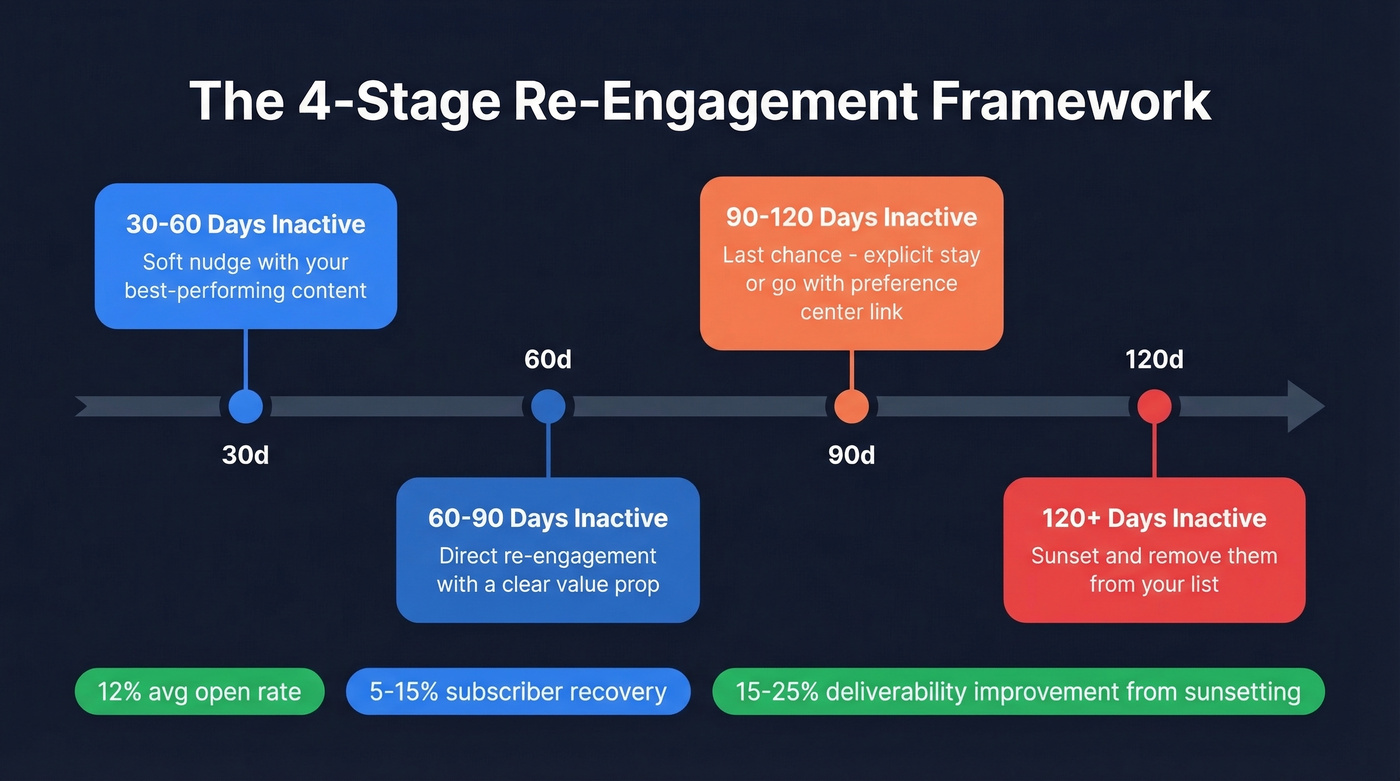
- 30-60 days inactive: Soft nudge with your best-performing content.
- 60-90 days: Direct re-engagement with a clear value proposition.
- 90-120 days: Last chance - explicit "stay or go" with a preference center link.
- 120+ days: Sunset. Remove them.
Re-engagement emails average about a 12% open rate and recover 5-15% of inactive subscribers. Here's the part people miss: removing non-engagers improves email deliverability by 15-25%, which helps every email you send to people who actually want to hear from you. Sunsetting isn't losing subscribers. It's protecting the ones you have.
6. Clean Your List Before You Send
Bad data creates a chain reaction. Invalid addresses cause bounces, bounces damage sender reputation, and damaged reputation pushes emails to spam. One Reddit practitioner reported their bounce rate dropped from 22% to 7% after adding email verification to their workflow.
Prospeo's 5-step verification catches spam traps, honeypots, and catch-all domains before they wreck your sender reputation - 98% accuracy at roughly $0.01 per email, with a free tier to start. Clean list hygiene is the invisible foundation that makes every other tactic on this page work. Skip this step and you're optimizing on a cracked foundation. (Related: email bounce rate benchmarks and fixes.)
7. Set Expectations at Signup
Tell subscribers exactly what they'll get and how often at the point of opt-in. "Weekly marketing tips every Tuesday" is infinitely better than "Subscribe to our newsletter."
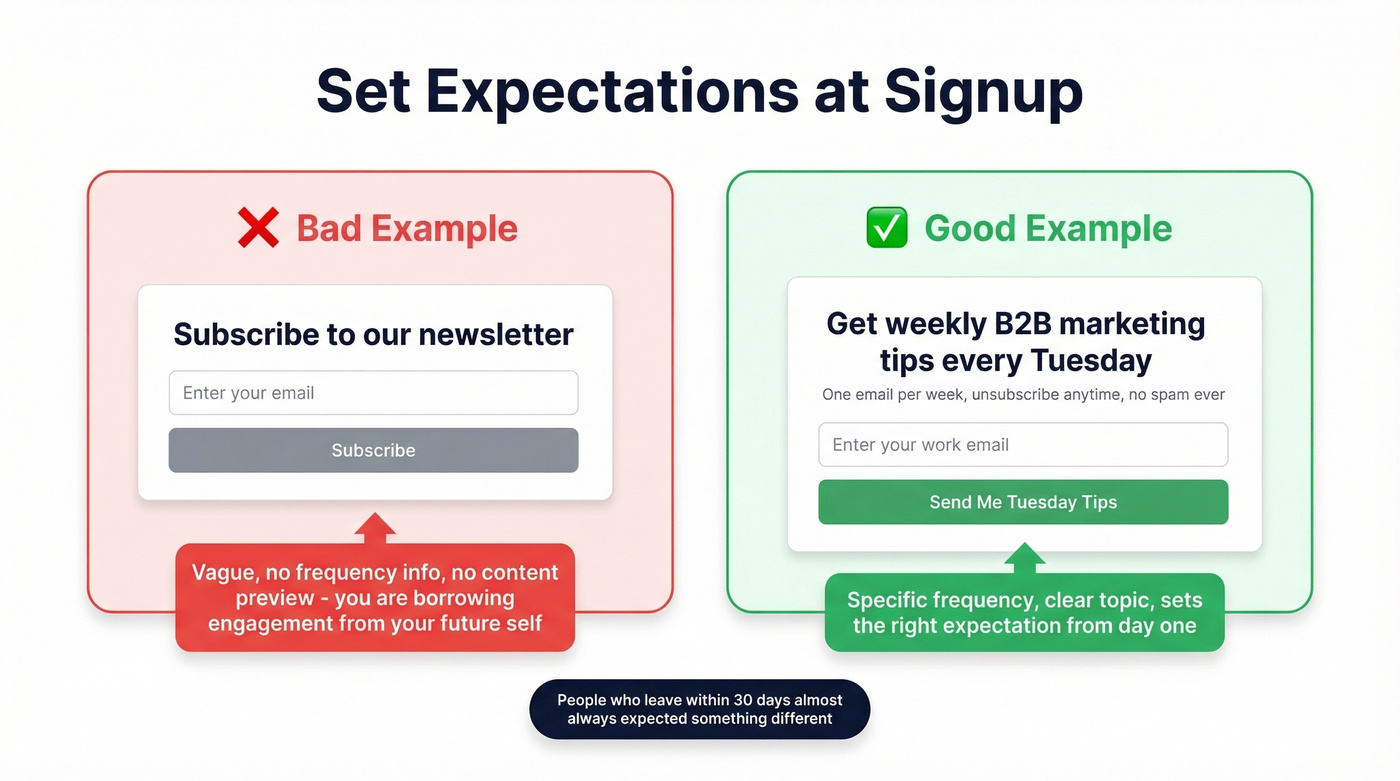
Misaligned expectations are a major driver of early-stage churn. People who leave within 30 days almost always expected something different from what they received. If your signup form is vague, you're borrowing engagement from your future self and paying it back with unsubscribes. If you're also running cold outreach, align this with your cold email sequence structure.
Bounces destroy sender reputation, and destroyed reputation pushes your emails to spam - where the only option left is unsubscribe. Prospeo's 5-step verification catches spam traps, honeypots, and catch-all domains at 98% accuracy for ~$0.01 per email.
Clean your list before your next send wrecks your domain.
FAQ
What's a good email unsubscribe rate?
Below 0.5% is healthy. The 2026 cross-industry median is 0.22% per MailerLite. Consistently above 0.5% signals a frequency, relevance, or data quality problem that needs immediate attention.
Does making unsubscribe easy hurt my list?
No - it protects it. A hidden or broken unsubscribe link pushes people to hit "spam," which tanks your sender reputation far worse than a clean opt-out. Gmail now requires one-click unsubscribe for bulk senders, so this isn't optional anymore.
Can email verification help lower opt-out rates?
Indirectly, yes. Bounces from bad addresses damage sender reputation, pushing legitimate emails to spam. Verification tools like Prospeo, ZeroBounce, and NeverBounce keep your reputation intact so emails actually reach people who want them.
What's the fastest way to reduce email unsubscribes?
Add an opt-down option to your unsubscribe page. Offering a "switch to monthly" alternative saves 10-20% of people who'd otherwise leave entirely. It takes minutes to implement and costs nothing.