

Relationship Intelligence Platforms: What They Cost, How They Work, and Whether You Need One
A managing partner at a mid-market PE firm asked us last quarter why they're paying $400K a year for a CRM that half the team doesn't log into. The answer wasn't that they needed a better CRM - it was that they'd bought a relationship intelligence platform without understanding what problem it actually solves. Buying groups have ballooned from 5 to 20 stakeholders over the past decade, and the pitch for RI platforms is that they map the invisible web of connections between your team and those stakeholders. The reality is messier. Most teams don't need one, and the ones that do are overpaying.
What You Need (Quick Version)
- VC/PE firms managing deal flow: Affinity. Transparent pricing, go-live in weeks, built for this exact use case.
- Enterprise sales teams (50+ reps): Nektar or Revenue Grid. CRM-native, RevOps-focused, designed to surface relationship signals inside Salesforce.
The rest of this guide is for teams who aren't sure which bucket they fall into, or who want to understand what they're actually buying before signing a six-figure contract.
What Does Relationship Intelligence Software Do?
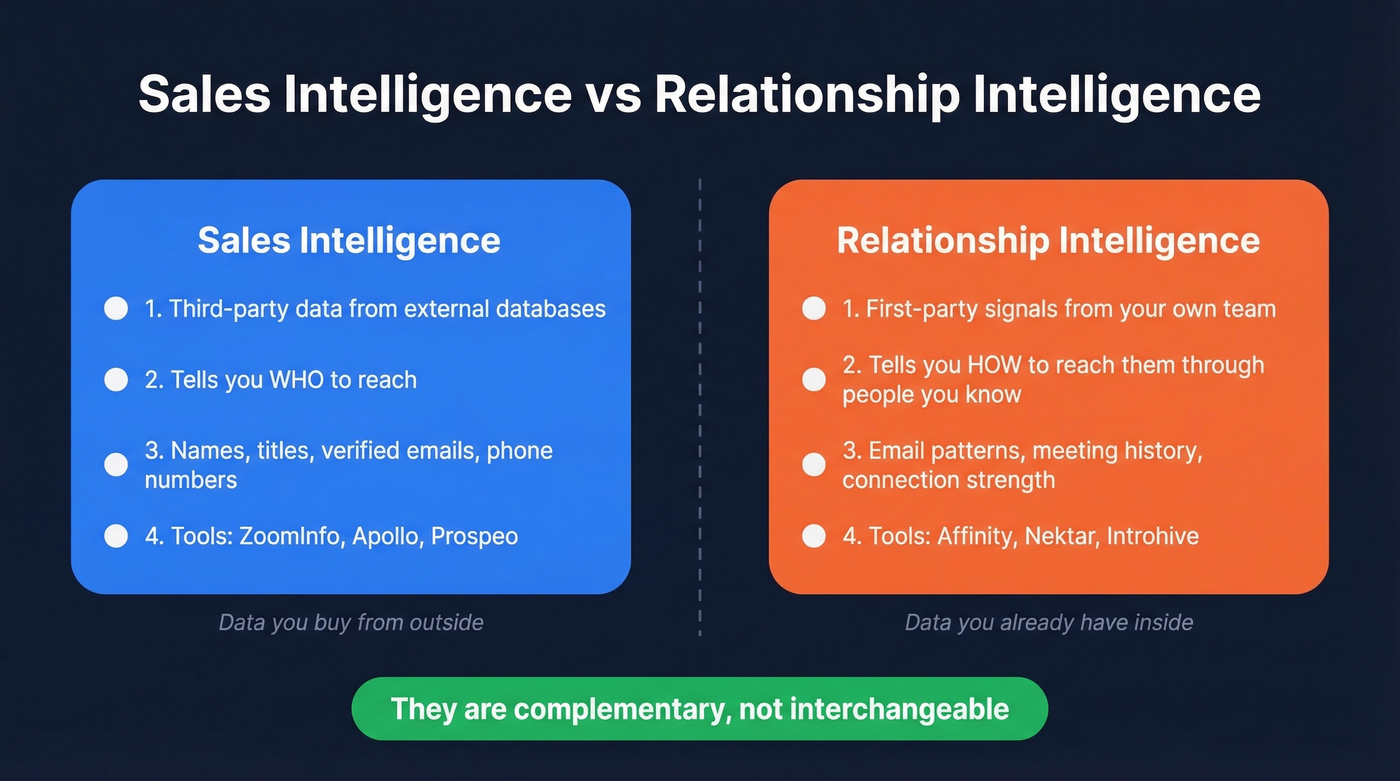
A relationship intelligence platform isn't a contact database. It doesn't scrape the web for email addresses or phone numbers. Instead, it analyzes first-party signals - your team's emails, calendar events, meeting notes, CRM activity, sometimes Slack or Teams messages - to answer one question: who in your organization already knows someone at the target account?
The outputs fall into four categories. Relationship scores measure how strong a connection is based on communication patterns and reciprocity. Stakeholder maps show who's connected to whom across the buying committee. Warm introduction paths trace the shortest route from your team to the decision-maker. Engagement alerts flag when a key relationship goes cold.
This is a different category from sales intelligence tools like ZoomInfo or Apollo, which provide third-party data - names, titles, verified emails - from external databases. Relationship intelligence focuses on existing connection points inside your organization. It's also not ABM software, not a sales engagement platform, and not a CRM replacement.
Here's the distinction that matters: sales intelligence tells you who to reach. RI tells you how to reach them through people you already know. They're complementary, not interchangeable, and conflating the two is the most common mistake buyers make in this category.
Why RI Tools Matter Now
Sales reps spend roughly 28-30% of their week actually selling. The rest goes to admin, internal meetings, and CRM hygiene. Meanwhile, 44% of millennial buyers prefer minimal contact with a sales rep, 59% of buyers say sellers don't understand their goals, and sellers get approximately 5% of a prospect's time during the buying process.
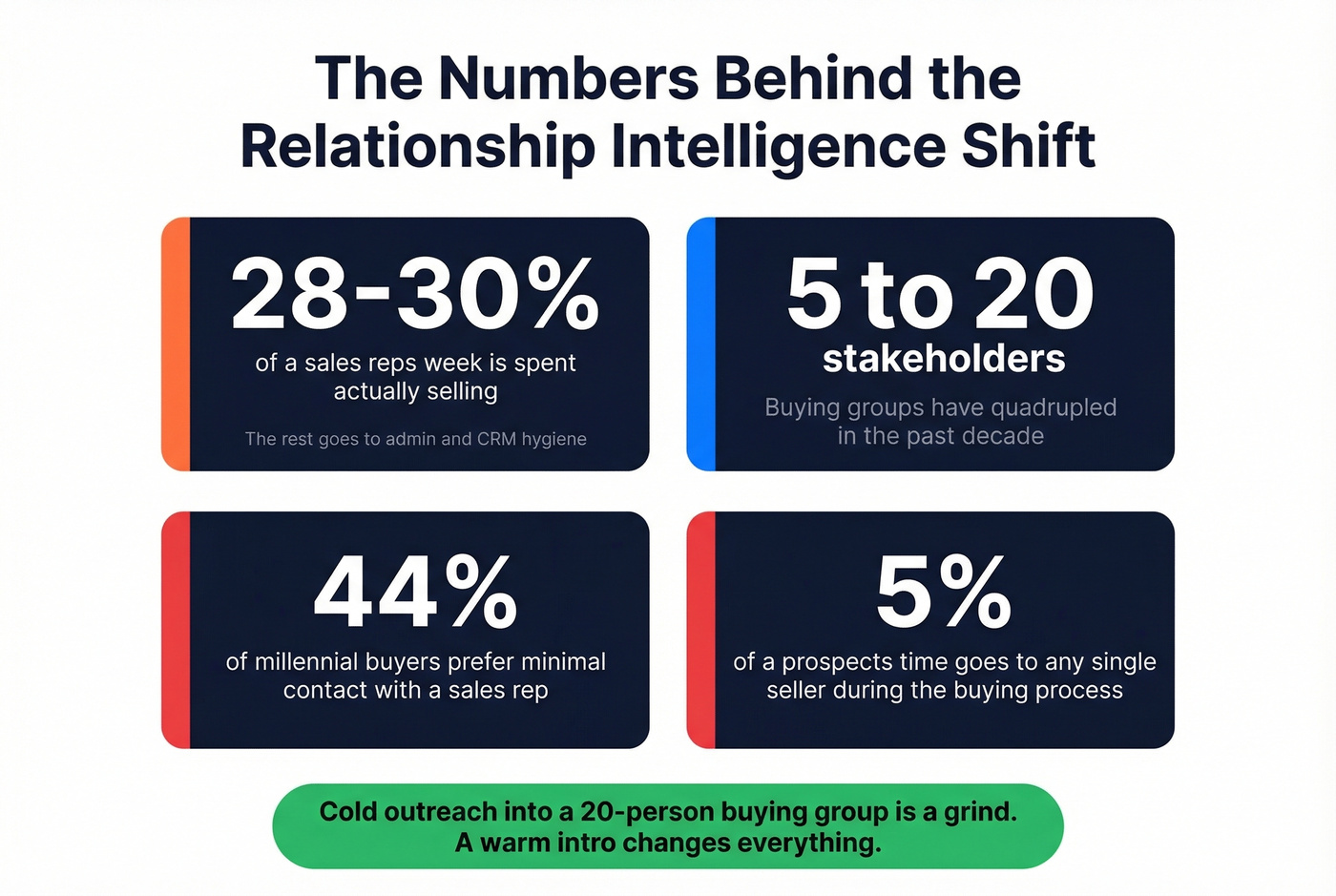
Those numbers create a brutal math problem. You have less time with buyers, buyers want less time with you, and the buying committee has quadrupled in size. Cold outreach into a 20-person buying group is a grind. A warm introduction from a colleague who already has a relationship with the CFO's chief of staff? That's a different conversation entirely.
RI platforms promise to surface those warm paths at scale. Whether the promise justifies the price depends entirely on deal size, sales cycle length, and how many relationships your organization actually has to map.
Let's be honest: if your average contract value is under $50K, you almost certainly don't need a dedicated RI tool. The ROI math just doesn't work at that deal size.
How Relationship Scoring Works
Not all scoring is created equal. The best platforms weigh 20+ discrete data points - seniority of the contact, reciprocity of communication (are they replying or just receiving?), frequency, organizational size, role changes, and meeting attendance patterns. A relationship score built on that foundation is useful.
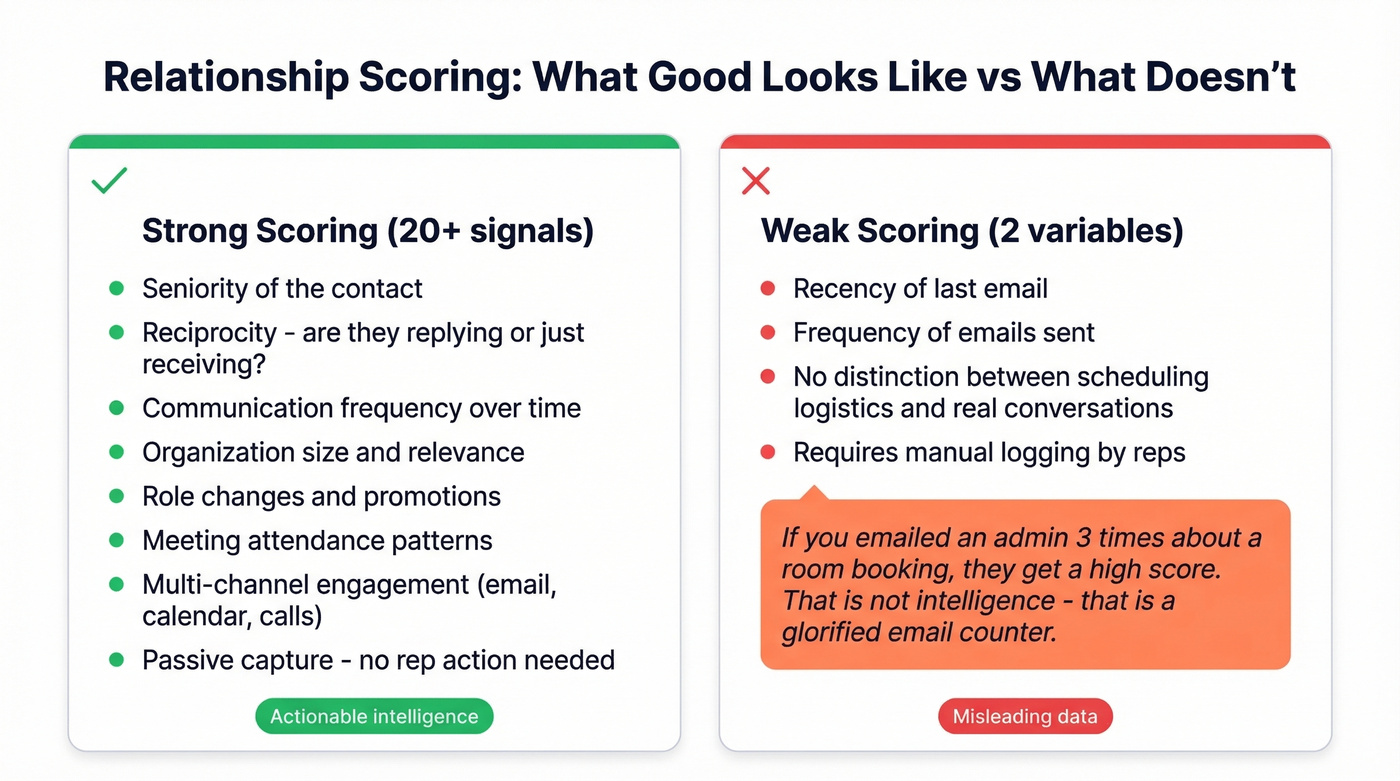
The worst scoring engines rely on two variables: recency and frequency. If you emailed someone three times last week, they get a high score - even if all three emails were scheduling logistics with an admin. That's not intelligence. That's a glorified email counter.
The other critical distinction is passive capture versus manual logging. Platforms like Affinity sync email and calendar data automatically - no rep action required. DealCloud, by contrast, often ends up with heavier process and configuration overhead, which means your relationship data is only as good as your team's discipline. We've seen this play out repeatedly: the tool with the best features on paper loses to the simpler one because reps actually use it.

Relationship intelligence shows you the warm path. But once you map the buying committee, you still need verified contact data to execute. Prospeo's 300M+ profiles with 98% email accuracy and 125M+ verified mobiles fill the gap RI platforms leave open - at $0.01 per email.
Map the relationship. Then reach them with data that actually connects.
Top Relationship Intelligence Platforms in 2026
Affinity
Use this if you're a VC, PE, or professional services firm that needs deal flow management with automatic relationship capture. Affinity's pricing is published transparently - a rarity in this category - starting at $2,000/user/year (Essential), $2,300 (Scale), and $2,700 (Advanced). Enterprise configurations can run up to $4,600+/seat/year per third-party benchmarks. Implementation is typically days to weeks, and Affinity positions go-live as weeks, not months. They pull from 40+ data enrichment sources and have 3,000+ customers with a 4.4/5 on G2 across 71 reviews.

Skip this if you need deep analytics below the Enterprise tier - many teams hit reporting and customization limits and end up exporting to Excel for serious analysis. The mobile app can't create opportunities or edit lists, and API access caps at 100K calls/month unless you're on Enterprise. But for firms where relationship mapping is the core workflow, Affinity is the obvious starting point.
Intapp DealCloud
DealCloud's pricing tells you everything about its target buyer. Contracts range from ~$85K to $1.4M/year, with an average around $505K/year. Implementation runs 4-12 months. This is a platform built for large professional services firms and capital markets teams with complex deal tracking needs and a budget to match.
DealCloud can capture and enrich contact data through signature parsing and email/event metadata, but many teams still experience more process, configuration, and services dependency than tools designed to be fully hands-off. Practitioners give mixed reviews on implementation quality - the platform is powerful once configured, but getting there is a project unto itself.
Negotiation tip: DealCloud typically won't agree to contract redlines, but they'll discount services more readily than subscription fees.
Introhive
Introhive offers quote-only pricing and no free trial. Capterra gives it a 4.5/5, though with only 12 reviews.
The case for it: Introhive layers relationship intelligence onto existing enterprise CRMs (Salesforce, Dynamics) with automatic data capture and scoring built on 20+ data points per relationship.
The case against it: Expect mid five-figures to low six-figures annually depending on seats and integrations. Implementation falls in the 6-16 week range. You can't evaluate before committing to a sales cycle. If pricing transparency matters to you, look elsewhere.
4Degrees
4Degrees targets relationship-driven firms - VC, PE, real estate - with a CRM that auto-captures communication data and scores relationship strength. Expect $150-$300/user/month depending on firm size. The main limitation is that scoring leans heavily on communication frequency, and external discovery is minimal. For teams that need a global contact database alongside relationship mapping, you'll need to pair 4Degrees with a separate data provider.
Nektar
Purpose-built for RevOps teams running Salesforce. Nektar captures buyer engagement signals - emails, meetings, calls - syncs them against the right contacts and opportunities, and delivers relationship insights through Salesforce reporting and Slack. Best for enterprise B2B sales organizations where pipeline inspection and forecasting accuracy matter more than deal sourcing. Pricing typically runs $500-$2,000/month for mid-market teams.
Revenue Grid
Revenue Grid combines automatic activity capture with guided selling workflows inside Salesforce. It's less about mapping your firm's network and more about ensuring reps follow the right engagement cadence with existing opportunities. At ~$30-$70/user/month, it's one of the most accessible options in the category. When your primary pain is CRM data quality rather than network mapping, Revenue Grid deserves a serious look.
LexisNexis InterAction
A common CRM choice in large law firms. InterAction turns a firm's relationship information into growth opportunities. Enterprise pricing runs six figures annually.
If you're not a law firm, this isn't for you. If you are, you probably already have it.
Louisa AI
An AI-native newcomer focused on relationship analytics and warm introduction discovery. Still early-stage with limited market presence - expect pricing in the $15K-$40K/year range based on its positioning below enterprise players but above point solutions. Worth watching but not yet proven enough to recommend over established options.
Pricing Comparison
Affinity is one of the few vendors in this category that publishes exact numbers. The rest hide behind "contact sales" buttons. Here's the best data we've found - estimated figures are marked with a tilde (~).
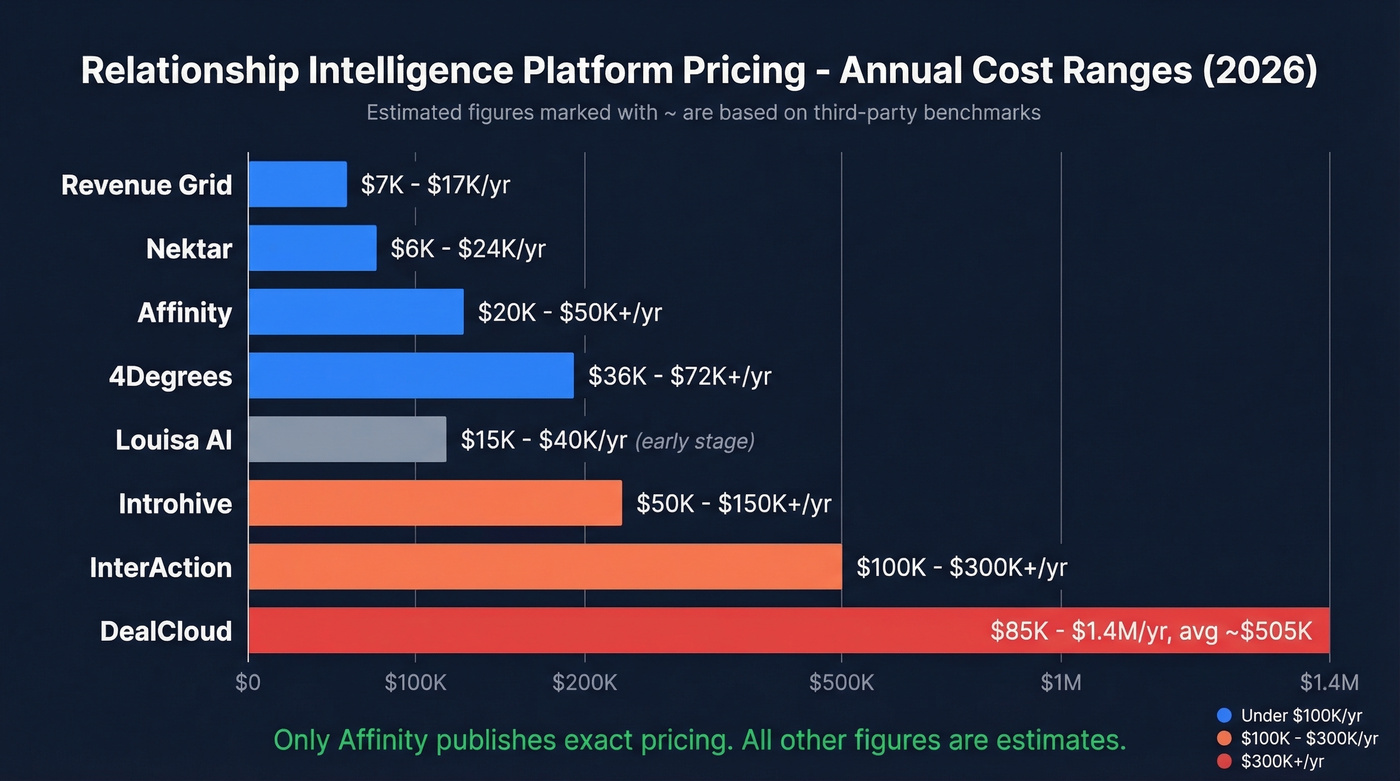
| Tool | Starting Price | Typical Annual | Deploy Time | Best For |
|---|---|---|---|---|
| Affinity | $2K/user/yr | $20K-$50K+ | Days-weeks | VC/PE firms |
| DealCloud | ~$85K/yr | ~$505K/yr avg | 4-12 months | Enterprise PS |
| Introhive | ~$50K/yr | ~$50K-$150K+ | 6-16 weeks | Enterprise CRM |
| 4Degrees | ~$150-$300/user/mo | ~$36K-$72K+ | 4-8 weeks | VC/PE/RE |
| Nektar | ~$500-$2K/mo | ~$6K-$24K | 4-8 weeks | RevOps/Salesforce |
| Revenue Grid | ~$30-$70/user/mo | ~$7K-$17K+ | 2-6 weeks | Salesforce teams |
| InterAction | ~$100K+ | ~$100K-$300K+ | Months | Law firms |
| Louisa AI | ~$15K/yr | ~$15K-$40K | Weeks | Early adopters |
The pricing opacity in this category is genuinely frustrating. You're expected to sit through multiple discovery calls before learning whether a tool costs $50K or $500K. Affinity deserves credit for breaking that pattern.
Implementation Pitfalls
Before you sign anything, here are the ways RI implementations fail:
Interoperability gaps. The tool doesn't integrate cleanly with your CRM, creating data silos and duplicate records. If it can't capture activity cleanly, your data is only as good as your laziest rep.
One-dimensional scoring. Platforms that score relationships based only on recency and email frequency produce misleading results. Insist on seeing the scoring methodology before buying.
Usability friction. If reps need to log into a separate tool to see relationship data, adoption craters. The data needs to live where reps already work - inside the CRM, inside email.
Email domain management. Private entities, subdomains, and shared domains require manual stewardship. Nobody tells you this during the demo.
Privacy and due diligence gaps. Insufficient validation controls, inability to block specific domains or addresses. This matters more than vendors admit.
Stale data. Signature-based and address-book-only enrichment degrades fast. Contacts change jobs, emails go dead, phone numbers rotate. We've watched teams build beautiful relationship maps on top of data that was six months out of date - the maps looked great and produced nothing.
No clear ROI measurement. Among organizations actively using AI tools, only 21% report clear measurable value. Define your success metrics before implementation, not after.
The Data Quality Gap
Here's a scenario we've seen too many times. Your RI tool maps the perfect warm introduction path to the CFO at a target account. Your colleague has a strong relationship score. You draft the intro email, hit send - and it bounces. The relationship intelligence was perfect. The contact data was dead.
This is the gap RI platforms don't solve. They map who to reach and how to get introduced, but they don't verify that the email address at the end of that path actually works. And when a warm intro bounces, you burn social capital with the colleague who made the introduction. That's damage you can't undo with a follow-up email.
Pair your RI tool with a verification layer. Prospeo runs bulk verification at ~$0.01/email with 98% accuracy and a 7-day refresh cycle, pushing clean data back into Salesforce or HubSpot in minutes.
If you want to pressure-test your stack, start with data enrichment and a dedicated email deliverability workflow, then track the downstream impact on pipeline health.
RI tools tell you who knows whom. Sales intelligence tells you how to reach them directly. Prospeo delivers both verified emails and direct dials refreshed every 7 days - not the 6-week-old data that tanks your deliverability. Teams book 26% more meetings than with ZoomInfo.
Stop paying six figures for stale contacts. Start at $0.01 per verified email.
FAQ
What is a relationship intelligence platform?
Software that analyzes first-party signals - emails, meetings, calendar data - to map who in your organization knows whom, score connection strength, and surface warm introduction paths into target accounts. It's distinct from contact databases, which provide third-party data like emails and phone numbers.
How much do RI platforms cost?
From $2,000/user/year (Affinity Essential) to $1.4M+/year (DealCloud enterprise). Most mid-market tools fall in the $50K-$200K/year range. Pricing is notoriously opaque - only Affinity publishes exact tiers.
What's the difference between relationship intelligence and sales intelligence?
Relationship intelligence maps existing connections using first-party data - your emails and meetings. Sales intelligence provides third-party contact data from external databases. They're complementary layers, not substitutes. Teams that combine both - RI for warm paths, a tool like Prospeo for verified contact data - see the strongest pipeline results.
How long does implementation take?
Affinity typically goes live in days to weeks. DealCloud takes 4-12 months. Most mid-market platforms fall in the 6-16 week range depending on CRM complexity and security review requirements. Ask for reference customers at your company size before committing.
Do RI platforms verify contact data?
No. They map relationships but don't verify that emails and phone numbers are current. Pairing an RI platform with a verification tool prevents warm introductions from landing in dead inboxes - which is the kind of mistake that burns internal goodwill fast.