

The 2026 Playbook for Remote Sales Teams That Actually Hit Quota
A RevOps lead we work with ran the numbers last quarter: 14 reps, fully remote, $2.4M in pipeline - and only 5 hitting quota. The tools were there. The CRM was clean. The problem wasn't technology. It was that nobody had built an actual operating system for how remote sales teams run day-to-day.
That's what this playbook fixes.
Remote Selling in 2026
Remote selling isn't a pandemic hangover. It's the operating model. An estimated 32.6 million Americans work remotely - roughly 22% of the workforce - and 98% of workers want remote options at least some of the time. On the buyer side, the shift is just as permanent: 80% of B2B sales interactions happen through digital channels, and 92% of B2B buyers actively prefer digital engagement.
One nuance: hybrid teams are 28% more likely to outperform both fully distributed and fully in-person teams. Everything in this playbook applies whether your team is 100% distributed or working a hybrid schedule. The operating system is the same.
So the question isn't whether remote selling works. It's why most teams underperform.
Here's the elephant in the room: quota attainment sits at 43.5%. More than half your reps are missing target. Ebsta found that 69% of reps fell short of quota, and only 15% of teams had more than half their reps hitting 80%+ of target. Meanwhile, reps spend roughly 30% of their time actually selling. The other 70% goes to admin, internal meetings, and fighting with tools.
The teams that win aren't doing anything magical. They've built a system - cadence, scorecard, comp plan, data layer, coaching rhythm - and they run it with discipline.
What You Need (Quick Version)
To run a distributed sales org that performs, you need five things:
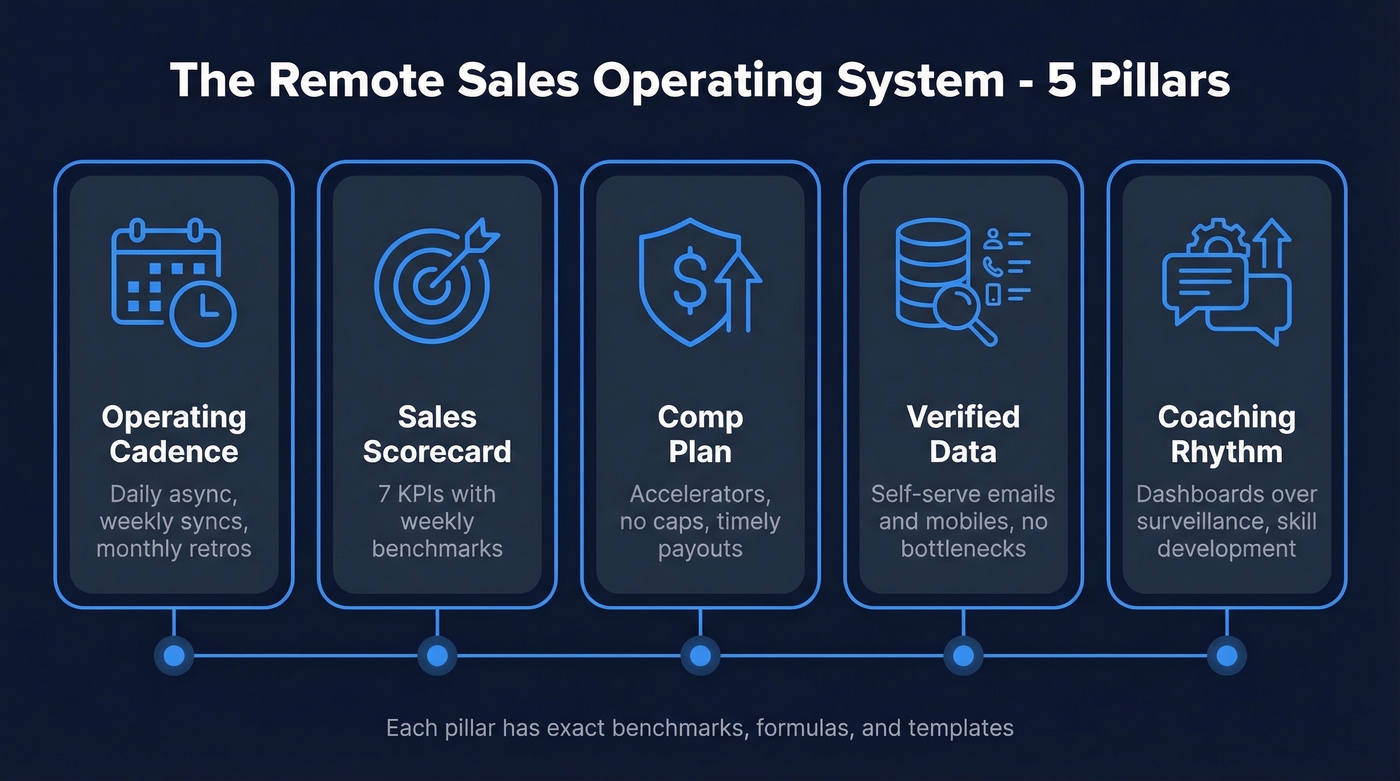
- A structured operating cadence - not more Zoom calls, but the right ones at the right rhythm
- A scorecard with real benchmarks - weekly targets your reps and managers actually review
- A comp plan that retains top reps with accelerators, no caps, and SPIFFs that drive behavior
- Verified contact data your reps can self-serve - pulling verified emails and mobiles without waiting on anyone
- A manager who coaches instead of surveils, using dashboards rather than keystroke tracking
Each of these is covered below with exact numbers, formulas, and templates.
Hiring for Remote-First Sales
Remote hiring opens your talent pool to the entire country - or the entire world. That's the upside. The downside is that comp expectations vary wildly, and you're competing with every other distributed team for the same top performers. With 98% of workers wanting remote options, offering it isn't a differentiator. You win talent with comp, culture, and career trajectory.
OTE ranges for inside and remote sales roles in 2026:
| Role | Base Salary | Typical OTE | Pay Mix |
|---|---|---|---|
| SDR | $35k-$55k | $70k-$90k | 70/30 or 80/20 |
| Inside Sales Rep | $38k-$72k | $90k-$110k | 60/40 or 50/50 |
| Mid-Market AE | $60k-$90k | $120k-$160k | 50/50 |
| Enterprise AE | $90k-$130k | $180k-$250k+ | 50/50 |
Average base for an inside sales rep runs about $52k; inside AEs average $56k. Your actual numbers will shift based on geography, vertical, and whether you're hiring in San Francisco or Omaha.
For global hiring, Employer of Record platforms like Remote.com and Deel handle compliance, payroll, and benefits for $300-$800 per employee per month. That's a real option if you want to hire a strong SDR in Portugal or an AE in the UK without setting up a local entity.
The hiring filter that matters most for remote roles is self-direction. You can teach product knowledge. You can't teach someone to structure their own day without a manager hovering. In interviews, ask candidates to walk you through how they'd plan their first 30 days with zero hand-holding. The ones who give you a specific, hour-by-hour answer are the ones who'll thrive.
Comp Plans That Retain Top Reps
One stat should shape every comp decision you make: 17% of reps generate 81% of revenue. If your comp plan doesn't disproportionately reward that top quintile, you'll lose them to someone who does.
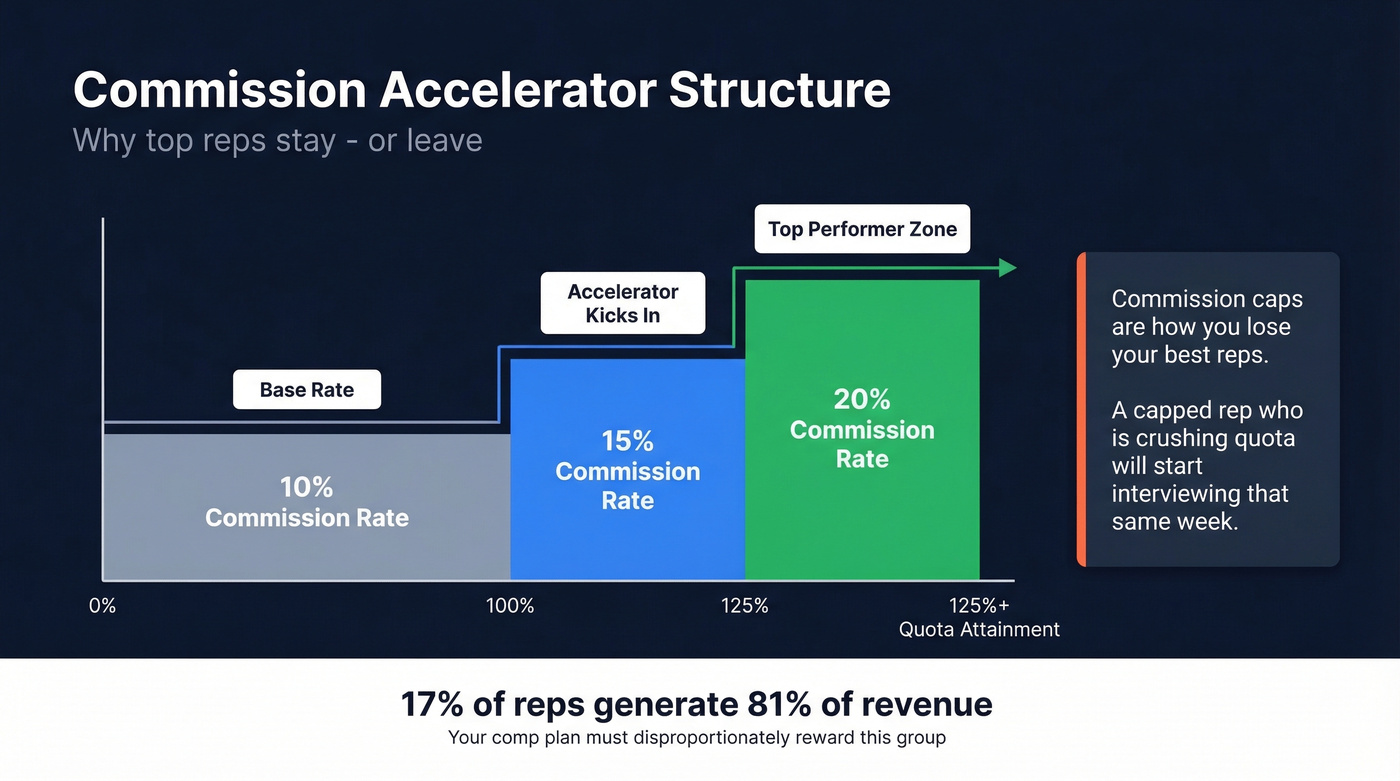
Accelerators are non-negotiable. Once a rep crosses 100% of quota, the commission rate should increase - not stay flat. A common structure: 10% commission up to quota, 15% from 100-125%, 20% above 125%. This rewards overperformance and keeps your best reps from coasting after they hit target in week three of the month.
Decelerators - lower rates for underperformance - are trickier. Use them cautiously. They can punish reps in tough territories or during seasonal dips, which breeds resentment rather than motivation.
Let's be honest: commission caps are how you lose your best reps. If finance demands a cap, negotiate a higher accelerator rate below the cap instead. A rep who's on pace to blow out their number and hits a ceiling will start interviewing that same week. We've seen it happen repeatedly.
For reps ramping in their first quarter, consider a draw against commission - a guaranteed minimum payout that gets reconciled against future earnings. This removes the financial anxiety of onboarding and lets new reps focus on learning instead of worrying about rent, which is especially important for remote hires who don't have the psychological safety net of an office full of peers.
SPIFFs work well for short-term behavior change - pushing a new product, driving activity during a slow quarter, rewarding multi-threading into accounts. Keep them at 5-10% of variable comp and time-bound to 2-4 weeks. Permanent SPIFFs just become expected comp, which defeats the purpose.
For distributed teams specifically, make sure commission payouts are transparent and timely. Delayed payouts are one of the fastest ways to kill trust - and nothing burns morale faster than a rep checking their bank account and not seeing the commission they calculated. Publish the formula. Show the math. Pay on time, every time.
Onboarding Without Losing Them
Replacing a sales rep costs 50-200% of their annual salary. For a mid-market AE earning $140k OTE, that's $70k-$280k in lost productivity, recruiting costs, and ramp time. And yet 88% of employees say their onboarding was ineffective.
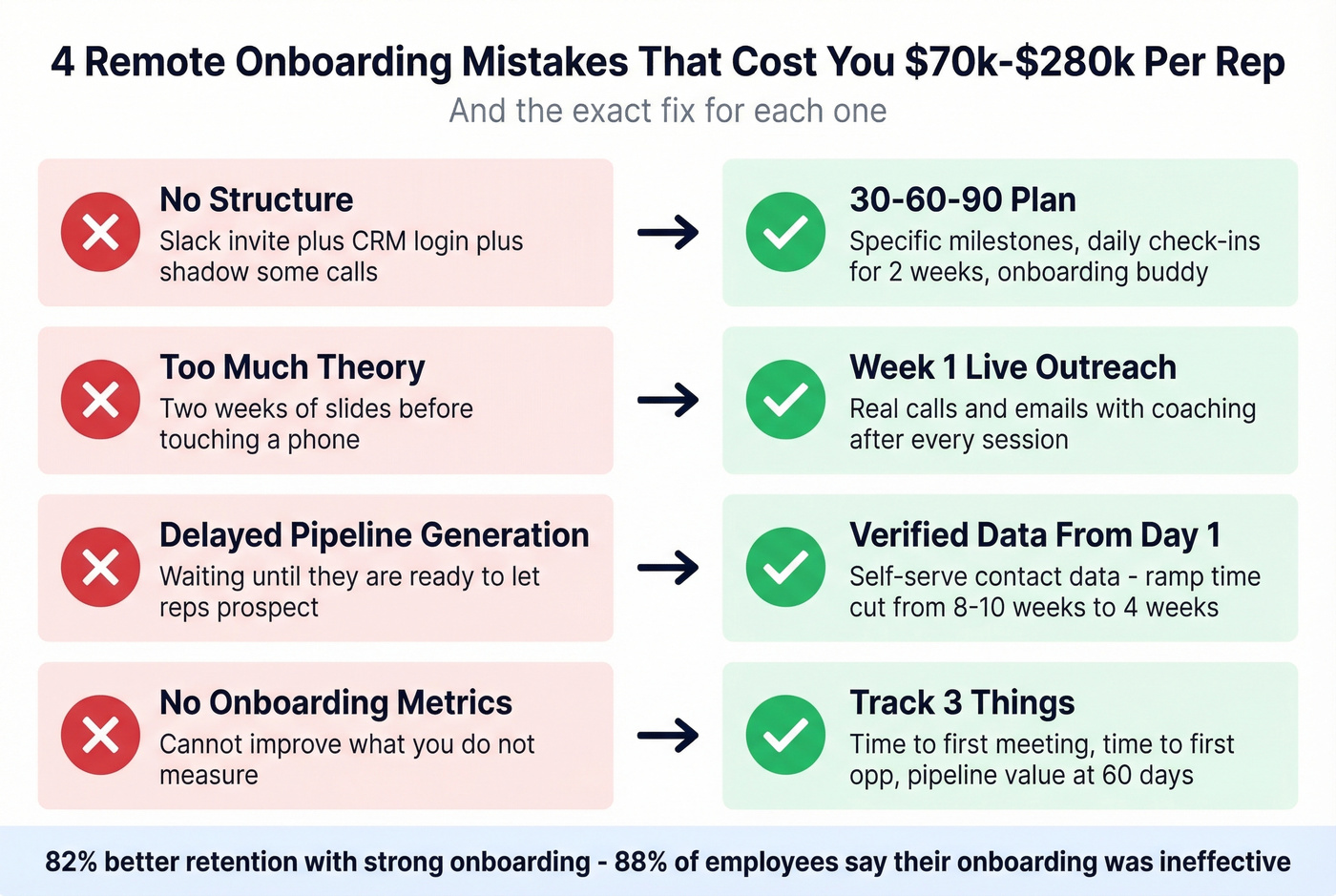
Organizations with strong onboarding improve new hire retention by 82%. The math is obvious. Four mistakes kill remote onboarding - and each one has a clear fix.
Mistake 1: No structure. New reps get a Slack invite, a CRM login, and a "shadow some calls" instruction. Fix: build a 30-60-90 plan with specific milestones, daily check-ins for the first two weeks, and a designated onboarding buddy who isn't their manager.
Mistake 2: Too much theory. Two weeks of product training slides before a rep touches a phone. Fix: supervised outreach starts in week one. Real calls, real emails, real pipeline - with coaching after every session.
Mistake 3: Delayed pipeline generation. Waiting until "they're ready" to let reps prospect. Fix: give them verified contact data from day one. GreyScout cut rep ramp time from 8-10 weeks to 4 weeks after switching to Prospeo for prospecting data - bounce rates dropped from 38% to under 4%, and new reps started generating pipeline in their first month.
Mistake 4: No onboarding metrics. You can't improve what you don't measure. Track three things: time to first qualified meeting, time to first opportunity created, and early pipeline value generated in the first 60 days.

Remote reps can't afford to waste time chasing bad contact data. Prospeo gives your distributed team 300M+ profiles with 98% email accuracy and 125M+ verified mobiles - self-serve, no bottlenecks.
Stop making remote reps wait on anyone for verified contact data.
The Operating Cadence
The biggest mistake managers of remote sales teams make is replacing hallway conversations with more meetings. Your reps don't need six hours of Zoom per week. They need a rhythm that creates accountability without eating into selling time.
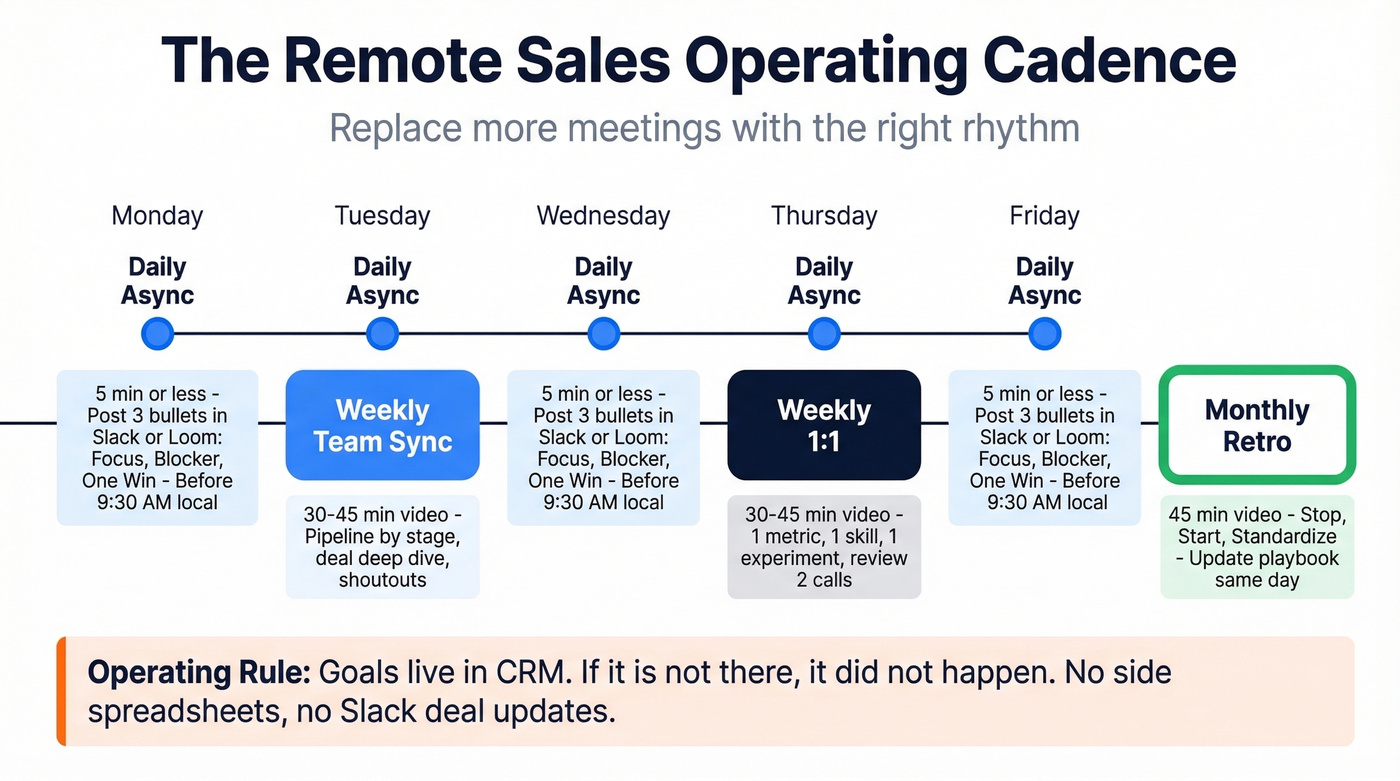
Here's the cadence that works:
| Rhythm | Format | Duration | What Happens |
|---|---|---|---|
| Daily | Async (Slack/Loom) | 5 min or less | 3 bullets: Focus / Blocker / One win |
| Weekly | Team sync (video) | 30-45 min | Pipeline by stage, deal deep dive, shoutouts |
| Weekly | 1:1 (video) | 30-45 min | 1 metric + 1 skill + 1 experiment + review 2 calls |
| Monthly | Team retro (video) | 45 min | Stop / Start / Standardize - update playbook |
The daily async update is the backbone. Three bullets, posted before 9:30 AM local time: what they're focused on today, what's blocking them, and one win from yesterday. This takes less than five minutes and replaces the "quick check-in" call that always runs 20 minutes.
The weekly 1:1 is where coaching happens. Structure it around one metric the rep is working to improve, one skill they're developing, one experiment they're running in their outreach, and a review of two recorded calls or deals. This isn't a status update - it's a development conversation.
Goals live in CRM. If it isn't there, it didn't happen. This is the operating rule that makes everything else work. No side spreadsheets, no Slack threads with deal updates, no "I forgot to log it." The CRM is the single source of truth, and the cadence reinforces that every single week.
The monthly retro is underrated. Three questions: what should we stop doing, what should we start doing, and what should we standardize? Update the playbook the same day. Teams that skip retros repeat the same mistakes for quarters.
KPIs and the Sales Scorecard
Most guides tell you to "track pipeline." That's not a scorecard. This is:
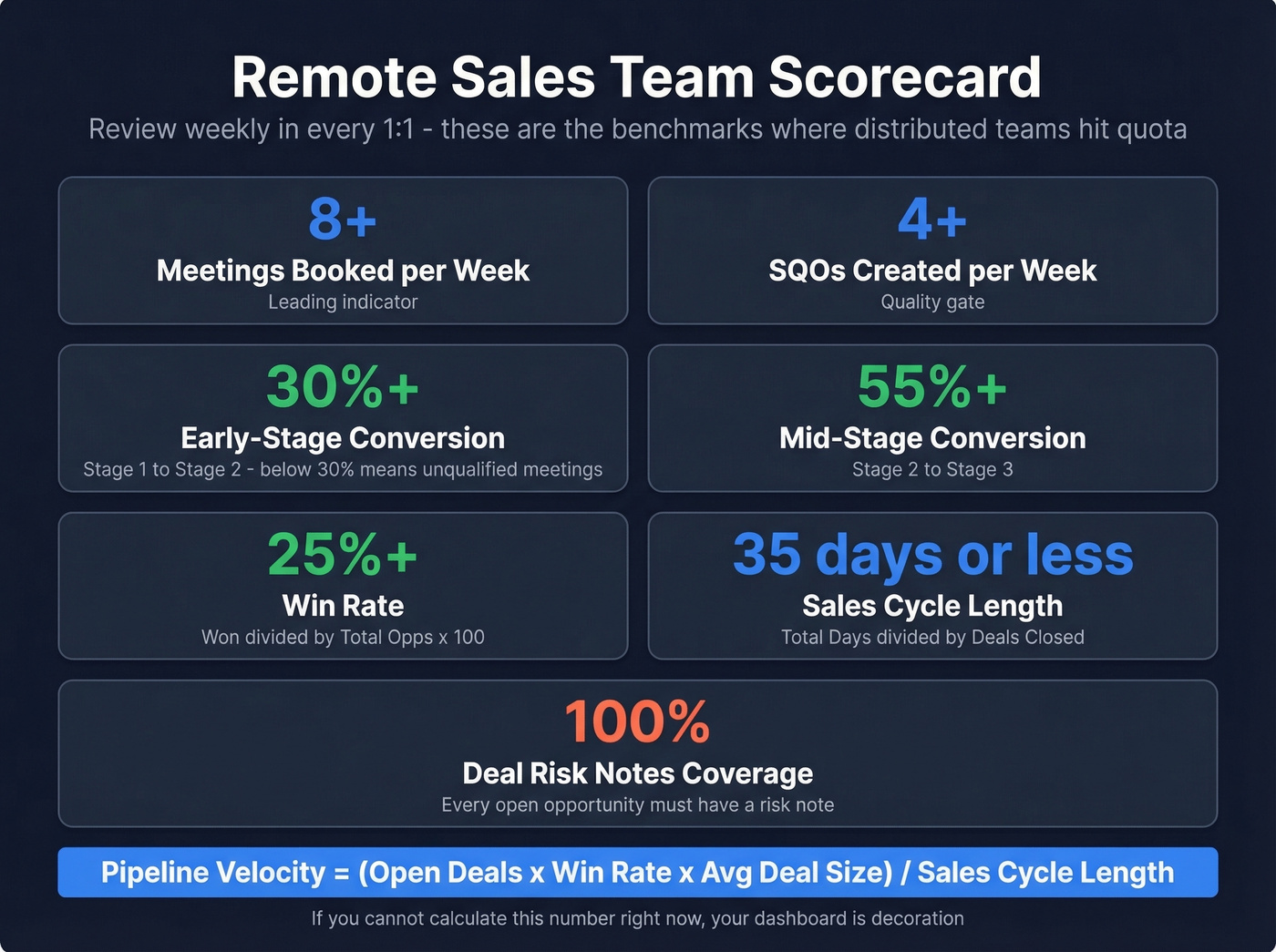
| Metric | Weekly Target | Formula / Notes |
|---|---|---|
| Meetings Booked | 8+ | Leading indicator |
| SQOs Created | 4+ | Quality gate |
| Early-Stage Conversion | 30%+ | Stage 1 to Stage 2 |
| Mid-Stage Conversion | 55%+ | Stage 2 to Stage 3 |
| Win Rate | 25%+ | Won / Total Opps x 100 |
| Sales Cycle | 35 days or less | Total Days / Deals Closed |
| Deal Risk Notes | 100% | Every opp has a risk note |
Copy this scorecard into your team wiki and review it in every weekly 1:1. These aren't aspirational numbers - they're the benchmarks where distributed teams start consistently hitting quota. If your early-stage conversion is below 30%, your reps are booking unqualified meetings. If your sales cycle exceeds 35 days, deals are stalling in mid-stage, and you need to look at your discovery and demo-to-proposal handoff.
Pipeline Velocity ties everything together:
Pipeline Velocity = (Open Deals x Win Rate x Avg Deal Size) / Sales Cycle Length
If you can't calculate your pipeline velocity right now, your dashboard is decoration. This single number tells you whether your pipeline is healthy or whether you're heading for a miss - weeks before quota day arrives.
One KPI worth adding that most teams miss: Meaningful Conversation Rate - the percentage of outbound touches that result in a two-way exchange longer than 60 seconds. This catches the gap between "activity" and "engagement" that dials-per-day alone can't reveal. A rep with high dials but low conversations has a timing or list quality problem. A rep with good conversations but low appointments has a pitch problem. The scorecard tells you which lever to pull.
For SDR and outbound teams, layer in activity KPIs: dials per day, conversations per day, average call duration (flag reps who can't keep prospects past two minutes), call disposition tracking, and calls by time of day to identify optimal windows.
Post these formulas in your team wiki so every rep can calculate their own numbers without asking RevOps:
- Win Rate = Deals Won / Total Opportunities x 100
- Sales Cycle Length = Total Days to Close / Deals Closed
- Quota Attainment = Actual Sales / Quota x 100
AI's Impact on Productivity
You can't talk about sales KPIs in 2026 without addressing AI. According to Gartner, reps who partner with AI tools are 3.7x more likely to meet quota. Salesforce reports that 81% of sales teams are investing in AI, and teams using it saw 83% revenue growth compared to 66% without. Automation alone can free up roughly 20% of rep capacity.
For distributed teams, this matters even more. AI-powered call summaries, automated CRM logging, and intelligent lead scoring eliminate the admin work that eats into selling time - the same admin that accounts for 70% of a rep's day. If your reps are still manually logging calls and writing follow-up emails from scratch, you're leaving quota attainment on the table.
The Tech Stack
You need five tools, not twelve. Every tool you add beyond the essentials creates another login, another tab, another integration to maintain, and another 15 minutes of non-selling time per day.
Data and Prospecting - this is where most teams get it wrong. Remote reps can't walk over to marketing for better leads. They need self-serve access to verified contact data, and bad data kills outbound faster than any other problem. Bounced emails tank domain reputation, wrong numbers waste dial time, and stale contacts mean reps are pitching people who left the company six months ago.
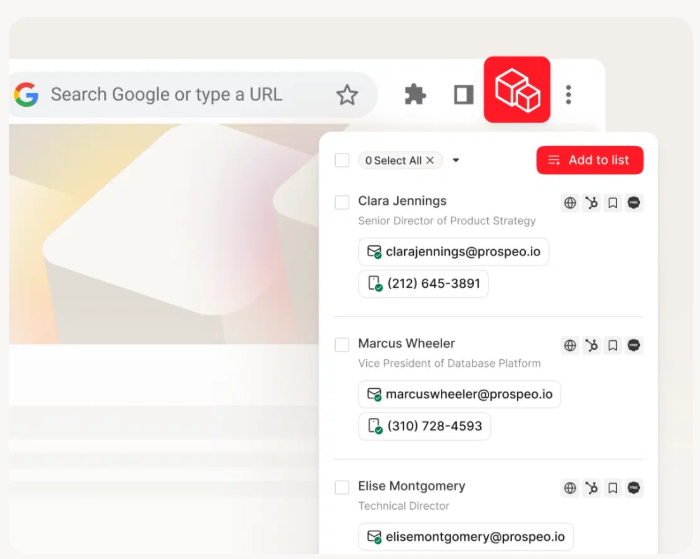
Prospeo covers 300M+ professional profiles with 98% email accuracy and 125M+ verified mobile numbers, all on a 7-day refresh cycle. The Chrome extension lets reps find verified emails and phones from any website or CRM in one click. At roughly $0.01 per email with a free tier of 75 emails/month, it's the most cost-effective way to arm a distributed team with accurate data - no contracts, no "talk to sales" gates.
The full stack with realistic pricing:
| Category | Tool | Price Range | Best For |
|---|---|---|---|
| CRM | HubSpot | Free-$150+/user/mo | Teams under 50 |
| CRM | Salesforce | $25-$300+/user/mo | Enterprise |
| CRM | Pipedrive | $14-$99/user/mo | Teams under 20 |
| Sequencing | Instantly / Smartlead | $30-$97/mo | Cold email at scale |
| Sequencing | Outreach / Salesloft | $100-$150+/user/mo | Enterprise sequences |
| Data | ZoomInfo | $15k-$40k+/yr | Full platform, big budget |
| Data | Apollo | Free-$99/user/mo | Free-tier starting point |
| Conv. Intel | Gong / Chorus | $100-$200+/user/mo | Call coaching at scale |
| Video | Zoom | Free-$22+/user/mo | Team meetings |
| Chat | Slack | Free-$12.50/user/mo | Async communication |
| Async Video | Loom | Free-$12.50/user/mo | Quick updates, demos |
Conversation intelligence tools like Gong and Chorus are a nice-to-have when call volume justifies it. If your team runs 20+ discovery calls per week, the coaching insights are worth the spend. Skip them if you're a five-person team doing 30 calls total - review recordings manually and save $6,000+/year.
Here's the thing: if your average deal size is under $15k, you probably don't need ZoomInfo-level data spend. A self-serve tool with high accuracy and a Chrome extension will get your reps 90% of the way there at a fraction of the cost. Save the enterprise budget for when you're selling enterprise deals.
The playbook above only works if your reps reach real buyers. With a 7-day data refresh cycle and 30+ filters - including buyer intent and job changes - Prospeo keeps your remote team's pipeline full of live prospects, not dead ends.
Fresh data every 7 days means your distributed team never dials a dead number.
Trust, Visibility, and the Surveillance Trap
Here's a contradiction that should bother every sales leader: 69% of managers say remote and hybrid work has made their teams more productive. And yet 81% of companies use employee tracking software. If your team is more productive, why are you monitoring keystrokes?
The answer is that only 54% of managers strongly agree they trust remote workers to be productive. There's a gap between what the data shows and what managers feel - and surveillance software fills that gap with false comfort instead of real systems.
Surveillance software is a management failure, not a management tool. The scorecard above gives you everything you need to know about whether a rep is performing. Meetings booked, SQOs created, pipeline velocity, win rate - these are the signals. Screen time isn't.
Your sales manager is probably the bottleneck. Gallup's data is stark: 70% of team engagement is attributable to the manager. Manager engagement itself dropped to 27% globally. Gallup estimates disengagement cost the global economy $438B, with global employee engagement sitting at just 21%. If your team is underperforming, look at the manager first. Are they coaching or just reviewing dashboards? Are they running structured 1:1s or 30-minute status updates? Are they developing skills or just tracking quota?
The fix isn't more oversight. It's better systems. Build dashboards everyone can see. Run the cadence. Coach to the scorecard. Trust the numbers instead of the webcam.
Culture: Recognition and Burnout
55% of the U.S. workforce is experiencing burnout, and burnt-out employees are nearly 3x more likely to leave within the year. For sales teams - where 40% of remote workers struggle to unplug after hours - the risk is even higher. Motivated employees are 87% less likely to leave and 17% more productive. The ROI on culture isn't soft. It's math.
What actually works:
Weekly Slack shoutouts in a dedicated channel where managers and peers call out wins - not just closed deals, but great discovery calls, creative objection handling, and helping a teammate. Peer-to-peer recognition improves performance up to 14%.
Monthly peer-nominated awards where the team votes on who made the biggest impact. A $50 gift card costs nothing compared to the engagement it drives. Pair this with instant digital rewards for SPIFFs - don't wait until end of quarter. Same-day recognition reinforces the behavior you want.
Skills-based evaluation alongside quota prevents penalizing reps in tough territories and signals that development matters. Evaluate reps on discovery quality, objection handling, and pipeline behaviors - not just numbers.
Protect selling time ruthlessly. Block 2-3 hours per day where no internal meetings are scheduled. Reps need uninterrupted time to prospect and run calls. Respect flexibility too - if it were removed, 40% of workers would start job hunting and 22% would expect a raise. Flexibility isn't a perk anymore. Setting clear expectations around availability windows, response times, and meeting-free blocks prevents the always-on culture that drives burnout in the first place.
The teams that retain top reps aren't the ones with the best virtual happy hours. They're the ones with clear expectations, fair comp, real coaching, and managers who treat adults like adults.
FAQ
How many tools does a remote sales team actually need?
Five core tools cover 90% of needs: CRM, sequencer, data provider, video conferencing, and async chat. Add conversation intelligence once you're running 20+ discovery calls per week. Every tool beyond these five adds complexity and non-selling time - and in our experience, the teams with the leanest stacks spend the most time actually selling.
What's a good quota attainment rate?
Industry average is 43.5%, and only 15% of teams have more than half their reps hitting 80%+ of target. If you're above those benchmarks, you're outperforming most organizations. Focus on pipeline velocity and win rate as leading indicators - by the time you're looking at quota attainment, it's too late to fix the quarter.
How do you prevent burnout on a distributed sales team?
Set async-first communication norms, enforce meeting-free prospecting blocks, and use peer recognition programs that reward behaviors beyond just closed revenue. Evaluate reps on skills development - not only numbers. With 55% of the workforce reporting burnout and burnt-out employees 3x more likely to quit, structured cadences and clear work-life boundaries aren't optional.
What's the best way to get verified contact data for remote reps?
Use a self-serve data provider with 98%+ email accuracy and verified mobile numbers so reps can prospect independently. A 7-day data refresh cycle matters more than database size - stale data is worse than no data. Look for transparent pricing with no contracts so you can scale credits up or down as your team grows.
What's the biggest management mistake with remote sales teams?
Replacing in-office visibility with surveillance instead of systems. Keystroke tracking tells you nothing about sales performance. The fix is a scorecard with leading indicators - meetings booked, SQOs created, pipeline velocity, win rate - reviewed in structured weekly 1:1s. Seventy percent of team engagement comes down to the manager, so if your team is underperforming, that's the first place to look.