

Revenue Generation: Definition, Strategies, and How to Build a Revenue Engine
Only 16% of B2B reps hit quota in a recent Salesforce study. Buying committees have ballooned to 25 stakeholders, sales cycles average 6.5 months, and reps spend barely 30% of their time actually selling. That's the environment your revenue engine has to survive in. Below is what revenue generation actually means, the strategies that move the needle, and a framework for building an engine that compounds.
The Short Version
Revenue generation is every activity that produces income - not just closing deals. It's a cross-functional system spanning marketing, sales, customer success, and operations. The three levers that matter most, in order: retention, expansion, acquisition.
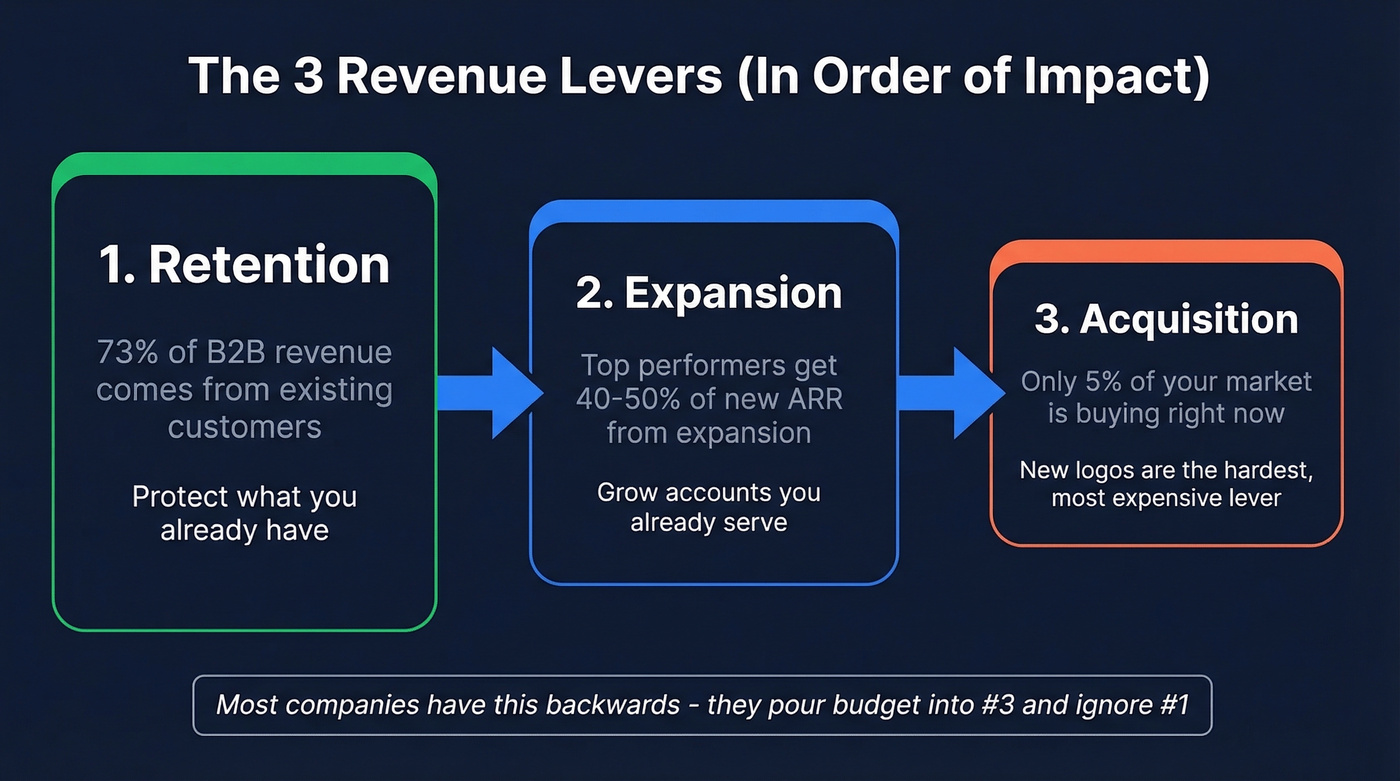
Most companies have this backwards. They pour budget into new logos while ignoring the 73% of B2B revenue that comes from existing customers. If you just want the definition, the next section takes 60 seconds. If you want to build the engine, keep reading.
What Is Revenue Generation?
Revenue generation is the complete set of processes, strategies, and activities a business uses to earn income and grow profitability over time. It covers everything from acquiring new customers to expanding existing accounts to monetizing intellectual property.
Don't confuse it with profit or cash flow. Revenue is the top line - total income before any costs are subtracted. Profit is what's left after expenses. Cash flow is the actual money moving in and out of your accounts on a given timeline. A company can generate $10M in revenue and still lose money if costs exceed income.
The term applies broadly. On r/smallbusiness, a stationery shop owner recently asked how to generate revenue through additional services - proof that this concept scales from solo operators to enterprise teams. The scale changes; the underlying discipline doesn't.
Revenue Generation in Practice
Understanding the revenue generation meaning goes beyond a textbook definition. In practice, it means every team contributes to income production: marketing fills the pipeline, sales converts it, customer success protects and grows it, and operations removes friction from the entire cycle.
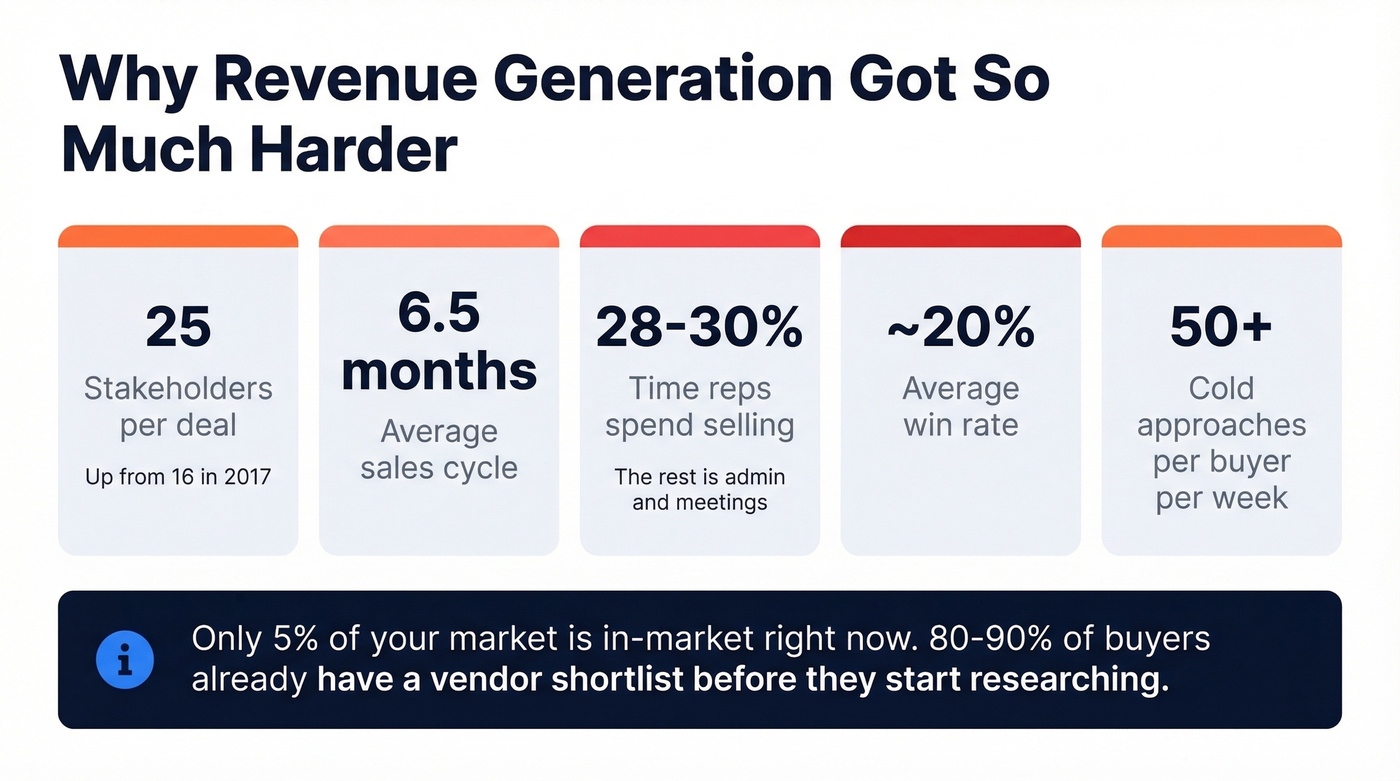
The B2B selling environment has gotten dramatically harder. Buying committees have grown to 25 stakeholders, up from 16 in 2017. Sales cycles average sales cycles average 6.5 months. Reps spend 28-30% of their time selling - the rest disappears into admin, tool-switching, and internal meetings. Win rates hover around 20%.
The noise is deafening, too. A single decision-maker receives 50+ cold approaches every week. The B2B Institute's 95/5 rule makes this worse: only about 5% of your addressable market is "in market" at any given time. The other 95% are future buyers who don't care about your product yet.
Bain & Co. research adds another layer - 80-90% of buyers already have a shortlist of vendors before they start researching. If you're not on that shortlist before the buying process begins, you're fighting for scraps. This is why income production can't be a sales-only function anymore. Relying on outbound alone to hit a moving target that's smaller and harder to reach every quarter is fighting physics.
Revenue Generation Models
A revenue model is the specific mechanism you use to earn money. It's narrower than a business model, which covers value creation, delivery, and profit, and broader than a revenue stream, which is a single income source. Most mature companies run multiple streams under one or two models.
| Model | How It Works | Example |
|---|---|---|
| Subscription | Recurring fee | Microsoft 365 |
| Usage-based | Pay per consumption | AWS |
| Freemium | Free core, paid upgrades | Dropbox |
| Tiered pricing | Feature-gated tiers | HubSpot |
| Per-user | Price per seat | Slack |
| Flat-rate | Single price, all features | Basecamp |
| Hybrid | Mix of models | Adobe Creative Cloud |
The model you choose shapes everything downstream - pricing psychology, retention mechanics, expansion potential, and how you forecast. A usage-based model like AWS creates natural expansion revenue as customers grow. A flat-rate model like Basecamp trades expansion upside for simplicity and lower churn.
And don't overlook operational efficiency as a revenue lever. Faster quoting, automated invoicing, and reduced billing friction directly accelerate how quickly revenue converts from signed deal to recognized income.
Who Owns Revenue Generation?
Here's the thing: nobody and everybody. This discipline is inherently cross-functional. Sales closes deals. Marketing creates demand and pipeline. Customer success drives retention and expansion. RevOps builds the data infrastructure and processes that connect all three. Product influences monetization through packaging and feature development.
The most effective teams we've seen organize into pods - SDRs booking meetings, AEs closing deals, CSMs managing renewals - all sharing the same data, metrics, and accountability structure. Forrester research shows that companies with strong data analytics across these functions drive up to 15% higher revenue growth than those operating in silos. The pod structure isn't just an org chart preference; it's a revenue multiplier.

You just read that reps spend 70% of their time not selling and win rates hover at 20%. Bad data makes both worse. Prospeo gives your revenue team 300M+ profiles with 98% email accuracy and 125M+ verified mobiles - refreshed every 7 days, not every 6 weeks.
Stop feeding your revenue engine stale data. Start at $0.01 per lead.
Revenue Generation vs. Related Concepts
These terms get used interchangeably, and they shouldn't be.
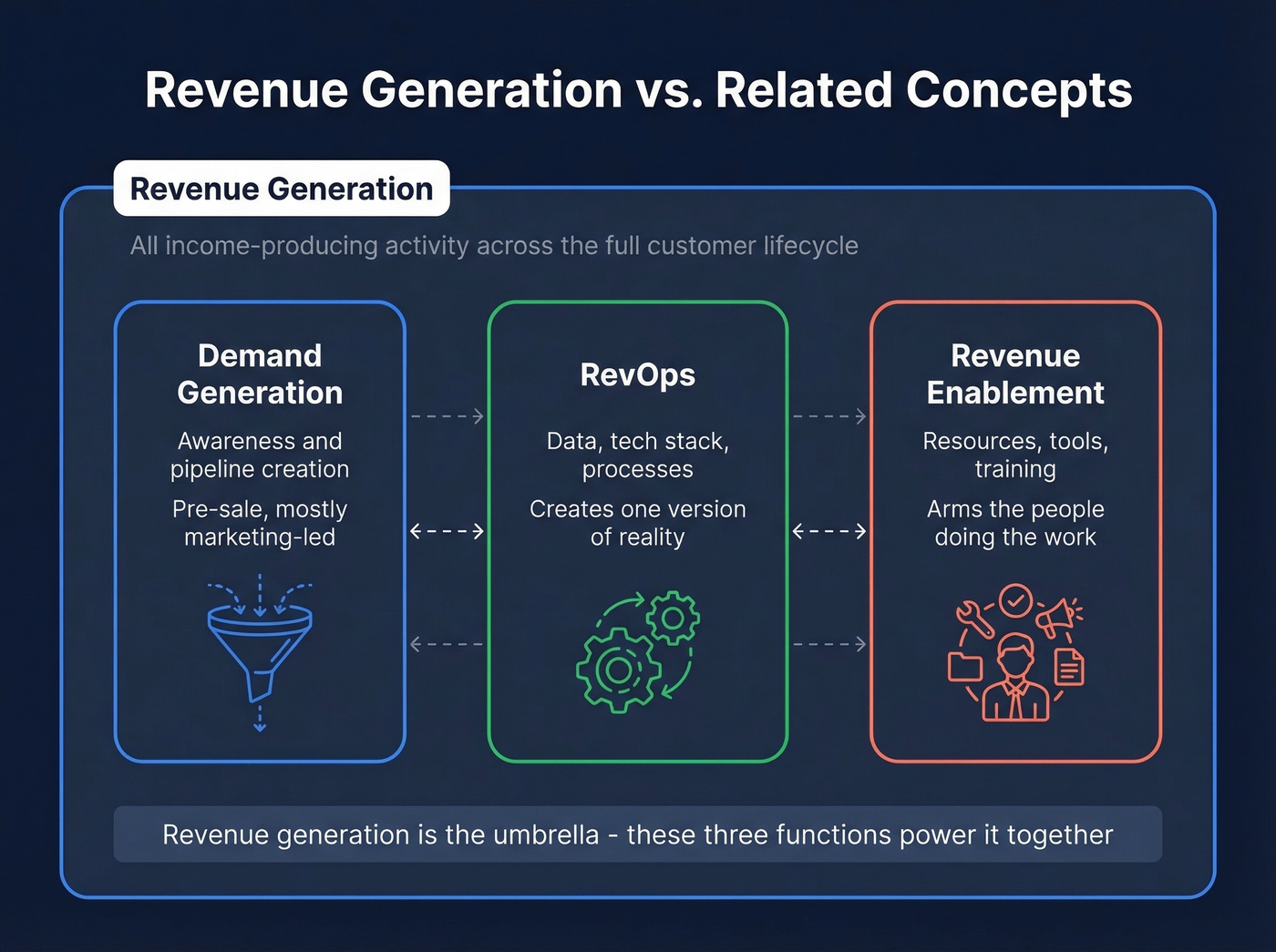
| Concept | Focus | Scope |
|---|---|---|
| Revenue generation | All income-producing activity | Full customer lifecycle |
| Demand generation | Awareness + pipeline creation | Pre-sale, mostly marketing |
| RevOps | Data, tech stack, processes | Ops infrastructure |
| Revenue enablement | Resources, tools, training | Supporting revenue teams |
RevOps creates the "one version of reality" - shared data, standardized processes, unified metrics - that makes scalable income production possible. Demand gen fills the top of the funnel. Revenue enablement arms the people doing the work. Revenue generation is the umbrella that covers all of it.
Strategies That Actually Work
Every article lists the same five strategies: upsell, cross-sell, optimize pricing, improve retention, expand into new markets. That's a to-do list, not a strategy. Let's look at what actual execution looks like.
A founder on r/EntrepreneurRideAlong shared a detailed breakdown of what happened when their core SaaS revenue dropped from $2,847/mo to $1,680/mo in 30 days. One large customer canceled - 23% of revenue, gone overnight - and competitors launched aggressive pricing simultaneously. Within six months, they'd rebuilt to $4,230/mo across four streams: core SaaS at 65%, done-for-you services at 20%, educational content at 10%, and affiliate revenue at 5%.
Three principles drove the recovery. First, asset leverage over asset creation - monetize existing relationships, expertise, and infrastructure instead of building something new. Second, customer journey expansion - serve people before they're customers through education and consulting, while they're customers through upsells, after they leave through training, and even people who'll never buy the core product through alternate formats at different price points. Third, effort multiplication - repurpose content, reuse expertise, and scale existing processes rather than adding entirely new workstreams.
Retention comes first. 73% of B2B revenue comes from existing customers. If your strategy is 100% new logos, you're ignoring three-quarters of your engine. The highest-ROI move for most B2B companies isn't a new outbound campaign - it's reducing churn by 1-2 points and building a systematic expansion motion.
For teams closing deals under $15K, you probably don't need a complex ABM stack or enterprise data platform. You need a tight ICP, verified contact data, and a follow-up cadence that doesn't quit after three touches.
Pricing optimization is the second-highest leverage play. Most B2B companies underprice, over-discount, or use one-size-fits-all packaging that leaves money on the table. ICP discipline - ruthlessly focusing on the accounts most likely to buy, expand, and stay - compounds every other strategy you run.
How to Measure Revenue Growth
Organize your metrics across five pillars: Acquisition, Engagement, Retention, Growth, and Efficiency. Here are the 2026 benchmarks that matter most.
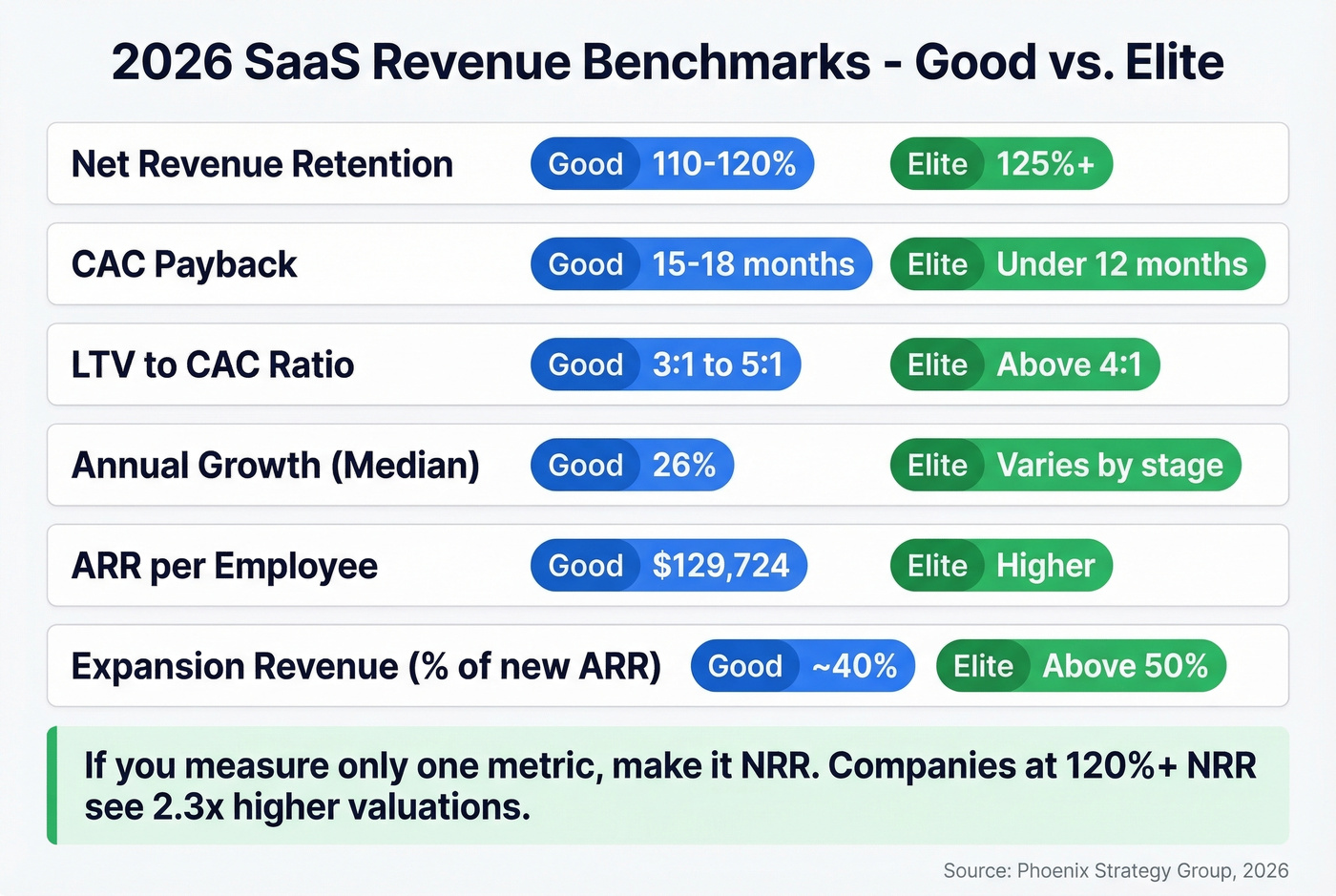
| Metric | Good | Elite |
|---|---|---|
| Net Revenue Retention | 110-120% | 125%+ |
| CAC Payback | 15-18 months | <12 months |
| LTV:CAC | 3:1-5:1 | >4:1 |
| Annual Growth | 26% (median) | Varies by stage |
| ARR per Employee | $129,724 | Higher |
| Expansion Revenue | ~40% of new ARR | >50% |
Growth expectations shift dramatically by stage. Companies under $1M ARR should be growing around 100%. Between $1M-$10M, 60-80% is the target. Above $50M, 20-30% is strong.
If you measure only one metric, make it NRR. Top performers at 120%+ NRR see 2.3x higher valuations. A 1% reduction in churn can increase company valuation by up to 15%. NRR tells you whether your existing customer base is growing or shrinking without any new sales - it's the purest signal of revenue engine health.
Mistakes That Kill Revenue Growth
Customer concentration risk. If one customer represents 20%+ of revenue, you're one cancellation away from a crisis. The founder case study above proves this isn't theoretical.
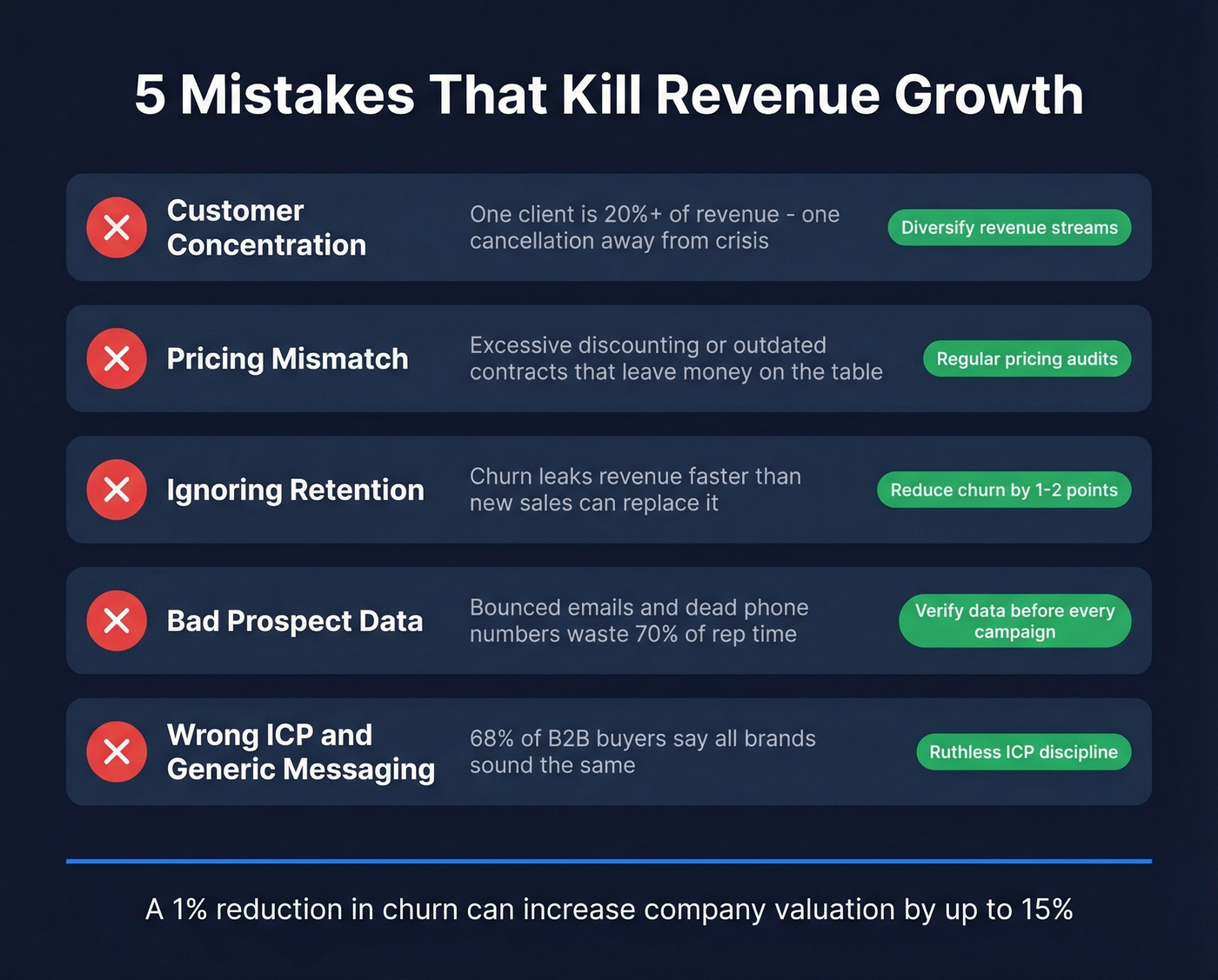
Pricing mismatch. Excessive discounting to win deals undermines perceived value and starves reinvestment. Outdated contracts that don't reflect current value delivered are just as bad.
Ignoring retention and expansion. Churn is a silent killer. Weak support, unresolved disputes, and no proactive expansion motion create steady revenue leakage that new sales can't outrun.
Bad prospect data. Reps already spend 70% of their time on non-selling activities. When a big chunk of emails bounce and phone numbers are disconnected, you're compounding the problem. Verify prospect data before every campaign - tools like Prospeo give you verified emails to start, with a free tier that doesn't require a sales call.
Wrong ICP and generic messaging. 68% of B2B buyers say brands all sound the same (Dentsu). If your messaging is indistinguishable, your efforts are invisible. New tools don't fix bad habits - they just make bad habits faster. If you're targeting the wrong accounts with templated outreach and no follow-up cadence, more volume just burns your domain reputation.
Building a Revenue Engine
A revenue engine isn't a tool - it's an architecture. We think about it in four layers, each dependent on the one below.
Layer 1: Intelligence foundation. Your revenue engine is only as good as your data. If a big chunk of your emails bounce and your phone numbers are disconnected, every layer above this one fails. Meritt tripled pipeline from $100K to $300K/week after switching to verified data with 98% email accuracy. Bounce rates dropped from 35% to under 4%. Clean data isn't a nice-to-have; it's the foundation everything else sits on.
Layer 2: Precision targeting. Account scoring, intent signals, and ICP fit analysis. You're narrowing from "everyone who could buy" to "the accounts showing buying behavior right now." This is where the 95/5 rule becomes actionable - you can't market to all 95%, but you can identify the 5% that's in-market and focus your resources there.
Layer 3: Orchestrated execution. B2B marketing now manages 10+ channels on average. Coordination across them is the difference between a coherent buying experience and noise. This layer is where your messaging, sequencing, and channel strategy come together - or fall apart.
Layer 4: Continuous optimization. Feedback loops from closed-won and closed-lost back into targeting and messaging. This is where most teams stall. They build layers 1-3 and then never close the loop, so the same mistakes repeat quarter after quarter.
Cross-functional revenue generation only works when every team shares accurate contact data. Prospeo's CRM enrichment returns 50+ data points per contact at a 92% match rate - plus intent signals across 15,000 topics to find the 5% actually in-market right now.
Turn your revenue framework into booked meetings with data that connects.
FAQ
What's the difference between revenue and profit?
Revenue is total income from sales before any costs are subtracted - the top line. Profit is what remains after deducting expenses like COGS, operating costs, and taxes. A company can generate millions in revenue and still lose money if expenses exceed income.
What are examples of revenue-generating activities?
Selling products or services, subscription renewals, upselling existing customers, licensing IP, affiliate commissions, and usage-based fees are all common examples. For most B2B companies, 73% of revenue comes from existing customers through renewals and expansion - not new logos.
How does better data improve revenue generation?
Verified contact data means fewer bounced emails, more live conversations, and shorter sales cycles. Meritt saw pipeline triple from $100K to $300K/week after switching to verified data, with bounce rates dropping from 35% to under 4%. Clean data compounds - every layer of your revenue engine performs better when the foundation is accurate.
What's the most important revenue metric to track?
Net Revenue Retention. Companies with 120%+ NRR see 2.3x higher valuations. It measures whether your existing customer base is growing or shrinking without new sales - the purest signal of whether your revenue engine is healthy or leaking.