

ICP Sales Strategy: The Scoring Rubric and Playbook Most Teams Skip
Pull up your closed-lost report from last quarter. A good chunk of those deals were accounts that never fit your ICP in the first place. With only 22% of leads reaching MQL and 7% of opportunities converting to closed-won, a weak ICP sales strategy isn't a positioning problem - it's a math problem.
What You Need (Quick Version)
- Build your ICP from your top 20% of customers by revenue and retention - not from aspirations.
- Score every account on a 100-point rubric and tier them A/B/C.
- Encode tiers in your CRM with routing SLAs - Tier A gets a call within 5 minutes, not a drip sequence.
What an ICP Actually Is (and Isn't)
An ICP is a company-level profile describing the accounts most likely to buy, stay, and expand. It's not a buyer persona - that's the individual, like the VP of Ops who signs off. And it's not your TAM, which covers every company that could theoretically buy.
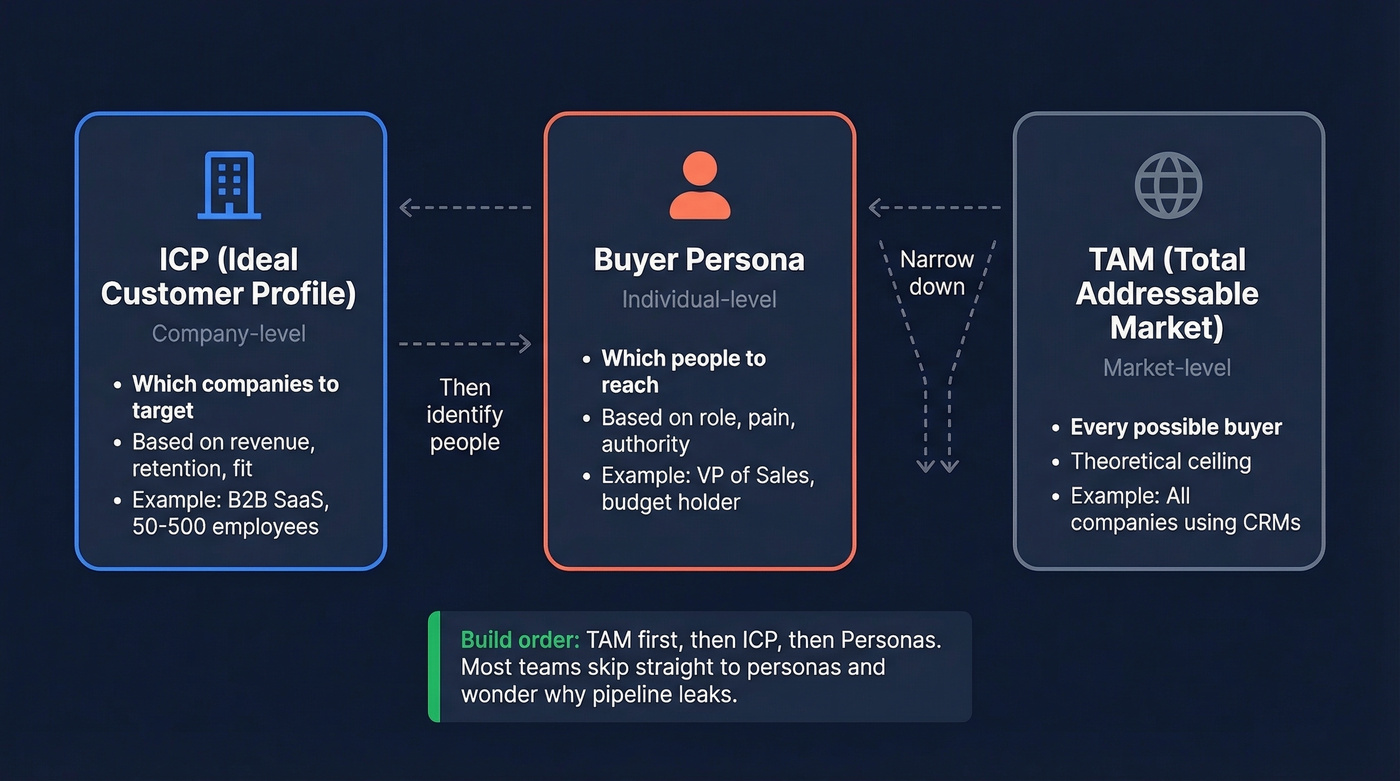
Gartner draws a clear distinction between ICPs (companies), personas (people involved in the purchase), and your target market (every possible company that might buy). The distinction matters because the average B2B buying committee involves five decision-makers. Your ICP tells you which companies deserve attention. Personas tell you which people inside those companies to reach.
One concept most teams skip entirely is the anti-ICP. What defines an account you can't sell to? Disqualifiers like wrong tech stack, no budget authority, or regulatory blockers save more pipeline than refining your ideal profile ever will.
Five ICP Mistakes That Kill Pipeline
Built on gut feel, not win-rate data. If your ICP came from a whiteboard session instead of your CRM's closed-won report, it's fiction.
Stops at firmographics. Industry + company size + revenue is a starting point. Without technographics and intent signals, you're targeting shells.
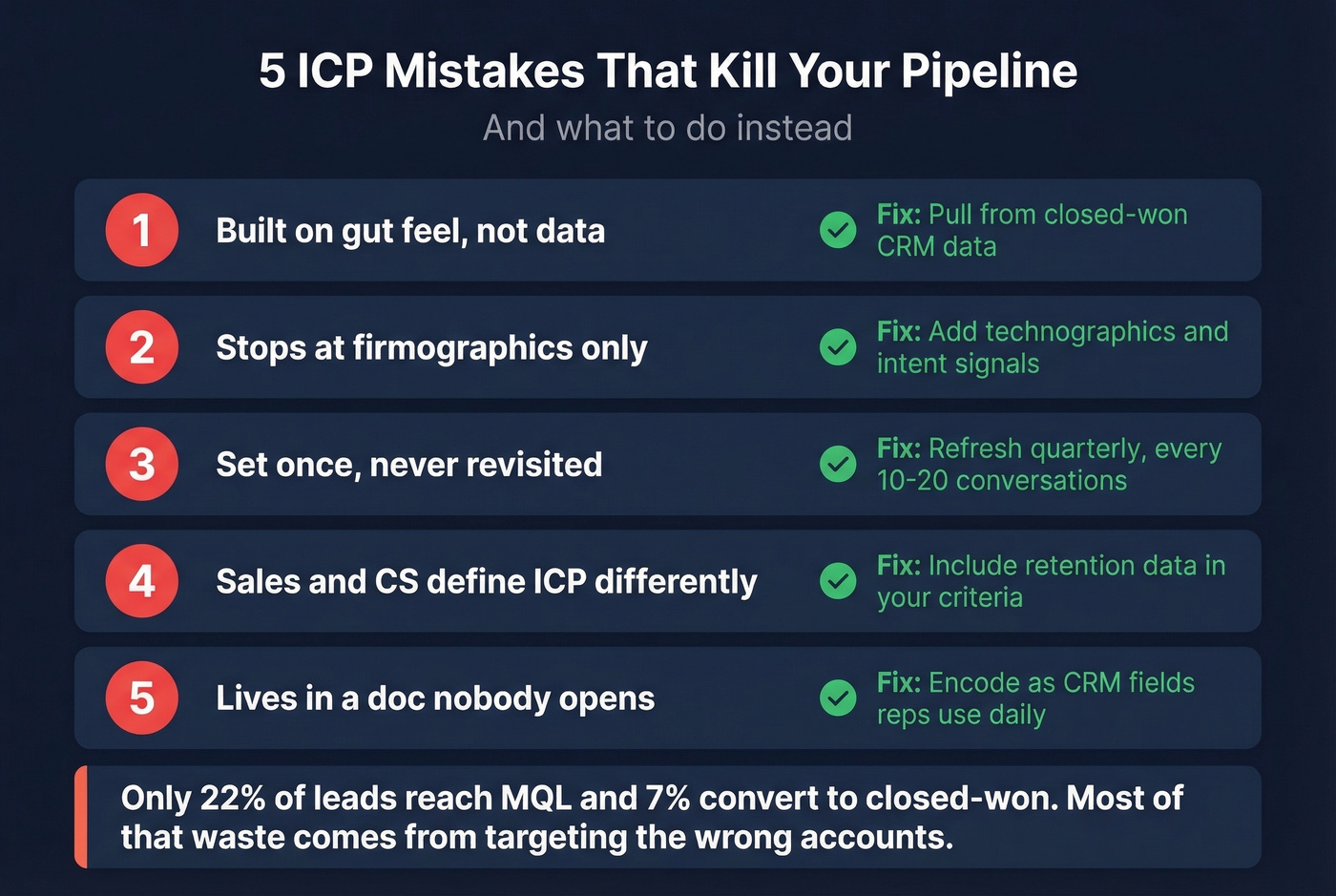
Set once, never revisited. Markets shift. Your product evolves. If you haven't touched your ICP in 6-12 months, it's stale.
Sales/CS misalignment. Sales defines ICP as "who could upgrade." CS defines it as "who actually stays." Include retention data in your criteria or you'll keep closing accounts that churn at month four. (If churn is showing up in your ICP, you need a churn analysis loop, not just better targeting.)
Exists as a doc nobody uses. If reps can't filter by ICP tier in their daily workflow, the ICP doesn't exist. Sales practitioners on r/sales flag this constantly - beautiful ICP decks that never touch the CRM.

Your ICP rubric scores the accounts. But firmographics and technographics are useless without accurate contact data behind them. Prospeo's 30+ search filters - including buyer intent across 15,000 topics, tech stack, and headcount growth - let you operationalize your ICP tiers instantly. 98% email accuracy. 7-day data refresh. No contracts.
Stop scoring accounts you can't actually reach.
How to Build Your Ideal Customer Profile
Start with Close.com's no-nonsense workflow: identify your top 20% of customers by revenue and retention, interview 5-10 of them, and build one core ICP. Not three. Not five. One. (If you want a ready-to-use format, use an ideal customer profile template and adapt it to your data.)
From there, the practitioner flow is straightforward:
- Map the core pain your product solves
- Identify who experiences it - users vs. economic buyer (this is where technical buyer vs economic buyer clarity prevents bad targeting)
- Define timing and urgency moments like compliance deadlines, hiring bursts, or quarter-end pushes
- Catalog buying triggers: failed audit, migration, budget refresh (build a system for how to track sales triggers so this stays current)
- Find lookalikes using pain signals like job posts, tool changes, and growth announcements
- Refine every 10-20 conversations
Here's what a filled-out mid-market B2B SaaS ICP looks like:
| Attribute | Criteria |
|---|---|
| Industry | B2B SaaS, FinTech |
| Employees | 50-500 |
| Revenue | $5M-$50M ARR |
| Tech stack | Uses Salesforce + Outreach |
| Trigger | Hired 3+ SDRs in 90 days |
| Pain | Bounce rates above 15% |
| Buying committee | VP Sales, RevOps lead |
| Anti-ICP signal | No dedicated sales team |
The 100-Point Scoring Rubric
This is the piece most ICP guides skip, and it's the piece that actually changes outcomes. A binary "fits / doesn't fit" model wastes your best reps' time on mediocre accounts. A weighted scoring rubric forces prioritization.
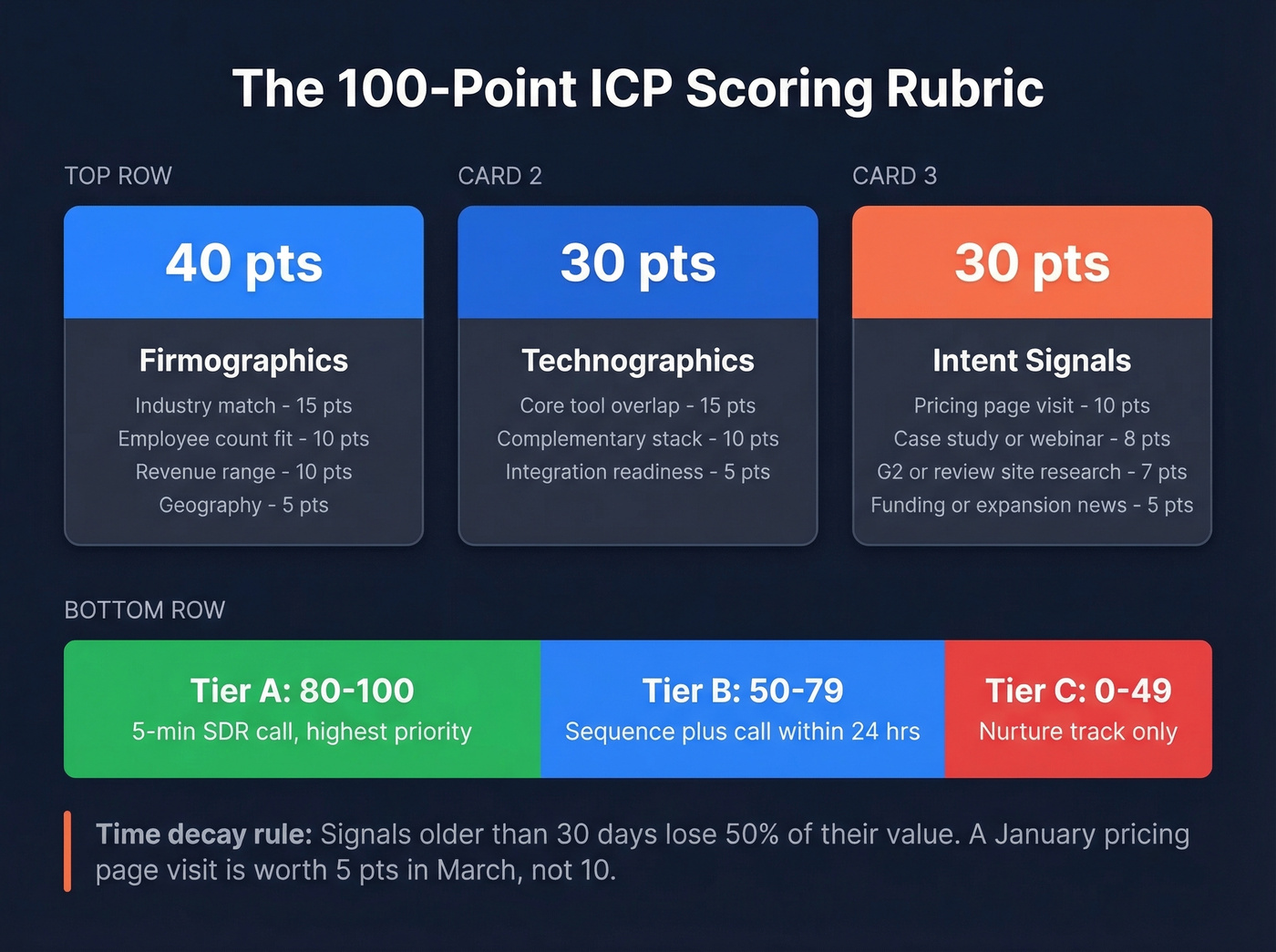
| Category | Weight | Example Criteria |
|---|---|---|
| Firmographics | 40 pts | Size, industry, revenue |
| Technographics | 30 pts | Tech stack overlap |
| Intent Signals | 30 pts | See breakdown below |
Intent signal scoring works like this - pricing page visit earns 10 pts, case study or webinar attendance gets 8 pts, G2/review site research adds 7 pts, and funding or expansion news contributes 5 pts. (If you need a cleaner framework for this, borrow from identifying buying signals and translate it into points.)
Tier thresholds: A = 80-100, B = 50-79, C = 0-49. Teams using tiered scoring consistently report Tier A win rates 1.5-2x higher than Tier B, with 15-20% shorter sales cycles. In our experience, the critical rule most teams miss is time decay. Signals older than 30 days should lose 50% of their value. A pricing page visit from January means nothing in March.
Here's the thing: if your average deal size is under $15k, you probably don't need a 100-point rubric. A simple 3-question checklist - right industry, right size, active buying signal - will outperform a complex model that nobody maintains. The rubric matters when deal sizes justify the overhead.
Operationalize Tiers in Your CRM
A scoring model that lives in a spreadsheet is barely better than no model at all.
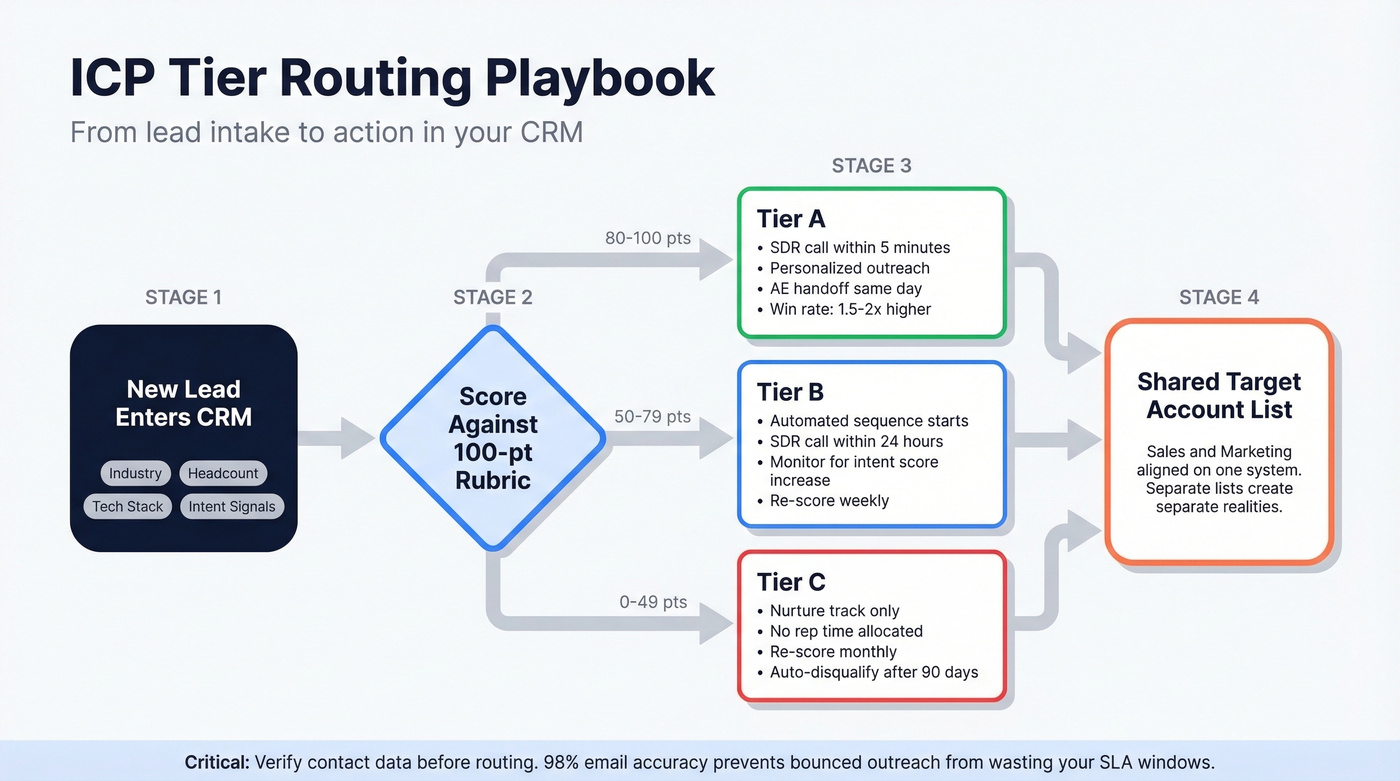
You need CRM fields that make ICP tiers actionable: employee bands, revenue bands, standardized industry picklists, tech stack fields, and intent signal tracking. Route by tier with clear SLAs - accounts scoring 80-100 get an SDR call within 5 minutes, accounts at 60-79 enter a sequence plus call within 24 hours, and everything below 60 goes to a nurture track. Run one shared target account system across sales and marketing. Separate lists create separate realities, and that's how marketing ends up nurturing accounts sales already disqualified. (If your team is still debating the basics, align on examples of a CRM setups that support routing and scoring.)
Early intent-based outreach lifts win rates 35-50%, which is why your intent signals checklist should cover pricing page visits, competitor research, review site engagement, technographic changes, funding events, and hiring surges. (This is also where intent based segmentation keeps marketing and sales from working different definitions of “hot.”)
We've seen teams build perfect scoring models only to have them collapse because bounce rates quietly wreck deliverability and reply rates. Prioritizing accounts you can't actually reach defeats the purpose. Prospeo's 98% email accuracy and 7-day data refresh cycle close that gap - filter by buyer intent across 15,000 topics, layer in technographics and headcount growth, and export a verified list that matches your ICP tiers directly. (If you're seeing bounces, fix the root cause with email bounce rate benchmarks and remediation.)

Tier A accounts deserve Tier A data. Prospeo matches your ICP criteria across 300M+ profiles with verified emails and 125M+ direct dials - so your 5-minute SLA actually connects reps to decision-makers. At $0.01 per email, even SMB teams can run enterprise-grade ICP execution.
Turn your ICP tiers into booked meetings, not bounced emails.
FAQ
ICP vs. Buyer Persona - What's the Difference?
An ICP defines which companies to target; a buyer persona defines which people inside those companies to reach. You need both - the ICP aims, the persona connects. Build the company-level profile first, then layer in persona-level messaging once you've confirmed the account is worth pursuing.
How Often Should You Revisit Your ICP?
Quarterly at minimum, and after every 10-20 sales conversations. If your product roadmap or competitive landscape has shifted, your profile is already stale. Teams that refresh quarterly see 15-20% higher pipeline accuracy than those who set it once a year.
How Do You Find Contacts at ICP-Matched Accounts?
Use a B2B data platform with 30+ filters for firmographics, technographics, and buyer intent, then verify emails before outreach. Skip this step if you're comfortable with 15%+ bounce rates tanking your domain reputation - otherwise, verification isn't optional.