

Revenue Lifecycle Management: What It Is, What It Costs, and Whether You Actually Need It
Your Salesforce AE just told you CPQ is going away. Now you're staring at a ~$200/user/month quote for Revenue Cloud Advanced, wondering whether this revenue lifecycle management thing is a genuine upgrade or just a rebrand with a bigger price tag. You're not alone - more than half of enterprises still run manual processes to integrate quotes and contracts, and the average company leaks 5-9% of contract value through handoff errors between quoting, billing, and renewals.
Most guides on this topic are vendor marketing pages dressed up as education. This isn't that.
The Short Version
RLM unifies quoting, contracting, billing, and renewals into one platform - replacing CPQ plus a stack of point solutions. Budget $150-250/user/month for enterprise platforms and around 2-6 months of implementation. Before you buy anything, fix your CRM data. An RLM platform automating stale contacts is just automating revenue leakage.
What Is RLM?
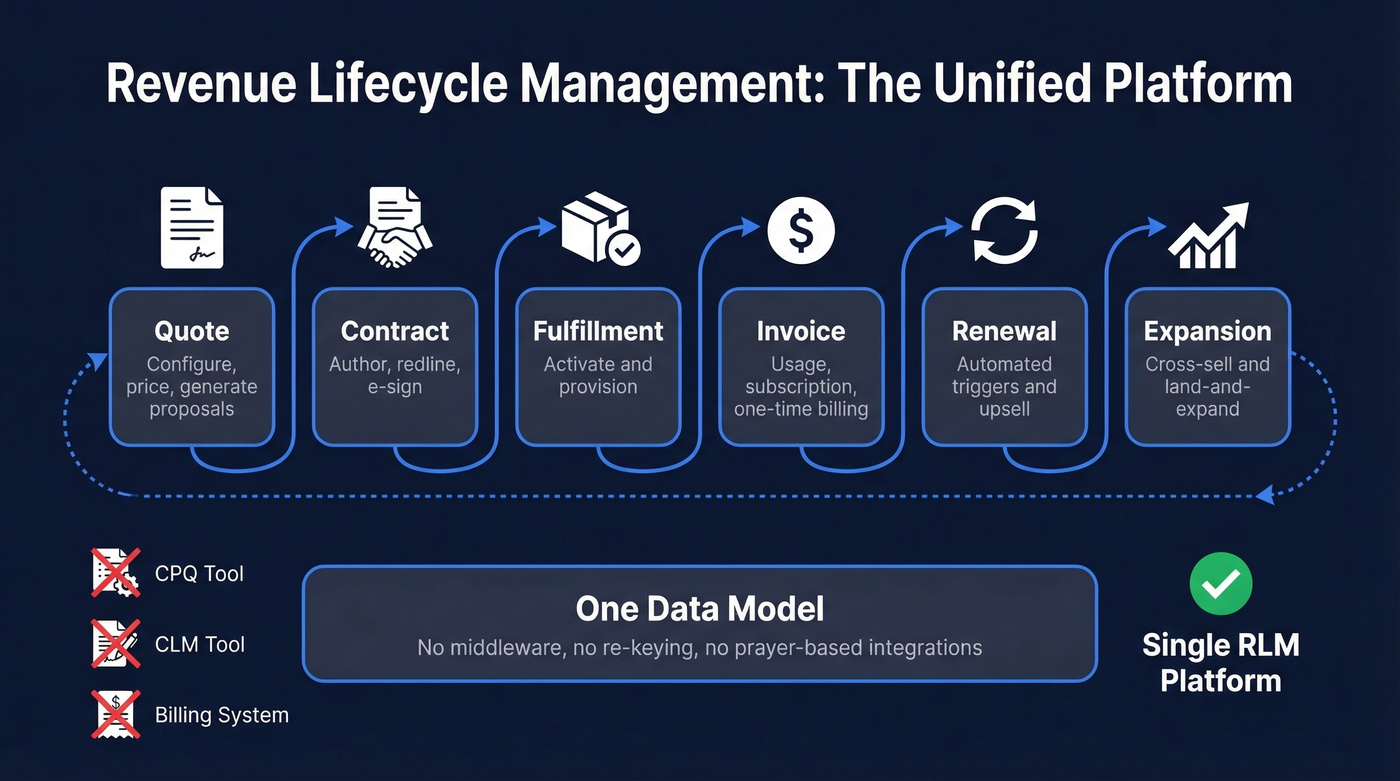
ISG defines revenue lifecycle management as a unified platform connecting customer-facing teams across the entire revenue journey: quote, contract, fulfillment, invoicing, renewal, and expansion. The key word is unified. Instead of stitching together a CPQ tool, a CLM tool, a billing system, and a renewal tracker with middleware and prayers, RLM puts it all on one data model.
Three terms get confused constantly, and they shouldn't:
- RLM is a software platform covering the full quote-to-renewal cycle.
- Revenue Cycle Management (RCM) is a healthcare billing term - completely different industry.
- Revenue Operations (RevOps) is an organizational model for aligning sales, marketing, and CS - a team structure, not a software category.
RLM platforms typically bundle CPQ for quoting, CLM for contract authoring and redlining, billing engines that handle usage-based, subscription, and one-time models with ERP integration, subscription and renewal management with automated upsell triggers, and revenue recognition modules for ASC 606/IFRS 15 compliance .
The "true RLM" promise is that important terms get digitized and stored within documents - so when a contract says "net-60 with 3% early-pay discount," the billing system actually knows that without someone re-keying it.
Why RLM Matters Now
Salesforce CPQ entered end-of-sale in March 2025, pushing thousands of orgs to evaluate Revenue Cloud Advanced. That's the proximate trigger. But the underlying pressure has been building for years.
CLM implementations recover 2-5% of leaked contract value. Contract cycle times drop 40-55%, and legal review time falls 50-70% when you move from email-based redlining to structured workflows. Gartner predicts that by 2026, 75% of the highest-growth companies will have a dedicated RevOps function, and the global RevOps market is projected to hit $16.98B by 2033. RLM is the software layer that makes RevOps operational - without it, you've got a cross-functional team staring at disconnected spreadsheets.
RLM vs. CPQ vs. RevOps
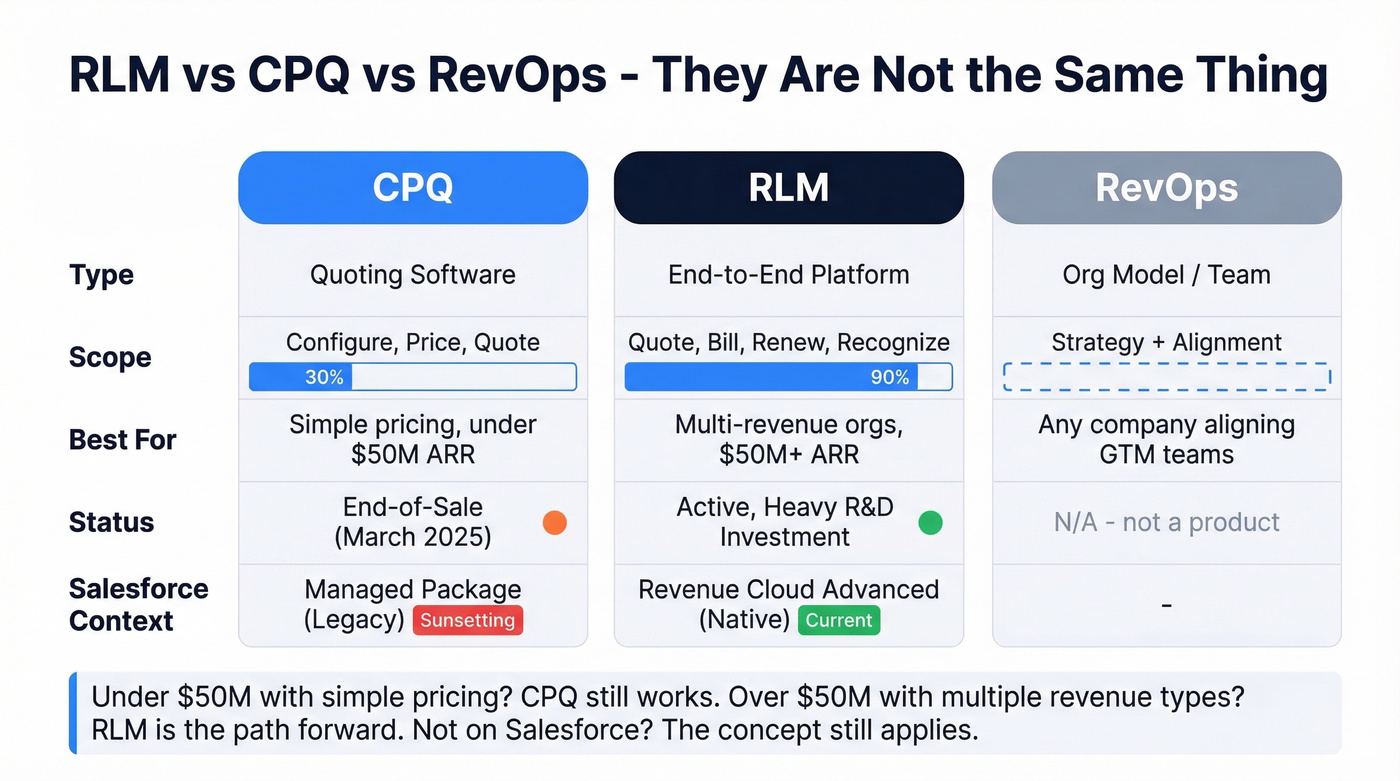
| CPQ | RLM | RevOps | |
|---|---|---|---|
| What it is | Quoting software | End-to-end platform | Org model / team |
| Scope | Configure, Price, Quote | Quote, Bill, Renew, Recognize | Strategy + alignment |
| Salesforce version | Salesforce CPQ (managed package) | Revenue Cloud Advanced (native on Einstein 1 Platform) | Not a product |
| Status | End-of-sale (March 2025) | Active, heavy R&D investment | N/A |
| Best for | Simple pricing, <$50M ARR | Multi-revenue orgs, $50M+ ARR | Any company aligning GTM teams |
In the Salesforce ecosystem, CPQ was a managed package bolted onto the platform with its own data model. Revenue Cloud Advanced is built natively on the Einstein 1 Platform - shared objects, a configurable pricing waterfall, and Dynamic Revenue Orchestration with SLA tracking that CPQ couldn't support.
Salesforce CPQ's estimated end-of-life is ~2029-2030. If you're on CPQ today, you've got runway - but not infinite runway. Migration timelines run 4-12 weeks depending on complexity.
Here's the thing: if you're on Salesforce doing $50M+ ARR with multiple revenue types, a unified revenue platform is the path forward - stop debating it. If you're under $50M with simple pricing, CPQ still works and the migration can wait. And if you're not on Salesforce at all, the CPQ-to-RLM migration story doesn't apply to you, but the concept of replacing point solutions with one quote-to-renewal system is vendor-agnostic.

You said it yourself: an RLM platform automating stale contacts just automates revenue leakage. Prospeo's 7-day data refresh cycle and 98% email accuracy ensure the contacts flowing into your quote-to-renewal pipeline are real buyers - not bounced addresses draining your sender reputation.
Clean data in, clean revenue out. Fix the foundation before you automate.
What RLM Actually Costs
Here's what we've pinned down from community discussions, partner estimates, and published tiers:
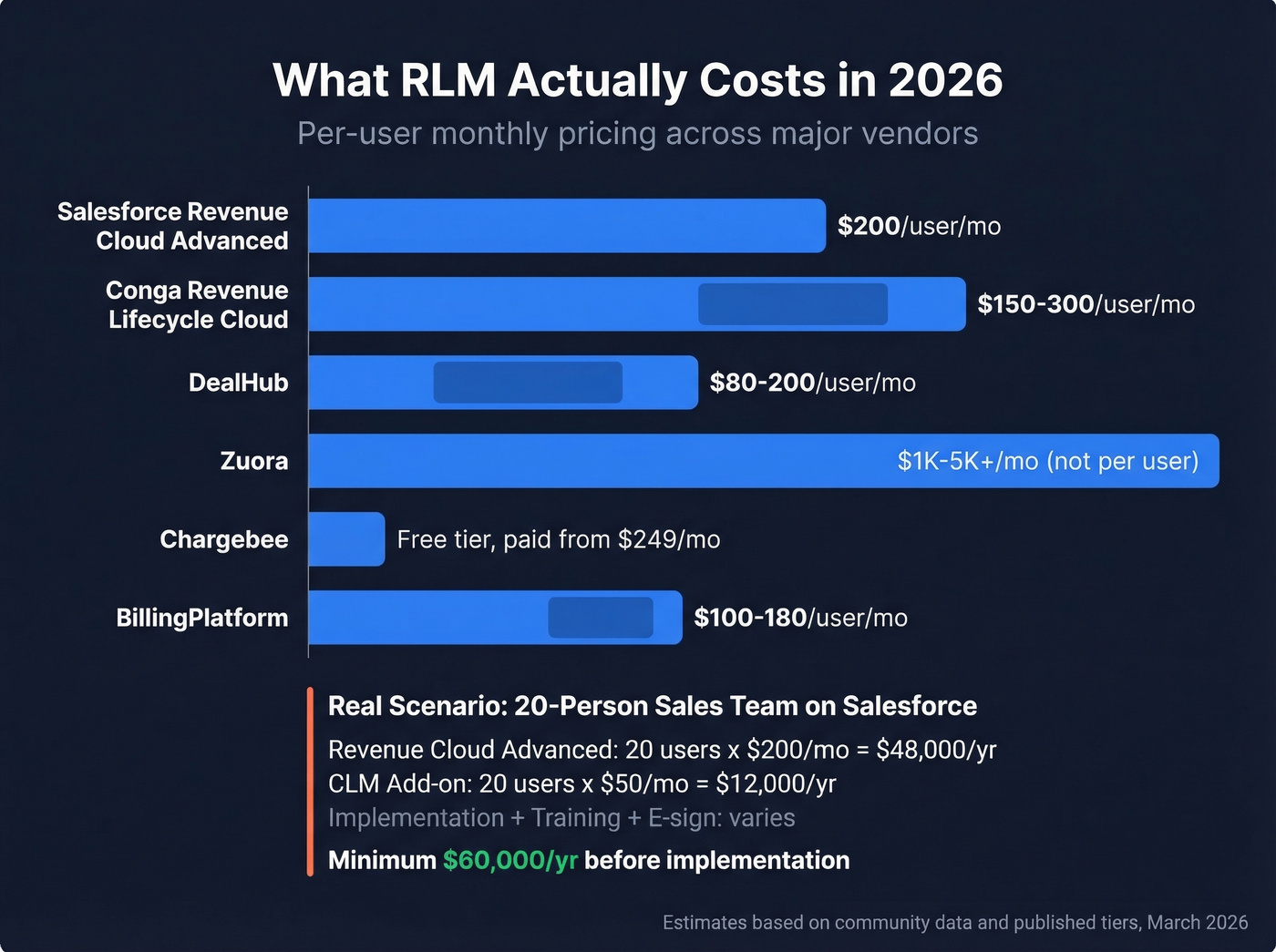
| Vendor | Pricing | Implementation | Best For |
|---|---|---|---|
| Salesforce Revenue Cloud Advanced | ~$200/user/mo | 4-12 weeks | Salesforce-native orgs |
| Salesforce CLM add-on | ~$50/user/mo | Usually part of the same project | Contract management layer |
| Conga | $150-300/user/mo (est.) | ~4 months | Multi-revenue-type orgs |
| DealHub | $80-200/user/mo (est.) | 2-4 months | Mid-market quote-to-revenue |
| Zuora | ~$1K-5K+/mo | 3-6 months | Subscription-first billing |
| Chargebee | Free tier; paid from $249/mo | 2-6 weeks | SaaS subscription billing |
Let's do the math on a real scenario. A 20-person sales team on Salesforce Revenue Cloud Advanced at ~$200/user/month is looking at ~$48,000/year in licensing alone - before implementation, training, or customization. Add the CLM module at ~$50/user/month and you're stacking another ~$12,000/year. That doesn't include the Microsoft 365 and e-signature tools you'll also need. Total cost of ownership climbs fast once you start adding layers.
The Vendor Landscape
Salesforce Revenue Cloud Advanced
The forced migration context is the story here. With CPQ end-of-sale, Salesforce is betting the farm on Revenue Cloud Advanced, which means it gets the lion's share of R&D investment. At roughly $200/user/month, you get native Einstein 1 Platform integration, AI-guided quoting, capabilities that support ASC 606/IFRS 15 compliance, and an end-to-end quote-to-renewal lifecycle. If you're already deep in the Salesforce ecosystem, fighting this current is more expensive than swimming with it.
The migration path from CPQ is well-documented but not painless. Expect 4-12 weeks depending on how much custom Apex you've layered onto CPQ over the years, and budget for a certified implementation partner - this isn't a DIY project for most orgs. Salesforce's own migration guide walks through the technical steps, but the real complexity is in your custom pricing logic and approval workflows.
Conga
The numbers tell the story: 4.3/5 on G2 across 625+ reviews. Conga supports revenue types most platforms can't touch - subscriptions, usage-based, licensing, rentals, direct and indirect sales. Implementation averages about 4 months. Don't underestimate the admin overhead; we've heard from teams that Conga's flexibility is both its strength and its biggest time sink during setup.
DealHub
DealHub is a strong fit when you want CPQ + contract management + subscription quoting without Salesforce lock-in. Skip it if you need deep revenue recognition or complex multi-entity billing - you'll usually end up pairing it with a dedicated billing/rev-rec stack anyway, which defeats the "unified platform" purpose.
Zuora & Chargebee
These are subscription-billing specialists, not full RLM platforms. Zuora handles complex subscription models at scale; Chargebee starts free and scales from $249/month. If your revenue is 90%+ subscription-based and you don't need CLM or CPQ, these are leaner, cheaper options. Don't try to force them into a full quote-to-renewal role - that's like using a screwdriver as a hammer.
What Real Users Are Saying
The Reddit sentiment around Salesforce RLM is cautious. One r/salesforce thread frames it bluntly: RLM is "early in its lifecycle" and requires heavy customization after CPQ migration. Another user implementing CPQ with NetSuite for post-sales discovered Revenue Cloud Advanced requires incremental licensing and additional implementation - their reaction was essentially "is this worth the price and time?"
The cost-stacking perception is real. When an AE quotes $50/user/month for CLM and you realize you also need Microsoft 365 and an e-signature tool, the "unified platform" pitch starts feeling less unified.
In our experience, the pattern repeats: teams buy an RLM platform expecting plug-and-play automation, then spend months on configuration that should've been scoped upfront. The teams that skip scoping spend 2x on configuration. Every time.
The Data Quality Problem Nobody Talks About
Here's the contrarian take most guides won't give you: most mid-market companies don't need revenue lifecycle management software yet. They need better data and fewer tools.
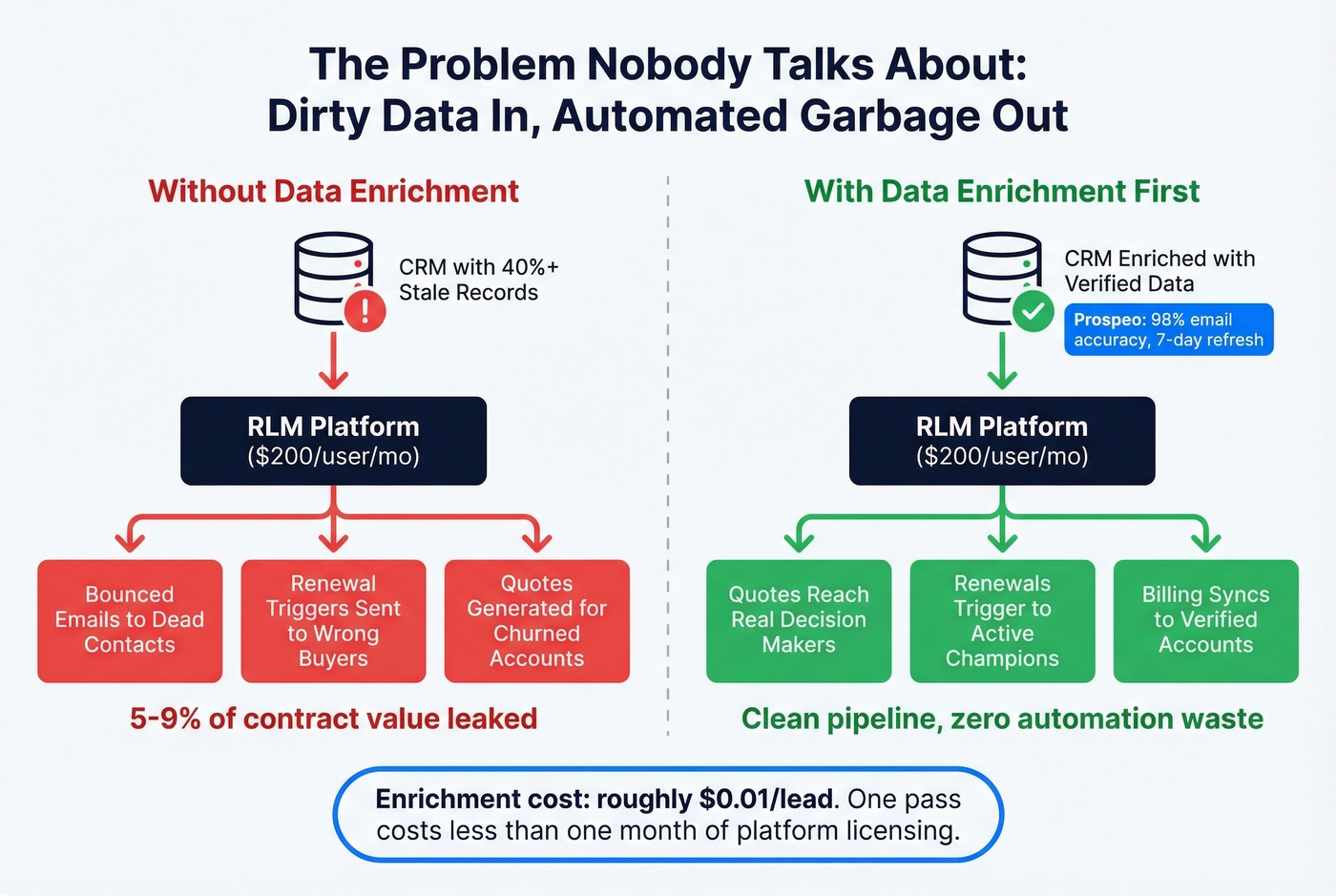
These platforms automate whatever's in your CRM. If your contact records are stale, your emails bounce, and your phone numbers are disconnected, you're automating revenue leakage at $200/user/month. We've run enrichment passes on CRMs with 40%+ stale records - the platform was literally automating bounced emails and dead phone numbers.
Fix the data feeding your system before investing in the automation layer. Prospeo's enrichment API delivers 98% email accuracy with records refreshed every 7 days, and at roughly $0.01/lead, running an enrichment pass on your CRM before an RLM implementation costs a fraction of one month's platform licensing. It's the difference between automating a clean pipeline and automating garbage at enterprise prices.

Decision Framework: Do You Actually Need RLM?
Not every company needs a unified revenue platform. Here's how to think about it based on where you actually sit.
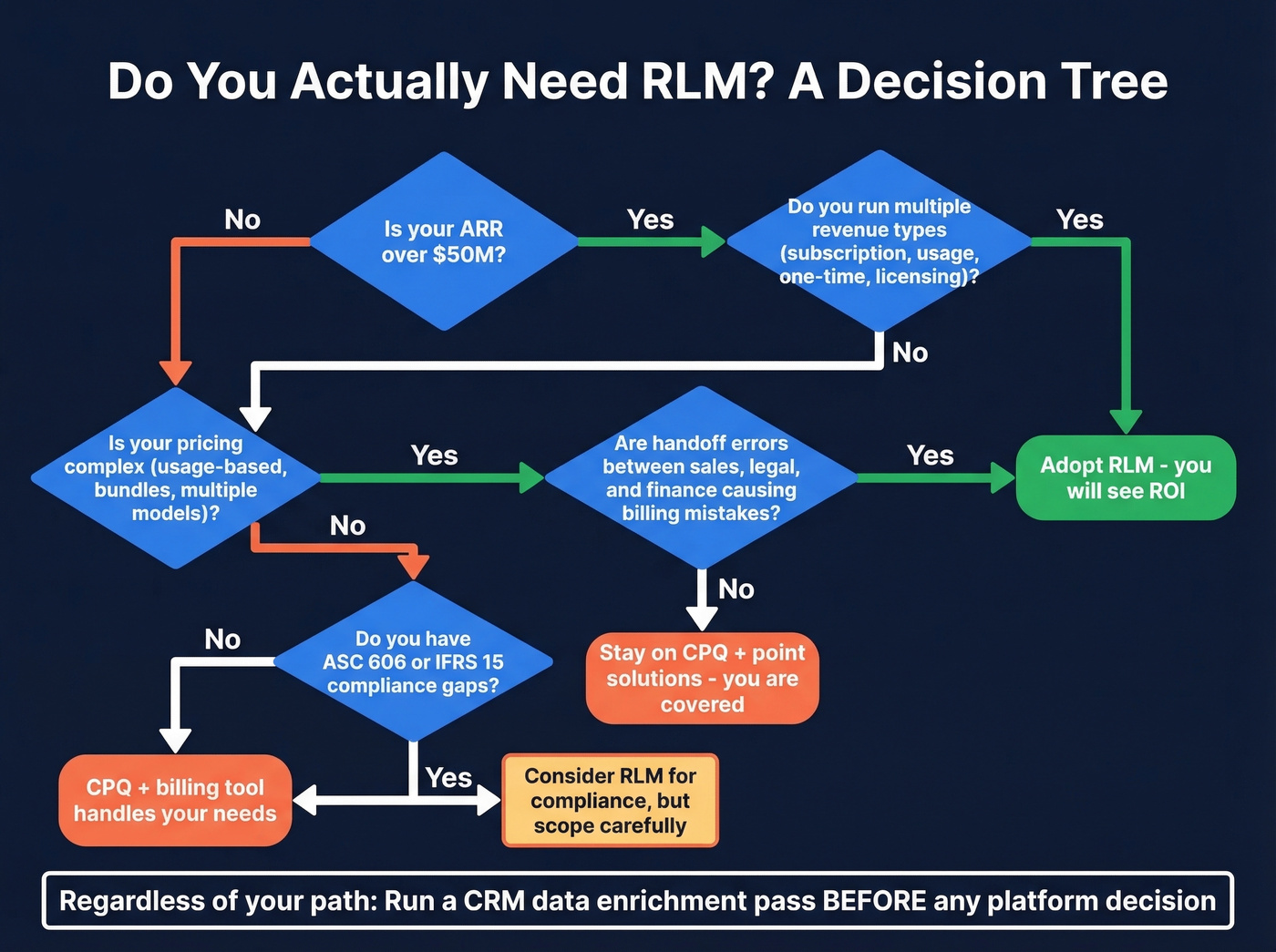
Adopt RLM if:
- You manage complex multi-product pricing with bundled discounts and usage components
- Your ARR exceeds $50M and you're running multiple revenue types
- Cross-functional handoffs between sales, legal, and finance cause billing errors or missed renewals
- You have ASC 606/IFRS 15 compliance requirements your current stack can't handle
- Contract cycle times exceed 30 days and legal review is a bottleneck
Stay on CPQ + point solutions if:
- Your pricing is straightforward - flat-rate or simple tiered
- You're under $50M ARR with one primary revenue model
- Your current CPQ + billing tool covers 80% of your needs
- You don't have the admin bandwidth for a 2-6 month implementation
For teams in either camp, run your CRM through a data enrichment pass before making any platform decisions. Clean data makes every tool work better - and it exposes whether your real problem is software or data quality.
Before you spend $48K/year on Revenue Cloud licensing, make sure your 20-person sales team is actually reaching decision-makers. Prospeo gives you 300M+ verified profiles with 30+ filters - buyer intent, job changes, funding signals - at $0.01 per email. That's 90% cheaper than ZoomInfo.
Stop piping dead leads into a $200/user/month platform.
FAQ
What's the difference between RLM and CPQ?
CPQ handles product configuration, pricing rules, and quote generation - one stage of the revenue cycle. RLM covers the entire lifecycle: contracting, billing, subscriptions, renewals, and revenue recognition. Think of CPQ as one module within a broader RLM platform.
How much does RLM software cost?
Enterprise platforms like Salesforce Revenue Cloud Advanced run ~$200/user/month. Budget $150-250/user/month for enterprise tools, plus 2-6 months of implementation. Subscription-focused tools like Chargebee start much lower, from $249/month for paid tiers.
Is Salesforce CPQ being discontinued?
Salesforce CPQ entered end-of-sale in March 2025 - it's no longer sold to new customers. Existing orgs can continue using it until estimated end-of-life around 2029-2030. New customers are directed to Revenue Cloud Advanced.
What ROI can you expect from RLM?
Industry benchmarks show 40-55% reduction in contract cycle times, 2-5% recovery of revenue leakage on a 5-9% baseline, and 50-70% reduction in legal review time. For a company doing $100M in contracts, recovering even 2% of leakage is $2M annually - that pays for the platform many times over.
What should you do before buying an RLM platform?
Audit your CRM data quality first. Check email bounce rates, contact freshness, and title accuracy. If more than 15-20% of your records are stale, fix that before spending on automation. A clean CRM makes implementation faster, adoption smoother, and ROI measurable from day one.