

Revenue Operations: The Guide Nobody Gave You on Day One
You just got promoted to Head of RevOps. Or maybe you're the first revenue operations hire at a company that's been running sales ops, marketing ops, and CS ops as three separate fiefdoms with three separate spreadsheets. Either way, nobody handed you a playbook.
In 2023, LinkedIn ranked Head of Revenue Operations as the #1 fastest-growing job in the US, with salaries ranging from $70K to $300K. But here's the tension: Gartner predicted that by 2026, 60% of B2B organizations would fail to build a functioning end-to-end revenue process and revert to silos. We're living that prediction right now, and a lot of teams are running straight into it.
The gap between "fastest-growing title" and "most likely to fail" is where this guide lives.
RevOps isn't rebranded Sales Ops. It's an operating model that unifies sales, marketing, and CS under shared data, shared metrics, and shared accountability. If you just got the title, start with the maturity model. If you're building the business case, jump to the ROI numbers. If your data's broken, go straight to the tech stack.
What Is Revenue Operations?
It's the function that owns the systems, data, processes, and analytics across the entire customer lifecycle - from first touch through renewal. It doesn't just "align" sales, marketing, and customer success. It operates the connective tissue between them.
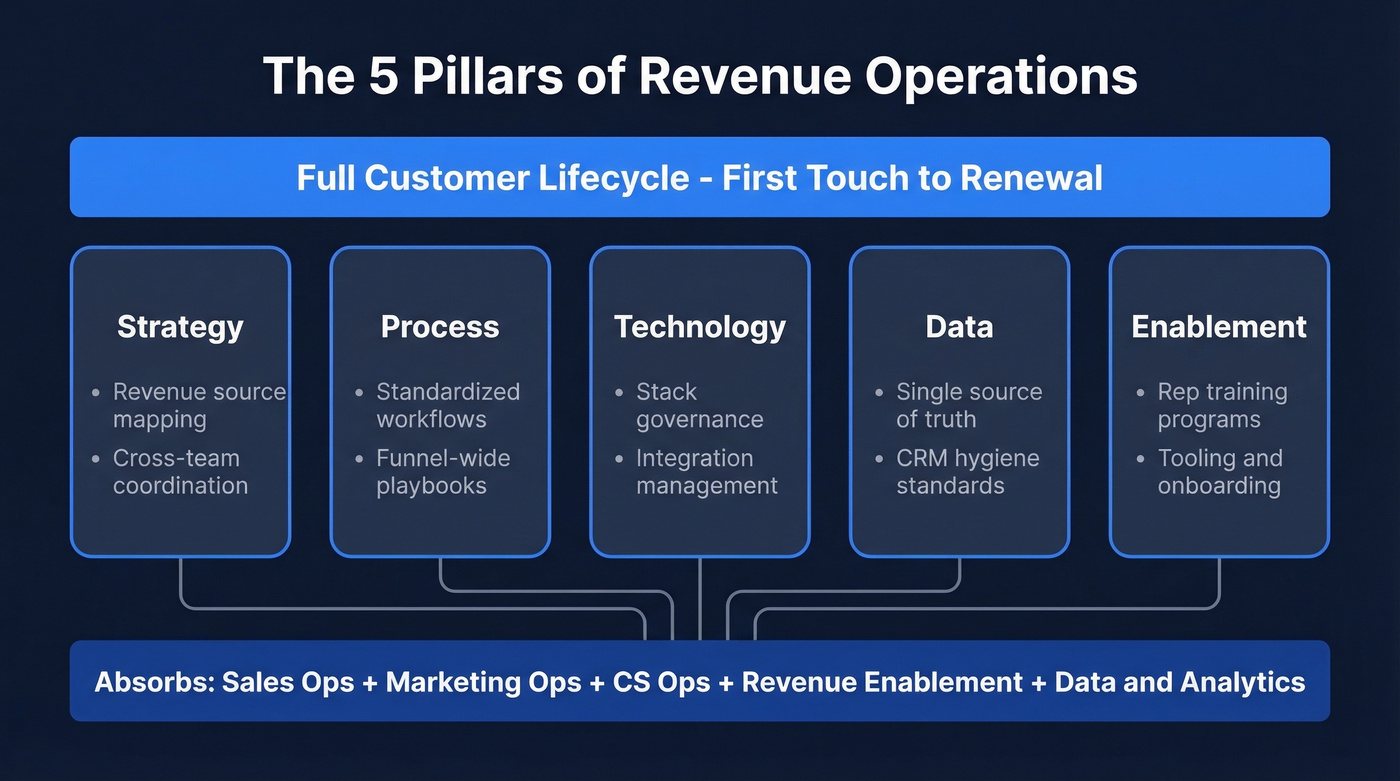
The clearest definition comes down to five pillars: Strategy - where revenue comes from and how teams coordinate to capture it. Process - standardized workflows across the funnel. Technology - the stack and its integrations. Data - a single source of truth everyone trusts. Enablement - training and tooling that makes reps productive. These aren't theoretical categories. They map directly to what RevOps teams actually spend their weeks on.
In practice, RevOps absorbs five functions that used to operate independently: Sales Ops, Marketing Ops, Customer Success Ops, Revenue Enablement, and Data & Analytics.
The Revenue Enablement Institute publishes a report that includes 12 distinct capabilities showing up in RevOps job descriptions, mapped across a 36-point maturity model. That level of specificity tells you something - this is an operational discipline with defined outputs, not a vague "alignment" play.
The mistake most companies make is treating the function as a title change. They rename the Sales Ops manager, give them a Slack channel called #revops, and call it done. That's not RevOps. That's a rebrand with no structural change.
The RevOps Business Case
Let's talk numbers, because this is the slide your CFO actually cares about.
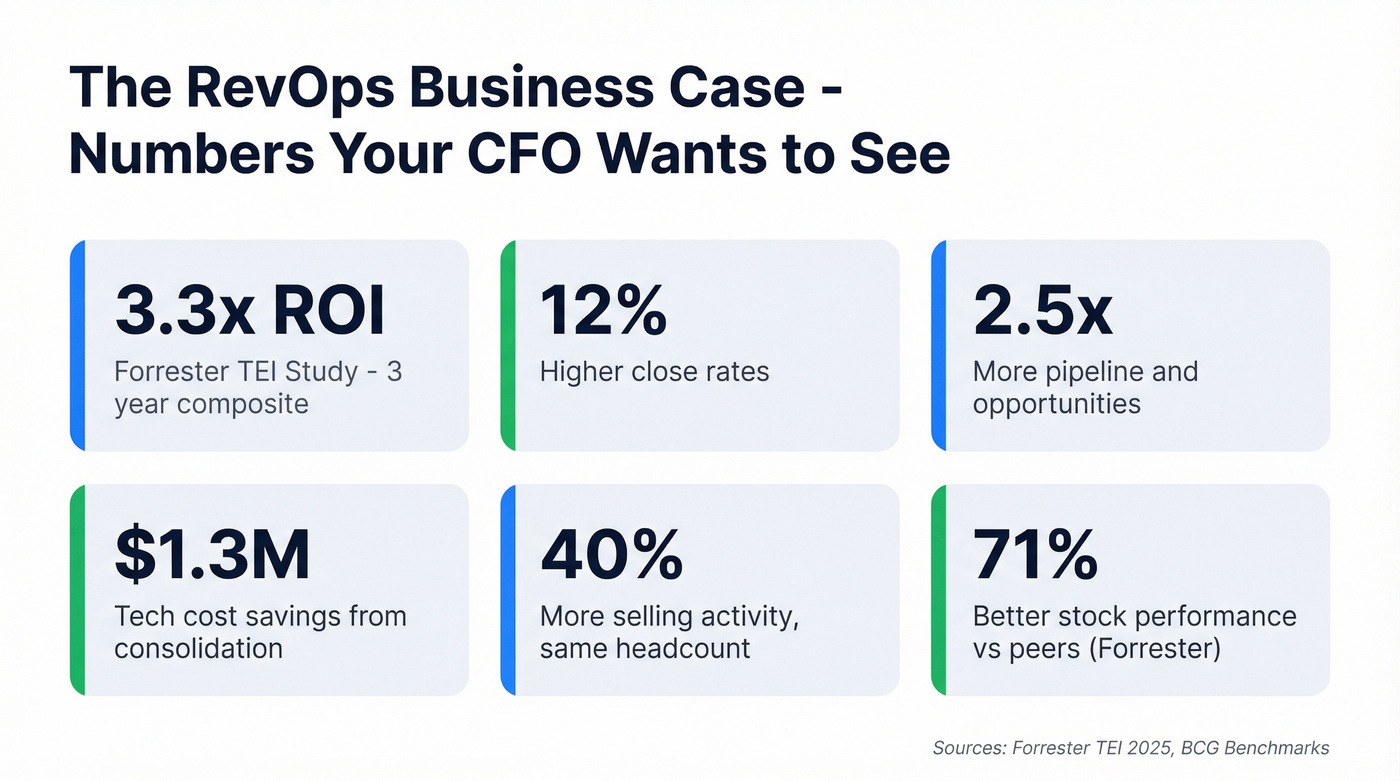
A Forrester TEI study - commissioned by Salesloft but modeled on a composite $7B enterprise with a 1,500-person revenue org over three years - found striking results: 3.3x ROI, 12% higher close rates, 2.5x more pipeline and opportunities, $1.3M in tech cost savings through consolidation, and 40% more selling activity without adding headcount. One interviewee cited $75M in new business pipeline generated and roughly $10M ACV closed.
BCG's benchmarks put the sales productivity lift at 10-20% for companies that centralize revenue ops properly. Forrester's broader research on revenue alignment shows 71% better stock performance, 19% faster growth, and 15% higher profits compared to peers.
These aren't small numbers. And most of the ROI comes from eliminating waste - duplicate tools, manual data entry, misrouted leads, pipeline that stalls because nobody owns the handoff between marketing and sales. RevOps doesn't generate revenue directly. It removes the friction that prevents revenue teams from hitting their ceiling.
Here's the thing: if your deal sizes sit below $10K and your sales cycle wraps up inside 30 days, you probably don't need a dedicated RevOps function yet. A sharp sales ops person with cross-functional authority will get you 80% of the way there. The discipline becomes essential when the complexity of your go-to-market motions outgrows any single team's ability to manage the data and handoffs.
RevOps vs Sales Ops
This distinction matters more than most people think. It comes down to scope and reporting structure.
| Dimension | Sales Ops | RevOps |
|---|---|---|
| Scope | Sales funnel | Full lifecycle |
| Metrics owned | Quota, pipeline | CAC, NRR, LTV, velocity |
| Reports to | VP Sales | CRO or CEO |
| Lifecycle coverage | Lead to close | First touch to renewal |
| Data ownership | CRM fields | Unified data model |
Sales Ops optimizes the sales team. Revenue operations optimizes the revenue engine. When Sales Ops reports to the VP of Sales, every decision gets filtered through "does this help my reps close?" That's fine for sales productivity, but it creates blind spots in marketing attribution, CS handoffs, and expansion revenue. RevOps sits above those silos.
A clean way to summarize it: Sales Ops is a seat at the table. RevOps owns the table.
RevOps Org Structure
How you structure the function determines whether it actually works or just becomes another layer of bureaucracy.
Who RevOps Reports To
About 30.4% of RevOps teams report to the CRO, and 25.6% report directly to the CEO. In practice, reporting to a CRO or directly to the CEO/COO is what preserves neutrality and gives the team authority to enforce standards across sales, marketing, and CS.
If your company doesn't have a CRO, report to the CEO or COO. The CFO can work too, especially if they're operationally minded. Never the VP of Sales. That kills the cross-functional mandate on day one.
Three Org Models
Centralized puts a single RevOps leader over all ops functions - sales ops, marketing ops, CS ops, analytics. It eliminates turf wars and creates a single owner for data quality, process design, and tool governance.
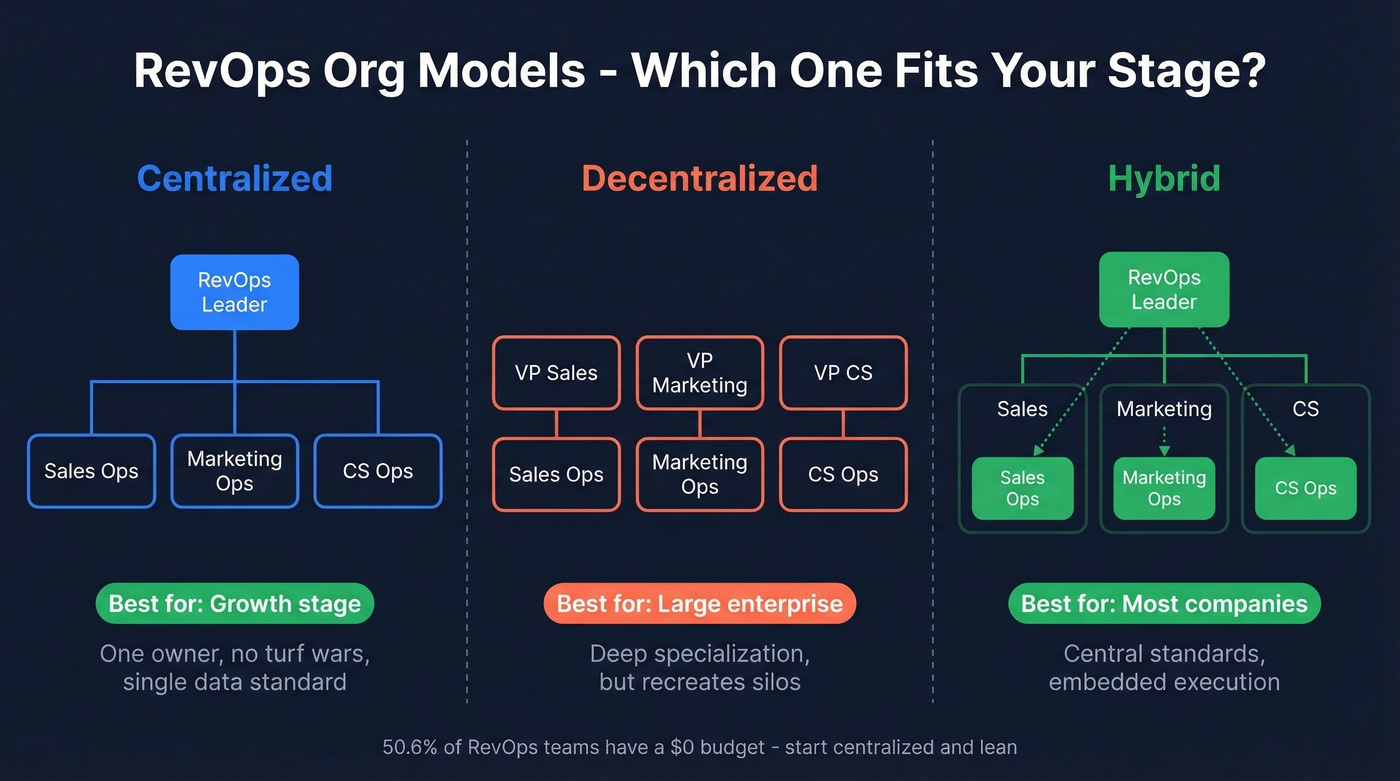
Decentralized embeds ops people within each function. Marketing has their ops person, sales has theirs, CS has theirs. This can work in very large enterprises where each function is complex enough to need dedicated support, but it recreates the silo problem RevOps was supposed to solve.
Hybrid is what we've seen work best for growth-stage companies. A central RevOps leader sets standards, owns the data model, and manages the stack. Embedded ops people execute within their functions but follow centralized playbooks. It's the best of both worlds if - and only if - the central leader has real authority to enforce standards.
The Solo RevOps Reality
Here's the uncomfortable truth: 50.6% of RevOps teams have a $0 budget.
If you're the solo hire with no budget, you're triaging, not building. Focus on CRM hygiene, pipeline reporting, and one integration that eliminates the most manual work. Everything else can wait. Team size scales with revenue complexity - expect 1-2 people at seed or Series A, 3-8 during growth stage, and 10+ at enterprise scale.

RevOps fails when the data model is broken. Prospeo's CRM enrichment returns 50+ data points per contact at a 92% match rate - so your unified revenue engine runs on verified emails, direct dials, and intent signals, not stale records from a 6-week refresh cycle.
Stop triaging bad data. Start operating a revenue engine that works.
The RevOps Tech Stack
The average enterprise RevOps team manages 12-18 tools. Most of them overlap. The enrichment layer is the worst offender - roughly 70% coverage overlap between ZoomInfo and Apollo on US business contacts means teams paying for both are lighting money on fire.
You don't need 15 tools. You need 5 that talk to each other.
Five Stack Categories
| Category | Example Tools | Directional Pricing |
|---|---|---|
| CRM | Salesforce, HubSpot | Salesforce: ~$80-$165/user/mo; HubSpot: free CRM, paid Sales Hub ~$90/seat/mo |
| Engagement | Salesloft, Outreach | ~$100-$150/user/mo |
| Analytics | Gong, Tableau, Looker | Gong: ~$100-$150/user/mo; Tableau: ~$70/user/mo; Looker: ~$3K-$5K/mo |
| Orchestration | Census, Hightouch, Zapier | Free tiers; paid ~$300-$800/mo |
Enrichment Bloat and the Fix
We've seen teams running ZoomInfo, Apollo, Lusha, and a manual research process simultaneously - four sources writing conflicting data into the same CRM fields. The result isn't better coverage. It's a data quality nightmare where nobody trusts any of the numbers.
The consolidation play: pick one primary enrichment provider with high accuracy and a fast refresh cycle, then use waterfall logic for the gaps. Prospeo fits well here - 98% email accuracy, a 7-day data refresh cycle versus the 4-6 week industry average, and native integrations with Salesforce, HubSpot, and orchestration tools like Clay and Zapier. At ~$0.01 per email with no annual contract, it eliminates the budget bloat that comes with enterprise enrichment vendors while keeping data quality high enough that your CRM fields actually mean something.

Warehouse-Centric Architecture
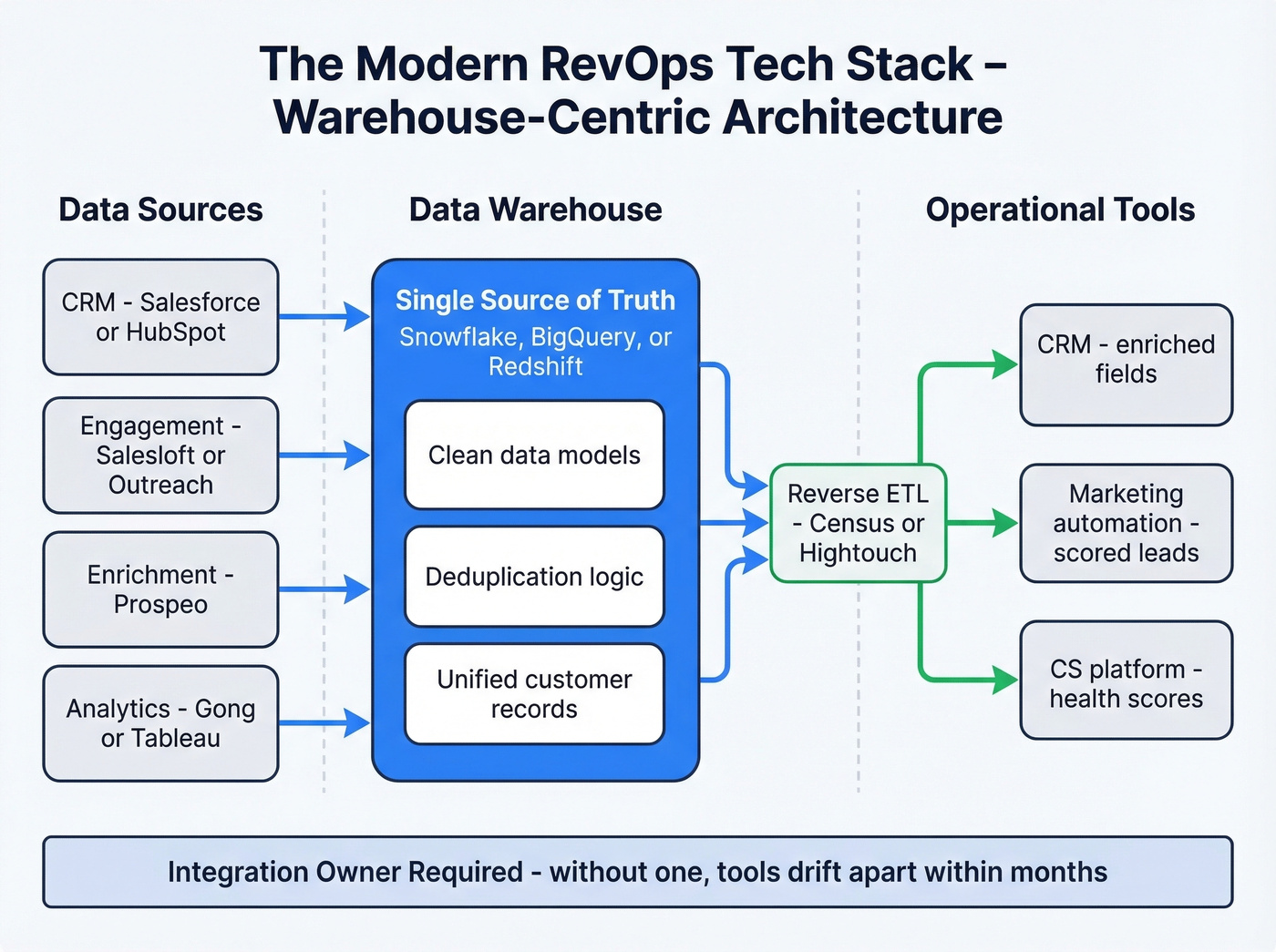
The modern RevOps stack is warehouse-centric. Your data warehouse - Snowflake, BigQuery, Redshift - becomes the single source of truth. Reverse ETL tools like Census or Hightouch push modeled data back into your CRM and operational tools. This architecture means your CRM reflects the warehouse's clean data, not the other way around.
You need an integration owner. Someone who manages the data flows between systems. Without one, tools drift apart within months. Implementations built on this architecture report roughly 18-day shorter sales cycles and about 60% less manual data entry.
One trend worth watching: about 39.8% of RevOps professionals now use AI for mission-critical workflows - lead scoring, forecasting, and automated data hygiene. AI doesn't replace the architecture, but it's accelerating what mature teams can do with clean data.
RevOps Maturity Model
Not every company needs predictive analytics. Most need to get their CRM adoption above 80% first. This 5-level maturity model, adapted from RevPartners' framework, gives you a clear sequence. For enterprises needing more granularity, the Revenue Enablement Institute publishes a 36-point version.
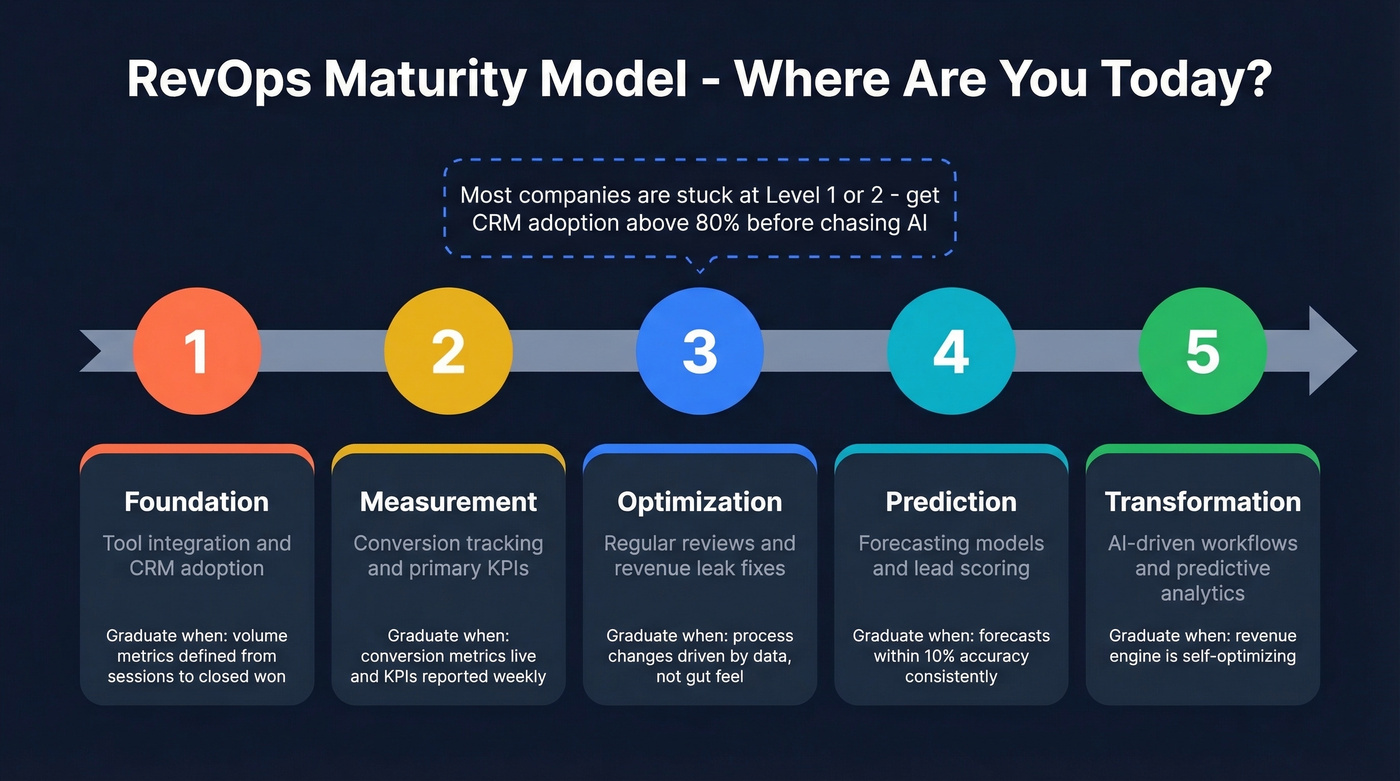
| Level | Focus | Graduation Criteria |
|---|---|---|
| 1 - Foundation | Tool integration, CRM adoption | Volume metrics defined (sessions to closed won) |
| 2 - Measurement | Conversion tracking, primary KPIs | Conversion metrics live; KPIs reported weekly |
| 3 - Optimization | Regular reviews, revenue leak fixes | Supporting metrics tracked; training programs running |
| 4 - Segmentation | Who/what/where/when analysis | Forecasting accuracy improving; segment-level reporting |
| 5 - Predictive | Real-time visibility, NRR modeling | Proactive leak detection; predictive analytics operational |
If you're at Level 1, focus exclusively on CRM adoption and volume metrics. Don't build predictive models before you can trust your pipeline data. I've seen teams skip to Level 4 because a VP wanted a forecasting dashboard - they built it on garbage data and spent six months debugging instead of selling.
The volume metrics at Level 1 are deceptively simple: sessions, leads, MQLs, SQLs, opportunities, closed won. Get those six numbers accurate and flowing automatically from your systems. That's your foundation.
Level 2 adds conversion rates between each stage - this is where you start seeing where the funnel leaks. Level 3 is about acting on what you find: fixing the leaks, running regular reviews, building training around the gaps. Most growth-stage companies should aim to stabilize at Level 3 before pushing further. Levels 4 and 5 are enterprise territory requiring clean data, mature processes, and usually a team of 5+ to maintain.
Core RevOps Metrics
Metrics without formulas are just words on a dashboard. Here's what the team actually owns, how to calculate each one, and where the data lives.
| Metric | Formula | System of Record | Target Range |
|---|---|---|---|
| CAC | Total S&M spend / new customers | CRM + finance | SaaS median ~$1.00-$1.40 per $1 ARR |
| ARR/MRR | Sum of active recurring revenue | Billing system | Growth-dependent |
| NRR | (Start ARR + expansion - contraction - churn) / Start ARR | Billing + CRM | 110-130% (best-in-class) |
| LTV | ARPU x gross margin / churn rate | Billing + product | 3x+ CAC minimum |
| LTV:CAC | LTV / CAC | Warehouse (calculated) | 3:1 to 5:1 |
| Win Rate | Closed won / total opps | CRM | 20-30% (B2B SaaS) |
| Pipeline Velocity | (Opps x win rate x ACV) / cycle length | CRM | Trending up QoQ |
| Churn Rate | Lost customers / start customers | Billing + CS | <5% annual (enterprise) |
The system of record column matters more than people think. If your win rate lives in the CRM but your churn rate lives in a billing system that nobody on the RevOps team can access, you've got a data governance problem. The warehouse-centric architecture from the tech stack section solves this - pull everything into one place, model it there, push it back out.
Pipeline velocity is the metric that tells you the most about operational health. It combines volume, quality, value, and speed into a single number. When velocity drops, you can diagnose which component is dragging - and that diagnosis is the entire point of having a RevOps function in the first place.
Why Revenue Operations Fails
Gartner's prediction has arrived. In 2026, 60% of B2B organizations are failing to create a functioning end-to-end revenue process and reverting to silos. That's not pessimism - it's what happens when companies consolidate org charts without fixing the underlying process, data, and tooling.
The four most common anti-patterns:
Under-investing in ops experience. Hiring a junior analyst and calling them "Head of RevOps" doesn't work. The role requires someone who can push back on VPs, redesign processes, and make architectural decisions about the tech stack.
Keeping sales ops and marketing ops separate. If they still report to different leaders with different goals, you haven't built a unified operating model. You've just added a Slack channel.
Tools-first thinking. Buying Clari, Gong, and a new enrichment platform before defining what metrics you're tracking is how CRMs become idea graveyards - full of fields and automations created to solve problems nobody remembers.
Failure to diagnose root causes. Revenue is down 15%. Is it a lead quality problem? A sales execution problem? A pricing problem? A churn problem? RevOps exists to answer this question. If the team is just running reports instead of investigating, it's not doing its job.
And then there's the silent killer: bad data. If 20% of your emails bounce, your engagement metrics are fiction. If phone numbers are stale, your outbound team wastes hours dialing dead lines. The consensus on r/sales and r/salesoperations is consistent - data quality is the single biggest bottleneck in RevOps execution, and it's the one most teams underinvest in.
Skip the RevOps title entirely if your company has $0 budget for the function. Remember, 50.6% of teams are in that position. If there's no budget, there's no real mandate. Your company wants the title on the org chart without the investment to make it work.
You just read that $1.3M in savings comes from tech consolidation. Prospeo replaces your email finder, mobile provider, and enrichment tool at $0.01/email - 90% cheaper than ZoomInfo - with 98% accuracy and native Salesforce, HubSpot, and Clay integrations.
Consolidate your stack and give RevOps data it doesn't have to babysit.
RevOps Salaries in 2026
The pay range is wide because the role is wide. The $70K-$300K range LinkedIn cited reflects the spread from first hire to VP at a public company - these are fundamentally different jobs with fundamentally different expectations.
| Role | Base Range | OTE/Bonus | Notes |
|---|---|---|---|
| Analyst/Specialist | $85K-$124.5K | Base only typical | Entry point; often first RevOps hire |
| Manager | $100K-$235K | 10-20% bonus | Wide range reflects company size |
| Director | $150K-$250K | 15-25% bonus | Usually requires 5+ years ops experience |
| VP/Head of RevOps | $180K-$300K | 20-30%+ bonus | Strategic role; reports to CRO/CEO |
Median OTE across all roles sits around ~$129K. Company size is the biggest modifier - RevOps at companies with 50 or fewer employees pays a median OTE of ~$100K, while companies with 1,000+ employees pay ~$162K for comparable roles. That's a 60% premium for scale.
Geography still matters. SF, NYC, and Boston command a 20-30% premium over national averages. Annual raises are trending around ~5%, which is solid but not keeping pace with the demand curve for experienced operators. The RevOps Alliance salary report found that taking a role at the wrong company maturity stage could mean earning 78% less than peers. Stage matters as much as title.
FAQ
What is revenue operations?
Revenue operations is the function that unifies sales, marketing, and customer success under shared systems, data, and processes across the entire customer lifecycle. Unlike Sales Ops, which optimizes one team, RevOps owns the connective tissue from first marketing touch through renewal and expansion - turning separate go-to-market teams into a single revenue engine.
How big should a RevOps team be?
Most seed and Series A companies start with 1-2 people. Growth-stage companies ($20M-$100M ARR) typically need 3-8. Enterprise organizations run 10+ with specialized sub-functions. Scale with revenue complexity - number of products, segments, and go-to-market motions - not just headcount.
What tools do RevOps teams use?
Five core categories: CRM (Salesforce, HubSpot), engagement (Salesloft, Outreach), enrichment (Prospeo, ZoomInfo, Apollo), analytics (Gong, Tableau), and orchestration (Census, Hightouch, Zapier). Aim for 5 integrated tools, not 15 overlapping ones.
Who should RevOps report to?
The CRO is the best reporting line - they own the full revenue number and can enforce cross-functional alignment. If there's no CRO, the CEO or COO works. Never the VP of Sales or CMO. Reporting into a single function destroys the neutrality that makes RevOps effective.
How do you measure RevOps success?
Pipeline velocity, win rate, net revenue retention, and CAC are the four metrics that matter most. At maturity Level 1, focus on accurate volume metrics. By Level 3, track conversion rates and fix revenue leaks. The metric that matters most is the one your CEO asks about in board prep.