

Role Playing Sales Training: Scripts, Rubrics & Session Blueprint
A RevOps lead we work with ran weekly role-plays for a quarter. Reps hated them. Managers dreaded them. Nothing changed on actual calls. Then she rebuilt the program around three things - real scenarios, a scoring rubric, and 15-minute sessions instead of two-hour marathons. Ramp time dropped 30% in one quarter.
Only 18% of buyers think salespeople show up prepared for conversations. That's not a skills problem - it's a practice problem. The global sales training market hit $10.32B in 2024 and is climbing toward $19B by 2032, yet most teams still run role playing sales training the same way they did in 2015: awkward, unstructured, and forgettable.
This playbook gives you the scripts, rubrics, and session structure to fix that.
The Quick Version
- Run 15-minute sessions weekly, not two-hour workshops quarterly. Spaced learning beats marathon cramming every time.
- Manager goes first to kill the awkwardness.
- Use the scripts and scoring rubric below - not vague "work on your closing" feedback.
- Build scenarios around real prospect data, not fictional "Acme Corp" accounts.
- Track objection-to-next-step conversion rate, not "did reps enjoy it."
Why Most Sales Role-Plays Fail
Most sales roleplay programs die for predictable reasons.
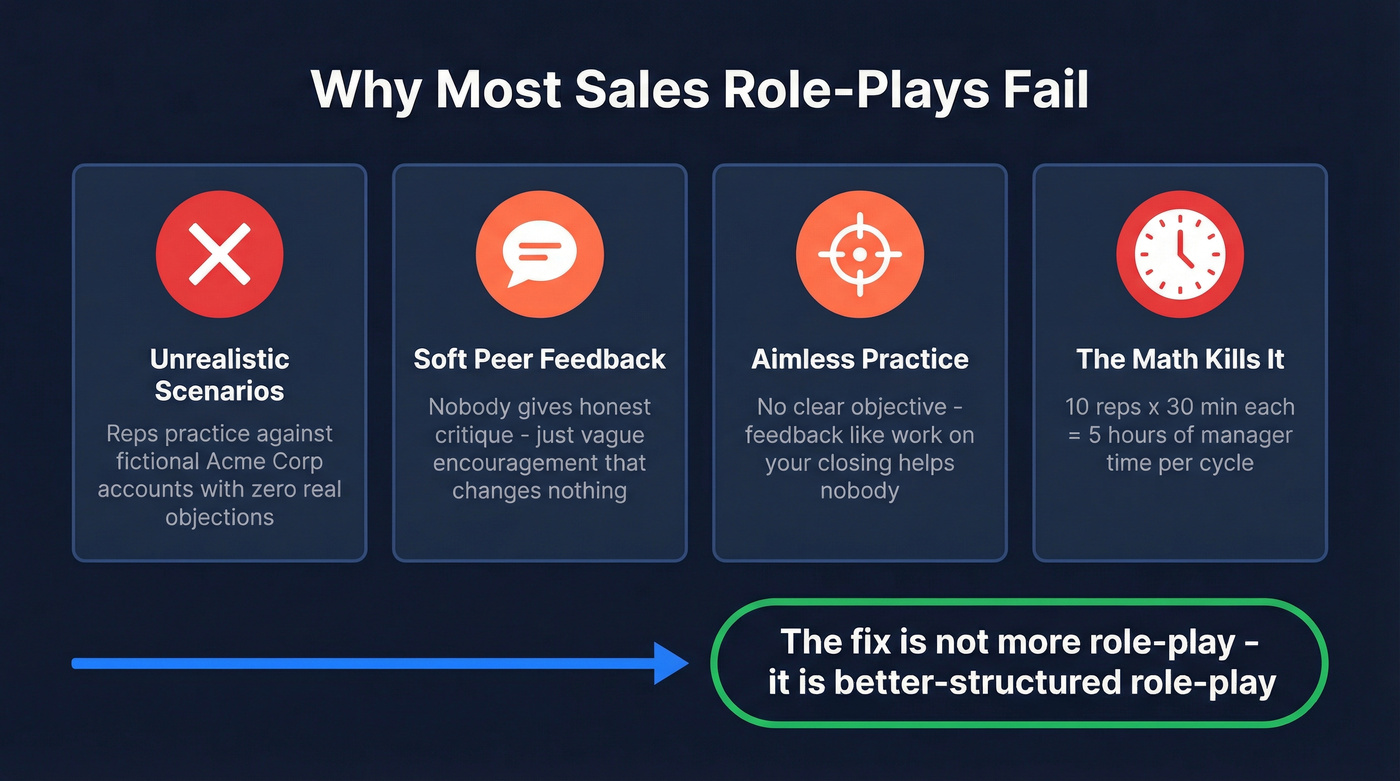
Unrealistic scenarios. Reps practice against "Acme Corp" with a fictional buyer who has no real objections. Nothing transfers to actual calls because the muscle memory doesn't match the real conversation.
Peer feedback stays soft. Nobody wants to tell a colleague their discovery was weak in front of the team. The result? "That was good, maybe just ask a few more questions." Zero behavior change.
Aimless practice. No clear objective for the session. Feedback sounds like "work on your closing" - about as useful as telling a golfer to "hit it better."
The math kills consistency. With 10 reps, a single role-play round eats roughly 30 minutes per rep. That's five hours of manager time for one cycle. No wonder it happens quarterly instead of weekly.
Here's the thing - role-play doesn't expose weakness. It exposes lack of preparation. When reps default to "I'll introduce myself and learn about your business" as their opening move, that's a prep problem the role-play just made visible. The fix isn't more role-play. It's better-structured role-play.
How to Run a Session That Works
Cadence: 15-20 minutes, weekly. Not monthly. Not quarterly. Weekly repetition builds muscle memory. Structured onboarding and training programs retain 50% more new hires and reduce ramp time up to 34%. Cadence is the first variable to get right.
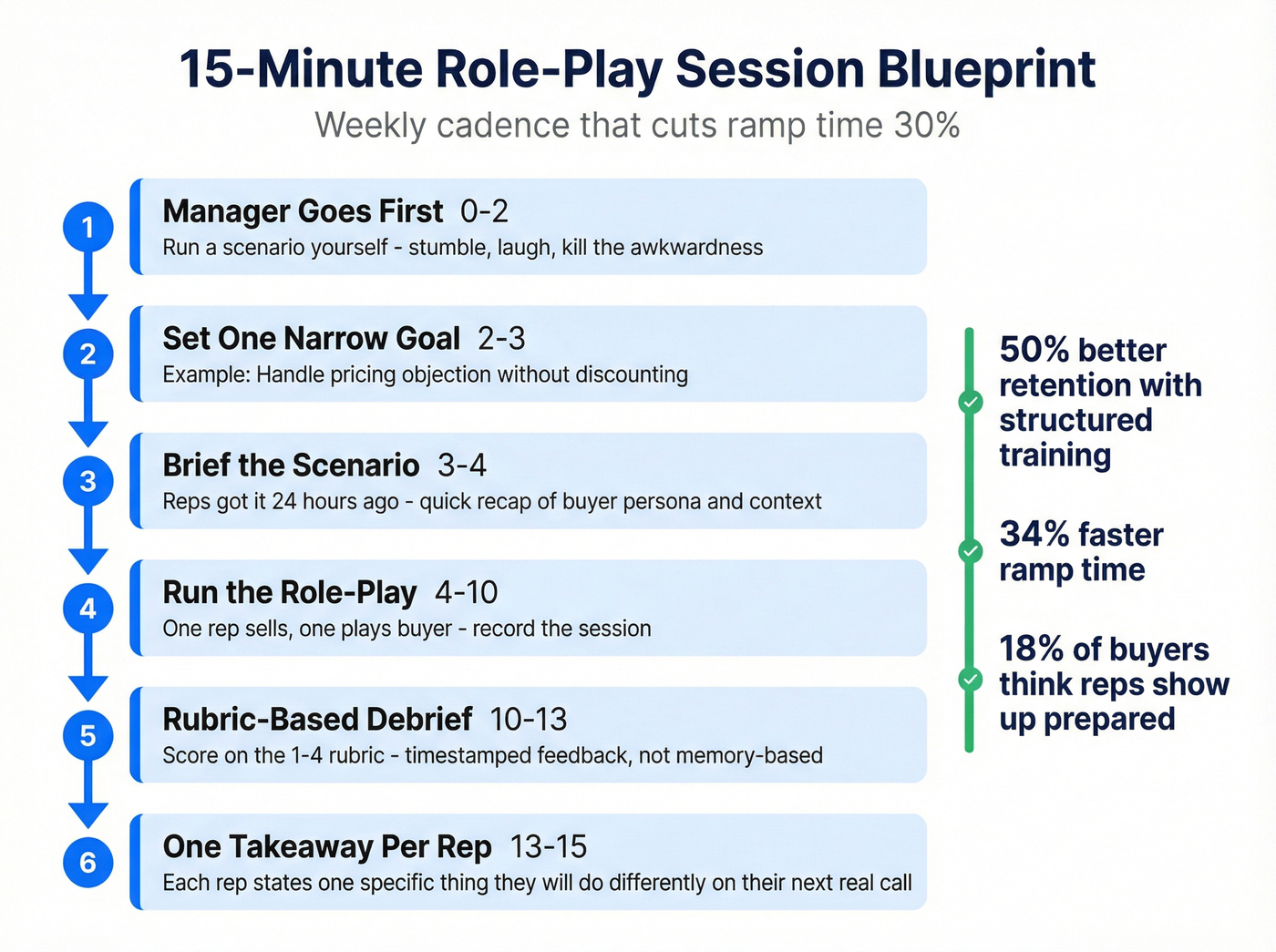
Manager goes first. Before asking any rep to role-play, the manager runs a scenario in front of the group. This isn't optional - it's the single most effective way to kill the awkwardness. When reps see their manager stumble on an objection and laugh about it, the psychological safety bar drops immediately.
Map scenarios to role and tenure. BDRs need cold call openers and objection handling. AEs need discovery and negotiation. CSMs need renewal conversations and upsell pivots. Don't run the same scenario for everyone.
Ground rules (post these visibly):
- Learning beats judgment. Always.
- One narrow goal per session - for example, "handle the pricing objection without discounting."
- No ambush role-plays. Reps get the scenario 24 hours in advance.
- Rotate roles. Reps who play the buyer develop sharper objection-handling instincts.
- Record sessions. Debrief with timestamped feedback, not memory-based impressions.
8 Sales Role Play Examples with Scripts
Each scenario below adapts to your industry - the structure is what matters. For SaaS, swap "lead-to-SQL time" with "free-trial-to-paid conversion rate." For services, swap it with "proposal-to-close cycle."
Cold Call Opener
Situation: Rep calls a VP of Marketing at a mid-market SaaS company pulled from your team's actual target list.
Buyer: "I'm in the middle of something - what's this about?"
Rep: "Totally fair. I'll be quick - we help marketing teams at companies like [similar customer] cut their lead-to-SQL time by 40%. Worth a 10-minute call this week to see if that's relevant?"
Coaching prompt: Did the rep earn the right to keep talking in under 15 seconds?
Common mistake: Leading with a product pitch instead of a relevant outcome.
Discovery Call
Situation: First scheduled meeting. Buyer agreed to 30 minutes.
Buyer: "So, tell me about what you guys do."
Rep: "Happy to - but I want to make sure I focus on what's actually relevant to you. Can you walk me through how your team handles [specific process] today?"
Coaching prompt: Did the rep redirect to questions within the first 60 seconds, or did they launch into a monologue? The rep should hold a 30/70 talk-to-listen ratio.
Elevator Pitch - Bad vs. Good
Most reps do this: cram every feature into 60 seconds, end with a weak "so yeah, that's what we do," and watch the buyer's eyes glaze over.
What works instead:
Rep: "We help [target persona] solve [specific problem]. Our customers typically see [quantified outcome] within [timeframe]. The biggest difference is [key differentiator]. What does that process look like on your team today?"
Coaching prompt: Was the pitch under 45 seconds? Did it end with a question?
Objection: Price
Situation: Mid-deal. Buyer pushes back on cost after seeing the proposal.
Buyer: "This is way over our budget. Can you come down 30%?"
Rep: "I hear you - budget matters. Let me ask: when you say over budget, is it the total investment or the timeline of the spend? Because we've structured deals where [payment flexibility option] made the numbers work."
Coaching prompt: Did the rep explore the objection before responding to it? The instant-discount reflex is the single most expensive habit in B2B sales.
Objection: Status Quo / Timing
Situation: Buyer is interested but stalling.
Buyer: "This looks great, but we're not ready to make a change right now. Maybe next quarter."
Rep: "Makes sense - timing is everything. Quick question: what would need to change between now and next quarter for this to become a priority? I ask because most teams we work with said the same thing, and the cost of waiting ended up being [specific consequence]."
Coaching prompt: Did the rep quantify the cost of inaction? Accepting "next quarter" at face value without exploring the real delay is the most common mistake here.
Product Demo
Situation: Live demo for a buying committee of three.
Buyer: "Can you show us the reporting dashboard? That's what our CEO cares about."
Rep: "Absolutely - and before I pull that up, help me understand: what's the CEO measuring today, and where are the gaps?"
Coaching prompt: Did the rep customize the demo flow based on buyer priorities, or run the standard deck?
Advanced move: Before the demo, ask each stakeholder their top priority. Tailor the first three minutes to the economic buyer's metric, not the feature the champion requested.
Negotiation (Discount Request)
Situation: Final stage. Buyer asks for a concession.
Buyer: "Your competitor offered us 25% off. Can you match that?"
Rep: "I appreciate you sharing that. We don't typically match competitor discounts, but I can look at what we include in the package. If we adjusted [scope element], would that bring the investment in line?"
Coaching prompt: Did the rep use a give/get trade-off instead of a straight discount? No shorter timeline, no expanded scope, no multi-year commitment = no discount.
Closing / Asking for Commitment
Situation: All stakeholders are aligned. Rep needs to close.
Buyer: "This all looks good. Let me run it by the team and get back to you."
Rep: "Glad to hear it. Who else needs to weigh in, and what questions do you think they'll have? I can put together a one-pager that addresses those directly. Can we schedule a 15-minute call for Thursday to finalize?"
Coaching prompt: Did the rep propose a specific next step with a date, or leave it open-ended?
Scoring Rubric for Role-Play Coaching
Vague feedback kills improvement. Use this rubric to score every session on a 1-4 scale.
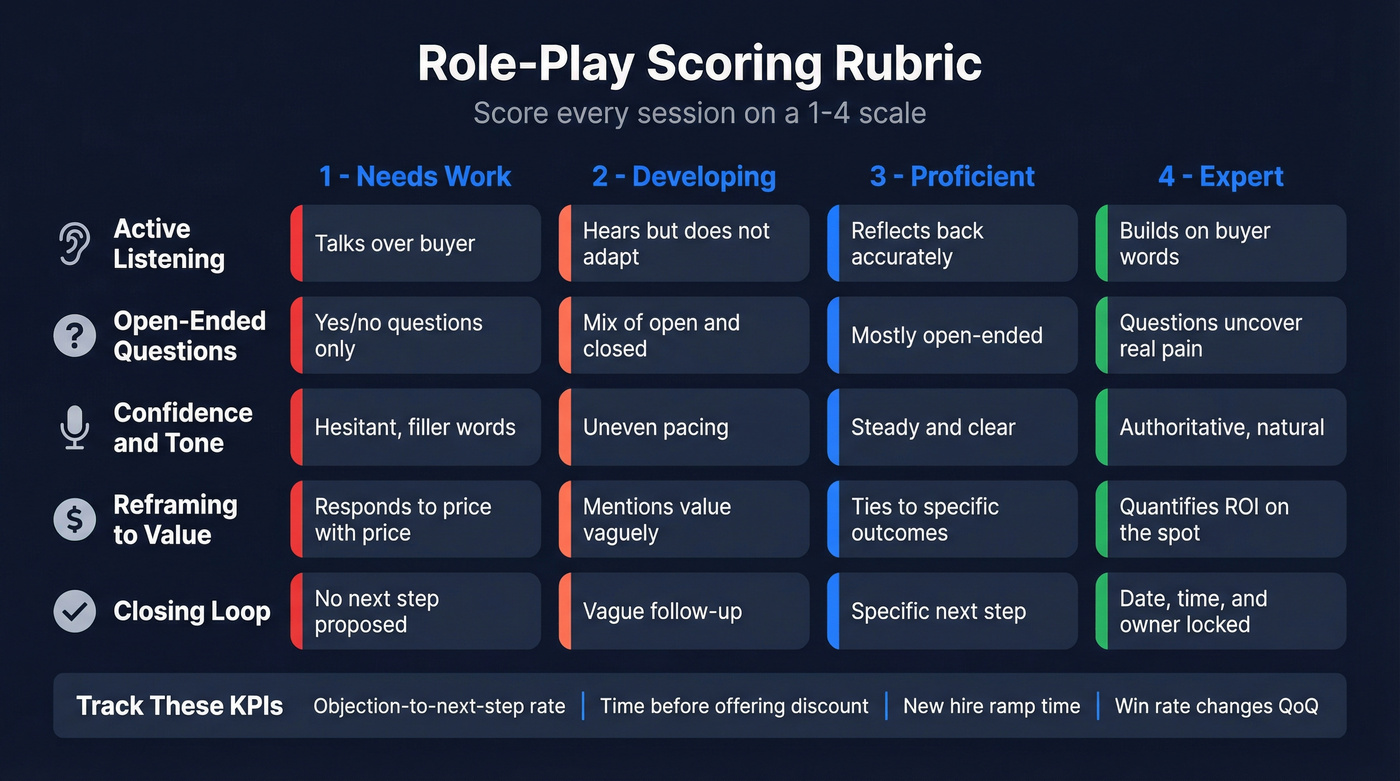
| Criteria | 1 - Needs Work | 2 - Developing | 3 - Proficient | 4 - Expert |
|---|---|---|---|---|
| Active listening | Talks over buyer | Hears but doesn't adapt | Reflects back accurately | Builds on buyer's words |
| Open-ended questions | Yes/no questions only | Mix of open and closed | Mostly open-ended | Questions uncover real pain |
| Confidence/tone | Hesitant, filler words | Uneven pacing | Steady and clear | Authoritative, natural |
| Reframing to value | Responds to price with price | Mentions value vaguely | Ties to specific outcomes | Quantifies ROI on the spot |
| Closing loop | No next step proposed | Vague follow-up | Specific next step | Date, time, and owner locked |
Track these KPIs over time: objection-to-next-step conversion rate, average time before offering a discount, ramp time for new hires, and win rate changes quarter over quarter. These numbers tell you whether practice sessions are changing behavior or just filling calendar slots.

Your role-plays fail because reps practice against fictional "Acme Corp" accounts. Build scenarios around real prospects instead - Prospeo gives you 300M+ profiles with 30+ filters so reps rehearse against actual buyer titles, industries, and company sizes from your target list.
Stop rehearsing against fake buyers. Practice with real prospect data.
Align Role-Play to Your Methodology
Role-play without a methodology is just improv. The scenarios above work best when they're anchored to how your team actually sells.
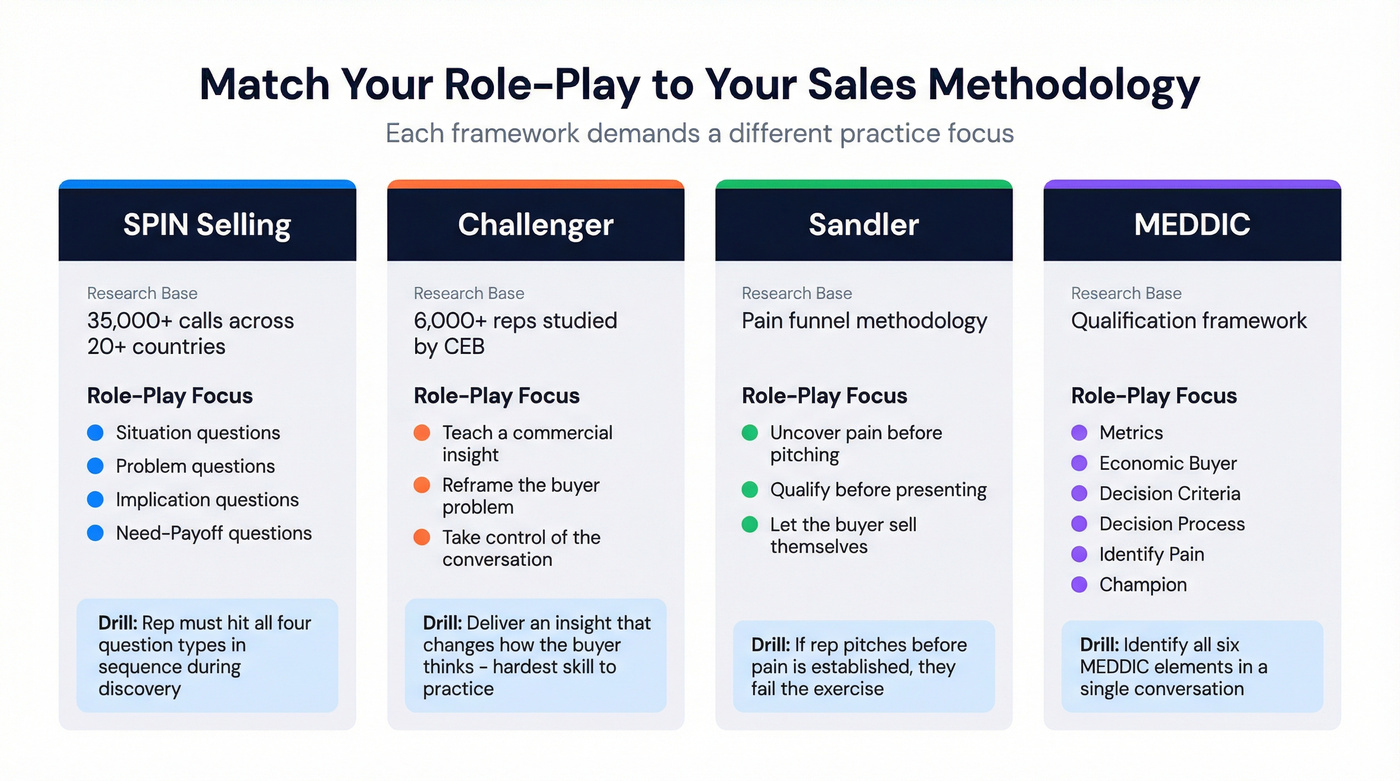
SPIN Selling - built on research analyzing 35,000+ sales calls across 20+ countries over 12 years - gives you four question types to practice: Situation, Problem, Implication, Need-Payoff. Run discovery role-plays where reps must hit all four in sequence.
Challenger - based on CEB research involving 6,000+ reps - focuses on the teach-reframe moment. Practice scenarios where the rep delivers a commercial insight that reframes how the buyer thinks about their problem. This is the hardest skill to role-play and the most valuable. Xerox proved it at scale: after adopting the Challenger approach, they saw a 17% sales increase on a $65M contract.
Sandler uses a pain funnel. Role-play the qualification conversation where the rep must uncover pain before discussing solutions. If the rep pitches before pain is established, they fail the exercise.
MEDDIC turns role-play into a qualification drill. Can the rep identify the Metrics, Economic Buyer, Decision Criteria, Decision Process, Identify Pain, and Champion in a single conversation?
Let's be honest about the real problem: Korn Ferry research shows that when teams reach 75%+ adoption of a structured methodology, quota attainment jumps 21%, win rates climb 15%, and revenue grows 6%. Role playing sales training is how you get to that adoption number. But most teams pick a methodology and never practice it. They buy the training, run a two-day workshop, and wonder why nothing sticks. If your reps can't execute your methodology in a 15-minute role-play, they won't execute it on a live call either.
One on One vs. Group Sessions
Not every session needs the full team.
One on one sales role play between a manager and a rep is the fastest way to address individual skill gaps - a rep struggling with discovery gets focused reps without the pressure of an audience. These sessions work best for new hires during onboarding and for experienced reps preparing for high-stakes deals.
Group sessions build team-wide pattern recognition. When five reps watch a colleague handle a pricing objection, everyone absorbs the technique. Group sessions also surface competitive intel - one rep's buyer objection often mirrors what the rest of the team is hearing. We've seen teams where a single group debrief uncovered that three reps were all hearing the same "we're evaluating [competitor]" objection and nobody had flagged it to leadership.
The ideal cadence: one group session per week, one on one sessions as needed for coaching or deal prep.
Build Scenarios with Real Prospect Data
The biggest gap in most role-play programs isn't the scripts - it's the scenarios. When reps practice against "Acme Corp, a mid-size tech company," nothing sticks because the conversation doesn't feel real.
The fix is simple: practice on accounts your reps will actually call this week. Pull real prospect profiles - job title, company size, industry, recent funding, tech stack - and build the scenario around that data. When a rep role-plays a cold call to an actual VP of Engineering at a Series B fintech company they're targeting, the preparation transfers directly to the real conversation.
In our experience, the teams that get the most out of role-play are the ones that spend 10 minutes before the session pulling five real prospect profiles and building scenario cards around them. Tools like Prospeo make this fast - 30+ search filters let you pull profiles matching your exact ICP, and with 98% email accuracy and 125M+ verified mobile numbers, the data holds up when reps pick up the phone for real.

Role-play builds the skill. Accurate data makes it count on real calls. Reps who train on realistic scenarios still bounce 35% of emails with bad data. Prospeo delivers 98% email accuracy and 125M+ verified mobiles so the calls your reps practiced actually connect.
Great training deserves data that actually reaches the buyer.
AI Role-Play Tools Worth Knowing
You don't need AI software to run effective practice sessions. You need a scoring rubric, 15 minutes a week, and a manager willing to go first. AI tools help you scale - they don't replace the fundamentals.
That said, the manager-time math adds up fast. Five hours per cycle for 10 reps. That's where AI tools earn their keep.
| Tool | Best For | Pricing (2026 est.) | Key Limitation |
|---|---|---|---|
| Second Nature | Multilingual teams (20+ languages) | ~$30-40/user/mo | Content upload required |
| Quantified AI | Onboarding & certification | ~$40-80/user/mo | No dynamic branching |
| Hyperbound | Cold call practice | ~$40-60/user/mo | Narrower scenario library |
| Mindtickle | Enterprise enablement suites | ~$15-30/user/mo | Overkill for role-play only |
| Highspot | Content + coaching combo | ~$30-50/user/mo (bundled) | Feature, not core product |
| PitchMonster | Budget-friendly starter | ~$20-35/user/mo | Smaller user community |
Quantified AI has a 4.5/5 rating on G2 across 16 reviews. Users praise the safe practice environment and on-demand availability. The knocks? Avatar limitations and AI inaccuracy - it takes multiple rounds for the system to learn your terminology.
Second Nature stands out for global teams. Twenty-plus language support means your EMEA and APAC reps practice in their selling language, not just English. You'll need to upload your own content to build scenarios, so budget time for initial setup.
Hyperbound is purpose-built for cold call practice. If that's your team's biggest gap, it's the most focused option. The scenario library is narrower than enterprise platforms, but depth beats breadth when you're drilling one skill.
Skip Mindtickle if you only need role-play. It's a full enablement suite - powerful for enterprise teams already using it across the stack, but way too much overhead if all you want is structured practice sessions.
To build an AI scenario, follow five steps: define the buyer persona aligned to your ICP, set the rep's conversation goal, describe the background context, define win criteria, and layer in specific objections. This structure works across every tool in the table.
How to Measure If It's Working
Use the Kirkpatrick framework to measure at four levels:
Reaction - Did reps find the session useful? Survey, but don't stop here. Learning - Can reps demonstrate the skill in a follow-up role-play? Score with the rubric above. Behavior - Are call recordings showing the practiced behaviors? Check CRM notes, call-to-meeting conversion rates, and objection handling patterns. Results - Win rate, ramp time, average discount given, and pipeline velocity.
These are the numbers that justify the program to leadership.
Sales training delivers $4.53 for every $1 spent - a 353% ROI - but only when you measure behavior change, not satisfaction scores. If your reps rate the session 5/5 but their call-to-meeting rate doesn't move, the program isn't working. Full stop.
Tips to Keep Sessions Effective
Even with the right structure, sessions drift. Keep these in mind as you scale:
Rotate who plays the buyer each week - reps who regularly take the buyer seat develop stronger empathy and objection-handling instincts. Debrief immediately after each round while the conversation is fresh, using timestamped notes from the recording.
Limit feedback to two actionable items per session. More than that overwhelms the rep and dilutes focus. We learned this the hard way after watching a manager give a new hire seven pieces of feedback in one sitting - the rep couldn't remember a single one by the next session.
Revisit the same scenario two weeks later to check whether the feedback actually changed behavior. And celebrate progress publicly - when a rep nails an objection they fumbled last month, call it out in front of the team.
FAQ
How often should sales teams role-play?
Weekly, 15-20 minutes per session. Biweekly is the minimum cadence that produces measurable skill change. Quarterly workshops feel productive but don't build the muscle memory needed for live calls.
How do you make role-play less awkward?
Manager goes first - always. Set ground rules that learning outweighs judgment, and give reps the scenario 24 hours in advance. Recording sessions actually reduces awkwardness because feedback becomes timestamped and specific, not personal.
What's the best free way to start?
Use the scripts and scoring rubric in this guide. Pair reps for a one on one session, record on Zoom, and debrief with timestamped feedback. For realistic scenarios, pull real prospect data so reps practice on accounts they'll actually call.
Do AI role-play tools replace manager coaching?
No. AI handles repetition at scale - useful for drilling cold call openers across 10+ reps without burning five hours of manager time. But AI can't coach deal-specific nuance, read competitive context, or adjust mid-session the way a manager who knows your pipeline can.
What's the difference between group and one on one sessions?
Group sessions build shared vocabulary and let the whole team absorb techniques from each rep's performance. One on one sessions allow deeper coaching on individual weaknesses without peer pressure. The best programs run one group session weekly and schedule one on one sessions for onboarding or high-stakes deal prep.