

Round Robin Distribution: The Complete Guide for Sales Teams & Engineers
Your RevOps lead just pulled the assignment report and discovered Rep A has 47 active opportunities while Rep C has 11 - despite running "fair" round robin distribution for three months. The algorithm isn't broken. The implementation is. And the fix starts upstream, before a single lead enters the queue.
What Is Round Robin Distribution?
Think of dealing cards. You give one to each player, circle back to the first, and repeat. That's the core concept - assigning items sequentially across recipients in a repeating cycle.
The pattern shows up everywhere: in sales teams routing inbound leads to reps, in CPU scheduling allocating processor time across tasks, in load balancing distributing requests across backend nodes, and in DNS rotating IP addresses behind a single domain.
The core principle is identical across all four. Distribute work evenly by count, in sequence, without favoritism. It's the simplest fair-distribution algorithm that exists, which is both its strength and its ceiling. Round robin doesn't care about context, capacity, or complexity. It just deals the next card.
The Short Version
- Simple, fair, fast. Round robin is the right starting point for most sales teams. Don't overthink routing until you've outgrown it.
- It breaks without data quality. Routing a junk lead in 30 seconds is worse than routing a verified lead in 5 minutes. Verify and enrich before leads enter the queue.
- Workloads diverge over time. Equal assignment doesn't mean equal workload. By day 90, your reps' books will look very different.
- Dedicated tools beat DIY. Building this in Salesforce Flow sounds easy until you hit mass inserts, multiple groups, or edge cases. Budget around $15-38/user/month for common Salesforce routing tools.
Why Round Robin Matters for Sales Teams
This routing method exists to solve one problem: speed-to-lead. The data is brutal.
Responding within one minute produces a 391% increase in lead conversions compared to waiting even a few minutes. Half of all sales go to the vendor that responds first. Companies that respond within five minutes are 100x more likely to connect with that lead than those that wait 30 minutes.
Here's the uncomfortable part: benchmark stats put the average B2B lead response time at 42 hours. Only 7% of companies achieve a five-minute window. 55% take more than five days.
Round robin lead distribution closes this gap by removing the manual step. Instead of a manager triaging leads or reps cherry-picking from a shared queue, the system assigns instantly. No delay, no favoritism, no "I'll get to it after lunch." Every minute you shave off response time compounds into pipeline. Every hour you waste compounds into lost deals.

Speed-to-lead means nothing if reps waste 20 minutes researching bad data. Prospeo enriches every lead with 50+ data points - verified email, direct dial, firmographics, and technographics - at 92% match rate before it ever hits your round robin queue. At $0.01 per lead, clean data costs less than one wasted rep minute.
Stop routing garbage. Enrich first, assign second.
How to Implement Round Robin Lead Routing
Here's a seven-step plan adapted from LeanData's operational framework and what we've seen work in practice.
Step 1: Define Objectives and Criteria
Start with what you're routing and why. Inbound MQLs? Demo requests? Chat leads? Define your rep pool, eligibility rules, and what "fair" means - equal by count, by capacity, or by territory. Apply qualification logic upfront: filter out leads below a minimum company size or outside your ICP before they ever enter the queue.
Step 2: Choose Your Tools
You need two layers: a CRM (Salesforce, HubSpot) and a routing tool. Native CRM assignment rules handle basic sequential assignment but fall apart with any complexity. If you've got a larger rep pool or multiple routing paths, budget around $15-38/user/month for a dedicated router.
Step 3: Enrich and Verify Before Routing
Routing speed means nothing if the lead data is garbage. A rep who gets an unverified email, no phone number, and a company name that's just "LLC" will waste 20 minutes researching before even attempting contact. We've seen this kill response times more often than the routing logic itself.
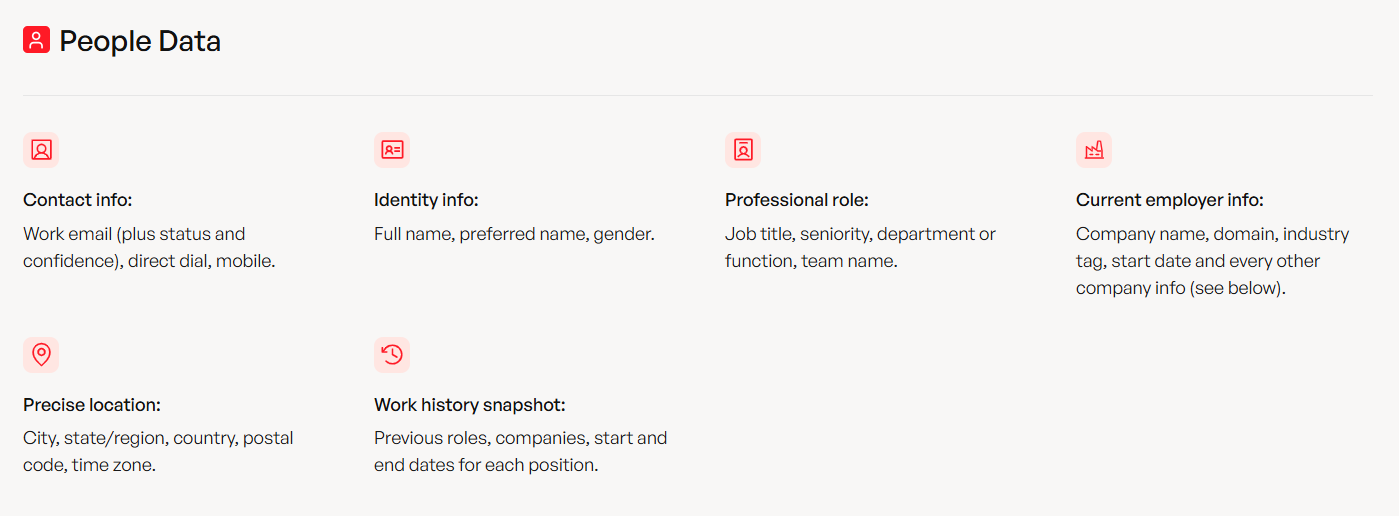
Before a lead enters your routing queue, run it through an enrichment layer. Prospeo's enrichment API, for example, returns 50+ data points per contact - verified email at 98% accuracy, direct dial, job title, company firmographics, technographics, and funding data - with a 92% match rate at roughly $0.01 per lead. Your reps get leads with verified emails, direct dials, and firmographic context instead of a name and a maybe-valid address.
Step 4: Configure Routing Logic
Set up rules: rep eligibility, assignment sequence, and fallback behavior if no rep qualifies. Most routing tools let you pause reps, set capacity caps, and layer territory or skill-based filters on top of the base cycle. Follow a strict availability evaluation order - check holidays first, then out-of-office status, then business hours, then active/idle state. This prevents leads from landing in a black hole when a rep is on PTO.
Step 5: Integrate Lead Sources
Connect every inbound channel - forms, chat, paid landing pages, partner referrals - to the same routing engine. Leads that bypass the router create the exact cherry-picking and response-time problems you're trying to eliminate.
Step 6: Test and Pilot
Run a two-week pilot with a subset of reps and lead sources. Check edge cases: duplicate leads, leads matching existing accounts, two leads arriving in the same millisecond. These are the scenarios that break DIY implementations, and they will happen faster than you expect.
Step 7: Monitor, Optimize, Train
Build a dashboard tracking assignment distribution, response time, and conversion by rep. Review weekly for the first month. The best routing logic in the world fails if reps don't follow up within the SLA.
Your round robin is only as good as the leads feeding it. Unverified emails bounce, missing phone numbers stall outreach, and incomplete records kill the speed advantage you built. Prospeo delivers 98% email accuracy and 125M+ verified mobile numbers so every routed lead is actually reachable.
Give your reps leads worth calling - verified before they're assigned.
When Round Robin Breaks Down
Let's be honest: this algorithm is a starting point, not a destination.
Workload Divergence
Equal assignment doesn't produce equal workload. As Gradient Works explains, leads close, disqualify, and go quiet at different rates. By day 90, one rep might have 40 active accounts while another has 12 - despite receiving the same number of leads. The "hands" diverge even when the dealing is perfectly fair.
This is the single most common reason teams abandon pure sequential assignment, and it's the right call once you see it happening.
Variable Lead Complexity Without Skill Matching
If you're routing enterprise prospects and SMB trials through the same cycle, you're setting up junior reps to fail on complex deals and senior reps to waste time on low-value ones. Weighted or skill-based routing handles this better.
The Salesforce DIY Trap
Here's the thing: Salesforce doesn't offer a simple, first-class round robin feature out of the box. Teams usually build it with Flow/Apex or grab a dedicated AppExchange tool. The auto-number field approach breaks when you need multiple groups routed separately. The incrementing-number method can't handle mass inserts created in the same transaction. The consensus on r/salesforce is pretty clear - threads are full of admins who tried Flow and ended up needing Apex or a third-party tool. Even Salesforce Labs' own Round Robin Assigner confuses admins trying to configure target objects and record collections.
Skip the DIY route if you have more than one routing group or any volume above a trickle.
What to Use Instead
When basic lead routing breaks, the fix is often better data upstream rather than a fancier algorithm. From there, consider weighted round robin (assign more leads to higher-capacity reps), skill-based routing, capacity-based distribution, territory-based assignment, or AI-based routing that factors in historical win rates.
Lead Routing Tools Compared
The routing tool market is crowded but stratified. Here's what matters.
| Tool | Routing Logic | Starting Price | CRM | Best For |
|---|---|---|---|---|
| Chili Piper | RR, territory, forms | ~$22.50-$30/user/mo + platform fees | SF, HubSpot | Inbound-heavy teams |
| Distribution Engine | Weighted RR, fallback | From $20/user/mo | Salesforce | SMB Salesforce orgs |
| PowerRouter | RR, weighted, territory | From $15/user/mo | Salesforce | Budget-conscious teams |
| Kubaru | RR, load balancing, SLA | $20/user/mo | Salesforce | SLA-driven routing |
| Q-assign | RR, skill, capacity | $38/user/mo | Salesforce | Complex skill matching |
| LeanData | RR, territory, matching | Custom enterprise pricing | Salesforce | Enterprise account matching |
| LeadAngel | Territory, rule-based | From $99/company/mo | SF, HubSpot | Territory-first orgs |
| HubSpot (native) | RR workflows | Included w/ CRM | HubSpot | HubSpot-only teams |
| Salesforce (native) | Basic assignment rules | Included w/ CRM | Salesforce | Simple needs |
Our recommendations: For Salesforce teams wanting affordable weighted round robin, start with Distribution Engine or PowerRouter. HubSpot teams should try native workflows first - they're surprisingly capable for straightforward sequential routing. Enterprise Salesforce orgs with complex territory and account-matching needs should evaluate LeanData.

Hot take: Most teams shopping for routing tools are solving the wrong problem. If your reps are ignoring leads or complaining about data quality, no $38/user/month router fixes that. Spend the first dollar on enrichment upstream - at $0.01/lead, it's a rounding error - and the routing tool you already have will perform dramatically better.
Round Robin in Infrastructure
The same algorithm that routes your sales leads powers core infrastructure systems. If you're purely here for the sales angle, feel free to skip ahead to the FAQ.
CPU Scheduling
In operating systems, round robin scheduling gives each process a fixed time slice (quantum) before preempting it and moving to the next. It's starvation-free, but quantum size is a trade-off: too small and context-switch overhead eats throughput; too large and response time degrades toward first-come-first-served. Typical quanta run around 10-100ms. Dynamic time quantum algorithms adjust the slice based on process priority and burst time.
Load Balancing
Round robin distributes requests evenly by count across backend servers - simple and effective until request durations vary. One node can max out on a 2-second database query while others idle on 50ms static responses, spiking P95 latency by roughly 3x. The same unfairness appears at the packet level: when packet sizes vary widely, count-based distribution gives disproportionate bandwidth to senders with larger packets.
Least-connections algorithms handle variable cost better by routing to the server with the fewest active connections. IP hash provides session stickiness when users need to hit the same backend consistently.
DNS Round Robin
DNS round robin is the most primitive form: multiple A records for the same domain, rotated by the authoritative nameserver. It's completely state-blind - no health checks, no session persistence, no awareness of server load. If a server goes down, DNS caching and TTL delays mean clients keep hitting the dead node for minutes or hours. It's not a replacement for a real load balancer. It's a distribution mechanism with zero intelligence.
FAQ
What's the difference between round robin and weighted round robin?
Standard round robin assigns one lead per rep before the cycle repeats. Weighted round robin assigns proportionally based on capacity or seniority - a senior AE might receive 3 leads for every 2 a junior rep gets. Use weighted when your team has meaningfully different experience levels or workload capacities.
Does round robin work for large sales teams?
Yes, but it needs guardrails. Teams above 15 reps should add eligibility filters - availability, territory restrictions, capacity caps - and use a dedicated routing tool rather than DIY CRM logic. Without filters, large teams see faster workload divergence and more edge-case failures.
How do I prevent routing bad leads to reps?
Enrich and verify lead data before it enters the queue. An enrichment API that returns 50+ data points at 98% email accuracy and a 92% match rate for roughly $0.01/lead turns a name-and-email stub into a record your reps can actually work. Bad data in means wasted rep time out - no routing algorithm fixes that.
What's the best round robin tool for Salesforce?
Distribution Engine and PowerRouter offer weighted round robin with straightforward setup at $15-20/user/month. For enterprise orgs with complex territory and account-matching requirements, LeanData is the standard choice with custom pricing.
Round robin distribution is the simplest routing algorithm worth implementing, and for most sales teams, it's the only one you need until your data proves otherwise. Get the data quality right, pick a tool that handles edge cases, and measure relentlessly. The algorithm is never the bottleneck - the implementation always is.