

SaaS Business Development: What It Actually Takes in 2026
A RevOps lead we know ran a three-tool bake-off last quarter. The "best" database created 4,000 duplicate contacts in Salesforce in five days. The cheapest one had better phone connect rates. That's SaaS business development in a market headed toward $10 trillion by 2030 - the strategy matters, but execution details move pipeline.
BD isn't sales development. It's the layer above: defining your ICP, shaping positioning, and building the two engines (acquisition + expansion) that feed everything downstream. The single biggest thing most teams get wrong? Data quality. You can nail your ICP, craft perfect messaging, and still watch pipeline collapse because 35% of your emails bounce.
What SaaS BD Actually Means
The confusion between business development and sales development kills more org charts than bad quota design.
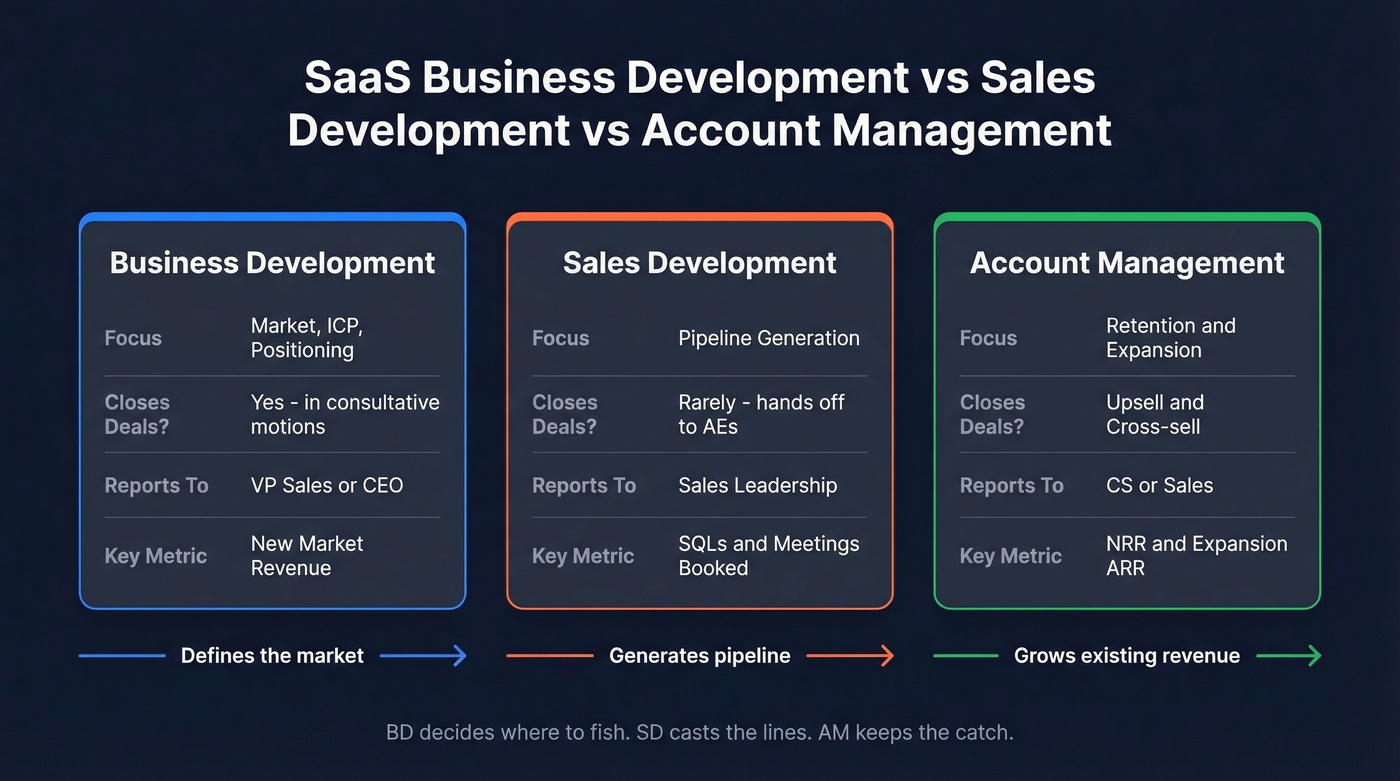
Business development focuses on market-level work - identifying product-market fit, defining your ICP, crafting positioning, and spotting new revenue channels. Sales development is the systematic execution within that market: the prospecting, the sequences, the meetings booked. BD decides where to fish. SD casts the lines.
In consultative, high-ACV motions, business developers often close deals themselves. In transactional models with simpler products, they hand off to AEs. Both are valid - different jobs, different comp structures.
| Business Development | Sales Development | Account Management | |
|---|---|---|---|
| Focus | Market, ICP, positioning | Pipeline generation | Retention, expansion |
| Closes deals? | Sometimes (consultative) | Rarely (hands to AEs) | Upsell/cross-sell |
| Reports to | VP Sales or CEO | Sales leadership | CS or Sales |
| Key metric | New market revenue | SQLs, meetings booked | NRR, expansion ARR |
The 2026 SaaS Market
Global SaaS revenue exceeded $232 billion in 2025. But growth has slowed. Per the latest Benchmarkit data, median growth rates dropped to 26%, with even the top quartile declining from 60% in 2023 to 50% in 2024. NRR sits at 101% - barely above flat.
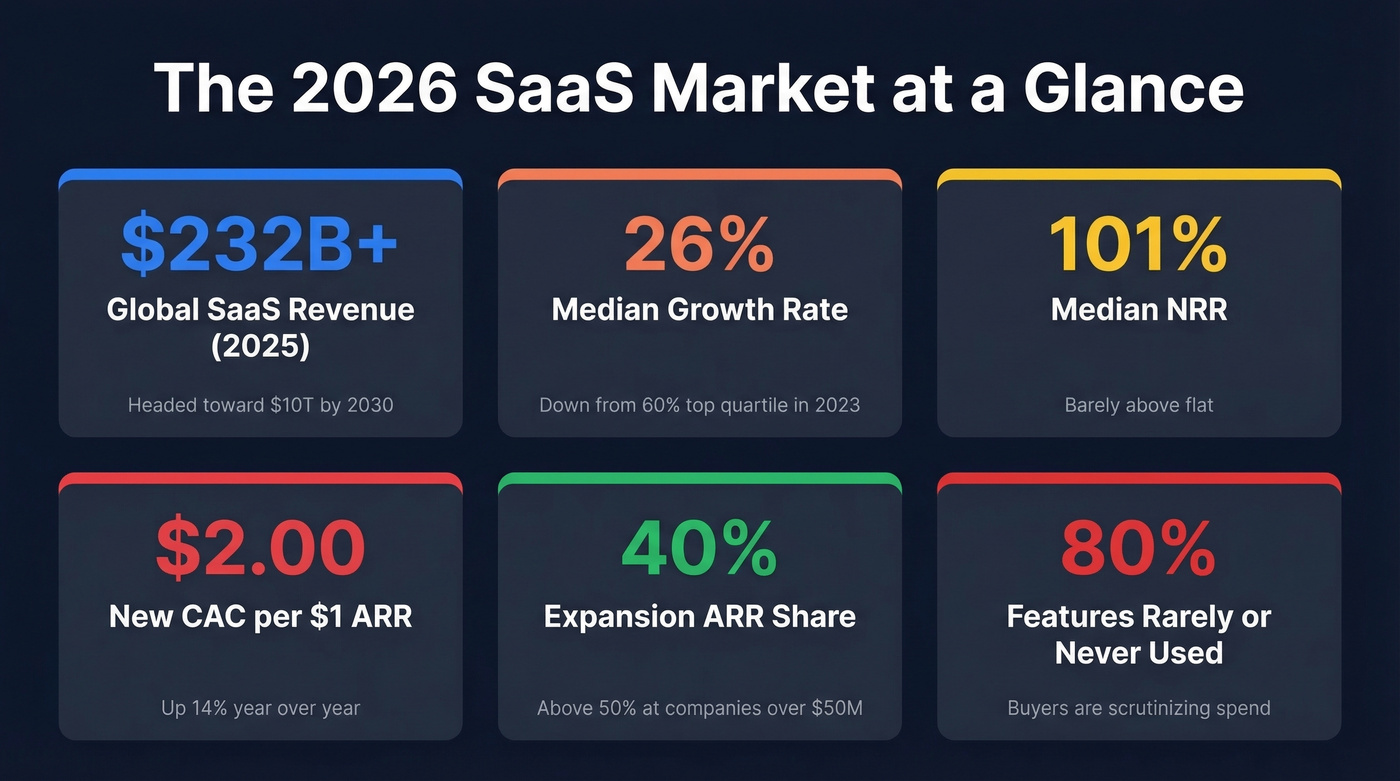
The cost side is worse. New CAC hit $2.00 in S&M spend per $1.00 of new customer ARR, up 14% year-over-year. Expansion ARR now accounts for 40% of total new ARR, climbing above 50% at companies over $50M. Enterprise buyers are shifting toward agent-based interfaces, which means BD teams need to sell outcomes, not features. Pendo found 80% of SaaS features are rarely or never used. Buyers are scrutinizing spend like never before.
The Two Engines of SaaS BD
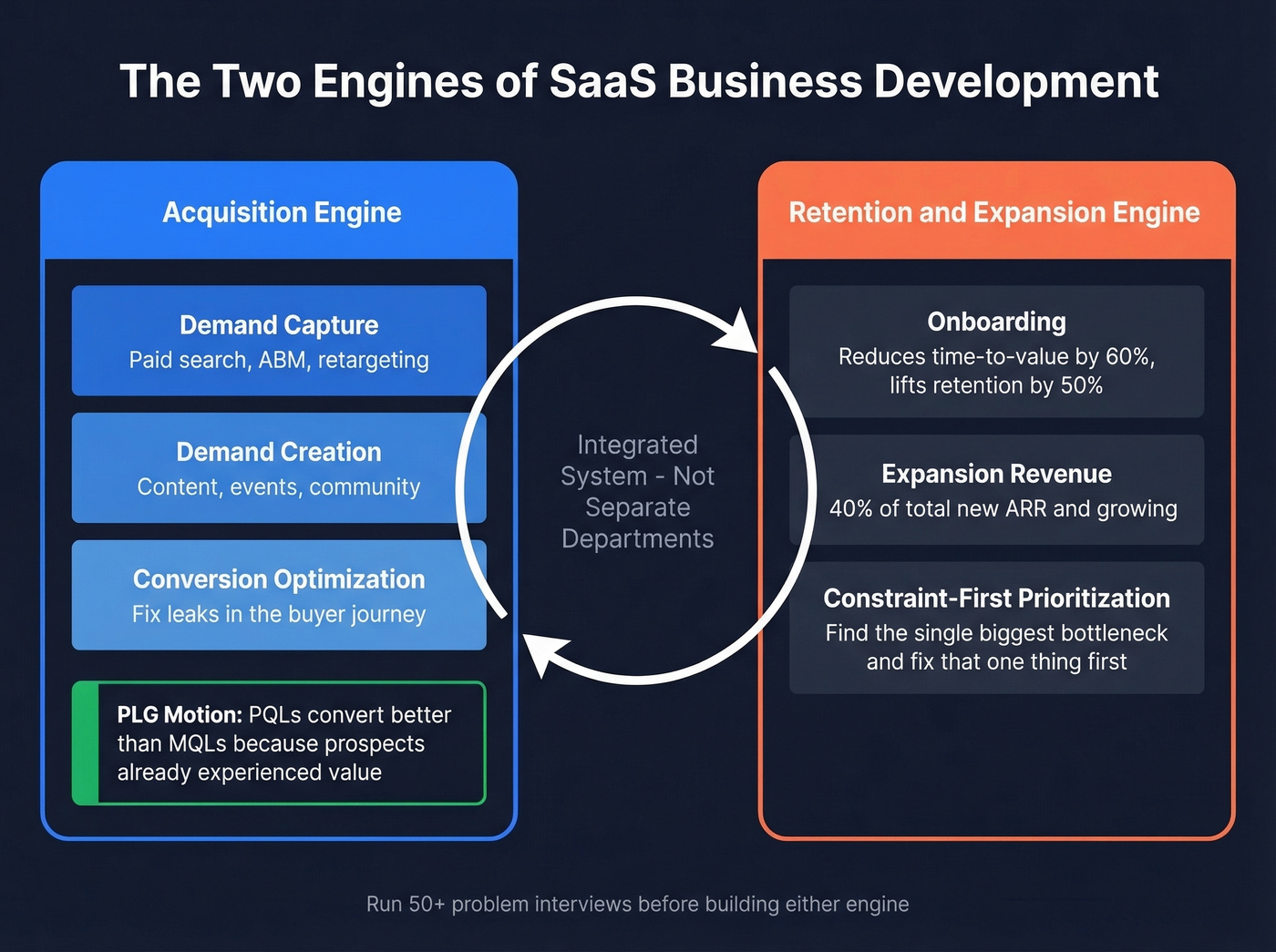
Every BD program runs on two interconnected engines. Treat them as one integrated system, not separate departments.
The Acquisition Engine
Three levers drive acquisition: demand capture like paid search, ABM, and retargeting; demand creation through content, events, and community; and conversion optimization - fixing leaks in the buyer journey. Inbound leads cost 61% less, but outbound gives you control over who enters the pipeline. Most teams need both.
Before you build any of this, run at least 50 problem interviews with your target buyers. The Mom Test methodology is non-negotiable - talk to prospects about their problems before solidifying your solution. Teams that skip customer discovery build pipelines full of people who don't actually need what they're selling.
Product-led growth adds a third motion. PLG companies define Product-Qualified Leads - users who hit usage thresholds like inviting teammates or exceeding free-tier limits. PQLs convert better than MQLs because the prospect has already experienced value. If your product supports it, building a PLG-to-sales-assisted handoff is one of the highest-leverage BD moves available.
The Retention & Expansion Engine
Expansion ARR is 40% of total new ARR across the industry - and growing. Strong onboarding reduces time-to-value by 60% and lifts retention by up to 50%. That makes onboarding a BD function, not just a CS function.
The smartest approach: constraint-first prioritization. Don't try to optimize acquisition, onboarding, and expansion simultaneously. Identify the single biggest bottleneck - maybe it's trial-to-paid conversion, maybe it's month-three churn - and fix that one thing first.
What a High-Performing Week Looks Like
One SaaS BDM running at 200%+ quota shared their weekly rhythm on r/sales: 15 new qualified prospects identified, 4 net new meetings booked, 6 ongoing deal meetings, and 10 business partner meetings. The partner meeting volume is the part most people miss. Channel and ecosystem development is a multiplier that compounds over quarters.
Here's the thing: the critical variable most teams underweight is speed-to-lead. Responding to inbound interest within 1-5 minutes dramatically improves win rates and deal velocity. After 30 minutes, conversion drops off a cliff.
Most BD teams scale through a predictable arc. Solo BDR handling everything, then a 3-person pod splitting inbound and outbound, then a full team with a manager running segmented books. Where you are on that curve determines your weekly rhythm more than any playbook.
- Monday: Pipeline review, prioritize accounts by intent signals, prep personalized outreach for top 10
- Tuesday-Thursday: Execute 100-150 daily touches, run 3-5 discovery calls, update CRM
- Friday: Analyze conversion data, refine messaging, prep next week's target list

You read it above: CAC is $2.00 per $1.00 of new ARR and climbing. Every bounced email makes it worse. Prospeo delivers 98% email accuracy, 125M+ verified mobiles with a 30% pickup rate, and a 7-day data refresh - so your BDRs spend time booking meetings, not cleaning lists.
Stop burning pipeline on bad data. Start with 75 free verified emails.
Building the Right Tech Stack
You need three layers: a CRM, a data platform, and an engagement tool. Everything else is optimization.
The data layer is the foundation. Bad data wastes BDR time, tanks your domain reputation, and produces pipeline numbers that look great in Salesforce but never close. In our experience, starting with Prospeo makes the most sense - 300M+ professional profiles, 98% email accuracy, 125M+ verified mobile numbers with a 30% pickup rate, and a 7-day data refresh cycle that's roughly six times faster than the industry average. The 30+ search filters let you build hyper-targeted lists without stitching together three different tools, and the free tier gives you 75 verified emails plus 100 Chrome extension credits per month to test before committing.
| Category | Tools | Typical Cost |
|---|---|---|
| B2B Data | Prospeo | Free tier; ~$0.01/email |
| B2B Data | ZoomInfo | $15K-$40K+/year |
| B2B Data | Apollo | Free tier; ~$49-$99/mo/user |
| Engagement | Outreach / Salesloft | $100-$200+/user/month |
| Conversation Intel | Gong | $100-$200+/user/month |
| CRM | HubSpot / Salesforce | HubSpot: free tier; paid Sales Hub ~$20-$150+/seat/month. Salesforce: ~$25-$330+/user/month |
Skip Gong until you have at least five reps running consistent discovery calls. Before that threshold, you won't generate enough call data to make the insights worthwhile, and the budget is better spent on data quality.
KPIs That Matter
Pipeline coverage separates teams that hit number from teams that scramble every quarter end. Target 3-5x coverage for new logo pipeline and 2-3x for expansion, segmented by SMB, mid-market, and enterprise.
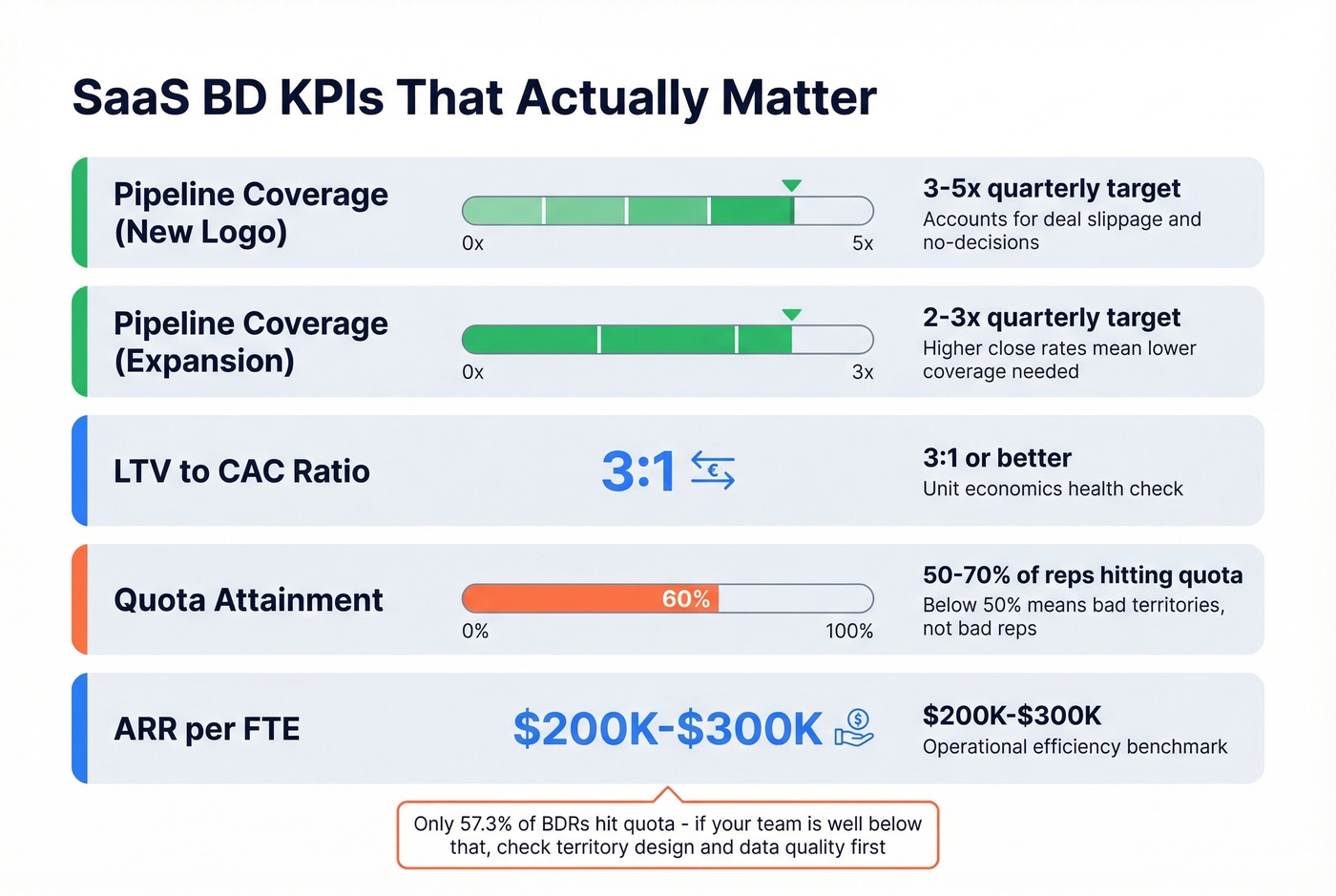
| KPI | Target | Why It Matters |
|---|---|---|
| Pipeline coverage (new) | 3-5x quarterly target | Accounts for deal slippage |
| Pipeline coverage (expansion) | 2-3x quarterly target | Higher close rates, lower coverage needed |
| LTV:CAC | 3:1 or better | Unit economics health check |
| Quota attainment | 50-70% of reps | Below 50% = bad territories or bad targets |
| ARR per FTE | $200K-$300K | Operational efficiency benchmark |
Only 57.3% of SDR/BDRs hit quota. If your team is well below that, the problem is usually territory design or data quality - not effort.
Comp and Career Path
Median BDR base salary is $60,000 with $85,000 OTE. Top performers reach $127,955. Geography matters: NYC averages $78K, San Francisco $108K, and DC $96K.
The career ladder runs BDR to Senior BDR to BDM to Director of BD to VP. Startups compress this timeline - we've seen strong performers make BDM in 12-18 months. But do your diligence before joining. Check RepVue for quota attainment and comp data. A startup with a leaky product and no enablement will burn you out regardless of the OTE number on your offer letter.
For teams selling deals under $10K ACV, you probably don't need ZoomInfo-level data or a 15-person BD org. A two-person team with accurate contact data and a tight ICP will outperform a bloated team running on bad lists every time.
Mistakes That Kill Pipeline
Over-automating enterprise outreach. Cadences work for SMB. Enterprise buyers smell automation instantly. Personalize or lose the deal.
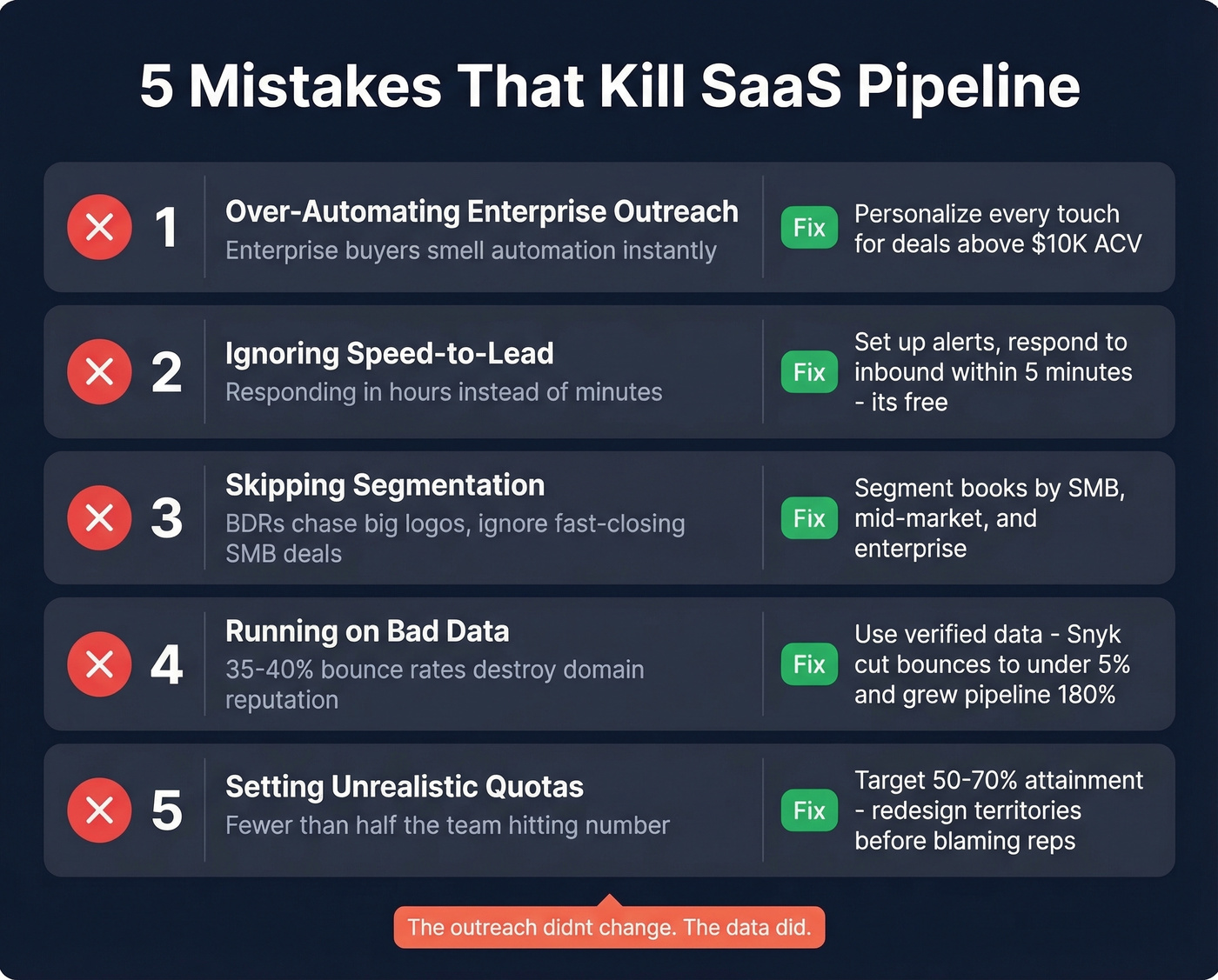
Ignoring speed-to-lead. If your inbound response time is measured in hours, you're losing to competitors who respond in minutes. This is the single easiest fix for most BD teams, and it's free.
Skipping segmentation. When BDRs work a mixed book of SMB and enterprise accounts, they'll gravitate toward the bigger logos and ignore the SMB deals that actually close faster with shorter sales cycles. Segment the book.
Running on bad data. Snyk's team of 50 AEs was prospecting 4-6 hours per week with a 35-40% bounce rate. After switching to verified data, bounces dropped under 5%, and AE-sourced pipeline jumped 180%. The outreach didn't change. The data did.
Setting unrealistic quotas. Aim for 50-70% of reps hitting quota. If fewer than half your team is attaining, you've got a design problem, not a talent problem. I've watched leadership blame reps for three straight quarters before admitting the territories were drawn on a napkin.
The article says it plainly: data quality is the single biggest thing most BD teams get wrong. Prospeo's 300M+ profiles, 30+ filters including buyer intent and technographics, and $0.01/email pricing give SaaS BD teams enterprise-grade targeting without the $40K ZoomInfo contract.
Teams using Prospeo book 26% more meetings than ZoomInfo users.
FAQ
Is SaaS business development the same as sales?
No. Business development defines the market - ICP, messaging, positioning, and channel strategy. Sales development executes within that market by generating pipeline. In consultative motions, BD closes deals directly; in transactional models, BD hands qualified opportunities to AEs who run the closing process.
What tools do SaaS BDRs actually use?
At minimum: a CRM like HubSpot or Salesforce, a verified data platform for accurate contact info, and a sales engagement tool such as Outreach or Salesloft. Layer in conversation intelligence and intent data as you scale past five reps.
How much do SaaS BDRs earn in 2026?
Median base is $60,000 with $85,000 OTE. Top performers reach $127,955. Only 57.3% of BDRs hit quota - research companies on RepVue before accepting offers to understand realistic attainment rates at specific employers.
What's the biggest mistake in SaaS BD strategy?
Running outbound on unverified data. Teams averaging 30%+ email bounce rates waste BDR hours, damage sender reputation, and inflate pipeline metrics that never convert. Verified contact data with sub-5% bounce rates is the single highest-ROI fix for most underperforming BD programs.