

SAL vs SQL: Definitions, Benchmarks, and the Handoff Playbook
A RevOps lead posts in r/salesforce about the SAL vs SQL distinction: "Is the lead now a SAL if the account executive calls? If they reject it, where does it go? If the call goes well, is that an opp - which is synonymous with a SQL? Or is SQL its own Lead stage?" Forty comments deep, nobody agrees. Marketing blames sales for ignoring leads, sales blames marketing for sending garbage, and the CRM is a graveyard of ambiguous statuses.
This distinction exists to fix exactly that mess - but only if you implement it right.
The Short Version
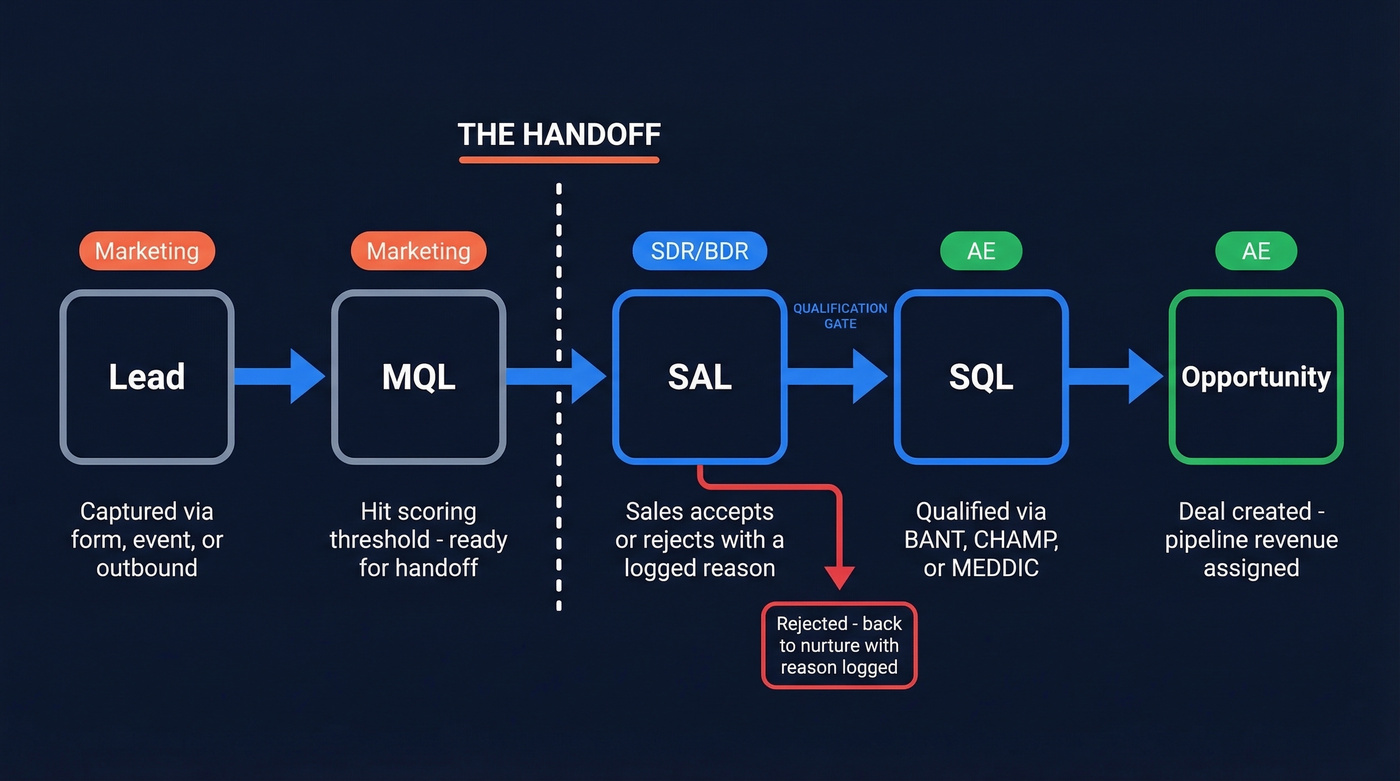
SAL means sales accepted the lead from marketing. SQL means sales qualified the lead as a real opportunity. SAL comes first - A before Q, as Kellblog's mnemonic puts it.
Many teams skip the acceptance stage entirely and then wonder why reps call every inbound lead "garbage" with no data to back it up. Adding a formal acceptance checkpoint means sales accepts or rejects the lead, logs a reason, and marketing gets a feedback loop instead of a blame game.
The Core Difference
The confusion isn't about definitions. It's about ownership and CRM mechanics.
| SAL | SQL | |
|---|---|---|
| Meaning | Sales Accepted Lead | Sales Qualified Lead |
| Funnel position | After MQL, before SQL | After SAL, before Opportunity |
| Who owns it | SDR/BDR accepts | Sales qualifies (often the AE) |
| CRM object | Often a Lead Status or Lifecycle stage | Often the point you convert/create an Opportunity |
| Exit criteria | Sales accepts ownership and commits to follow-up within the SLA | Meets your qualification framework (BANT/CHAMP/MEDDIC) |
| Typical action | Accept/reject + follow-up queued | Qualified discovery booked or completed |
SAL is the handshake. Marketing says "this lead is ready," and sales either accepts or rejects it with a documented reason. SQL is the qualification - after working the lead, sales confirms budget exists, authority is identified, need is validated, and timeline is plausible.
Without a sales accepted lead stage, there's no accountability layer between "marketing sent it" and "sales says it's junk." The acceptance step forces both sides to put skin in the game.
Where MQL Fits In
An MQL is a lead that's hit a scoring threshold based on engagement and fit - downloaded an ebook, attended a webinar, visited pricing, matches your ICP. It's marketing's stamp of approval before the handoff.
This taxonomy traces back to the SiriusDecisions Demand Waterfall, launched in 2002 and revised in 2012 to add sub-stages like AQL, TAL, TQL, and TGL. Most teams don't need that granularity. The core progression - Lead, MQL, SAL, SQL, Opportunity - remains the backbone of B2B funnel measurement.
Conversion Benchmarks by Stage
Benchmarks without context are dangerous. A 13% MQL-to-SQL rate isn't a target to aspire to - it's a symptom of misalignment.
Full-Funnel Ranges
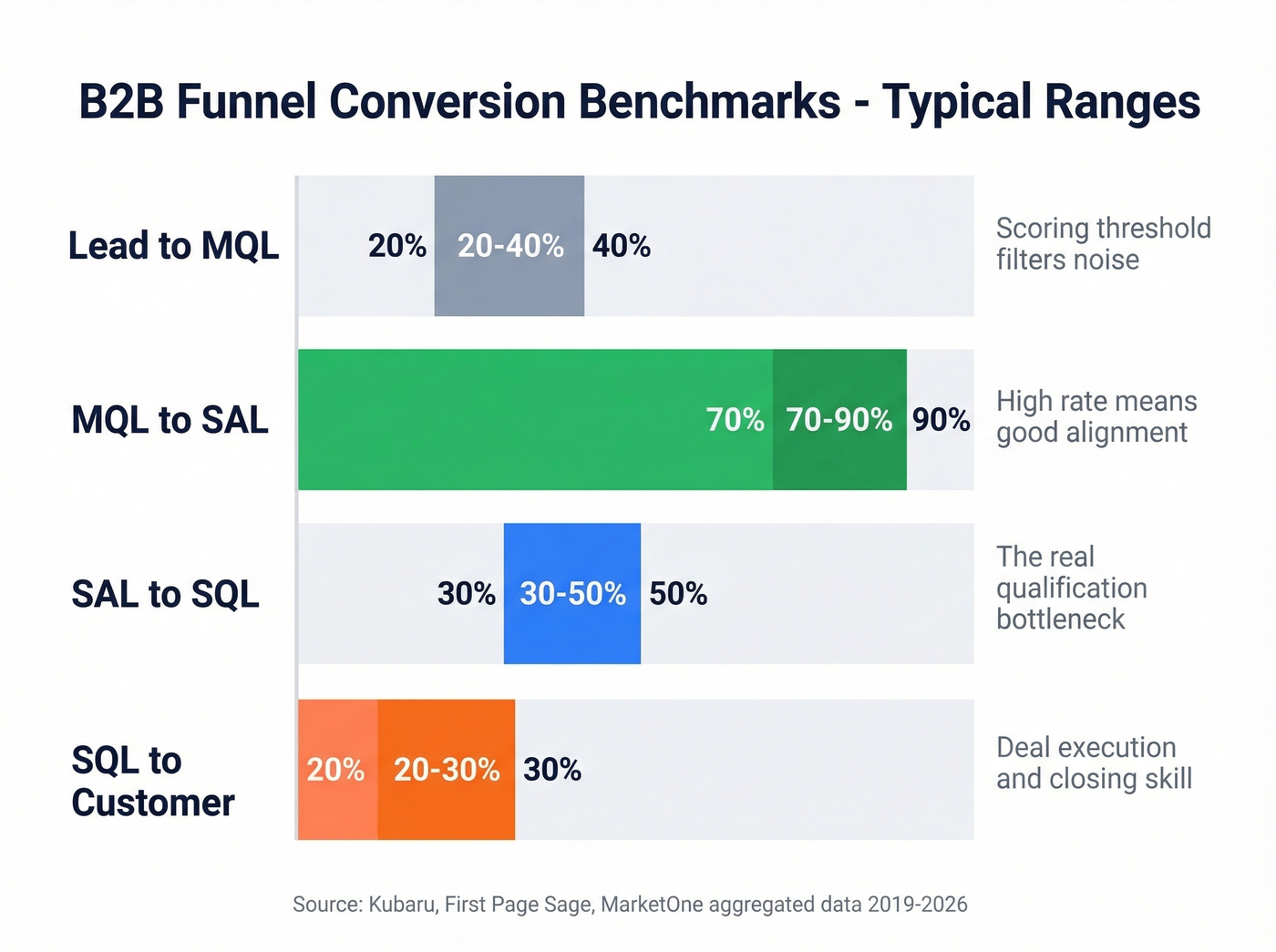
These common B2B benchmark ranges give you a directional gut check:
| Stage | Conversion Range |
|---|---|
| Lead to MQL | 20-40% |
| MQL to SAL | 70-90% |
| SAL to SQL | 30-50% |
| SQL to Customer | 20-30% |
MQL to SQL by Industry
First Page Sage analyzed client data from 2019-2026 and found massive variance by vertical:
| Industry | MQL-to-SQL Rate |
|---|---|
| Business Insurance | 26% |
| eCommerce | 23% |
| Cybersecurity | 15% |
| B2B SaaS | 13% |
| Financial Services | 13% |
| Construction | 12% |
| Engineering | 11% |
Lead to MQL by Channel
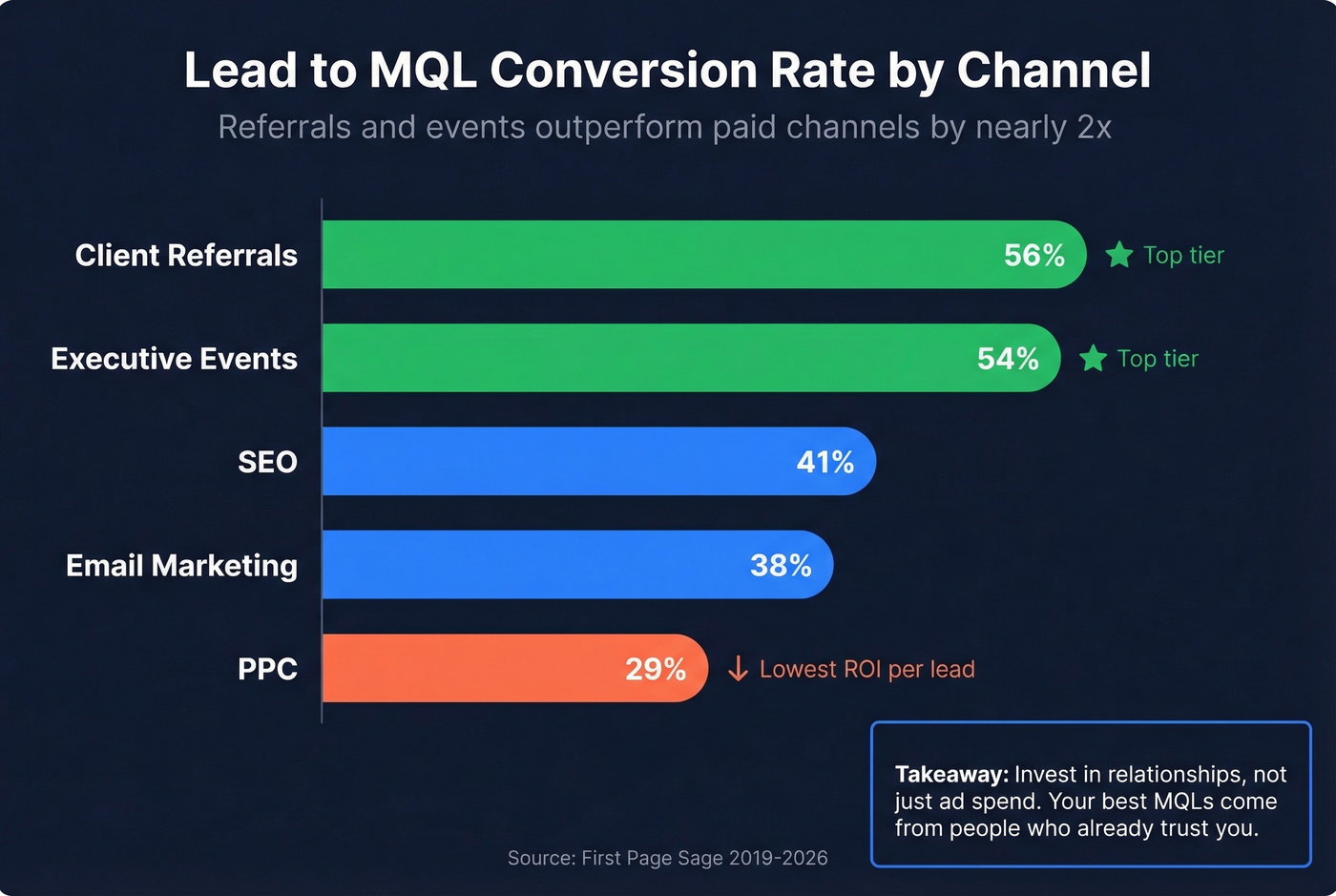
Channel matters as much as industry. First Page Sage's data shows client referrals and executive events crushing paid channels:
| Channel | Lead-to-MQL Rate |
|---|---|
| Client referrals | 56% |
| Executive events | 54% |
| SEO | 41% |
| Email marketing | 38% |
| PPC | 29% |
Source-Segmented MQL to SQL
Here's where it gets interesting. MarketOne shared conversion rates by lead source that reveal how wildly different "MQL-to-SQL" looks depending on origin: web leads converted at 85%, ISR-sourced leads at 50%, and campaign responders at just 15%. Averaging those into a single number is meaningless.
RevBlack's data reinforces the point: typical teams run 25-35% MQL-to-SQL, while high-alignment RevOps organizations hit 40-50%. The gap isn't about lead quality - it's about process.
How to Score and Grade Leads
A single composite lead score hides whether you have a fit problem or an intent problem. Split them.
Lead score measures intent through behavior: +20 for a director-level title, +15 for webinar attendance, +10 for a pricing page visit. Lead grade measures fit through firmographics on an A-F scale: company size, industry, tech stack, seniority. Combined, you get notation like "A95" - strong fit, high intent, clear candidate for sales acceptance - versus "C25" - weak fit, low engagement, stays in nurture.
For the SQL qualification gate, start with BANT. It's simple and it works for most mid-market deal sizes. Graduate to CHAMP or MEDDIC as average contract values climb and buying committees get complex. Pair scoring with real-time data verification - stale records inflate scores artificially. A lead who changed jobs six months ago still triggers "VP title" points. Prospeo's 7-day data refresh cycle keeps scoring inputs current so your automation isn't promoting ghosts.

Stale data inflates lead scores and wastes your SAL-to-SQL pipeline. Prospeo refreshes 300M+ profiles every 7 days - not every 6 weeks - so your scoring models grade real job titles, verified emails, and current companies. Stop promoting ghosts to your AEs.
Clean data turns SAL rejections into qualified SQLs.
CRM Implementation
Here's the thing: the real problem isn't defining these stages. It's that your CRM has no rejection workflow.
In Salesforce: Teams typically track both stages on the Lead object via Lead Status until conversion. The SDR/BDR owns the status change from MQL to SAL. SQL is commonly the point you convert the Lead and create an Opportunity. Lead object for pre-conversion, Opportunity object for post-conversion.
In HubSpot: Track both using Lifecycle Stage or a custom "Lead Stage" property. Set up a workflow: when the stage changes to SAL, auto-create a task for the assigned AE to accept or reject within 24 hours. No task completion within the window? Escalate to the sales manager.
The rejection loop matters most. When an AE rejects a sales accepted lead, it returns to a nurture sequence with a rejection reason logged in a custom field. Marketing reviews rejection reasons weekly. "Wrong title" means your lead scoring model needs work. "Bad contact info" means your data source needs replacing. "Not ready to buy" means your timing threshold is off. Every rejected lead teaches you something - but only if the reason is logged, and only if someone actually reads the logs.
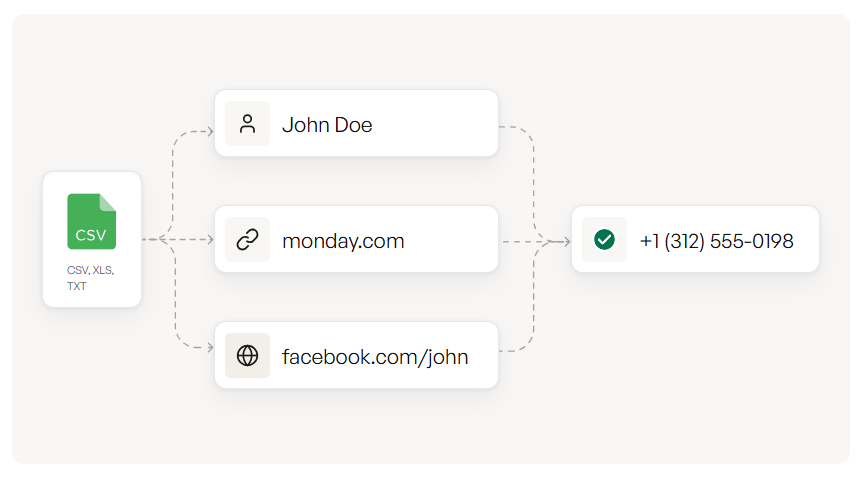
A common reason leads get rejected at the acceptance stage is bad contact data - disconnected numbers, bounced emails, outdated titles. Enriching CRM records with verified emails and direct dials before the handoff means AEs spend time selling instead of Googling phone numbers.
SLAs That Actually Work
Responding to an inbound lead within five minutes makes you 9x more likely to convert. Your SLA needs to codify that urgency.
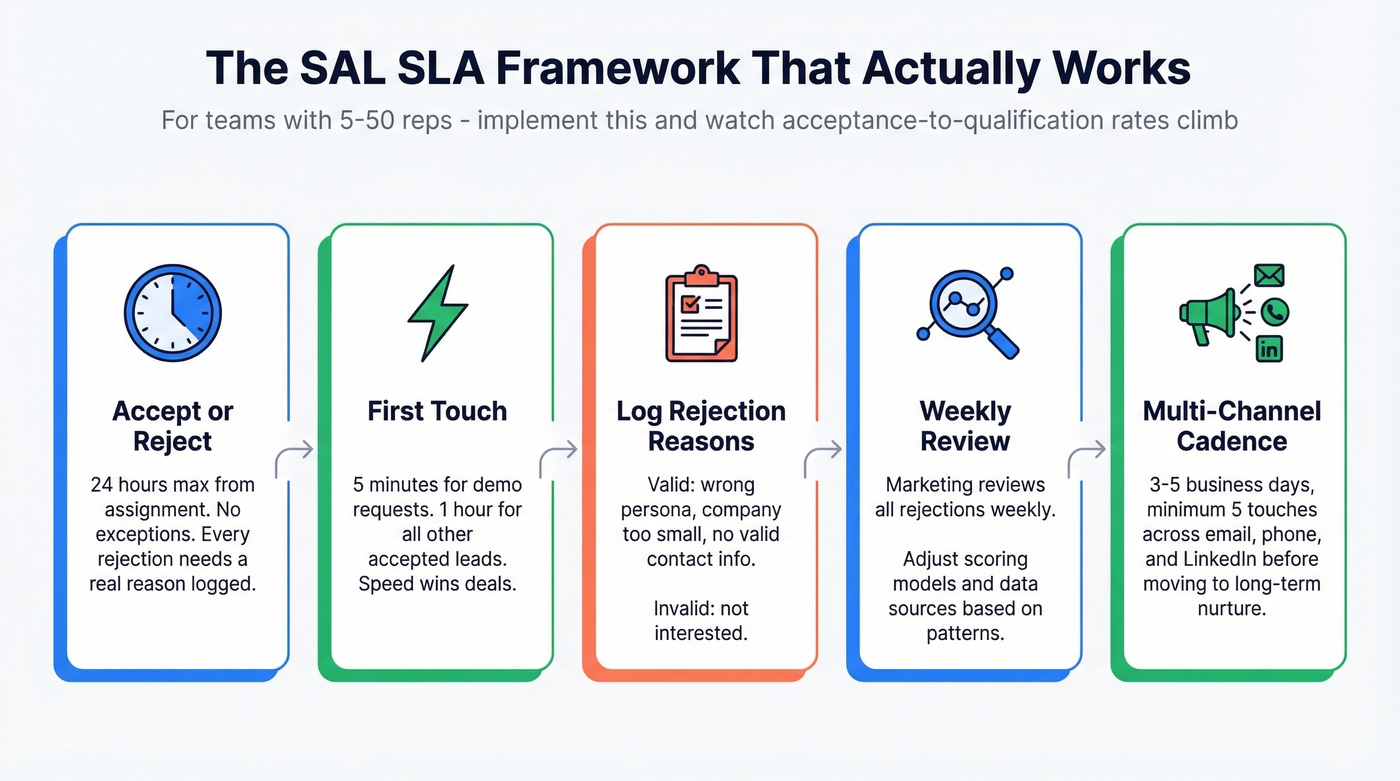
We've found the following framework works well for teams between 5 and 50 reps:
- Accept or reject every sales accepted lead within 24 hours of assignment. No exceptions.
- First touch within 5 minutes for inbound demo requests, within 1 hour for all other accepted leads.
- Every rejection requires a logged reason. "Not interested" doesn't count. Valid reasons: "wrong persona," "company too small," "no valid contact info."
- Marketing reviews all rejections weekly and adjusts scoring or data sources accordingly.
- After acceptance, run a multi-channel cadence over 3-5 business days with a minimum of 5 touches before moving to long-term nurture.
We've seen teams implement SLAs like this and materially lift their acceptance-to-qualification conversion within a quarter. The SLA doesn't change lead quality - it changes whether good leads get worked before they go cold.
Why Your Funnel Metrics Lie
Even with clean definitions, your pipeline data is probably being gamed. MarketOne documented the patterns we see constantly: sandbagging where reps move SQLs back to earlier stages to avoid close-date pressure, push behavior where close dates slide forward quarter after quarter, and best-case syndrome where deals get marked as likely to close when they're nowhere near it.
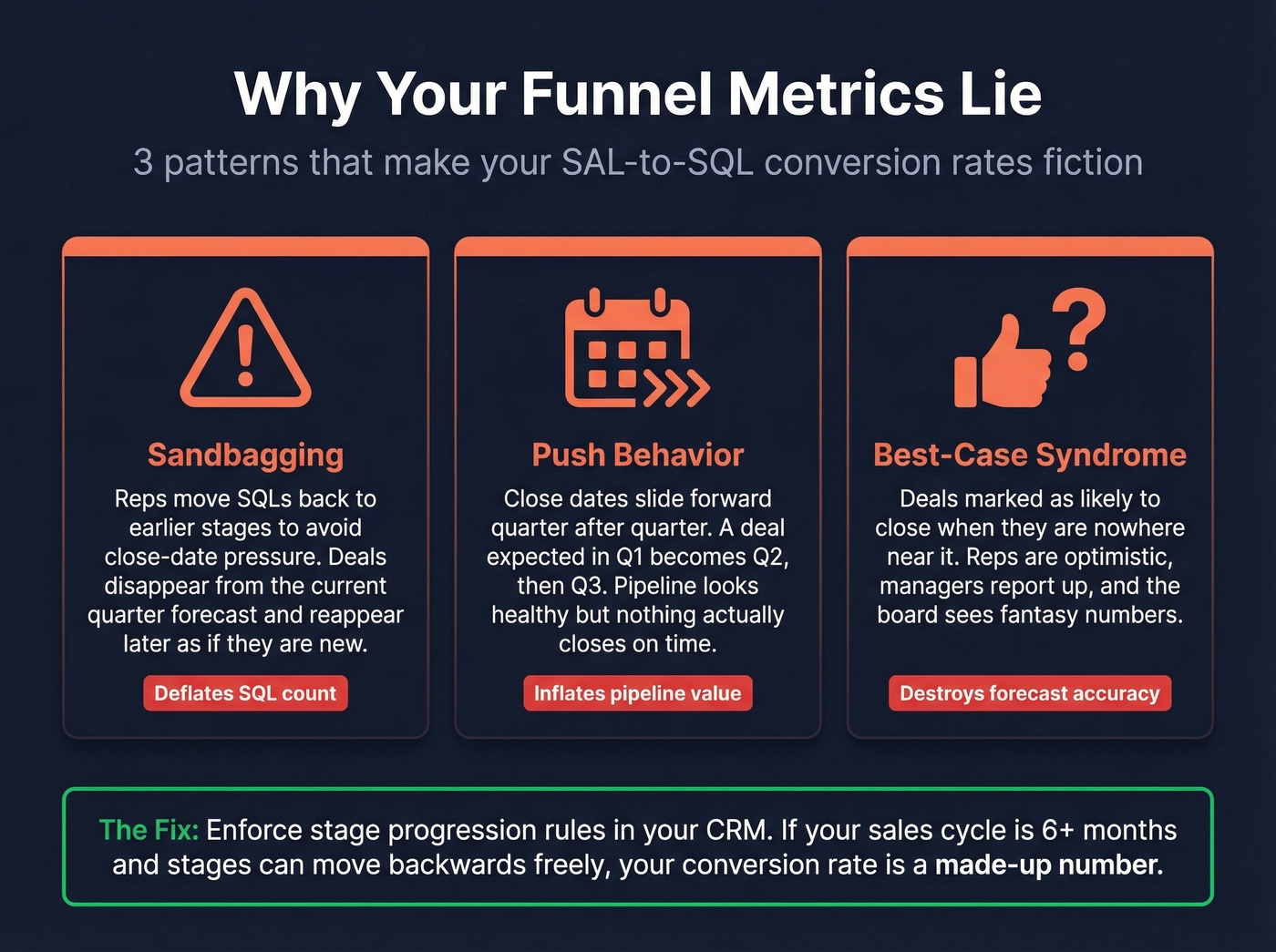
The worst version: reps moving qualified leads back to a future lead status if they don't close within 90 days - despite a 9-12 month sales cycle - then re-entering them later as "new" leads. This creates duplicate records and makes your conversion metrics fiction.
A thread in r/marketing shows a related frustration: marketers being pressured to "own SQLs" even though sales controls the qualification criteria, turning the metric into a political football rather than a diagnostic tool.
Before you trust any conversion number between these stages, audit whether your CRM actually enforces stage progression rules. If your sales cycle exceeds six months and you don't have those rules enforced, your conversion rate is a made-up number. Stop optimizing it and fix the plumbing first.
Is SAL Still Necessary in 2026?
For keeping it: It forces accountability, creates a feedback loop between marketing and sales, and catches bad data before it wastes AE time. For teams above five reps, the checkpoint pays for itself in reduced finger-pointing alone.
For dropping it: It adds friction. Newer demand unit waterfall models retain SQL but seem to abandon the acceptance stage. Kellblog suggests skipping the semantics entirely and using "stage 1 opportunity" and "stage 2 opportunity" instead.
Let's be honest - the label can change. Call it SAL, call it "sales accepted," call it "stage 1." The handoff checkpoint shouldn't disappear. For teams with dedicated SDRs handing off to AEs, a formal acceptance step is non-negotiable. For solo founders doing everything themselves, merge both stages into one and move on.
Applying This in Complex Verticals
The SAL vs SQL framework isn't limited to SaaS. Industries with long procurement cycles and multiple stakeholders - manufacturing, construction, enterprise IT - benefit enormously from a formal acceptance step.
In manufacturing, leads often come from trade shows, distributor referrals, or RFQ portals, and the buying committee can include engineers, procurement officers, and plant managers. Without an acceptance checkpoint, these leads sit unworked because no single rep claims ownership. Adding a structured stage with clear acceptance criteria (verified contact, confirmed project scope, budget range) ensures high-value leads don't die in a shared inbox. Skip this step if your team is under five people and one person handles the full cycle - the overhead isn't worth it at that scale.
The #1 SAL rejection reason is bad contact info - bounced emails, wrong titles, disconnected numbers. Prospeo enriches CRM records with 98% accurate emails and 125M+ verified mobiles before the handoff, so reps actually connect instead of logging 'bad data' rejections.
Eliminate 'bad contact info' as a rejection reason for $0.01 per lead.
FAQ
What if an inbound demo request skips MQL entirely?
Route it straight to SAL. High-intent actions like demo requests don't need a scoring gate - they need speed. Apply your 5-minute response SLA immediately and let the AE accept within the hour.
Can SAL and SQL be the same stage?
Yes, for teams under five reps where the same person accepts and qualifies. Merge them into a single "Sales Qualified" stage. Add the acceptance step back when you have dedicated SDRs handing off to AEs.
How do you fix low SAL-to-SQL conversion?
Start with data quality. If AEs reject leads because of bounced emails or wrong titles, fix enrichment upstream - a 98% email accuracy rate and weekly data refresh eliminate most bad-data rejections. Then audit your scoring model for fit-vs-intent balance. Finally, check SLA compliance: leads untouched for 48 hours aren't a quality problem, they're a process problem.
What's the ideal SAL-to-SQL conversion rate?
Healthy B2B teams convert 30-50% of accepted leads into qualified opportunities. Below 30%, either your MQL scoring is too loose or your SLA enforcement is too weak. Above 50% consistently means marketing is being too conservative and leaving pipeline on the table.