Sales Abbreviations (2026): The Workflow Glossary + Cheat Sheet
$15k in pipeline "slipped," the CRO wants a "commit," Marketing's mad about "SAL quality," and someone drops "QTC" like you're supposed to nod.
Sales teams don't speak English in meetings. They speak sales abbreviations.
This is the version you can actually use: organized by workflow, collisions fixed, plus the formulas RevOps will quiz you on.
If you're new (or just new to this company), you're not dumb. I've watched strong reps stall in week one because they can run discovery just fine, but they can't decode the alphabet soup fast enough to follow the forecast call. The fix isn't memorizing 150 terms. It's learning the 30 you'll hear this week, then using a simple collision habit so you don't build process on the wrong definition.
What you need (quick version): the 30 sales abbreviations you'll hear this week
Use this as your meeting survival checklist. If you only learn one thing: "commit" and "best case" are forecast buckets, not vibes - and ACV/ARR/MRR are different numbers that people mix up constantly.

These 30 cover roles, funnel, forecasting, contracting, and retention - the stuff that comes up in standups, pipeline reviews, and "quick syncs" that are never quick.
- SDR - Sales Development Rep. Use it: "SDRs are working inbound demo requests today."
- BDR - Business Development Rep (often outbound). Use it: "BDRs are running the new outbound sequence."
- AE - Account Executive (closer). Use it: "The AE will run discovery and own the deal."
- CSM - Customer Success Manager. Use it: "CSMs are driving renewals and expansion."
- RevOps - Revenue Operations (systems + process across GTM). Use it: "RevOps is changing routing rules in the CRM."
- CRM - Customer Relationship Management system. Use it: "If it's not in the CRM, it didn't happen."
- ICP - Ideal Customer Profile. Use it: "This account fits our ICP."
- TAM - Total Addressable Market. Use it: "Our TAM expands if we add healthcare."
- ABM - Account-Based Marketing. Use it: "ABM's warming the top 50 accounts."
- MQL - Marketing Qualified Lead. Use it: "We got 300 MQLs from the webinar."
- SAL - Sales Accepted Lead. Use it: "We accepted 60 SALs; 20 became opps."
- SQL - Sales Qualified Lead. Use it: "Only 40 of those became SQLs."
- SLA - Service Level Agreement (handoff rules). Use it: "SLA says respond to inbound within 15 minutes."
- BANT - Budget, Authority, Need, Timeline. Use it: "Need and Timeline are clear; Budget isn't."
- MEDDIC - Enterprise qualification framework. Use it: "MEDDIC gap: we don't have a Champion yet."
- POC - Proof of Concept. Use it: "They want a 30-day POC before procurement."
- ROI - Return on Investment. Use it: "We need an ROI model for the CFO."
- KPI - Key Performance Indicator. Use it: "Pipeline coverage is the KPI this quarter."
- ACV - Annual Contract Value (deal size per year). Use it: "ACV is $24k; it's a mid-market deal."
- ARR - Annual Recurring Revenue (company-level recurring). Use it: "We're at $6M ARR, pushing for $8M."
- MRR - Monthly Recurring Revenue. Use it: "MRR grew 8% MoM."
- NRR - Net Revenue Retention. Use it: "NRR is 118% - expansion is carrying us."
- GRR - Gross Revenue Retention. Use it: "GRR is 89% - churn's a problem even with expansion."
- CAC - Customer Acquisition Cost. Use it: "CAC spiked after we hired three AEs."
- LTV - Lifetime Value. Use it: "LTV is strong if churn stays low."
- QBR - Quarterly Business Review. Use it: "QBR with the customer is next Thursday."
- MAP - Mutual Action Plan (shared close plan). Use it: "If it's not in the MAP, it's not real."
- TTV - Time to Value. Use it: "TTV is 45 days; target is 21."
- DPA - Data Processing Addendum (privacy terms). Use it: "DPA is mandatory for EU customers."
- QTC - Quote to Cash (quote -> contract -> invoice -> revenue). Use it: "QTC is slow because redlines sit with legal."
Sales abbreviations vs sales acronyms vs initialisms (and why it matters)
"Sales abbreviations" is the umbrella term. In practice, teams mix abbreviations, acronyms, and initialisms - and then act surprised when new hires look lost.
Here's the real problem: the same three letters can mean a role, a metric, a meeting type, or a process step depending on who's talking. Onboarding docs help, but only if your org also defines how you use the term in your workflow, because that's what determines what gets built into stages, dashboards, routing rules, and comp plans.
Quick definitions (keep this in your head):
- Abbreviation: any shortened form (includes acronyms + initialisms).
- Acronym: pronounced like a word (SaaS, SPIN).
- Initialism: pronounced letter-by-letter (SDR, ARR, QBR).
Don't argue about labels. Argue about meaning and context.
Sales abbreviations collision list: same abbreviation, different meaning (how to disambiguate fast)
Acronym collisions are why "simple glossaries" fail. Your org doesn't just need definitions - it needs a disambiguation habit.
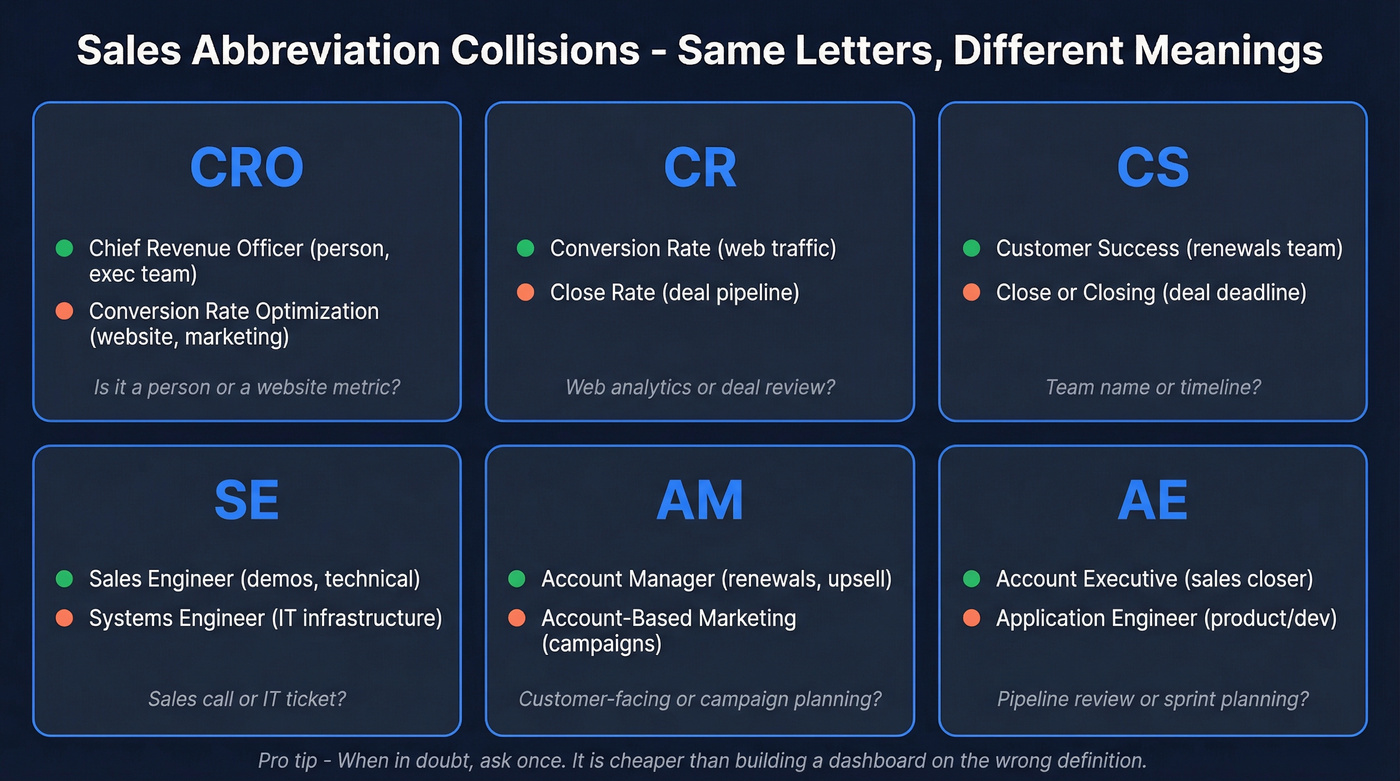
In our experience, the #1 collision in GTM meetings is CRO:
- CRO = Chief Revenue Officer (exec role spanning marketing, sales, CS)
- CRO = Conversion rate optimization (marketing/web discipline)
Collision table (print this)
| Term/Abbrev | Meaning A | Meaning B | How to tell fast |
|---|---|---|---|
| CRO | Chief Revenue Officer | Conv rate opt | person vs site |
| CR | Conversion rate | Close rate | web vs deals |
| CS | Customer Success | Close/closing | renewals vs deadline |
| SE | Sales Engineer | Systems Engineer | demos vs IT |
| AM | Account Manager | Account-based mktg | renewals vs campaigns |
| AE | Account Executive | Application Engineer | sales vs product |
| ISR | Inside Sales Rep | Info systems req | quota vs IT docs |
| Bounce rate | Website bounce | Email bounce | analytics vs deliverability |
Your collision-handling system (works in 30 seconds)
When you hear an abbreviation you're not 100% sure about, run this rule:

- Department context: Sales, Marketing, CS, RevOps, Product, Finance
- Meeting type: forecast call, pipeline review, QBR, standup, deal desk
- Metric context: is someone quoting a number, a rate, or a stage conversion?
- Neighbor words: "in the CRM," "on the website," "in the contract," "in commit"
- Ask once: "Quick check - CRO as in Chief Revenue Officer or conversion rate optimization?"
Asking once is cheaper than building a dashboard on the wrong definition and explaining it to the board later.

You just learned 150+ sales abbreviations. Now put them to work. Prospeo gives you the ICP-filtered leads, intent signals across 15,000 topics, and 98% verified emails so your SDRs and AEs actually connect with decision-makers - not bounce.
Stop decoding acronyms. Start filling pipeline at $0.01 per email.
Sales abbreviations glossary by workflow (bookmark this)
Organized the way sales actually happens: prospect -> qualify -> forecast -> close -> retain -> operate. Definitions are tight, and the examples are how you'll hear them in meetings.

Prospecting & targeting
Top 7 you'll hear daily (and what they really mean)
- ICP: "Would we still want this customer in 12 months?"
- Intent: "They're researching the problem right now."
- Trigger: "Something changed - reach out today."
- DM / EB: "Who can say yes, and who controls the money?"
- Sequence / cadence: "What touches happen, and how often?"
- CTA: "What's the next step we're asking for?"
- OOO: "This is why your follow-up timing is wrong."
| Term | Meaning | What you'll hear in meetings |
|---|---|---|
| ICP | Ideal Customer Profile | "That's not ICP - wrong segment." |
| TAM | Total Addressable Market | "TAM's big; reachable TAM isn't." |
| SAM | Serviceable Available Market | "SAM is mid-market US only." |
| SOM | Serviceable Obtainable Market | "SOM is what we can win this year." |
| ABM | Account-Based Marketing | "ABM's warming the top 100 accounts." |
| AIDA | Awareness, Interest, Desire, Action | "This ad is Awareness; the demo page is Action." |
| T1/T2/T3 | Tiering of accounts | "T1 gets 1:1; T3 is scaled." |
| Persona | Buyer type (role + pains) | "We need IT + Finance personas." |
| DM | Decision Maker | "We haven't met the DM yet." |
| EB | Economic Buyer | "EB wants a 12-month payback." |
| Champion | Internal advocate | "No champion, no deal." |
| Intent | Buying signals | "Intent spiked on 'data governance.'" |
| Trigger | Event that creates urgency | "New VP is a trigger - reach out." |
| Warm intro | Referral into an account | "Can we get a warm intro to the EB?" |
| Cold outbound | Unsolicited outreach | "Cold outbound's down - list quality?" |
| Sequence | Multi-step outreach | "Add them to the 12-step sequence." |
| Cadence | Outreach pattern | "Cadence is too aggressive for EMEA." |
| CTA | Call to action | "CTA is 'book a 15-min fit check.'" |
| OOO | Out of office | "OOO reply - pause the sequence." |
| SPF/DKIM/DMARC | Email auth records | "DMARC's strict - don't mess with domains." |
Use it in a sentence: "This ICP is narrow, but intent + trigger accounts convert like crazy."
Discovery & qualification
| Term | Meaning | What you'll hear in meetings |
|---|---|---|
| MQL | Marketing Qualified Lead | "MQL volume's up, quality's down." |
| SQL | Sales Qualified Lead | "SQL means we confirmed pain + fit." |
| SAL | Sales Accepted Lead | "We accepted it as a SAL; routing worked." |
| SLA | Handoff agreement | "SLA breach: response time was 2 hours." |
| Discovery | First real sales call | "Discovery was messy - no agenda." |
| Qual | Qualification call | "Book a qual before AE time." |
| BANT | Budget/Authority/Need/Timeline | "BANT is partial; Authority's unclear." |
| CHAMP | Challenges/Authority/Money/Prioritization | "CHAMP says prioritize pain first." |
| MEDDIC | Enterprise qualification | "MEDDIC gap is Decision Process." |
| MEDDPICC | MEDDIC + Paper Process + Competition | "Paper Process will kill EOQ if late." |
| LAER | Listen, Acknowledge, Explore, Respond | "Use LAER - don't argue with the objection." |
| POC | Proof of Concept | "POC is required for security signoff." |
| POV | Proof of Value | "POV ties to ROI, not just features." |
| SOW | Statement of Work | "SOW needs to match scope exactly." |
| MSA | Master Services Agreement | "MSA redlines are blocking signature." |
| NDA | Non-disclosure agreement | "NDA first, then we can share roadmap." |
| RFP | Request for Proposal | "RFP is a trap unless we're wired in." |
| RFQ | Request for Quote | "RFQ means procurement's involved." |
| Stakeholder | Anyone influencing the deal | "We're missing Security as stakeholder." |
| Mutual plan | Shared close plan | "Mutual plan has dates + owners." |
"Qualified" often means "AE feels good." Don't allow that.
Define qualification in CRM stages, not vibes.
Skip this if you're SMB/high-velocity: if your average deal's low five figures (or less) and you close in under 30 days, MEDDPICC turns into performative theater fast. Use a lightweight qual (BANT/CHAMP), move quickly, and spend your energy on next steps, pricing clarity, and clean handoffs.
Pipeline, forecasting & meetings
Stage definitions we enforce in CRM (steal this) If your stages are fuzzy, your forecast's fiction. Here's a clean baseline:
- Stage 1 (Discovery scheduled): meeting booked, agenda sent
- Stage 2 (Discovery complete): pain + ICP fit confirmed, next step booked
- Stage 3 (Evaluation): demo/technical validation in motion, stakeholders mapped
- Stage 4 (Proposal): pricing shared, mutual action plan dated
- Stage 5 (Commit / contracting): paper process started, close date tied to steps
- Closed-won / Closed-lost: self-explanatory - no "ghosting" stage
| Term | Meaning | What you'll hear in meetings |
|---|---|---|
| Opp | Opportunity | "Is the opp real or just a convo?" |
| Pipe | Pipeline | "Pipe's light for next quarter." |
| Pipe coverage | Pipeline ÷ quota | "We need 3-4x coverage to hit." |
| Stage | Pipeline step | "Stage 2 isn't 'demo done.'" |
| Forecast | Expected revenue | "Forecast is $420k for March." |
| Commit | High-confidence bucket | "Only commit with paper started." |
| Best case | Medium-confidence bucket | "Best case if legal turns fast." |
| Upside | Low-confidence bucket | "Upside is nice, don't bank on it." |
| Slip | Deal moved out in time | "It slipped because security review." |
| Pull-in | Move deal earlier | "Can we pull it in with a fast-start?" |
| ACV | Annual Contract Value | "ACV is $60k; discount needs approval." |
| SMART | Specific, Measurable, Achievable, Relevant, Time-bound | "Make the Q2 pipeline goal SMART." |
| QBR | Quarterly Business Review | "QBR deck needs outcomes, not features." |
| EOM/EOQ/EOY | End of month/quarter/year | "EOQ is when procurement wakes up." |
| WBR/MBR | Weekly/Monthly business review | "WBR is metrics only - no storytelling." |
| 1:1 | Manager meeting | "Bring your commit notes to the 1:1." |
| Deal desk | Pricing/terms approval | "Deal desk needs margin + justification." |
| SPIF | Sales performance incentive fund | "SPIF for multi-year deals this month." |
| MAP | Mutual action plan | "MAP is the only way to control timeline." |
Use it in a sentence: "We're at 2.1x coverage - either generate pipe or lower the forecast."
Negotiation & closing
Contracting checklist (the stuff that actually blocks signature)
- Security: SOC 2, pen test summary, security questionnaire
- Privacy: DPA, subprocessor list, data residency
- Commercials: discount approval, net terms, invoicing schedule
- Paper: MSA + SOW alignment, PO requirement, signature routing
Run that checklist early and you stop losing deals to "we ran out of time at EOQ."
| Term | Meaning | What you'll hear in meetings |
|---|---|---|
| QTC | Quote to Cash | "QTC is slow - CPQ isn't configured." |
| CPQ | Configure, Price, Quote | "CPQ rules broke discount approval." |
| Quote | Commercial offer | "Send the quote today, not tomorrow." |
| Redlines | Contract edits | "Redlines are liability + data terms." |
| Procurement | Buying process owner | "Procurement wants three bids." |
| DPA | Data Processing Addendum | "DPA is mandatory for EU customers." |
| SOC 2 | Security compliance report | "SOC 2 is required before signature." |
| MSA | Master agreement | "MSA signed; now we do SOWs." |
| SOW | Scope + deliverables | "SOW needs milestones for invoicing." |
| PO | Purchase order | "No PO, no invoice." |
| Net terms | Payment timing | "They want Net 60 - Finance hates it." |
| T&Cs | Terms and conditions | "T&Cs changed - re-approve the quote." |
| Closed-won | Deal won | "Mark closed-won after countersign." |
| Closed-lost | Deal lost | "Closed-lost reason: incumbent + timing." |
Here's the thing: most "negotiation" is internal alignment (discounts, security, legal). That's why QTC matters.
Marketing <-> Sales alignment
| Term | Meaning | What you'll hear in meetings |
|---|---|---|
| SLA | Response + quality agreement | "SLA is broken on both sides." |
| SAL | Sales accepted lead | "SAL rate is the real handoff health." |
| Handoff | Lead ownership transfer | "Handoff happens after intent + fit." |
| Routing | Assignment rules | "Routing's wrong - enterprise leads hit SMB." |
| Attribution | Credit for pipeline | "Attribution says paid search sourced it." |
| Sourced vs influenced | Origin vs impact | "Sales sourced, Marketing influenced." |
| TOFU | Top of funnel | "TOFU content is driving MQLs." |
| MOFU | Middle of funnel | "MOFU is case studies + webinars." |
| BOFU | Bottom of funnel | "BOFU is ROI tools + security docs." |
| CPL | Cost per lead | "CPL is down; SQL rate is down too." |
| CPA | Cost per acquisition | "CPA's too high for this segment." |
| UTM | Tracking parameters | "UTMs are missing - attribution's broken." |
Use it in a sentence: "We don't need more MQLs; we need higher SAL rate and faster SLA response."
Customer success & retention
| Term | Meaning | What you'll hear in meetings |
|---|---|---|
| CS | Customer Success | "CS is escalating churn risk." |
| CSM | Customer Success Manager | "CSM owns renewal forecast." |
| Onboarding | Initial implementation | "Onboarding slipped - TTV will suffer." |
| TTV | Time to Value | "TTV is 45 days; target is 21." |
| Adoption | Usage + engagement | "Adoption's flat - run enablement." |
| Renewal | Contract continuation | "Renewal's at risk due to support." |
| Expansion | More revenue from same customer | "Expansion motion is working." |
| Contraction | Revenue decrease | "Contraction is seat reductions." |
| Churn | Customer or revenue loss | "Churn's concentrated in SMB." |
| NRR | Net revenue retention | "NRR is 110% - good, not elite." |
| GRR | Gross revenue retention | "GRR is 92% - healthy base." |
| Health score | Composite risk metric | "Health score dropped after usage dip." |
| EBR | Executive business review | "EBR is how we multi-thread renewals." |
| VOC | Voice of customer | "VOC says reporting is the pain." |
RevOps, systems & data quality
| Term | Meaning | What you'll hear in meetings |
|---|---|---|
| RevOps | Revenue Operations | "RevOps is standardizing stages." |
| CRM | System of record | "CRM hygiene is slipping." |
| Enrichment | Append missing data | "Enrich the list before outreach." |
| Deduping | Removing duplicates | "Deduping's mandatory before import." |
| Routing | Lead/account assignment | "Routing rules need territory updates." |
| CQL | Conversation Qualified Lead | "CQL means we had a real convo." |
| Deliverability | Ability to land in inbox | "Deliverability tanked after bounces." |
| Bounce rate | Email bounce rate | "Bounce rate is 8% - hard or soft?" |
| Hard bounce | Invalid mailbox | "Hard bounces mean bad data." |
| Soft bounce | Temporary issue | "Soft bounces can recover." |
| Suppression list | Do-not-send list | "Add unsubscribes to suppression." |
| Domain reputation | Sender trust | "Reputation dropped - pause sends." |
| Data freshness | How current records are | "Titles changed; data's stale." |
| API | System integration | "Use the API to enrich in real time." |
A scenario you'll recognize: an SDR imports a list, blasts 800 emails, bounce rate hits 9%, and suddenly everyone's arguing about "messaging" while your domain reputation quietly falls off a cliff. Real talk: that's a data problem first.
If you're trying to prevent that, tools like Prospeo (the B2B data platform built for accuracy) help because they verify emails in real time at 98% accuracy and refresh records every 7 days, so you're not sending to stale contacts and hoping for the best.
Messaging & communication (the mini-glossary most glossaries forget)
This is the "how we talk" layer - useful because it shows up in Slack, call notes, and manager feedback.
| Term | Meaning | What you'll hear in meetings |
|---|---|---|
| TL;DR | Summary | "TL;DR: deal slipped; next step is security." |
| FYI | For your information | "FYI, procurement added a new approver." |
| EOD | End of day | "Send the recap EOD." |
| EOW | End of week | "We need the mutual plan by EOW." |
| ETA | Estimated time of arrival | "What's the ETA on redlines?" |
| NFS | Not for sale / not for sharing | "That doc is NFS externally." |
| GTM | Go-to-market | "GTM motion is shifting upmarket." |
| POV (alt) | Point of view | "What's our POV vs the incumbent?" |
My opinion: if your team overuses "circle back" and underuses "next step + date," your pipeline hygiene will always be a mess. Language becomes process.
Framework abbreviations you'll see in enablement (and when to use which)
Enablement loves frameworks because they create shared language. The trap is using an enterprise framework on a transactional motion - or using a lightweight one when you're in a compliance-heavy, multi-stakeholder deal where security, legal, and procurement can add weeks even after the buyer says "yes," and your close date only survives if the paper process is mapped early with owners and dates.
A quick origin note: SPIN is still popular because it's built on research into 35,000+ sales calls. MEDDIC traces back to 1996 at PTC, and MEDDPICC exists because modern deals add two realities: paper process and competition.
| Framework | Best for | Avoid when | "Good" looks like |
|---|---|---|---|
| SPIN | Better discovery | Late-stage only | Clear pain + impact |
| MEDDIC | Complex deals | High-velocity SMB | EB + process mapped |
| MEDDPICC | Regulated + competitive | Simple renewals | Paper + comp known |
| BANT | Quick triage | Multi-threaded enterprise | 3/4 clear |
| LAER | Objection handling | You want to "win" the argument | Prospect feels heard |
How to learn sales acronyms fast (without cramming)
- Practice in low-risk places: write call notes using 5 acronyms correctly.
- Adopt the ask-once rule: clarify the first time, then mirror the team's usage.
- Build "your 10": pick 10 acronyms you personally hear daily and master those first.
Qualification abbreviations (BANT isn't a checklist)
BANT's the most abused four-letter word in sales.
It came out of IBM in the 1950s, and the modern guidance (popularized via Pipedrive's write-up quoting IBM) is blunt:
"Neither BANT nor SID examples are sets of questions... [they show] the type of information sellers highly value... conversation flows naturally..."
That's the right mindset. BANT isn't an interrogation script - it's a map of what you need to learn.
A practical heuristic many teams use: if you've got 3 of 4, the lead's viable. That's fine, as long as you don't pretend "Authority" is a single person anymore. Buying groups are real, and "A" usually means "how does authority work here?"
Do:
- Use BANT to spot the missing piece (usually Authority or Timeline).
- Translate "Budget" into "how do they fund this?" (opex vs capex, renewal timing, reforecast windows).
- Treat "Timeline" as a mutual plan, not a guess.
Don't:
- Gatekeep discovery with "what's your budget?" in minute three.
- Mark a lead unqualified just because they can't name a number yet.
- Assume one champion equals authority.
Sales metrics abbreviations with formulas (the ones RevOps will quiz you on)
If you want to sound fluent fast, learn the formulas - and the denominator rules. We've seen teams argue for weeks over "CR" because they never agreed on what the denominator was.
Formula cards (copy/paste into your notes)
CVR - Conversion Rate
Formula: CVR = (Conversions ÷ Total) × 100
Denominator rule: "Total" must match context - visitors, clicks, leads, MQLs, SQLs, opps, or stage-to-stage. Pick one and stick to it.
ROI - Return on Investment
Formula: ROI = (Gain - Cost) ÷ Cost × 100
Sales reality: if you can't explain ROI in one sentence, your champion can't sell it internally.
ACV - Annual Contract Value
Formula: ACV = Contract value ÷ # of years
Example: $72k over 3 years -> $24k ACV.
ARPA - Average (Monthly Recurring) Revenue Per Account
Formula: ARPA = Total monthly revenue ÷ # of accounts
Example: $50,000 ÷ 400 = $125
NRR - Net Revenue Retention
Formula: NRR = (Starting RR + Expansion - Contraction - Churn) / Starting RR × 100
Interpretation: >100% means net expansion; <90% is a flashing warning light.
GRR - Gross Revenue Retention
Formula: GRR = (Starting RR - Churn - Contraction) / Starting RR × 100 GRR ignores expansion on purpose. It answers: "Are we leaking?"
CAC:LTV
Rule of thumb: 3:1+ is healthy, <2:1 is weak (unless you're intentionally overspending to grab market share).
Worked example (NRR vs GRR)
Starting recurring revenue: $100,000
Expansion: +$25,000
Contraction: -$10,000
Churn: -$8,000
- NRR = (100k + 25k - 10k - 8k) / 100k = 107%
- GRR = (100k - 10k - 8k) / 100k = 82%
That's the classic board conversation: NRR looks fine, but GRR's screaming that the base is unhealthy.
Mini table: what "good" suggests (common SaaS benchmarks)
| Metric | Formula | What "good" suggests |
|---|---|---|
| CVR | conv ÷ total ×100 | Funnel's working |
| ROI | (gain-cost) ÷ cost ×100 | Value is provable |
| ACV | value ÷ years | Deal size clarity |
| ARPA | rev ÷ accts | Pricing/upsell strength |
| NRR | (start+exp-con-ch)/start | Expansion engine |
| GRR | (start-ch-con)/start | Product stickiness |
| CAC:LTV | LTV ÷ CAC | Efficient growth |
One useful benchmark framing (often cited in SaaS circles): NRR above ~120% earns premium attention, while GRR below ~90% is a churn problem even if expansion hides it. Treat those as directional guardrails, not laws of physics.
Role abbreviations (SDR/BDR/AE/CSM) and why titles vary by company
Job titles in sales are messy because companies design roles around their motion, not around a universal dictionary.
A clean mental model: qualifiers don't close. SDR/BDR/ADR/ISR roles create conversations and qualified handoffs, then AEs run the deal cycle and close.
One stat worth knowing: Martal (citing Bridge Group benchmarks) finds only ~25% of companies keep a strict inbound SDR vs outbound BDR split. Most teams blend it because headcount's tight and pipeline pressure's real. Same dataset: average SDR tenure's ~1.5 years, and ramp is 3+ months - so your org's constantly onboarding people who don't know your acronyms yet, which is exactly why a living glossary beats a "read this PDF once" approach.
Common title mapping (how it usually works):
- SDR / BDR / ADR / ISR: qualify, book meetings, create SALs/SQLs
- AE: discovery -> evaluation -> negotiation -> close
- AM: renewals and/or expansion (varies a lot)
- CSM: adoption, retention, expansion influence (sometimes owns renewals)
- SE: technical validation, demos, security deep dives
If your company uses "AM" to mean "Account Manager" and Marketing uses "ABM" daily, you've already got a collision risk. Document it.
Sales abbreviations cheat sheet: download + how to document sales acronyms in your org
A good acronym system's a UX problem, not a vocabulary problem.
What works best in real teams is a searchable table plus a one-pager people can save. The extra step that makes it stick: an editable sheet (Google Sheets or Notion) that anyone can update when a new acronym shows up.
What to include in your internal acronym doc (template)
For every abbreviation, add:
- Owner (Sales, Marketing, CS, RevOps, Finance)
- Definition (1 line)
- Example sentence (the way it's used in your meetings)
- Where used (forecast call, CRM field, dashboard, enablement deck)
- Collision rule (if it collides, what context disambiguates)
The collision rule (document it explicitly)
When an acronym has multiple meanings, add a line like:
- "Use department + meeting type + metric context to disambiguate."
That one sentence prevents most confusion.
Recommended formats (do all three)
- Web page: searchable glossary table (fast)
- One-pager PDF: top 30 + collisions + formulas (portable)
- Editable sheet: the living source of truth (best for onboarding)
If you want a simple onboarding win: give new hires the top 30 list on day one, then have them add 10 "new acronyms I heard" to the editable sheet by end of week.
FAQ
What are the most common sales abbreviations for beginners?
Start with 20 that show up in almost every meeting: SDR, BDR, AE, CSM, CRM, ICP, MQL, SQL, SAL, SLA, pipeline, commit, ACV, ARR, MRR, NRR, GRR, CAC, LTV, and QBR. Learn them with one example sentence each and you'll follow 80%+ of pipeline and forecast conversations.
What's the difference between MQL, SQL, and SAL?
MQL's a lead Marketing says is worth Sales attention, SAL's the explicit checkpoint that Sales accepted the lead, and SQL's a lead Sales has qualified into a real opportunity. If you track one handoff metric, make it SAL rate - most teams aim for 30-60% depending on segment and routing rules.
What does CRO mean in sales (and why is it confusing)?
CRO usually means Chief Revenue Officer in leadership and forecast conversations, but it also means conversion rate optimization in marketing and web analytics. The fastest disambiguation is the noun next to it: "our CRO" is a person; "site CRO" is a program, test, or metric tied to web conversion.
What's the difference between NRR and GRR?
NRR includes expansion and answers "did existing customers grow net revenue?", while GRR excludes expansion and answers "did we retain the base?" A practical rule: NRR above ~120% is excellent, but GRR below ~90% signals churn/contraction that expansion may be masking.
What does "bounce rate" mean in sales (website vs email)?
Website bounce rate is single-page sessions in analytics, while email bounce rate is the percent of messages rejected by mail servers. For outbound, keep email bounce under 3-5% by verifying before you send; Prospeo verifies in real time at 98% accuracy and refreshes records every 7 days, which prevents domain reputation damage.
MQLs, SALs, SQLs - none of them matter if your contact data bounces. Prospeo's 5-step verification and 7-day refresh cycle keep bounce rates under 4%, so every abbreviation in your funnel translates to real pipeline.
Turn your GTM vocabulary into booked meetings with data that connects.
Summary (so you actually remember it)
Sales abbreviations aren't the problem - undefined workflow meaning is. Learn the top 30 you'll hear weekly, use the collision rule (department + meeting + metric context), and keep a living internal glossary with examples and formulas. Do that, and the "alphabet soup" stops being stressful and starts being useful.