Sales AI Tool Updates: What Actually Shipped in the Last 90 Days
Your VP forwarded a Gong article Monday morning. You opened three "best AI sales tools" listicles and found the same screenshots from 2024. None of them covered what actually changed last quarter.
The average sales team runs 8 tools, and overwhelmed sellers are 45% less likely to attain quota. More tools isn't the answer. Tracking real sales AI tool updates - specifically, tools that shipped meaningful improvements - might be.
Here's the thing: every "best AI sales tools" article is a snapshot that's stale the day it publishes. What matters right now is which tools got materially better in Q4 2025 through Q1 2026, what those changes mean for your stack, and which trends are worth paying attention to versus which ones are vendor marketing dressed up as innovation.
What You Need (Quick Version)
If you're short on time, three updates from the last 90 days actually matter:
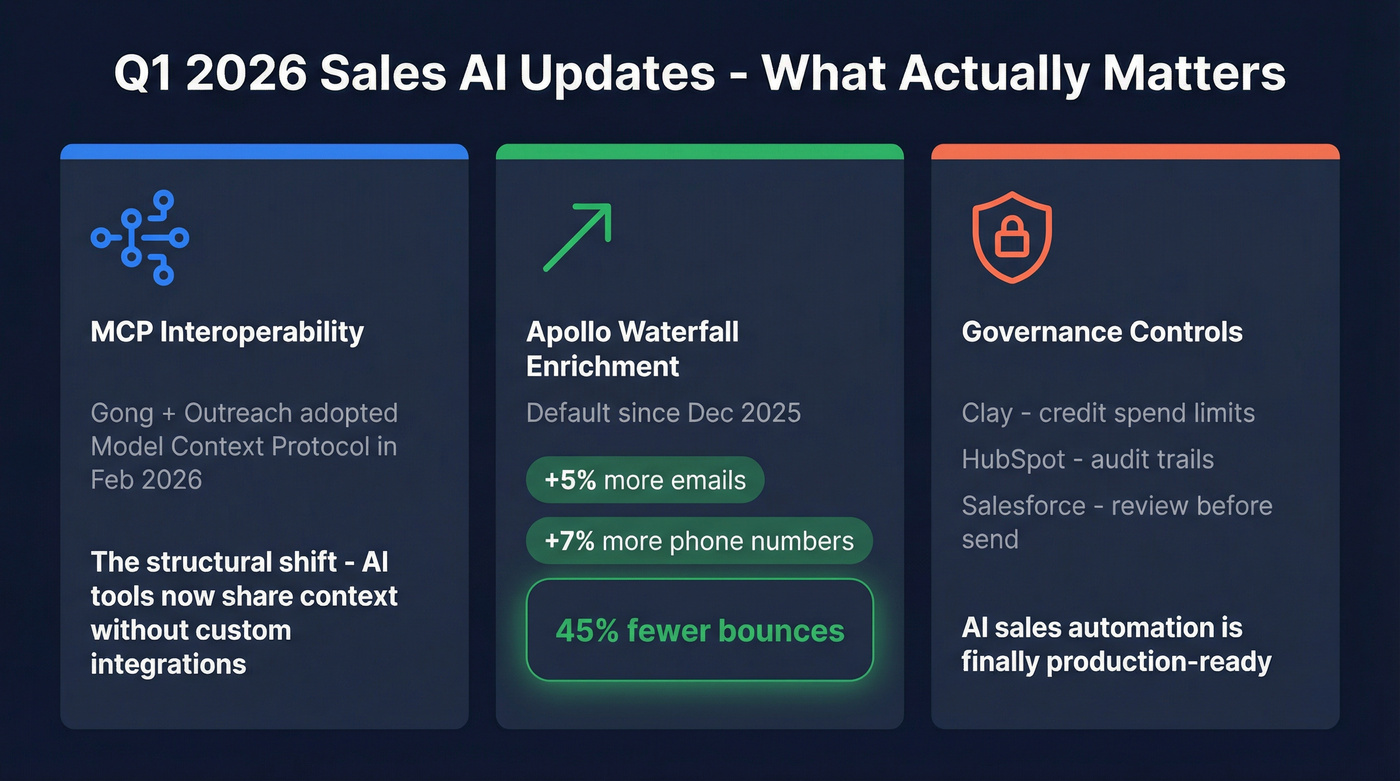
MCP interoperability is the structural shift. Both Gong and Outreach adopted Model Context Protocol in February 2026. This open standard lets AI tools share context without custom integrations. Fewer tools talking to each other beats more tools bolted together.
Apollo's waterfall enrichment delivered the most measurable improvement. Default since December 2025, it's producing ~5% more emails, ~7% more phone numbers, and 45% fewer bounces. That last number is the one your deliverability team cares about.
Governance controls are the update nobody's talking about. Clay added credit spend limits. HubSpot shipped audit trails. Salesforce built "review before send" controls. These aren't sexy features - they're signals that AI-powered sales automation is finally ready for production, not just demos.
Three Trends Behind Recent Updates
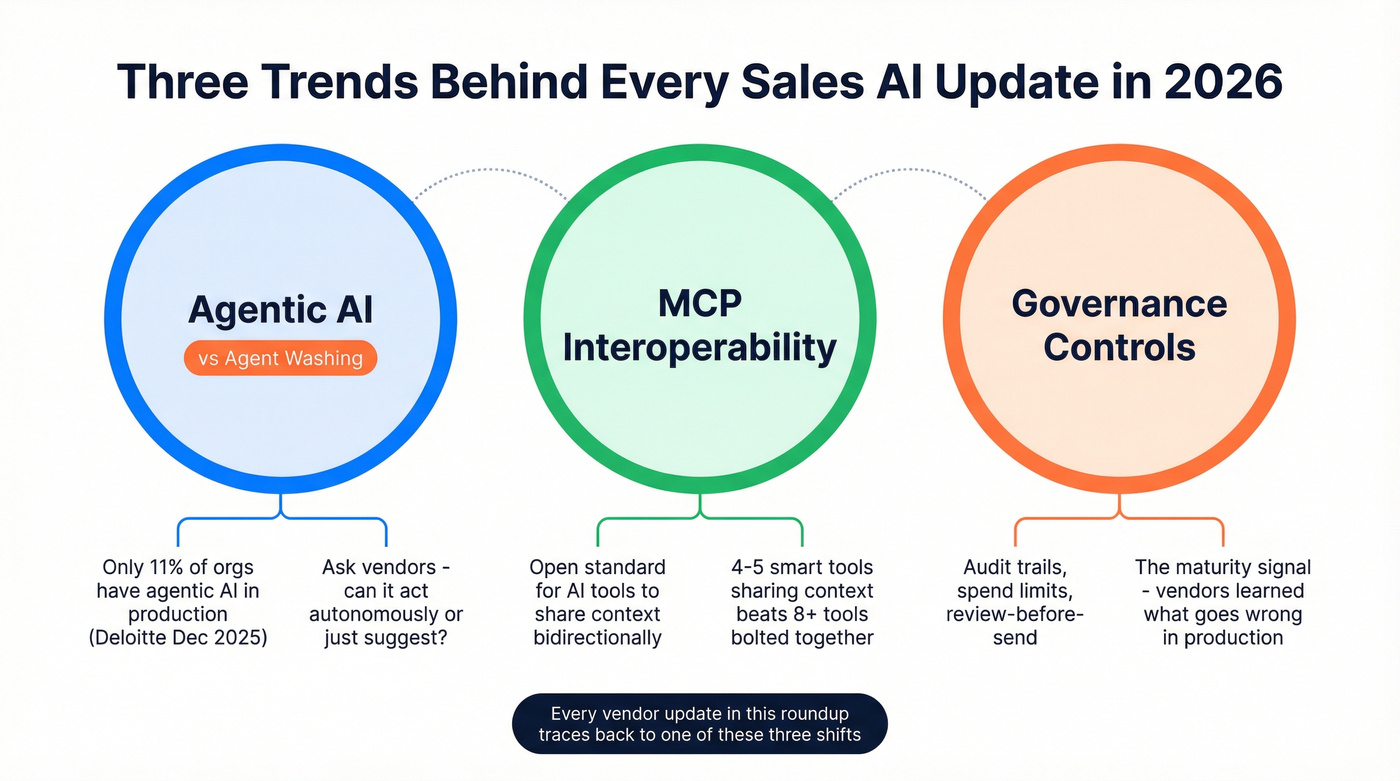
Every vendor update in this roundup traces back to one of three macro trends. Understanding them helps you separate real progress from noise.
Agentic AI vs. "Agent Washing"
An autonomous AI agent can perceive, reason, and act without external control. That's different from a chatbot that suggests next steps or an automation that fires when a field changes.
The reality is sobering. Deloitte's Dec 2025 research found 11% of organizations have agentic AI in production, 38% are piloting, 14% are ready to deploy, and 30% are still exploring. When a vendor tells you they've shipped "AI agents," ask whether those agents can actually take action autonomously or whether they're just surfacing recommendations with a new label. The distinction matters for any playbook you're building around these tools.
MCP Interoperability
Model Context Protocol is an open standard - originally from Anthropic - that lets AI tools share context bidirectionally. Think of it as a universal translator for your sales stack. Instead of building point-to-point integrations between every tool, MCP lets any compliant tool push and pull context from any other.
Gong and Outreach adopted Model Context Protocol in February 2026. The sales stack of 2026 isn't about finding one platform that does everything. It's about 4-5 intelligence tools that share context without middleware. MCP is the plumbing that makes that possible, and it's the single biggest reason to re-evaluate your stack right now.
Governance Controls
Clay shipped credit spend limits. HubSpot introduced audit trails showing exactly what an agent did. Salesforce built "review before send" controls into Agentforce engagement.
If a vendor is shipping audit trails and spend limits, they've had enough customers in production to know what goes wrong. That's the maturity signal.
Vendor-by-Vendor Roundup
Here's what each major vendor actually shipped. We've varied the depth by tool because not every update deserves the same treatment.
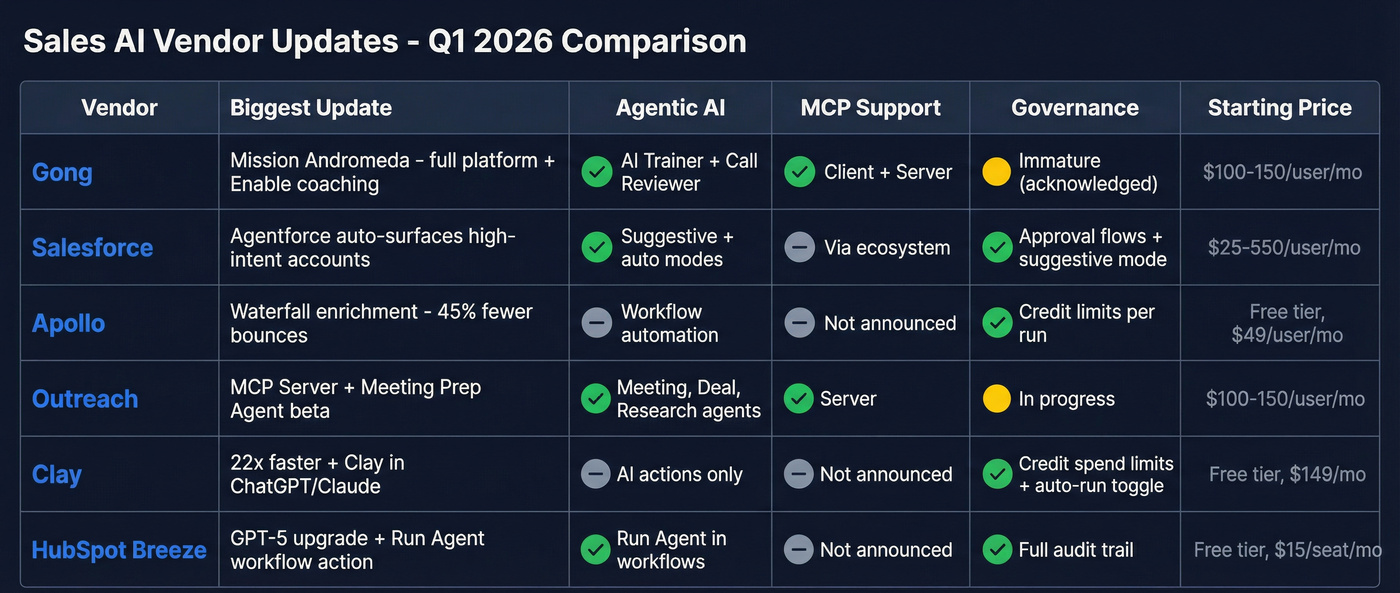
Gong - Mission Andromeda + Enable
What shipped (Feb 25, 2026):
- Mission Andromeda - a bundled platform release combining Gong Enable, Gong Assistant (revenue chatbot), Account Console/Boards, and MCP interoperability
- Gong Enable includes AI Trainer for role-play simulations, AI Call Reviewer, and Initiative Tracking - this is a new paid product tier
- "Ask anything across calls" for instant factual answers across segmented call libraries
- AI Data Extractor upgrades with date extraction, email/call support, timeframe selection, and in-app AI refinement
- MCP client/server support spanning Dynamics 365, M365 Copilot, Salesforce Agentforce, and HubSpot CRM
This is the biggest single launch in the roundup. Gong went from conversation intelligence to a full engagement platform with coaching and interoperability in one release. The MCP adoption is particularly notable - Gong's leadership openly acknowledged that MCP security is still immature, which is refreshingly honest for a launch announcement.
Pricing: Core Gong runs roughly $100-150/user/mo for mid-market. Enable adds "tens of dollars per seat per month" on top.
Salesforce - Agentforce + Sales Cloud
Agentforce can now automatically surface high-intent accounts using continuously updated, prioritized lists in Salesforce or Slack. It manages pipeline updates across fields like stage and next steps, with an option to review and approve updates in "suggestive mode" or update automatically. Einstein features include call search/Q&A (Call Explorer), conversation topic grouping (Sales Signals), and one-click summarization for CRM objects.
The real story here is governance. "Suggestive mode" and approval flows are what make agentic automation usable in production. For sales managers evaluating these capabilities, controls separate a useful tool from a liability.
Pricing: Starter $25 -> Pro $100 -> Enterprise $175 -> Unlimited $350 -> Agentforce 1 Sales $550/user/mo.
Apollo - Waterfall Enrichment + Inbound
A 45% reduction in email bounces isn't incremental. It's a fundamental change in whether cold email is even viable for your team. That's why Apollo's December 2025 update is the most measurable improvement in this entire roundup.
Waterfall enrichment became the default across all accounts, delivering ~5% more emails, ~7% more phone numbers, and that 45% bounce reduction. Apollo now offers three enrichment modes: maximize accuracy (validation-first), maximize coverage (more providers), and cost-efficient (Apollo-only sources). You pick the tradeoff rather than getting a one-size-fits-all result.
The inbound add-on is worth noting too: website visitor identification at 50K visitors/mo plus form enrichment at 5K enrichments/mo, requiring a paid plan. Workflow credit limits per run and lifetime add governance to the mix. For teams building a cold outreach stack, Apollo's enrichment layer is now a serious contender - though we've found its raw email accuracy still lags behind dedicated verification platforms.
Pricing: Free tier with 1,200 credits/year. Paid plans from $49/user/mo on annual billing.
Outreach - MCP Server + AI Agents
Outreach processed 43.9M deals and $765B in pipeline in 2025 across 390K weekly active users, analyzing 2.5M+ calls along the way. That scale is the context for understanding why their February 2026 updates matter.
The MCP Server pushes Outreach context, insights, and next-best-actions into external AI systems without custom integrations. The Meeting Prep Agent (currently in beta) auto-generates meeting briefs with talking points, attendee overviews, and account context. Deal Agent now supports custom sales methodologies with AI-recommended updates and can auto-apply updates without rep intervention. The Research Agent runs scheduled research refreshes on daily, weekly, or monthly cadences. Outreach Knowledge, also in beta, brings internal content like product details, pricing policies, and technical answers into the platform.
Where engagement platforms are heading: from sequence execution engines to systems that know what happened in the last call before suggesting the next email. The MCP Server plus Knowledge beta are proof of that direction.
Pricing: Custom, typically $100-150/user/mo for mid-market teams.
Clay - 22x Faster + Governance
Clay is maturing from an enrichment toy into enterprise infrastructure - the governance controls are the proof.
The headline performance numbers: 22x improvement in action run performance and 10x improvement in AI action processing for large workflows. For teams running enrichment tables with thousands of rows, that's the difference between "grab coffee" and "it's done." The governance additions matter more, though. Teams now get credit spend limits, better credit warnings with estimated costs, and the ability to toggle Auto-run off before import. Clay also shipped Clay in ChatGPT and Clay in Claude (both in beta), bringing Clay workflows into those environments.
Pricing: Free at 100 credits/mo. Paid from $149/mo. Enterprise pricing is custom.
HubSpot Breeze - GPT-5 + Run Agent
HubSpot made a meaningful model upgrade: Breeze Studio upgraded to GPT-5 in January 2026, and the "Run Agent" workflow action entered beta, letting you trigger agents inside HubSpot workflows with configurable context and output routing. For mid-market teams, this is one of the most accessible entry points into agentic workflows.
The sleeper feature is the audit trail. It shows exactly what an agent did - including CRM property changes and qualification outcomes. For SMB and mid-market teams without a dedicated RevOps person watching every automation, this is governance that actually works.
Pricing: Free tier available. Paid from $15/seat/mo.
SalesLoft, Clari, ZoomInfo, and Others
Salesloft continues pushing deeper AI coaching and call optimization inside the rep workflow. The direction is clear: less "write me an email," more "coach me across the deal motion." Custom pricing, typically $75-150/user/mo.
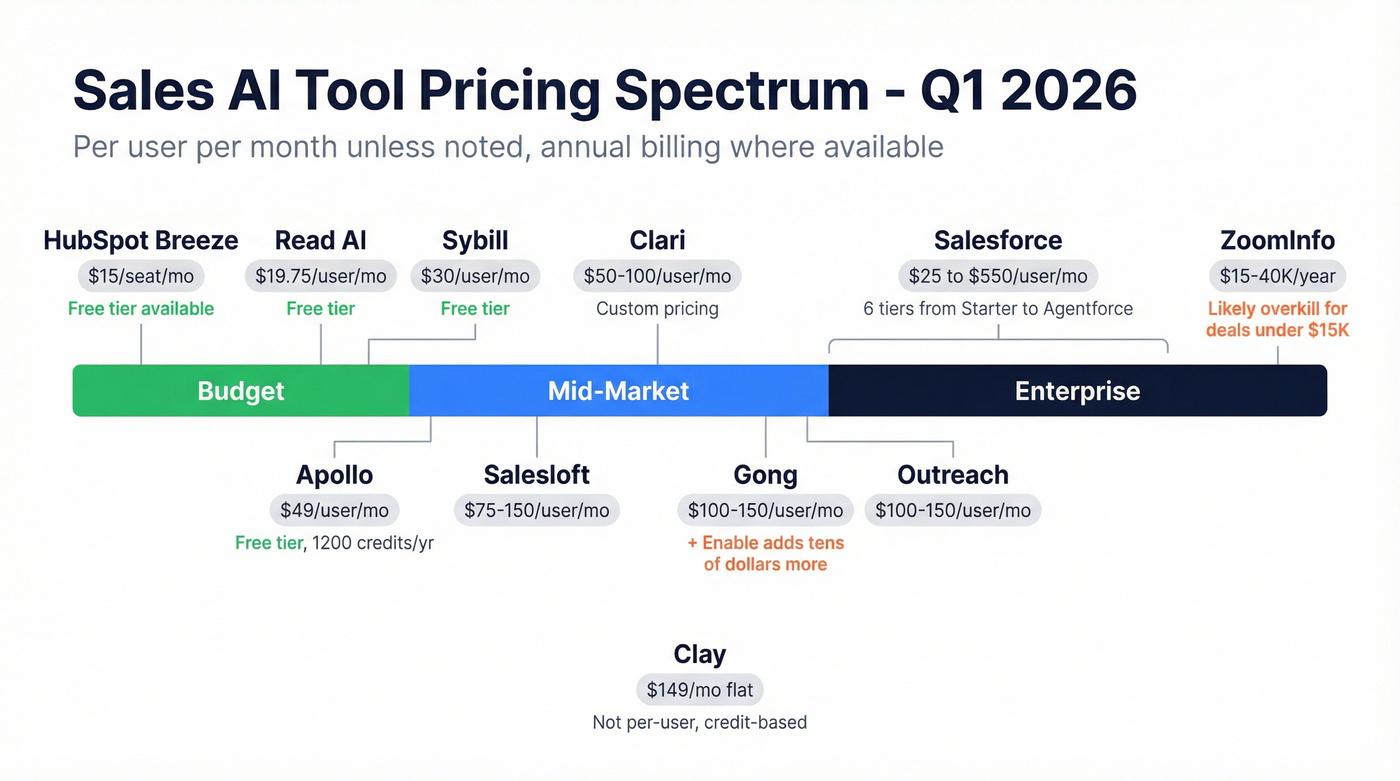
Clari's February 2026 release improved search with faster results, more deal detail, and better filtering. Groove's "Any Step Automated Actions" trigger Salesforce field updates after a specific number of emails or calls. Custom pricing, typically $50-100/user/mo.
ZoomInfo launched its Copilot Workspace in late 2025, consolidating "book of business" work into a single view. At $15-40K/year, it remains the premium intelligence platform - and for teams with deal sizes under $15K, it's almost certainly overkill.
Two smaller players worth tracking: Sybill ($30/user/mo, free tier) shipped AI-generated call summaries and CRM autofill. Read AI ($19.75/user/mo, free tier) offers cross-platform meeting analytics plus CRM Copilot workflows. Neither had a blockbuster Q1 2026 update, but both are solid budget alternatives for conversation intelligence without the full revenue platform price tag.

Apollo's waterfall enrichment cut bounces 45%. Prospeo's 5-step verification delivers 98% email accuracy and under 4% bounce rates - without waterfall workarounds. 143M+ verified emails, refreshed every 7 days.
Skip the enrichment modes. Start with data that's already accurate.
The Update Nobody Wrote About
Every tool in this roundup - conversation intelligence, deal agents, engagement automation, enrichment workflows - runs on contact data.

We've seen this pattern repeatedly in our own testing. A team runs a 10,000-contact sequence, bounces on the first send, and the domain reputation tanks before any AI-powered personalization even matters. Apollo's 45% bounce reduction proves the point - the single most impactful update in this entire roundup wasn't an AI agent. It was better data.
Let's be honest: you can have the best AI deal agent in the world, but if it's personalizing emails to addresses that don't exist, you've automated failure. Prospeo's 98% email accuracy and 7-day data refresh cycle exist precisely for this reason - the unsexy data layer is where most teams should spend their next dollar, not on another AI feature. Snyk's results after switching tell the story: bounce rates dropped from 35-40% to under 5%, and AE-sourced pipeline jumped 180%.
Pricing Snapshot
| Tool | Starting Price | Model | Free Tier |
|---|---|---|---|
| Gong | ~$100-150/user/mo | Custom / per seat | No |
| Gong Enable | ~$30-50/user/mo | Per seat add-on | No |
| Salesforce Sales Cloud | $25/user/mo | Per seat, tiered | No |
| Apollo | $49/user/mo | Per seat + credits | Yes |
| Outreach | ~$100-150/user/mo | Custom / per seat | No |
| Clay | $149/mo | Credit-based | Yes |
| HubSpot Sales Hub | $15/seat/mo | Per seat + credits | Yes |
| Salesloft | ~$75-150/user/mo | Custom / per seat | No |
| Clari | ~$50-100/user/mo | Custom | No |
| Sybill | $30/user/mo | Per seat | Yes |
| Read AI | $19.75/user/mo | Per seat | Yes |
| ZoomInfo | ~$15-40K/yr | Custom / per seat | No |
| Prospeo | ~$0.01/email | Credit-based | Yes |
How to Act on These Updates
You don't need 13 tools. You need 4-5 that talk to each other.
Audit your data layer first. Before evaluating any AI feature, check your contact data freshness and accuracy. If your bounce rate is above 5%, fix that before spending another dollar on AI. This is step zero. If you need a framework, start with data quality and B2B contact data decay.
Check MCP compatibility. If you're evaluating Gong, Outreach, or any tool that adopted MCP, ask whether your other tools support it too. MCP is the consolidation signal - it means you can get interoperability without replacing everything.
Look for updates that make other tools redundant. Apollo's inbound add-on might replace a standalone visitor identification tool (see Visual Visitor alternatives). Outreach Knowledge might replace your internal wiki integration. Every update is a chance to subtract a tool, not add one - and that's how reps reclaim time rather than add complexity.
Prioritize governance features. If your vendor shipped audit trails, credit limits, or "review before send" controls, turn them on. The teams that succeed with agentic AI will be the ones with guardrails, not the ones that moved fastest. This pairs well with keeping CRM hygiene tight.
Run a 30-day bake-off, not a 30-minute demo. In our experience, teams that test tools against production data move faster and get cleaner answers than those evaluating in sandbox environments. Reps reclaim around 6-8 hours per week from admin automation when the tools actually fit their workflow. Demo environments lie. Production data doesn't.
Skip all of this if your team is under five reps and closing deals fine with a CRM and a spreadsheet. Not every team needs an AI stack - some just need better data and a phone.
The sales AI tool updates from Q1 2026 point in one direction: interoperability, governance, and data quality matter more than flashy new features. Build your stack accordingly. If you're rebuilding, use a B2B sales stack blueprint and a sales tools checklist to keep it lean.
You're running 8 tools and still chasing bad data. Prospeo gives you 300M+ profiles, 125M+ verified mobiles, and intent data across 15,000 topics - at $0.01/email. No contracts. No sales calls.
Fewer tools, better data. That's the only stack update that matters.
FAQ
What are the biggest sales AI tool updates in early 2026?
Gong's Mission Andromeda (Feb 25, 2026) was the most comprehensive single release - bundling coaching, a revenue chatbot, and MCP interoperability. Apollo's waterfall enrichment delivered a measurable 45% bounce reduction. MCP adoption by both Gong and Outreach in the same month signals a structural shift in how tools share context.
What is MCP and why does it matter?
Model Context Protocol is an open standard that lets AI tools share context bidirectionally without custom integrations. Gong and Outreach adopted it in February 2026. It means your tools can exchange deal context, call insights, and engagement data without middleware - reducing stack complexity while improving data flow across platforms.
Are agentic AI sales tools working yet?
Mostly not. Deloitte's Dec 2025 research found only 11% of organizations have agentic AI in production, with 38% piloting and 30% still exploring. The governance controls now shipping - audit trails, credit limits, review-before-send - are the real maturity signal, not the agent announcements themselves.
How often should sales contact data be refreshed?
Weekly is the standard to target. The industry average sits around 6 weeks, meaning most teams work with stale data by default. Both Apollo's waterfall enrichment and Prospeo's 7-day refresh cycle prove that data freshness drives more ROI than model sophistication.
Do I need to replace my entire stack for AI?
No. MCP means existing tools are becoming interoperable rather than requiring wholesale replacement. Focus on 4-5 tools that integrate well. Evaluate which recent updates make other tools redundant, and consolidate where you can. Subtraction beats addition.