

How to Write a Business Follow-Up Email After No Response (Templates That Work)
You sent a perfectly good email. Then nothing. Now you're refreshing your inbox like it owes you money.
A Belkins study of 16.5M cold emails found the best-performing sequences start at about an 8.4% reply rate on the first message - and 55% of all replies come from a follow-up, not the original email. Silence isn't rejection. It's the default. Nearly half of salespeople give up after one attempt, which means the bar for standing out is embarrassingly low.
The quick version:
- Wait 3-5 business days, then send Tuesday or Thursday, 9-11 AM in the recipient's timezone.
- Keep subject lines to 2-4 words and personalize them - personalized lines hit 46% open rates vs. 35% generic and more than double reply rates (7% vs. 3%). (If you need examples, start with these subject lines.)
- Cap your sequence at 3-4 emails. After that, unsubscribe and spam complaint rates more than triple while reply rates keep sliding.
Why Follow-Ups Work
That unanswered email nags at your recipient too. Psychologists call it the Zeigarnik Effect: unfinished tasks stay mentally open, creating low-grade tension until they're resolved. Your follow-up reactivates an open loop they already wanted to close.
The second principle is reciprocity. Lead with something genuinely useful - a resource, a quick insight, a relevant case study - and you create a subtle sense of obligation. We've seen this pattern consistently across our own outreach: value first, ask second. That's the entire framework. (For more on building this into your messaging, see personalization.)
When to Send (and When to Stop)
Best days: Tuesday and Thursday. Wednesday works. Avoid Monday and Friday. Best windows: 9-11 AM or 1-3 PM in the recipient's timezone. Spacing: 3-5 business days between each follow-up. Ceiling: keep your sequence under 4 emails total - 4+ emails more than triple unsubscribe and spam complaint rates.
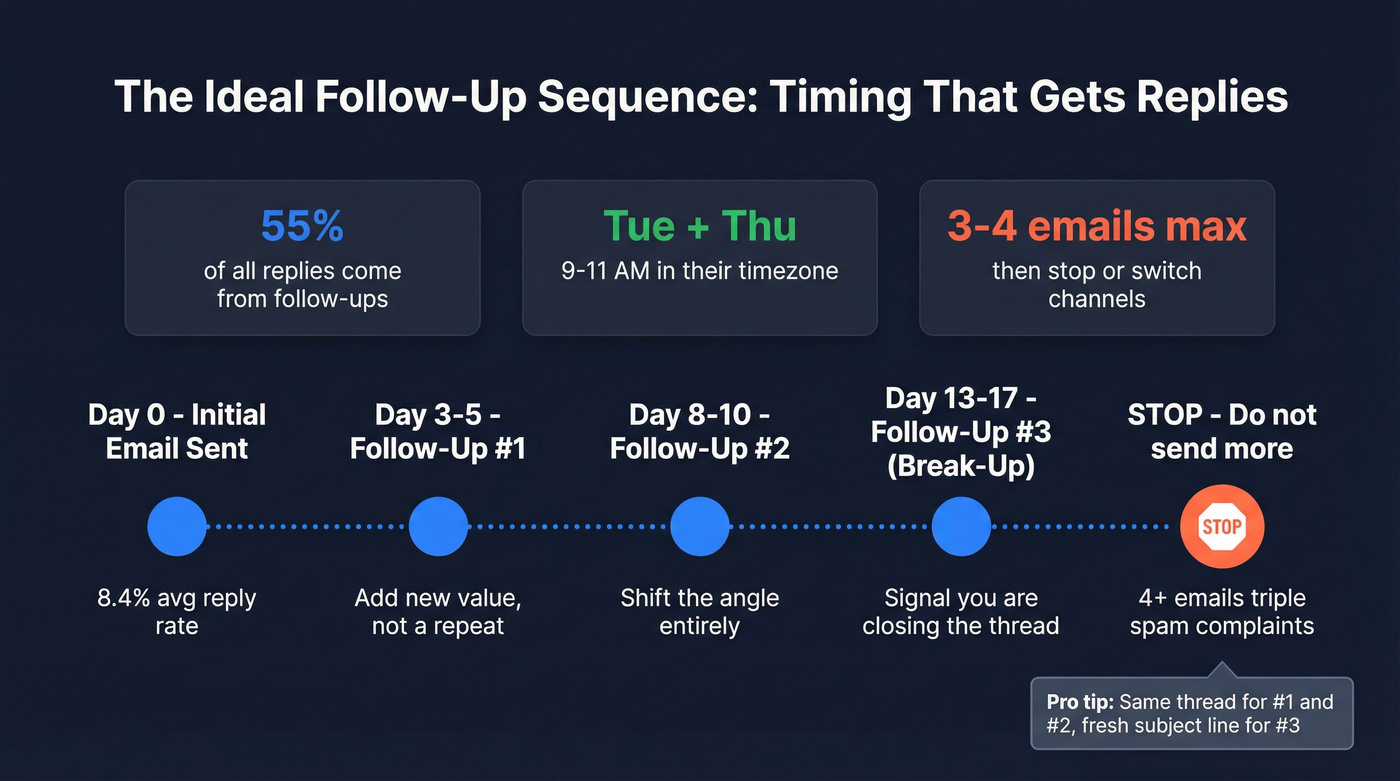
Tolerance for persistence varies by audience, and the differences are bigger than you'd expect. Small businesses show a 9.2% initial reply rate that bounces back to 8.4% after a second follow-up - they're forgiving. Enterprise contacts are allergic to persistence and tend to ghost quickly when you keep pushing. Founders peak at the second follow-up (6.94%) then decline steadily: 5.75% by the third, 3.01% by the fourth. If email isn't working, consider a different channel entirely - a message plus profile visit combo on professional networks pulls an 11.87% reply rate in the same Belkins dataset. (If you're building a full cadence, use a proven sales cadence example.)

55% of replies come from follow-ups - but only if your emails actually land. Bad data means your carefully crafted follow-up hits a dead inbox. Prospeo verifies emails at 98% accuracy with a 7-day refresh cycle, so every follow-up reaches a real person. 75 free verifications per month, no credit card required.
Stop rewriting copy when the real problem is bad data.
Subject Lines That Get Opened
| What works | What doesn't |
|---|---|
| 2-4 words (46% opens) | 9-10 words (~34-35%) |
| Personalized (46% opens) | Generic (35% opens) |
| Question format (46%) | "ASAP" or urgency hype (<36%) |
| Lowercase, casual tone (46%+) | "Hello, friend" openers (<36%) |
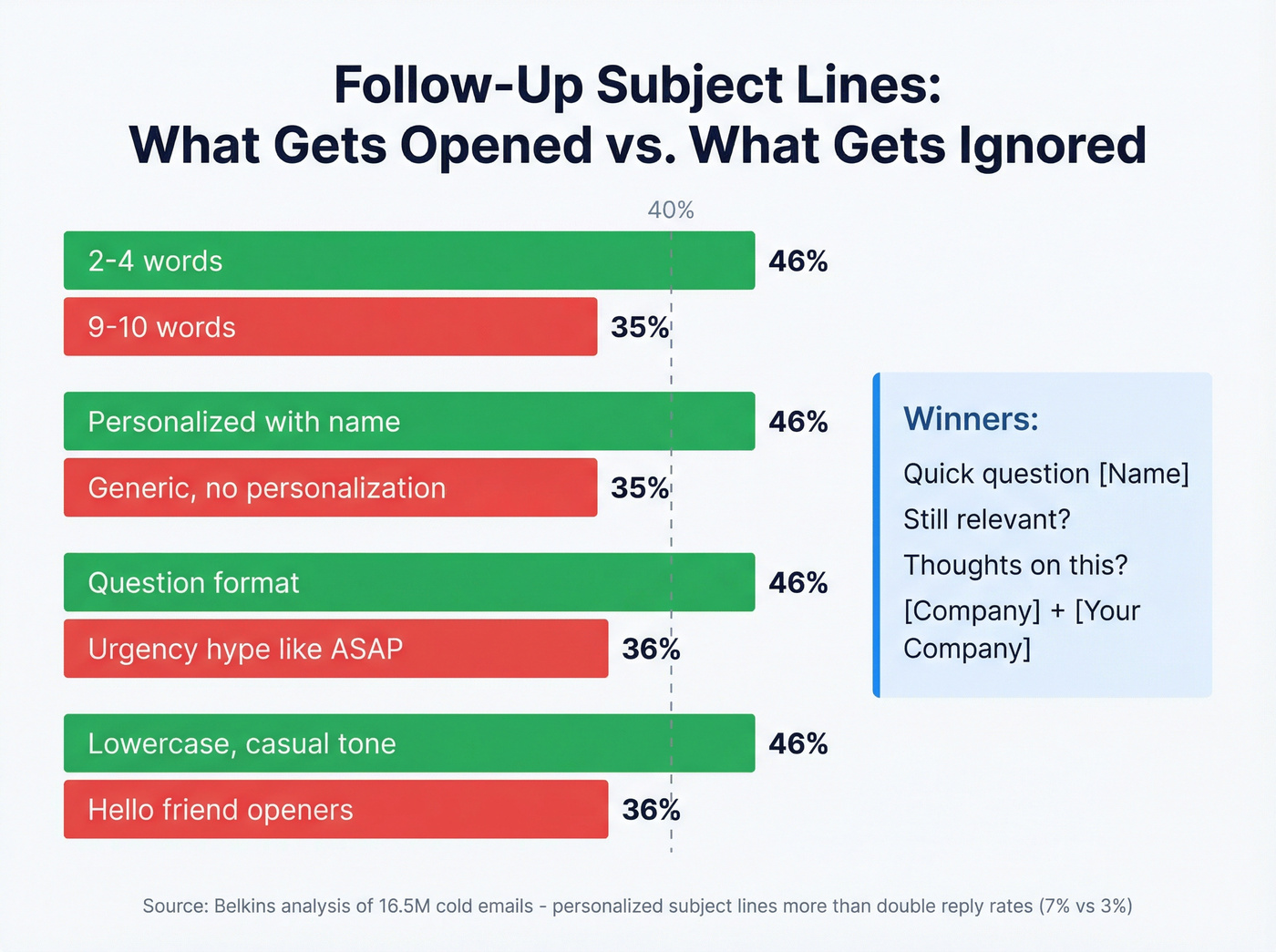
Lines that consistently perform: "Quick question, [Name]," "Still relevant?," "Thoughts on this?," and "[Company] + [your company]." Short beats clever. (More ideas: re-engagement email subject lines.)
8 Templates for Every Scenario
1. First Follow-Up After Cold Outreach
Send 3-5 business days after your initial email.
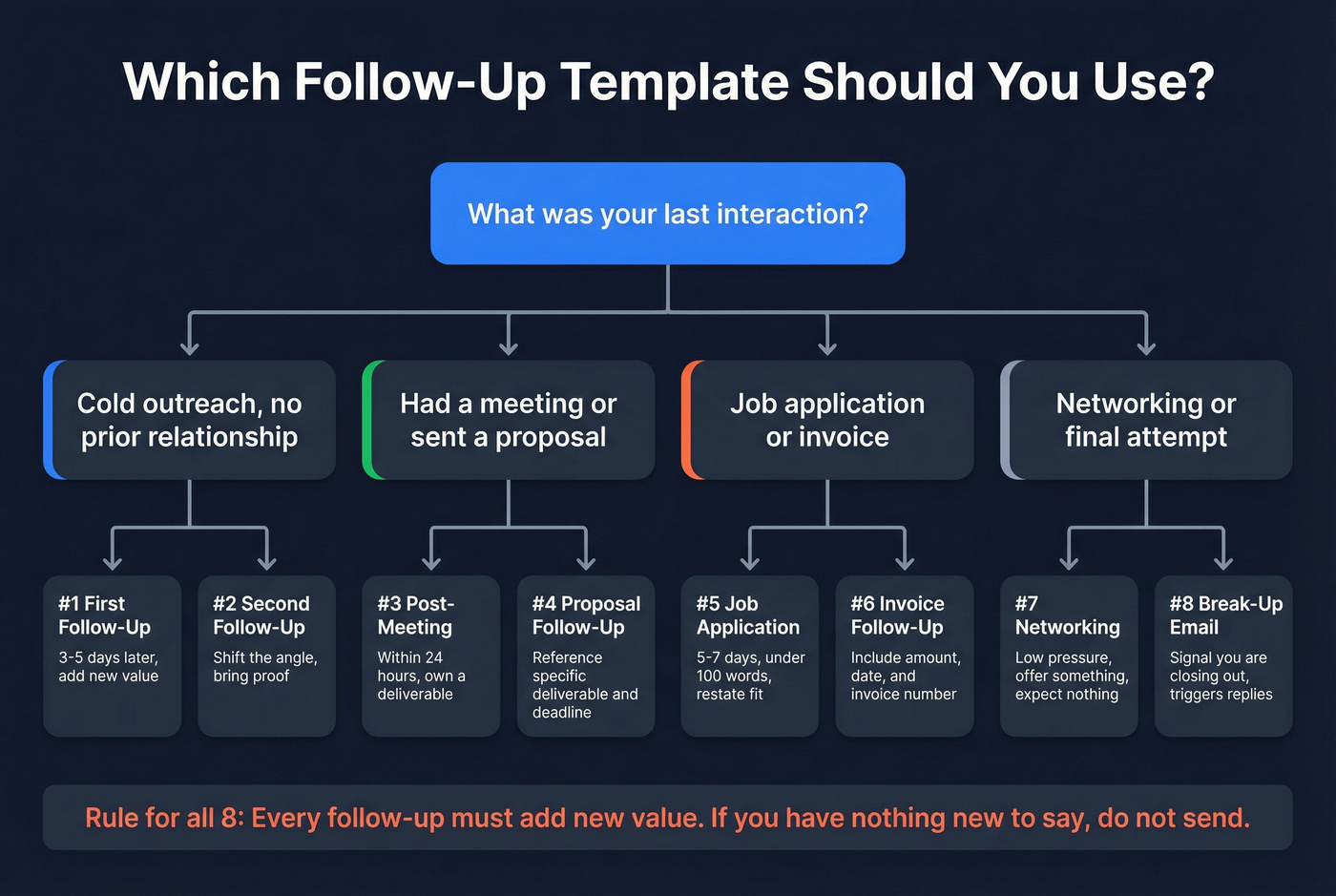
Hi [Name], I shared some thoughts on [specific problem] last week. Since then, [relevant new data point] came across my desk - thought it'd be useful regardless. Worth a 10-minute call?
Add new value. Don't restate the original pitch. (If you want more cold outreach options, use these outreach email templates.)
2. Second Follow-Up (New Angle)
Most people soften the ask on the second follow-up. Do the opposite - shift the frame entirely with proof.
[Name], I put together a quick case study on how [similar company] solved [problem]. Here's the link: [URL]. Happy to walk through what'd apply to [their company].
3. Post-Meeting Follow-Up
Send within 24 hours.
Great speaking today, [Name]. Quick recap: we discussed [key topic], and the next step is [specific action] by [date]. I'll send [deliverable] by EOD tomorrow.
Own a deliverable. Don't leave it open-ended. (If the goal is a meeting, these schedule meeting email examples help.)
4. Proposal or Quote Follow-Up
Bad version: "Just wanted to check in on the proposal I sent over."
Good version:
[Name], circling back on the [specific deliverable] proposal from [date]. The pricing we discussed holds through [deadline]. Any questions I can clear up before your team reviews?
Reference the specific deliverable and add a real deadline - not a manufactured one.
5. Job Application Follow-Up
Wait 5-7 business days after applying.
Hi [Name], I applied for the [role] on [date] and wanted to reiterate my interest. My background in [specific skill] maps directly to [something from the job description]. Happy to provide anything else that'd help.
Keep it under 100 words. Restate fit, not your resume.
6. Invoice or Payment Follow-Up
Invoice #[number] for [$amount] was due [date] - could you confirm it's in the queue? Happy to resend or connect with your AP team directly.
Direct, polite, specific. Include the amount and date so they don't have to dig through their inbox.
7. Networking Follow-Up
[Name], really enjoyed our conversation at [event] about [specific topic]. I came across [relevant resource] and thought of you. No ask - just wanted to stay connected.
Low pressure. Reference the shared context, offer something, expect nothing.
8. The Break-Up Email
Let's be honest - the break-up email is the most underrated message in any sequence. We've watched it pull replies from threads that seemed completely dead, precisely because it removes pressure and gives the other person an easy way to close the loop.
Hi [Name], I've reached out a few times and haven't heard back - totally understand. I'll close out this thread, but if [problem] becomes a priority, I'm easy to find. Best of luck with [specific thing].
This email often triggers a reply because it signals you're about to disappear. People respond to what they're about to lose. (More on timing rules: when should I send a follow up email.)
Mistakes That Kill Your Follow-Ups
"Just checking in" adds zero value. Change the angle every time. Share a resource, reference something timely, bring a new data point. If you don't have anything new to say, you don't have a reason to send.
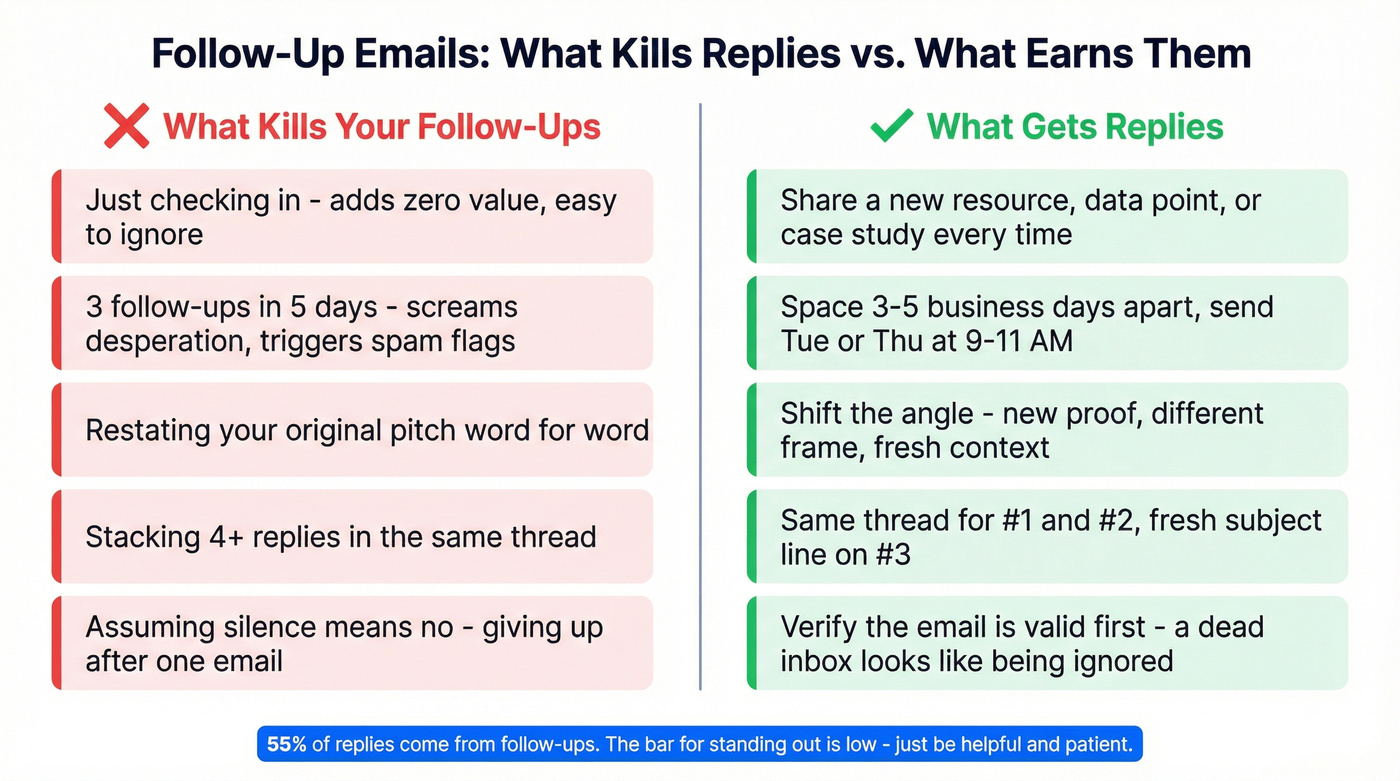
Respect the timing windows above. Firing off three follow-ups in five days because you're anxious is how you get flagged as spam. Tuesday 10 AM beats Friday 5 PM every single time. (If deliverability is slipping, use an email deliverability checklist.)
Use the same thread for follow-ups one and two to preserve context, then start a new thread with a fresh subject line on the third attempt to reset attention. The "stacked replies" look signals desperation faster than anything you could write.
Look - B2B contact data decays fast. Job changes, company switches, abandoned inboxes. Your follow-up might be landing in a dead inbox nobody checks anymore. Before rewriting your copy for the third time, verify the address is still active. Prospeo's email verification catches invalid addresses before you waste sends - 98% accuracy, free tier with 75 verifications per month. Sometimes the fix isn't better copy. It's better data. (If you’re comparing tools, start with the best email checker tool options.)

Before you send that break-up email, make sure silence isn't just a dead address. Contact data decays fast - job changes, company switches, abandoned inboxes. Prospeo's database of 143M+ verified emails refreshes every 7 days, not every 6 weeks. Find the right email for $0.01 per lead.
Replace dead contacts with verified ones in seconds.
FAQ
How long should a follow-up email be?
Aim for 50-100 words with one clear ask. Your recipient already has context from the first email - repeating it wastes their time and yours. Shorter messages consistently outperform longer ones in reply rate.
Should I reply in the same thread or start fresh?
Same thread for follow-ups one and two to preserve context. On the third attempt, start a new thread with a fresh subject line. This resets attention and avoids the stacked-reply look.
What if I've followed up three times with no response?
Stop emailing that address. Either the timing isn't right, the person isn't the right contact, or the email never arrived. Before assuming disinterest, verify the address is still active - a dead inbox looks exactly like being ignored, and there's no way to tell the difference without checking.
Can I reuse these templates for different prospects?
Yes, but don't send identical copy to multiple people at the same organization. Every template here is designed to be customized with your prospect's name, company, and specific context. Swap in the relevant details and you're good.