How to Implement AI in Sales: A 2026 Roadmap That Actually Works
Your VP just came back from a conference. They saw a keynote about AI agents booking meetings autonomously, watched a demo where a chatbot qualified leads in real time, and now they want AI in sales by next quarter. You've been handed a vague mandate, a modest budget, and a CRM full of data that hasn't been cleaned since the Obama administration.
You're not alone. 80% of IT professionals say they feel pushed to adopt AI faster than they're ready for. But here's what nobody on that conference stage mentioned: sellers already use an average of 8 tools, 42% feel overwhelmed by their stack, and reps spend roughly 60% of their time on non-selling tasks. 73% of B2B buyers actively avoid sellers who send irrelevant outreach. Adding more AI on top of a broken foundation doesn't fix anything - it amplifies the mess.
The teams that actually get value from AI in sales don't start with tools. They start with strategy, data, and a willingness to move slower than the hype cycle demands.
Three Priorities, in Order
Fix your data first. CRM data decays about 20% per quarter. If your contact records are stale, every AI model you layer on top will produce polished nonsense. (If you want the benchmarks and fixes, start with CRM hygiene.)
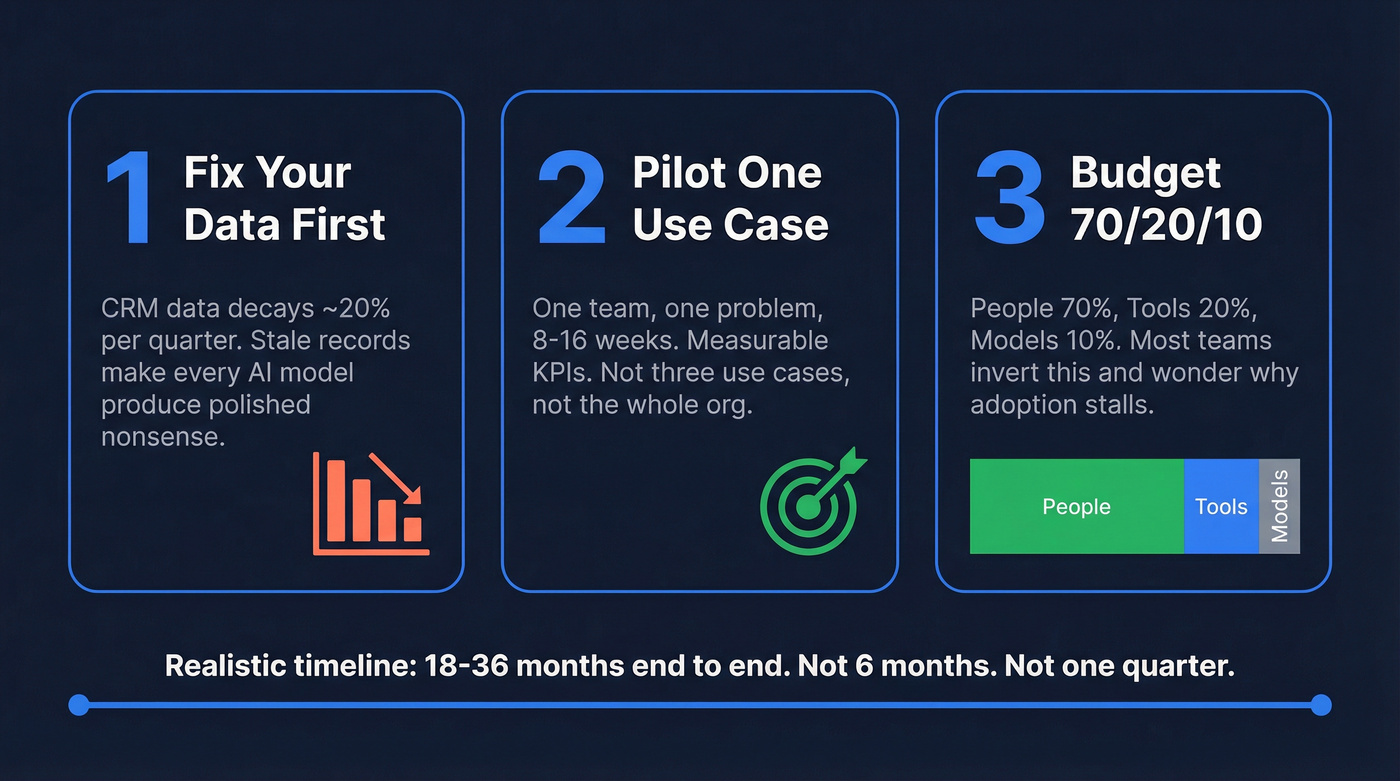
Pick one use case and pilot it with one team for 8-16 weeks. Not three use cases. Not the whole org. One team, one problem, measurable KPIs.
Budget 70% for people, 20% for tools, 10% for models. Most teams invert this ratio and wonder why adoption stalls.
Realistic timeline? 18-36 months end-to-end. Not 6 months. Not one quarter. Anyone telling you otherwise is selling something.
What Goes Wrong First
Failure is the norm, not the exception.
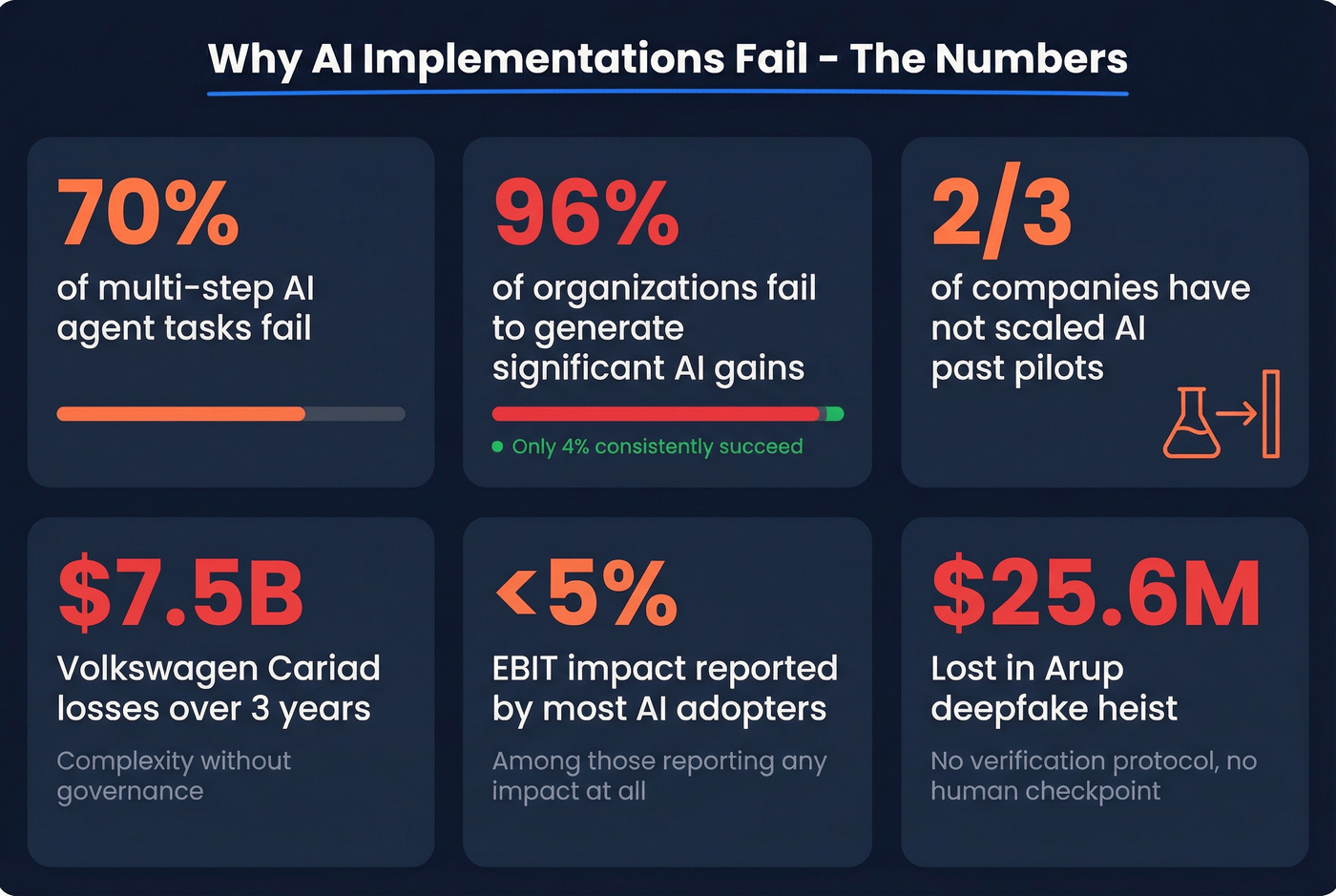
Volkswagen's Cariad software unit burned through $7.5B in operating losses over three years trying to build a software-defined vehicle platform. They had 200+ suppliers and a "big bang" transformation strategy that led to major delays - over a year - for launches like the Porsche Macan Electric and Audi Q6 E-Tron. The fallout included 1,600 job cuts. That's automotive, not sales, but the pattern is identical: complexity without governance, ambition without sequencing.
AI agents fail 70% of multi-step office tasks. Advanced agents succeed on only 30-35% of multi-turn CRM tasks. And then there's the Arup deepfake heist - a finance worker was tricked by AI-generated video impersonations of colleagues into transferring $25.6M because there was no verification protocol and no human checkpoint. If your AI sales tools have write access to your CRM without approval gates, the same class of failure can hit your pipeline data.
The macro numbers are equally sobering. Only 4% of organizations consistently generate significant AI gains across business functions. Two-thirds of companies haven't scaled AI past pilots. Among those reporting any EBIT impact, most say it's less than 5%.
The common thread isn't bad technology. It's bad sequencing - teams buy tools before fixing data, skip governance, rush past change management, and end up in "pilot purgatory" where nothing scales and nobody trusts the output.
Here's our honest take: if your average deal size sits below five figures, you probably don't need autonomous AI agents. You need clean data, a solid sequence tool, and reps who know how to have a conversation. The 70% failure rate on multi-step AI tasks means the technology isn't ready for most sales motions - but the data layer absolutely is, and that's where the real ROI lives in 2026.
The AI Sales Maturity Model
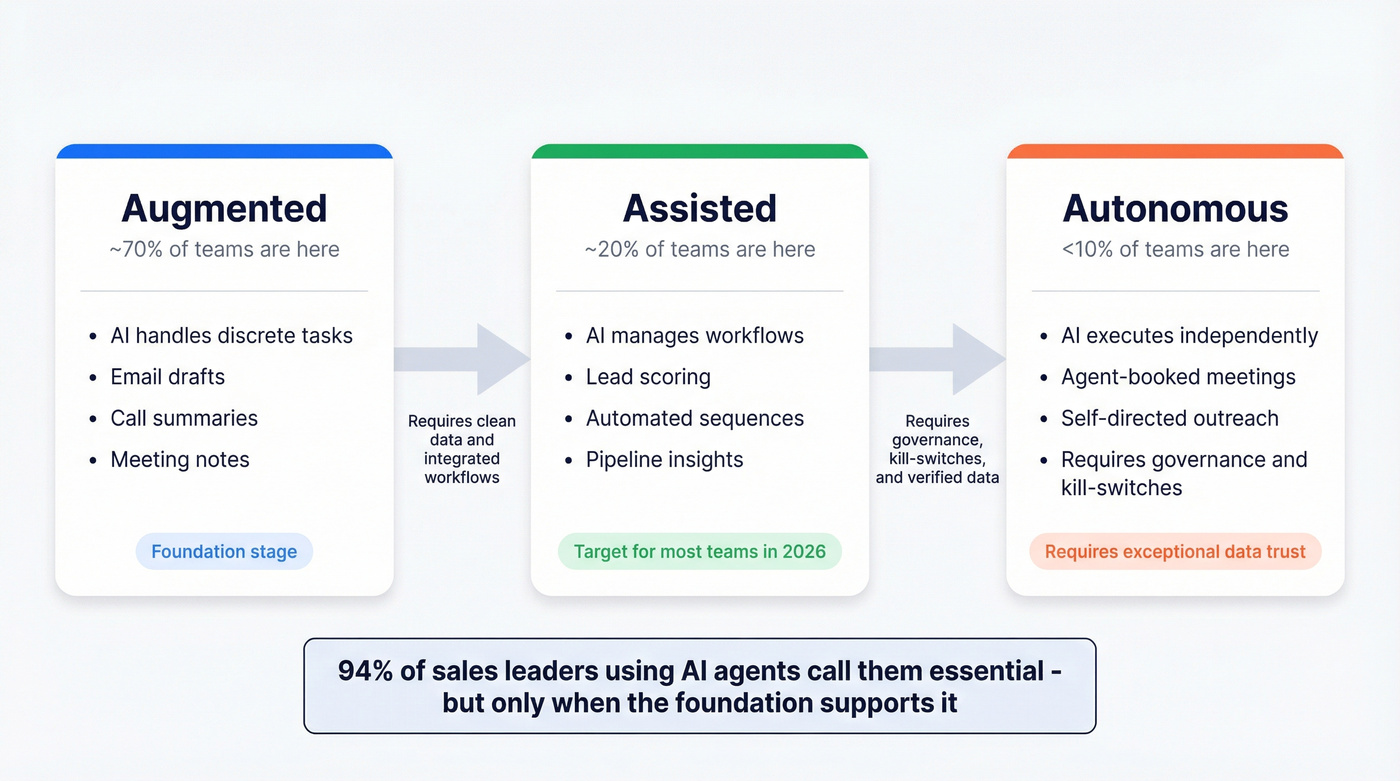
Before you buy anything, figure out where you are. BCG defines three modes of AI-assisted selling:
| Stage | What It Looks Like | Examples | Who's Here |
|---|---|---|---|
| Augmented | AI handles discrete tasks | Email drafts, call summaries | ~70% of teams |
| Assisted | AI manages workflows | Lead scoring, sequences | ~20% of teams |
| Autonomous | AI executes independently | Agent-booked meetings | <10% of teams |
Seven in ten sellers still use general-purpose AI for tactical tasks like drafting emails and summarizing calls. That's the augmented stage, and there's nothing wrong with staying there while you build the foundation for more.
The numbers aren't all doom, though. Among sales leaders already using AI agents, 94% call them essential, and 88% of reps say agents increase their odds of closing. The technology works - when the foundation supports it.
Most teams should target "assisted" before dreaming about "autonomous." The jump from augmented to assisted requires clean data, integrated workflows, and trained reps. The jump to autonomous requires all of that plus governance, kill-switches, and a level of data trust that almost nobody has today. Be honest about where you are. (If you're evaluating agentic tools, see our breakdown of an AI sales agent.)

This article makes one thing clear: AI in sales fails when the data foundation is broken. CRM records decay 20% per quarter. Prospeo refreshes every 7 days - not 6 weeks - so every AI model you layer on top works with current, verified contacts. 98% email accuracy. 300M+ profiles. The data layer is where the real ROI lives.
Stop feeding stale data to expensive AI tools.
A 4-Phase Implementation Roadmap
This framework draws from Pythian's enterprise AI roadmap and adapts it for sales organizations. The phases are sequential - skipping ahead is how you end up in pilot purgatory.
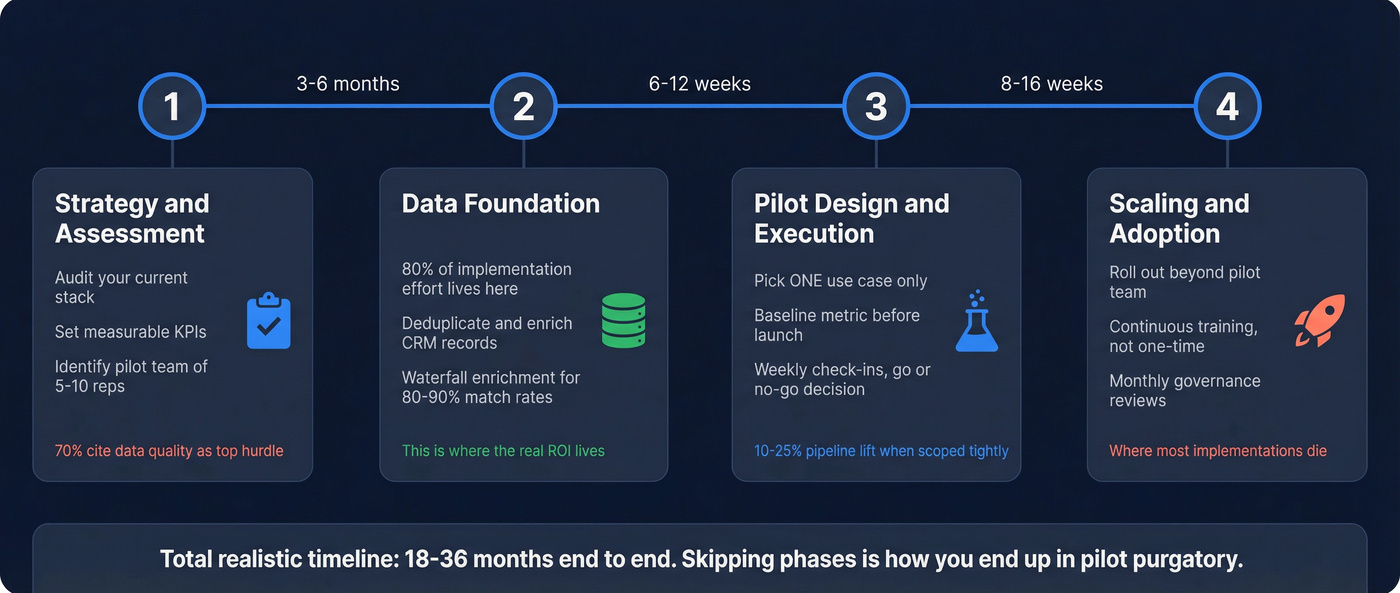
Phase 1: Strategy and Assessment (3-6 Months)
This phase feels slow. It's supposed to.
Start by defining what "AI in sales" actually means for your org. That sounds obvious, but we've seen teams buy conversation intelligence tools when their real problem was lead quality. We've watched orgs invest in forecasting AI when they didn't have enough pipeline data to forecast anything meaningful. The tool isn't the strategy.
Audit your current stack. Map every tool, every integration, every data flow. Identify redundancies. If you're running 8+ tools and reps are overwhelmed, consolidation comes before addition. (Use a sales tools checklist to make the cut list objective.)
Set measurable KPIs before buying anything. "Improve sales productivity" isn't a KPI. "Reduce time-to-first-touch from 48 hours to 4 hours for inbound leads" is.
Allocate budget correctly: 70% goes to people - training, change management, dedicated project ownership. 20% goes to tools. 10% goes to models and infrastructure. Teams that spend 60% on tools and 10% on training consistently fail. Then identify your pilot team. Pick 5-10 reps led by someone respected in the org. Not the most tech-savvy team - the most influential one.
Don't underestimate this phase. 70% of leaders cite data quality and governance as their number one technical hurdle. If you discover that during Phase 3, you've wasted months. A thorough assessment period is what separates successful implementations from the 96% that never generate significant returns.
Phase 2: Data Foundation (6-12 Weeks)
Your AI is only as good as your data. This is where 80% of the actual implementation effort lives - integration, testing, validation, deduplication. Unglamorous? Absolutely. But ask any sales ops leader what went wrong with their AI rollout, and "bad data" comes up before anything else.
Raw CRM data decays about 20% per quarter. People change jobs, companies get acquired, phone numbers go stale. If you haven't enriched or verified your database in 90 days, a fifth of it is already wrong. More than four out of five sellers cite inaccuracy and poor data integration as their top obstacles to using AI effectively - which means reps double-check AI outputs manually, eroding every efficiency gain you were hoping for. (For a deeper dive, see B2B contact data decay.)
Single data providers typically match 50-60% of your records. A waterfall enrichment approach - running contacts through multiple verified sources - pushes match rates to 80-90%. But the refresh cycle matters as much as the initial match. Many providers update records around every 6 weeks. By the time your data is "fresh," it's already aging.
In our experience, the teams that skip data cleanup always regret it by month three. When Meritt improved their data foundation using a 7-day refresh cycle and 98% email accuracy from Prospeo, their pipeline tripled from $100K to $300K per week, and bounce rates dropped from 35% to under 4%. That's what clean data does for every downstream AI tool - better lead scoring, better personalization, better forecasting, because the inputs are actually correct. (If you're validating emails as part of cleanup, use an email checker tool or a dedicated email ID validator.)

Phase 3: Pilot Design and Execution (8-16 Weeks)
Pick ONE use case. Not three. One.
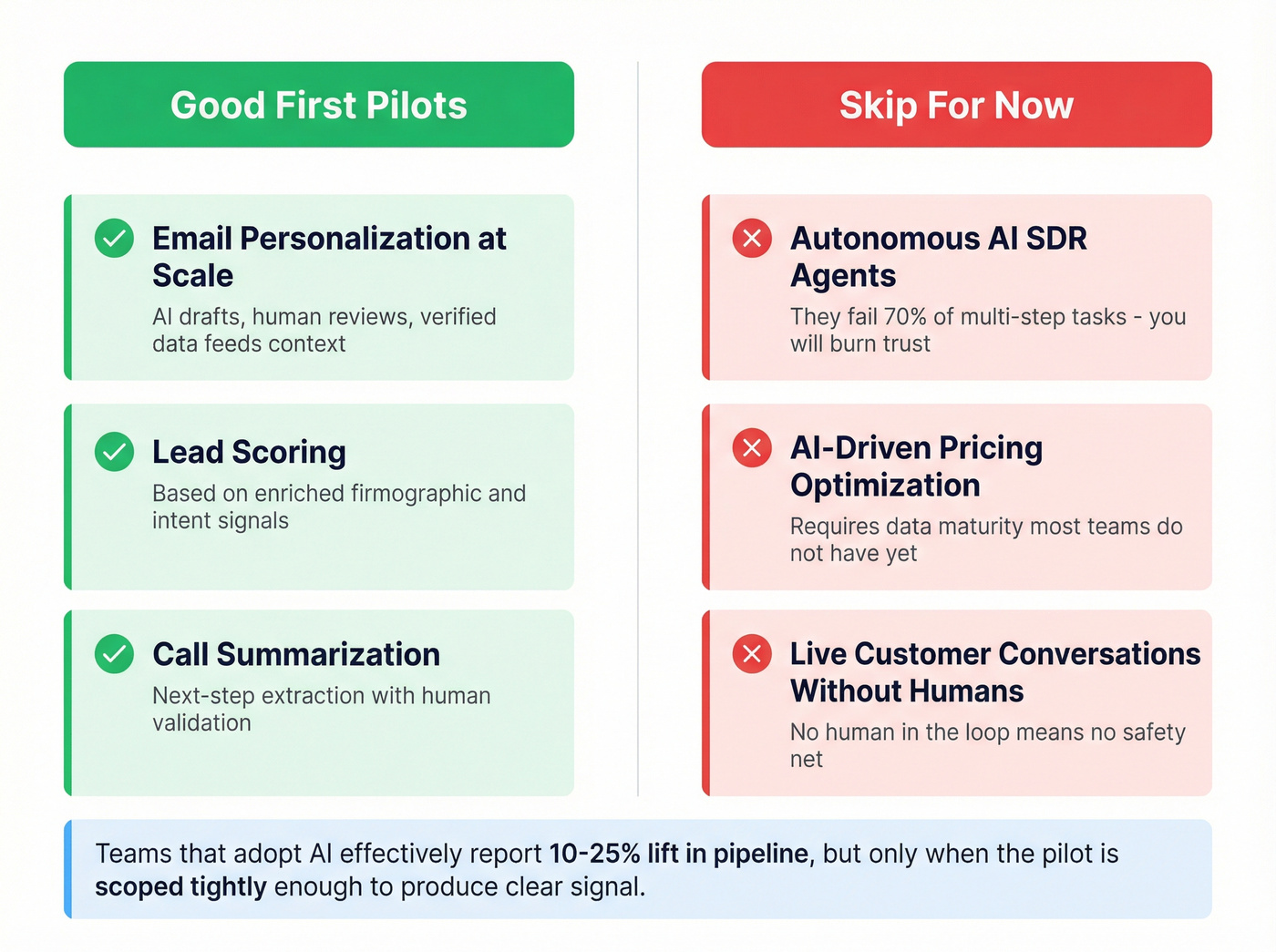
Good first pilots:
- Email personalization at scale - AI drafts, human reviews, verified data feeds the context (see AI personalized email sequences)
- Lead scoring based on enriched firmographic and intent signals (use an ABM lead scoring model if you're account-led)
- Call summarization and next-step extraction
Skip for now:
- Fully autonomous AI SDR agents (they fail 70% of multi-step tasks - you'll burn trust)
- AI-driven pricing optimization (requires data maturity most teams don't have)
- Anything that touches live customer conversations without a human in the loop
Your pilot framework is simple: establish a baseline metric before the pilot starts, run it for 8-16 weeks with weekly check-ins, measure against the baseline, and make a go/no-go decision. Teams that adopt AI effectively report 10-25% lift in pipeline. But that lift only materializes when the pilot is scoped tightly enough to produce clear signal.
For proof that pilots can scale: Salesforce's own SDR agent generated 3,200 qualified opportunities in its first four months. The difference between that result and the 70% failure rate? Clean data, tight scope, and human oversight at every decision point.
Monthly check-ins during the first quarter aren't optional. They're how you catch data quality issues, adoption friction, and workflow gaps before they become organizational narratives about "AI not working."
Phase 4: Scaling and Adoption (6-18 Months)
This is where most implementations die. The pilot worked. Leadership wants to roll it out company-wide. And then nearly a third of teams hit a wall called team resistance.
The resistance isn't irrational. Reps worry about job security. Managers worry about losing control. Three in four sellers feel under-supported in using AI technology, with training that's too episodic to build real confidence. You can't solve this with a lunch-and-learn.
Be transparent about what's changing and why. "We're adding AI to help you spend less time on research and more time selling" beats "we're implementing an AI transformation initiative." Reps can smell corporate euphemism from a mile away.
Involve teams early in tool evaluation. Let reps test tools during the pilot. People adopt what they helped choose. Pair skeptical-but-respected reps with the pilot team - the senior AE who's willing to try carries more influence than the junior rep who loves every new tool.
Create feedback loops that actually change things. If reps report that the AI lead scores are wrong, investigate and fix it publicly. Nothing kills adoption faster than ignored feedback. And when a rep closes a deal faster because AI surfaced the right intent signal, make sure the team hears about it. The consensus on r/sales is consistent: the hardest part isn't choosing the tool - it's getting reps to actually use it. Public wins solve that.
McKinsey's data shows that high-performing AI adopters redesign workflows rather than bolt AI onto existing processes. That's the key differentiator. Don't automate processes that are already broken - redesign them with AI as a native component. (If you need a starting point, map your automated sales process first.)
Let's be direct about job-security fears. AI agents fail 70% of multi-step tasks. They can't build relationships, read a room, or navigate the political dynamics of a complex deal. What they can do is eliminate the non-selling busywork that eats 60% of a rep's week. Frame AI as a force multiplier, not a replacement, and back it up with evidence.
Building Your AI Sales Stack
You need 3-4 purpose-built tools, not 8 generic ones. The typical B2B company runs 15-25 tools across sales, marketing, and customer success. That fragmentation is the problem AI is supposed to solve - don't recreate it with your AI stack. (If you're rebuilding from scratch, use a B2B sales stack blueprint.)
The stack works in layers: data and enrichment at the foundation, engagement in the middle, intelligence on top. Each layer feeds the next. If the foundation is wrong, everything above it produces confident-sounding hallucinations.
For the data layer, accuracy degrades fast without a short refresh cycle. Prospeo sets the benchmark: 98% verified emails, 125M+ verified mobile numbers with a 30% pickup rate, and intent data across 15,000 topics. Self-serve, no contracts, starts free. Pair it with Apollo if you want a broader prospecting workflow with built-in sequencing.
For CRM, Salesforce remains the enterprise default - tiers run from $25 to $550 per user per month depending on how much Einstein AI you want baked in. HubSpot is the mid-market alternative with a gentler learning curve. Outreach and Salesloft both handle multi-channel sequencing with AI-assisted optimization at around $100-150 per user per month. For conversation intelligence, Gong is the category leader at about $65K per year for 50 users - negotiate hard, because discounts of 14-54% on add-ons are common. For forecasting, Clari runs $30-50K per year and gives you pipeline visibility that most CRM reports can't match.
| Category | Tool(s) | Starting Price | Why |
|---|---|---|---|
| Data & Enrichment | Prospeo, Apollo | ~$0.01/email; from $49/mo | Accuracy + coverage |
| CRM / Platform | Salesforce, HubSpot | $25/user/mo (SF Starter) | Foundation of record |
| Engagement | Outreach, Salesloft | ~$100-150/user/mo | Multi-channel sequences |
| Conversation Intel | Gong | ~$65K/yr (50 users) | Call analysis + coaching |
| Forecasting | Clari | ~$30-50K/yr | Pipeline visibility |
The anti-bloat principle: if you can't explain why each tool exists in your stack and what unique data it contributes, cut it. Every redundant tool is a tax on your reps' attention and your integration budget.
AI Governance Checklist
Governance isn't optional, and it isn't something you bolt on after deployment. Non-compliance with privacy laws averages $14.8M in penalties. Data breaches cost $4.45M per incident. Those numbers make the cost of a governance framework look trivial.
Before any AI model touches customer data, you need governance artifacts in place: a model registry tracking what models are running, where, and on what data; model cards documenting training data, known limitations, and intended use; decision logs for any AI-driven customer-facing action; and testing protocols for accuracy, bias, and drift.
Operational controls:
- Bias testing on every model before deployment
- Human-in-the-loop for any autonomous customer interaction
- Kill-switches that can disable any AI workflow in minutes
- Version rollback capability for when updates break things
Compliance frameworks to track:
- GDPR and CCPA for data privacy
- EU AI Act for risk classification
- ISO/IEC 42001 for AI management systems (Outreach was among the first in sales tech to achieve this certification)
- NIST AI Risk Management Framework for US-based organizations
Only 55% of organizations have a dedicated AI board, and about one-third say they have responsible controls governing AI models. If you're in the majority without these structures, build them now - before a rogue agent corrupts your production data or a breach makes the news. Governance is the unglamorous backbone of every successful effort to scale AI across a sales organization.
Phase 2 of any AI implementation is data - and it's where 80% of the effort lives. Prospeo's CRM enrichment returns 50+ data points per contact at a 92% match rate, cleaning and filling gaps across your pipeline automatically. At $0.01 per email, fixing your data costs less than one failed AI pilot.
Clean data in weeks, not months. No contracts required.
FAQ
How long does it take to implement AI in sales?
Expect 18-36 months end-to-end across four phases: strategy and assessment (3-6 months), data foundation (6-12 weeks), pilot execution (8-16 weeks), and scaling (6-18 months). Teams that rush skip data prep and governance - and end up in pilot purgatory where nothing scales past one team.
What's the realistic ROI?
Teams that adopt AI effectively report 10-25% pipeline lift, but only 39% of organizations see any EBIT impact - and most say it's under 5%. ROI depends entirely on data quality and whether you've redesigned workflows or just automated broken ones.
Will AI replace sales reps?
No. AI agents fail 70% of multi-step tasks, and advanced agents succeed on only 30-35% of multi-turn CRM interactions. AI makes reps faster and better informed - it doesn't replace the judgment, relationship-building, and context synthesis that close complex deals.
What should we implement first?
Data quality. CRM data decays 20% per quarter, and every downstream AI tool inherits those errors. Start with a verified, regularly refreshed data layer, then pilot one use case like email personalization or lead scoring with a single team.
How do we overcome rep resistance?
Involve reps in tool evaluation during the pilot - people adopt what they helped choose. Be transparent about what AI will and won't change, pair skeptical-but-respected reps with the pilot team, and share wins publicly. Three in four sellers feel under-supported in using AI, so ongoing training matters far more than a one-time rollout session.