


Plecto alternatives (2026): pick the right tool by use case + true cost
Most "plecto alternatives" lists mash TV dashboards, gamification, coaching, and BI into one bucket. That's how teams churn tools - and rebuild the same KPIs three times.
Teams usually leave Plecto for two reasons: they bought the wrong category for the job, and the pricing model punished them once they scaled. In a 20-rep team, Plecto can jump to about $1,224/month once add-ons land, so cost structure matters as much as features.
Look, if your average deal size is modest and you're not running formal coaching programs, you probably don't need an all-in-one gamification suite. Buy a clean wallboard (or reporting tool) and spend the rest of the budget on data quality and enablement.
Our picks (TL;DR): the best Plecto alternatives in 2026
Geckoboard (TV dashboards)
- Use this if: you want clean wallboards fast, and you refuse to pay per-seat for every viewer (TV/share links don't require accounts).
- Skip this if: you need real contests, reward stores, and coaching workflows.
Prospeo (fix upstream data so dashboards reflect reality)
- Use this if: your "activity" KPIs look fine but meetings/pipeline don't move - bad contact data is the silent killer.
- Skip this if: you only need a prettier wallboard and you don't run outbound or enrichment workflows.
SalesScreen (gamification depth + adoption proof)
- Use this if: you want serious contests and rep motivation, and you care that it's battle-tested (4.7/5 on G2 with 472 reviews).
- Skip this if: your main pain is TV deployment simplicity; it takes real setup time.
Databox (templates + multi-source reporting)
- Use this if: you want "good enough" dashboards across lots of tools, with templates and all plans including unlimited users.
- Skip this if: you have lots of properties/accounts - source counting gets expensive fast.
Ambition (coaching + performance management at scale)
- Use this if: you're running a larger sales org and want structured coaching, scorecards, and accountability.
- Skip this if: you're a small team that just wants a TV leaderboard.
Why teams switch from Plecto (and when you should keep it)
Switch from Plecto when...
- You're paying for Large-only features you barely use. The gating's real: Contests, Reward Store, SQL integrations, IP restriction, custom permission profiles sit in Large (and above).
- Add-ons are turning into a tax. Dynamic Dashboards and Coaching & Training are $238/month each. Two add-ons is $476/month on top of your base plan.
- You don't actually need "tracked licenses." If your office just needs wallboards and share links, tracked-seat math's the wrong model.
- You're moving toward BI. Once you need modeling, governance, and a semantic layer, you're in Power BI/Tableau territory.
Keep Plecto when...
- You want one tool that blends dashboards + gamification + basic coaching and you're already set up.
- Your tracked-license model is working for you. If only a subset of reps/systems are "tracked," Plecto can be cost-efficient.
- You rely on Plecto's Large-only controls like IP restriction or custom permission profiles and don't want to rebuild governance elsewhere.
I've watched teams blame "adoption" when the real problem was KPI trust.
One client I worked with had a gorgeous wallboard and a weekly contest, but half their sequences were bouncing and the dialer was full of wrong numbers, so reps stopped believing the leaderboard; by week three, the TVs were basically office wallpaper - pretty, ignored, and quietly wrong.
How Plecto pricing really works (tracked licenses + add-ons) - with TCO examples
Plecto's pricing is simple once you internalize one rule:
You pay for tracked licenses (people or systems sending data). Viewers/managers who only view are free.
Pricing checked against vendor pages in Feb 2026. The clean monthly anchors are:
- Medium: $239/month for 10 tracked licenses (=$23.90 per tracked license/month)
- Large: $374/month for 10 tracked licenses (=$37.40 per tracked license/month)
- Enterprise: custom
- Add-ons:
- Dynamic Dashboards: $238/month
- Coaching and Training: $238/month
All examples below use the monthly-billing per-tracked-license anchors for apples-to-apples comparisons.
The licensing nuance most teams miss
Plecto allows a consolidation workaround for part-time staff: if two part-time employees work separate days, you can combine them under one license. If they overlap, you need two.
That's helpful... until "tracked licenses" turns into a scheduling policy you have to police.
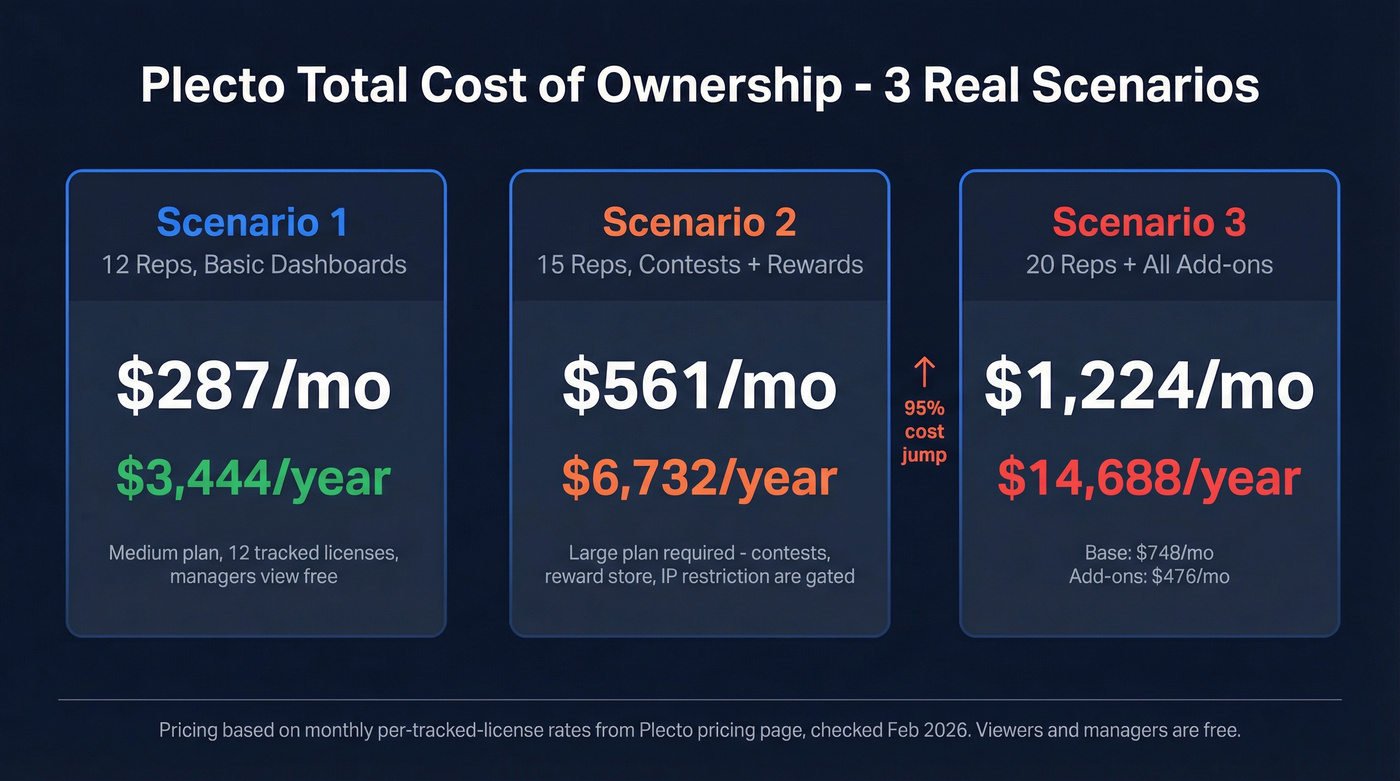
TCO example 1: 12 reps, 2 managers, basic dashboards
- Tracked: 12 reps (managers are free viewers)
- Medium: you'll effectively need 12 tracked licenses -> ~$287/month (12 x $23.90)
- Annualized: ~$3,444/year
If you're only using wallboards and basic KPIs, this is where Geckoboard often wins: you stop paying per tracked rep.
TCO example 2: 15 reps, contests + reward store + IP restriction
Now you're in Large territory because those features are gated.
- Large: 15 x $37.40 = ~$561/month
- Annualized: ~$6,732/year
This is the "Plecto is expensive" moment for SMBs - not because the product's bad, but because feature gating forces you into a higher per-license band.
TCO example 3: 20 reps + Dynamic Dashboards + Coaching & Training
This is common in teams trying to run role-based views plus structured coaching.
- Large: 20 x $37.40 = ~$748/month
- Add-ons: $238 + $238 = $476/month
- Total: ~$1,224/month
- Annualized: ~$14,688/year
At about $15k/year, be brutally honest about what you're optimizing for. If it's TVs, you're overbuying. If it's coaching + contests with governance controls, you might be right on target.

You're comparing $15K/year dashboard tools, but bad contact data is why reps ignore the leaderboard. Prospeo delivers 98% email accuracy and 125M+ verified mobiles - refreshed every 7 days - so your KPIs reflect real pipeline, not bounced sequences.
Stop decorating walls with wrong numbers. Fix the data feeding them.
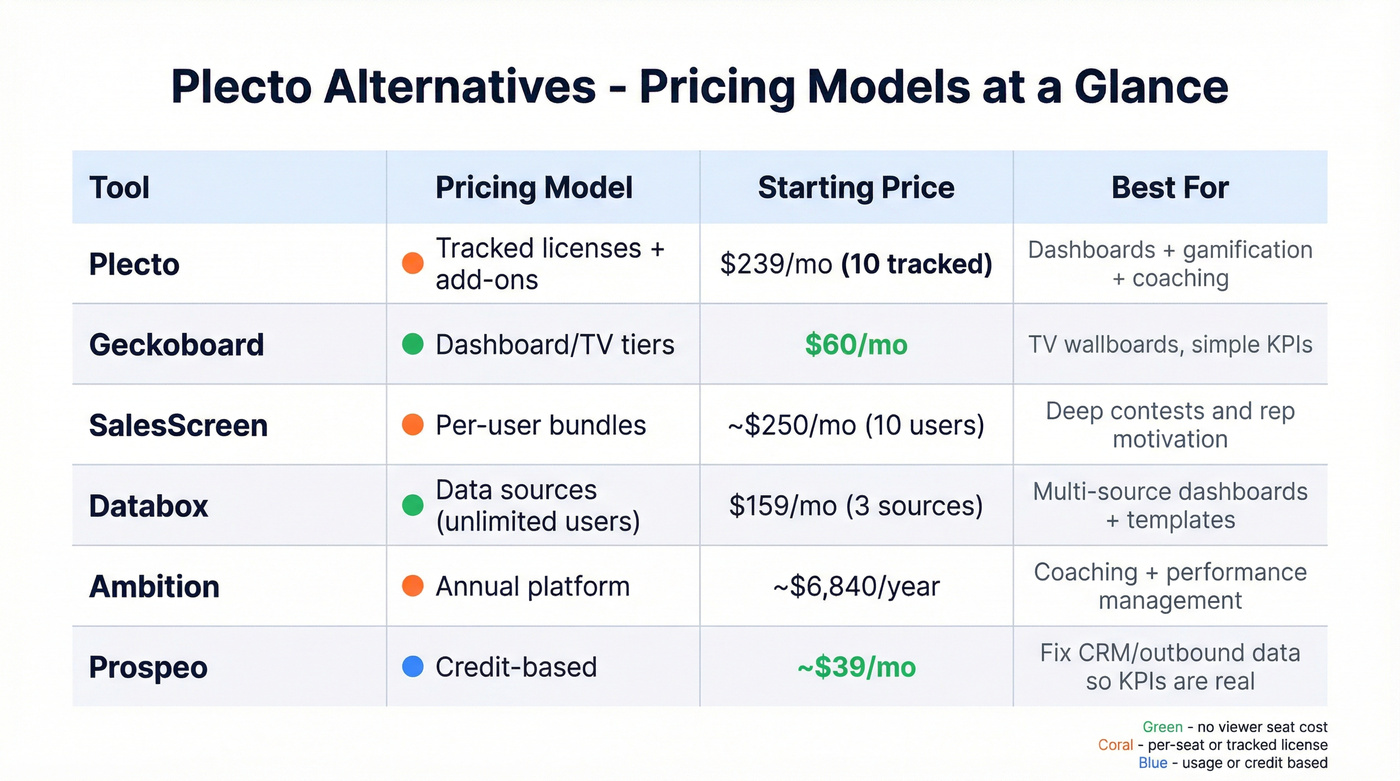
Plecto alternatives: pricing models + best-for matrix (comparison table)
Use this table like a shortcut: match the pricing lever to your reality.
- Lots of viewers? Avoid per-seat.
- Lots of tools/properties? Avoid "priced by data source" surprises.
- Need contests + coaching? Don't buy a wallboard and duct-tape motivation later.
| Tool | Pricing model | Price anchors (2026) | Best for |
|---|---|---|---|
| Plecto | Tracked licenses + add-ons | $239/month (Medium, 10 tracked) or $374/month (Large, 10 tracked); add-ons $238/month each | Dashboards + gamification + basic coaching in one place |
| Geckoboard | Dashboard/TV tiers | $60 / $175 / $319 per month (annual billing) | TV wallboards with simple KPIs |
| SalesScreen | Per-user bundles + add-ons | Starts ~ $250/month (10 users) or ~$675/month (15 users); add-ons ~$5/user/month | Deep contests, leaderboards, rep motivation |
| Databox | Data sources (unlimited users) | $159/month (3 sources); $399/month (Growth); ~$5.60/month per extra source (annual pricing) | Multi-source dashboards + templates |
| Ambition | Annual platform | Starts around $6,840/year | Coaching cadence + performance management |
| Spinify | Quote-based with minimums | 15-user minimum (Business); 200-user minimum (Enterprise) | "All-in" gamification for teams that meet minimums |
| Octoboard | Client-based tiers | $25 / $50 / $100 / $150 per month for 5/10/20/30 clients; also $5 per client per month | Agency portals + white-label reporting |
| Power BI | Per-user BI licensing | Typical public licensing lands around ~$10-20/user/month (plus implementation) | Governed BI modeling + analytics |
| Looker Studio Pro | Per-user (plus connectors) | Common pricing lands around ~$9/user/month (connectors may add cost) | Lightweight, shareable dashboards |
| Tableau | Per-user tiers | Typical public ranges ~$70-150/user/month by role (plus admin) | Enterprise analytics programs |
| Prospeo | Credit-based B2B data | Free tier + paid from ~$39/month (about $0.01/email; mobiles use credits) | Making CRM/outbound inputs accurate so KPIs mean something |
Best Plecto alternatives (mini-reviews + who each is for)
Prospeo - make your KPIs trustworthy by fixing inputs first (Tier 1)
Dashboards don't fail because the charts are ugly. They fail because the inputs are wrong: stale emails, missing mobiles, duplicates, and half-filled fields that make "connect rate" and "meetings set" look healthy while pipeline quietly stalls.
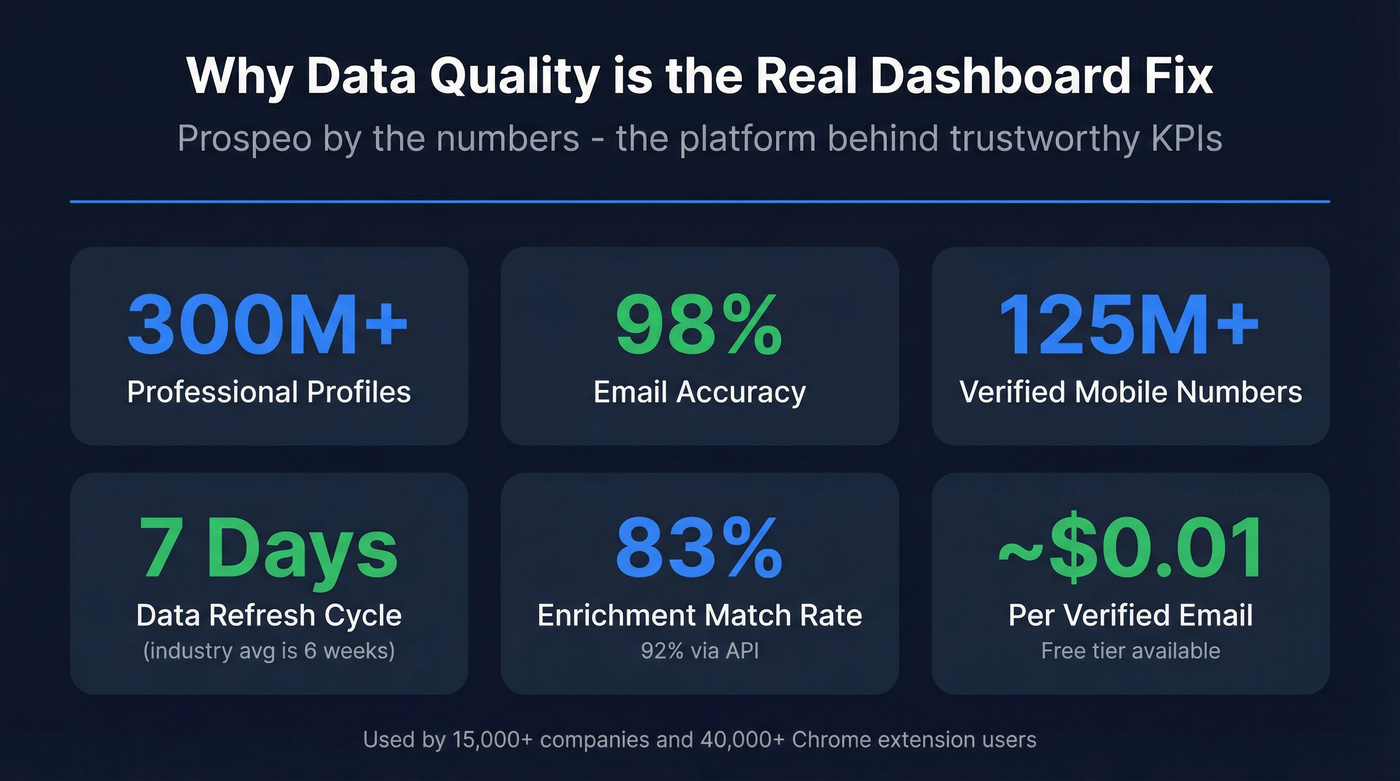
In our experience, the fastest way to "fix the dashboard" is to stop feeding it junk. Prospeo is The B2B data platform built for accuracy: 300M+ professional profiles, 143M+ verified emails with 98% accuracy, and 125M+ verified mobile numbers with a 30% pickup rate. Records refresh every 7 days (industry average is 6 weeks). Enrichment returns 50+ data points with an 83% enrichment match rate and a 92% API match rate. It's used by 15,000+ companies and 40,000+ Chrome extension users.
Here's the thing: if your outbound KPIs are the scoreboard, contact data is the ball. If the ball's flat, you can argue about dashboards all day and still lose.
How it fits: keep your wallboard/reporting tool; Prospeo makes the underlying CRM and outbound data reliable so the dashboards stop lying.
- Best for: outbound teams, RevOps, and agencies that want dashboards to reflect real reachability and pipeline motion
- Pricing model: credit-based; free tier + paid from ~$39/month (about $0.01/email); no contracts
If you want the "what you'll actually do" version, it's simple: pick your ICP filters (role, tech, growth, intent), run real-time verification, enrich missing fields, then push clean records into HubSpot/Salesforce or export to your outbound tools so your KPIs reflect real conversations instead of bounce logs and wrong numbers.
Geckoboard - the cleanest TV wallboard replacement for Plecto (Tier 1)
If your real requirement is "put KPIs on TVs and don't make it a project," Geckoboard's the straightest swap. Pricing's predictable - $60 / $175 / $319 per month (annual billing) - and it doesn't punish you with viewer-seat sprawl just to get dashboards onto screens.
My favorite part: TV/share links don't require accounts. That one detail prevents the classic "we need 60 viewer seats" budget spiral.
Use Geckoboard if you want a dashboard that looks good from 10 feet away, quick setup for sales floor/support wallboards, and sharing that doesn't turn into identity-management work.
Skip it if you want deep gamification (contests, reward store) or BI-grade analysis. It's a wallboard tool, and it stays in its lane.
SalesScreen - the "behavior change" gamification pick (Tier 1)
SalesScreen is what you buy when you want the dashboard to do something: drive calls, follow-ups, and competitive energy, not just report numbers. It has strong adoption proof: 4.7/5 on G2 with 472 reviews, and it's a deeper gamification engine than most wallboard-first tools.
Pricing anchors:
- Starts around $250/month for 10 users
- Starts around $675/month for 15 users
- Add-ons commonly run ~$5/user/month (coaching, scorecards, reward shop, etc.)
Where teams win with it: weekly contests that reset automatically (calls, meetings, pipeline created), team-vs-team competitions (SDR pods, regions), and manager coaching tied to the same scorecards reps see.
One frustration: TV deployment can be fiddly. Budget time for the last mile (TV browser quirks, auth sessions, display formatting) so you don't burn a week on "why won't this screen stay logged in?"
Databox - best when you need dashboards across lots of tools (Tier 1)
Databox is the "I need dashboards across a bunch of tools and I don't want to build BI" option. It's also honest about the pricing lever: you pay by connected data sources, not seats (plans include unlimited users).
Anchors:
- $159/month for Professional (3 sources)
- $399/month for Growth
- ~$5.60/month per extra data source (annual pricing)
Here's the cost trap in plain English: "we only use 5 tools" turns into 12-18 sources once you count multiple ad accounts, multiple GA4 properties, multiple HubSpot portals, and sandbox/prod splits. Count sources before you fall in love with templates.
Ambition - best for manager-led coaching systems (Tier 1)
Ambition is what you pick when the real problem isn't dashboards - it's manager cadence. If you want scorecards, coaching workflows, accountability, and consistent 1:1s across a larger org, Ambition's built for that.
A typical rollout looks like: define scorecards by role (SDR vs AE vs CSM), set weekly coaching rhythms (review, commit, follow-up), and standardize what "good" looks like across teams. Pricing's usually annual; a clean anchor is starting around $6,840/year.
Before you switch dashboards: fix KPI inputs (contact + CRM hygiene)
Most Plecto competitor decisions get framed as a UI debate. That's backwards. If your inputs are messy, every dashboard tool disappoints you - just with different fonts.
Here's what breaks KPI trust in the real world:
- Bounces and catch-all emails inflate "emails sent" while crushing reply rate and deliverability. (If you're seeing hard bounces like 550 Recipient Rejected, start with this: 550 Recipient Rejected.)
- Missing mobiles make connect rate look like a rep problem when it's a data problem. (If you're tracking call KPIs, align on answer rate vs connect rate.)
- Duplicates double-count activity and scramble attribution ("who sourced this opp?").
- Stale titles/companies mis-route sequences and distort segment dashboards (SMB vs Mid-market vs Enterprise).
And here's what gets distorted downstream: connect rate, meetings set, pipeline created, and contest fairness (reps with better territories/data win, not better execution).
Operationalize it like a system, not a one-time cleanup:
- Verify emails/mobiles before they hit sequences. (Use a repeatable SOP like this: email verification list.)
- Enrich missing fields so segments are real. (If you're comparing vendors, see lead enrichment tools.)
- Dedupe contacts and accounts so attribution isn't chaos.
- Push clean records into the CRM (and outbound tools) via native integrations or automation.
- Then lock KPI definitions and start measuring performance.
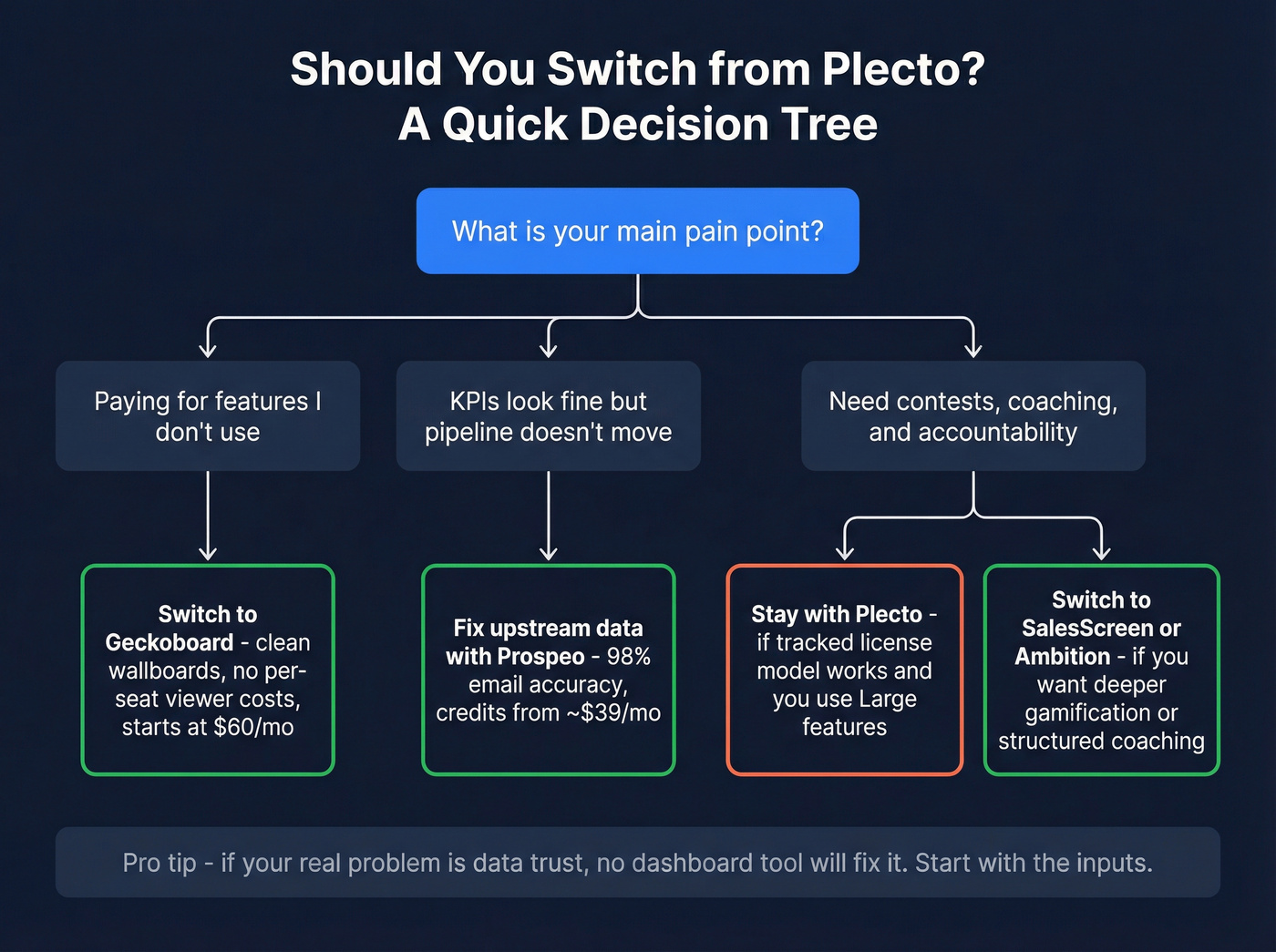
Choose by use case: a simple decision tree (TV vs gamification vs coaching vs agency vs BI)
Use this like a routing tree. Don't overthink it.
If your primary goal is TV dashboards (wallboards)
Pick Geckoboard for fast setup and TV/share links without accounts.
Pick Databox if you need lots of templates across many tools and you're comfortable managing source-based pricing.
If your primary goal is gamification (contests, motivation, leaderboards)
Pick SalesScreen for deeper contests and strong adoption proof.
Pick Spinify if you want everything included, you meet the 15-user minimum, and you want a vendor that'll help rebuild your program.
If your primary goal is coaching + performance management
Pick Ambition for manager workflows and structured performance systems.
Pick SalesScreen if you want coaching tied directly to contests and leaderboards.
If your primary goal is agency/client reporting
Pick Octoboard for white-label client portals and client-based pricing.
Pick Databox for broad templates and multi-source reporting with unlimited users.
If your primary goal is BI/analytics
Pick Power BI when modeling and governance matter more than speed.
Pick Tableau if you're already an enterprise analytics org.
Pick Looker Studio for lightweight sharing and quick dashboards.
If your dashboards look fine but meetings aren't rising
Fix reachability first. Bad data makes every wallboard feel "off," and it turns coaching into finger-pointing.
TV dashboard deployment gotchas (what breaks in the real world)
TV dashboards are deceptively simple until you deploy them outside your laptop.
Practical checklist
- Viewer access model: Geckoboard's share links and TV viewing don't require accounts - perfect for office-wide screens.
- TV browser quirks: cheap TV browsers time out, don't handle modern auth well, and randomly clear sessions. A $30 streaming stick often beats the "smart TV browser."
- Network constraints: if your security team wants IP restrictions, confirm the tool supports it (and whether it's tier-gated).
- Refresh cadence: "real-time" usually means "every X minutes." Align contests and alerts to the actual refresh interval.
- Single sign-on: if you need SSO, confirm it early. This is where "simple tools" suddenly become procurement projects.
Migration reality: what to audit before switching from Plecto
Switching tools is rarely hard because of the UI. It's hard because of definitions, permissions, and timing.
Pre-migration audit (do this before you sign anything)
- Metric definitions & formulas: write down the exact logic for "meeting set," "SQL," "pipeline created," "connect rate." If you don't, you'll rebuild them three different ways and argue about which one's "right."
- Formula parity gotcha (concrete example): if Plecto counts "meetings set" off created date but your new tool counts off activity date, your weekly contest looks broken on day one.
- Permissions & visibility: Plecto's custom permission profiles are Large-gated; alternatives might be simpler or stricter. Decide whether reps can see team totals, peer rankings, or only their own numbers.
- Contest timing gotcha: confirm timezone handling and reset logic (Sunday vs Monday, local vs UTC). This is the fastest way to accidentally crown the wrong winner.
- Data mapping: if your CRM has multiple pipelines, multiple currencies, or multiple "owner" fields, map them explicitly. Don't assume connectors guess correctly.
Ask vendors to rebuild your program (and get it in writing)
This is the most underused negotiation lever: some vendors will migrate dashboards, rebuild contests/leaderboards, and train managers as part of onboarding. If you're switching from Plecto because you want better adoption, make "rebuild + training" part of the deal, not an afterthought.
Week-1 rollout checklist (so adoption doesn't crater)
Recreate one flagship dashboard first (the one leadership checks daily).
Run one contest with a simple rule set before you get fancy.
Turn on alerts/notifications only after metrics are stable, or you'll spam the team with wrong numbers.
Train managers on the coaching workflow (if you're using it), or it becomes shelfware.
One more opinionated rule: clean your contact data before you measure outbound KPIs. If sequences bounce and dials don't connect, you'll end up coaching reps for problems they can't fix.
Final picks by scenario (hard calls)
- You want TVs on the wall by Friday: pick Geckoboard. It's the fastest path to clean wallboards without viewer-seat drama.
- You want contests that actually change behavior: pick SalesScreen. It's built for competition loops, not just reporting.
- You want a manager-led performance system: pick Ambition. It's heavier, but it's the right kind of heavy.
- You need dashboards across a messy stack: pick Databox, then count data sources before you commit.
- Your KPIs look "busy" but pipeline doesn't move: fix inputs first, then pick the dashboard.
Before you spend $1,224/month on dashboards and coaching add-ons, ask: are reps actually reaching buyers? At $0.01/email with a 30% mobile pickup rate, Prospeo costs a fraction of Plecto and moves the metric that matters - conversations booked.
One client tripled pipeline to $300K/week by fixing upstream data first.
FAQ: Plecto alternatives (2026)
What's the best Plecto alternative for TV dashboards?
Geckoboard is the best fit for TV wallboards because share links don't require user accounts and setup is fast. Expect $60-$319/month (annual billing) depending on dashboards and screens, and plan on using a streaming stick if your TV browser logs out.
Which Plecto alternative is best for sales gamification and contests?
SalesScreen is the strongest option for contests and behavior change, with deeper competition mechanics than most wallboard tools. Pricing starts around $250/month for 10 users, and common add-ons run ~$5/user/month, so budget for coaching/scorecards if you want the full program.
Is Plecto pricing per user or per tracked license (and do viewers count)?
Plecto charges per tracked license (people or systems sending data), while viewers who only look at dashboards are free. A practical rule: if someone only needs to view a TV dashboard or a shared link, they shouldn't increase your tracked-license count.
What's a good free alternative to ZoomInfo for fixing dashboard inputs?
Prospeo's a strong free starting point because it includes 75 emails + 100 Chrome extension credits/month and delivers 98% verified email accuracy with a 7-day refresh cycle. Pair it with a wallboard tool and your KPIs stop getting wrecked by bounces, duplicates, and missing mobiles.
Tier 2 tools (quick, practical notes)
Spinify - bundled gamification if you can meet the minimums (Tier 2)
Spinify's a strong fit if you want an "everything included" gamification suite and you meet the 15-user minimum (Business) or 200-user minimum (Enterprise). Pricing's quote-based; ask for migration help (contest rebuilds + training) as part of onboarding.
Power BI - BI-grade modeling when dashboards become analytics (Tier 2)
Power BI's the move when KPI definitions become political and you need governed models, permissions, and reusable datasets. Typical public licensing lands around ~$10-20/user/month, but the real cost driver is implementation: data modeling, refresh pipelines, and governance.
Looker Studio - lightweight, shareable dashboards (Tier 2)
Looker Studio is the simplest way to publish shareable dashboards when "good enough" is good enough. Looker Studio Pro commonly lands around ~$9/user/month, and your real cost is connector sprawl and ongoing maintenance.
Tableau - enterprise analytics (not wallboard-first) (Tier 2)
Tableau's still elite for enterprise analytics and exploratory reporting, but it's rarely the cleanest Plecto replacement. Typical public ranges run ~$70-150/user/month by role, plus meaningful admin and governance overhead.
Tier 3 tools (quick mentions)
- Domo: Full BI platform with lots of connectors and app-style dashboards. Pricing is enterprise-style - plan on ~$25k-$100k+/year and a real implementation effort.
- Klipfolio: Flexible dashboard builder with many integrations and a "build it yourself" feel. Pricing commonly lands ~$100-300/month for small teams and ~$500-$1,500/month for larger deployments.
- DashThis: Agency-focused marketing dashboards built for client delivery. Pricing typically runs ~$39-$399/month, and it's great for reporting - not sales-floor contests.
- ClicData: BI-leaning dashboards with data management features. Pricing often lands ~$79-$525+/month, depending on tier.
- Spider Strategies: KPI governance and strategy execution (balanced scorecard style), not gamification. Expect ~$125+/month up to ~$5,000+/month depending on tier, with implementation-heavy onboarding.
- ActivTrak: Productivity analytics (work patterns, focus time), not a KPI dashboard replacement. Pricing commonly runs ~$9-15/user/month for paid tiers (plus a free plan), and it pairs with dashboards when you want behavior context.
- Google Sheets / Excel: Cheapest "dashboard" if you can tolerate manual refresh and brittle formulas. Pair scheduled exports with a TV browser or a lightweight wallboard tool when you outgrow it.
Summary: choosing the right Plecto alternatives without overbuying
The best Plecto alternatives depend on what you're trying to accomplish: Geckoboard for TVs, SalesScreen for contests, Ambition for coaching systems, Databox for multi-tool reporting, and Prospeo when the real issue is that your inputs (emails, mobiles, enrichment) are making every dashboard untrustworthy. Pick the category first, then the vendor, and your total cost stops surprising you.