The Best AI Lead Generation Tools in 2026 (And the 3 Worth Trialing First)
A RevOps lead we know ran a 3-tool bake-off last quarter. The "best" database - the one with the biggest contact count - created 4,000 duplicate records in Salesforce in five days. The cheapest tool in the test had better phone connect rates and half the bounce rate. Database size is a vanity metric. Data accuracy is the one that closes deals.
B2B contact data decays up to 70.3% per year. People change jobs, companies rebrand, email servers get decommissioned. Reps waste roughly 27.3% of their time chasing leads built on stale data - bad emails, disconnected numbers, contacts who left the company six months ago. That's a quarter of your team's capacity gone before a single conversation happens.
The best AI lead generation tools in 2026 fix this at the source. They give you contacts that pick up the phone and don't bounce your sequences. Here's which ones deliver and which ones coast on brand recognition.
Our Top 3 Picks
| Tool | Best For | Starting Price | Email Accuracy | Free Tier |
|---|---|---|---|---|
| Prospeo | Email accuracy and freshness | ~$0.01/email | 98% | Yes (75 emails/mo + 100 extension credits) |
| Apollo.io | All-in-one for SMB teams | ~$49/user/mo | ~79% | Yes |
| Clay | Custom enrichment workflows | $134/mo | Varies by source | Yes (1,200 credits/yr) |
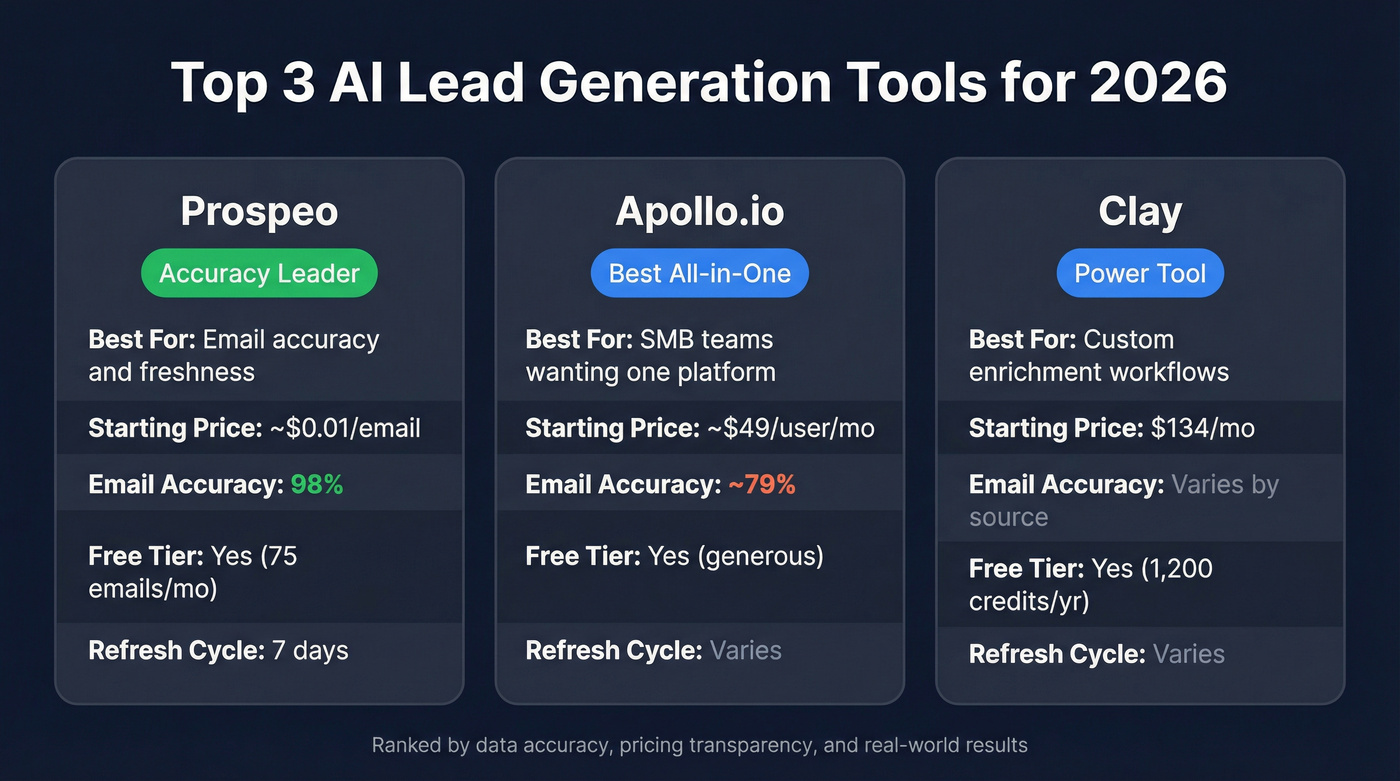
Prospeo is the accuracy leader - 98% verified emails, a 7-day refresh cycle, and transparent credit pricing that doesn't require a sales call. Apollo is the obvious starting point if you want prospecting, sequencing, and a lightweight CRM in one platform. Clay is the power tool for RevOps teams building custom enrichment waterfalls who don't mind a learning curve.
What Actually Matters in AI Lead Gen
Data accuracy over database size. A tool with 500M contacts and 80% accuracy gives you 100M bad records. A tool with 300M contacts and 98% accuracy gives you 6M bad records. Every bounced email damages your sender reputation, and domain reputation takes months to rebuild.

Refresh cycle. Email addresses decay about 3.6% per month. If your provider refreshes every six weeks, you're starting with stale data. Ask every vendor: how often do you re-verify? (If you want the benchmarks and fixes, see B2B contact data decays.)
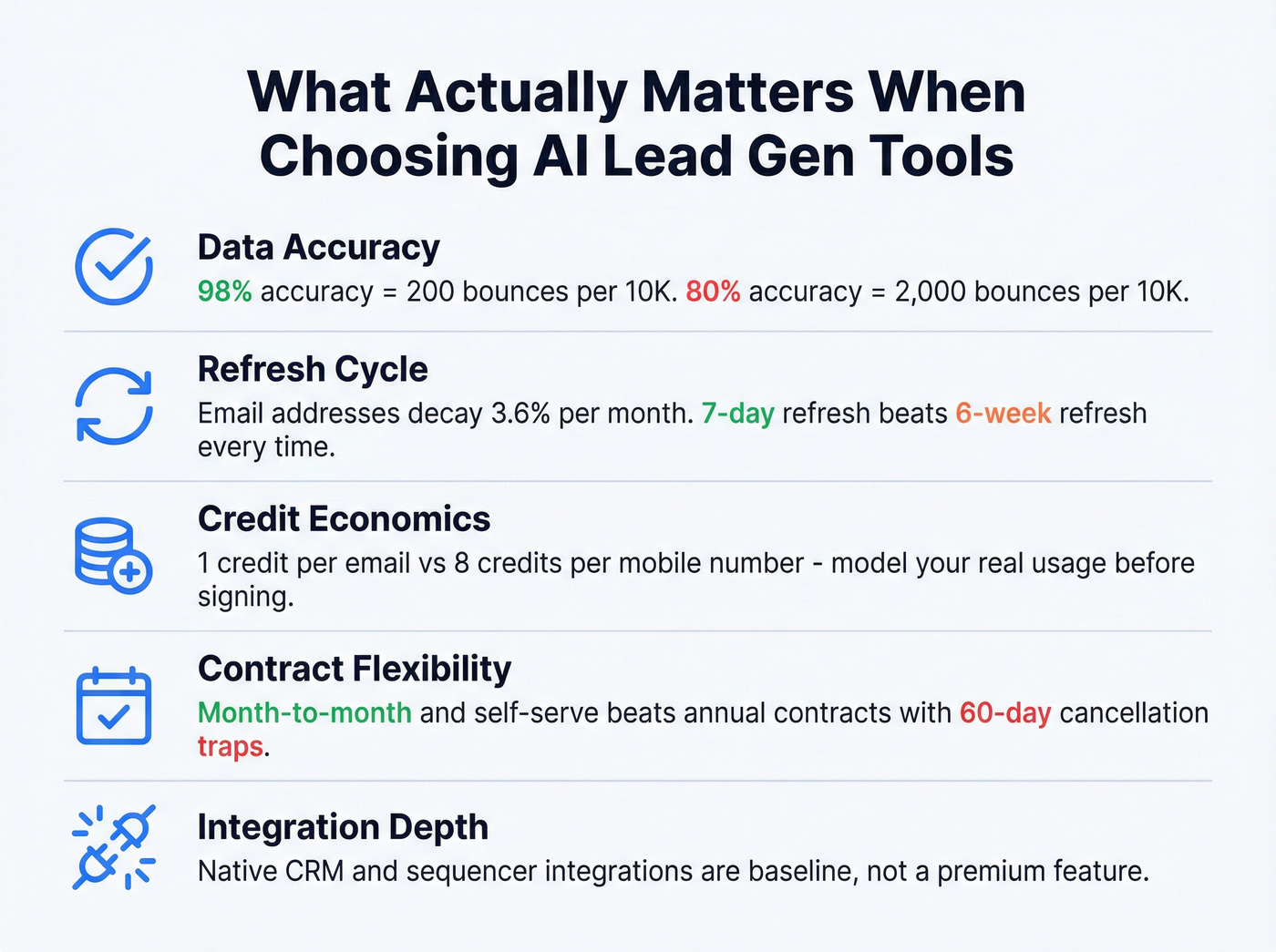
Credit economics. A tool charging 1 credit for an email and 8 credits for a mobile number has very different unit economics than one charging a flat rate. Model your actual usage before signing anything. (More on this in cost of sales tech stack.)
Contract flexibility. Annual contracts with auto-renewal and 60-day cancellation windows are designed to trap you. Self-serve, month-to-month options let you leave when the data stops performing.
Integration depth. The tool needs to push clean data into your sequencer and CRM without manual CSV exports. Native integrations with Salesforce, HubSpot, and outreach tools like Smartlead, Instantly, or Lemlist aren't optional - they're the baseline. (If you're cleaning up fields and duplicates, use a CRM hygiene checklist.)
AI Lead Generation Software Compared
Prospeo
Use this if: You care more about data quality than feature count and you want verified emails and direct dials that actually connect, without negotiating an enterprise contract.
Skip this if: You need a built-in sequencer - pair Prospeo with Smartlead, Instantly, or Lemlist for outreach execution. (For options, see cold email marketing tools.)
Prospeo's database covers 300M+ professional profiles, 143M+ verified emails, and 125M+ verified mobile numbers. The headline number: 98% email accuracy. On a 10,000-contact campaign, that gap means roughly 200 bounces versus 2,100 - the difference between a healthy sender domain and one landing in spam. Teams using Prospeo book 26% more meetings than ZoomInfo users and 35% more than Apollo users, a direct result of higher connect rates. (If you want a deeper framework, see prospect data accuracy.)

Thirty-plus search filters - buyer intent, technographics, job changes, headcount growth, funding - let you build lists that match your ICP precisely. The 7-day data refresh cycle is genuinely unusual; the industry average is about 6 weeks. Buyer intent data across 15,000 Bombora topics lets you filter by who's actively researching your category, not just who matches your ICP on paper. CRM enrichment returns 50+ data points per contact at a 92% API match rate. (Related: intent signals.)
The Snyk case study tells the story well: 50 AEs were prospecting 4-6 hours per week with bounce rates of 35-40%. After switching, bounces dropped under 5%, and AE-sourced pipeline jumped 180%. Meritt saw pipeline triple from $100K to $300K per week with bounce rates falling below 4%.
Pricing runs about $0.01 per email with a free tier of 75 verified emails per month plus 100 Chrome extension credits. No contracts, no sales calls required.
Apollo.io
Apollo is the Swiss Army knife of sales tools, and its 9,000+ G2 reviews at a 4.7-star rating reflect genuine popularity. For SMB teams that want prospecting, email sequences, and a basic CRM in one platform without stitching together five tools, it's the fastest path to value. The free tier is generous enough to evaluate properly, and paid plans start around $49-$119/user/month depending on features.
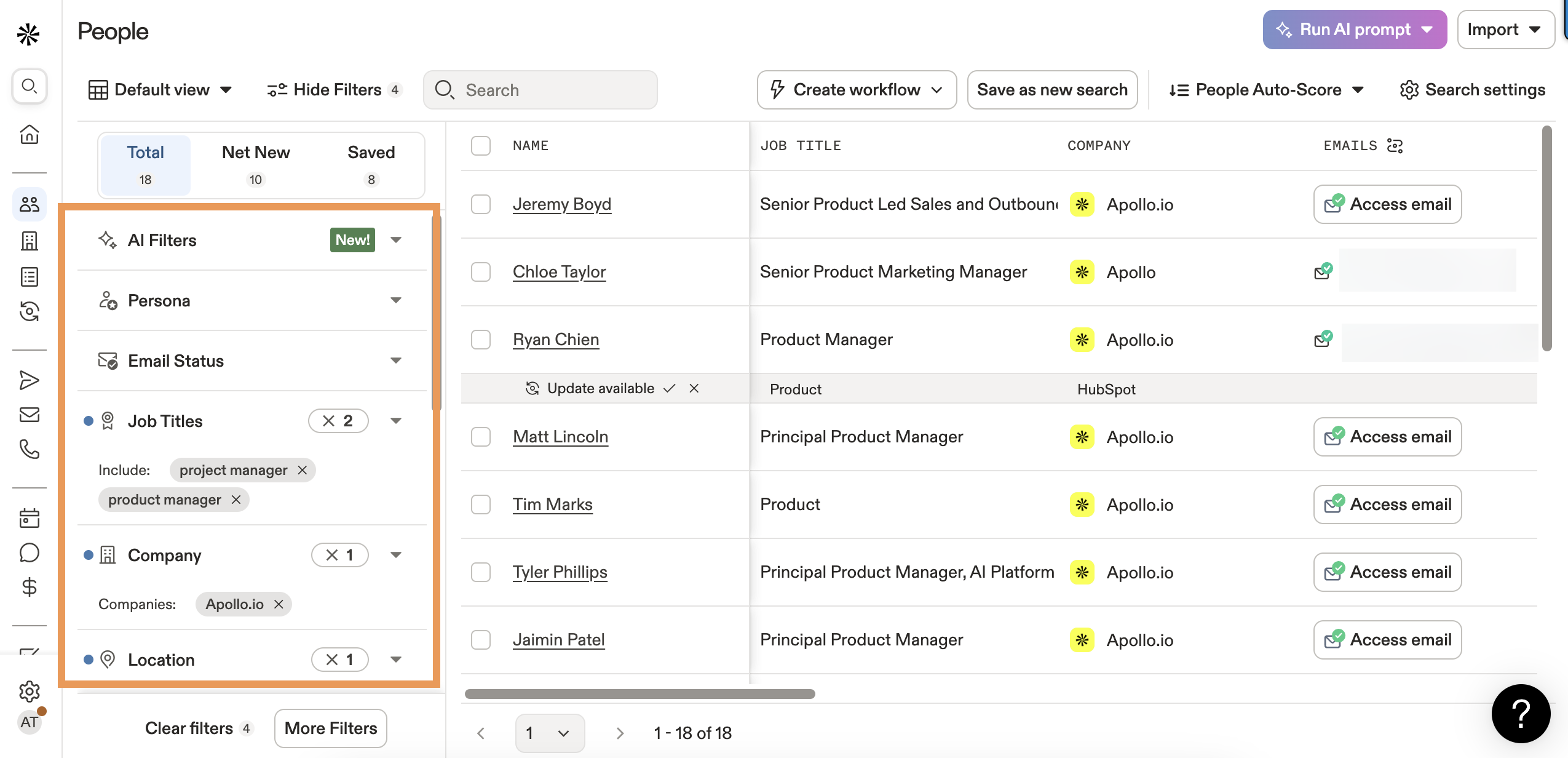
The credit system is where things get tricky. Emails cost 1 credit, but mobile numbers cost 8 credits. Credit burn rate is a recurring theme in sales communities - reps love Apollo's breadth but get frustrated when mobile lookups eat through monthly allocations in two weeks. Where Apollo beats ZoomInfo: price, speed to value, and the built-in sequencer. Where ZoomInfo still wins: database depth for enterprise accounts and intent signal volume.
Clay
Clay isn't a traditional lead gen database - it's an enrichment orchestration platform. You build workflows (called "tables") that pull data from dozens of providers, enrich through multiple sources, and output clean, scored leads. It's powerful, but it's not plug-and-play. If your reps just want to search for contacts and start emailing, Clay's learning curve will frustrate them. (If you're building multi-source workflows, see waterfall alternatives.)
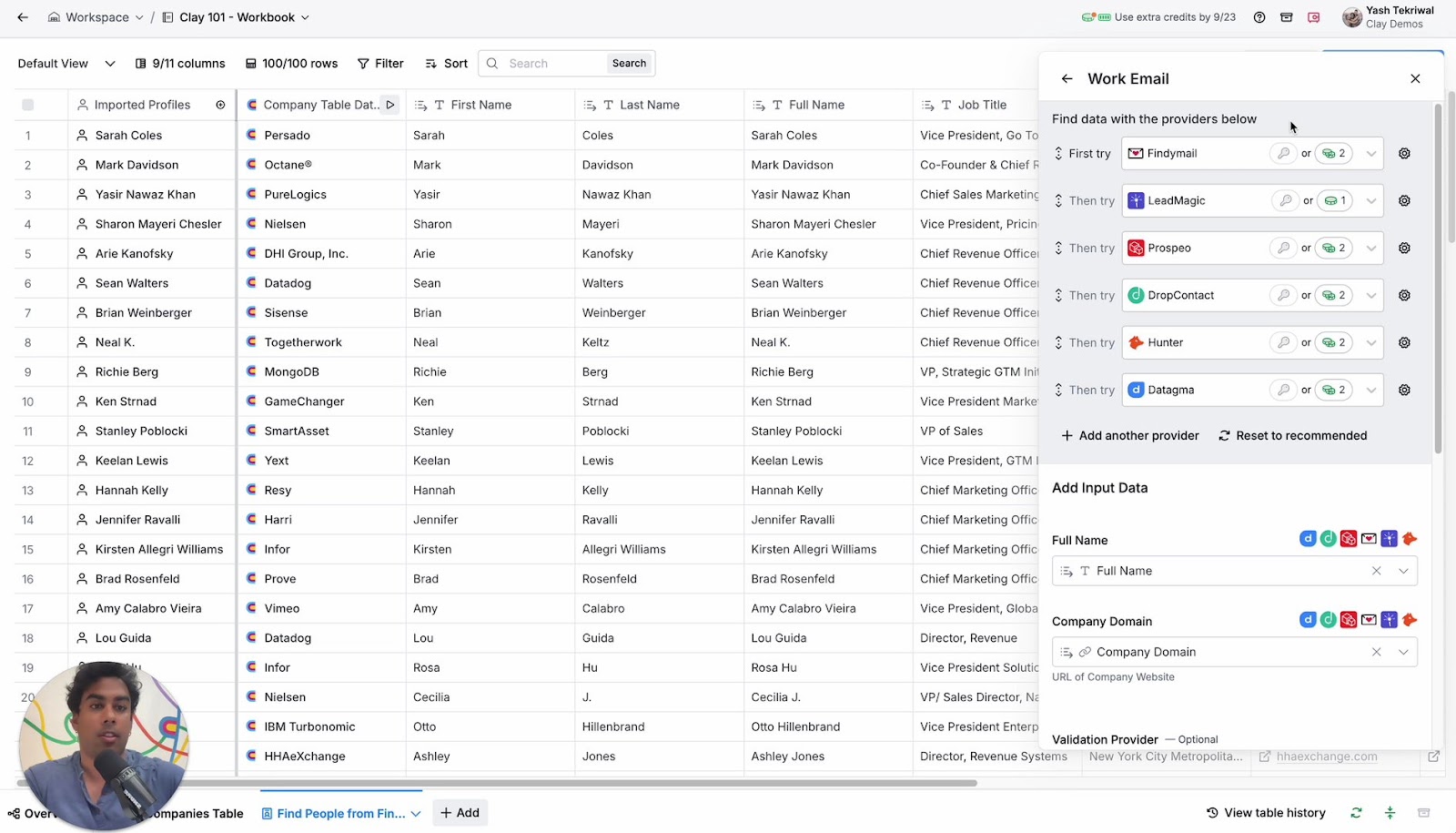
Pricing is transparent: Free ($0, 1,200 credits/year), Starter ($134/mo, 24K credits/year), Explorer ($314/mo, 120K credits/year), Pro ($720/mo, 600K credits/year). All plans include unlimited users, which is unusual and genuinely valuable for growing teams. The tradeoff compared to ZoomInfo: more flexibility, more setup time. ZoomInfo gives you a turnkey database but locks you into their ecosystem and pricing.
ZoomInfo
The largest B2B database at 500M+ contacts and 100M company profiles. Processes 1B+ monthly buying signals for intent data.
But pricing starts at $14,995/year for Professional and runs to $39,995/year for Elite - before add-on modules. ZoomInfo is typically sold on annual contracts. Email accuracy sits around 87%, and refresh cycles run 4-6 weeks. A common complaint on r/sales and in RevOps communities: paying for modules you never activate.
Here's the thing - ZoomInfo makes sense for 200+ person sales orgs that need intent, chat, and workflow automation from one vendor. For everyone else, you're subsidizing features your team won't touch. A 10-seat contract with intent data and mobile numbers can easily run $40-60K/year.
Cognism
Best-in-class GDPR and CCPA compliance, screening against 15 DNC lists. Bombora-powered intent data and strong EMEA/APAC coverage with phone-verified mobiles hitting 87% list connectivity. If you're selling into the UK or DACH region, Cognism deserves a serious look. (For the legal side, see GDPR for sales and marketing.)
Pricing isn't public - expect roughly $1,000-$3,000/month for small teams, typically on annual contracts. If you're US-only, the premium over self-serve alternatives is hard to justify.
Seamless.AI
A real-time search engine approach to finding contacts, with a free tier of 50 credits to test. Basic plans start around $147/month with 250 credits per user, typically billed annually. That sounds reasonable until you realize 250 credits per month per rep disappears fast during active prospecting weeks.
Contract complaints are consistent across review sites and sales communities - the 60-day cancellation notice catches teams off guard. Know exactly what you're signing.
Lusha, LeadIQ, UserGems, 6sense, and Demandbase
Lusha is the lightweight option: simple interface, fast lookups, 4.3/5 on G2 across 1,400+ reviews. Free to $79/month. Think of it as a browser extension that happens to have a database - good for individual reps, thin on team features.
LeadIQ is the affordable prospecting companion at $15/user/month with a free tier. Best paired with a primary data provider, not as a standalone database.
UserGems tracks champion job changes - when your buyer moves companies, you get an alert. Core plan runs $2,750/month plus a $3,000 implementation fee. No execution layer, so total stack cost for a 5-rep team can hit $60K-$133K/year. Enterprise-only play. (Related: automated champion tracking.)
6sense and Demandbase are ABM and intent platforms, not contact data providers. 6sense runs $25K-$100K+/year; Demandbase sits in a similar range. Both are built for marketing teams running account-based plays with predictive scoring. If you're an SDR team looking for emails and phone numbers, these aren't your tools. (If you're evaluating ABM fit, see account-based marketing plan.)

You just read that B2B data decays 70.3% per year. Prospeo refreshes every 7 days - not 6 weeks. 98% email accuracy, 125M+ verified mobiles, 30+ ICP filters. At $0.01/email, you stop paying for bounces and start paying for conversations.
Run your own bake-off. 75 free verified emails, no sales call required.
Pricing Comparison
If a tool won't show you the price, they're optimizing for their sales team's commission, not your budget. Credit-based models can be especially deceptive - a "low" per-credit cost means nothing if mobile lookups burn 8x the credits of an email reveal. Model your actual usage before signing.
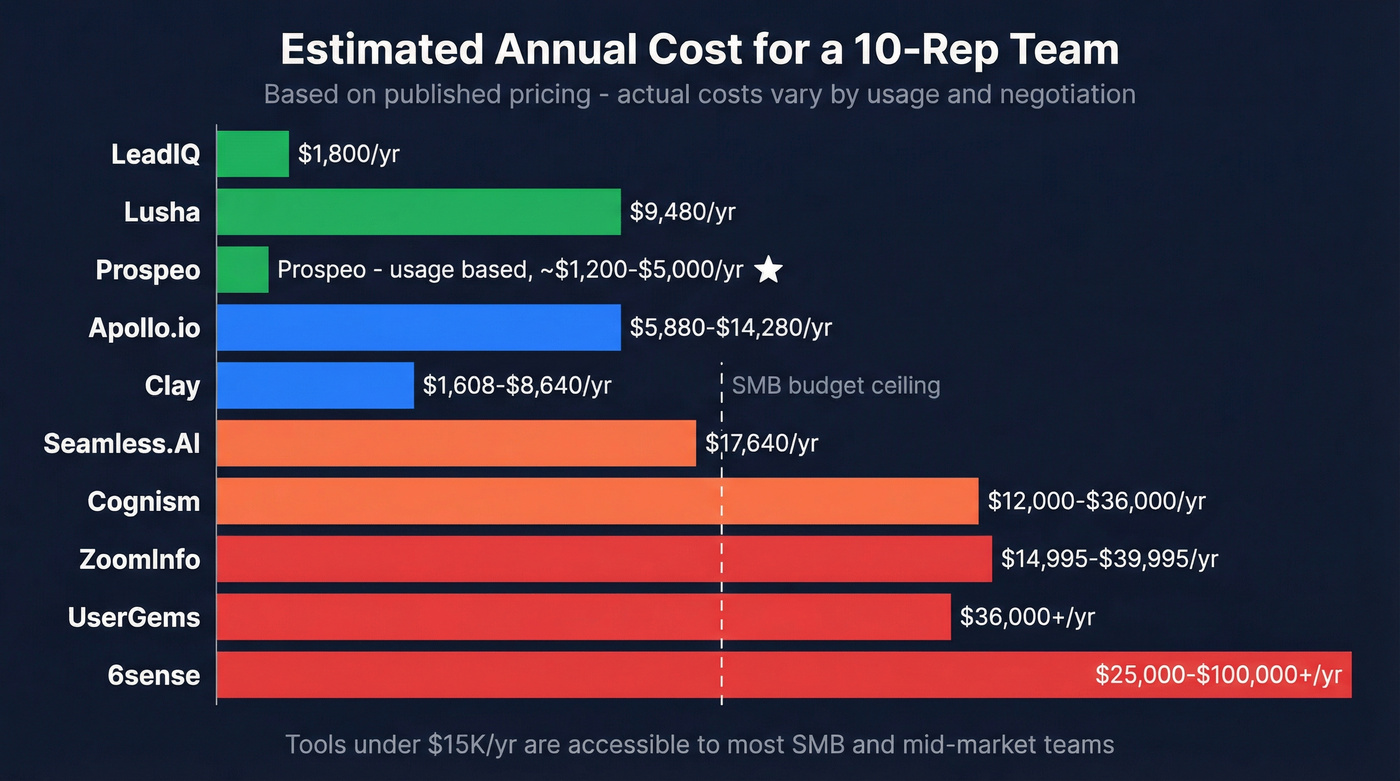
| Tool | Starting Price | Credit Cost | Free Tier | Annual Contract | Data Refresh |
|---|---|---|---|---|---|
| Apollo.io | ~$49/user/mo | 1 credit/email, 8 credits/mobile | Yes | No | Varies |
| Clay | $134/mo | Credit-based (varies by source) | Yes (1,200 credits/yr) | Billed annually | Varies |
| ZoomInfo | ~$14,995/yr | Bundled | No | Yes | 4-6 weeks |
| Cognism | ~$1,000-$3,000/mo | Bundled | No | Yes | Varies |
| Seamless.AI | ~$147/mo | Credit-based | Yes (50 credits) | Typically annual | Real-time |
| Lusha | Free-$79/mo | 1 credit/contact | Yes | No | Varies |
| LeadIQ | $15/user/mo | Credit-based | Yes (1 user / 50 credits) | No | Varies |
| UserGems | $2,750/mo + setup | Bundled | No | Yes | Event-driven |
| 6sense | $25K-$100K+/yr | Bundled | No | Yes | Varies |
The Accuracy Gap Nobody Talks About
Most comparison articles rank tools by database size or feature count. That's backwards. The metric that determines whether your outbound works is accuracy - and the differences are massive.
On mobile numbers, the gap is even wider: 30% pickup rate for the top-accuracy provider versus 12.5% for ZoomInfo and 11% for Apollo. Every bounced email is a wasted sequence step and a hit to your sender score. Every disconnected number is a rep staring at a dead line instead of having a conversation. (If you're troubleshooting bounces, see hard bounce.)
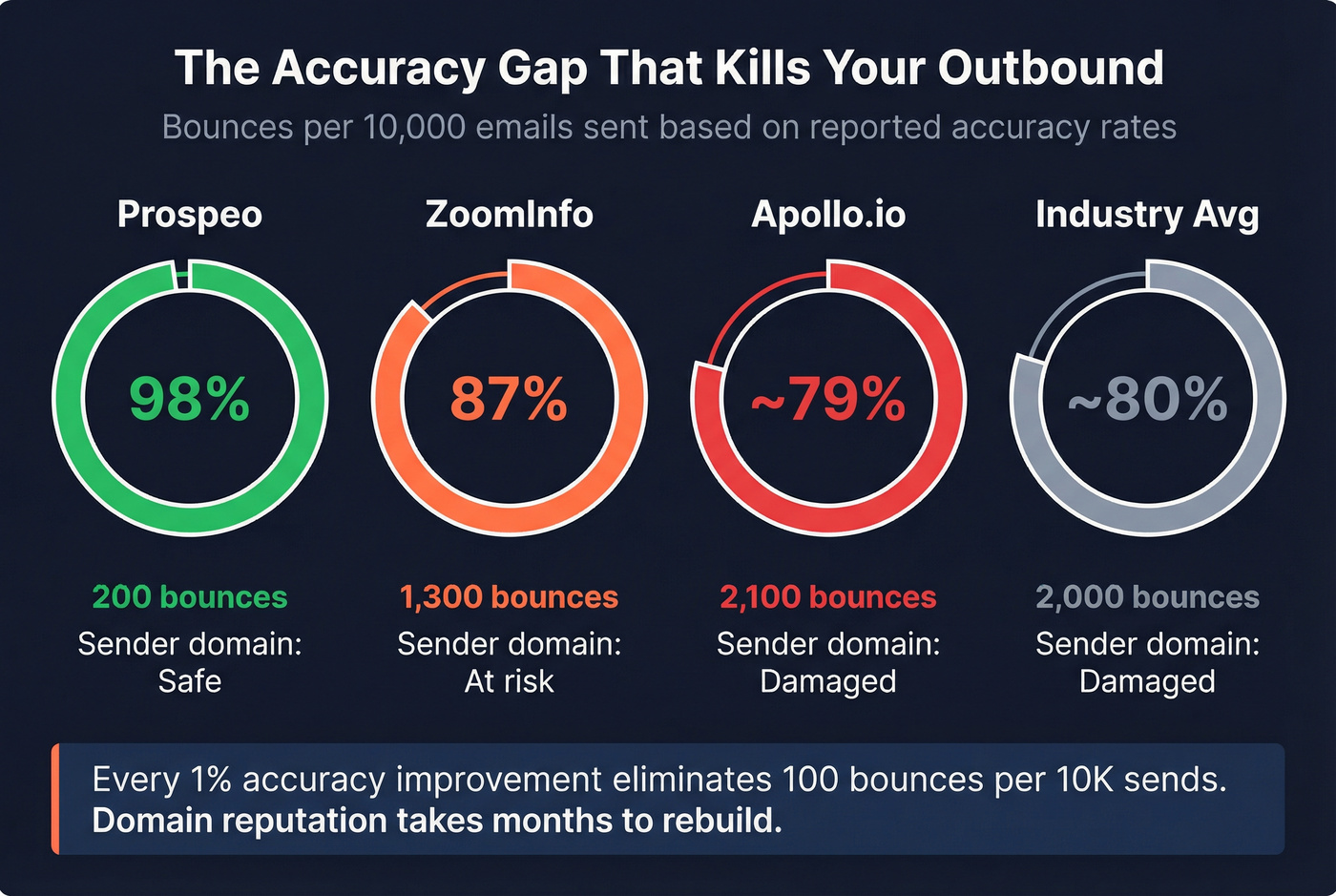
The refresh cycle amplifies these differences. At 3.6% monthly email decay, a list that's six weeks old has already lost roughly 5% of its valid addresses. A 7-day refresh means you're working with data that's never more than a week stale. Over a quarter, that gap compounds into thousands of wasted touches for a mid-size team.
Let's be honest: if your average deal size is under $15K, you probably don't need ZoomInfo-level intent data. What you need is accurate contact data and a good sequencer. Most teams we've talked to are over-spending on features and under-investing in data quality - then blaming their messaging when the real problem is a 15% bounce rate silently destroying their domain reputation. (If you want the deliverability playbook, see email deliverability guide.)
Which Tool Fits Your Team?
Solo founder or small team ($0-$200/month): Start with a free tier and test against the same prospect list. Whichever bounces less wins. At this stage, you don't need intent data or enrichment waterfalls - you need accurate emails and a sequencer. (For sequencing and sending, see outbound email campaign.)
5-15 rep SDR team ($500-$2,000/month): Apollo's all-in-one approach saves on tool count but sacrifices data accuracy at scale. A dedicated data provider paired with a sequencer gives you enterprise-grade data without enterprise pricing. Clay fits here too if you have RevOps capacity to build enrichment workflows.
20+ rep enterprise team ($10K+/year): ZoomInfo is the incumbent for a reason - the database depth and intent signals are strong for large US-focused teams. Cognism wins if EMEA compliance is non-negotiable. But before you sign that renewal, run a bake-off: take the same 500-contact list, push it through two tools, and compare bounce rates, pickup rates, and CRM match rates. The winner will be obvious in 48 hours. We've watched teams cut their data spend by 60-70% while improving deliverability just by switching their contact data source.
Snyk cut bounce rates from 40% to under 5% and grew AE-sourced pipeline 180%. Meritt tripled weekly pipeline to $300K. The difference wasn't effort - it was switching to data that actually connects. 300M+ profiles, 98% accuracy, zero contracts.
Stop ranking tools and start booking 26% more meetings.
FAQ
What's the most accurate AI lead generation tool?
Prospeo leads with 98% verified email accuracy and a 30% mobile pickup rate, compared to ZoomInfo at roughly 87% and Apollo at roughly 79%. A smaller, verified list consistently outperforms a massive, stale one - accuracy drives deliverability, which drives pipeline.
Are free AI lead gen tools worth using?
Yes, for evaluation. Free tiers from Apollo, Prospeo (75 verified emails/mo), and LeadIQ (50 credits) let you test data quality before committing budget. Compare bounce rates across the same prospect list, then upgrade the winner.
How much do AI lead generation platforms cost?
From free to $100K+/year. Self-serve tools like Prospeo and Lusha start under $100/month. Mid-market platforms like Clay run $134-$720/month. Enterprise tools like ZoomInfo and 6sense range from $15K to $100K+ annually with mandatory contracts.
What's the difference between a lead gen tool and a sequencing tool?
Lead gen tools find and verify contact data - emails, phone numbers, company info. Sequencing tools like Smartlead, Instantly, and Outreach automate the actual outreach. Apollo bundles both; most accuracy-focused providers integrate natively with major sequencers instead.
How often should B2B contact data be refreshed?
At minimum monthly. Email addresses decay about 3.6% per month, so a six-week-old list has already lost roughly 5% of valid addresses. Top providers refresh weekly; the industry average is about 6 weeks. That gap means thousands of wasted touches per quarter for active outbound teams.