

Sales and Marketing Organizational Structures: Models That Actually Align Revenue
82% of C-level B2B executives believe their sales and marketing teams are aligned. Only 35% of the people actually doing the work agree. That gap isn't a communication problem - it's a structural failure. The org chart itself is broken, and no amount of "alignment meetings" will fix it until you redesign how these teams connect, report, and share accountability.
The Revenue Alignment Stack
Here's the five-part foundation every revenue-aligned org needs. We call it the Revenue Alignment Stack because each layer depends on the one below it - skip one and the whole thing wobbles.
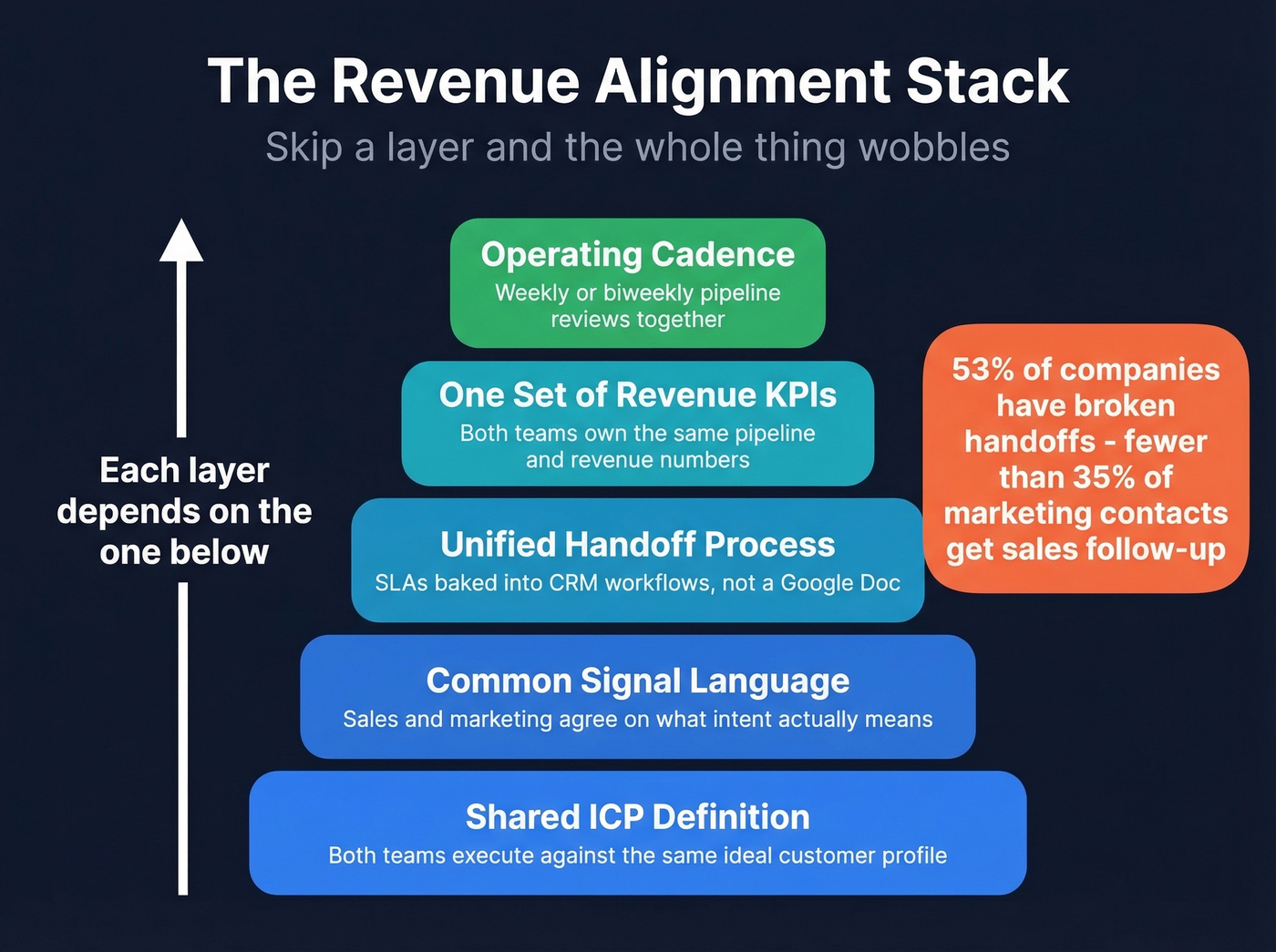
- Shared ICP definition that both teams execute against, not lip service
- Common signal language so sales and marketing agree on what "intent" actually means
- Unified handoff process with SLAs baked into CRM workflows
- One set of revenue KPIs that both teams own
- Operating cadence - weekly or biweekly rhythm where pipeline gets reviewed together
Most orgs skip at least one of these. The result? 53% of companies have broken handoffs where fewer than 35% of marketing-engaged contacts ever get followed up by sales. That's not a people problem. It's a systems problem - fractured foundations where teams don't agree on the ICP, don't share signals, and don't follow the same operating rhythms.
The fix isn't another Slack channel. It's rethinking how these teams are structured from the ground up.
Why Structure Drives Revenue
Org structure sounds like an HR exercise. It's not. It's a revenue lever, and Korn Ferry's research makes the case clearly: sales orgs with well-defined role clarity achieve +25% quota attainment, +8% revenue attainment, and +17% win rates compared to peers with ambiguous structures. The retention numbers are just as striking - clear structures drive 17% lower voluntary turnover and 20% lower involuntary turnover.
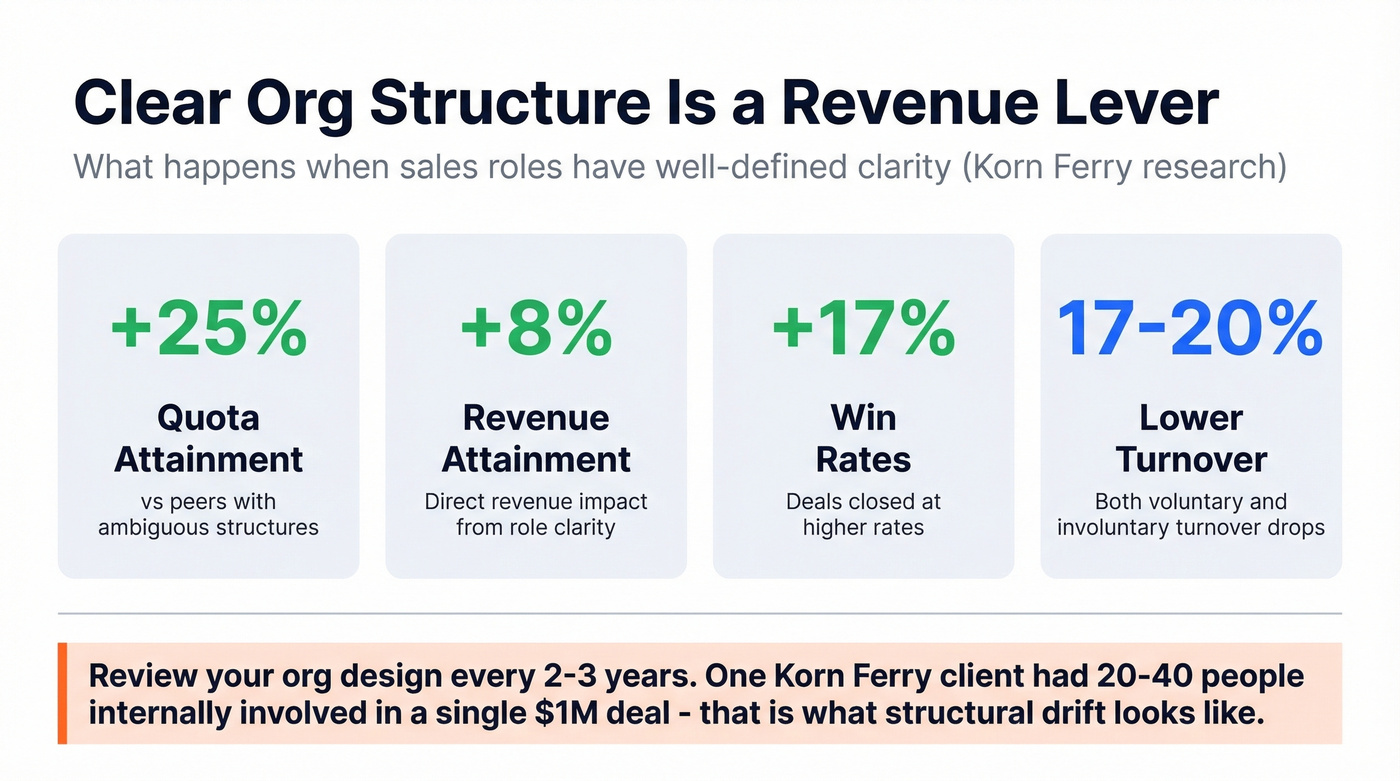
When people know what "excellent" looks like for their role, they stay longer and perform better. Simple as that.
Korn Ferry recommends reviewing your org design every 2-3 years because markets shift, buyer behavior evolves, and what worked at 30 reps won't work at 100. One of their clients had 20-40 people internally involved in a single $1M deal - that's what structural drift looks like in practice. Buyers can't navigate your org chart, and neither can your own reps. When marketing reports into a silo with its own KPIs (MQLs, traffic, brand awareness) and sales has a completely separate scorecard (pipeline, close rate, revenue), you get two teams optimizing for different outcomes. Structure is the only thing that forces shared accountability.
Core Structure Models
Sales Team Structures
Most sales orgs use a handful of common patterns. Each has a natural fit depending on your product complexity, geography, and deal size.
| Model | How it works | Best for | Watch out for |
|---|---|---|---|
| Functional | SDR → AE → CS assembly line | High-volume, repeatable sales | Handoff friction between stages |
| Geographic | Reps own territories | Field sales, regional nuance | Duplicate effort across regions |
| Product | Reps specialize by product line | Multi-product portfolios | Customer gets multiple reps |
| Segment | Reps by company size/vertical | SMB + enterprise mix | Segment boundaries get political |
| Assembly line | Full pipeline stages with specialists | Scaling outbound orgs | Context loss from over-specialization |
The assembly line model is common in SaaS because it lets you scale each stage independently. But it creates the exact handoff problems that kill alignment - every transition point is a potential leak. We've seen teams lose a meaningful chunk of qualified pipeline simply because the SDR-to-AE handoff lacks clear criteria and timing SLAs. If three or more reps tell you they "didn't know the lead was warm," that's a structural symptom, not a training gap.
Marketing Team Structures
Marketing org design has its own taxonomy. Alexander Group identifies four core archetypes: functional, product-based, segmented, and matrix. A fifth model - customer-stage (journey-stage) - is also gaining traction in customer-centric orgs.
| Model | How it works | Best for | Watch out for |
|---|---|---|---|
| Functional | Teams by skill (content, demand gen, ops) | Generalist orgs, early stage | No one owns the full journey |
| Product | Marketers embedded per product | Multi-product companies | Duplicated skills across teams |
| Segment | Teams by buyer persona or vertical | ABM-heavy orgs | Small segments under-resourced |
| Customer-stage | Teams own acquisition → conversion → retention | Customer-centric orgs | Hard to staff and measure |
| Matrix | Dual reporting (function + BU) | Enterprise, complex portfolios | Slow decisions, role confusion |
More mature marketing organizations tend to be more centralized - counterintuitive, since you'd think scale means decentralization, but centralization gives you consistent messaging, shared data, and unified measurement. Right now, 81% of marketing teams use genAI tools, but only 19% have integrated AI into daily workflows. That gap is forcing orgs to formalize AI ownership, often as a centralized specialist function or a shared services layer.
Why Silos Keep Breaking
If you've tried "aligning" sales and marketing before and it didn't stick, the problem is almost certainly structural. Here are the five mistakes we see repeatedly.
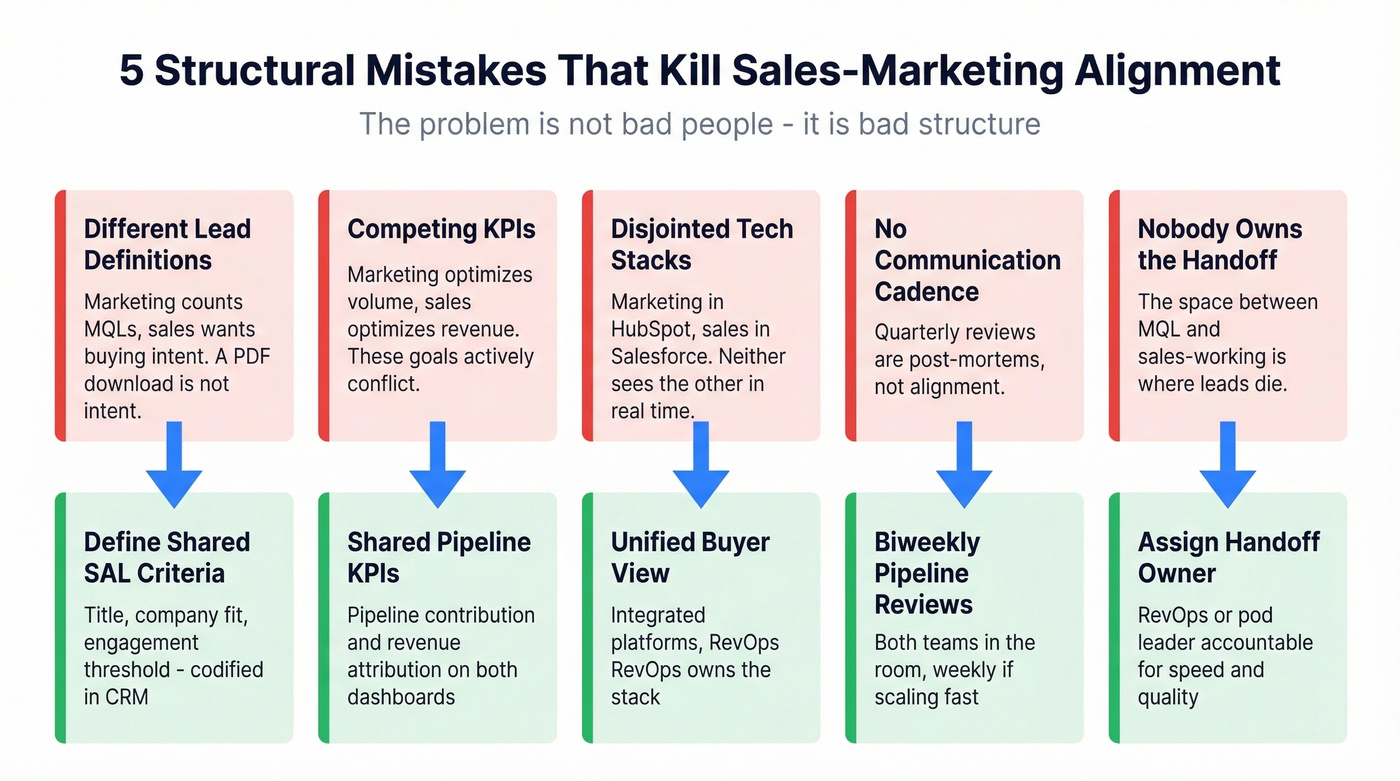
The most common failure pattern is predictable: marketing sends contacts sales won't prioritize, and sales follows up too slowly on the ones that actually matter. That frustration isn't about bad people. It's about bad structure.
Mistake 1: Different definitions of a "lead." Marketing counts MQLs. Sales wants buying intent. A click isn't intent. Downloading a PDF isn't intent. Until both teams agree on what qualifies a contact for sales follow-up, every handoff will feel like a betrayal. → Fix: Define a shared Sales Accepted Lead (SAL) with specific criteria - title, company fit, engagement threshold - and codify it in your CRM.
Mistake 2: Competing KPIs. Marketing optimizes for volume. Sales optimizes for revenue. These goals actively conflict when marketing floods the funnel with low-quality contacts. → Fix: Shared KPIs. Pipeline contribution, revenue attribution, and speed-to-lead should appear on both teams' dashboards.
Mistake 3: Disjointed tech stacks. Marketing lives in HubSpot. Sales lives in Salesforce. Neither sees the other's data in real time. → Fix: Integrated platforms with a unified view of the buyer journey. RevOps owns the stack.
Mistake 4: No regular communication cadence. Quarterly business reviews aren't alignment. They're post-mortems. → Fix: Biweekly pipeline reviews with both teams in the room. Weekly if you're scaling fast.
Mistake 5: No one owns the handoff. The space between "marketing qualified" and "sales working" is a no-man's-land where leads go to die. → Fix: Assign explicit ownership. Someone - RevOps, a shared ops role, or a pod leader - is accountable for handoff speed and quality.
Three Combined Models That Work
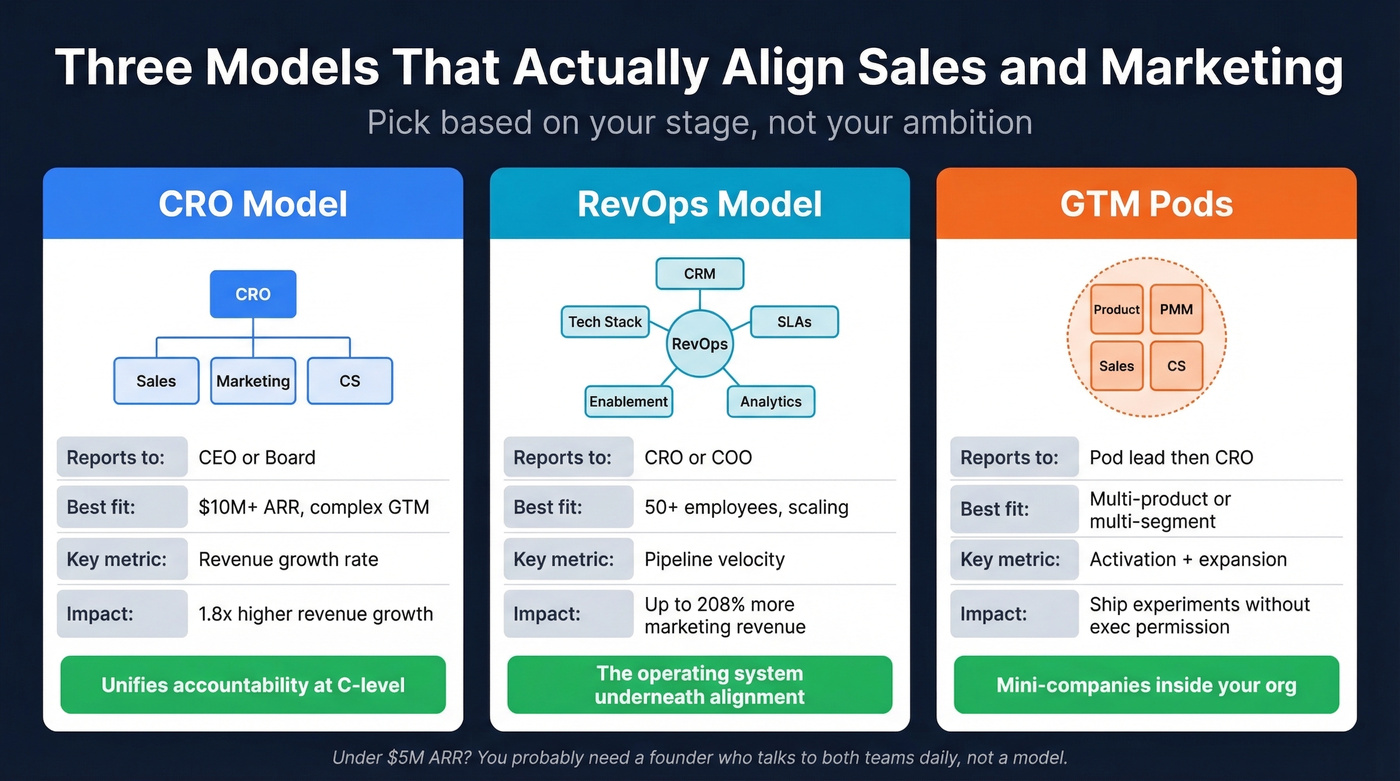
Once you accept that separate sales and marketing orgs with separate leaders and separate KPIs will always drift apart, you need a combined model. Three work right now.
The CRO Model
Fortune 100 companies with a CRO-like role show 1.8x higher revenue growth than peers. As of McKinsey's analysis, over 2,000 open CRO positions existed on LinkedIn, and companies founded between 2016-2022 hired CROs about twice as fast as the prior generation.
Use this if: You're past $10M ARR, have distinct sales and marketing leaders who need a unifying executive, and want shared accountability at the C-level.
Skip this if: You're pre-Series B. A CRO with no infrastructure underneath them is just a fancy VP of Sales title.
Sales, marketing, and often customer success all report to one revenue leader. KPIs unify around pipeline and revenue, not departmental vanity metrics. The CRO creates a single revenue engine spanning lead generation through closing and harmonizes people, data, and measurement across functions.
RevOps: The Operating System
Here's what RevOps is NOT: a rebranded sales ops team, and it's not a Salesforce admin with a fancier title. RevOps is the operating system underneath the CRO - or underneath aligned leaders if you don't have a CRO yet. It owns CRM governance, SLAs, analytics, enablement, and the tech stack.
A standard RevOps team includes a leader plus specialists in systems/ops, analytics, enablement, and GTM operations. RevOps doesn't replace sales ops or marketing ops - it unifies them under one roof so the handoff between marketing-sourced and sales-worked pipeline has a single owner.
Companies report up to 208% more revenue from marketing efforts when operations are truly aligned. RevOps is how you enforce that alignment operationally, through shared definitions, integrated workflows, and SLAs that live in the CRM rather than in a forgotten Google Doc.
Best fit: 50+ employees where the CRM is becoming a mess of conflicting workflows and broken attribution. Fewer than 3 people touching the CRM? You don't need a RevOps leader - you need a RevOps-minded founder.
GTM Pods
Pods are cross-functional outcome teams: product, product marketing, sales, and customer success working together with one objective, one owner, one timeline, and one P&L impact. Think of them as mini-companies inside your org.
The operating model runs on weekly meetings with metrics tied to outcomes: activation %, CAC, time-to-value, expansion revenue, and support tickets tied to features. Each pod owns its number and has the cross-functional muscle to move it.
Use this if: You're running multiple products, segments, or motions and need teams that can ship experiments fast without executive permission for every move.
Skip this if: You have a single product with a single buyer persona. Pods add coordination overhead that isn't worth it for simple GTM motions.
| Model | Reports to | Best fit | Key metric |
|---|---|---|---|
| CRO | CEO/Board | $10M+ ARR, complex GTM | Revenue growth rate |
| RevOps | CRO or COO | 50+ employees, scaling | Pipeline velocity |
| GTM Pods | Pod lead → CRO | Multi-product/segment | Activation + expansion |
Let's be honest: most companies under $5M ARR don't need any of these models yet. They need a founder who talks to sales and marketing every day and a shared spreadsheet with honest pipeline numbers. Premature structure is just as dangerous as no structure - it creates bureaucracy before you've found repeatable revenue.

Broken handoffs kill pipeline because sales doesn't trust marketing's contacts. Prospeo gives both teams one source of truth - 300M+ profiles with 98% verified emails, refreshed every 7 days. When every contact is accurate, the handoff argument disappears.
Stop losing pipeline at the handoff. Start with data both teams trust.
Alignment Maturity Ladder
Not every company is ready for a CRO or pods. Oracle outlines four stages of alignment maturity that serve as a useful self-assessment.
Stage 1 - Strategic alignment. Teams agree on target markets and messaging. Table stakes, and most companies think they're here even when they're not.
Stage 2 - Technology integration. Shared platforms, unified data, real-time visibility. This is where most companies stall - they buy the tools but don't integrate the workflows.
Stage 3 - Operational integration. Shared KPIs, SLAs, joint pipeline reviews, unified lead definitions. This is where RevOps earns its keep.
Stage 4 - Revenue unification. Sales and marketing operate as one revenue team. Aligned organizations at this stage are nearly 3x more likely to exceed new customer acquisition targets.
Real talk: most companies are stuck between stages 1 and 2. They've aligned on strategy in a slide deck but haven't integrated the tech or operationalized the handoffs. If you're honest about where you sit, you can prioritize the right structural changes instead of jumping straight to a CRO hire.
Org Charts by Company Stage
Your organizational structure should match your stage. Here's what works at each level, based on common SaaS org chart patterns and the reality that marketing departments average about 5% of total company headcount.
Startup (1-10 People)
Flat structure. The founder runs sales. One "revenue generalist" handles marketing, SDR work, and early customer success. Roles are loosely defined and cross-functional by necessity.
Hiring priority: someone who can write, run ads, and qualify leads - not a specialist. Weekly pipeline review with the whole team. B2B orgs allocate roughly 8.7% of total budget to marketing, with 36% of that going to lead generation. At this stage, that budget is tiny, so every dollar needs to produce pipeline. A $15-40k/year ZoomInfo contract is hard to justify here - self-serve tools with free tiers and pay-per-lead pricing give you enterprise-grade data quality without the enterprise commitment.
Growth (11-50 People)
First SDRs get hired. You split into a sales lead and a marketing lead, but they should share pipeline definitions and an SLA from day one. Typical startup marketing team size is 2-5 people.
Hiring priority: a demand gen marketer and a second SDR. Shared definitions matter now - what's an MQL vs. a SAL, what's the speed-to-lead SLA, who owns the handoff. Skip this step and you'll spend the next two years relitigating it. This is the stage where your revenue org design either solidifies or fractures, and in our experience, the teams that nail their lead definitions early scale about twice as fast as those that don't.
Mid-Market (51-200 People)
Add a RevOps leader. This is the inflection point where specialization becomes critical - dedicated demand gen, content, sales enablement, and analytics roles. Only 35% of B2B companies do marketing entirely in-house at this stage; 50% outsource at least one content activity, with 84% of outsourcers farming out content creation.
Hiring priority: RevOps leader, then enablement. The RevOps hire pays for itself by cleaning up the CRM, enforcing SLAs, and giving leadership a single source of truth on pipeline.
Enterprise (200+ People)
CRO plus pods or matrix structure. ABM becomes a dedicated function. Regional overlays for field sales. At this scale, McKinsey data shows roughly 19% of headcount in sales and 14% in marketing.
Hiring priority: ABM lead, regional sales directors, and a marketing ops team that can support the matrix. Customer-stage marketing structures or segment-based pods start to make sense here.
Make It Operational
Structure without operating rhythm is just a pretty org chart.
Both teams should own the same KPIs: lead-to-opportunity conversion rate, speed-to-lead (time from engagement to first sales touch), opportunity-to-close rate, retention and expansion revenue, and attribution accuracy. When these numbers appear on both dashboards, finger-pointing dies fast.
SLAs need to live in CRM workflows, not slide decks. Marketing commits to delivering X qualified leads per month meeting agreed criteria. Sales commits to following up within Y hours with Z touches minimum. RevOps audits compliance weekly and flags violations. When SLAs are automated, alignment becomes enforceable rather than aspirational - and the consensus on r/sales is that teams without automated SLAs almost always revert to finger-pointing within a quarter.
Cadence that actually works:
- Weekly pipeline review, 30 min, both teams
- Biweekly alignment check, 60 min, leadership + RevOps
- Quarterly structure review - is the model still working?
The key insight from RevPartners' framework: map the full revenue model, not just the funnel. Track stages from first touch through renewal inside the CRM, with explicit entry/exit criteria and owners per stage.
Measuring Alignment Effectiveness
Influ2's 105-company dataset gives us the best benchmarks for measuring whether your structure is working. They track two metrics: handoff rate (% of marketing-engaged contacts that sales actually follows up on) and audience overlap (whether sales and marketing are targeting the same accounts).
The results split into three buckets:
- 11% of companies: Effective handoff + high audience overlap. This is the goal.
- 36% of companies: Effective handoff but large "cold sales audience" - sales is working accounts that marketing isn't targeting. Fixable with shared account lists.
- 53% of companies: Broken handoff. Fewer than 35% of engaged contacts get sales follow-up.
The threshold for "effective" is 35% or higher handoff rate. If you're below that, your structure isn't working - regardless of what model you've chosen. Here's a quick diagnostic: if more than a third of your reps are missing quota, a third of your pipeline is stalling at the same stage, and a third of your leads never get touched, the problem isn't coaching. It's structure. Measure this monthly.
Tools That Support the Structure
Structure and process only hold up if the underlying data is clean. Here's the minimal stack for a revenue-aligned org.
CRM - the foundation. Salesforce or HubSpot. This is where SLAs, handoffs, and attribution live. RevOps owns it.
Data layer - the fuel. This is where most teams overspend or underinvest. ZoomInfo runs $15-40k/year depending on seats and modules - justified for enterprise orgs, overkill for most growth-stage teams. Apollo offers a free tier with paid plans from ~$49-99/mo per user, solid for SMB prospecting, but you'll still want a dedicated verification layer for deliverability. Prospeo sits in the sweet spot for RevOps and pod-based teams that need verified data without the overhead: 98% email accuracy, a 7-day data refresh cycle, and intent data covering 15,000 topics, with native Salesforce and HubSpot integrations that keep your CRM clean without manual intervention.

Sequencing - the motion. Outreach and Salesloft run $100+/mo per user for enterprise-grade features. Instantly and Lemlist start with free or low-cost tiers for teams scaling outbound on a budget. The sequencer matters less than the data feeding it - bad emails tank deliverability regardless of which platform you're on. If you're evaluating platforms, compare Outreach alternatives and purpose-built sales follow-up software.
Intent - the signal. Bombora and 6sense are enterprise-priced, typically $25k+/year, and best suited for large ABM programs. For growth-stage teams, intent data bundled into your data platform avoids a separate five-figure contract while still telling you which accounts to prioritize.
Competing KPIs vanish when sales and marketing work from the same buyer signals. Prospeo tracks 15,000 intent topics and layers them with technographics, job changes, and headcount growth - so both teams target the same in-market accounts.
Shared signals beat shared Slack channels. Get intent data both teams act on.
FAQ
What is a sales and marketing organizational structure?
It defines how revenue-facing teams are arranged, who reports to whom, and how work flows between marketing and sales. The best structures create shared accountability for pipeline and revenue through models like CRO-led, RevOps-unified, or pod-based approaches - not separate departments with separate scorecards.
Should SDRs report to sales or marketing?
SDRs should report to whoever owns the pipeline number they're feeding - usually sales. In ABM-heavy or inbound-led orgs, SDRs reporting to marketing can work if the handoff SLA to AEs is ironclad and measured weekly. The reporting line matters less than shared metrics.
What is RevOps, and where does it sit?
RevOps unifies sales ops, marketing ops, and CS ops under one team, typically reporting to the CRO or COO. It owns CRM governance, SLA enforcement, analytics, and tech stack integration so handoffs and measurement stay consistent across the full revenue cycle.
What tools help RevOps keep lead data clean?
RevOps teams need a data layer that refreshes frequently and verifies contacts before they enter the CRM. Look for platforms with native Salesforce and HubSpot integrations that enforce deduplication, paired with a sequencing tool - that combination gives you a clean data foundation supporting every handoff.
How do you build sales and marketing teams from scratch?
Start with a revenue generalist who can handle both prospecting and early marketing motions, then layer in specialists as pipeline becomes repeatable. Define shared lead criteria and a simple SLA before you hire your second rep - getting the organizational structure right early prevents costly rewiring later.