

How to Build a RevOps Framework That Doesn't Become Expensive Overhead
Your CEO just told you to "build out RevOps." Maybe it came after a board meeting, maybe after a missed forecast, maybe you're a PLG company layering on a sales-led motion and someone from FP&A got tapped to figure it out. Either way, you're staring at a blank Notion doc wondering where to start.
You're not alone. The "VP of Revenue Operations" title grew 300% in 18 months. Companies are hiring for this function faster than they're figuring out what it actually does. And the gap between "we have RevOps" and "RevOps is driving revenue" is where most teams get stuck - burning budget on dashboards nobody reads and meetings nobody wants.
Here's how to build one that earns its keep.
Three Things That Matter More Than Everything Else
Before you go deep:
- Diagnose your maturity stage before buying tools or hiring. A $30-50k/year platform doesn't fix a Stage 1 problem.
- Fix your data layer first. 75% of B2B pros say data inconsistencies are their biggest tech stack frustration. Everything downstream - forecasting, routing, reporting - breaks when the data's wrong. (If you're evaluating vendors, start with a shortlist of data enrichment services.)
- Hire in this order: RevOps Manager, then Data Analyst, then Systems Admin. Not the other way around.
The rest of this guide unpacks each of those, plus the frameworks, KPIs, and failure modes that separate RevOps-as-overhead from RevOps-as-growth-engine.
What RevOps Actually Is (and Isn't)
A revenue operations framework is the operating model that unifies sales, marketing, and customer success under shared data, shared processes, and shared KPIs. It's not a reorg. It's not a new title for your sales ops lead. It's the shared infrastructure between teams that historically operated in silos.
The anti-pattern is painfully common. The top thread on r/SalesOperations about whether RevOps is "worth it" nails the failure mode: it becomes expensive overhead when it's just a title change layered onto the same silos. More meetings, more dashboards, zero adoption.
This isn't sales ops with a bigger scope. Sales ops serves one team. RevOps unifies three. That distinction sounds semantic until you realize it changes the reporting line, the KPI set, the tech stack ownership, and the hiring profile entirely. If your "RevOps" person still reports to the VP of Sales and only touches pipeline metrics, you've got sales ops with a fancier title. Some teams are also pulling finance into the umbrella to close the gap between booked and recognized revenue - the right move if your billing complexity warrants it.
Four Pillars of Revenue Operations
Every operational model rests on four pillars: people, process, data, and technology. Most articles give each one equal weight. That's a mistake. Data is the bottleneck, and it's not close.
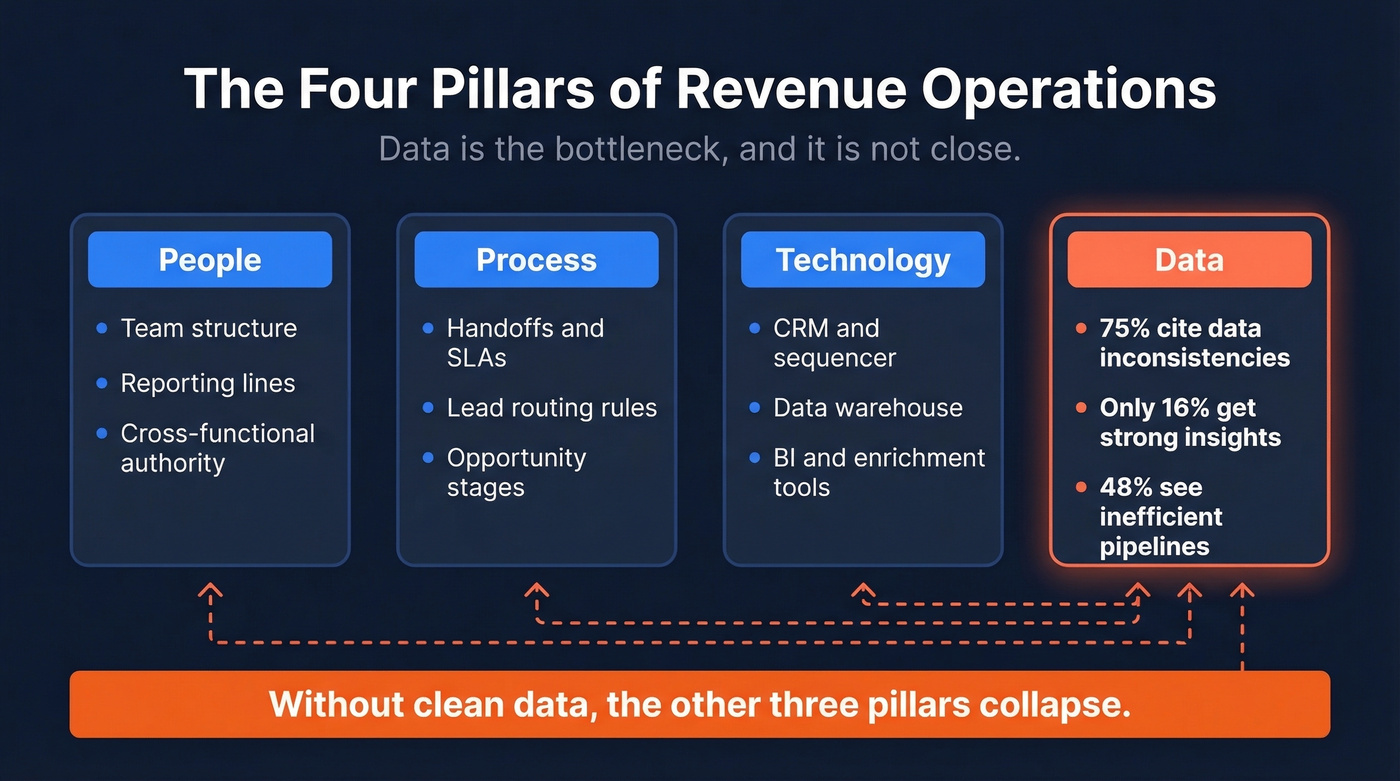
People
Your team structure and reporting lines. Who owns what, who reports to whom, and how decisions get made across sales, marketing, and CS. The short version: you need a centralized owner with cross-functional authority.
Process
The workflows, handoffs, and SLAs that move a prospect from first touch to closed-won to renewal. Lead routing rules, MQL definitions, opportunity stages, CS handoff criteria - these need to be documented, agreed upon, and actually enforced, not living in someone's head. Many overlap with core sales operations work like territory management, quota setting, and deal desk governance, but in a RevOps context they extend across the full customer lifecycle rather than stopping at closed-won. (If you're tightening the funnel, map your lead status and formalize lead scoring before you automate anything.)
Technology
Your CRM, your sequencer, your data warehouse, your enrichment tools, your BI layer. The stack matters, but it matters less than most vendors want you to believe. A well-configured HubSpot beats a poorly implemented Salesforce every time. (If you're auditing CRM fit, see examples of a CRM.)
Data - The Real Bottleneck
Here's where most implementations quietly die.
A survey of 250+ B2B professionals found that 75% cite data inconsistencies as the most frustrating part of their tech stack. Only 16% say their RevOps tech provides strong, data-driven insights that actually lead to revenue-impacting decisions. And 48% say poor data quality results in inefficient pipeline management. We've seen this firsthand - teams with six-figure tech stacks producing garbage forecasts because nobody owns data hygiene.

Solving the data pillar means running your contact database through an enrichment platform that verifies and refreshes continuously, not once a quarter. That's the kind of infrastructure that makes the other three pillars functional. Without it, you're building on sand. (For a deeper breakdown, see lead enrichment.)
Choosing the Right RevOps Model
You'll see Waterfall and Agile referenced elsewhere - they're execution methodologies, not RevOps operating models. Don't conflate the two. Here are four model options that actually matter.
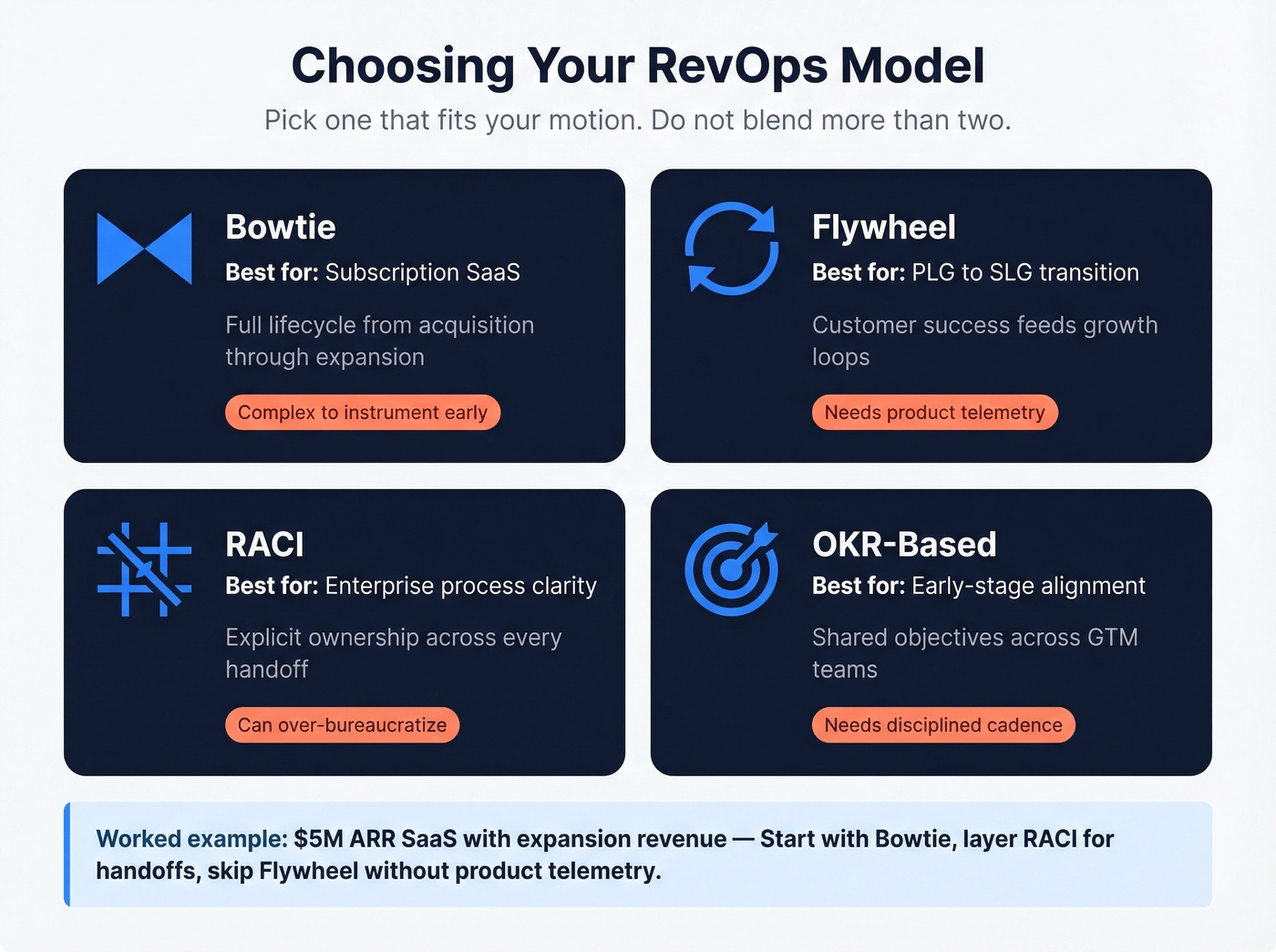
| Model | Best For | Core Idea | Limitation |
|---|---|---|---|
| Bowtie | Subscription SaaS | Full lifecycle from acquisition through expansion | Complex to instrument early |
| Flywheel | PLG to SLG transition | Customer success feeds growth loops | Needs product telemetry |
| RACI | Enterprise process clarity | Explicit ownership across every handoff | Can over-bureaucratize |
| OKR-based | Early-stage alignment | Shared objectives across GTM teams | Needs disciplined cadence |
The Bowtie model works well for B2B SaaS companies with expansion revenue - it forces you to think past the close into onboarding, adoption, and renewal. The Flywheel is the right mental model if you're a PLG company layering on sales-led motions. RACI is less a framework and more a governance layer, useful when you've got a lot of people touching the revenue process and nobody knows who owns what. OKR-based alignment is the lightest-weight option and often the best starting point when you need alignment without heavy process.
A worked example: Say you're a mid-market SaaS company at $5M ARR with expansion revenue. Start with the Bowtie model for lifecycle visibility, layer RACI for handoff governance between sales and CS, and skip the Flywheel unless you have product telemetry feeding your CRM. Don't blend more than two models - complexity kills adoption.
Pick one that fits your motion, implement it, and iterate. The model isn't the hard part. The data and process discipline underneath it is.
RevOps Maturity Model
Before you build anything, you need to know where you are. The most actionable maturity model uses five stages with pillar-level scoring.
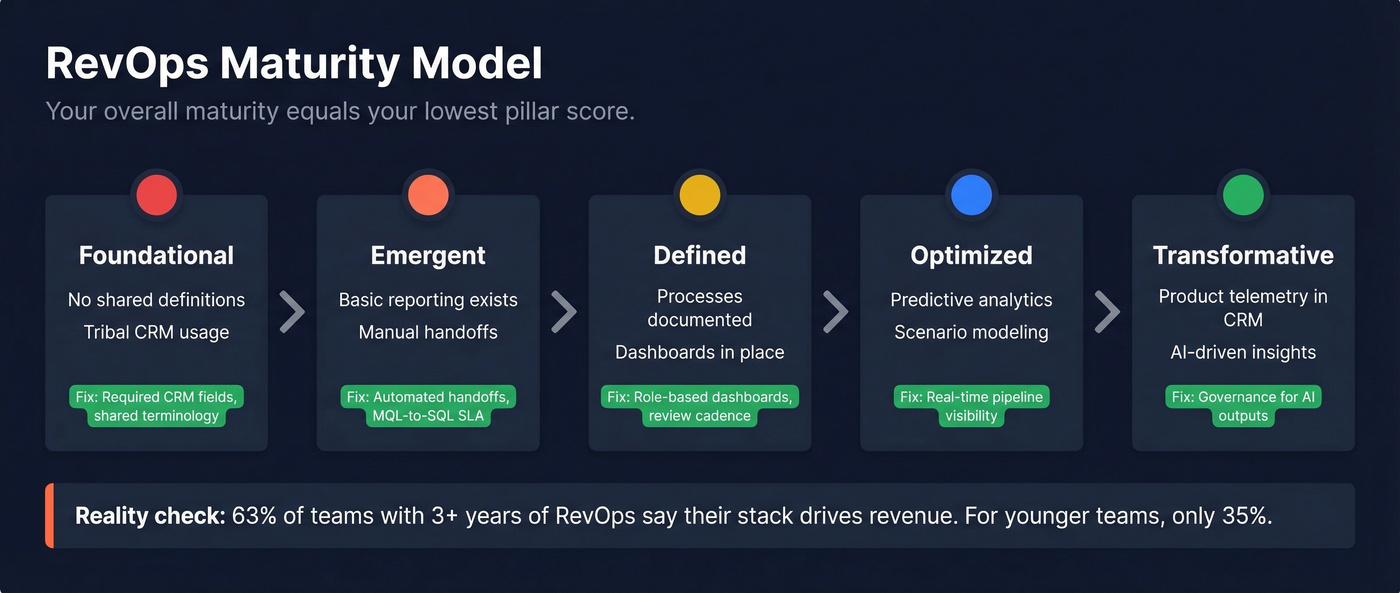
| Stage | Description | Red Flags | Priority Fix |
|---|---|---|---|
| Foundational | No shared definitions, tribal CRM usage | Custom fields everywhere, no MQL def | Required CRM fields, shared terminology |
| Emergent | Basic reporting exists, handoffs are manual | Ad hoc routing, no SLAs | Automated handoffs, MQL-to-SQL SLA |
| Defined | Processes documented, dashboards in place | Unused dashboards | Role-based dashboards, review cadence |
| Optimized | Predictive analytics, scenario modeling | Accurate but slow forecasts | Real-time pipeline visibility, SLA alerts |
| Transformative | Product telemetry in CRM, AI-driven | Over-reliance on models | Governance framework for AI outputs |
Your overall maturity equals your lowest pillar score. Score your pillars on a 0-8 scale, and treat the lowest score as the constraint. If your process is a 6 but your data is a 2, you're a Stage 1 organization pretending to be Stage 3.
This is why Gartner's projection that 75% of the highest-growth companies will deploy a RevOps model by 2026 comes with a caveat - deploying isn't the same as maturing. Among organizations with RevOps teams in place for 3+ years, 63% report their tech stack contributes directly to revenue growth. For younger teams, that number drops to 35%. Maturity takes time. Don't skip stages.

75% of B2B teams say data inconsistencies are their biggest tech stack frustration. Prospeo refreshes 300M+ profiles every 7 days - not every quarter - with 98% email accuracy and a 92% API match rate. That's the data foundation your RevOps framework actually needs.
Stop building your revenue operations on stale, unverified data.
Building Your RevOps Team
Hire in this order: RevOps Manager first, Data Analyst second, Systems Administrator third. The RevOps Manager defines the operating model and owns cross-functional alignment. The Data Analyst builds the reporting layer and maintains data quality. The Systems Admin handles CRM configuration, integrations, and tool administration.
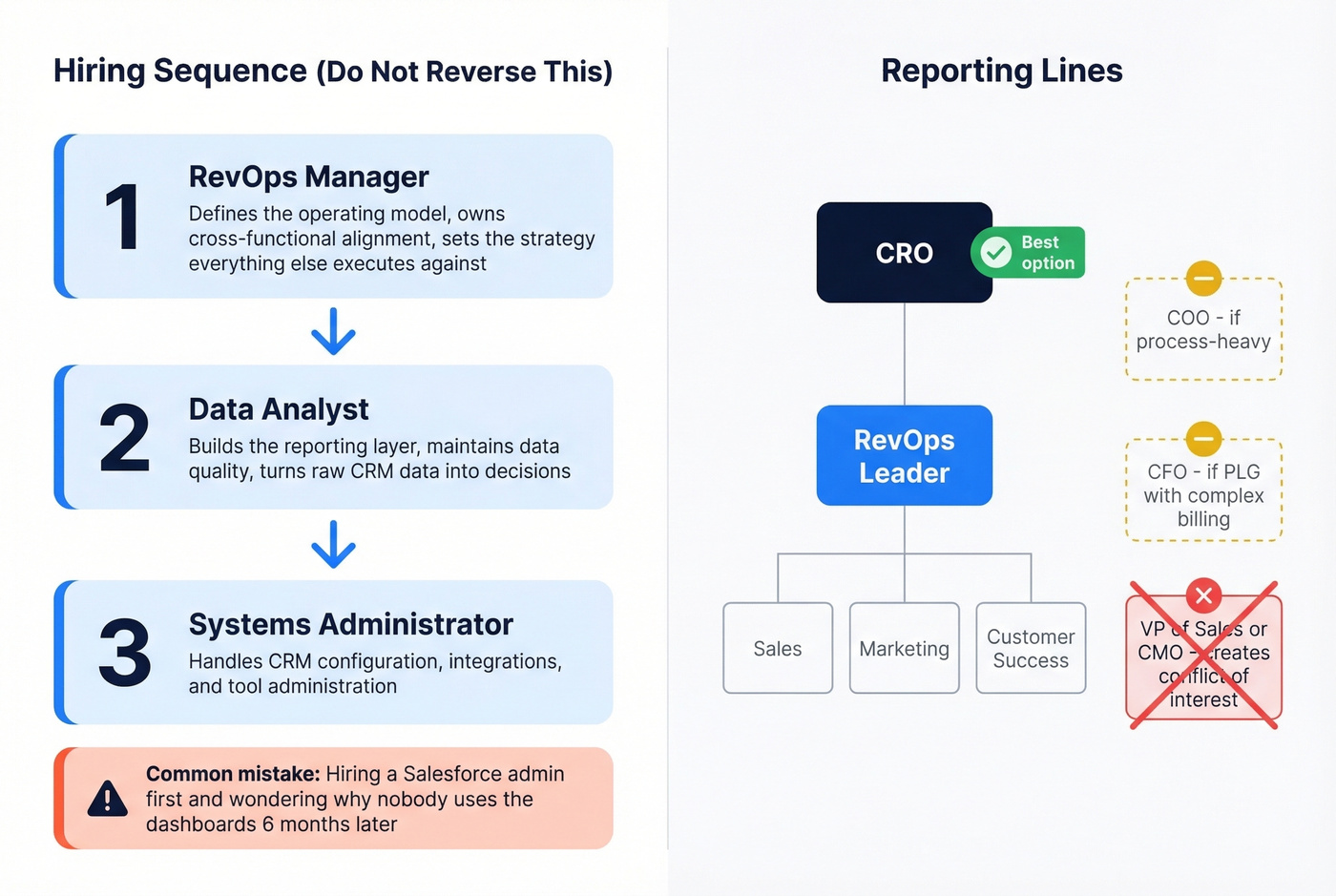
Most companies get this backwards - they hire a Salesforce admin first and wonder why nobody's using the dashboards six months later. The admin needs a strategy to execute against. That strategy comes from the RevOps Manager.
On reporting lines, let's be direct: RevOps should report to the CRO. The alternatives - COO if you're process-heavy, CFO for PLG companies with complex financial models - can work, but reporting to the VP of Sales or CMO creates an inherent conflict of interest. RevOps can't be neutral if it reports to one of the teams it's supposed to align.
KPIs and Dashboards
Two formulas every RevOps team needs on day one:
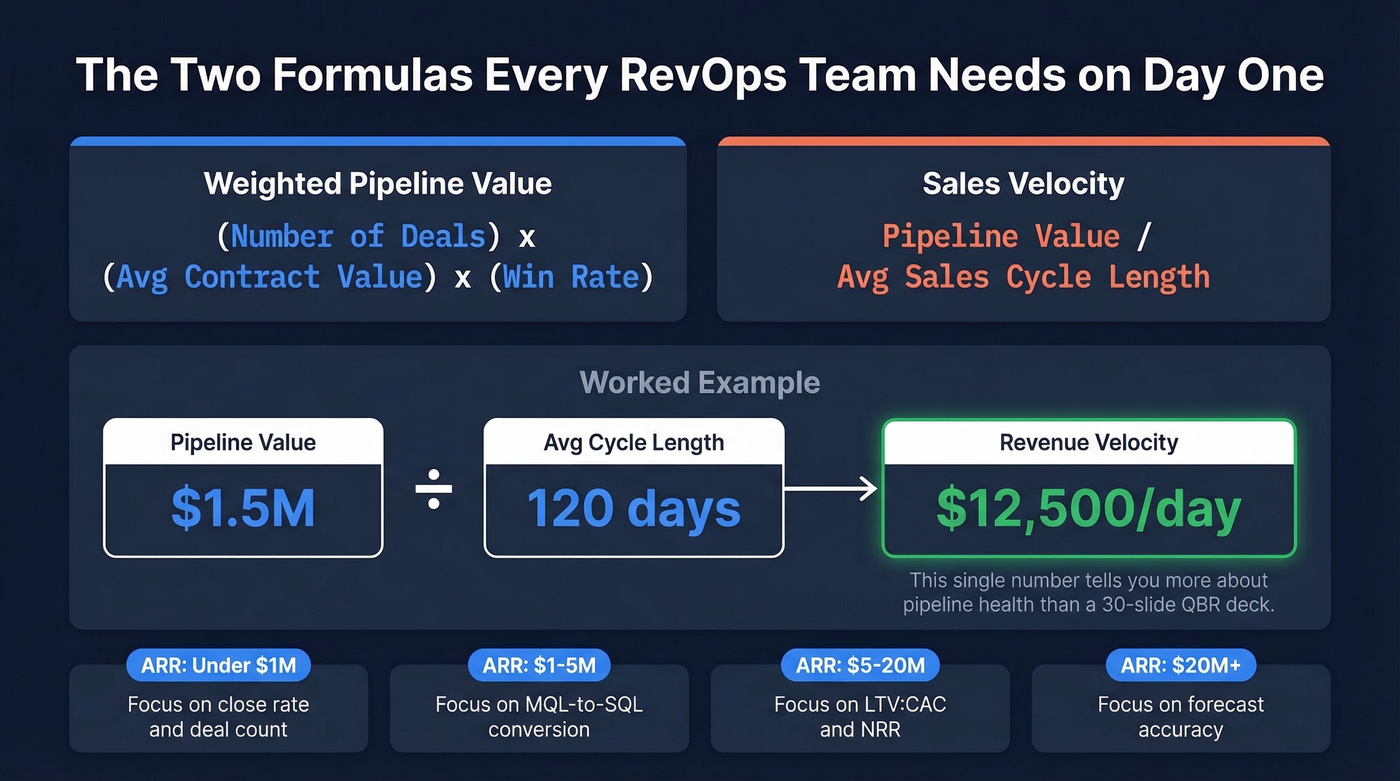
Weighted Pipeline Value = (# deals) x (average contract value) x (win rate)
Sales Velocity = pipeline value / average sales cycle length
A worked example: $1.5M in pipeline divided by a 120-day average cycle = $12.5k/day in revenue velocity. That single number tells you more about pipeline health than a 30-slide QBR deck. (If you want a tighter KPI set, start with pipeline health.)
Which metrics matter depends on your ARR band:
| ARR Band | Priority Metrics | What to Ignore |
|---|---|---|
| Under $1M | Conversations, close rate, deal count | LTV:CAC (not enough data) |
| $1-5M | MQL-to-SQL conversion, pipeline coverage | Revenue per employee |
| $5-20M | LTV:CAC, net revenue retention | Vanity metrics like MQLs alone |
| $20M+ | Forecast accuracy, revenue per employee | Anything without a trend line |
Tie your maturity level to your metric sophistication. Level 1 organizations should focus on clean volume metrics - sessions through closed-won. Level 2 adds conversion rates. Levels 3 and 4 add segmentation and forecasting. Level 5 is real-time visibility with NRR formulas operational in dashboards. Don't try to measure Level 5 metrics with Level 1 data. (For benchmarks and definitions, see sales operations metrics.)
Tech Stack Architecture
The warehouse-centric pattern is the right architecture for most B2B companies: CRM feeds the data warehouse, reverse ETL pushes insights back into the tools your reps actually use via platforms like Census or Hightouch.
Priority order: CRM, then data warehouse, then enrichment and verification, then reverse ETL, then everything else. Most teams buy the "everything else" first and wonder why their data's a mess.
A useful cost benchmark: annual tool cost for a new AE runs roughly 15-20% of OTE. If your AEs have $200k OTE, you're spending $30-40k per head on tools. That number should make you audit your stack quarterly and appoint a single integration owner to prevent tool sprawl. Teams that implement warehouse-centric architectures report roughly 18-day shorter sales cycles and 60% less manual data entry within a few months.
Here's the thing, though - most teams under $10M ARR don't need a data warehouse yet. They need a clean CRM and an enrichment layer that keeps it clean. Prospeo handles this with a 7-day refresh cycle across 300M+ profiles, returning 50+ data points per contact with native Salesforce and HubSpot integrations. When 83% of your leads come back enriched with verified contact data, your downstream processes actually work.
Your CRM enrichment is the infrastructure that makes every RevOps pillar functional. Prospeo returns 50+ data points per contact at 83% match rates, integrates natively with Salesforce and HubSpot, and costs $0.01 per email. No contracts, no sales calls required.
Give your RevOps team the data layer they've been begging for.
The AI Layer
Everyone's talking about AI in RevOps. Almost nobody's doing it well. A survey of 300+ RevOps leaders found that 30% are experimenting without seeing results, 25% are integrating across GTM functions, and only 4% are truly AI-driven organizations. Nearly one in four have no clear owner for AI adoption. (If you're building AI into outbound, compare approaches in generative AI lead generation.)
The pattern that works: going deep beats going wide. One or two focused AI workflows - like AI-assisted forecasting or automated research summaries - deliver stronger time savings than scattering AI across a dozen use cases. CROs and senior revenue leaders target forecast accuracy of 85-90% and 45-60 minutes saved per rep per day. Those are achievable numbers, but only if your underlying data is clean. The biggest blocker to AI ROI? Data quality and budget, tied at 27% each. Start with data hygiene before you buy AI tools.
Why RevOps Frameworks Fail
Three failure patterns show up repeatedly.
Premature restructuring. Reducing headcount or reorganizing before understanding downstream impact. You lose institutional knowledge and break revenue functions that were working, even if they were messy.
Lack of stakeholder buy-in. If sales leadership doesn't believe in the framework, reps will build workarounds within a month. Change management isn't optional - it's the whole game. In our experience, the teams that succeed spend as much time on internal selling as they do on system configuration.
System changes without transition plans. Migrating CRMs or swapping tools without a phased rollout creates confusion, productivity loss, and data integrity issues that take quarters to fix. Skip this if you're thinking about a "big bang" migration - phase it or regret it.
Look, the RepVue Sales Index tells a sobering story: only 43% of cloud software sales pros hit quota in Q4, down from 48% the prior year. RevOps exists to improve those numbers. But it can't if the framework itself becomes the bottleneck. The biggest mistake isn't picking the wrong model. It's starting with tools instead of data. (If you're seeing leakage, diagnose common sales pipeline challenges before you add more tooling.)
FAQ
How long does it take to implement a RevOps framework?
Expect 3-6 months to lay the foundation - shared definitions, clean CRM data, basic reporting, and your first hire. Full optimization takes 12-18 months. Prioritize change management over speed; skipping stages creates technical debt that compounds quarterly.
What's the difference between RevOps and sales ops?
Sales ops serves one team and optimizes one funnel. RevOps unifies sales, marketing, and customer success under shared data, processes, and KPIs. The scope difference changes reporting lines, tech stack ownership, and which metrics matter - it's a structural shift, not a rebrand.
Do small companies need RevOps?
Yes, but scope it to your stage. A sub-$1M startup needs shared definitions, a clean CRM, and agreement on what counts as a qualified lead. One person who owns the operating model and keeps the data honest is enough.
How do I fix bad CRM data before building RevOps?
Run your database through an enrichment platform to verify contacts, fill missing fields, and establish a quality baseline. Then build maintenance processes - required fields, automated deduplication, and a regular enrichment cadence. Bad data compounds; fix it early.
Should I hire a RevOps team or use consultants?
Start with one RevOps Manager in-house and use consultants for the initial audit and framework selection - they bring pattern recognition from multiple implementations. Long-term ownership must be internal. Consultants leave; your operating model shouldn't leave with them.