

Sales Automation Benefits, Quantified - Stats, Pitfalls, and What to Automate First
Most sales automation content reads like a brochure. Big promises, zero math. So here's a number worth remembering: McKinsey's research puts the ceiling at 10% sales uplift and 10-15% cost-of-sales reduction. The floor - where most teams actually sit - is reps spending 71% of their time on non-selling tasks, manually logging calls and copy-pasting data between tabs.
The gap between those realities defines the real upside of automating your sales process. And the real pitfalls. It's not a technology problem. It's a sequencing problem: teams automate the wrong things first, feed dirty data into clean workflows, and wonder why their pipeline still leaks.
The Quick Math
- Time back: Automation saves reps 6+ hours per week on admin - nearly a full selling day recovered.
- Revenue impact: Teams report 27% higher close rates, 20% faster deal cycles, and a 451% increase in sales-ready leads from automated nurturing.
- The layer most teams skip: None of this works if your contact data bounces. The data layer matters more than the sequencing tool.
Key Sales Automation Benefits, Quantified
Real numbers against the five benefits that actually move pipeline.
Faster Lead Response
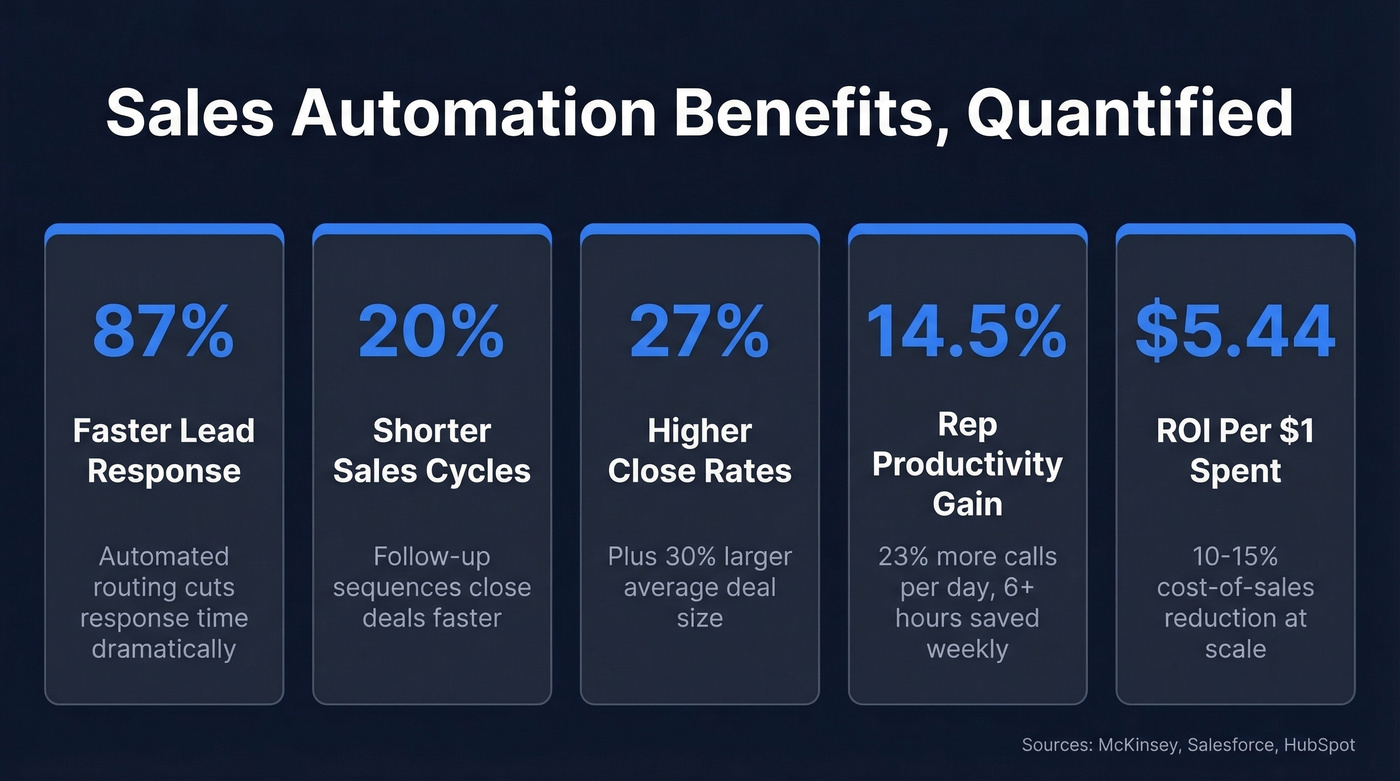
Speed-to-lead is the single highest-leverage automation you can deploy. Conversion likelihood drops if your response comes more than five minutes after a lead arrives, and automating lead distribution improves response time by up to 87%. That's the difference between catching a hand-raiser while they're still on your pricing page and calling them back tomorrow when they've already booked a demo with your competitor.
Shorter Sales Cycles
One B2B company was spending three weeks generating proposals. After automating the process, turnaround dropped to two hours - and the revenue uplift from that single change was 5%. Across the board, automating follow-up sequences closes deals 20% faster. These are the "just checking in" emails reps forget or deprioritize, and they directly accelerate pipeline velocity.
Higher Close Rates and Deal Size
This is where compounding kicks in. Automation is associated with a 27% higher close rate and a 30% increase in average deal size. When reps aren't drowning in admin, they spend more time multi-threading and running deeper discovery - the activities that actually expand deals. The gains compound over quarters as reps reinvest recovered time into higher-value conversations, which is why the ROI curve steepens rather than flattens over time.
Rep Productivity Gains
Picture a rep's typical morning: 15-20 minutes researching a single prospect, another 10 logging the last call, five more hunting for a scheduling link. Enrichment and automation tools collapse that entire ritual into seconds. Teams using sales force automation see a 14.5% productivity increase on average, with reps making 23% more calls per day. Individually modest. Stacked together, it's the difference between hitting 80% of quota and clearing it.
Cost Reduction at Scale
Cost-of-sales reduction hits 10-15% for mature automation deployments. The ROI works out to roughly $5.44 returned per $1 spent. Global sales force automation spend is projected to grow from $8.6B to $19.5B by 2030 - a 10.4% CAGR. Companies aren't spending that because it's trendy.
What AI Changes in 2026
Between 2023 and 2024 alone, AI adoption among sales reps jumped from 24% to 43%. Gartner found that sellers partnering effectively with AI are 3.7x more likely to meet quota, and Bain's early deployment data shows 30%+ win rate improvements. Sales enablement has shifted from "nice to have" to survival infrastructure.
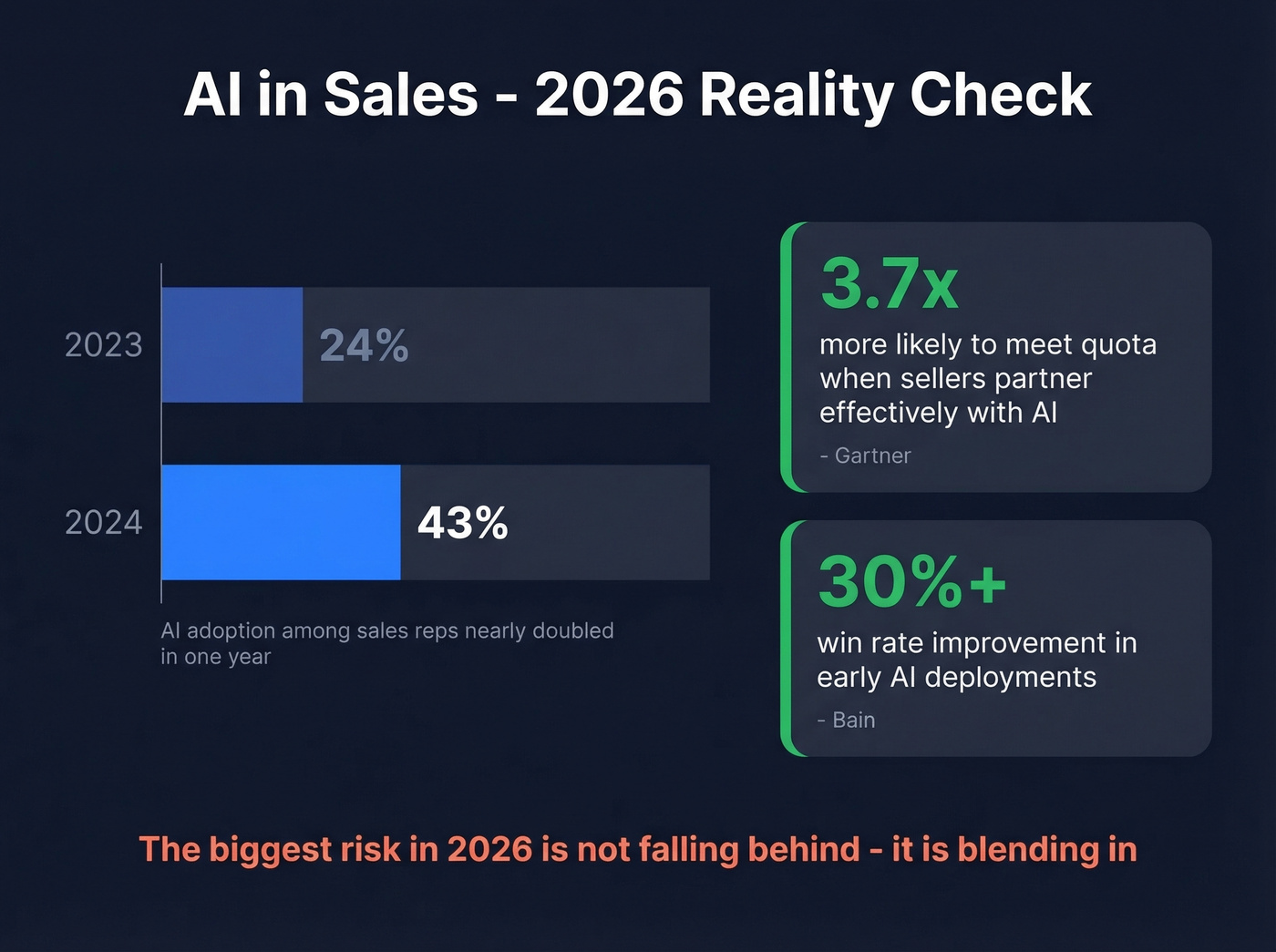
Here's the thing: the biggest risk of automating sales in 2026 isn't falling behind. It's blending in. When every team runs the same AI-powered sequences, differentiation becomes the scarce resource.

Every automation benefit in this article - faster response, shorter cycles, higher close rates - collapses without clean data. Prospeo delivers 98% email accuracy across 143M+ verified addresses on a 7-day refresh cycle, so your sequences actually reach real buyers.
Stop automating bounces. Start automating pipeline.
The Automation Trap
A post on r/sales captured the problem perfectly: SDRs making 200 calls a day, getting zero connections. Sequences blasting thousands of emails with a click. "With ChatGPT, everyone sounds exactly the same."
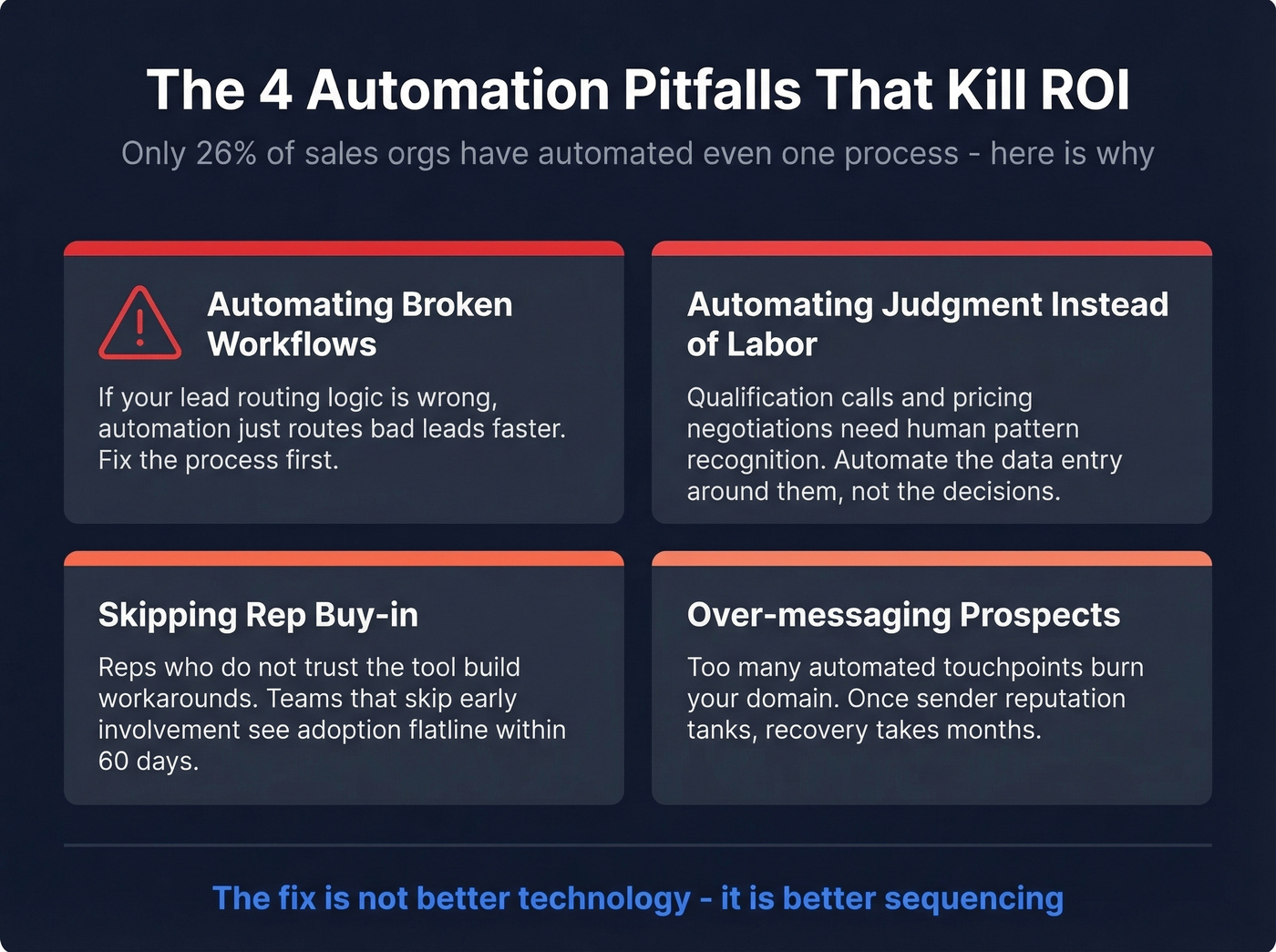
Only 26% of sales organizations have automated even one business process. Not because the technology doesn't exist - because teams keep hitting the same four pitfalls:
- Automating broken workflows. If your lead routing logic is wrong, automating it just routes bad leads faster. Fix the process first.
- Automating judgment instead of labor. Qualification calls and pricing negotiations require human pattern recognition. Automate the data entry around them, not the decisions themselves.
- Skipping buy-in. Reps who don't trust the tool build workarounds. In our experience, teams that don't involve reps early watch adoption flatline within 60 days.
- Over-messaging. Too many automated touchpoints and prospects tune out. It's the fastest way to burn a domain - and once your sender reputation tanks, recovery takes months.
What to Automate First
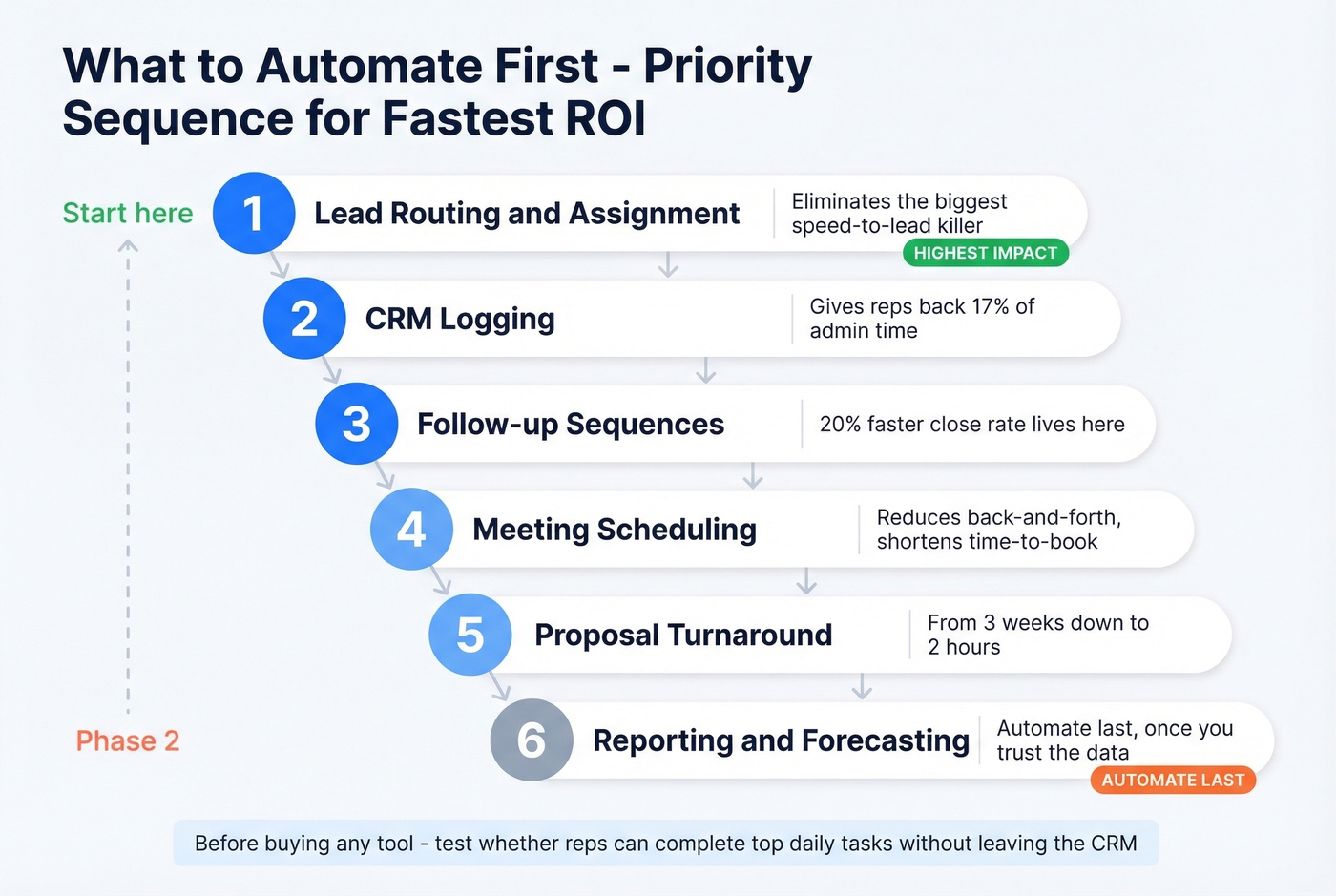
Don't try to automate everything at once. This sequence delivers the fastest ROI, based on Highspot's task mapping:
- Lead routing and assignment - eliminates the biggest speed-to-lead killer
- CRM logging - gives reps back 17% of their admin time
- Follow-up sequences - the 20% faster close rate lives here
- Meeting scheduling - reduces back-and-forth and shortens time-to-book
- Proposal turnaround - the "3 weeks to 2 hours" case
- Reporting and forecasting - automate last, once you trust the data
Before buying any tool, test whether your reps can complete their top daily tasks without leaving the CRM. If the answer's no, you're buying a sync tool, not a workflow tool. A basic stack - CRM, sequencer, and data provider - runs $50-$250/user/month.
Skip the $30k/year all-in-one platform if your average deal size is under $10k. A CRM, a sequencer, and a clean data provider will outperform an enterprise suite that your team uses at 40% capacity.
Clean Data - The Layer That Makes or Breaks Everything
Automation amplifies whatever data you feed it. Bad contact data doesn't just mean bounced emails - it means burned domain reputation, wasted sequence capacity, and reps losing trust in the entire stack. We've seen teams invest $30k in automation tooling and get worse results than before, because every automated touchpoint was hitting invalid addresses.

Let's be honest: most automation failures aren't workflow failures. They're data failures. Snyk's bounce rate dropped from 35-40% to under 5% across 50 AEs after fixing their data layer with Prospeo, and Meritt tripled pipeline from $100K to $300K per week after making the same switch. The difference was 98% email accuracy across 143M+ verified emails and a 7-day data refresh cycle versus the six-week industry average.
For teams building their first automation stack, the data provider is the foundation everything else sits on. Get that wrong and nothing downstream works, no matter how slick your sequencing tool looks in the demo.
Snyk cut bounce rates from 35% to under 5% across 50 AEs. Meritt tripled weekly pipeline to $300K. The difference wasn't a better sequencer - it was feeding their automation stack with verified data at $0.01 per email instead of gambling on stale records.
Your $30K automation stack deserves data that actually works.
FAQ
What sales tasks should I automate first?
Lead routing and CRM logging deliver the fastest ROI - reps save 6+ hours per week on admin alone. Add follow-up sequences next for 20% faster closes. Save proposal turnaround and forecasting for phase two, once your data's clean and your team trusts the workflow.
What are the proven revenue gains from sales automation?
Mature deployments see up to 10% sales uplift and 10-15% cost-of-sales reduction, with 27% higher close rates and roughly $5.44 return per $1 spent. These numbers assume clean contact data and properly sequenced rollouts - skip the data layer and results drop sharply.
How do I prevent automation from hurting outbound results?
Start with verified contact data to prevent the bounced-email spiral that tanks domain reputation. Beyond data quality, limit automated touchpoints per prospect, personalize the first and last touches manually, and audit sequence performance weekly. If your open rates drop below 30% or reply rates crater, that's your signal to pull back and recalibrate before scaling further.