

Sales BDR: Role, Pay, and Career Path in 2026
It's 8:47 AM. You've got 80 calls queued, a sequencer loaded with 200 contacts, and a quota that resets in 22 days. A third of those phone numbers are disconnected. Half the emails will land in spam if your list isn't clean. Welcome to life as a sales BDR - the hardest entry-level job in tech, and the single fastest path to a six-figure sales career.
The BDR role gets romanticized and trashed in equal measure. The truth sits in the middle: it's a grind with a clear payoff, but only if you understand the numbers, the tools, and the timeline.
What Is a BDR in Sales?
A Business Development Representative is the outbound engine of a sales organization. The job is straightforward on paper: find potential buyers, reach out through cold calls, emails, and social touches, qualify their interest, and book meetings for Account Executives to close. In practice, it's a high-volume, high-rejection position that demands resilience, pattern recognition, and sharp time management.
BDRs sit between marketing and the closing team. Marketing generates awareness and inbound leads; AEs run demos and close deals. The BDR bridges the gap by proactively creating pipeline that wouldn't exist otherwise. SDRs and BDRs are responsible for 30-45% of new revenue in SaaS organizations, per The Bridge Group's research cited in Crunchbase's KPI breakdown. In most B2B SaaS orgs, BDRs report to a sales manager or VP of Sales, though some companies align them under a dedicated Sales Development leader.
The core responsibilities haven't changed much in a decade: research accounts, build prospect lists, execute multi-channel outreach cadences, handle objections, and hand off qualified meetings. What's changed is the tooling, the volume expectations, and the increasing role of data quality in determining who hits quota and who doesn't.
Is the BDR Role Worth It?
Here's the honest math:
- Median OTE: $85,000. Base plus variable, with a median base around $60,000. Top performers clear $127,955.
- 12-18 months to AE. High performers get there in 10-12 months. AE OTE at mid-market companies runs $120K-$180K.
- 57.3% of reps hit quota. Nearly half don't. The role rewards preparation and process, not just effort.
- It's the fastest on-ramp to a high-earning sales career. No other entry-level position offers a realistic path to $150K+ within two years.
Burnout is real, and the washout rate is high. But if you go in with the right expectations and the right stack, the math works overwhelmingly in your favor.
BDR vs SDR vs AE
The most common convention - backed by a 6-to-2 source tally among top definitions - is that BDR means outbound and SDR means inbound. BDRs prospect cold accounts. SDRs qualify warm leads from marketing.
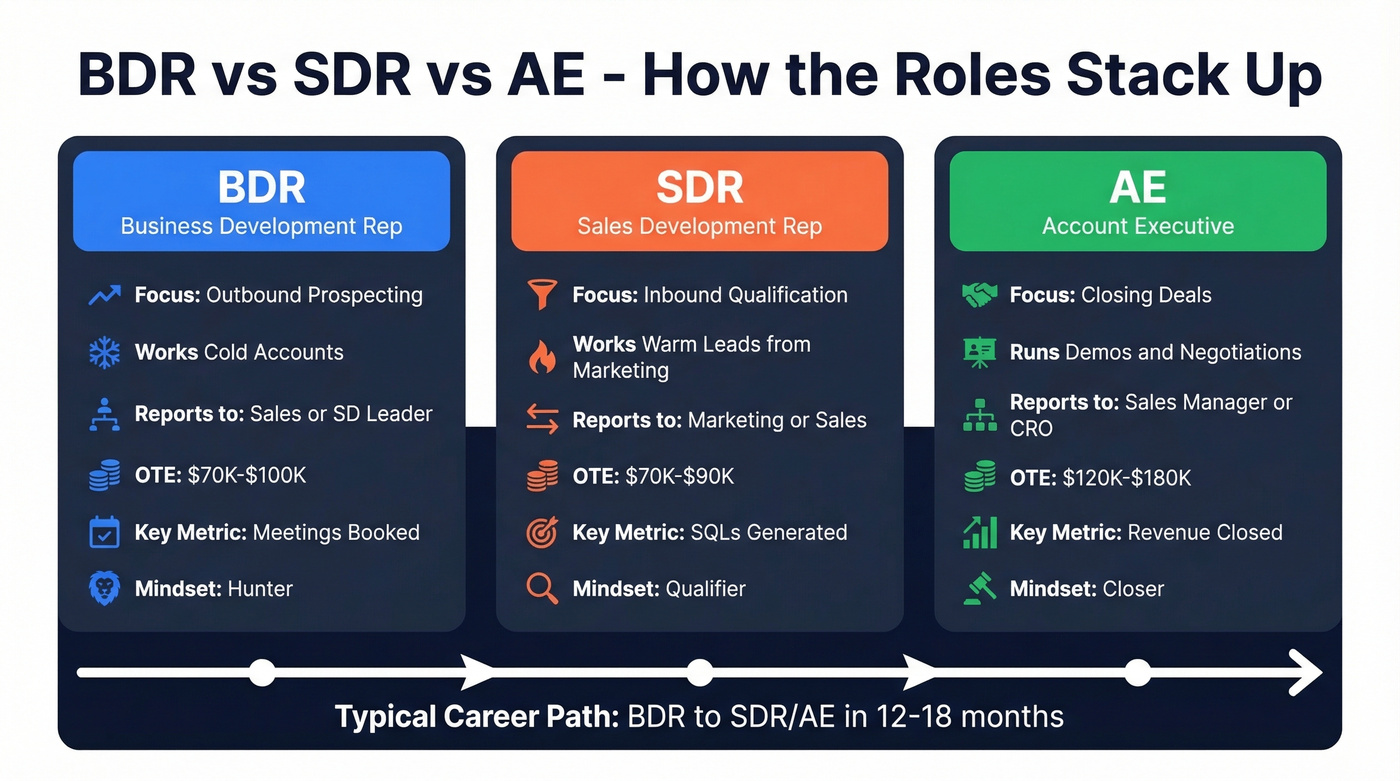
In practice? Companies under $50M ARR often use the titles interchangeably. A "BDR" at one startup does the exact same job as an "SDR" at another. If your company is under $5M ARR, you'll likely wear both hats. Specialization into dedicated BDR and SDR roles typically happens once you have 10+ salespeople.
| Role | Primary Focus | Reports To | Typical Comp | Key Metric |
|---|---|---|---|---|
| BDR | Outbound prospecting | Sales / SD Leader | $70K-$100K OTE | Meetings booked |
| SDR | Inbound qualification | Marketing / Sales | $70K-$90K OTE | SQLs generated |
| AE | Closing deals | Sales Manager / CRO | $120K-$180K OTE | Revenue closed |
58% of SDRs manage 75+ accounts per quarter. Whether your title says BDR or SDR, the workload is substantial. Focus on whether the role is inbound or outbound, not the three letters on your business card.
What a BDR Actually Does All Day
The daily reality depends on your segment. An SMB rep is a volume machine - 60-80 calls and 40-50 emails per day, working through large lists fast. An enterprise BDR plays a different game entirely: 30-40 highly researched calls, 20-30 personalized emails, and multi-threaded outreach into buying committees. Inbound SDRs handle roughly 15 leads per day, about 300 per month, with response speed being the critical variable.
Multi-channel cadences outperform single-channel approaches. An orchestrated multi-channel cadence drives 28% higher conversion rates than single-channel outreach, per Martal's research summarized by SalesFuel. The reps who treat outreach as a system - not a series of disconnected activities - are the ones who consistently build pipeline.
| Time Block | Activity | Volume (SMB) | Volume (Enterprise) |
|---|---|---|---|
| 8:00-9:00 | List building, research | 30-40 prospects | 10-15 accounts |
| 9:00-11:30 | Call block #1 | 35-45 dials | 15-20 dials |
| 11:30-12:30 | Email sequences + social | 25-30 emails | 15-20 emails |
| 1:00-2:00 | Follow-ups + CRM updates | 15-20 tasks | 10-15 tasks |
| 2:00-4:00 | Call block #2 | 25-35 dials | 15-20 dials |
| 4:00-5:00 | Prep for tomorrow + admin | Pipeline review | Account research |
Here's the thing that kills morale fastest: bad data. When 30% of your phone numbers are disconnected and a quarter of your emails bounce, you're not just wasting dials - you're burning your domain reputation and tanking deliverability for every future sequence. We've seen teams where the "low performer" was actually just the rep assigned the worst territory data. That's not a skills problem. That's a data problem.

You read it above: bad data kills BDR morale and quota attainment. When 30% of your dials are disconnected, that's not a rep problem - it's a data problem. Prospeo gives BDRs 125M+ verified mobile numbers with a 30% pickup rate and 98% email accuracy, refreshed every 7 days. At $0.01 per email, even entry-level reps can afford enterprise-grade data.
Stop burning dials on dead numbers. Start every call block with verified contacts.
Salary & Compensation in 2026
Base, OTE, and Pay Mix
The median BDR/SDR base salary in 2026 is $60,000, with a median OTE of $85,000. Top performers - the top 10% - clear $127,955. These are RepVue-sourced benchmarks reported by thousands of sales professionals.
| Experience | OTE Range | Base/Variable Split |
|---|---|---|
| Entry (0-1 yr) | $70K-$75K | 70/30 |
| Mid (1-3 yrs) | $80K-$90K | 65/35 |
| Senior (3-5+ yrs) | $90K-$100K+ | 60/40 |
About 54-57% of BDRs hit quota in any given period. Your realistic expected earnings are closer to 80-90% of OTE unless you're consistently in the top half. Factor that into your financial planning.
Commission Structures
BDR commission structures fall into three buckets:
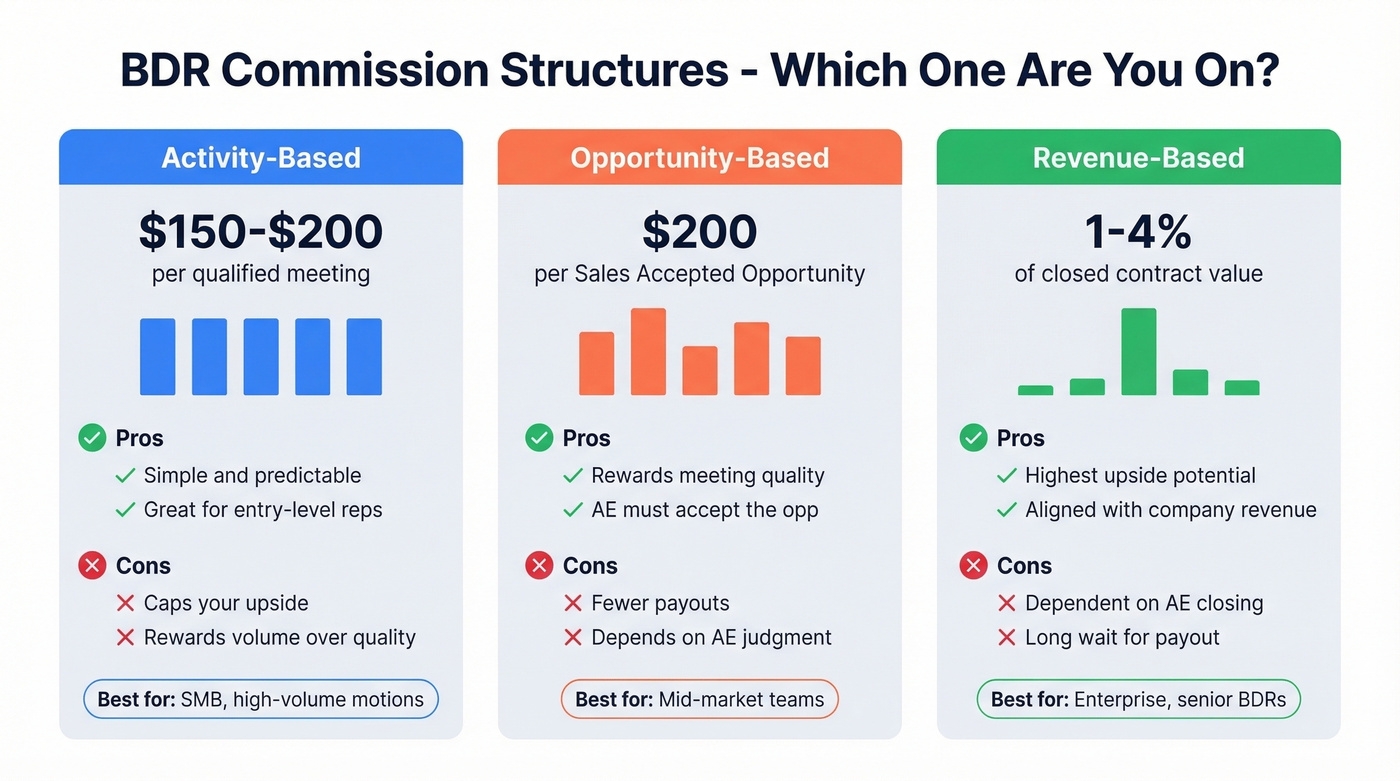
Activity-based: $150-$200 per qualified meeting booked. Common for entry-level reps and high-volume SMB motions. Simple and predictable, but caps your upside.
Opportunity-based: ~$200 per Sales Accepted Opportunity. Rewards quality over quantity - you only get paid when the AE agrees the meeting was real.
Revenue-based: 1-4% of closed contract value. The highest-upside structure, but you're dependent on AEs closing what you source. More common for senior reps working enterprise deals.
Salary by City
Geography still matters, even in a remote-first world.
| City | Annual Pay |
|---|---|
| San Jose, CA | $108,524 |
| San Francisco, CA | $108,091 |
| Washington, DC | $96,070 |
| New York, NY | $78,410 |
| Seattle, WA | $73,598 |
| Boston, MA | $72,000 |
| Austin, TX | $68,500 |
| Denver, CO | $67,200 |
Remote BDR roles average $66,616. A $68K rep in Austin probably has more disposable income than a $108K rep in San Jose - run the cost-of-living math before chasing the highest number on a job listing.
KPIs & Performance Benchmarks
The Numbers That Matter
A high-performing SDR/BDR in SaaS generates roughly $3M in pipeline per year. That's the number your VP of Sales is thinking about when they set your quota.
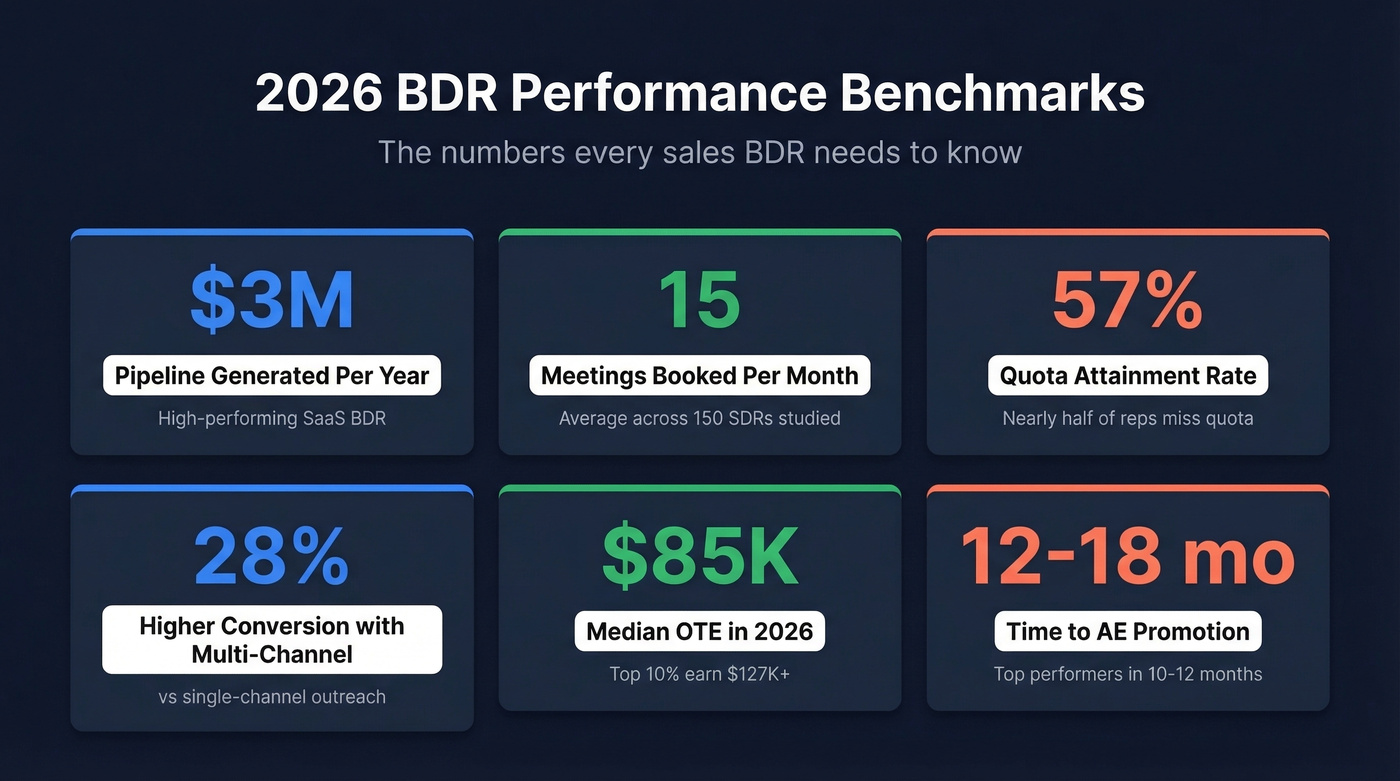
Let's break that down monthly using Operatix's study of 150 SDRs: the average rep books 15 meetings per month. Apply a 20% no-show rate and you're at roughly 12 attended meetings. About 50% convert to a next step - demo, POC, or proposal - giving you 6 qualified opportunities per month. At a $100K ACV, that's $600K in monthly pipeline from a single rep.
For inbound-focused roles, the conversion math differs. Low-intent leads like ebook downloads convert at 5-10% to meetings, while high-intent inbound like demo requests converts at 75-80%. Response speed matters enormously - many teams aim to respond in under 5 minutes.
Pipeline Math
Every business development representative should know how to reverse-engineer their number. Start from the revenue target and work backward:
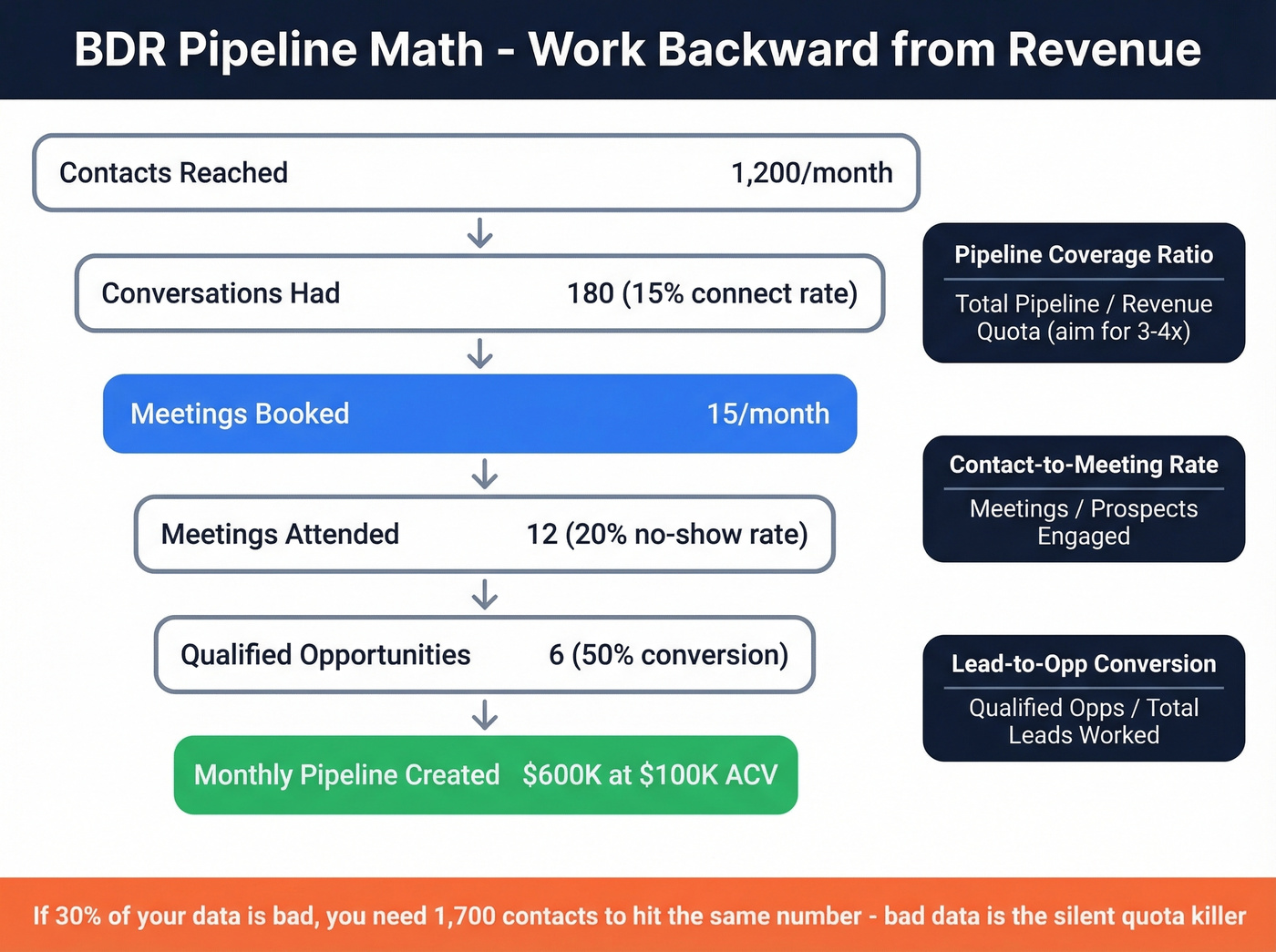
Revenue target → Close rate → Pipeline needed → Opps needed → Meetings needed → Contacts needed
The formulas that matter:
- Pipeline coverage ratio = Total Pipeline Value / Revenue Quota (aim for 3-4x)
- Contact-to-meeting rate = Meetings Booked / Prospects Engaged
- Lead-to-opportunity conversion = Qualified Opps / Total Leads Worked
Bad data is the silent KPI killer. If a third of your emails bounce, your meetings-booked number craters and your domain reputation tanks. Clean data doesn't just improve one metric - it lifts every number in the funnel.
The 2026 BDR Tech Stack
Companies adopting advanced sales technology grow revenue 2-3x faster than those that don't, per McKinsey. For BDRs, the stack isn't optional - it's the difference between 8 meetings a month and 20.
Prospecting & Data Enrichment
| Category | Tool | Starting Price | Best For |
|---|---|---|---|
| Data | Prospeo | Free tier; ~$39/mo | Accuracy + freshness |
| Data | Apollo | $49/mo | Free tier + all-in-one |
| Data | ZoomInfo | ~$15-40K/yr | Enterprise depth |
| Data | Cognism | ~$1-3K/mo | European mobile data |
| Enrichment | Clay | $149/mo | Waterfall enrichment |
| Data | Lusha | ~$36/mo | Quick lookups |
Prospeo is where we'd start any BDR stack build. The database covers 300M+ professional profiles, 143M+ verified emails at 98% accuracy, and 125M+ verified mobile numbers with a 30% pickup rate. Data refreshes every 7 days - the industry average is 6 weeks. At roughly $0.01 per lead versus $1+ at enterprise alternatives, it's the best value in B2B data. Free tier, no contract, self-serve onboarding. One of our customers, Snyk, cut their bounce rate from 35-40% to under 5% and saw AE-sourced pipeline jump 180% after switching.

Apollo is the obvious runner-up for teams that want prospecting and sequencing in one platform. The free tier is generous, and the database is massive. Accuracy runs lower - expect more bounces on email-heavy campaigns - but the all-in-one convenience is hard to beat at $49/mo.
ZoomInfo remains the enterprise standard, but pricing is enterprise-level: typically $30-100K+/year depending on seats and modules. The US database depth is unmatched; the refresh cycle and pricing are the tradeoffs. Here's our honest take: ZoomInfo is still the deepest all-in-one platform. But if your deal sizes sit under $25K, you almost certainly don't need it - and you'll get better email accuracy from a purpose-built data tool at a fraction of the cost.
Cognism is the pick for teams selling into EMEA. Their mobile verification and GDPR compliance are best-in-class for European markets. Expect $1,000-$3,000/mo for small teams.
Skip Clay unless you're running complex multi-source enrichment workflows. It's powerful, but at $149/mo it's overkill for a single BDR who just needs accurate contact data.
Outreach & Sequencing
| Category | Tool | Starting Price | Best For |
|---|---|---|---|
| Sequencing | Instantly | $30/mo | Budget cold email |
| Sequencing | Salesloft | ~$125/user/mo | Enterprise workflows |
| Sequencing | Outreach.io | ~$100/user/mo | Enterprise alternative |
| Sequencing | Smartlead | $39/mo | Multi-inbox rotation |
| Sequencing | Lemlist | ~$39/mo | Personalized outreach |
Instantly is the budget pick for cold email at scale - $30/mo gets you started with solid deliverability features. Salesloft and Outreach.io are the enterprise standards at $100-$125/user/mo, with deeper CRM integrations and manager analytics.
If we were building a stack from scratch on a startup budget, it'd be Prospeo for data, Instantly for sequencing, and HubSpot's free CRM. Total cost under $70/month. Everything else is optional until you're past 5 reps.
Calling & Dialing
Aircall at around $30/user/mo handles basic power dialing. Orum at around $250/user/mo is the parallel dialer enterprise teams use to 3-4x their connect rates. The consensus on r/sales is that parallel dialers pay for themselves if you're making 60+ dials a day, but they're a waste of money for enterprise reps doing 30 highly targeted calls.
Intent & Signals
Bombora and 6sense lead the intent data space. Both run $30-100K+/year, but knowing which accounts are actively researching your category transforms prioritization from guesswork to precision. Prospeo integrates Bombora intent data across 15,000 topics, which means you can layer buying signals directly into your prospecting filters without a separate enterprise contract.
That 8 AM list-building block eats an hour every morning. Prospeo's 30+ search filters - buyer intent, technographics, headcount growth, funding - let BDRs build targeted prospect lists in minutes, not hours. Teams using Prospeo book 35% more meetings than Apollo users and 26% more than ZoomInfo users.
Spend your morning dialing decision-makers, not researching them.
Career Paths After BDR
BDR to AE (The Default Path)
The standard promotion timeline is 12-18 months, with high performers making the jump in 10-12 months. The benchmark most managers use: hit 90%+ quota for two consecutive quarters and you've built a credible promotion case.
Post-pandemic, that timeline stretched roughly 28%, moving from an average of 12 months to 15-16 months. Tighter budgets, smaller AE teams, and fewer open seats all contributed. In our experience, the reps who get promoted fastest aren't just the ones hitting quota - they're the ones who can articulate their pipeline math, run a discovery call without a script, and demonstrate they understand the full sales cycle, not just the top of the funnel.
| Path | Timeline | Target Comp |
|---|---|---|
| Account Executive | 12-18 months | $120K-$180K OTE |
| Customer Success Manager | 15-20 months | $80K-$110K |
| RevOps | 18-24 months | $90K-$130K |
Alternative Paths
Not every BDR should become an AE. Two underrated alternatives:
Customer Success Manager: Ideal for reps who are great at relationship-building but don't love the hunt. The skills transfer directly - you already know how to run cadences, manage accounts, and have business conversations. The comp ceiling is lower, but the burnout rate is dramatically lower too.
RevOps is the most underrated move for analytical reps. If you're the person who builds their own dashboards, optimizes sequences with data, and geeks out over conversion rates, RevOps pays well and has a much longer career ceiling than most people realize. I've watched former BDRs move into RevOps and hit $130K within three years - with zero quota stress.
How AI Is Changing the Role
AI BDR tools exploded in 2025, and the market is still sorting out what's real versus hype. Lead generation, data enrichment, first-draft personalized messaging, CRM updates, and initial qualification scoring are all getting automated. Tools like 11x and Artisan position themselves as "digital workers" that handle top-of-funnel workflows end to end.
| AI BDR Tool | Starting Price | What It Automates |
|---|---|---|
| 11x | ~$5,000/mo | Full outbound sequences |
| Artisan | ~$2,000/mo | Email + qualification |
| MarketBetter | ~$99/user/mo | AI-assisted outreach |
Gupshup reported a 50% increase in SQLs per SDR after deploying their AI agent, with a 1.5x boost in output per rep. But the price tags are steep, and most of these tools only automate cold email effectively. Phone and multi-threaded account strategies? Still very much human territory.
What stays human? Commercial intelligence - understanding competitive dynamics, navigating multi-stakeholder buying committees, and building genuine trust. Multiple sales development leaders predict the role is evolving from "activity machine" to "orchestrator." The BDRs who treat AI as a force multiplier will thrive. The ones who compete with AI on volume will lose.
FAQ
Is a BDR a good first sales job?
Yes - it's the best entry-level path into high-earning sales. Median OTE sits at $85K with a clear 12-18 month promotion track to AE roles paying $120K-$180K. No other entry-level position offers that earnings trajectory with zero prior experience required.
How long does it take to get promoted from BDR to AE?
The average promotion timeline is 12-18 months, with top performers making the jump in 10-12 months. The standard benchmark: hit 90%+ quota for two consecutive quarters. Post-pandemic timelines have stretched to 15-16 months, so plan accordingly.
What's the difference between a BDR and an SDR?
The most common convention is BDR = outbound prospecting, SDR = inbound lead qualification. Many companies - especially those under $50M ARR - use the titles interchangeably. Focus on whether the role is inbound or outbound, not the title itself.
What tools do BDRs need to hit quota?
At minimum: a verified data platform for accurate emails and direct dials, a sequencing tool like Instantly or Salesloft, and a CRM like HubSpot or Salesforce. That three-tool stack covers prospecting, outreach, and pipeline tracking - and can run under $100/month total on startup budgets.