

Sales Call Structure: Scripts, Timers, and Benchmarks That Work
71% of senior managers say their meetings are unproductive. That's not a scheduling problem - it's a structure problem. And sales calls are the meetings where structure matters most, because every wasted minute is pipeline leaking out the bottom.
Teams with greater than 75% methodology adoption see +21% quota attainment and +15% win rates. Structure isn't optional. It's the gap between reps who hit number and reps who "had great conversations" all quarter with nothing to show for it.
The Short Version
The optimal talk-to-listen ratio is 43% talk / 57% listen - but that number shifts by call type. Cold calls demand 50-60% rep talk time. Discovery calls flip it: 30-40% you, the rest is the prospect talking. Structuring a sales call isn't about memorizing scripts. It's about how you allocate the 30 or 45 minutes you've got.
Below: timed agendas for every call type, cold call benchmarks backed by 300M+ analyzed cold calls, stage-specific ratios from additional datasets, copy-paste openers, and the five mistakes that tank close rates.
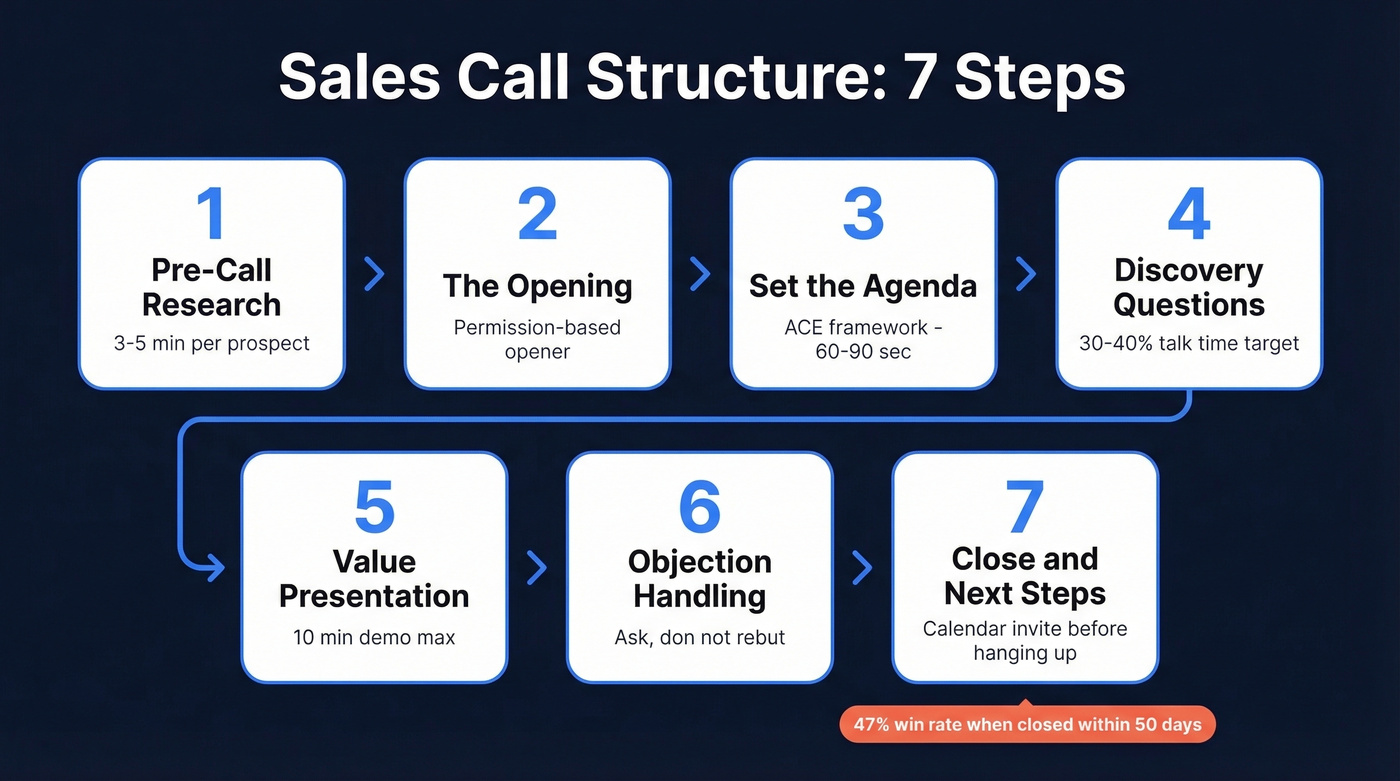
Anatomy of a Sales Call: 7 Steps
Pre-Call Research
Spend 3-5 minutes per prospect, not 15. You're looking for three things: a relevant trigger (funding round, new hire, product launch), the prospect's role and likely pain points, and whether you're actually reaching the right person.
That last point matters more than most reps think. If you're dialing a number that's been disconnected for six months, your beautiful framework is irrelevant. Verify your prospect's email and direct dial before the call block - tools like Prospeo run a 5-step verification process with 98% email accuracy, so you're not burning the first 20 minutes chasing wrong numbers.
Research team size, recent company news, and shared connections. Write down one sentence about why you're calling this person specifically. That sentence becomes your opening hook. (If you want a tighter system, use a simple call prep checklist.)
The Opening
Kill "How are you?" on cold calls. It's transparent filler and everyone knows it. The consensus on r/sales is that permission-based openers work better because they respect the prospect's time and create an early micro-commitment.
Here's the script:
"Hi [Name], this is [You] from [Company]. Have I caught you at a bad time?"
If they say yes, ask for a specific callback time. If they say no (which most do), you've earned 30 seconds of attention. Lead with your reason for calling, not your product pitch. (More options: best cold calling opening lines.)
Set the Agenda
Use the ACE framework:
- Appreciate: Thank them for their time - one sentence, not a monologue.
- Check the time: "I know we've got 30 minutes - does that still work?"
- End goal: State what you'd like to accomplish and invite them to add anything. "My goal is to understand how you're handling [problem] today and see if there's a fit. What would make this a good use of your time?"
This takes 60-90 seconds and prevents the single biggest structural failure: running out of time before you get to next steps.
Discovery Questions
Open-ended questions drive the conversation forward. "Walk me through how your team handles X today" beats "Do you use a tool for X?" every time. You're aiming for 30-40% talk time in this phase, which means you need to resist the urge to jump in with solutions the moment you hear a pain point.
A few worth keeping in your back pocket: "What happens when that process breaks down?" and "How are you measuring success with your current approach?" and "If you could change one thing about how this works today, what would it be?" These naturally surface BANT criteria without sounding like a qualification checklist, and they give the prospect room to tell you exactly where their current solution falls short. (If you need a bigger bank, steal from these discovery questions.)
Value Presentation
Tailor your pitch to the specific pain points they just told you about. If they mentioned three problems, pick the one with the most urgency and lead with that. Don't demo everything - demo the thing that matters.
The 10-minute demo rule is real. If your product walkthrough runs longer than 10 minutes in a 30-minute call, you've lost the room. Pause every 2-3 minutes and ask, "Does this match what you're dealing with?"
Objection Handling
Here's the thing: the biggest mistake isn't having a bad response to objections. It's responding before the prospect finishes talking. Let them get the full objection out, then respond with a question - not a rebuttal.
When someone says "We already have a solution for this," try:
"That makes sense - what's working well with it, and what would you change if you could?"
You're not attacking their current vendor. You're opening a door for them to articulate gaps they've been living with. That's where your value proposition lives. (More scripts: objection handling examples.)
Close and Next Steps
Book the follow-up before the last five minutes of the call. If you're down to ~5 minutes, schedule the next step before the prospect has to leave unexpectedly. "I'll send you an email" isn't a next step - it's a prayer.
Opportunities closed within 50 days hit a 47% win rate. Beyond that, it drops to 20% or lower. End every call with a calendar invite sent before you hang up, plus a recap email within the hour. Template: "Thanks for the time today. Here's what we covered: [1-2 bullets]. Next step: [meeting date/time]. Calendar invite attached." (For follow-through, use a simple call follow up cadence.)
Talk-to-Listen Ratios by Call Type
The 43/57 benchmark is the headline number everyone cites, but it's an average across all call types. The real insight is that the ratio should shift dramatically depending on what kind of call you're on.
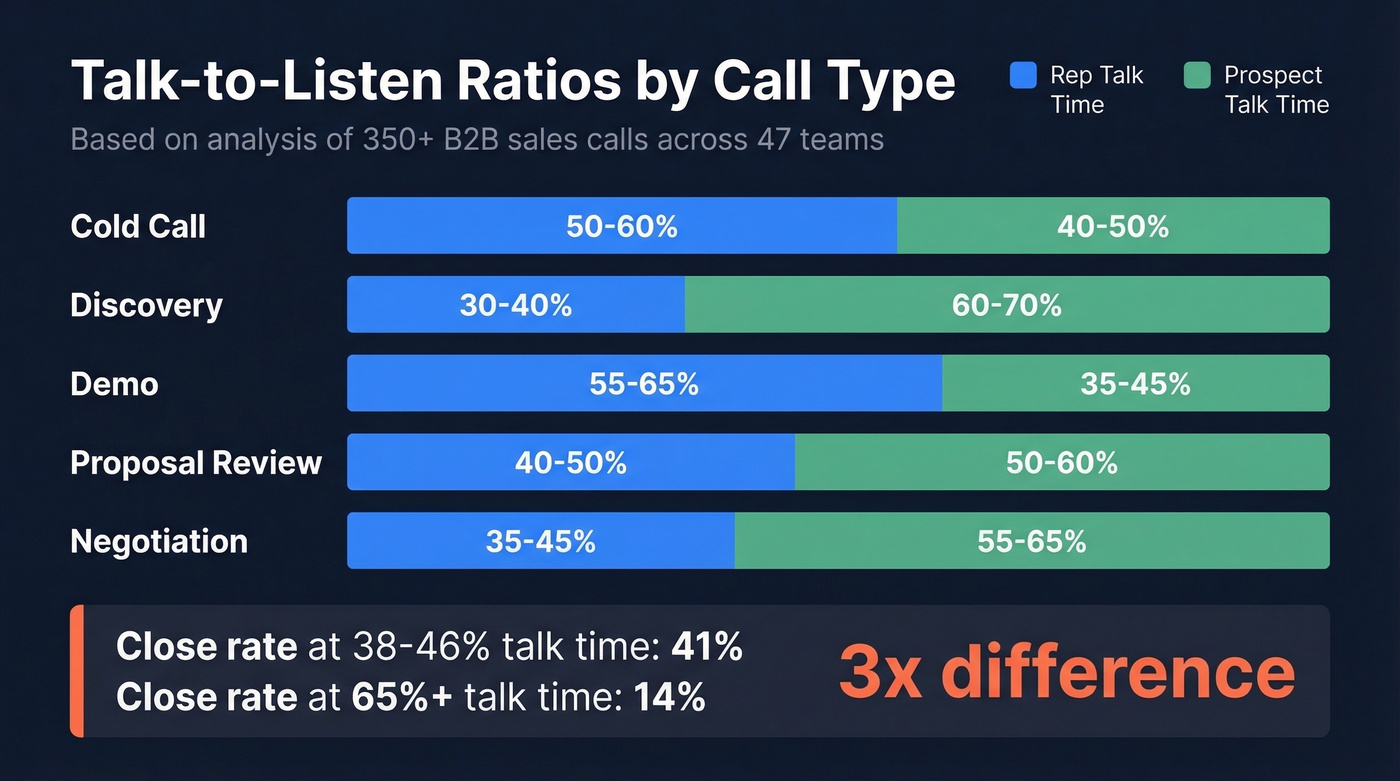
Nimitai's analysis of 350+ B2B sales calls across 47 teams breaks it down by stage:
| Call Type | Rep Talk Time | Prospect Talk Time |
|---|---|---|
| Cold Call | 50-60% | 40-50% |
| Discovery | 30-40% | 60-70% |
| Demo | 55-65% | 35-45% |
| Proposal Review | 40-50% | 50-60% |
| Negotiation | 35-45% | 55-65% |
The close-rate data is where this gets interesting. Reps who talk 38-46% of the time close at 41%. Reps who talk 65%+ close at 14%. Nearly 3x difference.
In our experience, consistency matters more than hitting the exact number. High performers maintain similar ratios whether they win or lose. Low performers swing about 10 points - 54% talk time in won deals vs 64% in lost deals. The inconsistency is the tell, not the absolute number.
Structuring Calls by Type
Cold Call Structure
You've got under five minutes. The goal isn't to sell - it's to earn a meeting.
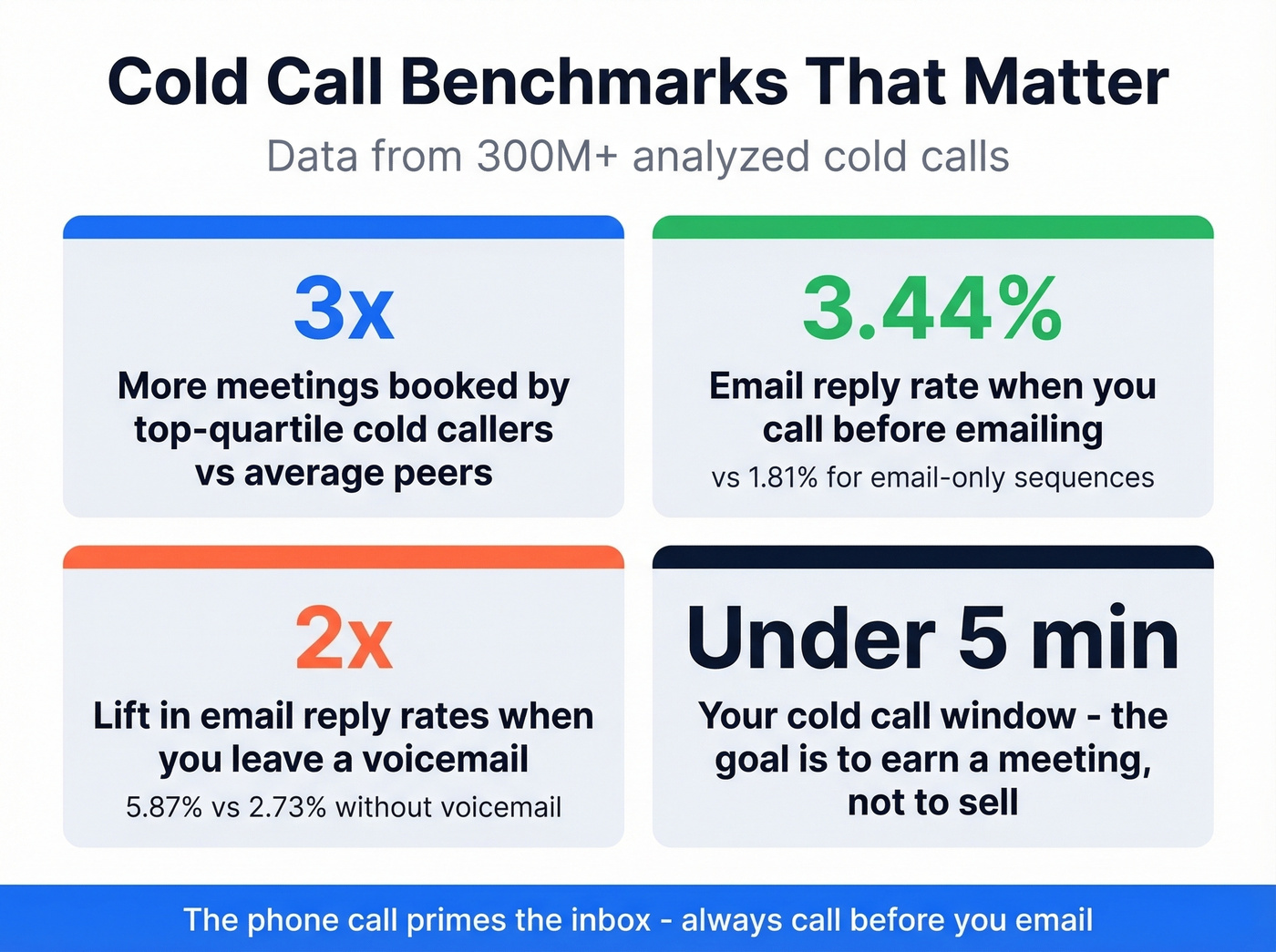
Based on analysis of 300M+ cold calls, top-quartile cold callers book more than 3x the meetings of average peers. And here's a stat most reps don't know: cold calling before emailing boosts reply rates to 3.44% vs 1.81% for email-only sequences. The phone call primes the inbox.
Open with the permission-based script from above. Then deliver your reason in one sentence using social proof: "We're helping [similar companies] solve [specific problem]." Stop talking. Let silence do the work. (If you want more copy-paste options, see these sales phone call scripts.)
The 3-minute framing opener is another strong option:
"In just three minutes, I can share how we help businesses like yours with [problem]. Does that sound fair?"
Even if you don't connect, leave a voicemail. Voicemails increase email reply rates from 2.73% to 5.87% - more than a 2x lift on your follow-up sequence for 30 seconds of effort. (Use these sales voicemail scripts to keep it tight.)
Skip the 45-minute discovery process if your average deal size is under $10K. A tight cold call that books a 15-minute demo will outperform a bloated multi-stage sequence every time. Match your call framework to the deal size.
Discovery Call Structure
Discovery calls run 15-30 minutes and follow the ACE opening framework. Your talk time target is 30-40%, which means you need to prepare 8-10 open-ended questions and let the prospect do most of the talking.
The agenda-setting line that works best: "My goal today is to understand your challenges and see if we're a good fit. Anything specific you'd like to cover?" Then go deep on their answers rather than racing through your question list. Two great follow-up questions beat ten surface-level ones.
Demo Call Structure
Demos flip the ratio back toward you - 55-65% talk time is the target. But that doesn't mean monologuing for 25 minutes. Build in a pause-for-questions rhythm every 3-4 minutes.
Start with a 2-minute recap of what you learned in discovery, then transition with: "Based on what you told me about [pain point], let me show you exactly how this works." Keep the demo focused on their top 2-3 priorities, not your full feature set. We've found that recording every demo call and reviewing one per week with your manager is the fastest coaching loop most teams never implement.

Pre-call research is step one of every sales call framework - but it falls apart when you're dialing disconnected numbers. Prospeo's 5-step verification delivers 98% email accuracy and 125M+ verified mobile numbers with a 30% pickup rate, so your structured call actually reaches a real person.
Stop perfecting your script for a number that doesn't ring.
Minute-by-Minute Agendas
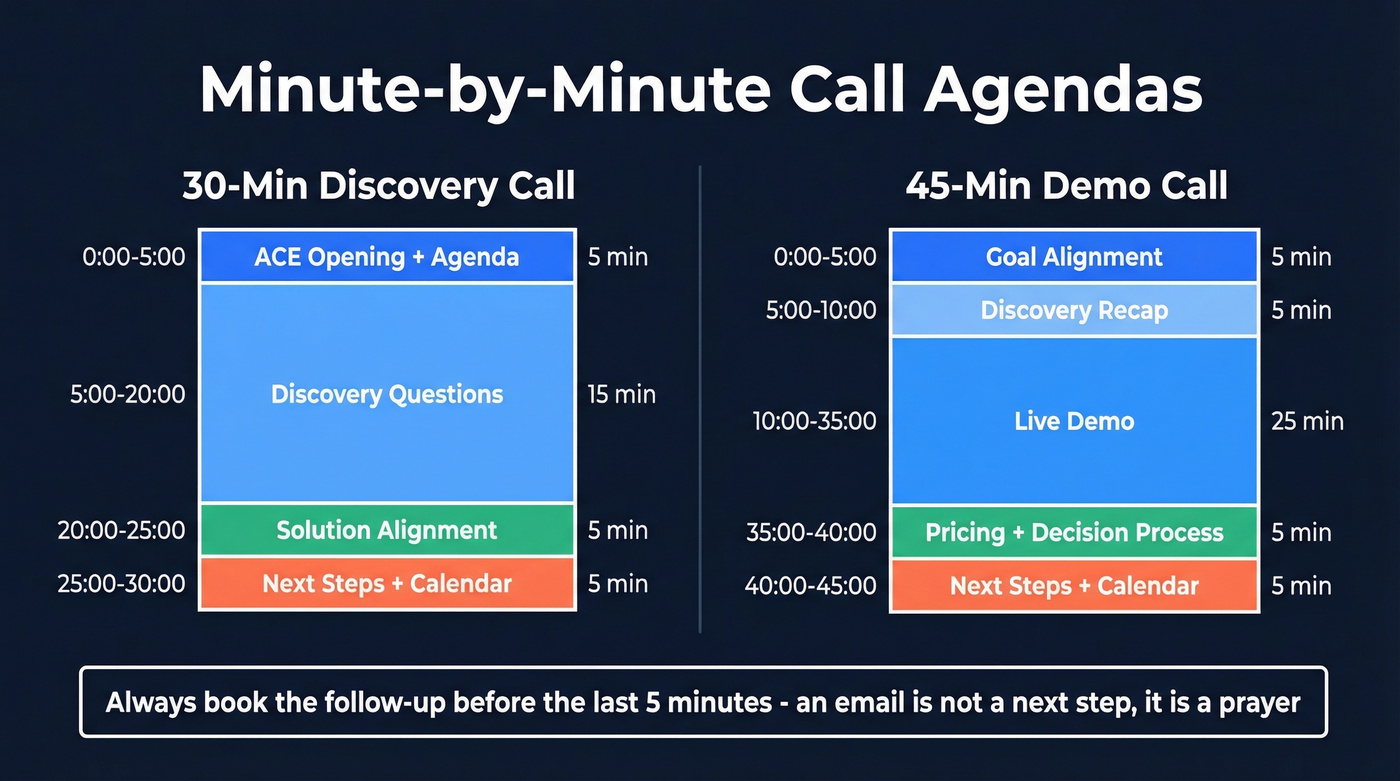
30-Minute Discovery Call
| Time Block | Activity | Duration |
|---|---|---|
| 0:00-5:00 | ACE opening + agenda | 5 min |
| 5:00-20:00 | Discovery questions | 10-15 min |
| 20:00-25:00 | Solution alignment | 5 min |
| 25:00-30:00 | Next steps + calendar | 5 min |
45-Minute Demo Call
| Time Block | Activity | Duration |
|---|---|---|
| 0:00-5:00 | Goal alignment | 5 min |
| 5:00-10:00 | Discovery recap | 5 min |
| 10:00-35:00 | Live demo | 25 min |
| 35:00-40:00 | Pricing + decision process | 5 min |
| 40:00-45:00 | Next steps + calendar | 5 min |
One framing sentence keeps both sides aligned throughout: "My goal today is to understand your challenges and see if we're a good fit - does that work, or is there something specific you'd like to cover?" Borrowed from Mixmax's agenda templates, this prevents the most common structural failure: mismatched expectations about what the call is for.
Pick a Methodology
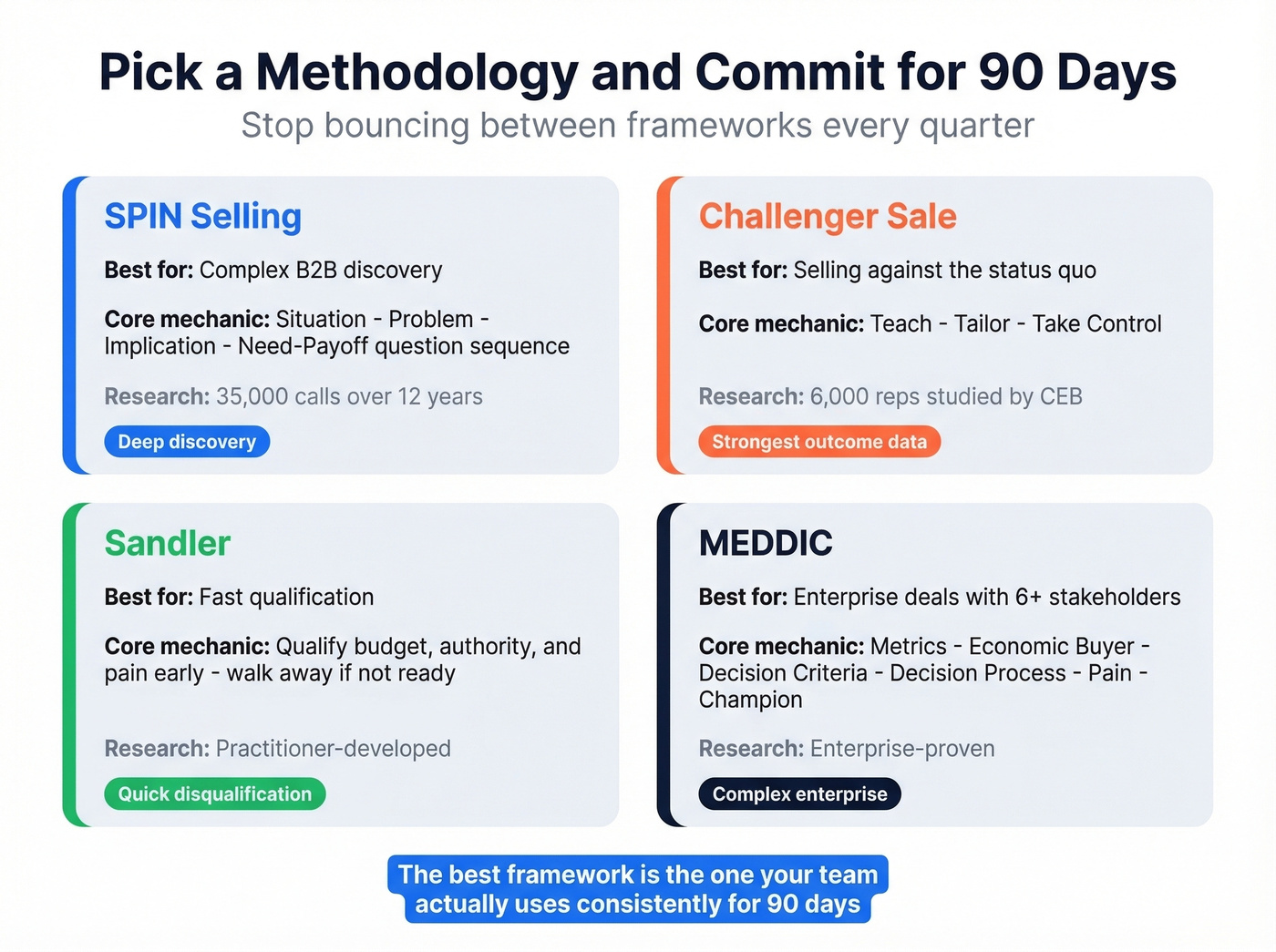
You don't need to invent a framework. You need to pick one and actually commit to it for 90 days. We've seen teams bounce between SPIN and Challenger every quarter and wonder why nothing sticks.
| Framework | Best For | Core Mechanic | Research Base |
|---|---|---|---|
| SPIN | Complex B2B discovery | S-P-I-N question sequence | 35,000 calls, 12 years |
| Challenger | Selling against status quo | Teach, Tailor, Take Control | 6,000 reps (CEB) |
| Sandler | Fast qualification | Qualify budget/authority/pain early; walk away if unready | Practitioner-developed |
| MEDDIC | Enterprise, 6+ stakeholders | Metrics, Economic Buyer, Decision Criteria/Process, Pain, Champion | Enterprise-proven |
Challenger has the strongest outcome data - Xerox reported +17% sales and $65M in contract value after implementation. SPIN has the deepest research foundation: Neil Rackham's team analyzed 35,000 calls across 20+ countries over 12 years. Sandler is the pragmatist's choice when you need to disqualify fast and stop wasting cycles on deals that won't close.
The methodology matters less than the adoption rate. Korn Ferry's research shows the +21% quota lift only kicks in when adoption exceeds 75%. Half-hearted rollouts produce zero results. One more data point: sellers who frequently use AI coaching tools generate 77% more revenue, based on analysis of 7.1M opportunities. Whatever methodology you pick, layer in AI call review to accelerate adoption. (If you want a tighter framework for the call itself, use a sales call checklist.)
Five Mistakes That Kill Deals
1. Talking too much. If you're above 46% talk time on discovery calls, you're leaving close rate on the table. Track it - most conversation intelligence tools show the number in real time.
2. Failing to qualify. Every unqualified deal that makes it to demo stage costs your team 2-4 hours. Use BANT or MEDDIC checkpoints in discovery as a mental framework for what you need to learn before advancing the deal.
3. Ignoring competitive timing. Competitive mentions in sales calls are up 57% since 2022. Reps who bring up the competitive landscape early in enterprise deals see a +32% win rate lift. Waiting for the prospect to ask about alternatives puts you on defense.
4. Staying single-threaded. I've watched reps lose six-figure deals because they only had one contact at the account. Analysis of 1.8M opportunities shows multi-threading boosts win rates by 130% for deals over $50K. Closed-won deals have roughly 2x as many buyer contacts as closed-lost. If you're single-threaded above five figures, you're gambling.
5. No next steps. "I'll follow up next week" isn't a next step. Book the meeting before you hang up. Send the calendar invite while you're still on the call.
The Data Problem Nobody Talks About
You can nail every step of this framework and still lose if your data is bad. A perfect cold call structure doesn't help when the number you're dialing was disconnected three months ago. A flawless discovery agenda is worthless if you spent 20 minutes tracking down the right contact because your database had stale information.
Let's be honest - bad data is the biggest drag on call productivity, and most advice on structuring calls completely ignores it. Prospeo solves this upstream with 300M+ professional profiles, 143M+ verified emails, and 125M+ verified mobile numbers that deliver a 30% pickup rate. Data refreshes every 7 days versus the 6-week industry average. The free tier gives you 75 emails per month to test, plus 100 Chrome extension credits - no contracts, no sales calls required. (If you're evaluating options, compare data enrichment tools.)

Top-quartile cold callers book 3x more meetings - but only when they reach the right prospect. Prospeo gives you verified emails and direct dials refreshed every 7 days, not stale data from six weeks ago. At $0.01 per email, bad data is no longer an excuse for a broken pipeline.
Book more meetings by calling numbers that actually connect.
FAQ
How long should a sales call be?
Discovery calls run 15-30 minutes; demos typically need 45 minutes to cover the walkthrough, pricing, and next steps. Cold calls should stay under 5 minutes - the goal is securing a meeting, not closing on the spot.
What's the ideal talk-to-listen ratio?
The benchmark is 43% talk / 57% listen, but it varies by call type: cold calls 50-60% you, discovery 30-40%, demos 55-65%. Reps who stay in the 38-46% range close at 41% versus 14% for those above 65%.
Which methodology fits my team best?
SPIN suits complex B2B discovery with long sales cycles. Challenger wins when you're displacing an incumbent. Sandler is ideal for fast disqualification on shorter deal cycles. MEDDIC handles enterprise deals with 6+ stakeholders. Pick one and commit for 90 days - the +21% quota lift only appears above 75% adoption.
How do I handle "I don't have time" on a cold call?
Acknowledge it immediately and propose a specific callback: "Totally understand - would Thursday at 2 PM work for a 3-minute conversation?" Don't argue, don't pitch harder. The goal is getting on their calendar, not winning the conversation right now.
How do I make sure I'm calling verified contacts?
Use a data platform with frequent refresh cycles and multi-step verification before your call block starts. Building a verified list is the highest-ROI prep step most reps skip - and it takes less time than you'd think with the right tooling.