

Call Follow Up: Scripts, Timing & Cadence for 2026
It's Tuesday morning. You've got 15 follow-up calls on your list, a cold coffee, and zero idea what to say after "Hey, just checking in." So you stall. You send an email instead. You tell yourself you'll call tomorrow. Tomorrow becomes next week. The deal dies quietly.
Here's the uncomfortable math: only 2% of sales close on the first call. Every call follow up after that first conversation needs a system - scripts, timing, and a cadence that doesn't rely on willpower. Nobody taught you what to say on call #2. That's not a you problem. It's a scripts problem.
The Quick Version
- Follow up within 24 hours. Call between 10-11 AM or 3-4 PM. Tuesday and Thursday are strong days to start.
- Use the scripts below - don't improvise. Every scenario from voicemail to post-demo has a talk track. Copy, personalize, dial.
- Build a 14-day multi-channel cadence. 80% of sales need 5-12 touches. One follow-up isn't a system - it's a coin flip.
Why Follow-Up Calls Matter
44% of salespeople make exactly one follow-up attempt before giving up. Meanwhile, 80% of sales require 5-12 follow-up touches to close. That gap is where pipeline goes to die.
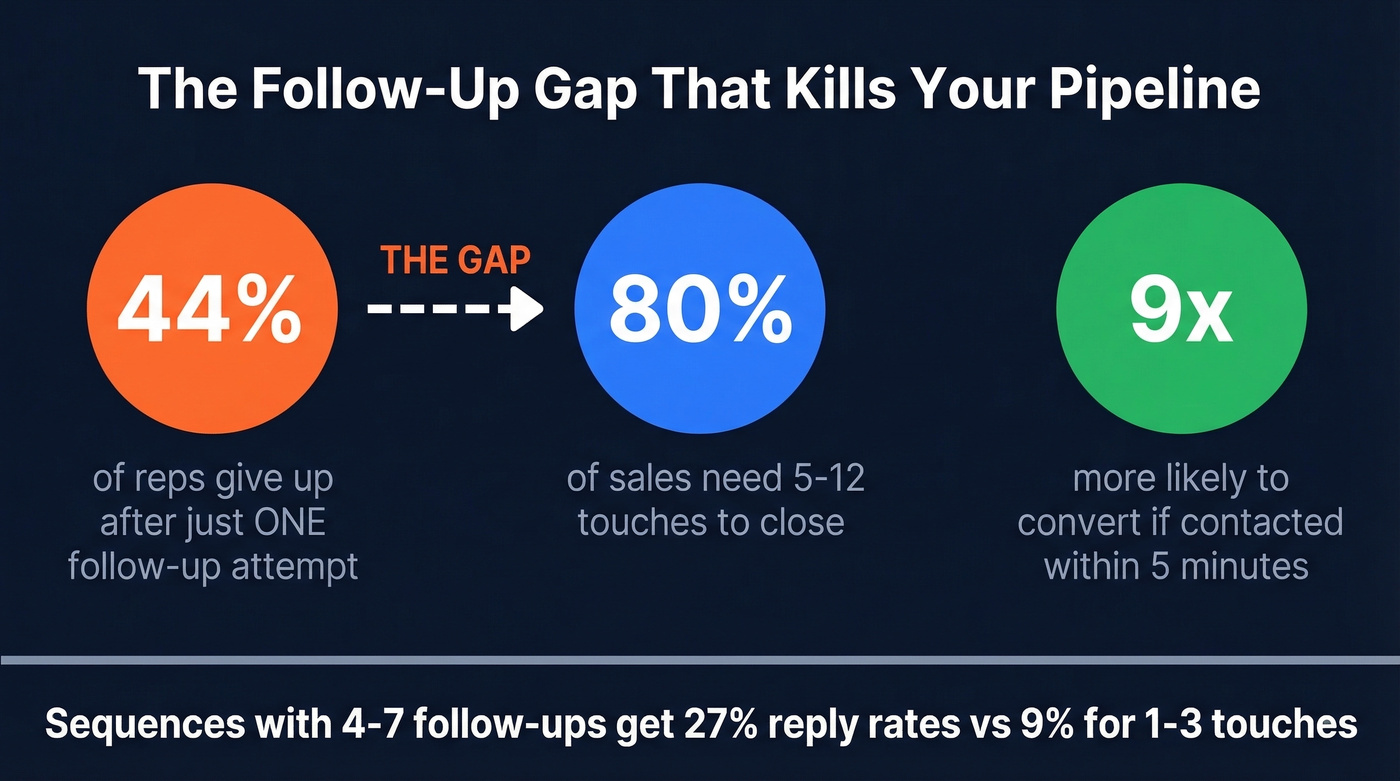
The speed advantage is just as stark. Leads contacted within five minutes of an inquiry are 9x more likely to convert. Within one hour, response rates jump 450%. And 35-50% of sales go to the vendor that responds first - not the one with the best product or the lowest price. Only 3% of companies qualify as "customer-obsessed", and they report 41% faster revenue growth. A consistent follow-up process is where that obsession starts.
The phone is what separates reps who close from reps who "nurture" forever. Sequences with 4-7 follow-ups generate 27% reply rates versus 9% for sequences with just 1-3 touches. If you're only emailing, you're not following up. You're hoping.
When to Make Your Follow-Up Call
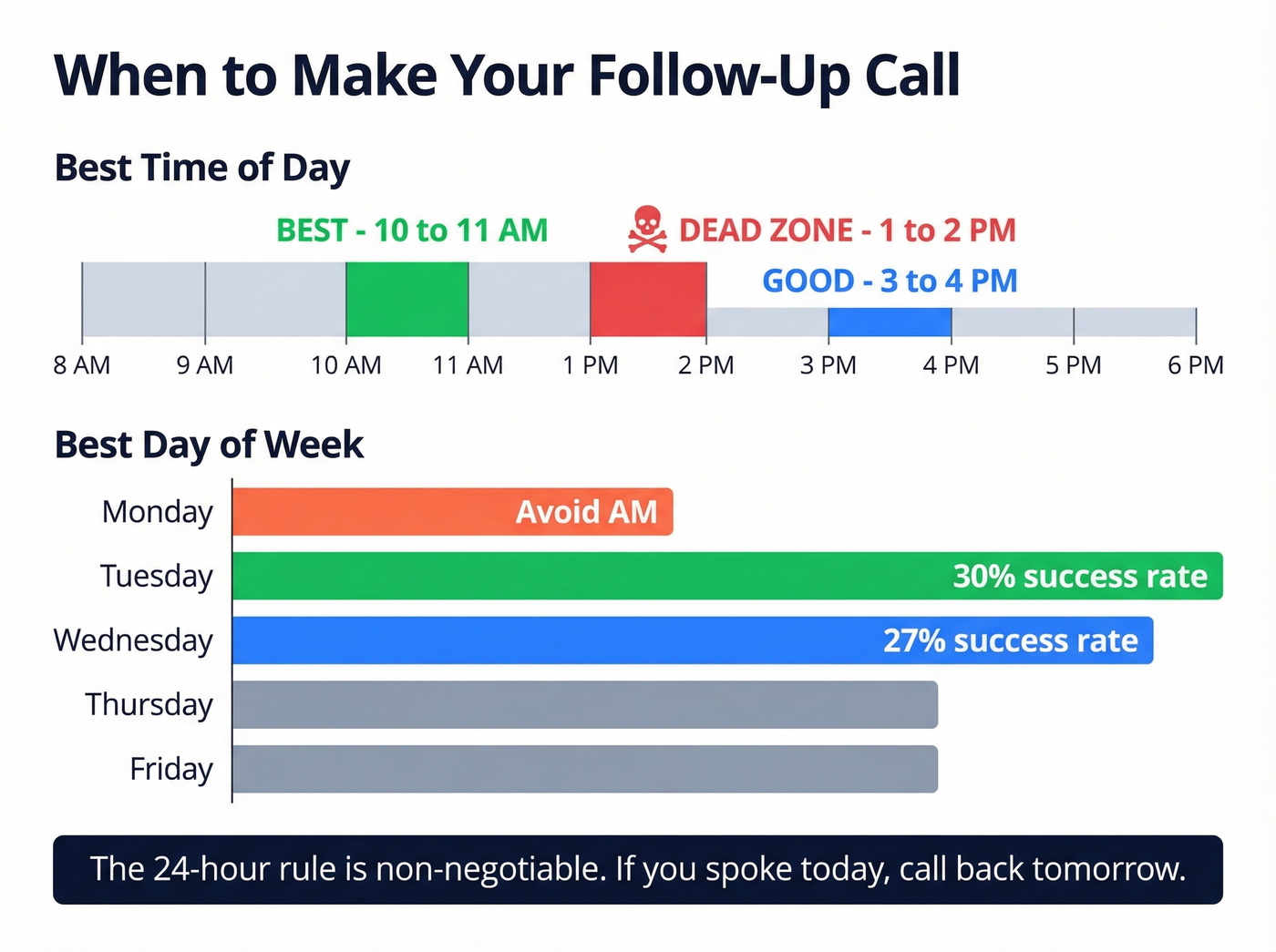
Timing isn't everything, but it's the easiest variable to control. The data points to two golden windows and one dead zone.
| Factor | Best | Second Best | Worst |
|---|---|---|---|
| Time of day | 10-11 AM | 3-4 PM | 1-2 PM |
| Day of week | Tuesday (30%) | Wednesday (27%) | Monday AM |
| Speed after inquiry | Within 5 min (9x) | Within 1 hour (450%) | Next day |
The 10-11 AM window consistently wins, and if you miss it, 3-4 PM is your second shot. Tuesday pulls a 30% success rate in widely cited benchmarks, with Wednesday close behind at 27%. Avoid the 1-2 PM dead zone. People are either at lunch or recovering from it.
The 24-hour rule is non-negotiable for first follow-ups. If you spoke with someone today, your next phone call happens tomorrow. Not "later this week." The conversation is still fresh, and you haven't yet been replaced by the competitor who called this afternoon.
One tip that consistently works: ask during your first call when they prefer to be reached. "What's the best time and channel for a follow-up?" removes all the guesswork and gives you permission to call back.
If you want deeper benchmarks on timing, see our breakdown of the best time to call prospects.
Scripts for Every Scenario
Stop calling it a "follow-up." Every touch should deliver something - a new insight, a relevant case study, a specific answer. Keep your calls to 2-5 minutes; that's the sweet spot for 49% of successful calls. Take notes during every conversation - specific details, objections raised, personal context. Your script is only as good as the notes feeding it. (If you need more templates, start with these sales call scripts.)
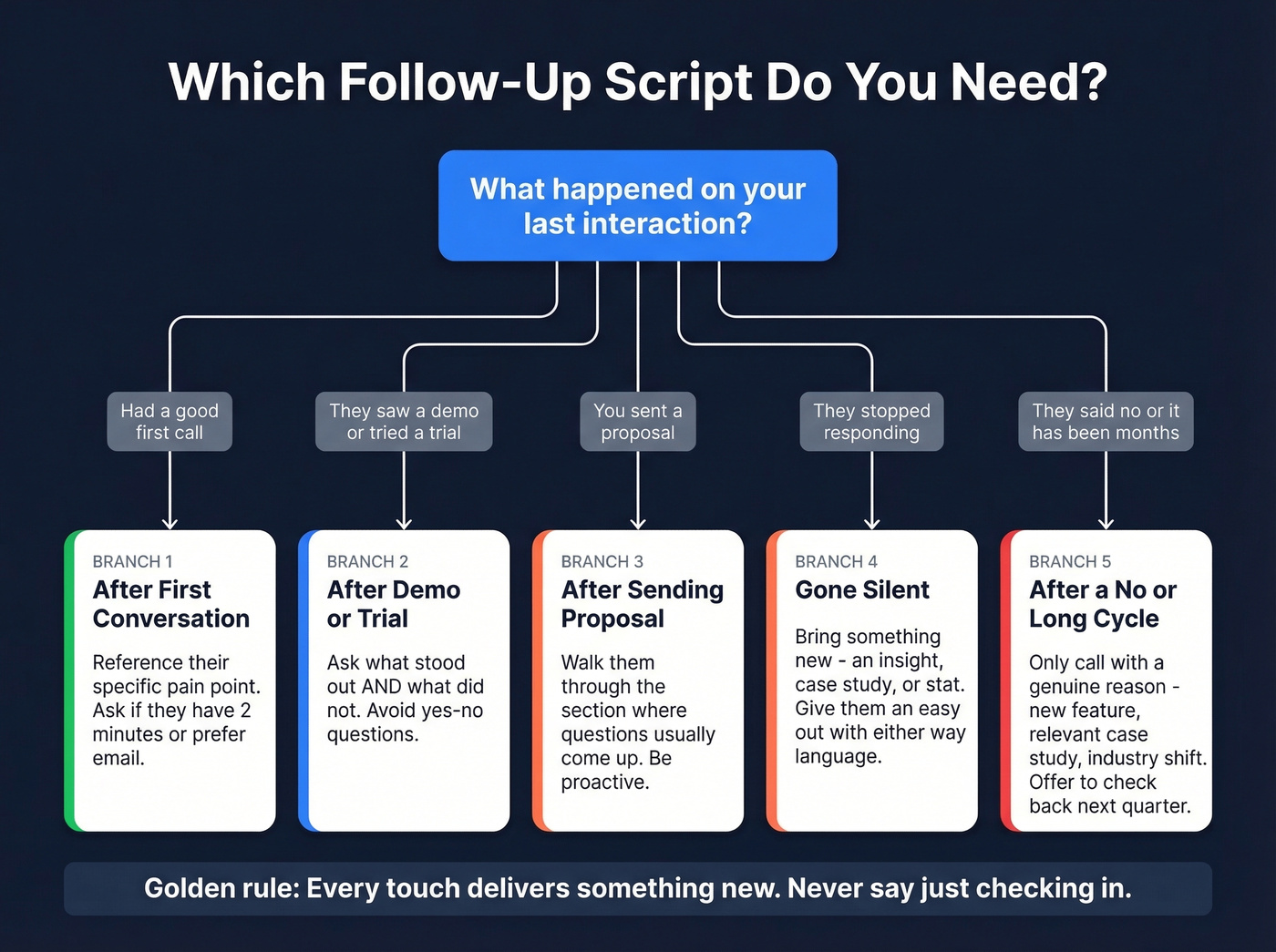
Here are five scripts for the scenarios you'll actually face.
After the First Conversation
You had a good initial call. They seemed interested. Now you need to keep momentum without sounding like you're reading from a script (even though you are).
"Hi [Name], it's [Your Name] from [Company]. We spoke [yesterday/Tuesday] about [specific topic]. I had a couple of thoughts on [their pain point] that I wanted to share. Do you have two minutes, or should I send them over in an email?"
Reference something concrete from your last conversation - a challenge they mentioned, a metric they shared. Generic "just following up" calls get brushed off. Specific ones get engagement. (If you’re still building your opener, borrow from these cold calling script examples.)
After a Demo or Trial
Don't ask "Did you like it?" That's a yes/no trap that lets them off the hook with a polite non-answer. Ask what stood out and what didn't - you'll get real feedback you can actually work with.
"Hi [Name], it's [Your Name]. You had a chance to [see the demo / try the trial] last week, and I'd love to hear your honest take. What stood out? What didn't? I've got about five minutes if now works."
If they mention a specific concern, resist the urge to rebut immediately. Write it down, acknowledge it, and address it in your follow-up email with supporting evidence.
After Sending a Proposal
This is where most reps get nervous and start sending "just checking in" emails. Don't.
"Hi [Name], it's [Your Name]. I sent over the proposal on [day]. Before you dig into the numbers, I wanted to walk through one thing - [specific section] - because it's where most questions come up. Got a quick minute?"
Pick the pricing section or the implementation timeline. Those are usually where the real questions surface first, and addressing them proactively signals you've done this before. If you want a tighter structure for proposals, use our guide to winning sales proposals.
When They've Gone Silent
This is the scenario that fills r/sales with anxiety posts - "How do I follow up without sounding desperate?" The answer: bring something new. No response to your last two touches doesn't mean no interest. It means you haven't given them a reason to re-engage.
What NOT to say: "Did I lose you?" or "Just bumping this to the top of your inbox." Both are passive-aggressive and hand them an easy brush-off.
What to say instead:
"Hi [Name], it's [Your Name] from [Company]. I know things get busy - I've been there. I wanted to share something quick: [relevant insight, case study, or industry stat]. If [solving their problem] is still on your radar, I'd love to reconnect. If not, no hard feelings - just let me know either way."
The "either way" language gives them an easy out, which counterintuitively gets more responses. Nobody wants to feel trapped. If you’re hearing “not interested” a lot at this stage, use these objection handlers.
After a "No" or Long Sales Cycle
One rule here: only call if you have a genuine reason. A new feature, a relevant case study, a shift in their industry - something that justifies the interruption. If you don't have one, wait until you do.
"Hi [Name], it's [Your Name] from [Company]. We spoke back in [month] about [topic]. Since then, we've [launched a new feature / published a case study / worked with a company like theirs]. Thought it might be relevant. Worth a quick conversation, or should I check back next quarter?"
This is the long game. Most reps give up entirely at this stage. The ones who circle back with genuine value three months later close deals their competitors forgot existed.
Voicemail Strategy That Gets Callbacks
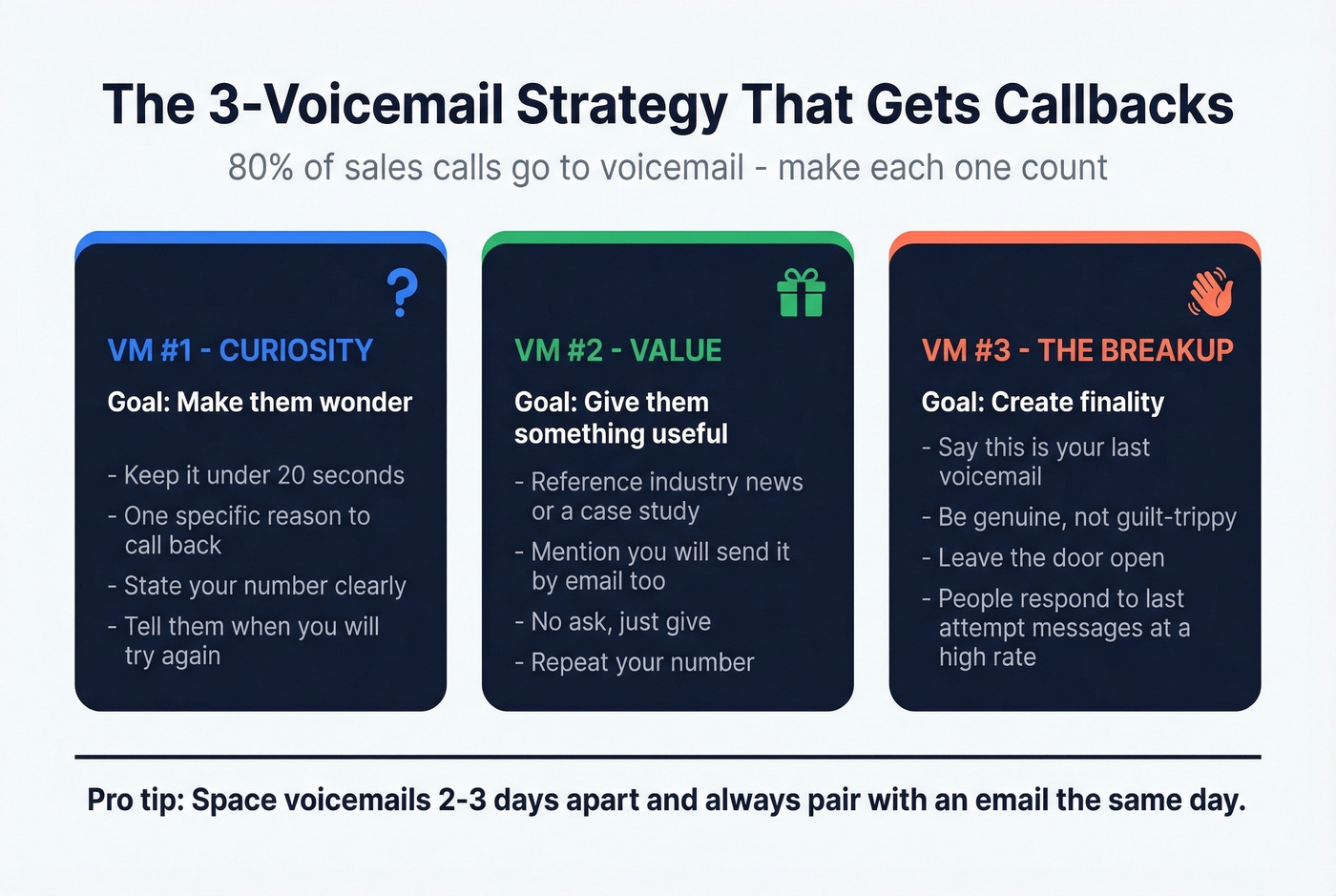
80% of sales calls go to voicemail. That's not an edge case - it's the default scenario. If you don't have a voicemail strategy, you don't have a follow-up strategy. (For more templates, see our voicemail scripts.)
First Voicemail: Curiosity
"Hi [Name], it's [Your Name] from [Company], [phone number]. I'm calling about [one specific thing relevant to their role]. I'll try you again [day], but feel free to reach me at [number] before then."
Keep it around 20 seconds. One reason to call back, your number, and when you'll try again. That's it.
Second Voicemail: Value
"Hi [Name], [Your Name] again from [Company]. Quick thought - I just saw [relevant industry news / case study result] that's relevant to [their company]. I'll send it over by email too. My number is [number]."
This one delivers something. You're not asking for their time - you're giving them a reason to be curious.
Final Voicemail: The Breakup
"Hi [Name], [Your Name] from [Company]. This'll be my last voicemail - I don't want to be that person who keeps calling. If [solving their problem] comes back on your radar, my number is [number] and I'm easy to reach. Either way, I wish you well."
The breakup voicemail works because it creates finality. People respond to "last attempt" messages at a surprisingly high rate.

Your 14-day cadence falls apart when 35% of your calls bounce to dead numbers. Prospeo gives you 125M+ verified mobile numbers with a 30% pickup rate - so every follow-up call actually reaches a human. At $0.01 per lead, bad data stops being the reason your deals go silent.
Stop following up with phone numbers that don't connect.
Getting Past the Gatekeeper
Gatekeepers aren't obstacles - they're routing systems. Treat them that way.
"Hi, I'm trying to reach the person who handles [specific function - outbound sales tools, vendor procurement for marketing]. Could you point me in the right direction?"
Tone matters more than words here. Be confident, not sneaky. Don't pretend you know the prospect personally. Don't say "they're expecting my call" unless they actually are - gatekeepers hear those tricks daily and will shut you down faster. If they ask what it's about, give a one-sentence business reason, not a pitch. "We help [their industry] companies reduce [specific problem]" works better than a 30-second elevator speech. For more, use this cold calling gatekeeper playbook.
The 14-Day Follow-Up Cadence
A single attempt isn't a system. Here's a 14-day cadence built on the 8-12 attempt framework with 2-3 day spacing between touches.
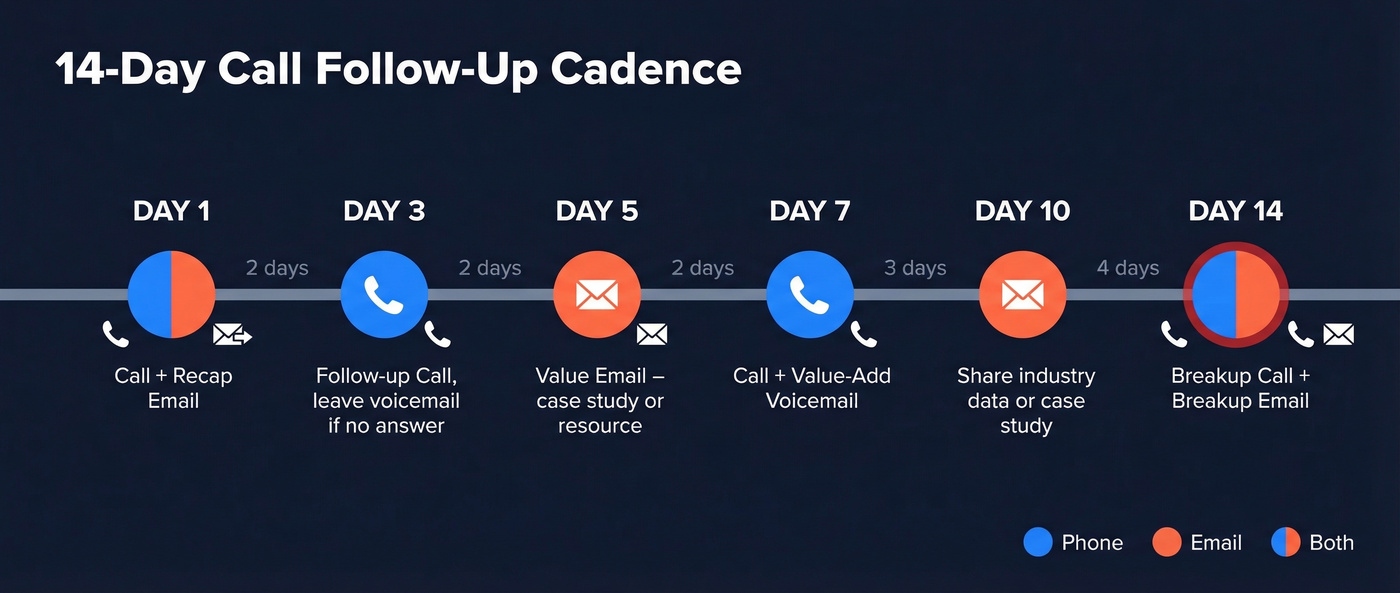
| Day | Channel | Action |
|---|---|---|
| 1 | Call + Email | Call, then send recap email same day |
| 3 | Call | Follow-up call, leave voicemail if no answer |
| 5 | New value - case study, insight, or resource | |
| 7 | Call + Voicemail | Call, leave value-add voicemail |
| 10 | Share relevant case study or industry data | |
| 14 | Call + Email | Breakup call + breakup email |
This cadence assumes your contact data is verified. If you're not sure your numbers are real, run your list through a verification tool like Prospeo's mobile finder before Day 1. Calling disconnected lines burns cadence days you can't get back.
The spacing matters. Two to three days between touches keeps you present without being intrusive. Tighter than that and you're a pest. Wider than that and you lose momentum. If two weeks pass with zero engagement - no opens, no callbacks, nothing - move on and revisit next quarter.
Let's be honest: campaigns with 4-7 follow-ups pull 27% reply rates. Sequences with 1-3 touches? Just 9%. Most reps quit at touch two. Don't be most reps. If you want a version built specifically for outbound, start with a cold calling cadence.
The Follow-Up Email After Your Call
Every call should be paired with an email. The email-after-call cadence is simple: same day, then day 3, then day 7 if needed.
Every follow-up email needs five things: a specific subject line, a reference to the call, a summary of what you discussed, a proposed next step with a specific time, and a short sign-off. If you need more templates, use these reminder email examples.
Same-Day Recap:
Subject: Quick recap from our call
Hi [Name], great speaking with you today. As discussed, [one-sentence summary of key point]. I'll [specific next step - send the proposal / schedule the demo / share the case study] by [day]. Let me know if anything comes up before then.
No-Response Bump (Day 3-5):
Subject: [First name] - one more thought on [topic]
Hi [Name], I wanted to share [specific resource, insight, or data point] that's relevant to what we discussed. Worth a quick look. Happy to jump on a 10-minute call [day] if you want to dig in.
Keep follow-up emails tight - under 100 words. Nobody reads a five-paragraph essay from a sales rep.
Five Mistakes That Kill Deals
1. Lying about callbacks. "You asked me to call today" - when they didn't. This destroys credibility instantly. Reps think it creates urgency; it creates distrust. Say "I told you I'd follow up this week" instead.
2. "Just checking if you got my email." They got it. They chose not to respond. Lead with new value instead of a guilt trip. If you catch yourself writing that line, replace it with one of these alternatives to just following up.
3. Calling at 1-2 PM. It's the worst window for connect rates. People are at lunch, in post-lunch meetings, or mentally checked out. Shift your calls to mid-morning or late afternoon.
4. Being vague about next steps. "I'll follow up soon" means nothing. "I'll call you Thursday at 2 PM with the case study" means everything. Every follow-up should end with a specific, time-bound commitment.
5. Relying on one channel. Email-only follow-up leaves a big chunk of your pipeline untouched. Multi-channel cadences - calls, emails, voicemails working together - consistently outperform single-channel approaches. We've seen this over and over in our own outbound workflows.
Your Cadence Isn't the Problem - Your Data Is
Here's the thing nobody talks about in call follow up guides: a lot of the numbers in your CRM are dead. You're not bad at follow-up - you're calling ghosts. When 80% of calls already go to voicemail, bad data makes the problem exponentially worse.
Most reps blame their scripts or their timing when connect rates tank. But if your phone numbers are six months stale, the best cadence in the world won't save you. Verify your list before you start dialing. In our experience, the single biggest unlock for outbound teams isn't a better script - it's cleaner data. Prospeo maintains 125M+ verified mobile numbers with a 30% pickup rate and refreshes data every 7 days, compared to the roughly 6-week industry average. Run your list through verification before Day 1 of your cadence, and you'll spend your time talking to real humans instead of disconnected lines. (If you’re building lists from scratch, start with calling lists.)

You just read the scripts. Now you need the direct dials. Prospeo's 300M+ profiles are refreshed every 7 days - not 6 weeks - so the number you call on Day 1 still works on Day 14. Teams using Prospeo book 26% more meetings than ZoomInfo users.
Fresh data every 7 days means your follow-up cadence never stalls.
FAQ
How many follow-up attempts should I make before stopping?
Aim for 8-12 attempts across channels over 14 days with 2-3 day spacing. 80% of sales require 5-12 touches to close, so stopping after one or two calls means you're abandoning the vast majority of winnable deals.
When's the best time to follow up after a phone call?
Within 24 hours - always. Send a recap email the same day, then make your next call within one to two business days. The 10-11 AM and 3-4 PM windows consistently produce the highest connect rates.
Should I call or email for follow-up?
Both. Pair every call with a follow-up email. Multi-channel sequences with 4-7 touches generate 27% reply rates versus 9% for sequences with just 1-3 touches. Voicemail fills the gap when prospects don't pick up.
What should I say when I hit voicemail?
Leave one specific reason to call back - not a generic "just following up." Keep it under 20 seconds, state your number clearly, and tell them when you'll try again. Curiosity-driven voicemails outperform sales-pitch voicemails every time.
How do I verify my call list before dialing?
Run your numbers through a real-time verification tool before launching any cadence. Stale CRM data is the top reason reps think their cadence is broken when the real issue is bad contact info. Skip this step and you're dialing into the void.