

Best Time to Call Prospects: What 300M+ Cold Calls Actually Show
You blocked 10-11am for cold calls like every article told you to. Forty dials later, you've reached two voicemails and an intern who "isn't sure who handles that."
That frustration is universal. The best time to call prospects is only part of the equation, and most guides stop right there. Here's what recent data shows - and then the variable that timing guides almost always ignore.
The Short Version
- Call between 10-11am or early afternoon in the prospect's local time, Tuesday through Thursday.
- Timing matters, but data quality and persistence matter more.
- A verified phone number beats the perfect hour. Fix your list first.
2026 Data on When to Call Prospects
Most "best time to call" articles still cite a 2007-2008 MIT/InsideSales study. That research is nearly two decades old, conducted before smartphones, remote work, and caller ID changed how people answer phones. It's time to stop treating it like gospel.
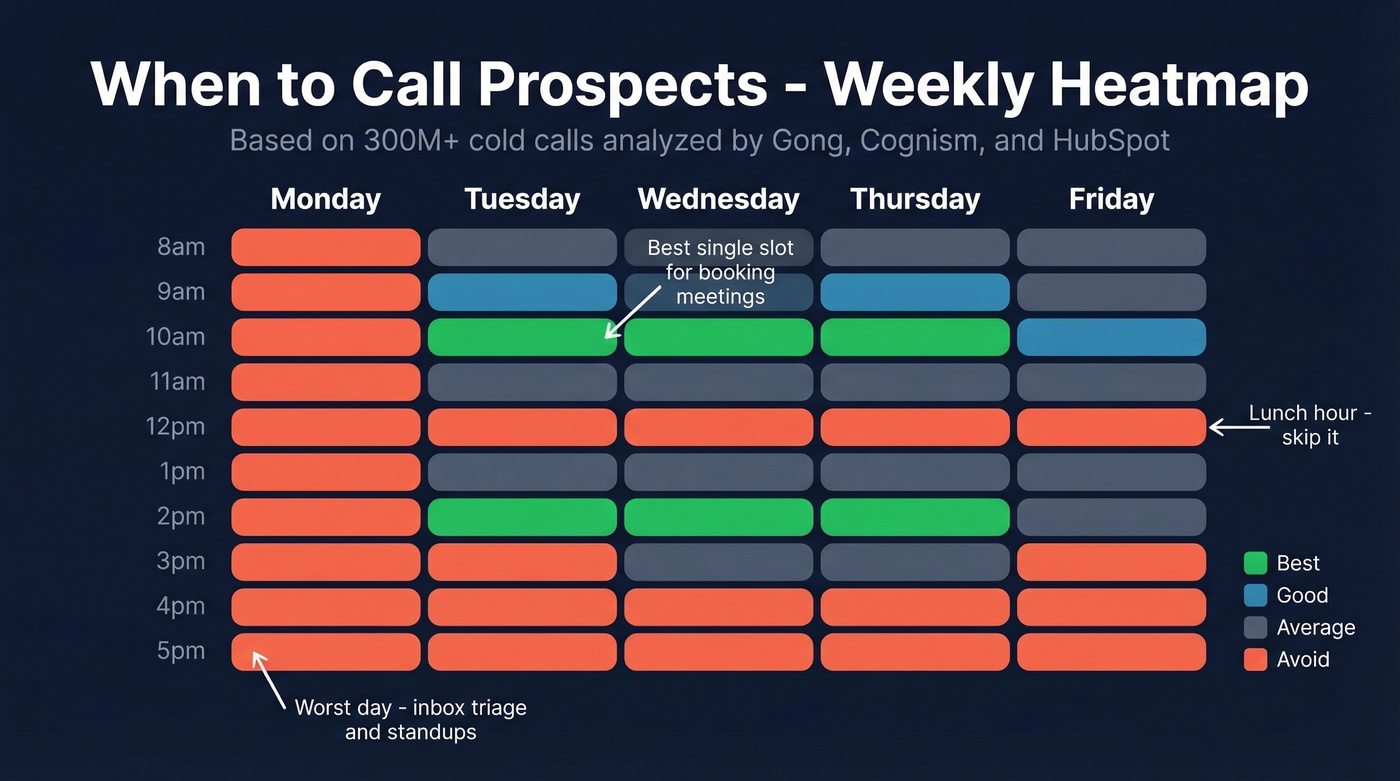
Gong's analysis of 300M+ cold calls found the average rep connects on just 5.4% of dials - roughly one conversation per 19 calls. Top-quartile reps hit 13.3%, about one in eight. The gap isn't just skill. It's data, targeting, and timing working together.
Cognism's State of Cold Calling Report drilled into when those conversations happen, using average talk time as the engagement proxy. HubSpot's survey of 379 sales professionals confirmed the same pattern: midweek and late-morning calls consistently outperform, with early afternoon close behind.
| Window | Day | Source | Notes |
|---|---|---|---|
| 10-11am local | Tue-Thu | Cognism | Longest talk times |
| 2-3pm local | Tue-Thu | Cognism | Next-best talk times |
| Avoid | Mon, lunch hours, 3-5pm | Cognism, HubSpot | Lowest effectiveness |
Tuesday is the best single day for booking meetings. Monday is the worst - people are buried in standups and inbox triage. Friday is interesting: it's the worst day for booking meetings but can actually be solid for conversations, because fewer reps are dialing and prospects are more relaxed and willing to chat without feeling pressured to commit.
On r/SalesOperations, one SalesOps leader cited connect rates around 6% - right in line with the 5.4% average from the 300M-call analysis - and questioned whether 15-20% is realistic anymore without verified mobile data. They're right to be skeptical.
If you're building a modern outbound motion, it helps to treat calling as one piece of a broader sales prospecting system.
The Time Zone Play
Here's the thing: if you're calling across the US, a flat "call at 10am" strategy means you're hitting West Coast prospects at 7am. That's not a timing strategy. That's an alarm clock.
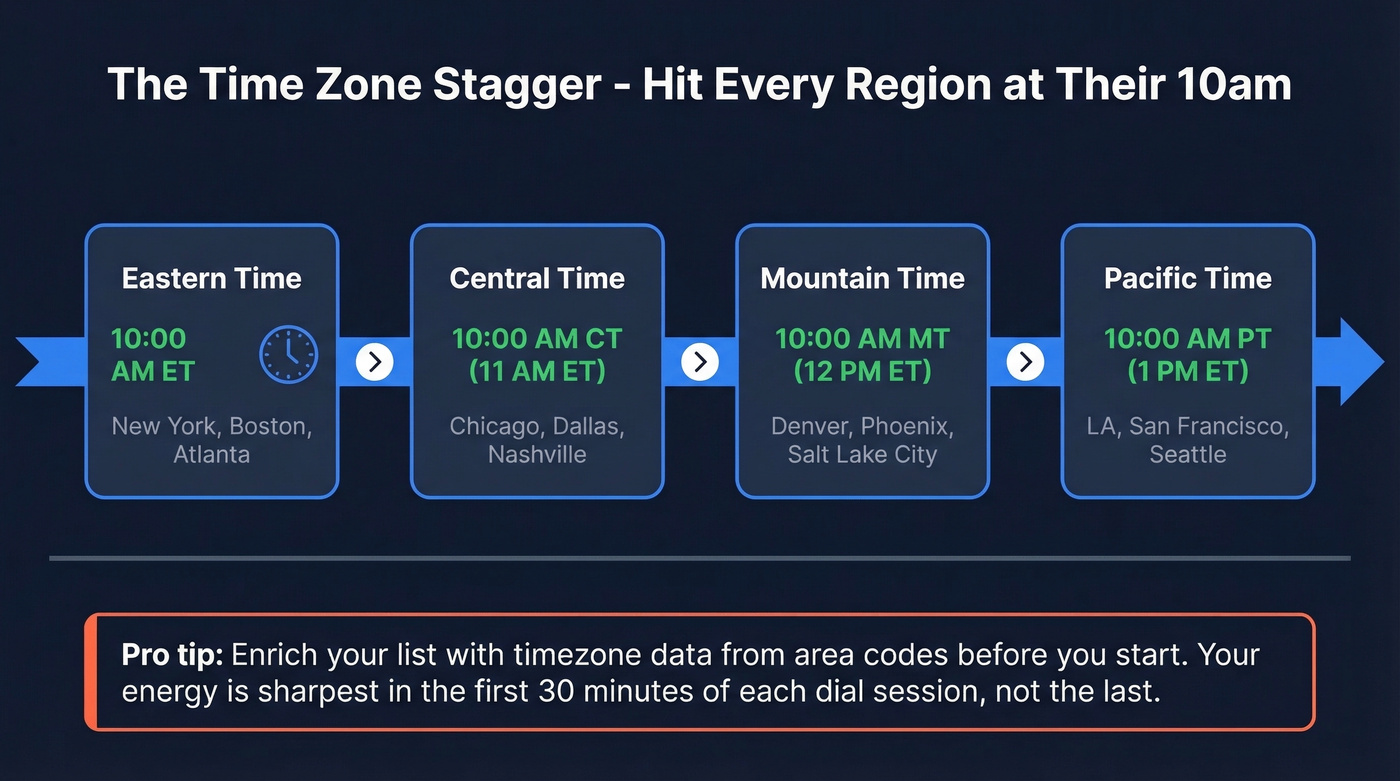
- Start East Coast at 10am ET. Prime window for New York, Boston, Atlanta.
- Shift to Central by 10am CT (11am ET). Dallas, Chicago, Nashville.
- Hit Mountain and Pacific by their 10am. You're now at noon or 1pm ET - a natural break from your own meetings.
- Enrich your list with timezone data from area codes before you start. Most dialers can sort by region if the data's there.
If your team is standardizing this across reps, document it as part of your cold calling system so it’s repeatable.
One angle most timing guides miss: your own energy matters as much as the prospect's availability. Block cold calls before follow-ups and admin work. Your voice is sharpest and most confident in the first 30 minutes of a dial session, not the last. By dial number 60, you sound like it - and prospects can tell.

Meritt tripled their connect rate to 20-25% after switching to verified mobile data - same timing playbook, same team. Prospeo gives you 125M+ verified direct dials refreshed every 7 days with a 30% pickup rate, so every call in your prime 10-11am window reaches a real person.
Stop burning your best calling hours on numbers that don't connect.
Why Timing Is Only Half the Equation
Timing advice without data hygiene is like optimizing your golf swing with a broken club. B2B contact data decays at roughly 2.1% per month - that's 22.5% of your list going stale every year. Sales reps lose an estimated 27.3% of their productive time to bad contact data.
If you’re evaluating vendors, start with a shortlist of data enrichment services and compare refresh cycles and verification methods.
We've seen this pattern repeatedly: a team nails their timing playbook, blocks the right hours, sequences east-to-west - and still can't break a 4% connect rate because half their numbers are dead. Meritt, an outbound sales team, saw their connect rate triple to 20-25% after switching to verified mobile data, and their weekly pipeline jumped from $100K to $300K. The timing didn't change. The numbers did.
This is also where data-driven selling beats “best practices” every time: measure, fix inputs, then optimize.
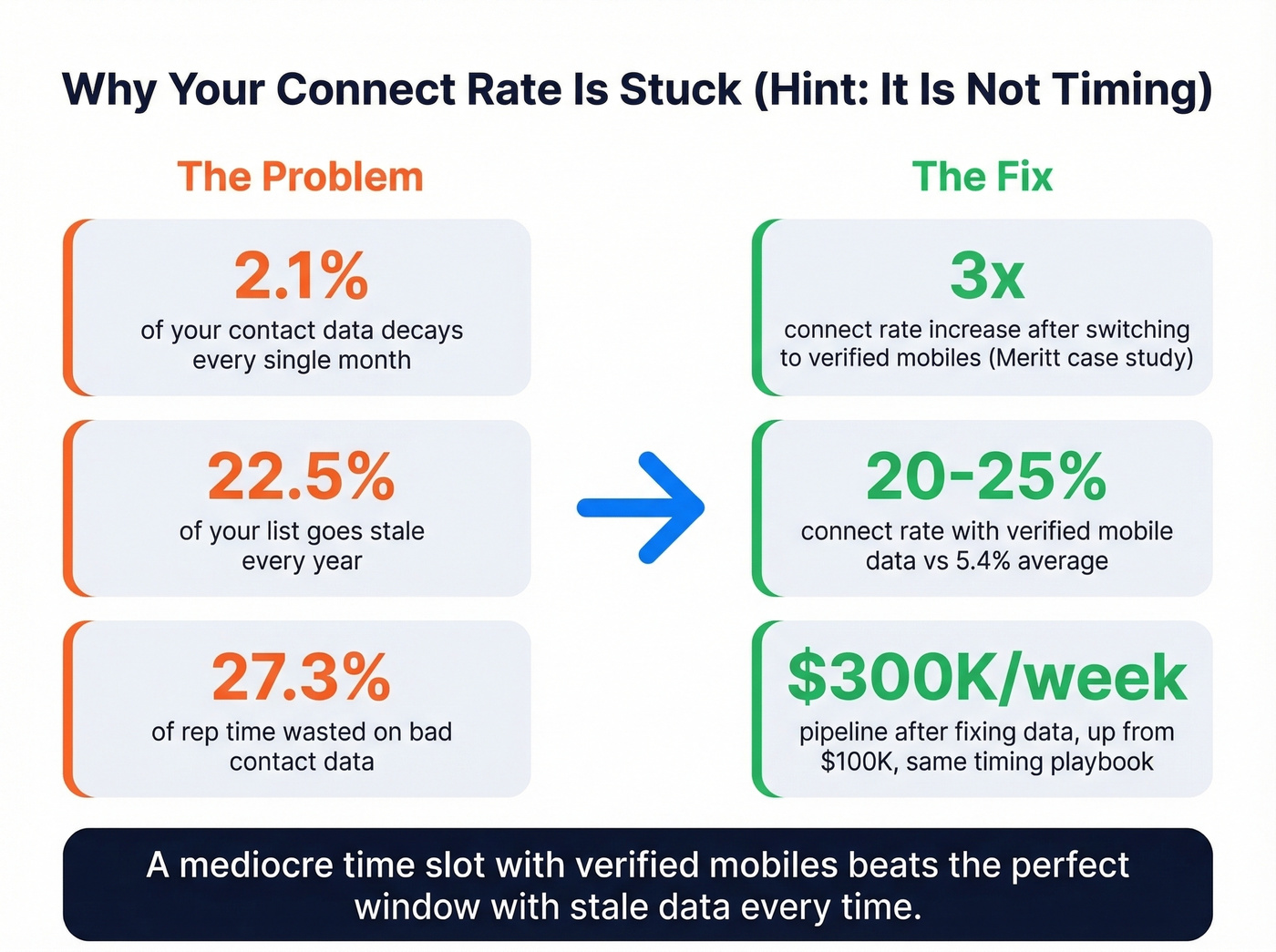
Let's be honest - if your connect rate is below 8%, your problem probably isn't timing. It's your data. Stop A/B testing call windows and start auditing your phone numbers. A mediocre time slot with verified mobiles will outperform the perfect window with stale data every single time.
If you’re consistently getting shut down early, it’s usually not the hour - it’s the opener and objection handling. See cold call rejection for scripts and fixes.
Make the Window Count
The average cold call lasts 83 seconds. You don't have time for a bad opener.
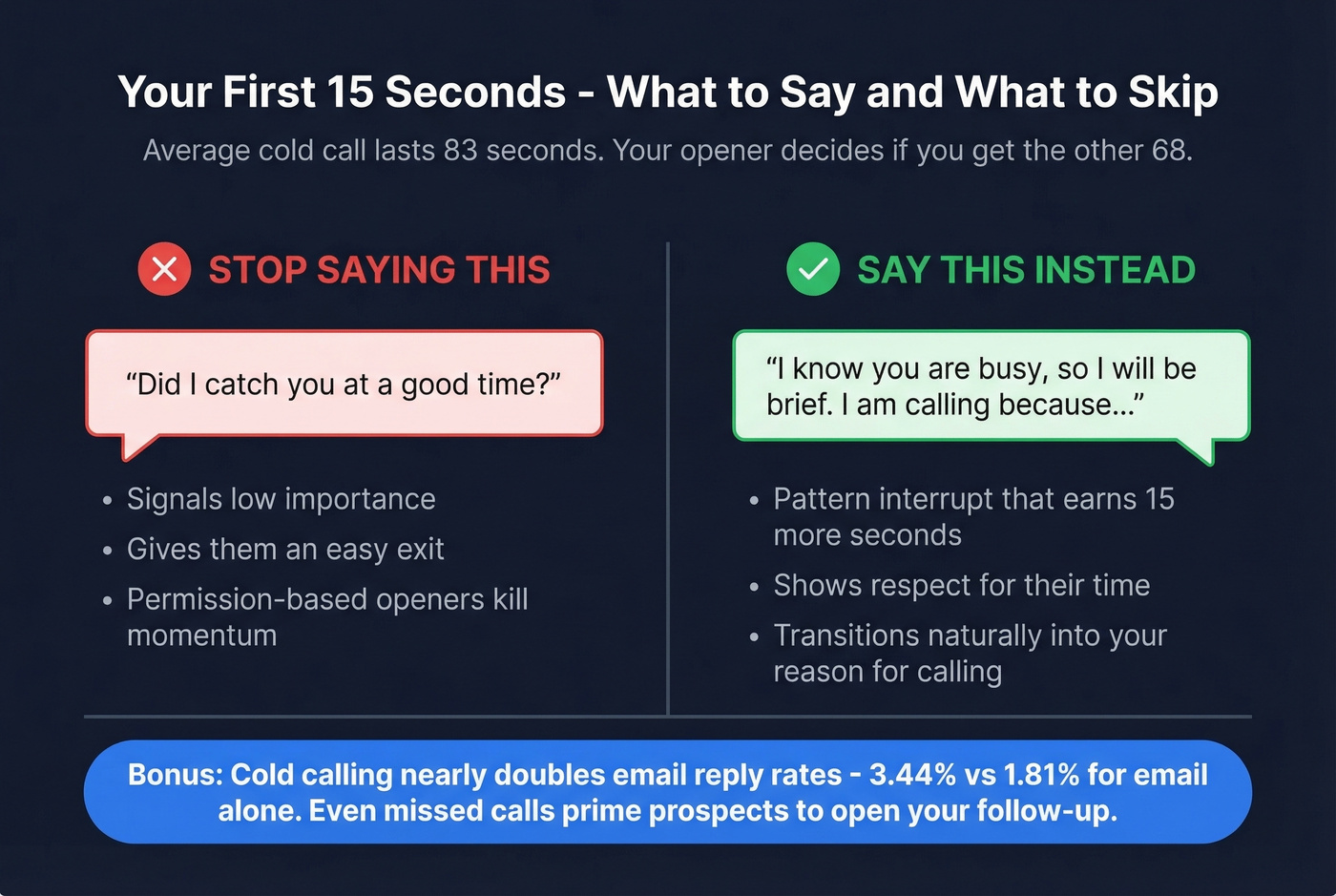
Don't say "Did I catch you at a good time?" It's an invitation to hang up. Hyperbound's research shows permission-based openers signal low importance. Try instead: "I know you're busy, so I'll be brief. I'm calling because..." That's a pattern interrupt that earns you 15 more seconds.
Two more things that move the needle:
Cold calling nearly doubles email reply rates - 3.44% vs 1.81% for email alone, per the 300M-call analysis. Even without a live connect, dialing boosts email engagement. Pair every dial block with a follow-up email sequence. And prep your list before the session starts: enrich with Prospeo's verified direct dials so every call in your 10-11am window reaches a real person, not a switchboard. With 125M+ verified mobiles refreshed every 7 days and a 30% pickup rate, you're not wasting prime calling hours on dead numbers.
To tighten the email side, keep a set of proven sales follow-up templates ready for same-day sends.
The data is clear: 5.4% average connect rate, and bad numbers are the biggest reason. At ~$0.01 per contact, Prospeo's verified mobiles and 98% accurate emails turn your Tuesday 10am dial block into actual pipeline - not 40 voicemails and an intern.
Fix your list before you fix your timing. Start free, no contracts.
Compliance Guardrails
Federal law limits outbound calls to 8am-9pm in the prospect's local time. Some states are stricter - Texas pushes the earliest permissible time to 9am on certain days, and Maine, Florida, Oklahoma, and Washington all have revised telemarketing regulations on the books.
Real talk: if you're running multi-state campaigns, check state-specific rules before you dial. A compliance violation can cost more than your entire quarter's pipeline is worth.
If you’re adding SMS to your outbound mix, read up on cold texting compliance and risks first.
FAQ
What's a realistic cold call connect rate in 2026?
The 300M-call analysis found the average rep connects on 5.4% of dials; top-quartile reps hit 13.3%. If you're around 5-6%, you're normal. The gap between average and top performers comes down to verified mobile data and multi-touch persistence more than any single tactic.
Does cold calling still outperform email?
Yes. Cold calling nearly doubles email reply rates at 3.44% vs 1.81%. Cognism's report found 51% of decision-makers prefer hearing from SDRs via phone over any other channel. Even unanswered dials prime prospects to open your follow-up emails.
What's the best time to call leads across multiple time zones?
Stagger dial sessions east-to-west so you reach each region during their 10-11am local window. Start with Eastern at 10am ET, shift to Central by 11am ET, then Mountain/Pacific by noon ET. Use a data provider with timezone-enriched records and frequent refresh cycles so you're not burning prime hours on disconnected numbers.
How do I improve connect rates without changing my call times?
Audit your phone data first. B2B contact data decays at 2.1% per month, so a list older than 90 days has roughly 6% dead numbers. Verify mobiles before each session, flag disconnected lines in your CRM, and pair dials with a same-day follow-up email. Teams that fix data quality before optimizing timing routinely see connect rates jump from sub-5% to 15%+.