

Objection Handlers: Scripts, Frameworks, and Tactics That Close Deals
A CFO tells your champion, "Budget is locked until next fiscal year." Your rep hears a dead deal. A great rep hears a buying signal wrapped in a timing constraint - and responds with a line that reframes the conversation from "cost" to "cost of inaction." That single moment determines whether the deal dies or moves to a signed contract 90 days later.
The best objection handlers aren't born with silver tongues. They follow repeatable frameworks, diagnose before they respond, and practice relentlessly. What follows are the scripts, tactics, and delivery mechanics that separate reps who close from reps who crumble at the first "no."
80% of sales require five or more follow-ups, but 92% of reps quit after four attempts. That gap isn't a motivation problem. It's a skills problem, a data problem, and a process problem - and most "objection handling" content treats it like a script problem.
Objections vs. Obstructions
Before you memorize a single script, know what you're actually hearing. Cognism makes a distinction worth internalizing: an objection is a reason someone won't buy. An obstruction is an excuse to end the conversation.
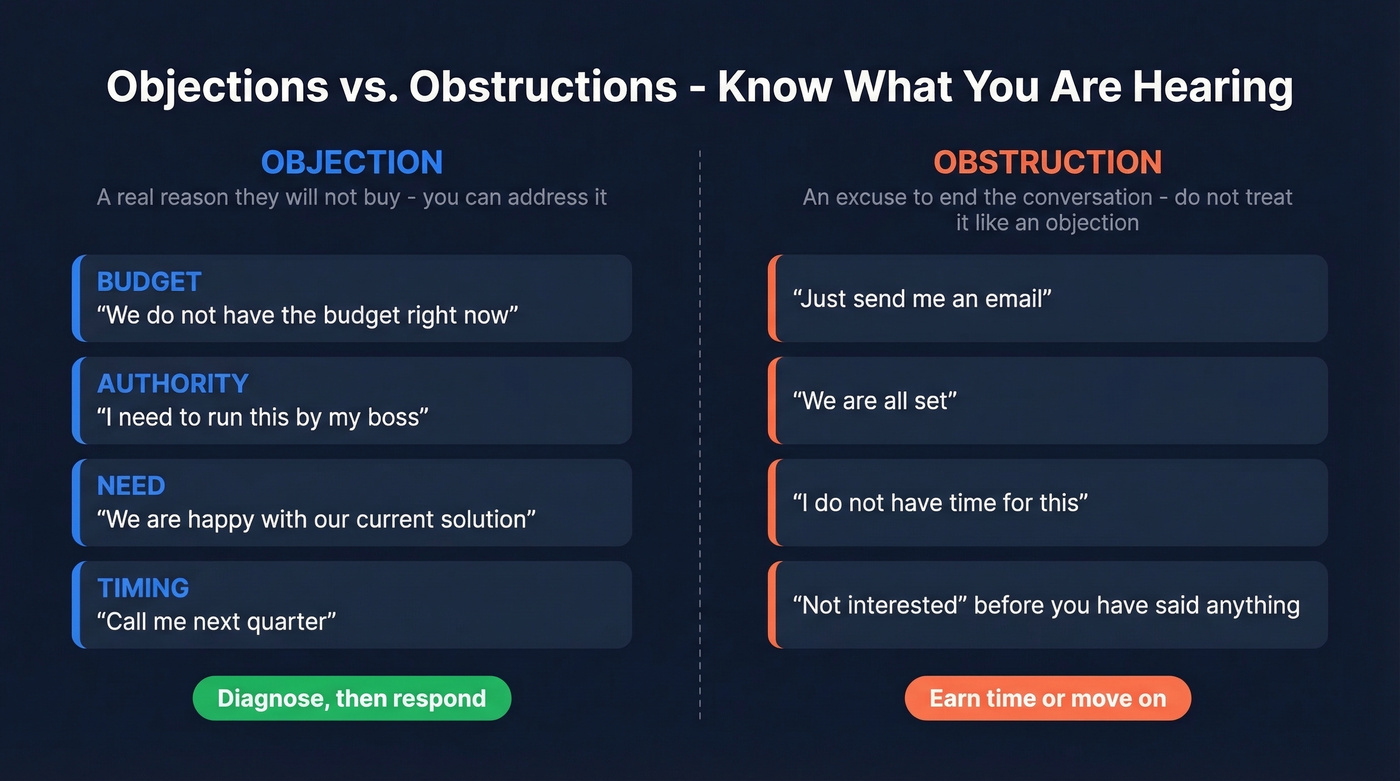
"It's too expensive" is an objection - there's a concern underneath it you can address. "I don't have time for this" on a cold call is usually an obstruction - they're not evaluating your price, they're trying to hang up. Treating an obstruction like an objection wastes everyone's time. Different animal, different playbook.
The BANT framework gives you a clean way to categorize real objections. Budget objections sound like "We don't have the budget" or "Your competitor is cheaper." Authority objections surface as "I need to run this by my boss." Need objections hide behind "We're happy with our current solution." And Timing objections show up as "Call me next quarter" or "We just signed with someone else."
When you hear something that doesn't fit any of those buckets - "Just send me an email" or "We're all set" with zero context - you're dealing with an obstruction.
The #1 Mistake Reps Make
A Featured.com expert roundup asked dozens of sales leaders about the biggest objection-handling mistake they see. The consensus was overwhelming: reps treat the first objection as the real one.
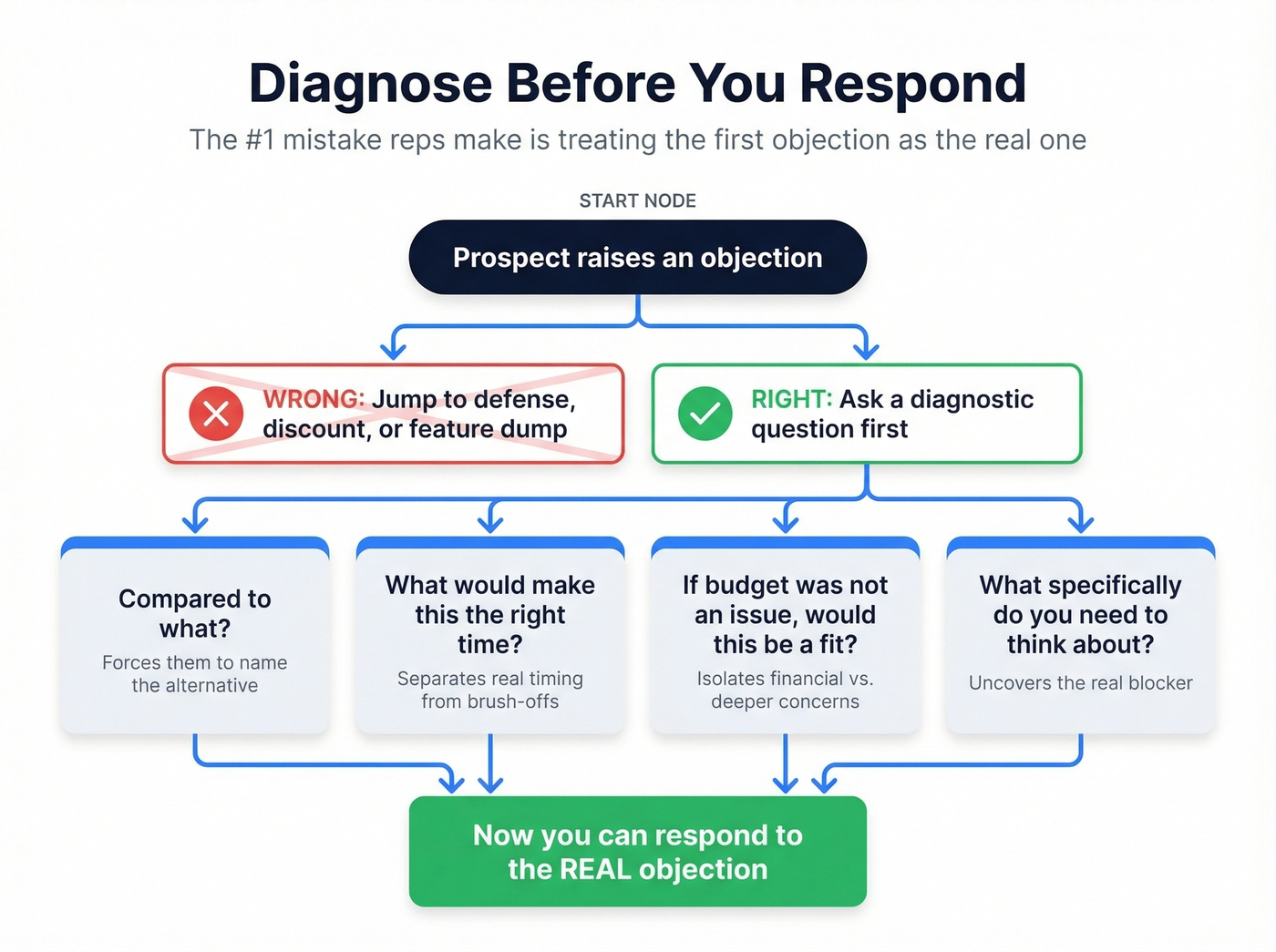
Someone says "it's too expensive," and the rep immediately launches into ROI math or offers a discount. But "too expensive" might mean "I don't have budget authority," or "I don't understand the value yet," or "I'm comparing you to a free tool." Responding to the surface objection is like treating a symptom without diagnosing the disease.
Richard Harris puts it well: nobody wants to be "handled." Objections are buying signals. The goal isn't to overcome them - it's to understand them. He advocates pre-handling objections by asking early: "Who's typically the most skeptical person on your team, and what might they push back on?"
These diagnostic questions should come before any rebuttal:
- "Compared to what?" - Forces them to name the alternative.
- "What would make this the right time?" - Separates real timing issues from brush-offs.
- "If budget wasn't an issue, would this be a fit?" - Isolates whether the objection is financial or something deeper.
- "What specifically do you need to think about?" - Uncovers the real blocker hiding behind "let me think about it."
The anti-pattern is clear: reps jump to defense, discounting, or feature-dumping instead of diagnosing. Every framework in the next section starts with listening. Skip that step and the rest doesn't matter.
Scripts by Funnel Stage
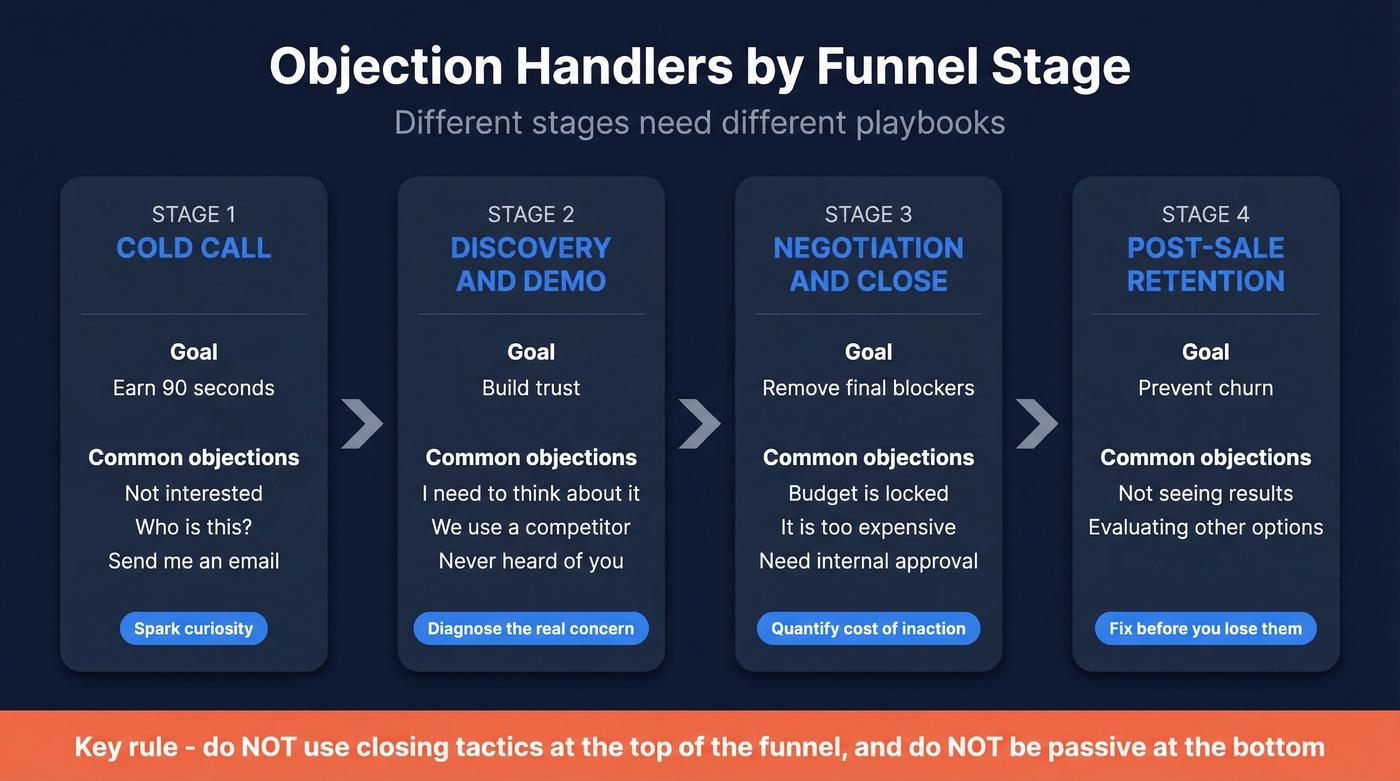
A "not interested" on a cold call is fundamentally different from a "the budget is locked" in a negotiation. EBQ makes this point clearly: the goal of a cold call is to determine fit and spark curiosity, not to close a deal. Treating every objection like a closing objection is how reps sound desperate at the top of the funnel and passive at the bottom.
If you're building a repeatable outbound motion, pair these scripts with a real cold calling system so reps know what to do before and after the objection moment.
Cold Call Rebuttals
60% of cold calls hit "I'm not interested" before you've said anything meaningful. The instinct is to push harder. The better move is to earn 90 seconds.
Permission-based opener:
"I get it - your time is valuable. If I could quickly show you how to [specific benefit relevant to their role], would you give me 90 seconds?"
This works because it respects their time, names a concrete benefit, and asks for a micro-commitment. It doesn't argue. It doesn't plead.
The feedback pivot (when they're firm):
"Fair enough. Before I let you go - what could I have said that might have actually interested you?"
This line is gold. It turns a rejection into intel. Even if they hang up, the ones who answer give you data you can use on the next 50 calls.
Wrong person redirect:
"Maybe you can help me out. Can you point me to the person who handles [specific function]?"
Skip anything that sounds like begging. "But if you just give me five minutes..." signals low status and triggers the exact brush-off you're trying to avoid. If this is a recurring issue, it’s often a cold call rejection pattern - not a script problem.
Discovery & Demo Responses
At this stage, the prospect has agreed to a conversation. Objections shift from brush-offs to genuine concerns - pricing, competition, internal politics. Your job changes from earning attention to building trust.
If you want a tighter structure for this stage, build your talk track around strong discovery questions so objections surface earlier.
"I need to think about it":
"Totally fair. Can I ask - what specifically do you need to think about? Is it pricing, implementation, timeline, or something else?"
This comes from Apparate's objection guide, and it works because it forces specificity. "Think about it" is a catch-all that hides the real objection. Naming the categories gives them permission to tell you what's actually going on.
"We're already using [competitor]":
This is a buying signal - they've already recognized the need. The r/sales cheat sheet frames it perfectly: probe what's working and what isn't, then target the complaints you can solve.
"That's great - means you already see the value of solving this. What's working well with them? And if you could change one thing, what would it be?"
"I've never heard of you":
Don't launch into a five-minute company history. Klue's framework emphasizes trust-first, open-ended questions over pitching. A quick value prop plus one proof point is enough.
"We're [one-sentence positioning]. [Company similar to theirs] switched to us last quarter and saw [specific result]. Happy to show you how that'd look for your team."
One critical note on competitive objections: buyers fact-check everything instantly. Speaking negatively about a competitor backfires more often than it helps. Stick to what you do well - and come prepared with sales battle cards so reps don’t improvise under pressure.
Negotiation & Closing Rebuttals
The prospect knows your product, sees the value, but something is blocking the signature. Usually it's budget, timing, or internal politics. Your responses here need to be sharper and more data-driven than at any other stage.
If you’re negotiating multi-stakeholder deals, it helps to understand the anchor in negotiation effect before you talk price.
"Budget is locked until next fiscal year":
This line from a Reddit objection-handling challenge nails the psychology:
"Jordan, just so I'm clear - if this backlog compounds like it has, we're talking about 300+ hours lost by next fiscal. Is there usually a process for surfacing that kind of operational risk to leadership now, or would it make sense for us to map out the cost together so you're ready when it comes up?"
It reframes from "budget" to "business risk," quantifies the cost of inaction, and offers to co-create the internal business case. The tone stays curious and collaborative - not pushy. The same Reddit thread called out what doesn't work: "Worst answers used humor, gave up, or went straight to discounts." That tracks with what we've seen coaching reps. Discounting before you've established full value trains the buyer to negotiate harder next time.
"It's too expensive":
The consensus on r/sales is clear - 99% of price objections are value perception problems. Circle back to the pain of not solving the problem.
"I hear you. What's the current cost of [the problem you solve]? Not just dollars, but time, missed deals, team frustration. If we can show the ROI covers the investment 3x, does that change the conversation?"
Post-Sale Retention Scripts
Most objection-handling content stops at the signature. That's a mistake. Post-sale objections determine churn, expansion, and referrals. Every objection here is a retention opportunity disguised as a complaint.
If you want to systematize this, track objections as leading indicators in your churn analysis process.
"We're not seeing results":
"Let's dig in. What metrics were you expecting to move, and where are they now? Sometimes the value shows up in places the original business case didn't anticipate."
"We're evaluating other options":
"I appreciate the transparency. What's driving the evaluation? If there's something we can fix, I'd rather do that than lose you over something solvable."
Frameworks Compared
Six named objection-handling frameworks float around sales enablement content. Most overlap. Here's how they actually differ:
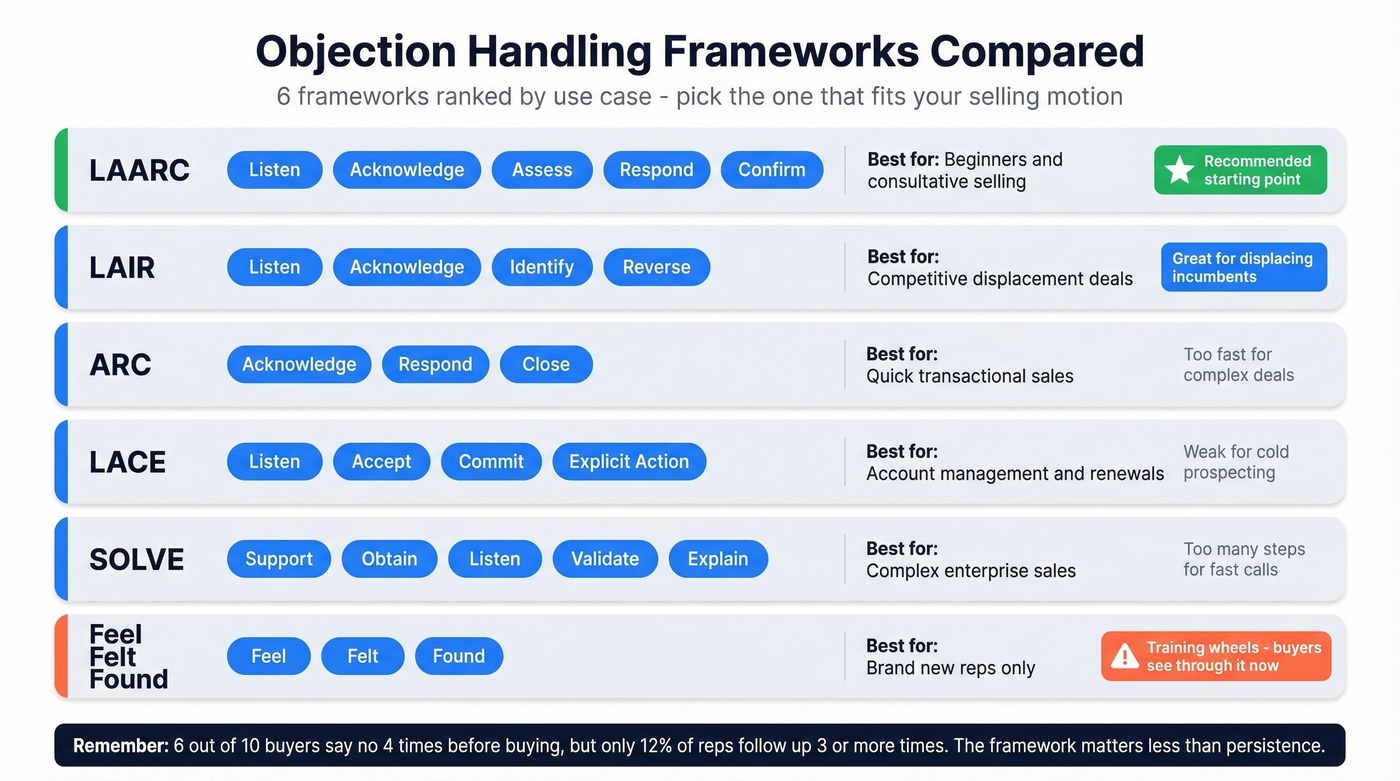
| Framework | Steps | Best For | Limitation |
|---|---|---|---|
| ARC | Acknowledge, Respond, Close | Quick, transactional sales | Too fast for complex deals |
| LAARC | Listen, Acknowledge, Assess, Respond, Confirm | Beginners, consultative selling | Feels formulaic if over-rehearsed |
| LAIR | Listen, Acknowledge, Identify, Reverse | Competitive displacement | Requires strong product knowledge |
| LACE | Listen, Accept, Commit, Explicit Action | Account management, renewals | Weak for cold prospecting |
| FFF | Feel, Felt, Found | Entry-level reps, simple objections | Buyers see through it now |
| SOLVE | Support, Obtain, Listen, Validate, Explain | Complex enterprise sales | Too many steps for fast calls |
Salesforce also publishes a P.O.W.E.R.F.U.L. framework with eight steps, but anything beyond five steps is hard to internalize under pressure.
Our recommendation: LAARC for beginners, because the "Assess" step forces you to diagnose before responding - which prevents the #1 mistake we covered earlier. For competitive deals where you're displacing an incumbent, LAIR is powerful if you know your product cold. Klue also teaches an ARR model that works well in the same scenarios - pick whichever clicks for your team.
Here's the thing: Feel-Felt-Found is training wheels. Today's buyers have heard "I understand how you feel, other clients felt the same way, but what they found was..." enough times to recognize the pattern mid-sentence. Use it if you're brand new to sales. Graduate from it fast.
One stat worth remembering: six out of ten buyers say no four times before purchasing, but only 12% of reps make three or more follow-ups. The framework matters less than the persistence to use it repeatedly - use a set of sales follow-up templates so reps don’t stall after the second touch.

80% of sales need 5+ follow-ups - but you can't follow up with bad data. Prospeo delivers 98% accurate emails and 125M+ verified mobile numbers so your reps reach real decision-makers, not dead ends.
Stop handling objections from the wrong person. Start dialing direct.
Five Things That Kill Rebuttals
Arguing. The moment you argue, you've lost. Even if you're right. Prospects don't buy from people who make them feel wrong.
Getting defensive. "Actually, our product does do that..." delivered with an edge turns a conversation into a confrontation. Reframe instead.
Immediately discounting. Dropping price before you've fully explored the objection signals your original price was inflated and trains the buyer to push harder on every future deal.
Giving up after one objection. One "no" isn't a rejection. It's the start of a conversation. (If your team struggles here, build resilience in sales as a system, not a pep talk.)
Using manipulative tactics. High-pressure closes and artificial urgency might work once. They destroy trust, kill referrals, and tank your reputation on review sites. Buyers talk to each other.
Delivery Mechanics
No ranking page covers this, and in our experience it matters more than the words themselves. LeadsAtScale's behavioral science research on cold calling delivery offers practical mechanics for any objection-handling moment:
Mirror their pace. Fast talkers respond to energy; slow, deliberate speakers need you to match their rhythm. Mismatched pacing creates subconscious friction.
Pause after your intro. An intentional two-second silence signals confidence and gives the prospect space to engage. Most reps rush to fill the gap - don't.
Lower your voice for critical information like the cost of inaction or the ROI number. It pulls them in rather than pushing at them. Use permission-based language to reduce resistance, and time-box everything - "a quick 90 seconds" sets expectations, while open-ended asks trigger the "this will take forever" reflex.
These aren't tricks. They're communication mechanics most reps never practice because they're too busy memorizing scripts. A skilled rep knows that tone and timing carry as much weight as the words themselves - especially in high-volume sales communication.
The Data Problem Nobody Talks About
A RevOps lead we work with ran the numbers on his SDR team last quarter. Out of 40 dials per rep per day, six were immediate brush-offs like "not interested," three had left the company, and three were never the right contact. That's 30% of objections that weren't objections at all - they were data failures dressed up as rejection. The real scripts and rebuttals never got used because reps burned their energy on ghosts.
Let's be honest: if your deal sizes sit below $15k and your reps spend more time navigating bad data than handling real objections, your problem isn't sales training - it's your database. Fix the data and you eliminate an entire category of pushback before it happens.
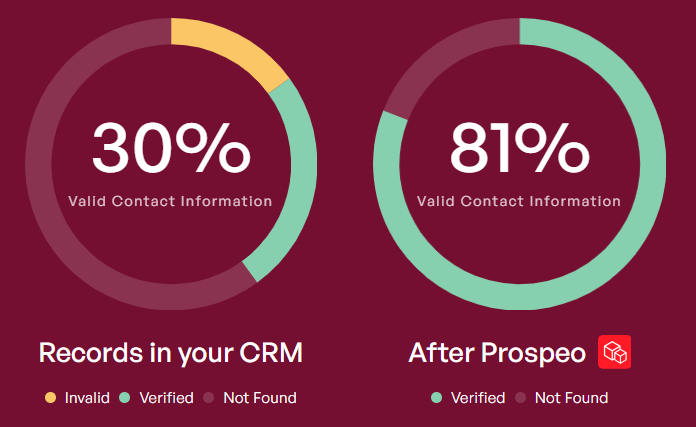
96% of prospects research companies before engaging with a sales rep, and 71% prefer independent research. Your prospects are more informed than ever. The ones who aren't informed probably aren't your prospects at all. And many "not interested" brush-offs aren't objections - they're the result of calling the wrong person with outdated data. You're pitching a VP of Marketing on a DevOps tool because your database had a stale title.
Prospeo's database covers 300M+ professional profiles with a 7-day refresh cycle, compared to the 6-week industry average. With 98% email accuracy and 125M+ verified mobile numbers, you're reaching the right person at a working number. When someone says "not interested" after that, it's a real objection worth handling - not a data artifact. If you’re evaluating vendors, start with a shortlist of data enrichment services and compare against your current workflow.
Every objection handler in this article assumes one thing: you're talking to someone who can actually buy. Prospeo's 30+ filters - buyer intent, job changes, department headcount - put your reps in front of real decision-makers at $0.01 per lead.
Eliminate the "I need to run this by my boss" objection before it happens.
How to Practice
Knowing the scripts isn't enough. Role-playing before live calls correlates with 20-45% higher win rates according to research in the Journal of Marketing Education. And yet most reps only practice when a manager forces them to.
AI is changing this. 43% of revenue enablement leaders already use AI-powered role-play for coaching. Tools like Gong analyze real call recordings to show where objection handling broke down. Second Nature acts as an AI pitch partner throwing realistic objections at you on demand - expect around $30-80 per user/month for mid-market plans. Mindtickle offers a full readiness platform at around $45k/year for 100 users, an enterprise play.
For smaller teams, even recording your cold calls and reviewing the first objection moment with a peer beats memorizing scripts alone. The gap between knowing a framework and executing it under pressure is enormous. Practice closes that gap - especially when it’s built into sales training tips your team can repeat weekly.
FAQ
What's the difference between an objection and a rejection?
An objection is a concern you can address - a rejection is a firm no with no path forward. Most "rejections" on cold calls are actually obstructions: excuses to end the conversation, not final answers. Understanding this distinction is the foundation of effective sales conversations.
How many objections should you handle before moving on?
Six out of ten buyers say no four times before purchasing. If you've uncovered the real objection and addressed it twice with no movement, it's likely an obstruction. Move on and revisit in 30-60 days with new context.
What's the best framework for beginners?
LAARC. It forces you to diagnose before responding, which prevents the most common mistake of answering the wrong objection. Graduate to LAIR for competitive displacement situations where you need sharper rebuttals.
Can you practice objection handling with AI?
Yes. Tools like Second Nature ($30-80/user/month) and Mindtickle (~$45k/year for 100 users) simulate realistic buyer conversations. Studies show role-playing correlates with 20-45% higher win rates, and 43% of enablement leaders already use AI-powered practice.
Does data quality affect how many objections you face?
Massively. Calling wrong contacts or outdated numbers generates brush-offs that aren't real objections. Clean, verified data means your team spends time on genuine sales conversations instead of chasing ghosts.