

"Just Following Up on the Email Below" Is Costing You Replies
You've typed "just following up on the email below," hovered over the send button, and felt that twinge of doubt. Good instinct. That phrase is doing more damage than you think - and the fix isn't just better wording. It's a combination of timing, specificity, and making sure your email actually lands in a real inbox. We've sent this exact line hundreds of times before overhauling our approach, and the difference in reply rates was immediate.
Three things you can do right now:
- Delete the word "just." It minimizes your own message. "I wanted to follow up" is immediately stronger.
- Replace the vague follow-up with a specific question and a deadline. Give the recipient a reason to respond today, not "whenever."
- Verify the email address before you send. 17% of cold emails never reach the inbox. The best follow-up in the world doesn't matter if it bounced.
Why This Phrase Fails
The word "just" is a linguistic minimizer. It signals that your message is optional instead of actionable. As CNBC's communication experts explain, phrases like "just following up," "circling back," and "just checking in" aren't strong enough to cut through a busy inbox.
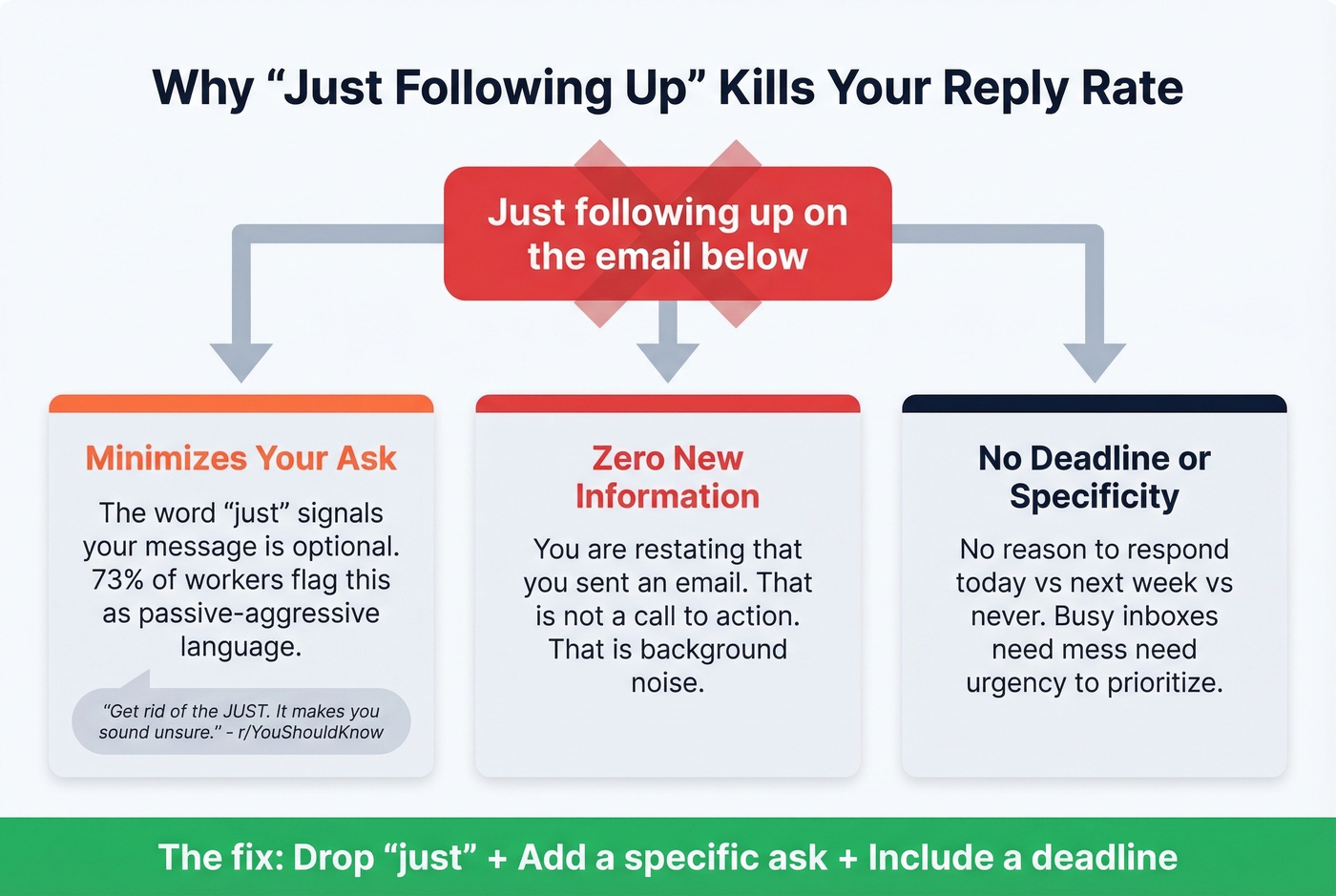
Here's the thing: the phrase provides zero new information. No deadline, no specific ask, no reason for the recipient to prioritize your email over the dozens of others sitting unread. You're essentially saying "I sent you something before and I'm reminding you it exists." That's not a call to action. That's background noise.
It gets worse. A Preply workplace survey found that 73% of workers regularly encounter passive-aggressive language at work, and "just following up" sits squarely in that family - alongside "as per my last email," "friendly reminder," and "circling back." You don't mean it passive-aggressively. But perception is what matters.
Quick note for non-native English speakers: adding "kindly" usually doesn't help. "I just wanted to kindly follow up" can read as condescending. Drop "kindly" and "just" together. You'll sound more direct and more professional.
A popular post on r/YouShouldKnow is blunt: "Get rid of the JUST. It's completely unnecessary and makes you sound unsure." Hard to argue with that.
What 16.5M Emails Reveal
Belkins analyzed 16.5 million cold emails across 93 business domains and found something counterintuitive: the highest reply rate - 8.4% - came from campaigns that sent just one well-crafted email. Each additional follow-up reduced reply rates from there.
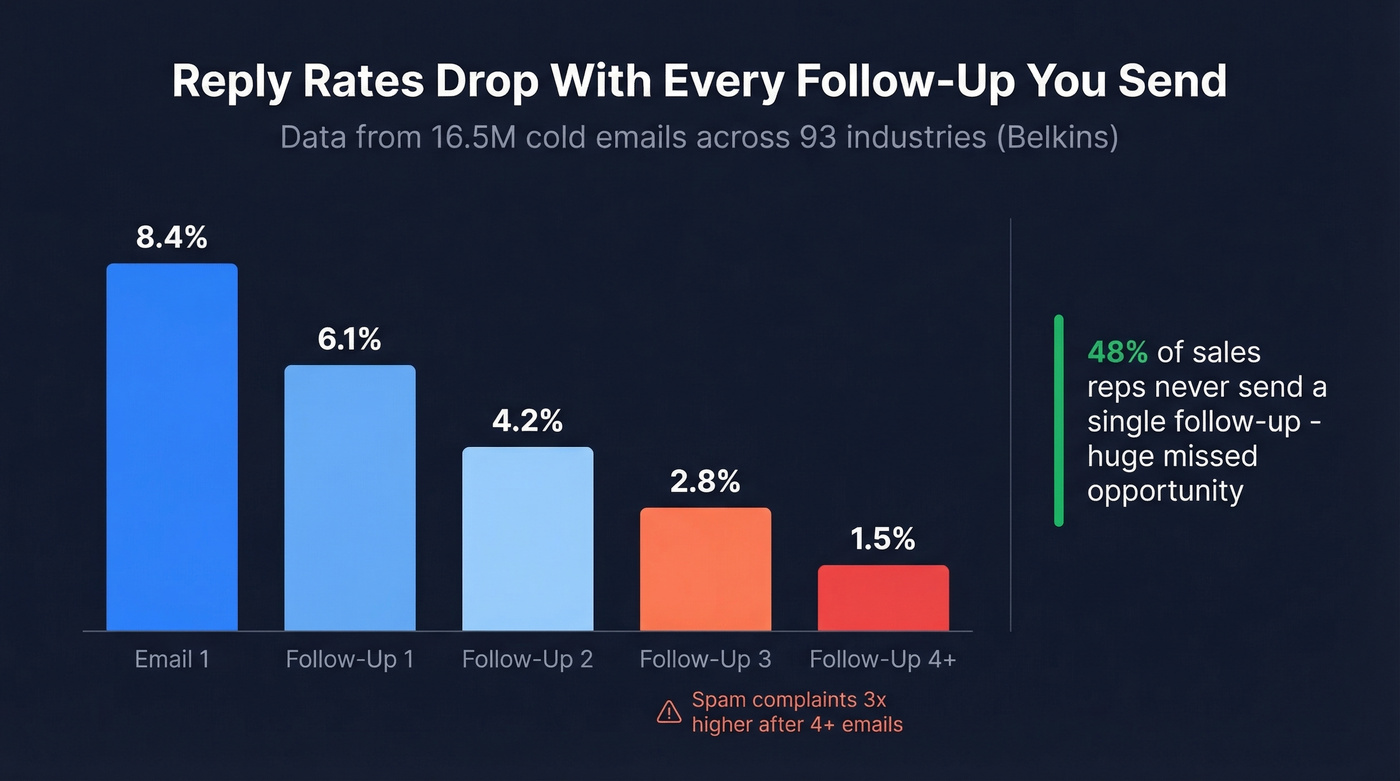
That doesn't mean follow-ups are useless. Far from it. Follow-ups generate 42% of all campaign replies, and 48% of reps never send a second message. The opportunity is massive - but it lives in the first one or two follow-ups, not the fifth. In our experience, the second follow-up is where most deals either advance or die quietly.
Once you hit four or more emails in a sequence, unsubscribe and spam complaint rates more than triple. You're not just annoying people at that point. You're actively damaging your sender reputation and domain health.
Let's be honest: most people don't have a follow-up problem. They have a first-email problem. If your initial message was specific, relevant, and sent to a verified address, you'd need fewer follow-ups in the first place. Wasting your one good shot on a vague "following up on the email below" is like showing up to a pitch meeting and saying "so... remember me?"

Your follow-up copy won't matter if 17% of your emails never reach the inbox. Prospeo's 5-step verification delivers 98% email accuracy - so every follow-up lands where it should. At $0.01 per email, fixing your deliverability costs less than the coffee you drink while writing that perfect second touch.
Stop perfecting follow-ups that bounce. Verify first.
Forwarding "The Email Below" Right
Let's address the literal intent behind this phrase. Sometimes you genuinely need to forward your original email and add a note on top. That's fine - here's how to do it without sounding like you're just bumping a thread.
Do this: Forward your original email and add a brief 2-3 sentence note at the top. State what you need and by when:
Subject: Fwd: Q2 Partnership Proposal - Acme Corp
Hi Sarah - forwarding my original note for context. Could you confirm by Thursday whether the proposed timeline works? Happy to adjust if the dates don't line up with your team's sprint cycle.
- Forwarded message ----------
Not this: Don't slap "Following up on the email below" at the top with no additional context, no deadline, and no specific ask. That's the email equivalent of tapping someone on the shoulder and walking away.
When to forward vs. reply in thread: forward when the recipient may have deleted or lost the original. Reply in thread when you're continuing an active conversation - the thread history gives them context without you needing to explain it.
Better Alternatives by Scenario
Here's where the rubber meets the road. Every weak follow-up below gets a replacement that actually earns a reply.
Sales Follow-Up
| Before | After |
|---|---|
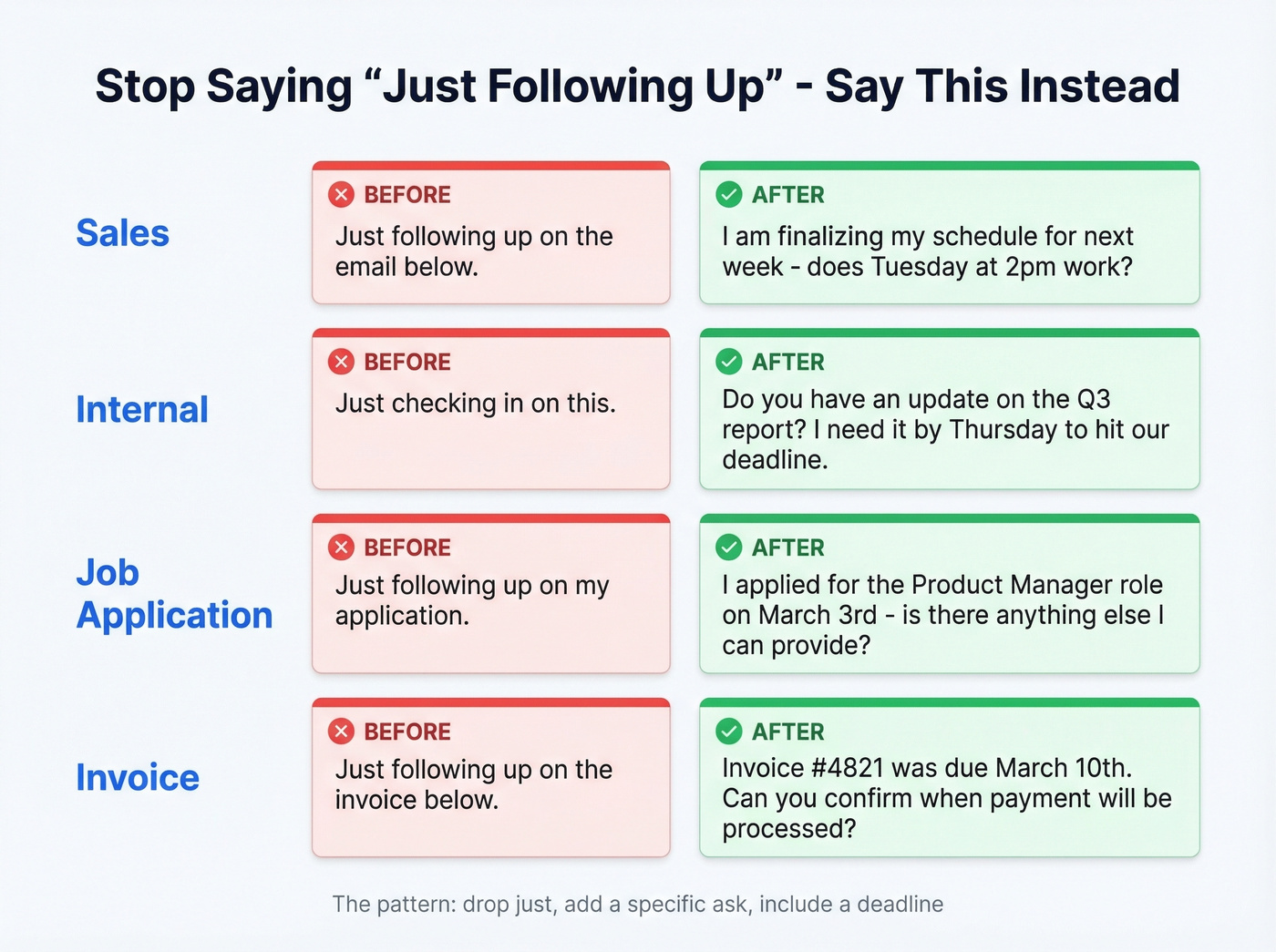
| "Just following up on the email below." | "I'm finalizing my schedule for next week - does Tuesday at 2pm work?" |
| "Wanted to circle back on my proposal." | "The pricing I sent expires Friday. Want to jump on a 15-min call before then?" |
The "finalizing my schedule" angle is a go-to on r/sales because it creates urgency without sounding pushy. It gives the recipient a concrete reason to respond now. Manufactured urgency feels sleazy; real calendar constraints don't.
If you want more plug-and-play options, keep a few sales follow-up templates ready so you’re not rewriting from scratch every time.
Internal / Coworker Follow-Up
| Before | After |
|---|---|
| "Just checking in on this." | "Do you have an update on the Q3 report? I need it by Thursday to hit our deadline." |
| "Bumping this up." | "Flagging this again - the client meeting is Monday and I need your input on slide 4." |
Deadlines do the heavy lifting here. You're not nagging - you're giving context about why the timing matters. If you don't have a real deadline, create a soft one: "I'm compiling updates for our Friday standup. Can you send your section by EOD Thursday?"
For more wording swaps like this, see how to say just checking in professionally.
Job Application Follow-Up
| Before | After |
|---|---|
| "Just following up on my application." | "I applied for the Product Manager role on March 3rd - is there anything else I can provide to support my application?" |
One follow-up, sent 5-7 business days after applying. That's it. More than that and you risk being flagged as overly aggressive, which is the opposite of the impression you want to make. Skip this advice if you're following up with a recruiter who explicitly asked you to check back - in that case, follow their timeline, not this one.
Invoice / Payment Follow-Up
| Before | After |
|---|---|
| "Just following up on the invoice below." | "Invoice #4821 was due on March 10th. Can you confirm when payment will be processed?" |
Invoice follow-ups are the one scenario where directness isn't just helpful - it's expected. Accounts payable teams process hundreds of requests; vague language gets deprioritized. State the invoice number, the due date, and what you need.
Follow-Up Timing and Subject Lines
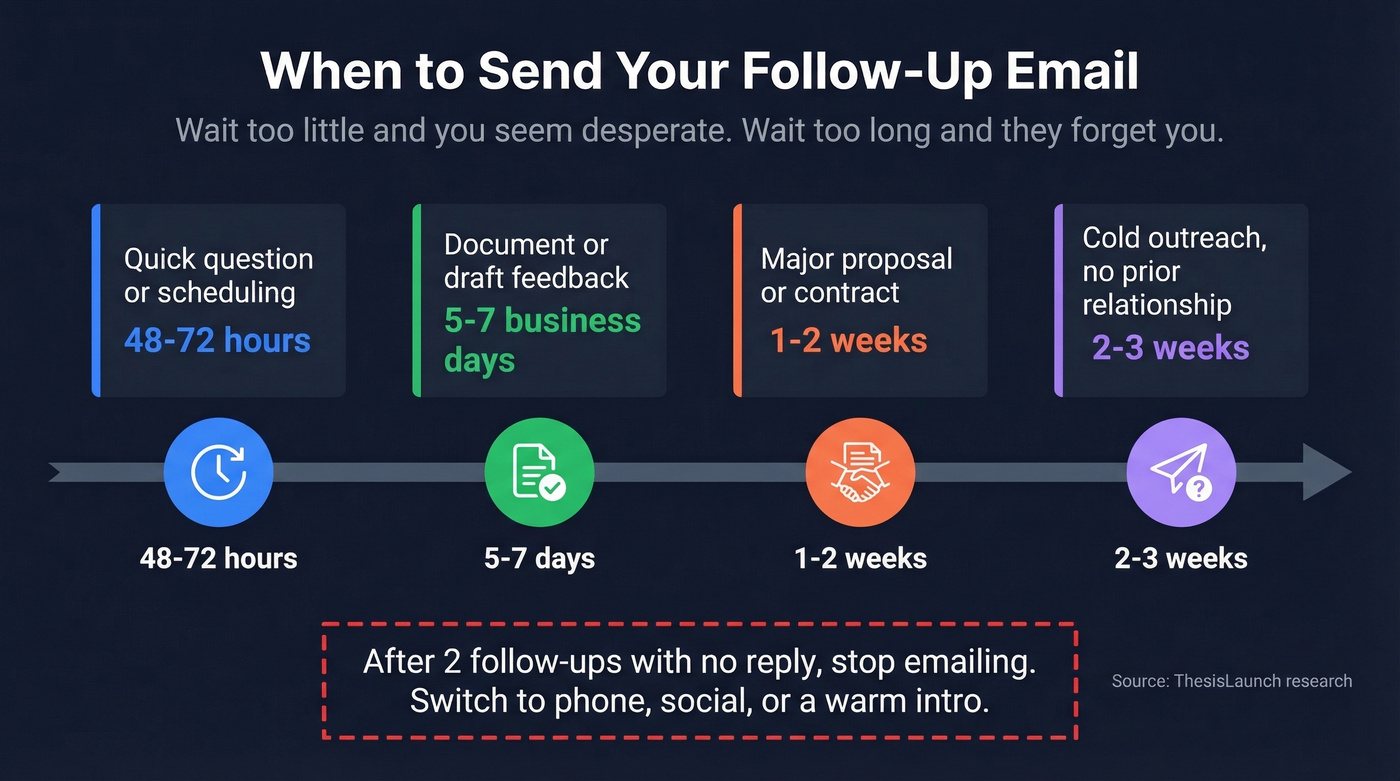
Timing matters more than most people think:
| Scenario | Wait Before Following Up |
|---|---|
| Quick question / scheduling | 48-72 hours |
| Document or draft feedback | 5-7 business days |
| Major proposal or contract | 1-2 weeks |
| Cold outreach, no prior relationship | 2-3 weeks |
If you’re trying to systematize this, use a simple rule set like the one in when should i follow up on an email.
For subject lines - a massive gap in most follow-up advice - here's what works:
- "Re: [Original Subject]" - reply-thread format signals continuity
- "[Name] - quick question about [X]" - personalized and specific
- "Following up: [deliverable] by [date]" - deadline-driven
- "Any update on [X]?" - short, direct, hard to ignore
If you need more ideas, pull from a swipe file of email subject line examples and adapt them to your scenario.
The golden rule from ThesisLaunch's research: stop after two follow-up emails. If you haven't heard back after two attempts, switch channels entirely - call, send a message on social, or ask for an introduction through a mutual connection.
Verify the Inbox First
The best follow-up template in the world doesn't matter if your email bounced. And 17% of cold emails never reach the inbox. That's nearly one in five messages vanishing before anyone sees them.
If you want the deeper mechanics (SPF/DKIM/DMARC, warming, list hygiene), start with an email deliverability guide and then track your email bounce rate as you scale.
We use Prospeo for this - 98% email accuracy, real-time verification, and a free tier that lets you verify 75 emails a month without a credit card. A two-second verification step saves you from wondering why your perfectly crafted follow-up got zero response. Before you agonize over phrasing, make sure you're reaching a real person.
If you’re troubleshooting whether an address is real before you send, use a workflow like check if an email exists.
The data is clear: your first email matters more than your fifth follow-up. Prospeo gives you 30+ filters - buyer intent, job changes, technographics - so your initial outreach is so targeted, you won't need to "just follow up" at all. Teams using Prospeo book 35% more meetings than Apollo users.
Send fewer follow-ups by nailing the first email.
FAQ
Is "just following up" unprofessional?
Not technically unprofessional, but it's vague and easy to ignore. The word "just" minimizes your request, signaling that even you don't think it's important. Replace it with a specific ask and a deadline - you'll sound more confident and get more replies.
How many follow-ups is too many?
Data from 16.5 million emails shows reply rates peak at the first email and decline with each additional touch. After two follow-ups with no response, stop emailing and switch channels - call, message on social, or ask for an introduction. Four-plus emails triple your spam complaint risk.
What's the best subject line for a follow-up email?
Keep the original thread ("Re: [Subject]") when possible - it signals continuity and avoids the spam filter. For a fresh email, use the recipient's name plus the specific topic: "[Name] - update on [X]?" Avoid generic lines like "Checking in" or "Quick follow-up."
Is "just following up on my previous email" any better?
Barely. Swapping "the email below" for "my previous email" changes the reference point but not the underlying problem - you're still restating your existence without adding new information or a specific ask. The fix is the same: drop "just," state what you need, and include a deadline so the recipient knows exactly how to respond.
How do I make sure my follow-up actually reaches the inbox?
Verify the recipient's email address before sending. Tools like Prospeo offer real-time verification with 98% accuracy and a free tier of 75 credits per month. Since roughly 17% of cold emails bounce, a quick verification step eliminates the most common reason follow-ups go unanswered.