

slug: winning-sales-proposals
How to Write Winning Sales Proposals (With Data From 2.6M Deals)
Your prospect said "just send me the proposal." That was two weeks ago. You've followed up twice, gotten nothing back, and now you're staring at a dead Slack thread wondering if the deal evaporated or if they're just busy. Probably both.
Here's the uncomfortable math: opportunities that reach the proposal stage carry a 47% win rate, according to RAIN Group research. The average proposal takes roughly 25 hours to assemble. That's three full working days poured into a document that fails more often than it succeeds. We've watched teams burn entire weeks on proposals that never got a response - not because the solution was wrong, but because the document itself killed momentum.
Let's break down what actually separates winning sales proposals from the ones that collect dust.
Three Changes That Move the Needle Most
If you're short on time, start here:
- Keep it under 5 pages. Analysis of 2.6M proposals by Proposify shows 5-page proposals close roughly 50% of the time. At 30 pages, that drops to about 35%.
- Offer tiered pricing. Multiple packages increase win likelihood by 36%.
- Follow up more than once. Nearly half of reps never make it past a second follow-up. The deals are there. The persistence isn't. (If you need copy you can send today, use these follow-up templates.)
The Numbers Behind Proposal Success
The data below draws from Proposify's 2.6M-proposal dataset, a practitioner analysis of 50,000 proposals shared on Reddit, and cross-industry RFP benchmarks.
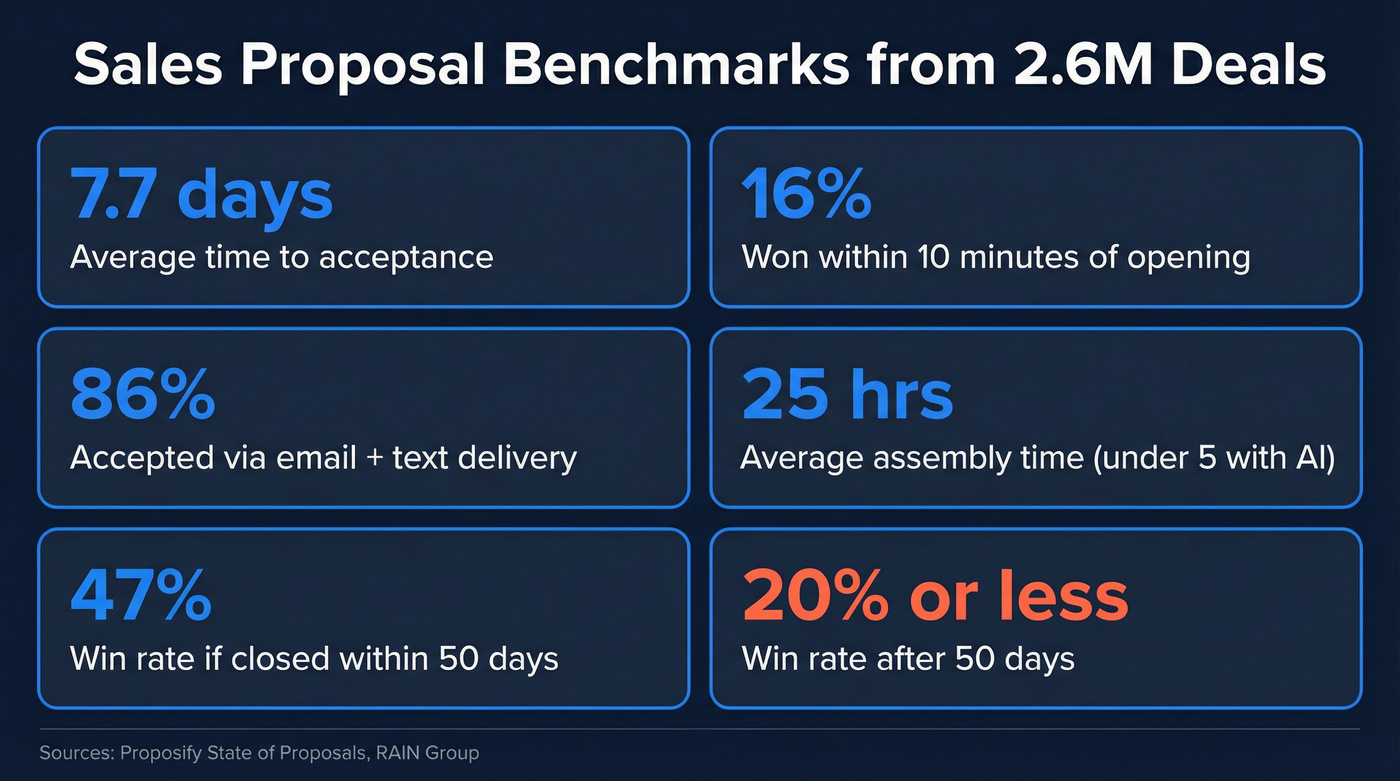
| Metric | Benchmark |
|---|---|
| Avg. time to acceptance | 7.7 days |
| Won within 10 min of opening | 16% |
| Accepted via email + text | 86% |
| Avg. assembly time | 25 hrs (can drop to under 5 with AI-powered automation) |
| Top performers using AI for proposals | 72% |
| Win rate within 50 days / after 50 days | 47% / 20% or less |
That 16% figure deserves a double-take. Those buyers had already decided - the proposal was just the formality. Your job is to make sure nothing in the document gives them a reason to slow down.
Here's the thing: stop obsessing over your proposal template. The template is table stakes. What separates winners from everyone else is almost entirely what happens after you hit send. (More on tightening the whole motion in sales process optimization.)
What Your Proposal Needs (and What It Doesn't)
Include these:
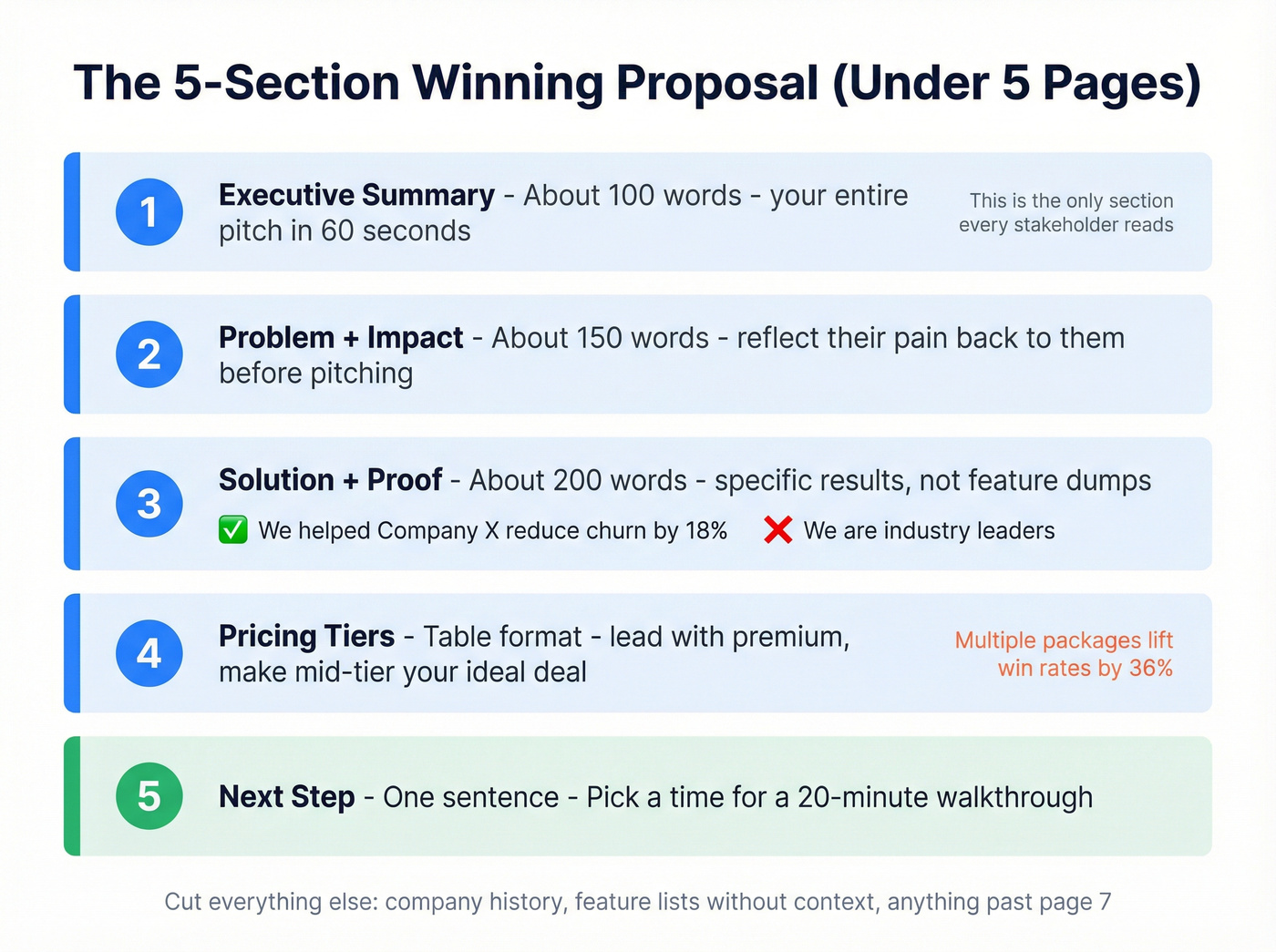
- Problem framing before your solution. 37% of lost deals cite no product fit and 35% cite poor value for money. Your proposal must prove fit and value before anything else - the buyer needs to see their pain reflected back before they'll trust your fix. (If your discovery is weak, fix it with better discovery questions.)
- An executive summary at roughly 10% of total length. This is the only section every stakeholder reads.
- Social proof with specifics. "We helped Company X reduce churn by 18%" beats "we're industry leaders" every time. (If you're selling retention outcomes, align your proof to churn analysis.)
- A concrete next step. Not "let us know your thoughts." Something like: "Pick a time for a 20-minute walkthrough." (This works best when it matches your steps to close a sale.)
Cut these: company history (nobody cares you were founded in 2012), feature dumps without context, and anything past page 7 unless the RFP demands it. Features don't close deals. Outcomes do.
One seller on r/sales shared a story about nearly sending a 138-page PDF before catching themselves and booking a live review instead. As another practitioner put it: "Stop writing long proposals, no one reads them." We've seen this pattern ourselves - the teams that win consistently aren't writing longer proposals, they're writing sharper ones.
A strong proposal in 5 sections: (1) Executive summary, about 100 words. (2) Problem + impact, about 150 words. (3) Solution + proof, about 200 words. (4) Pricing tiers in a table. (5) Next step - one sentence.

Your proposal is only as good as the inbox it lands in. 98% of emails in Prospeo's 300M+ database are verified through a 5-step process - so your 25-hour proposal actually reaches the decision-maker. At $0.01 per email, verification costs less than the coffee you drank writing it.
Stop sending winning proposals to dead inboxes.
How to Present Pricing
Lead with your premium tier. When the buyer sees the top option first, the mid-tier feels like a smart compromise rather than a stretch. The bottom tier covers the basics and gets your foot in the door. The middle tier is where most buyers land - make it your ideal deal. (If you want the psychology behind this, use an anchor in negotiation.)
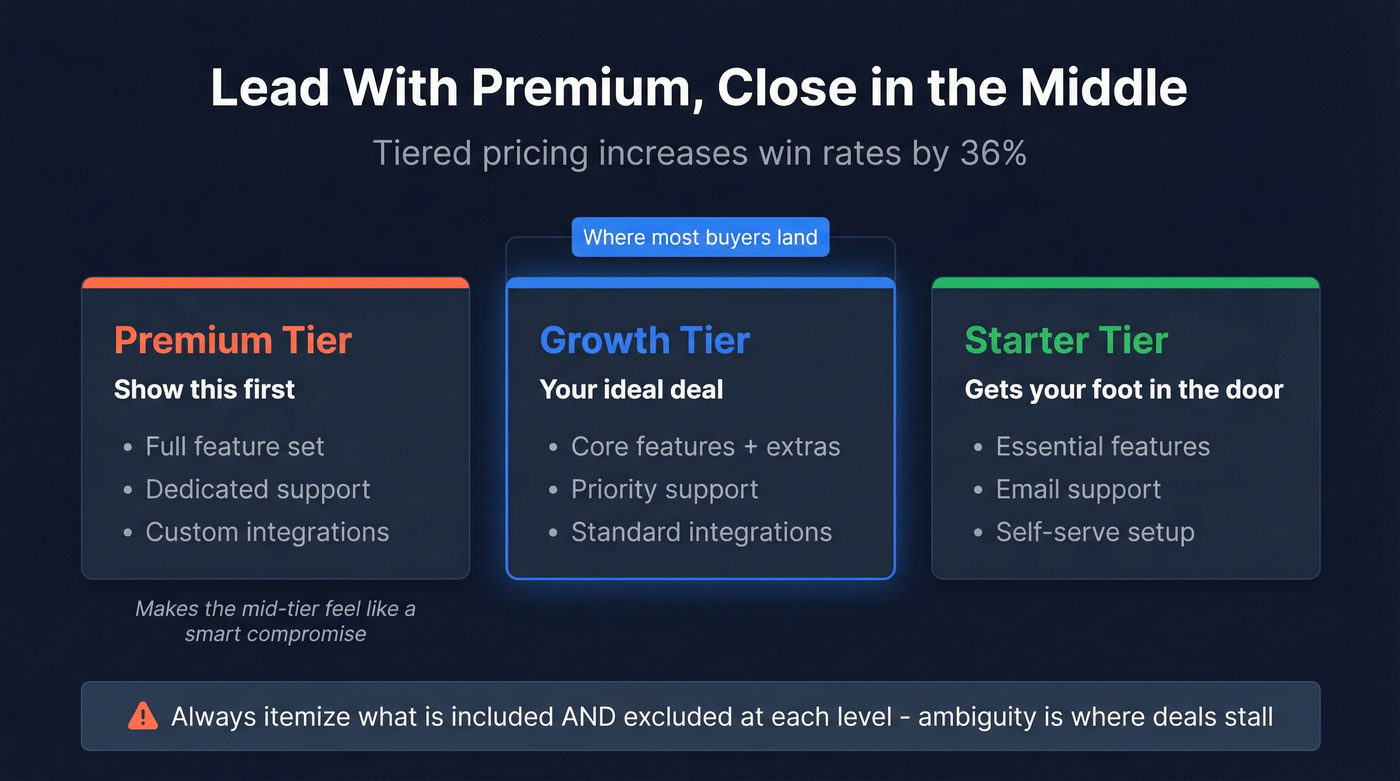
Offering multiple packages lifts win rates by 36% compared to single-option proposals. Itemize what's included and excluded at each level. Ambiguity around scope is where deals stall and relationships sour. We've seen more proposals die from pricing confusion than from actual price objections.
The Post-Proposal Playbook
Every other guide stops at "write a great proposal." That's a mistake. The proposal isn't the close - it's the start of a decision process. And 48% of reps never make it past the second follow-up, even though 75% of buyers expect 2-4 touches before deciding. (If you're rebuilding your motion, start with importance of follow-up in sales.)
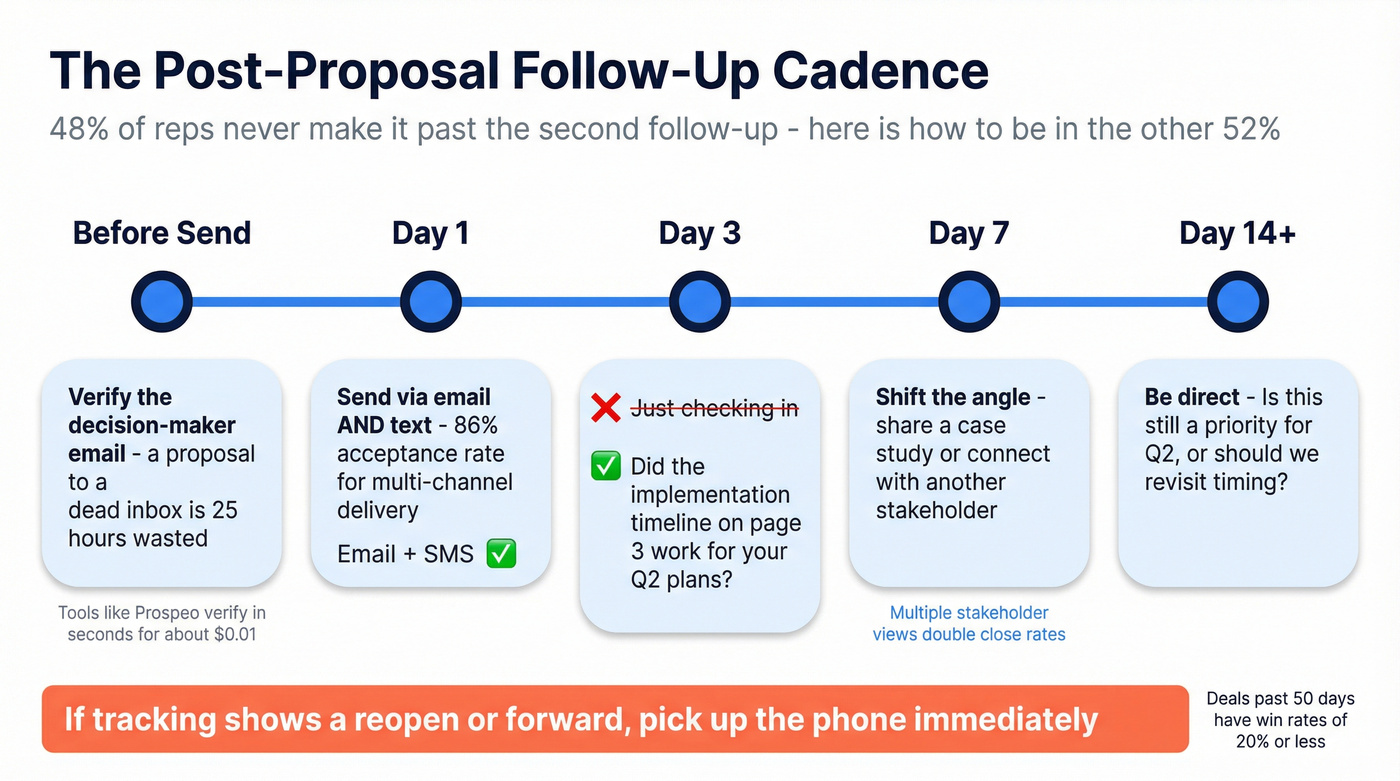
Before you send: Confirm the decision-maker's current email. A proposal to a dead inbox is 25 hours wasted. Prospeo verifies emails across 300M+ profiles with 98% accuracy - takes seconds and costs about $0.01 per email. (If you're troubleshooting bounces, see email bounce rate.)
Day 1: Send the proposal via email and text. That 86% acceptance rate for multi-channel delivery isn't a coincidence.
Day 3: This is where most reps default to "just checking in." Don't. Ask a specific question: "Did the implementation timeline on page 3 work for your Q2 plans?" (If you need better language, use this guide on how to say just checking in professionally.)
Day 7: Shift the angle. Share a relevant case study or connect with another stakeholder. When more than one stakeholder views a proposal, the close rate doubles.
Day 14+: Be direct: "Is this still a priority for Q2, or should we revisit timing?"
The best follow-up signal is a proposal reopen. If tracking shows the buyer opened the doc a second time or forwarded it to a colleague, pick up the phone immediately. The consensus on r/sales is unanimous on this one: call when the proposal gets reopened. Every time.
And watch the clock. Deals that drag past 50 days carry win rates of 20% or less. Urgency isn't a sales tactic here - it's math. (To diagnose where deals stall, use these pipeline health metrics.)
Tools for Building Better Proposals
33% of sales teams still don't use proposal software. If you're assembling proposals in Google Docs and manually tracking opens, you're leaving money on the table. (If you're evaluating your stack, start with examples of a CRM.)
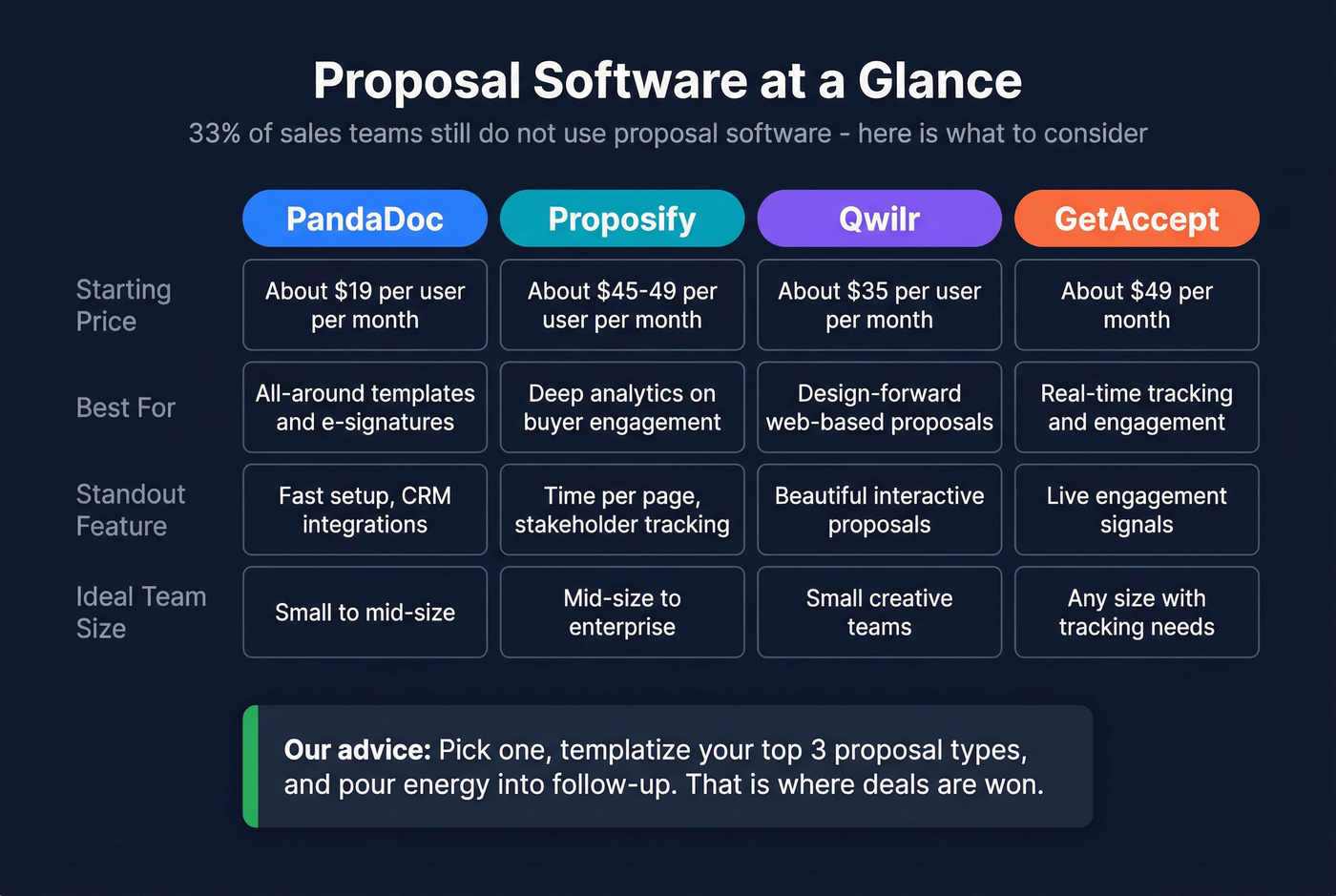
PandaDoc (from about $19/user/mo) is a strong all-around option for templates, e-signatures, and CRM integrations. It's the default pick for teams that want to get up and running fast without a steep learning curve. Proposify (from $45-49/user/mo) is a better fit when you want deeper analytics on exactly how buyers engage with each section - time spent per page, which stakeholders opened it, where they lingered. That data feeds directly into your follow-up strategy.
Qwilr (from $35/user/mo) is a design-forward option for web-based proposals when presentation matters, and GetAccept (from $49/month) stands out for real-time tracking. Some teams pair tools like these with digital sales rooms from Arrows or Highspot that let buyers interact with proposals rather than just read them. (If you're considering that approach, see what a digital sales room is actually for.)
Skip the tool comparison rabbit hole if you're a small team. In our experience, teams overthink tool selection here. Pick one, templatize your top 3 proposal types, and pour your energy into the follow-up cadence. That's where deals are actually won or lost. 80% of top performers maintain a content library for proposal reuse - build yours once, then iterate.
Your follow-up cadence doubles close rates when you loop in multiple stakeholders. Prospeo gives you verified emails and direct dials for the entire buying committee - 125M+ mobile numbers with a 30% pickup rate. Find every stakeholder in seconds, not days.
Reach the whole buying committee before your proposal goes cold.
FAQ
How long should a sales proposal be?
Analysis of 2.6M proposals shows 5-page documents close about 50% of the time, while 30-page proposals drop to roughly 35%. Aim for 3-7 pages unless the RFP demands more. Front-load your executive summary and pricing - those are the sections stakeholders actually read.
How soon should I follow up after sending a proposal?
Follow up within 24-48 hours, then at day 3 and day 7. Average acceptance time is 7.7 days, but 16% of proposals are won within 10 minutes of opening. Use open and reopen signals to time your outreach - a second open is your cue to call immediately.
What makes a proposal stand out from competitors?
The best proposals lead with the buyer's problem, not the seller's credentials. They include specific social proof, tiered pricing, and a single clear next step - all in under seven pages. Pair that with a disciplined follow-up cadence and you'll outperform the majority of competitors who stop at "let us know your thoughts."
How do I make sure my proposal reaches the decision-maker?
Verify the decision-maker's email before sending. Tools like Prospeo or Hunter can confirm deliverability in seconds. A proposal sent to a generic inbox or stale contact is wasted effort - and you won't know it failed until the silence stretches past two weeks.