

15 Cold Calling Script Examples Backed by Real Data
Rippling SDRs book 650 demos a month through cold calls. At Nooks, 75% of meetings come from the phone. Owner's BDRs generate $72K ARR per month per rep - 95% from calls.
The average cold calling success rate sits at 2.3%. That's roughly 1 meeting per 40-45 dials. These cold calling script examples are built on the frameworks those teams actually use, and we've pressure-tested them across dozens of outbound campaigns. You don't need 25 scripts. You need 3 frameworks and the discipline to practice them.
Quick Picks
The permission-based opener is the highest-converting cold call format right now. Pair it with a Sandler up-front contract close and you've got a framework that works across industries and seniority levels. But your script only matters if you're reaching real people - verified mobile numbers and correct timing are the other half of the equation.
- Best all-purpose script: Permission-based opener (Script 1)
- Best for discovery calls: "Doctor" approach (Script 3)
- Best for gatekeepers: Direct authority script (Script 5)
Cold Calling Benchmarks for 2026
Know what "good" looks like before you touch a script.
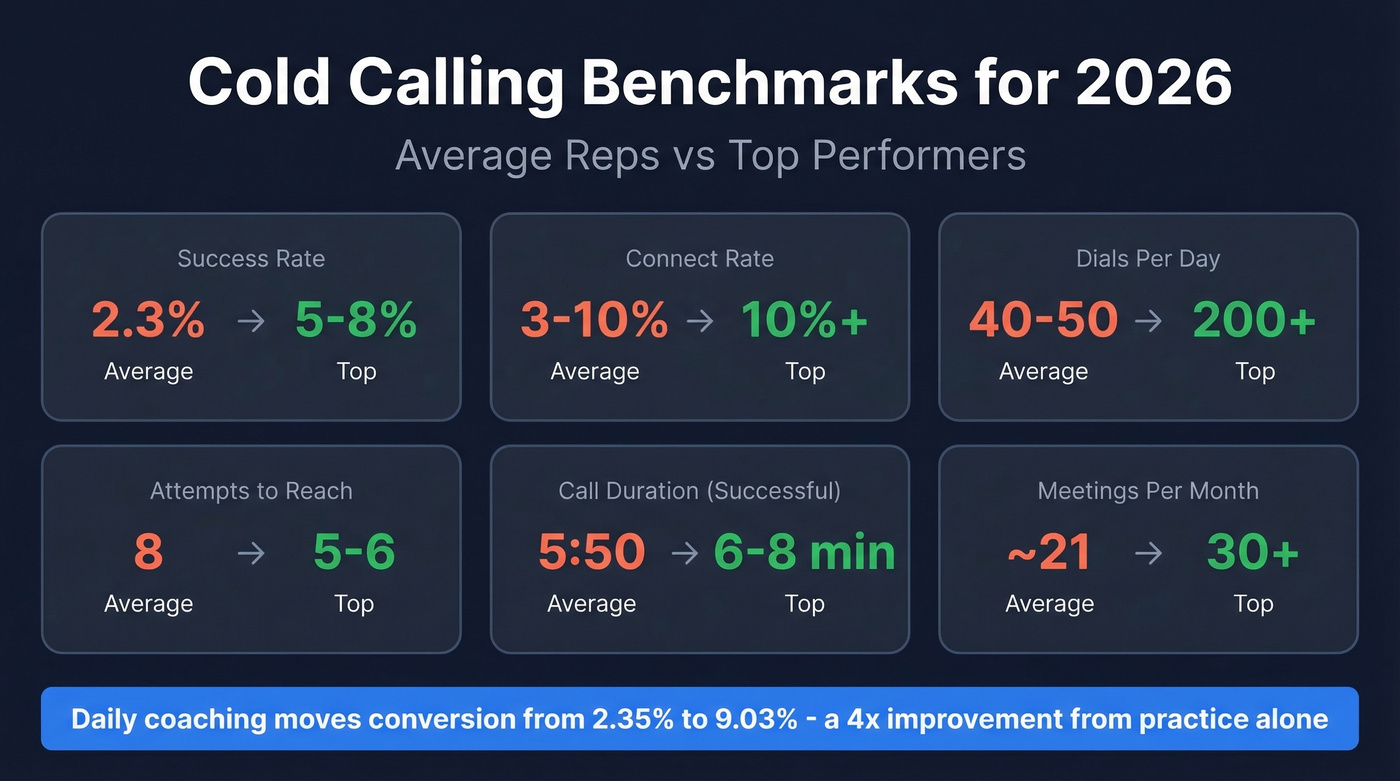
| Metric | Average | Top Performers |
|---|---|---|
| Success rate | 2.3% | 5-8% |
| Connect rate | 3-10% | 10%+ |
| Dials/day | 40-50 | 200+ |
| Attempts to reach | 8 | 5-6 (verified data) |
| Call duration (successful) | 5:50 | 6-8 min |
| Meetings/month | ~21 | 30+ |
The gap between average and top performers isn't talent - it's coaching. Daily training and role play can move conversion from 2.35% to 9.03%, a 4x improvement from practice alone. If your TAM is large enough, there's no excuse for not hitting these numbers. The scripts below give you the raw material. Repetition turns them into muscle memory.
15 Cold Call Scripts That Work
1. Permission-Based Opener
This is the script we recommend starting with. It disarms the prospect immediately - you're acknowledging the interruption instead of pretending it isn't one.
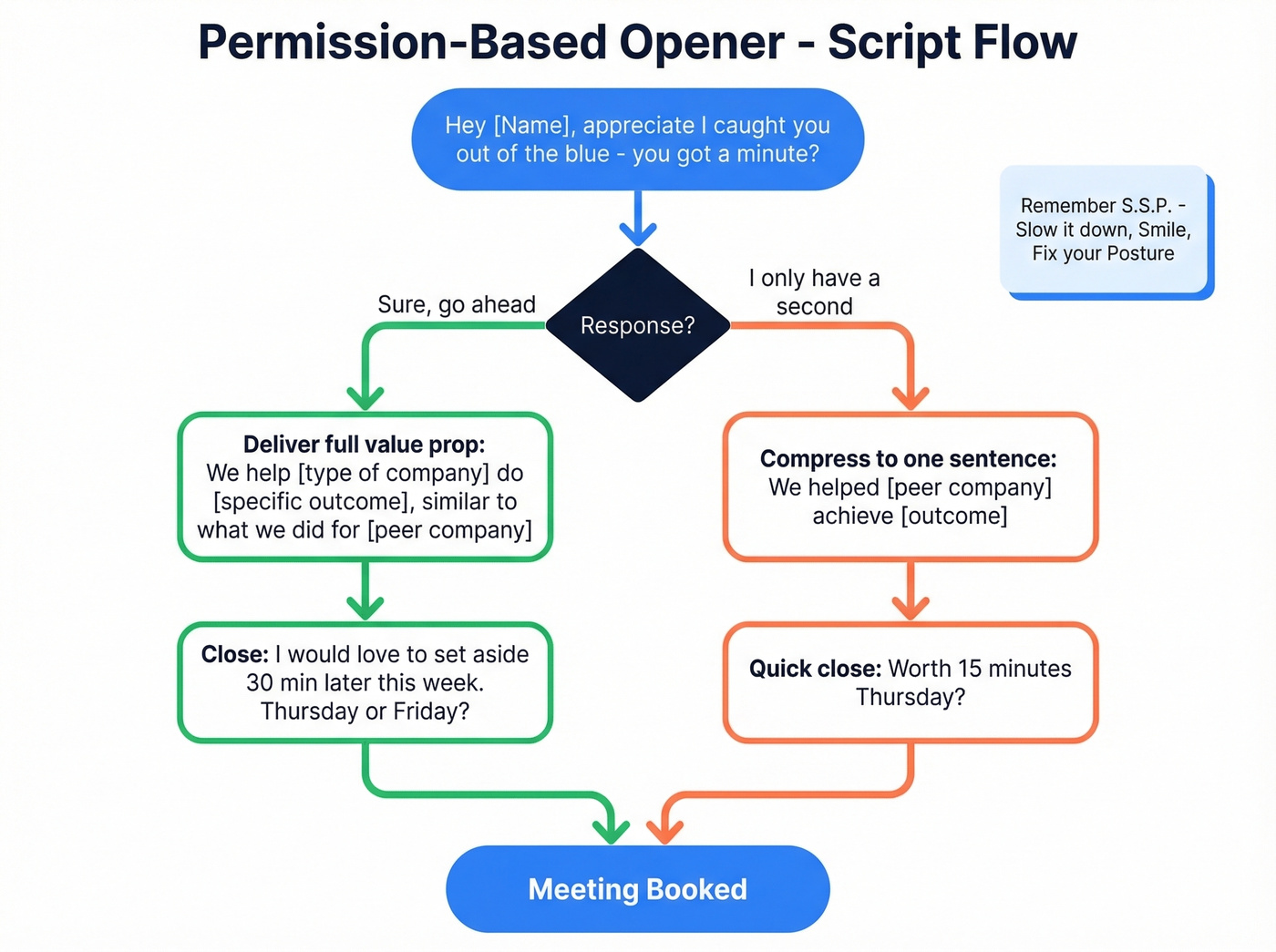
"Hey [Name], appreciate I caught you out of the blue - you got a minute? [Pause] We help [type of company] do [specific outcome], similar to what we've done for [competitor/peer]. I'd love to set aside a half hour later this week to show you how. Would Thursday or Friday work?"
One counterintuitive data point from Gong's research: opening with "How've you been?" pushes success rates to 10.01%. It sounds like small talk, but it triggers a reciprocity response that keeps prospects on the line.
Delivery matters as much as the words. Remember S.S.P. - Slow, Smile, Posture. Slow it way down, almost uncomfortably slow. Smile. Fix your posture. It sounds ridiculous, but it changes your tone in ways prospects can hear. The consensus on r/sales is that this opener outperforms everything else because it sounds human, not scripted.
Branch your script based on the response. If they say "sure, go ahead," move straight to your value prop. If they push back with "I only have a second," compress to one sentence: "We helped [peer company] [outcome]. Worth 15 minutes Thursday?" Two paths, same opener.
2. Sandler Up-Front Contract
The Sandler framework reduces resistance by giving the prospect control. You're not asking for a meeting - you're asking for 30 seconds. This structure works because it sets expectations before you pitch anything.
"Hey [Name], it's [Your Name] with [Company]. Can I take 30 seconds to tell you why I called? Then you can decide if we keep chatting. [Pause for yes] We help [companies like theirs] with [outcome]. If it makes sense, we'll book 20 minutes next week. If not, we'll part ways. Fair?"
The "fair?" at the end creates a micro-agreement that keeps the conversation alive.
3. Discovery-First "Doctor" Approach
A practitioner on r/Entrepreneur credited this framework with closing 200+ deals. The core principle: diagnose before you prescribe.
"So the way I usually run these calls is I'll start by asking a few questions about what you're working on and where things stand. If it sounds like I can definitely help, I'll explain how I work. Sound good?"
The prospect should do 80% of the talking in the first half. When you transition to your solution, use a permission bridge: "Would it be okay if I walk you through how I'd approach it?" This prevents the biggest cold call killer - talking at someone instead of with them.
4. Trigger Event Script
When you reference a specific trigger - a funding round, a new hire, a job change - your success rate jumps by 2.1% over generic openers. Here's how that looks:
"Hey [Name], saw [Company] just closed a Series B - congrats. Usually when teams hit that stage, [specific pain point] becomes a priority. We helped [similar company] solve that in [timeframe]. Worth a 20-minute conversation?"
Spend 3-5 minutes per prospect checking for recent news, job changes, or hiring signals before you dial. The trigger makes the call feel relevant instead of random.
5. Gatekeeper Script
Be direct, be brief, and sound like you belong. Don't try to trick gatekeepers.
"Hi, it's [Your Name] calling for [Prospect Name] - is she available?" [If asked what it's regarding] "We're working with [peer company] on [outcome] and I wanted to loop her in. Can you put me through?"
Friday afternoons are gold for reaching executives directly. Gatekeepers leave early, but VPs and C-suite are often still at their desks clearing the week's backlog.
6. Voicemail Script
Keep it under 30 seconds. One reason to call back, your direct number, nothing else.
"Hey [Name], [Your Name] with [Company]. Quick reason for the call - we helped [similar company] cut [metric] by [number]. Thought it'd be relevant given [trigger]. My direct line is [number]. Again, that's [number]."
7. Follow-Up After Email
"Following up on my email" is dead air - give them a reason to care.
"Hey [Name], I sent you a note Tuesday about [topic]. Wanted to add one thing - we just published results from [customer] showing [specific outcome]. Worth 15 minutes this week?"
8. Referral-Based Script
Mentioning a shared connection increases your meeting chance by 70% according to HubSpot's sales research. Even a shared professional group works.
"Hey [Name], [Mutual Connection] suggested I reach out. We helped their team with [outcome] and she thought you might be dealing with something similar."
9. Competitor Displacement Script
Don't trash the competitor. Acknowledge them, then introduce a specific gap you fill.
"Hey [Name], I know you're using [Competitor] for [function]. Most teams we talk to love [specific feature] but run into [specific limitation]. We solve that differently - mind if I take 60 seconds to explain how?"
10. Executive / C-Suite Script
Shorter. More direct. Lead with the business outcome.
"Hey [Name], [Your Name] with [Company]. We're helping [peer company's] team [specific business outcome]. I'd like 15 minutes to see if we can do the same for [their company]. What does Thursday look like?"
11. Re-Engagement Script
"Hey [Name], we spoke back in [month] about [topic]. Since then we've shipped [new feature/result] - thought it was worth a fresh conversation. Got 10 minutes this week?"
"Just checking in" is never a reason to call. Tie every re-engagement to something new.
12. Demo-Setting Script
"I've got a 2pm Thursday or 10am Friday - which works better for you?"
"Would sometime next week work?" is weak. Specific time slots convert higher because they reduce decision friction.
13. SaaS / Tech-Specific Script
"If your team's spending more than 2 hours a week on [manual process], we automate that and plug straight into [their stack]. Worth a quick demo?"
Open with a technical pain point and tie it to integration or ROI.
14. Real Estate Cold Call
"Properties in [neighborhood] are averaging [days on market]. I've got a strategy that's cutting that in half for my clients - worth a quick chat?"
Lead with local market data. Numbers make you credible before you've said a word about yourself.
15. Financial Services Script
"With the new [regulation] taking effect in Q2, most firms I talk to are scrambling to adjust [process]. We've built a playbook that handles it - can I walk you through it?"
Regulatory triggers are the strongest openers in financial services because they create urgency you don't have to manufacture.
Data Quality: The Prerequisite Nobody Talks About
Here's the thing: you're 30 dials in and haven't reached a single person. You check the list - half the numbers are disconnected. The problem isn't your script. It's your data.
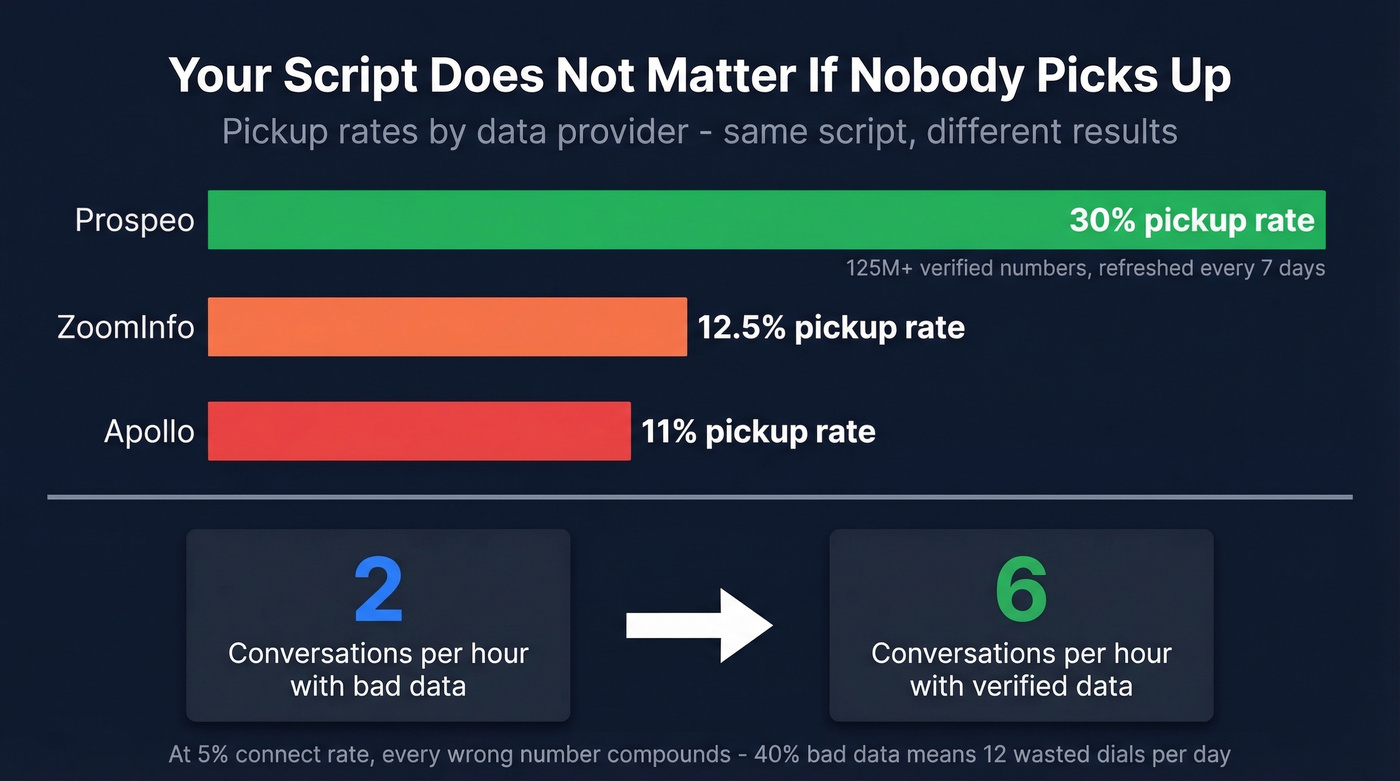
At a 5% connect rate, every wrong number compounds. If 40% of your list is bad data, you're burning 12 dials just to get through the garbage - wasted calling time every single day. We've seen teams double their connect rate overnight just by switching data providers.
Prospeo's mobile database covers 125M+ verified numbers with a 30% pickup rate, compared to ZoomInfo's 12.5% and Apollo's 11%. That's the difference between 2 conversations per hour and 6. Data refreshes every 7 days versus the 6-week industry average, so you're not calling numbers that went stale a month ago.
If your deal sizes run above $5K, bad phone data is the most expensive problem on your sales floor - more costly than bad scripts, bad timing, or bad coaching. Fix the data layer first.

Scripts don't book meetings - reaching the right person does. Prospeo gives you 125M+ verified mobile numbers with a 30% pickup rate, so every dial connects to a real decision-maker. Stop burning 8 attempts per prospect when verified data cuts it to 5.
Dial direct numbers that actually pick up - starting at $0.01 per lead.
Trigger events like funding rounds and job changes boost cold call success by 2.1%. Prospeo tracks 15,000 intent topics and refreshes data every 7 days - so your scripts always reference what's happening right now, not last quarter.
Turn every cold call into a warm call with real-time buyer signals.
Handling the 8 Most Common Objections
60% of cold calls hit "I'm not interested" before you've said anything of value. The framework is simple: Listen, clarify, respond with value.
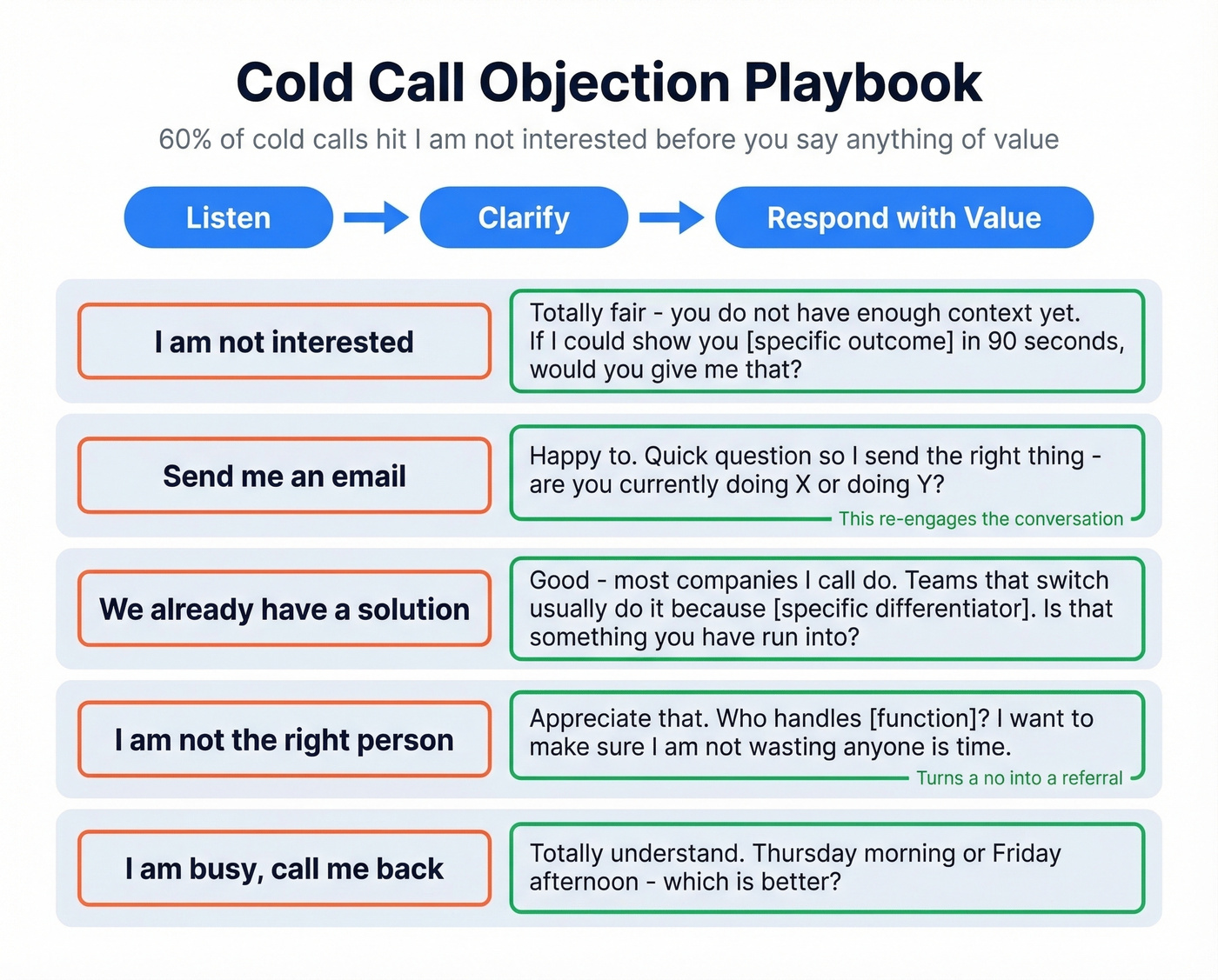
"I'm not interested." "Totally fair - you don't have enough context yet. If I could show you [specific outcome] in 90 seconds, would you give me that?"
"Send me an email." "Happy to. Quick question so I send the right thing - are you currently [doing X] or [doing Y]?" This re-engages the conversation and gives you intel for the follow-up.
"We already have a solution." "Good - most companies I call do. Teams that switch usually do it because [specific differentiator]. Is that something you've run into?"
"I'm not the right person." "Appreciate that. Who handles [function]? I want to make sure I'm not wasting anyone's time."
"I'm busy / call me back." "Totally understand. Thursday morning or Friday afternoon - which is better?" Pin down a specific time or it's a dead end.
"No budget." "Makes sense. Can I show you what [similar company] saved in 15 minutes? Then you'll know if it's worth bringing to your CFO."
"Not a priority right now." "I hear that a lot. Usually what changes is [trigger event]. Want me to follow up in [timeframe] so you're ahead of it?"
"I don't think it's a fit." "What specifically makes you say that? [Listen] What if I showed you how we handle [that concern]?"
And the hang-up? It happens. Wait 48 hours, try again with a different approach. The Feel-Felt-Found method works well on the second attempt: "Other [role] I've talked to felt the same way until they found that [specific result]."
Let's be honest - reading a cold call transcript of your own objection handling is painful. But it's one of the fastest ways to spot where your dialogue breaks down. Record yourself, review the transcript, and identify the exact moment you lost control.
Best Days and Times to Call
A 1.4-million-call study from InsideSales gives us the clearest picture of what days actually convert.
| Day | Demo Share | Notes |
|---|---|---|
| Monday | Highest efficiency (1.19%) | Quality over volume |
| Tuesday | ~22% of demos | Best day overall |
| Wednesday | ~22% of demos | Strong in EMEA too |
| Thursday | Solid | Mid-week momentum |
| Friday | Worst on every metric | Use for research |
For time of day, 4-5 PM is the best window, with 10-11 AM as a strong second. Successful cold calls average 5:50 in duration versus 3:14 for unsuccessful ones - when you do connect, don't rush. Let the conversation breathe.
7 Mistakes That Kill Results
No pre-call research. Spend 3-5 minutes per prospect. Check for funding, hiring signals, job changes. Skip this if your TAM is massive and you're running a pure volume play - but for mid-market and enterprise, research is non-negotiable. (If you need a repeatable workflow, start with an Ideal Customer Profile and build from there.)
Reading scripts verbatim. Use bullet-point frameworks. Memorize the structure - opener, value prop, questions, close - and let the words flow naturally. Prospects can hear when you're reading.
Talking too much. The 70/30 rule: prospect talks 70% of the time. If you're monologuing, you're losing.
Skipping follow-up. Most sales happen after 5-7 touchpoints. Build a 10-14 day multi-touch cadence mixing calls, emails, and social touches. Use these follow-up templates to keep it tight.
Calling at the wrong times. Tuesday-Wednesday, 10-11 AM or 4-5 PM. Deprioritize Friday.
No objection prep. Memorize responses to the 8 objections above. Role-play them daily until they're automatic. If you want a deeper system, see how to reduce sales objection rate.
Ignoring data quality. Verify your list before you start dialing. Bad numbers don't just waste time - they destroy your calling rhythm and confidence. Our team has watched reps go from frustrated to fired up just by cleaning their data before a calling block. (If you're evaluating vendors, compare B2B company data providers and data enrichment services.)
Using AI for Cold Calls
68% of business leaders call AI tools important to their overall strategy. For cold calling, three applications actually move the needle.
Pre-call research automation. AI pulls CRM data, recent company news, tech stack info, and hiring signals into a one-page brief before you dial. What used to take 10 minutes per prospect now takes 30 seconds. This pairs well with modern sales prospecting techniques.
Real-time coaching. Tools like Gong and Chorus analyze talk ratio, tone, and pacing live, nudging you when you're talking too much or speaking too fast. Many teams roll this into their broader SDR tools stack.
Post-call pattern analysis. AI identifies what top performers do differently - which openers convert, which objection responses work, which call times produce meetings. This turns anecdotal "what works" into data-driven playbooks that the whole team can run. If you're building a repeatable motion, document it as a cold calling system.
Compliance in 2026
TCPA litigation surged 95% in 2025, and 2026 is shaping up to be even more aggressive. You can't afford to ignore this.
McLaughlin v. McKesson (June 2025) changed the game: district courts are no longer bound by FCC interpretations in civil TCPA cases, so enforcement now varies by jurisdiction. AI-generated voices require prior express written consent under TCPA - no exceptions for cold outreach. And consent revocation rules that took effect in April 2025 mean consumers can revoke consent by any reasonable method, with cross-channel effects partially delayed to April 2026.
State-level laws are tightening fast. Texas SB 140 expands "telephone solicitation" to include texts with $10,000 security requirements. Virginia SB 1339 mandates honoring text opt-outs for 10 years. Connecticut SB 1058 restricts calling to 9 AM-8 PM with penalties up to $20,000 per violation.
Check your state-specific requirements before every campaign. Compliance isn't optional - it's a cost of doing business. (If you're adding SMS to your cadence, read this guide to cold texting.)
FAQ
What's the average cold calling success rate in 2026?
About 2.3%, or roughly 1 meeting per 40-45 dials. Top-performing teams with strong coaching and verified data hit 5-8%. Daily role play is the single biggest lever - one study showed it moved conversion from 2.35% to 9.03%.
How many cold calls should I make per day?
Target 40-50 dials per day with a standard dialer, yielding about 2 live conversations at a 5% connect rate. Teams running parallel or power dialers push 200+. Quality of data matters more than raw volume.
What's the best day and time to cold call?
Tuesday and Wednesday produce 44% of total demos according to a 1.4M-call analysis. Best time slots are 4-5 PM and 10-11 AM. Friday is the worst day on every metric - use it for research and list building instead.
Should I read a cold call script word for word?
No. Memorize the structure - opener, value prop, questions, close - and let the words flow naturally. The 15 cold calling script examples above are starting frameworks, not teleprompter copy. Prospects can hear when you're reading.
How do I improve my cold call connect rate?
Start with verified phone numbers. Then optimize timing to Tuesday-Wednesday peak windows and build a multi-touch cadence of 5-7 attempts per prospect. In our experience, data quality alone accounts for more connect rate variance than any other single factor.