

The Best Sales Calling Software in 2026: Real Pricing, Real Opinions
Your SDR manager pulls you aside. The team's doing 200 dials a day, connecting on maybe 12. You dig into the data and find 38% of the numbers in your CRM are disconnected. That's not a sales calling software problem - it's a data problem wearing a dialer disguise.
The average cold call conversion rate sits at 2.35% - roughly one sale per 43 calls. That number gets worse fast if a third of your dials never ring a human. Every tool on this list can auto-dial. The real question is whether the numbers you're feeding it are worth dialing. Fix the data first, then pick your dialer. That's the order of operations most teams get backwards, and it's the framework behind every recommendation here.
Here's the thing: if your average deal size is under $10K, you probably don't need a $250/user/month parallel dialer. A $35 power dialer with verified mobile numbers will outperform an enterprise dialer fed garbage data every single time.
Our Top Picks (TL;DR)
| Use Case | Pick | Why |
|---|---|---|
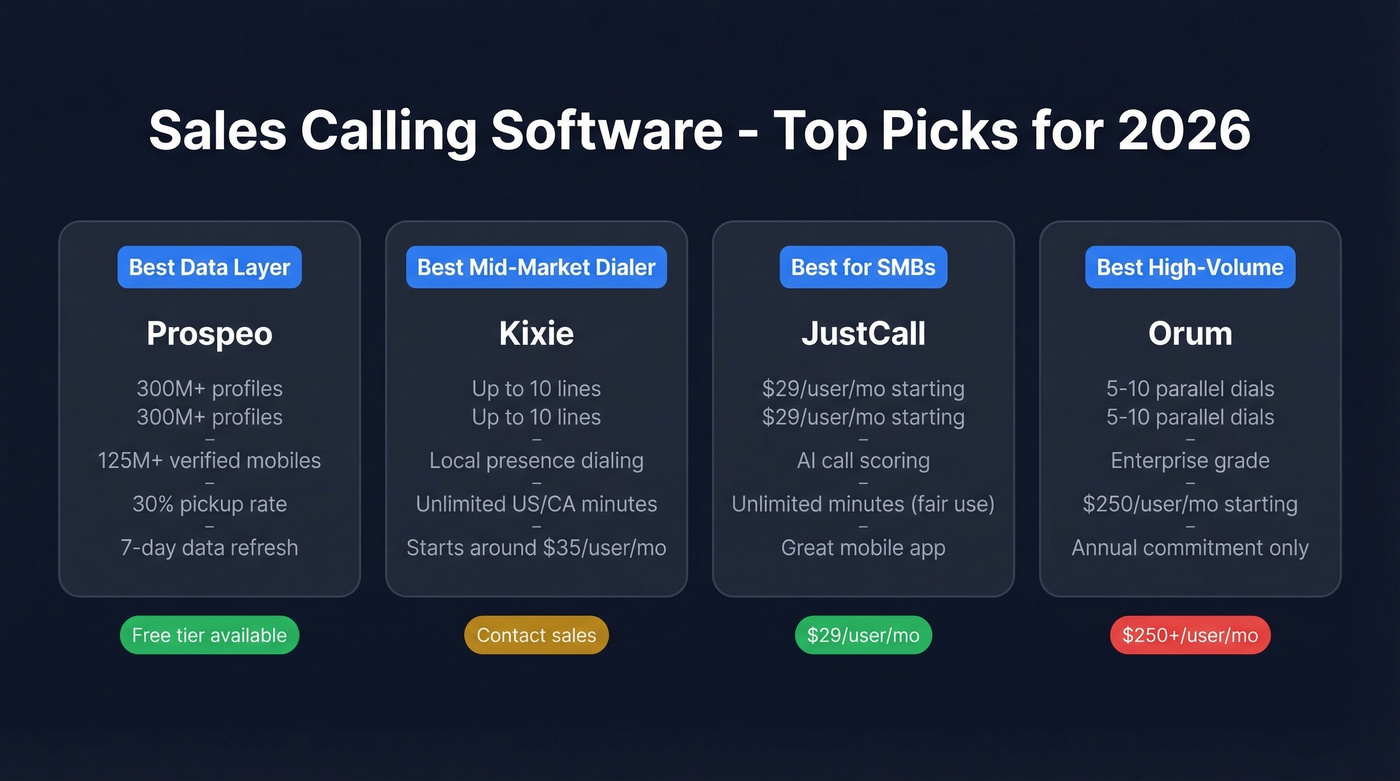
| Best data layer for calling | Prospeo | 300M+ professional profiles, 125M+ verified mobiles, 30% pickup rate, 7-day refresh |
| Best overall dialer (mid-market) | Kixie | Power dialer up to 10 lines, local presence, CRM sync |
| Best for SMBs / small teams | JustCall | $29/user/mo, unlimited minutes (fair use), AI scoring |
| Best for high-volume parallel | Orum | Enterprise parallel dialer - if you can stomach $250/user/mo |
Types of Outbound Calling Tools
Not every team needs the same kind of tool. Before you start comparing pricing pages, figure out which category fits your workflow.
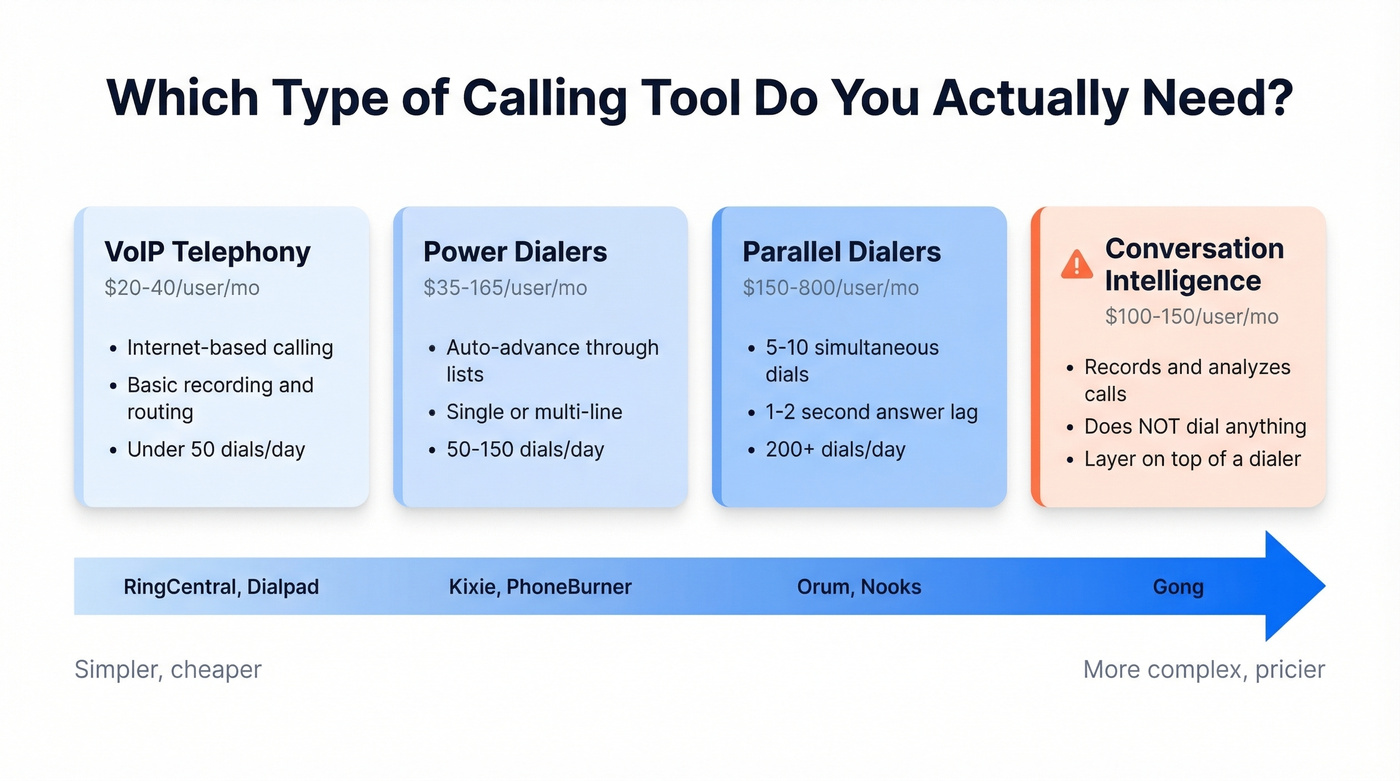
VoIP telephony is the baseline. Tools like RingCentral and Dialpad give you internet-based calling, call recording, and basic routing. They often start around $20-40/user/mo and work fine for teams making fewer than 50 calls a day.
Power dialers auto-advance through a list, dialing one number at a time so reps never manually punch digits. Single-line power dialers like PhoneBurner keep things simple, while multi-line options like Kixie's top tier try multiple numbers and connect the rep to whoever picks up first.
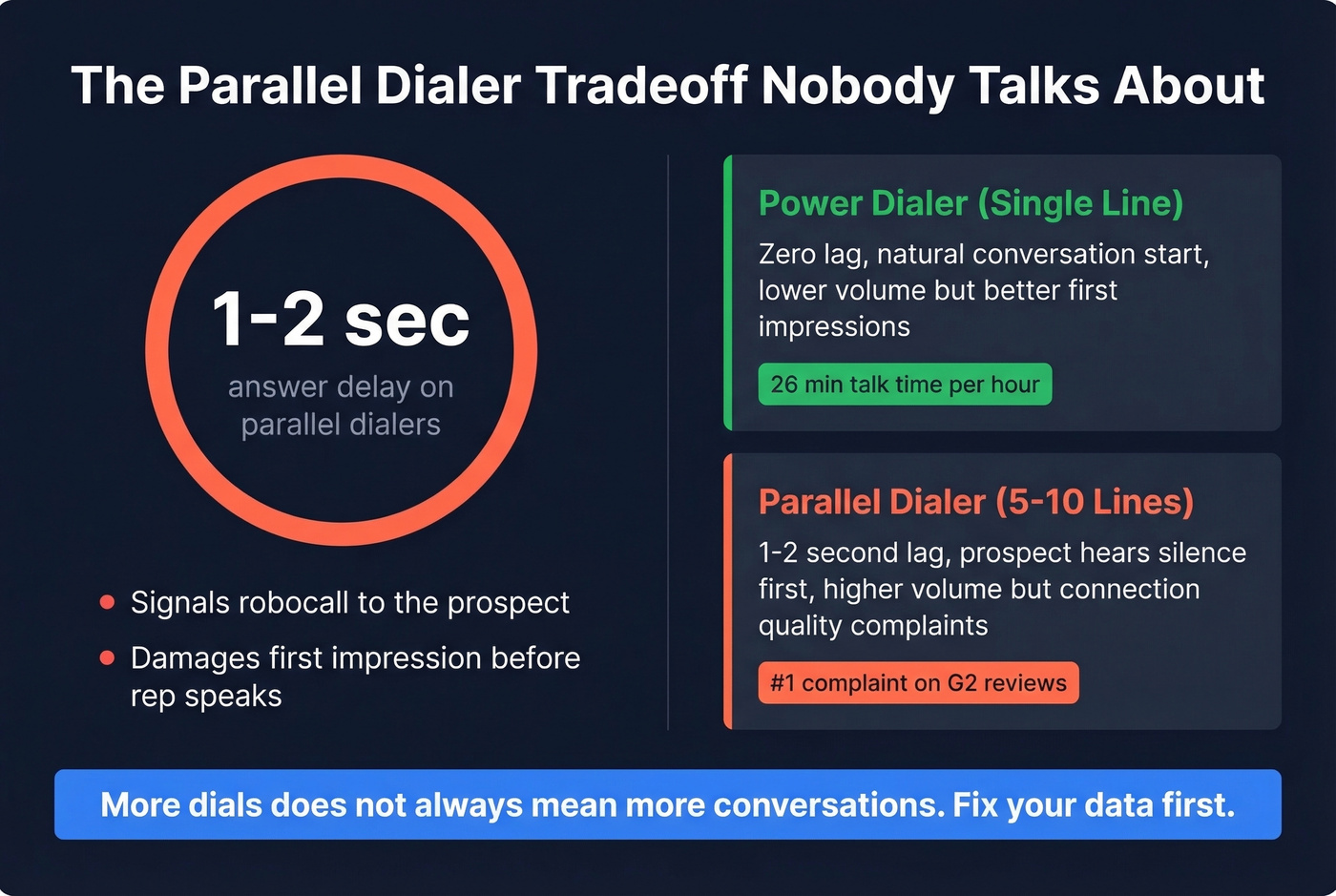
Parallel dialers call 5-10 prospects simultaneously and route the first live answer to a rep. Orum and Nooks live here. They're fast, but they introduce a 1-2 second lag when the prospect answers - and that delay can tank first impressions by signaling "robocall" before your rep says a word.
Conversation intelligence tools like Gong analyze calls after they happen. They don't dial anything. If you're looking for dialing software and landing on Gong, you're solving the wrong problem first.
One more thing: if you're a small team doing under 50 dials a day, you don't need a dedicated dialer at all. A click-to-call integration inside your CRM paired with verified contact data can get you surprisingly far.
Best Sales Calling Software in 2026
Prospeo - The Data Layer Your Dialer Needs
Your dialer doesn't source numbers. Prospeo does. The database spans 300M+ professional profiles with 143M+ verified emails and 125M+ verified mobile numbers globally, with a 30% pickup rate. Every record refreshes on a 7-day cycle versus the 6-week industry average, and email accuracy sits at 98%.
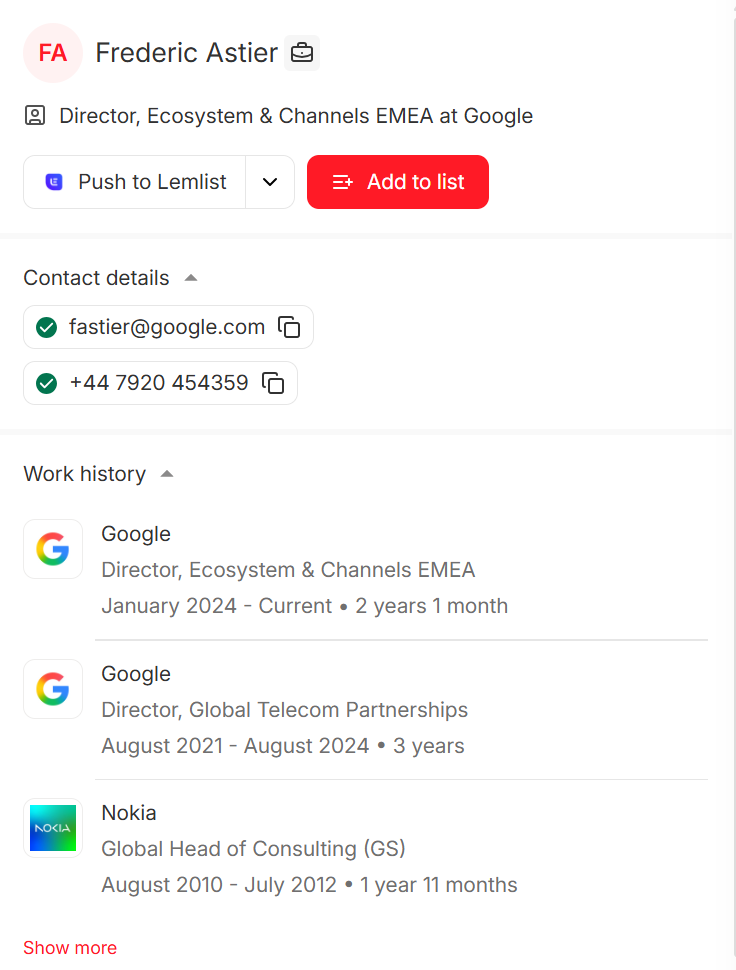
The search filters go deep - 30+ options including buyer intent powered by Bombora, technographics, job changes, headcount growth, and funding signals.
Meritt tripled their pipeline from $100K to $300K/week after switching, with connect rates jumping 3x to 20-25%. Pricing starts free (75 emails + 100 Chrome extension credits/mo), scales at roughly $0.01/email, and mobile numbers cost 10 credits each. No contracts, no sales calls required.
Use this if: You're investing in a dialer and need verified numbers to feed it. If your current bounce rate is above 5%, start here before spending another dollar on dialing software.
Skip this if: You already have a reliable data provider delivering fresh mobile numbers with sub-5% bounce rates.
Kixie - Best for Mid-Market Teams
Kixie is the dialer we'd recommend to most mid-market sales teams without hesitation. The multi-line power dialer handles up to 10 simultaneous lines, and the local presence feature - displaying a local area code to the prospect - lifts pickup rates by 15-40%. That's a meaningful edge when you're fighting for connects.

Unlimited US/Canada minutes come standard across all plans. The AI Human Detection add-on ($30/mo) filters out voicemails and IVR systems so reps only talk to humans. CRM integrations cover Salesforce and HubSpot natively.
The efficiency numbers tell the story: reps average 26 minutes of talk time per hour with a dialer versus 11 minutes manually.
Use this if: You have 4-15 reps doing outbound and want a reliable power dialer with strong CRM sync and local presence.
Skip this if: You need parallel dialing across 5+ lines simultaneously, or you're a solo founder who doesn't need auto-advance.
Kixie starts around $35/user/mo, though its pricing page requires you to contact sales.
JustCall - Best Sales Call App for SMBs
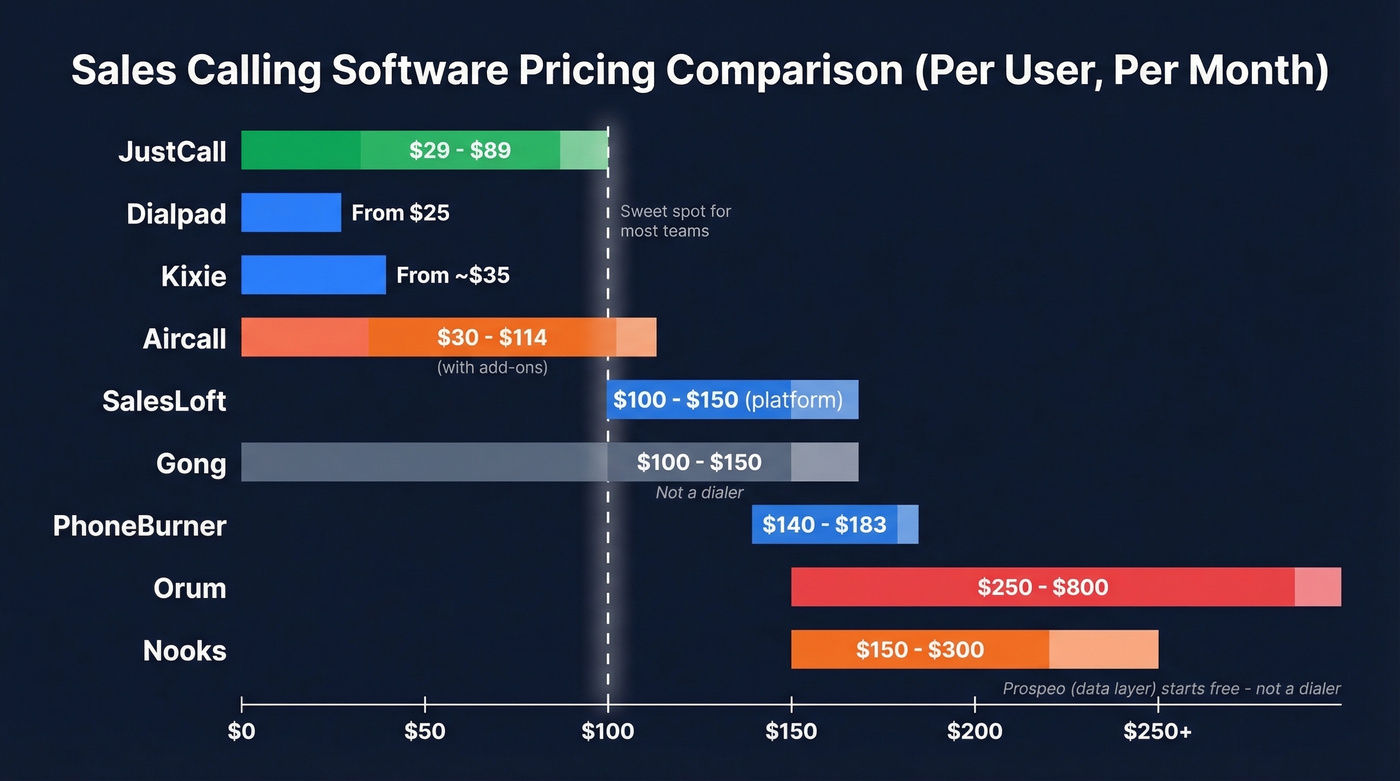
JustCall hits the sweet spot for small teams that need a real dialer without enterprise pricing. The Team plan starts at $29/user/mo on annual billing (minimum 2 licenses), Pro runs $49, and Pro Plus is $89. All plans include unlimited outbound minutes under a Fair Usage Policy - don't plan on running a call center off the Team tier.
Pro Plus is where it gets interesting: AI call scoring, sentiment analysis, real-time agent assist, and script compliance monitoring. For $89/user/mo, that's a lot of AI coaching baked in. SMS is included too - 500 segments on Team, 1,000 on Pro and Pro Plus. JustCall also works well on mobile, letting reps dial from anywhere without being chained to a desktop.
Use this if: You're a team of 2-10 reps who need affordable calling with AI coaching and don't want to negotiate enterprise contracts.
Skip this if: You need multi-line power dialing or parallel dialing. JustCall is a solid single-line tool, not a volume play.
Aircall - Mature Platform, Death by Add-Ons
Aircall looks affordable at $30/license/mo (Essentials) or $50 (Professional). Then the add-ons start stacking. AI Assist is $9/mo. AI Assist Pro is $49/mo. Analytics+ runs $15/mo. A rep on Professional with AI and analytics realistically pays $74-$114/license/mo depending on which AI add-on you choose. That's a very different conversation than the $30 headline.
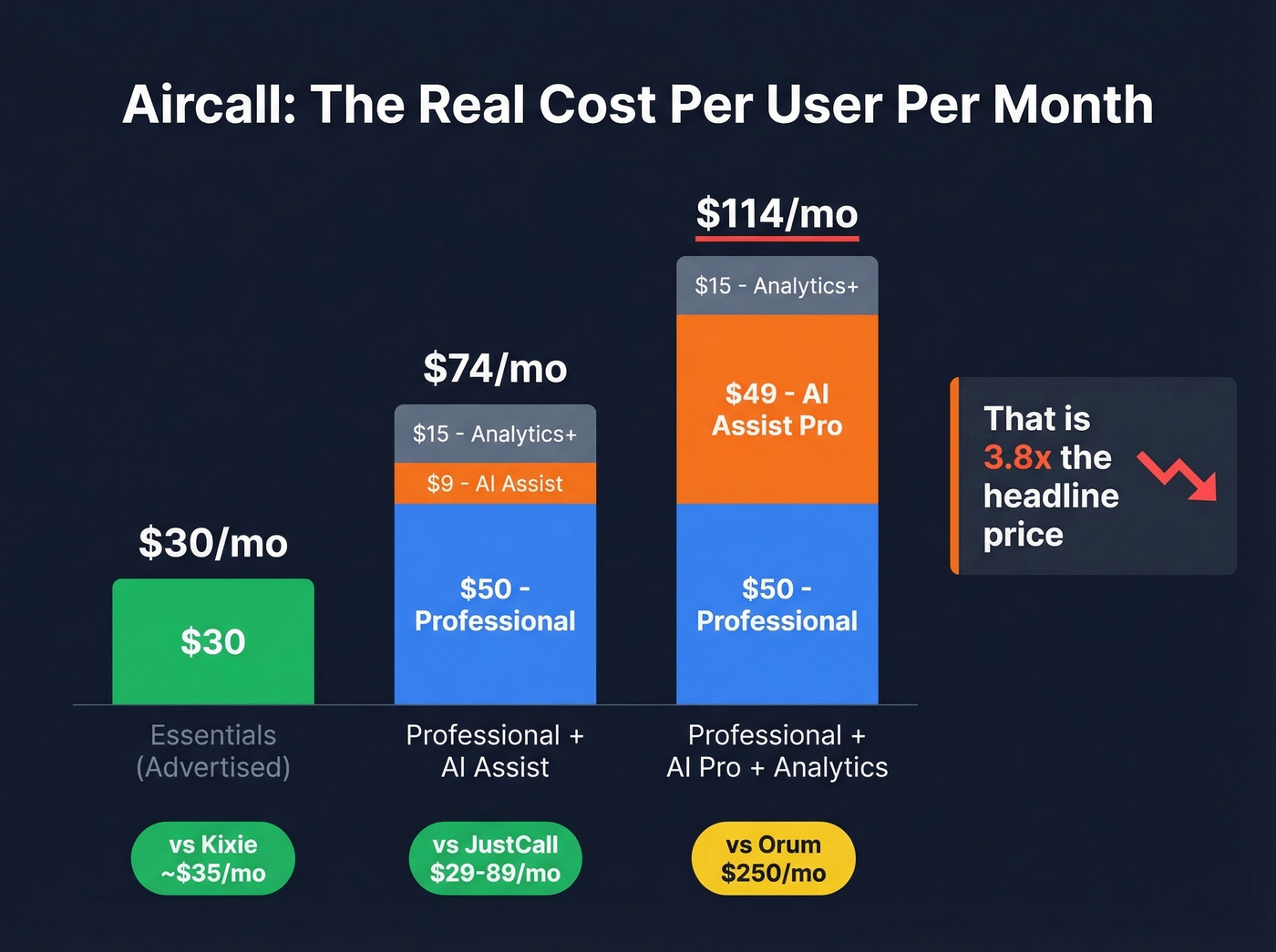
The power dialer isn't available on the Essentials plan - you need Professional or higher. And the Custom plan, which unlocks the full feature set, requires a minimum of 25 seats. For teams under that threshold, you're stuck choosing between an incomplete feature set and overpaying for seats you don't need.
We'd pick Aircall for teams of 25+ reps who want a mature, well-integrated phone system with a broad ecosystem. For everyone else, the add-on math makes Kixie or JustCall a better deal.
Orum - Enterprise Parallel Dialer
Orum is the tool teams buy when they want maximum dials per hour and have the budget to match. The Launch plan runs $250/user/mo (annual only), requires a minimum of 3 seats, and gives you 5 parallel dials. That's a $9,000/year minimum investment before you've paid for data, a sequencer, or a CRM.
The Ascend tier bumps you to 10 parallel dials and typically runs $500-800/user/mo. Integrations cover Salesforce, HubSpot, Outreach, and Gong, and Orum carries a 4.6/5 G2 rating across 781 reviews. You also get 200 enrichment credits per rep per month - not enough for serious outbound, but a nice inclusion.
The elephant in the room: the 1-2 second lag when a prospect answers. It signals "robocall" before you say a word, and no amount of scripting fixes a bad first impression. Annual commitment only, no monthly option.
Use this if: You have 15+ reps, deal sizes above $50K, and the budget to justify $250+/user/mo alongside a separate data provider.
Skip this if: Your team is under 10 reps or your average deal size doesn't justify the spend.
PhoneBurner - No Frills, Honest Pricing
PhoneBurner doesn't try to be clever. It dials through lists, drops voicemails, and logs calls. The pricing is refreshingly transparent: $140/user/mo (Standard), $165 (Professional), $183 (Premium) on annual billing. Monthly billing adds $25-32 per tier.
Standard gives you 30 days of call recording storage. Professional bumps that to 90 days. Premium unlocks unlimited storage, in-app transcription with an AI note-taker, and SMS messaging - though SMS requires A2P 10DLC compliance registration and carrier approval. The consensus on r/sales is consistently positive for teams that want a reliable workhorse without the complexity of parallel dialing. It's not flashy, but it's honest about what it does and what it costs.
Nooks - AI Parallel Dialer
Nooks carries the highest G2 rating in the auto-dialer category: 4.8/5 across 1,167 reviews. Impressive - until you dig into the review themes. Call Issues (212 mentions), Dialer Issues (110), Connection Issues (60). The same parallel dialer lag that plagues Orum shows up here too.
AI-powered parallel dialing with virtual salesfloor features makes it strong for high-volume SDR teams, but connection quality complaints are the #1 negative theme. Expect $150-300/user/mo based on team size, likely annual.
Dialpad - AI-Powered Communications
Dialpad is broader than a dialer - it's a full business communications platform that happens to include calling features for sales teams. Real-time transcription and AI-powered summaries come built in. Pricing starts around $25/user/mo. If your team needs unified communications (calling, messaging, video) alongside sales dialing, Dialpad consolidates that stack. Teams doing 100+ dials a day will want a dedicated power dialer instead.
SalesLoft - Sales Engagement with Built-In Dialer
Salesloft's dialer exists inside a broader sales engagement platform - sequences, email, tasks, analytics. If your team already runs cadences through Salesloft, the built-in dialer keeps everything in one workflow, including CRM call logging and contact sync with HubSpot and Salesforce. Custom pricing typically lands at $100-150/user/mo.
The dialer itself is competent but not the reason you'd buy Salesloft. You buy it for the engagement platform and get calling as part of the package. Teams shopping specifically for a standalone dialer should look elsewhere.
Gong - Conversation Intelligence (Not a Dialer)
Gong records, transcribes, and analyzes your calls - it doesn't make them. Enterprise pricing typically lands around $100-150/user/mo on annual contracts. It's genuinely excellent at surfacing coaching insights, tracking talk ratios, and identifying winning patterns. But it pairs with a dialer. It doesn't replace one. Buy your dialer first, then layer Gong on top once you're actually connecting with prospects.
Honorable Mentions
RingCentral starts around $20-30/user/mo and works as an enterprise communications platform. Overkill for pure outbound, but solid if you need a unified phone system across the whole company.
Close is a CRM with a built-in dialer starting at $29/seat/mo. Best for small teams that want calling, email, and pipeline management in one tool without stitching together integrations. The dialer is basic but functional.
Pricing Comparison
Several vendors on this list hide their pricing. We're publishing every number we could find.
| Tool | Best For | Starting Price | Dialer Type | Terms |
|---|---|---|---|---|
| Kixie | Mid-market teams | ~$35/user/mo | Power (up to 10 lines) | Contact sales |
| JustCall | SMBs | $29/user/mo | Single-line | Min 2 licenses |
| Aircall | 25+ seat teams | $30/license/mo | Power (Pro+ only) | 7-day free trial |
| Orum | High-volume SDR | $250/user/mo | Parallel (5 lines) | Annual only |
| PhoneBurner | Power dialing | $140/user/mo | Power (single-line) | Published pricing |
| Nooks | AI parallel | ~$150-300/user/mo | Parallel | Contact sales |
| Dialpad | Unified comms | ~$25/user/mo | Basic | Published pricing |
| Salesloft | Engagement suite | ~$100-150/user/mo | Built-in | Contact sales |
| Gong | Call analytics | ~$100-150/user/mo | None (intelligence) | Annual contracts |
| RingCentral | Enterprise comms | ~$20-30/user/mo | Basic | Published pricing |
| Close | CRM + calling | $29/seat/mo | Built-in | Published pricing |
One number that should sober you up: a 5-person outbound team running a dialer, data provider, sequencer, and CRM can easily spend $3,500-6,000+/month on the full stack. Factor in the whole picture, not just the dialer line item.

Your dialer is only as good as the numbers you feed it. Prospeo gives you 125M+ verified mobile numbers with a 30% pickup rate - refreshed every 7 days, not every 6 weeks. Teams like Meritt 3x'd their connect rates to 20-25% after switching.
Stop paying for a dialer to call disconnected numbers.
Cold Calling Benchmarks Worth Knowing
Before you optimize your tool stack, know what "normal" looks like. The average cold call conversion rate is 2.35% - about 1 sale per 43 calls. But that average hides massive variance by industry.
Technology and software companies convert at just 0.95%. Business services (HR, payroll, marketing) do better at 2.61%. Deal size matters too: $10K-50K deals convert at 2.34%, while $1M-5M deals drop to 1.16%. The bigger the deal, the harder the cold call.
Teams with daily call coaching see conversion rates of 9.03% - nearly 4x the average. That stat alone should tell you that investing in coaching alongside your dialer matters more than upgrading to a fancier one.
The efficiency gap between manual dialing and a proper outbound dialer is stark. Manual reps average 11 minutes of actual talk time per hour. With a power dialer, that jumps to 26 minutes - more than doubling productive time. Layer in local presence dialing (15-40% pickup lift) and you're compounding gains at every stage of the funnel.
Your Dialer Is Only as Good as Your Data
Let's be honest about something most dialer vendors won't tell you: you're about to spend $250/user/month on a parallel dialer, and 35% of the numbers in your list are disconnected. That math doesn't work.
Bad numbers create a cascade. Wasted dials burn through caller IDs, carriers flag your numbers as spam, answer rates crater, and suddenly your expensive dialer is just an expensive way to listen to dial tones. We've seen this pattern destroy outbound programs - a team invests in Orum or Nooks, loads up a purchased list, and watches connect rates hover at 3-5%. The dialer isn't broken. The data is.
Snyk's team was seeing 35-40% bounce rates before switching to a verified data source. After the switch, bounce rates dropped to under 5% and AE-sourced pipeline climbed 180%. Fresh data matters more than most teams realize. When you dial verified numbers from a 7-day refresh cycle instead of recycled lists that are months old, you reduce spam-flag risk and protect your caller ID reputation. The STIR/SHAKEN framework verifies caller identity at the carrier level - and verified caller ID helps keep legitimate outbound calls from getting mislabeled or blocked.
Before you sign a dialer contract, make sure the numbers you're feeding it are worth dialing. If you need a tighter workflow for list quality, start with calling lists and a proper data enrichment provider.
Before you spend $250/user/mo on a parallel dialer, spend $0.01/lead on numbers that actually ring. Prospeo's 300M+ profiles and 30+ filters - including buyer intent and job changes - let you build call lists worth dialing.
Fix the data first. Your connect rate will thank you.
Compliance in 2026: What Changed
The rules for outbound calling shifted dramatically in the last 18 months. If your dialer vendor isn't talking about compliance, that's a red flag.
TCPA litigation surged nearly 95% compared to the prior year. At least 15 states now have their own mini-TCPA laws - Texas SB 140 took effect in September 2025, Virginia SB 1339 kicked in January 2026, and more are coming. The FCC's February 2024 ruling classified AI-generated voices as "artificial or prerecorded" under TCPA, meaning they require prior express written consent. If you're using any AI voice features in your dialer, this applies to you.
The Supreme Court's McLaughlin v. McKesson ruling (June 2025) means district courts aren't bound by FCC interpretations in civil TCPA cases - making compliance even less predictable.
Key changes to track:
- Consent revocation rules (effective April 2025): consumers can revoke consent by any reasonable method. Cross-channel effects delayed to April 2026.
- STIR/SHAKEN: with 2.5 billion robocalls per month hitting US phones, carriers verify caller identity via digital certificates. Invalid or unverified calls get flagged or blocked.
- A2P 10DLC: any SMS sent through a dialer (PhoneBurner, JustCall, etc.) requires carrier registration and compliance approval.
- State mini-TCPAs: at least 15 states have their own laws, often stricter than federal TCPA.
Clean, fresh data also reduces compliance risk. Dialing verified numbers from a recent refresh cycle means you're less likely to hit numbers that have been reassigned - a common trigger for TCPA complaints. If you want the full legal breakdown, see Are Auto Dialers Illegal? and Cold Calling Laws in 2026.
How to Choose the Right Tool
The decision tree is simpler than vendors want you to believe.
1-3 reps: JustCall ($29/user/mo) or Close ($29/seat/mo with built-in CRM). You don't need a power dialer at this scale - a click-to-call integration with verified data is enough if you're doing under 50 calls a day.
4-15 reps: Kixie is the default recommendation. Multi-line power dialing, local presence, solid CRM sync. Aircall works too if you need the broader integration ecosystem, but watch the add-on costs.
15+ reps: Orum or Salesloft, depending on whether you need a standalone parallel dialer or a full engagement platform. Budget accordingly - you're looking at $100-250+/user/mo before data costs.
The budget reality check most teams skip: don't just price the dialer. Factor in your data provider, a sequencer (Outreach, Salesloft, Instantly), and your CRM. The full stack for a 5-person team runs $3,500-6,000+/month. When budget is tight, start with data quality - verified numbers fed into a basic dialer will outperform bad data fed into an expensive one every time.
The first question isn't "which sales calling software should I buy?" It's "do I have verified contact data?" If the answer is no, fix that before investing in anything else. (If you want a broader shortlist beyond this page, see our best sales dialer roundup.)
FAQ
What's the difference between a power dialer and a parallel dialer?
A power dialer calls one number at a time automatically, advancing through your list without manual input. A parallel dialer calls 5-10 numbers simultaneously and connects the rep to whoever picks up first. Parallel dialers are faster but introduce a 1-2 second lag when the prospect answers, which can signal "robocall" before your rep speaks.
How much does sales calling software cost?
Entry-level tools start at $25-30/user/month (Dialpad, JustCall). Mid-range power dialers run $35-183/user/month (Kixie, PhoneBurner). Enterprise parallel dialers cost $250-800/user/month (Orum). Budget for the full stack - dialer, data provider, CRM - and expect $3,500-6,000+/month for a 5-person team.
Do dialers include contact data, or do I need a separate provider?
Most dialers don't include contact data. Orum offers 200 enrichment credits per rep per month, but that's insufficient for serious outbound. A dedicated data provider with verified mobiles and a fast refresh cycle is what determines whether your dialer actually connects.
Is cold calling still effective in 2026?
Yes, but the average conversion rate is 2.35%, dropping to 0.95% in tech. A power dialer with verified data and local presence more than doubles talk time per hour (26 minutes vs. 11 manually). Teams with daily coaching hit 9.03% conversion. Cold calling works when data quality, caller ID reputation, and coaching are all dialed in.
What compliance rules matter for outbound calling?
TCPA litigation surged 95% recently, and at least 15 states have mini-TCPA laws with varying requirements. AI-generated voices require prior express written consent under FCC rules. Your dialer should support STIR/SHAKEN caller ID verification, DNC list scrubbing, and A2P 10DLC compliance for SMS. Fines are real and enforcement is accelerating.