

Sales Content Automation: What It Is, What It Costs, and How to Implement It
Your VP of Marketing just showed you the content library dashboard: 200 assets created this quarter. Your top AE uses exactly three of them - the same case study, the same one-pager, and a pricing sheet she built herself in Google Slides. Meanwhile, over on Reddit, a GTM engineer is describing his outbound stack as Apollo, Clay, Lemlist, n8n, warmup tools, and CRM, calling the whole thing "overwhelming."
That's two problems masquerading as one: content waste and tool sprawl. Sales content automation fixes both.
The Short Version
- The core idea: automate the full lifecycle of sales assets - creation, distribution, personalization, and measurement - so reps use relevant content instead of ignoring it.
- The number that matters: opportunities closed within 50 days carry a 47% win rate. After 50 days, it drops to 20%. Speed kills, and content findability is a speed problem.
- The stack you need: an enablement platform (or lightweight alternative), a clean data layer for verified prospect data, and your CRM. Two to three tools, not seven.
- Budget anchor: $12/seat/month at the low end (monday CRM), $100K+/year for enterprise enablement.
What Sales Content Automation Actually Means
Most teams confuse content management with content automation. Management is storage - a central repository where assets live. Automation adds intelligence on top: dynamic content generation tailored to buyer stage, contextual recommendations based on industry and persona, version control that keeps reps from sending last quarter's pricing, and analytics that connect content usage to closed revenue.
The distinction matters because B2B buying groups now include 5-16 people. A single case study PDF doesn't cut it when you're multi-threading across a CFO, a VP of Engineering, and a procurement lead. Prospects consume an average of 13 pieces of content before making a purchase decision, and automation ensures those 13 touchpoints are relevant, not random. The goal is to automate delivery so each stakeholder receives materials matched to their role and buying stage without the rep manually assembling every touchpoint.
Why It Matters in 2026
Organizations using sales automation report a 14.5% increase in sales productivity and 23% higher win rates compared to teams running basic setups. That's not a rounding error.
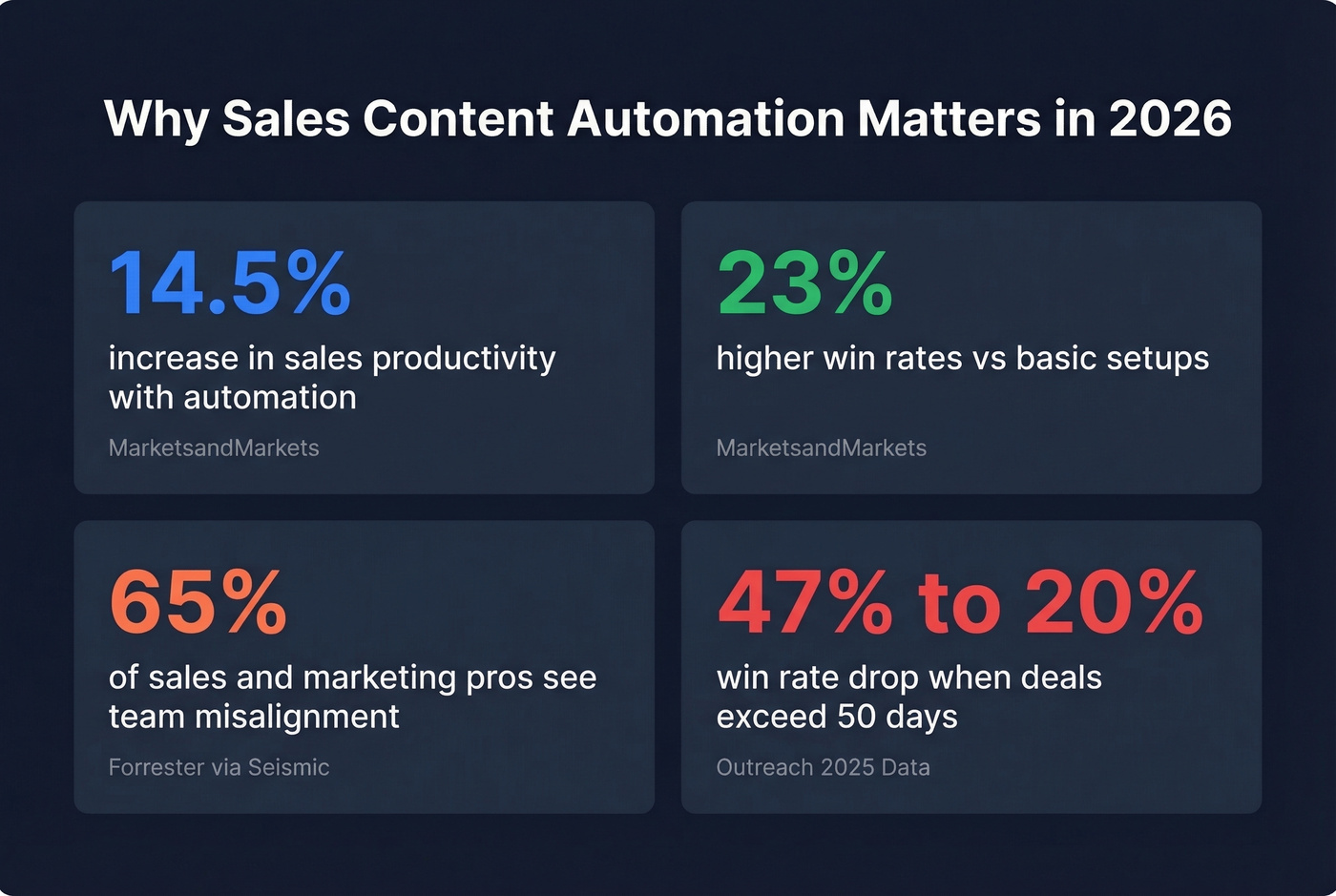
Companies spend nearly 8% of revenue on marketing, yet a huge chunk of the content produced goes unused. Forrester found 65% of marketing and sales professionals see a lack of alignment between their teams - content automation bridges that gap by making marketing's output directly usable in the sales workflow.
Here's the thing: if a rep can't locate the right asset in five seconds, it doesn't exist to them. They'll build their own in Google Slides or skip content entirely. Real-time delivery solves this by surfacing the right asset inside the rep's workflow the moment it's needed - no digging through folders. That's your $100K enablement platform failing at its one job.
The 5-Stage Workflow
This is the clearest model we've seen, and it works regardless of which tools you use.
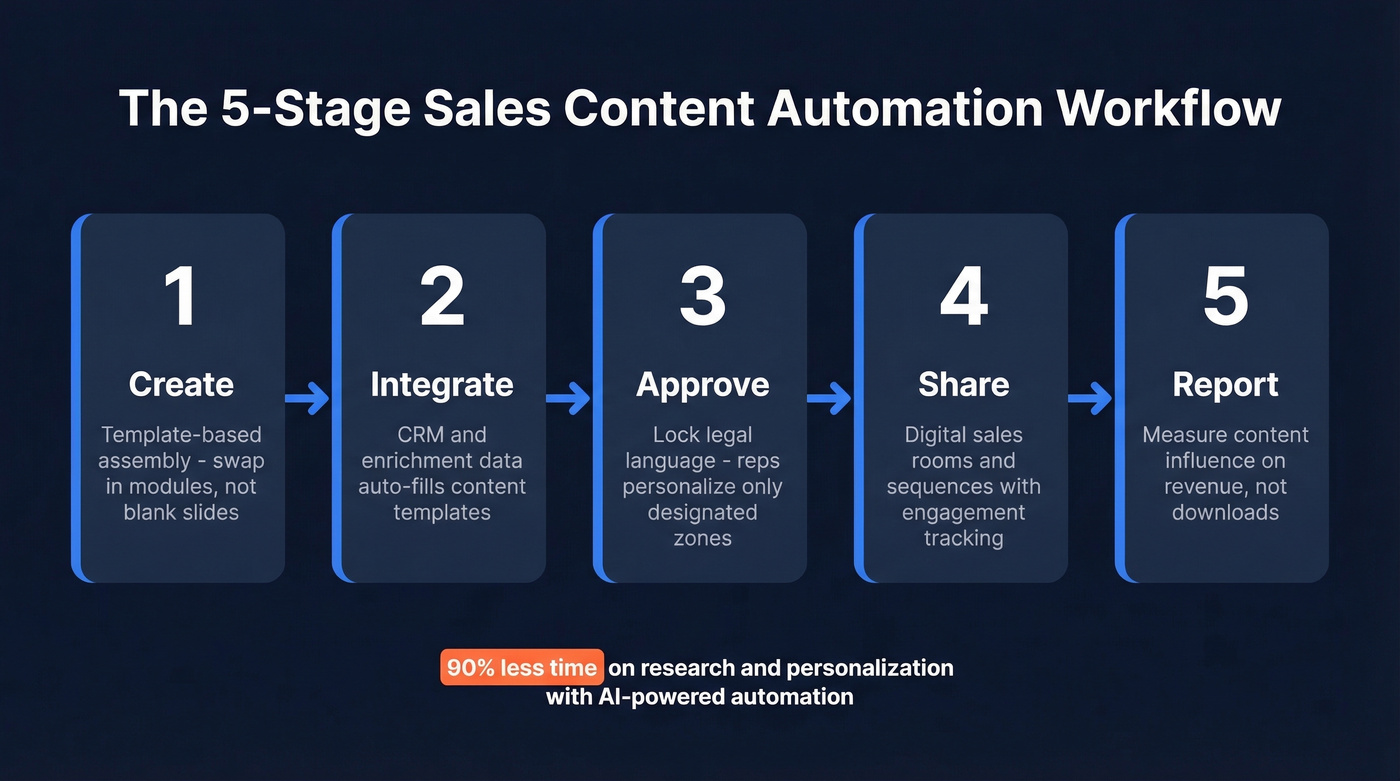
1. Create. Template-based assembly - reps swap in relevant modules (industry stats, customer logos, pricing) instead of building from scratch. Think proposal generators, not blank PowerPoints.
2. Integrate. Automated data collection from your CRM, enrichment tools, and intent signals feeds directly into content templates. No copy-pasting company names from Salesforce into a slide.
3. Approve. Limit which fields reps can edit so brand compliance is automatic. Legal-approved language stays locked; personalization happens in designated zones.
4. Share. Distribute through digital sales rooms, email sequences, or direct links with engagement tracking baked in. The rep hits send; the system tracks every page view. The best setups trigger follow-up decks, case studies, and pricing sheets based on deal-stage changes rather than manual effort.
5. Report. Measure which content sellers actually use, which assets buyers engage with, and - critically - which content correlates with closed deals. Not downloads. Revenue influence.
Sellers using AI-powered automation tools are cutting research and personalization time by 90%. That's the difference between an AE spending an hour personalizing a deck and spending six minutes.

Automated content built on stale data addresses the wrong person at the wrong company. Prospeo refreshes 300M+ profiles every 7 days - not every 6 weeks - so your personalized decks, sequences, and sales rooms always reach real buyers at 98% email accuracy.
Stop automating on top of bad data. Start with a clean foundation.
Five Mistakes That Kill Your ROI
1. Automating without mapping the workflow first. Only 2% of organizations have fully mapped their sales processes - most have documented less than a quarter. If you don't know where content breaks down, you can't fix it with software.
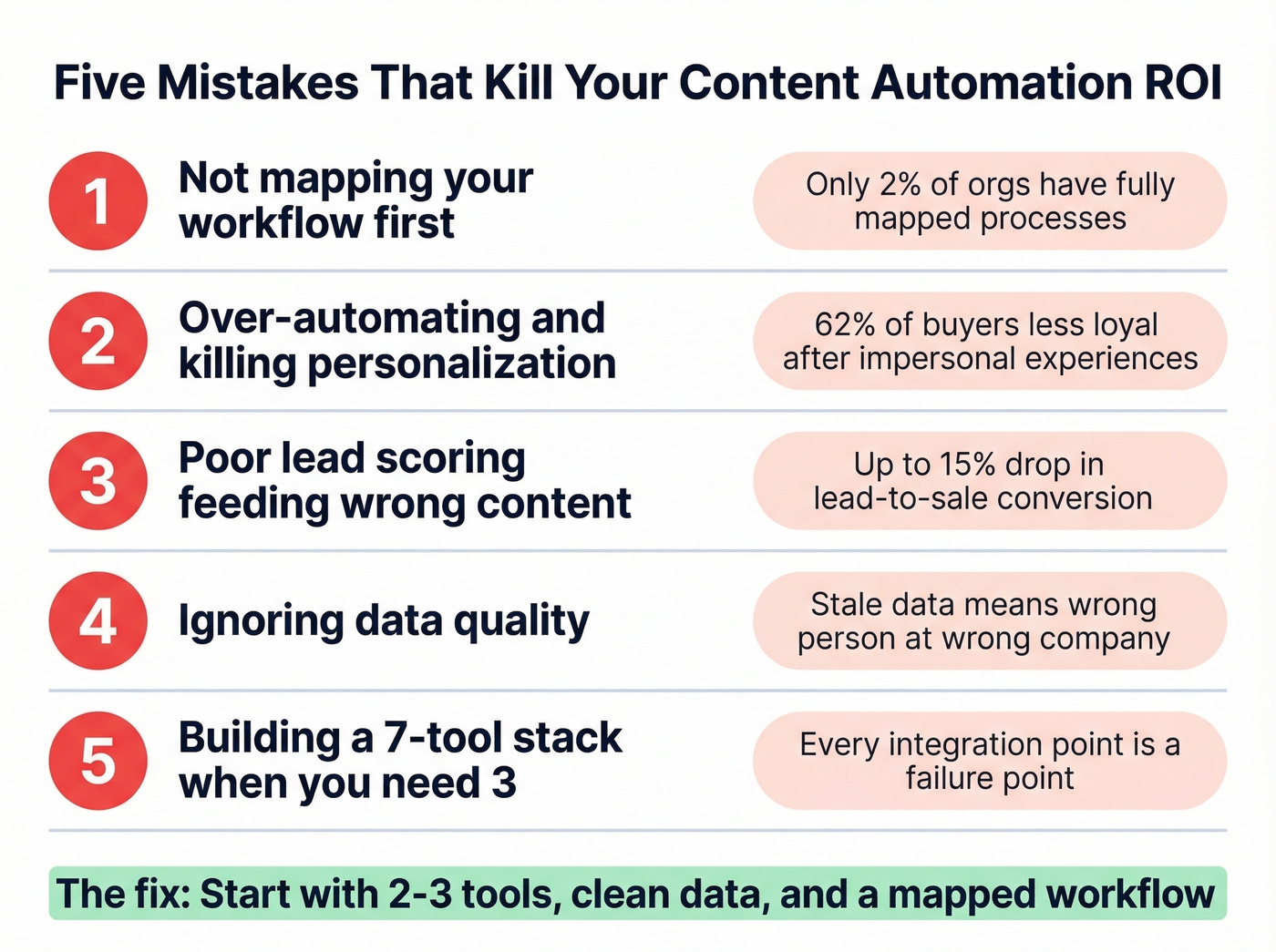
2. Over-automating and killing personalization. When every email reads like a mail merge, buyers notice. 62% of consumers say they're less loyal after impersonal experiences. Automation is an assistant, not a replacement.
3. Poor lead scoring feeding the wrong content. Misaligned lead scoring can cause up to a 15% drop in lead-to-sale conversion. If your scoring model is broken, your automation confidently delivers irrelevant materials to the wrong people - faster.
4. Ignoring data quality. Personalized content built on stale prospect data addresses the wrong person at the wrong company. A data enrichment layer that refreshes every 7 days - not every six weeks - keeps your automation reaching the right inbox instead of a dead end. We've seen teams triple their pipeline just by fixing bounce rates; Snyk's AE-sourced pipeline jumped 180% after switching to a weekly-refresh data provider.
5. Building a 7-tool stack when you need 3. That Reddit GTM engineer's chain of Apollo, Clay, Lemlist, n8n, warmup tools, and CRM is a cautionary tale. Every integration point is a failure point. In our experience, teams that start with two to three tools and expand later outperform those that buy the full stack upfront.
Real-Time Content Cards and AI Recommendations
The next evolution beyond static content libraries is real-time content cards - contextual snippets that surface inside a rep's CRM or dialer during live conversations. Instead of searching for a battlecard mid-call, the system pushes a compact card with competitive positioning, objection responses, or pricing context based on the deal record.
These cards work best when fed by AI-powered recommendations. The system reads the deal stage, industry, persona, and recent buyer engagement, then serves the card most likely to advance the conversation. Early adopters report that reps who receive contextual suggestions spend less time preparing and more time selling, which directly supports that 50-day close window we mentioned earlier.
Skip this approach if your CRM data is a mess. Content cards pulling from incomplete or outdated deal records will surface the wrong information at the worst possible moment - mid-call with a prospect who already told your SDR the same thing last week.
Tools and What They Cost
Every vendor hiding pricing tells you everything about their sales process. Here's what you'll actually pay.
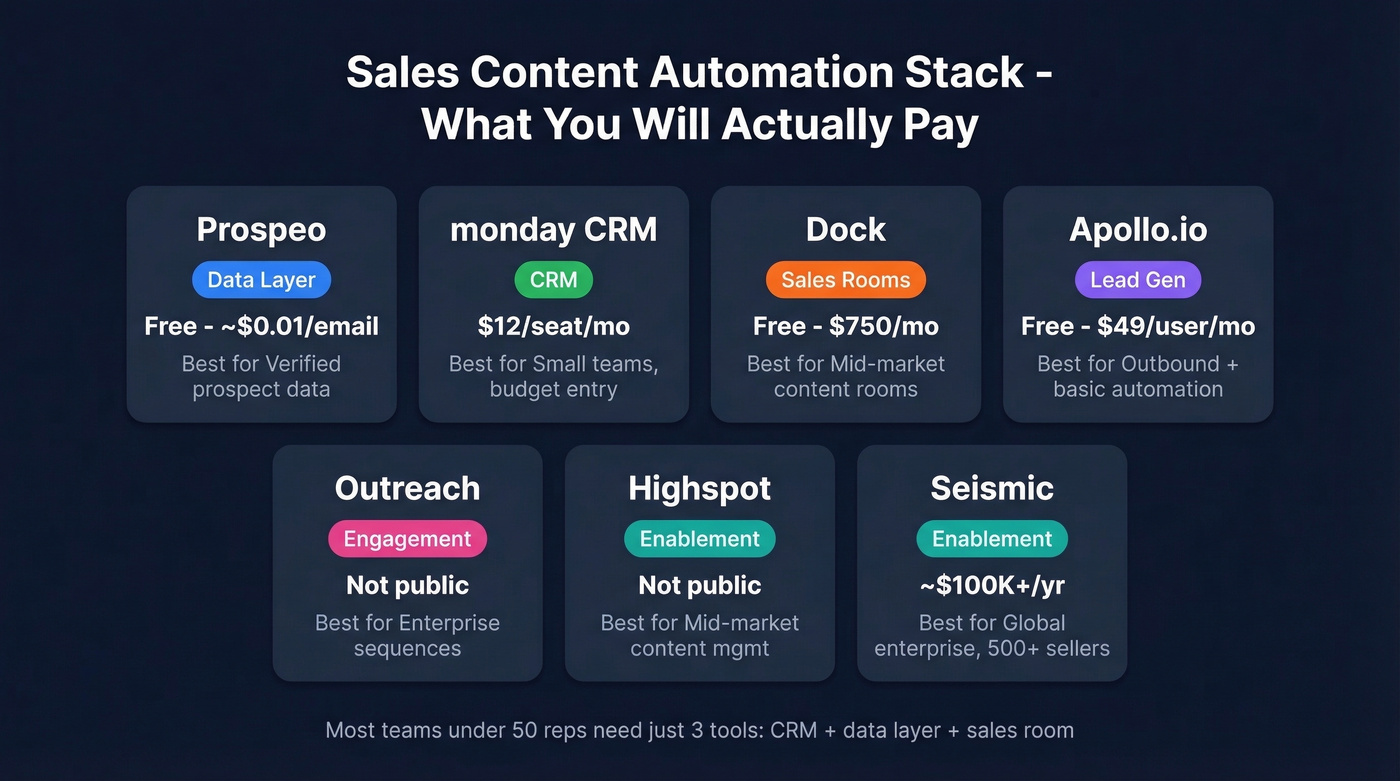
| Tool | Category | Starting Price | Best For |
|---|---|---|---|
| Prospeo | Data layer | Free; ~$0.01/email | Verified prospect data |
| monday CRM | CRM + automation | $12/seat/mo | Small teams, budget entry |
| Dock | Digital sales rooms | Free-$750/mo | Mid-market content rooms |
| Apollo.io | Lead gen + sequences | Free-$49/user/mo | Outbound + basic automation |
| Outreach | Sales engagement | Not public | Enterprise sequences |
| Highspot | Enablement platform | Not public | Mid-market content mgmt |
| Seismic | Enablement platform | ~$100K+/yr | Global enterprise, 500+ sellers |
Dock is the only enablement-adjacent tool with transparent pricing - free for individuals, $350/month for five users, $750 for ten. Their digital sales rooms let you package content for specific deals with built-in engagement analytics.
monday CRM at $12/seat/month is the budget entry point. It won't replace a dedicated enablement platform, but for a 10-person team that needs basic content workflows and deal tracking, it's enough to start.
Enterprise enablement platforms are overbuilt for most teams. Spending $100K+/year makes sense if you have 500+ sellers across global offices. A 20-person sales team buying an enterprise enablement suite is like a startup leasing a floor of WeWork - impressive, unnecessary, and expensive. If you're already on Salesforce or HubSpot, both offer native automation features, but they're CRM-first, not content-first, so a dedicated enablement layer still adds value for larger orgs.
Let's be honest: most teams under 50 reps don't need a dedicated enablement platform at all. A CRM with decent automation, a clean data layer, and a digital sales room like Dock will get you 80% of the value at 20% of the cost. The enablement platform industrial complex wants you to believe otherwise.

Getting Started
Start by auditing your current content usage. Pull your enablement analytics and figure out which assets reps actually send versus which ones have never been opened. Then reorganize by selling situation - "Objection: Competitor Price Comparison" beats "Q3_Deck_Final_v2.pdf" every time. Naming conventions sound boring until you realize they're the difference between the five-second findability rule working or failing.
From there, pick your stack: a CRM, a data layer, and one enablement or sales room tool. Integrate everything with your CRM so every content interaction logs against the deal record - no integration means no attribution, and no attribution means you can't justify your renewal.
Finally, measure content influence on revenue, not downloads. Track which assets appear in won deals. Vanity metrics won't save your budget. Sales content automation only delivers ROI when you can prove the link between what reps share and what closes.
If you're building this around outbound, pair your content workflow with sales prospecting techniques and a tighter sequence management process so reps aren't improvising every touchpoint.
Snyk's 50 AEs cut bounce rates from 35% to under 5% and grew AE-sourced pipeline 180% - because their content automation finally had accurate contact data behind it. Prospeo delivers verified emails at $0.01 each with 125M+ direct dials.
Your 3-tool stack starts here: clean data at one cent per lead.
FAQ
What's the difference between content management and sales content automation?
Management is storage - a central repository where assets live. Automation adds dynamic generation, contextual recommendations, version control, and analytics that surface matched content at the right moment in the deal cycle. Management organizes files; automation makes them drive revenue.
How much does a typical implementation cost?
Expect $500-2,000/month total for a 10-person team. Budget entries like monday CRM start at $12/seat/month; enterprise enablement platforms like Seismic run $100K+/year. A data layer adds roughly $0.01/email - negligible compared to the enablement platform spend.
Do I need AI to automate sales content?
Not yet, but you will soon. Gartner predicts that by 2030, 80% of CSOs will require AI-augmented plans. Start with organized content, clear taxonomy, and clean prospect data. AI-powered recommendations accelerate personalization and surface the right asset at the right time, but they won't fix a broken content library or stale CRM records. Get the foundation right first.