

Sales Deck Examples That Actually Close Deals in 2026
More slides don't mean more deals. A founder on r/Entrepreneurs replaced a 40-slide deck with 6 slides, built it in Gamma in about 20 minutes, and watched their close rate jump 35%. The uglier, faster version outperformed a polished deck they'd spent weeks refining. With 80% of B2B interactions happening in digital channels and buyers spending just 17% of their time with potential suppliers, the sales deck examples and templates you study matter more than your design budget.
The Quick Version
- Framework: Trust-first - lead with the prospect's pain, not your company story
- Slide count: 6-15 for live calls, up to 20-30 for leave-behinds
- Structure: Hook → Pain → Cost of inaction → Solution → Proof → ROI → Next step
- Template: Slide-by-slide breakdown below (case study: 6% → 39% close rate)
Sales Deck vs. Pitch Deck
A pitch deck is about belief. A sales deck is about commitment.
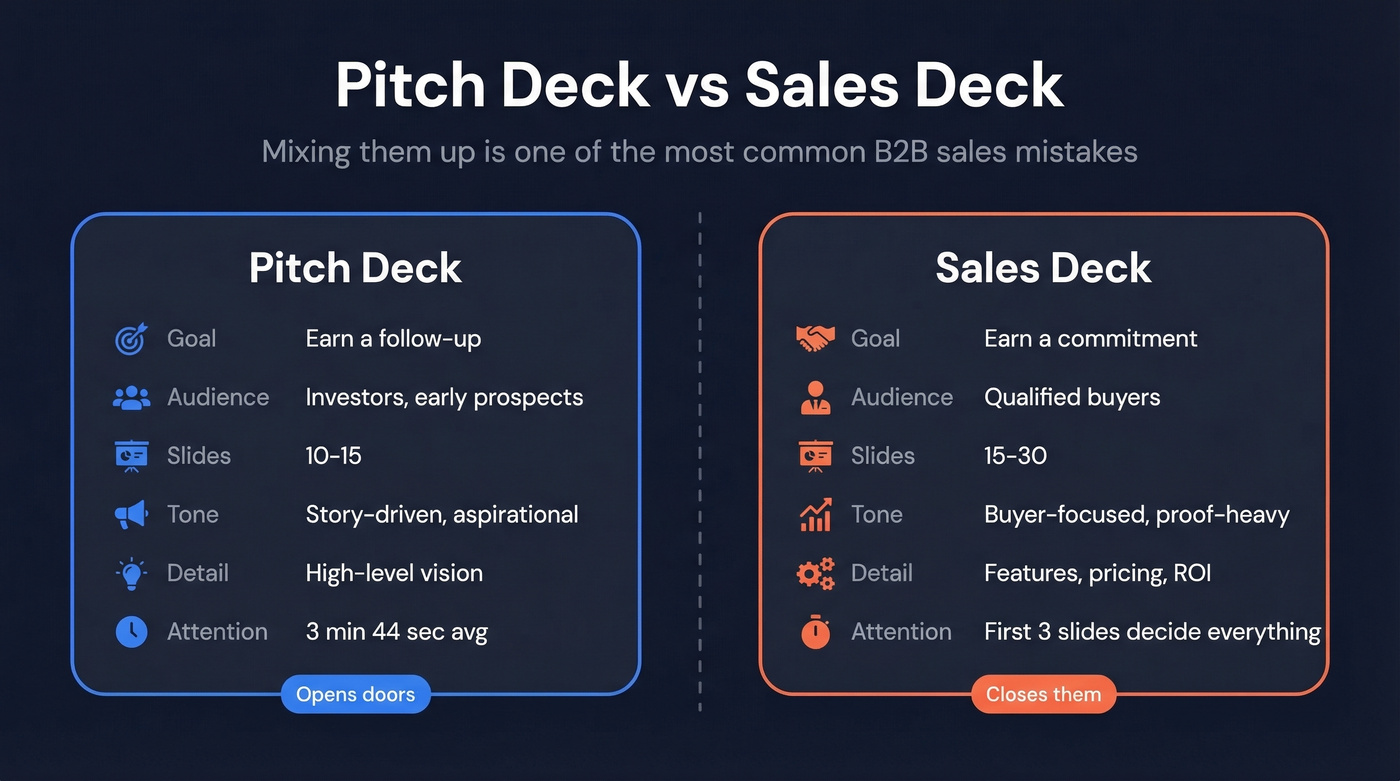
Pitch decks open doors. Sales decks close them. Mixing them up is one of the most common mistakes in B2B sales - a sales-heavy deck in a first meeting feels overwhelming, while a pitch-style deck in a late-stage evaluation feels evasive, like you're hiding something.
| Dimension | Pitch Deck | Sales Deck |
|---|---|---|
| Goal | Earn a follow-up | Earn a commitment |
| Audience | Investors, early prospects | Qualified buyers |
| Slide count | 10-15 | 15-30 |
| Tone | Story-driven, aspirational | Buyer-focused, proof-heavy |
| Detail level | High-level vision | Features, pricing, ROI |
| Attention window | 3 min 44 sec average | Even shorter - the first 3 slides decide whether they lean in |
Two Frameworks Worth Knowing
Trend-First (Andy Raskin)
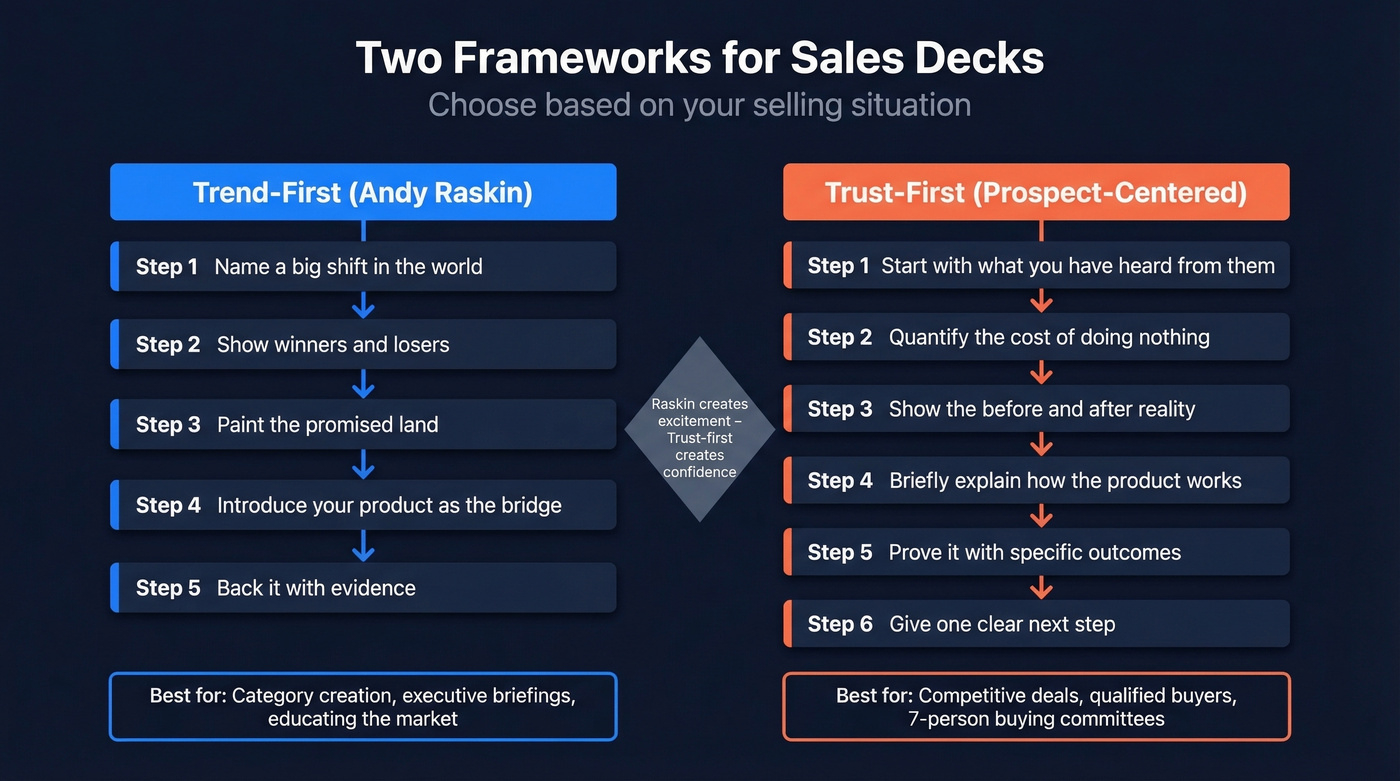
Andy Raskin's framework is the one you've seen referenced everywhere. Name a big shift in the world, show winners and losers, paint the "promised land," introduce your product as the bridge, back it with evidence. It's compelling and designed for category-creation pitches and executive briefings where you need to explain why the world is changing.
Trust-First (Prospect-Centered)
Here's the thing: most reps aren't creating categories. They're selling to a VP who has a specific problem and three other vendors in the mix. For that scenario, trust-first works better.
Start with "what we've heard" using the prospect's own language. Quantify the cost of doing nothing. Show the before/after reality. Briefly explain how the product works. Prove it with specific outcomes. Give one clear next step.
The principle is simple: your prospect needs to feel understood within the first three slides. Raskin creates excitement. Trust-first creates confidence. And confidence closes deals, especially when an average of 7 people are involved in a mid-market buying decision and your champion needs to sell internally without you in the room.
We default to trust-first for any deal where the prospect already knows they have a problem. Save trend-first for when you're educating the market.
B2B Sales Deck Examples Worth Studying
Rather than dumping a massive list, here are the decks that teach you something specific, grouped by narrative style.
Data-Led Decks
Zuora opens with macro trends in the subscription economy, uses data to make the shift feel inevitable, then positions itself as the infrastructure for that new world. It's from 2016 and shows its age, but the structure holds. The lesson: lead with an industry trend your prospect can't ignore, backed by real numbers.
ChartMogul follows a Problem → Solution → Benefits structure that works well as an async pre-read. Use the prospect's own KPIs as your opening hook.
Minimalist Decks
What if you only had six slides? TeleTracking shows how brevity works for exec audiences. If your buyer is a VP or above, cut everything that doesn't directly answer "why should I care?" and "what's the ROI?"
Reddit Ads is another strong example of clean, visual-first storytelling where data and screenshots carry the narrative instead of bullet points.
Problem-Quantification Decks
Gong leads with the problem and makes the pain feel real before going deep on product. Put a dollar figure on the prospect's problem early - that's the move.
One r/sales commenter captured why this works: "Nobody cares about your solution until they believe you understand their problem."
Clari runs the same playbook focused on revenue leak, quantifying it as an average of 14.9% across companies. The "cost of inaction" frame works in any industry where the status quo has a measurable price tag.
Day-in-the-Life Decks
Drift narrates a buyer's real experience first, then shows the alternative. Walking through your prospect's daily frustration before introducing your product is devastatingly effective - and surprisingly few companies do it well.
Big Shift Decks
Snapchat's 2015 ad sales deck opens with the claim: "Snapchat is the best way to reach 13-34-year-olds." Classic trend-first. If you're selling to marketers or execs, macro trends create urgency without being pushy.
Customer Story Decks
WiseStamp built an interactive deck with personalized elements using Storydoc. Results: 60% read in full, 50% shared internally, 10% CTA conversion. If your deck gets forwarded to stakeholders you've never met, it has to be self-explanatory.
Sastrify flips the typical structure by breaking benefits down for Finance, Procurement, and IT separately, and anticipates implementation questions with an FAQ slide. Open with the customer's story, not yours.
Social Proof That Actually Converts
The proof slide is where most decks fall flat.
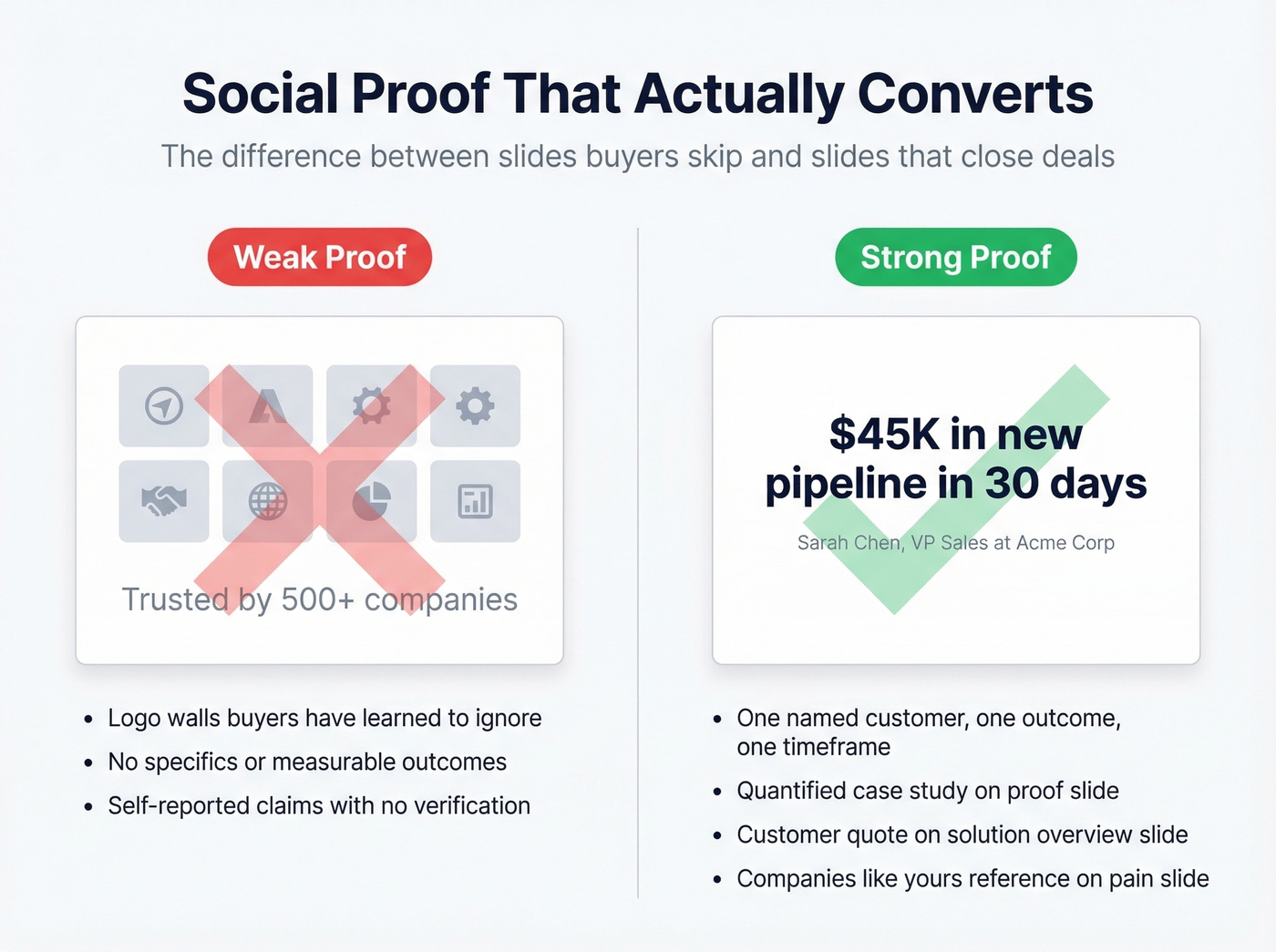
Slapping a grid of logos on a slide and calling it "trusted by 500+ companies" is the weakest form of social proof in sales. Buyers have learned to ignore logo walls. They want specifics. The strongest proof follows a simple formula: one named customer, one measurable outcome, one timeframe. "$45K in new pipeline in 30 days" is infinitely more persuasive than "our customers love us." Gong's deck nails this by leading with customer-reported metrics rather than self-reported claims.
For B2B SaaS specifically, consider layering three types: a quantified case study on your proof slide, a brief customer quote on your solution overview slide, and a "companies like yours" reference on your opening pain slide. This distributed approach weaves credibility throughout the narrative instead of confining it to a single slide that buyers might skim past.
If you want to go deeper on narrative structure, sales deck storytelling is the skill that makes these examples transferable.

Your proof slide is only as strong as the data behind it. Prospeo gives you 98% verified emails and 125M+ direct dials so your sales deck's "companies like yours" slide leads to actual conversations - not bounced emails.
Close the deal your deck opened. Start with data that connects.
Slide-by-Slide Template
This structure produced measurable results - one SaaS company went from 47 demos and 3 closes to 23 demos and 9 closes, moving their close rate from 6% to 39%.
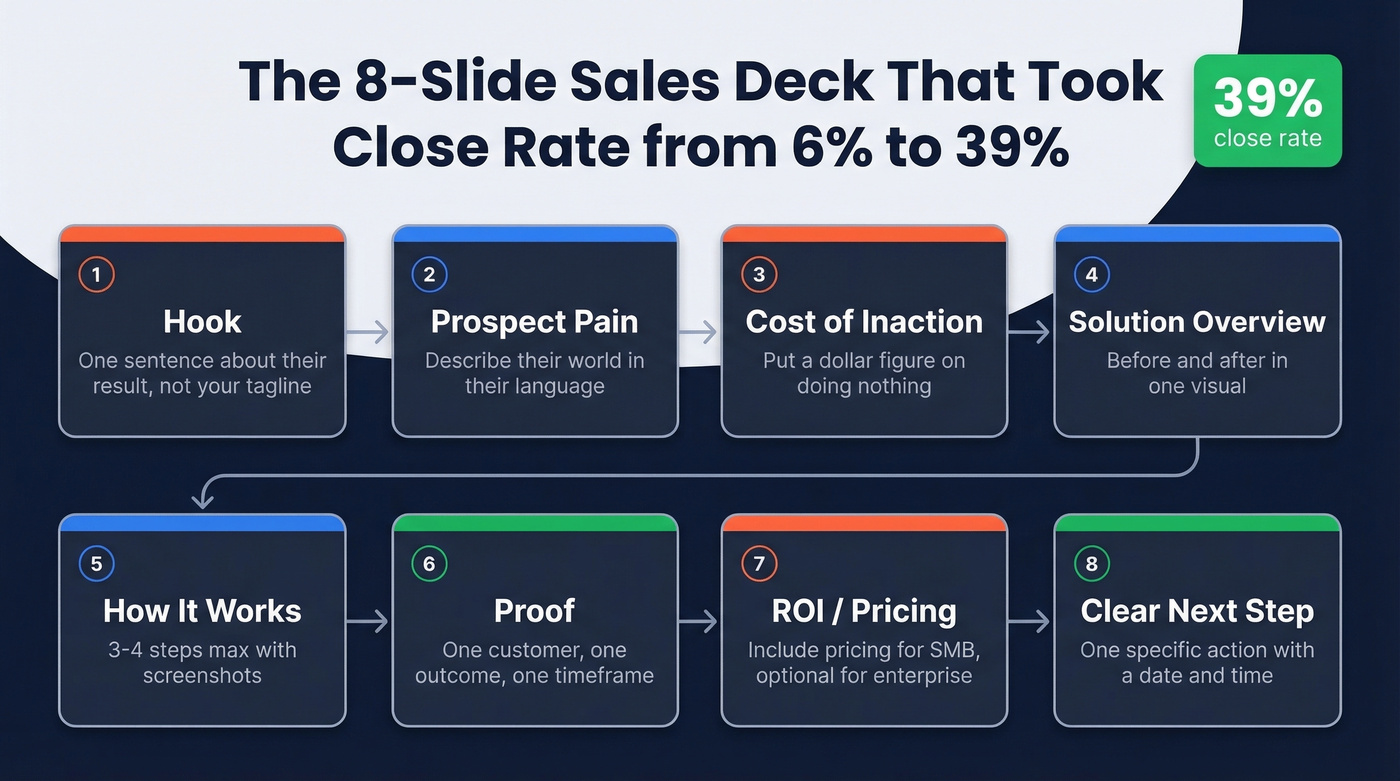
- Hook - One sentence. What outcome does the prospect get? Not your tagline. Their result.
- Prospect's Pain - Describe their world using their language. "What we've heard from teams like yours..." This is where you earn the right to keep talking.
- Cost of Inaction - Quantify what doing nothing costs. This single slide moves more deals than any design upgrade.
- Solution Overview - Show the before/after reality in one visual. Keep it high-level.
- How It Works - Three to four steps, max. Screenshots reduce cognitive load.
- Proof - One specific customer, one specific outcome. "$45K in new deals in 30 days" beats "trusted by 500+ companies." Make it concrete and verifiable.
- ROI / Pricing - For SMB and self-serve, include pricing. For enterprise, make it optional but don't hide behind "let's discuss."
- Clear Next Step - One action. "Let's schedule a 15-minute technical review Thursday" - not "any questions?"
That's 8 slides for a live call. For a leave-behind, expand sections 5 and 6 with additional use cases and proof points, but the core arc stays the same: tension → resolution → action.
If you're building this from scratch, a solid companion is a sample sales presentation you can adapt to your product.
Best Practices for 2026
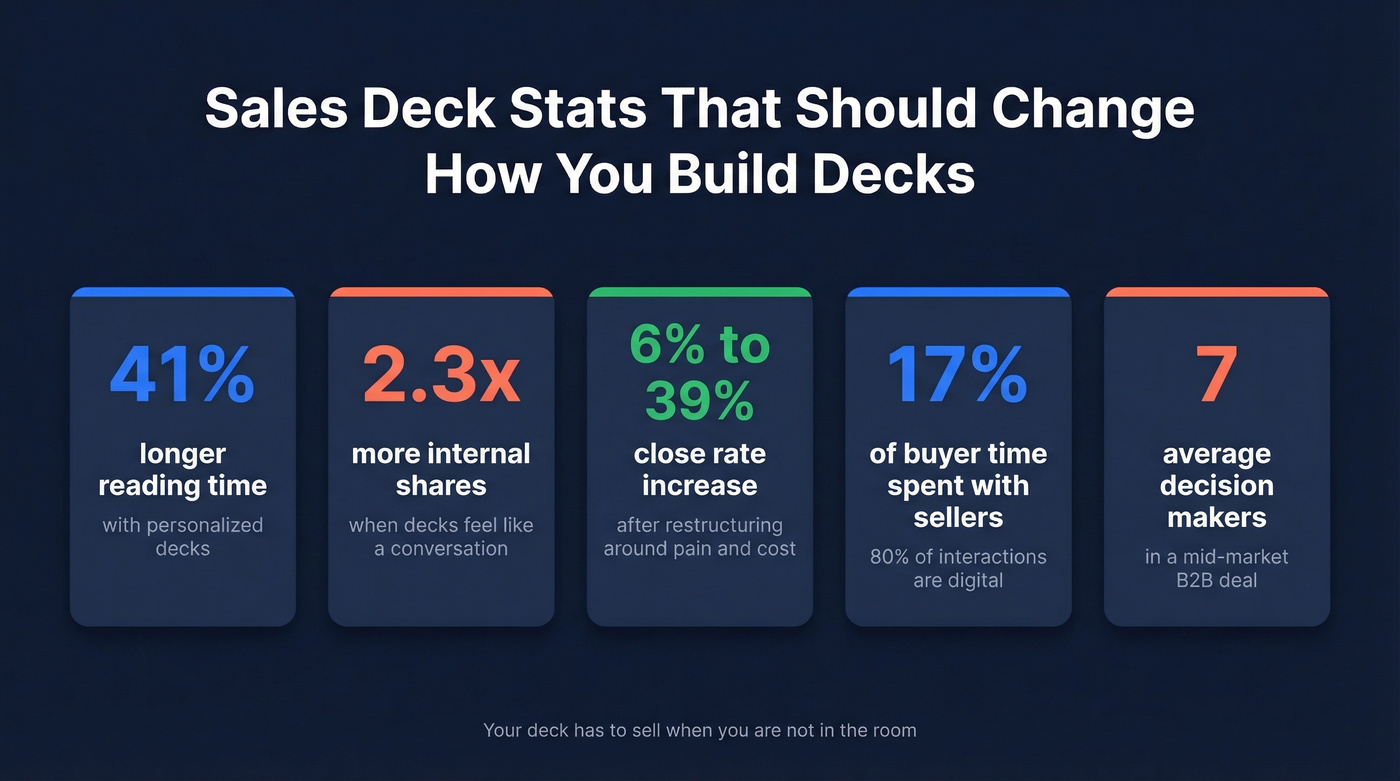
Personalized decks boost average reading time by 41% and get shared internally 2.3x more often. WiseStamp's results after switching to personalized, interactive decks came from one change: making each deck feel like a one-to-one conversation instead of a broadcast.
You can't personalize effectively without verified prospect data. We've found that enriching contacts with tools like Prospeo - which returns 50+ data points per record at 98% email accuracy - makes the difference between "Hi [First Name]" personalization and actually referencing a prospect's tech stack, recent funding round, or department headcount in your opening slide.
Quantify the cost of doing nothing on slide 2 or 3. That single change moves more deals than any design upgrade. The company that went from 6% to 39% close rate didn't redesign their deck. They restructured it around pain and cost.
Show the product early. A Reddit designer who's built 25+ founder decks put it bluntly: screenshots reduce cognitive load. Buyers shouldn't have to imagine what your product looks like.
Build a hidden objection appendix - 5-10 slides after your CTA that address common pushback on security, implementation timeline, and competitive comparison. Don't present them unless asked. But when a prospect raises an objection, pulling up a ready-made slide signals preparation and confidence (and it helps to have objection handling examples ready for the talk track).
Skip the 25-slide monster if your average deal size is under $10K. The decks that close SMB deals fastest are the ones that respect the buyer's time. Save the long leave-behind for enterprise committees.
AI Tools for Building Decks
| Tool | Best For | Starting Price | Key Limitation |
|---|---|---|---|
| Gamma | Speed + free tier | Free / ~$10-20/user/mo | Best for fast drafts; advanced brand control takes work |
| Beautiful.ai | Auto-formatting | ~$12-45/user/mo | Gets expensive at team scale |
| Pitch | Collaboration | Free / ~$8-20/user/mo | Analytics and advanced controls are paid |
| Storydoc | Interactive decks | ~$40+/user/mo | starts higher than most slide tools |
| PlusAI | Native PPT/Slides | ~$10-30/user/mo | Works inside PowerPoint/Google Slides, not standalone |
Real talk: AI builds a solid first draft in 20 minutes. The hard part is making it not look like AI built it. A common concern on r/SaaS is that decks that look obviously AI-generated kill credibility in deals. Use these tools for structure and speed, then customize heavily - swap in real screenshots, add prospect-specific data, and kill any slide that feels generic.
If you're also using AI upstream to source accounts and contacts, pair this with AI sales content generation so your deck and outreach stay consistent.
Gamma is a great free starting point. Storydoc is worth the premium if you need tracking and personalization at scale.
Mistakes That Kill Your Deck
One company ran 34 slides of features and closed 6% of demos. After restructuring around pain → proof → ROI, they hit 39%. Features belong in a follow-up doc, not your opening act (this is the same logic behind features vs benefits).
"Any questions?" isn't a CTA. "Let's book a technical review for Thursday at 2pm" gives the prospect a concrete next step. Vague endings produce vague outcomes.
The logo-first opener. Nobody cares about your company history on slide 1. Start with the prospect's problem, not your founding story. And if a slide is packed with text, you're writing a document, not a presentation - your voice carries the narrative, and slides are visual anchors.
One more: if you're sending a PDF with no tracking, you're flying blind. You can't see who opened it, how far they read, or whether it got forwarded. Use a tool with analytics (and make sure your sales enablement analytics are set up to capture what matters).
After the Deck
With 7 people involved in an average B2B buying decision, your champion needs to forward that deck to stakeholders you've never met. Your deck has to sell without you in the room.
Set up a follow-up sequence: a same-day email with the deck link, a check-in at 48 hours, and a value-add touch at day 5. Use a tracking tool so you know who opened the deck, which slides they lingered on, and whether it got forwarded. That intel shapes your next conversation.
Your champion won't be the only decision-maker. Find direct contact info for other stakeholders on the buying committee so you can follow up with each one individually - Prospeo's B2B database covers 300M+ professional profiles with 98% email accuracy and 125M+ verified mobile numbers, so when you follow up, you're reaching numbers that actually connect (more on list building if you're scaling this process).
A 39% close rate means nothing if you're presenting to the wrong people. Prospeo's 30+ search filters - including buyer intent, job changes, and technographics - ensure every demo lands in front of a qualified decision-maker.
Stop perfecting slides for prospects who were never going to buy.
FAQ
How many slides should a sales deck have?
Six to fifteen for live calls; leave-behinds can run 20-30. One founder cut from 40 to 6 slides and saw their close rate improve 35%. Match slide count to your audience's seniority - executives want fewer slides with sharper data.
What's the difference between a sales deck and a pitch deck?
A pitch deck earns belief and opens doors with story-driven, aspirational content. A sales deck earns commitment and closes deals - it's specific, proof-heavy, and buyer-focused. Using the wrong one at the wrong stage kills momentum.
Should I include pricing in my sales deck?
Yes for deals under $15K annually and self-serve motions - it builds trust and pre-qualifies. For enterprise, pricing is optional but shouldn't feel hidden. Buyers who see pricing early are 12% more likely to advance to a second call.
What's the best free tool for building a sales deck?
Gamma generates a polished first draft in under 20 minutes and has a generous free tier. Google Slides works best for real-time collaboration. Canva adds design polish. All three beat spending two weeks in PowerPoint.