

How to Build and Run a Sales Department That Actually Works
Most sales departments aren't broken by bad reps. They're broken by bad design. The org chart was drawn on a napkin, the comp plan rewards the wrong behavior, and SDRs are blasting unverified emails into the void. Organizations with clear role definitions report +8% revenue attainment, +25% quota attainment, and +17% win rates compared to those winging it. Systems fail people - not the other way around.
What You Need (Quick Version)
Five things broken sales departments always skip:
- Define roles before hiring. If you can't explain who does what in two sentences, you're not ready to add headcount.
- Build CRM and process before adding reps. A repeatable sales process beats a talented rep with no playbook every single time.
- Set concrete KPI targets. Not "more pipeline" - actual numbers. 3-5x pipeline coverage, sub-5-minute speed-to-lead, 60-70% selling time.
- Align comp plans with real business goals. 39% of revenue leaders admit their comp plans don't match what the business actually needs. Fix this before you hire.
- Invest in data infrastructure. Your reps shouldn't spend their first hour each morning guessing whether email addresses are real. Verified contact data is infrastructure, not a nice-to-have.
What Is a Sales Department?
A sales department is the team responsible for turning prospects into customers and customers into recurring revenue. Its core functions span prospecting, qualifying, closing, retaining, and expanding accounts.
About 13% of all full-time U.S. jobs are in sales, making it one of the largest professional functions in the economy. But the term means wildly different things at different companies. A 3-person startup where the founder closes every deal has one. So does a 500-person enterprise org with SDRs, AEs, sales engineers, and a RevOps team running Salesforce workflows. What matters isn't the size - it's whether the team has defined roles, repeatable processes, and the infrastructure to execute consistently.
This guide is for operators building or fixing their revenue org, not job seekers trying to understand the org chart.
Why Structure Matters More Than Talent
You can hire the best closers in the market and still miss quota if your structure is wrong. Korn Ferry's research makes this painfully clear: organizations that define what "excellent" looks like for each sales role see +8% revenue attainment, +25% quota attainment, and +17% win rates. They also report 17% lower voluntary turnover and 20% lower involuntary turnover.
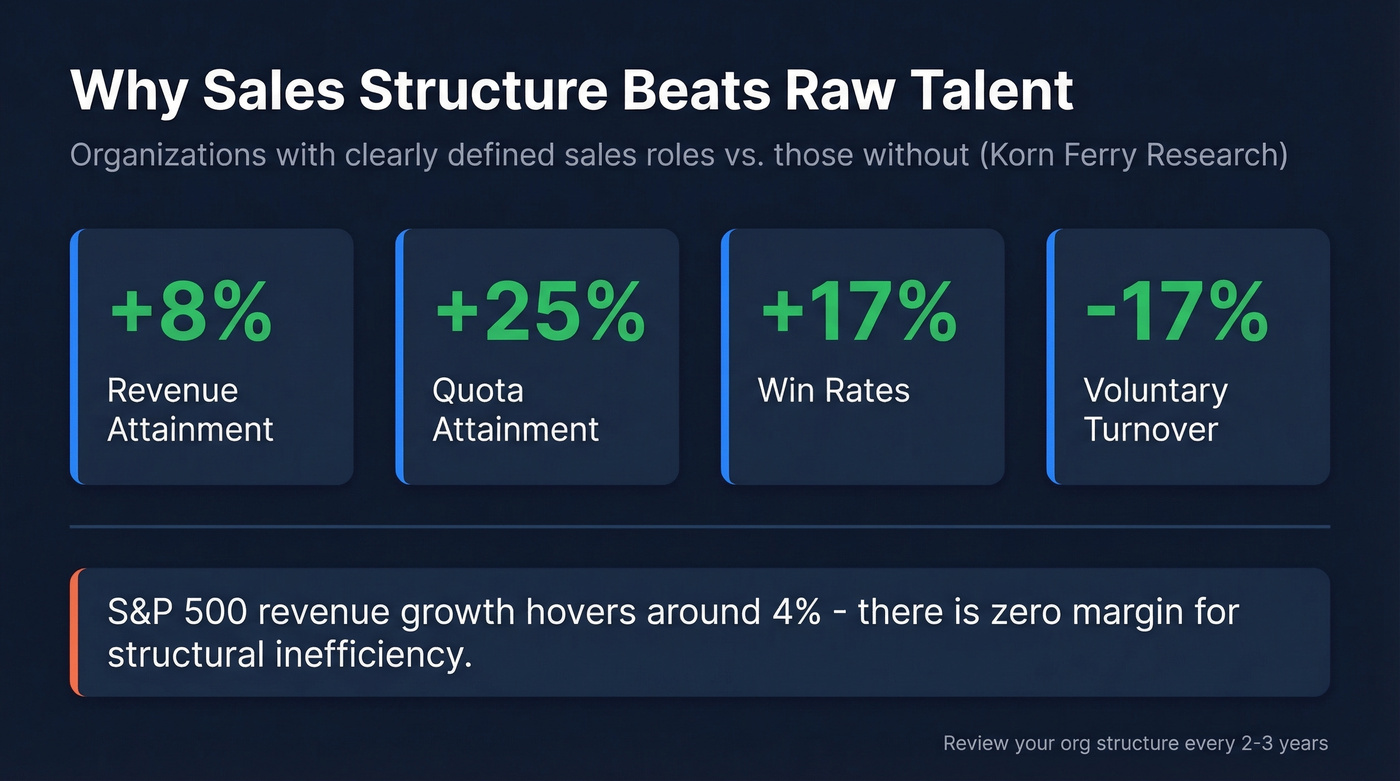
Better structure doesn't just close more deals - it keeps your best people from leaving and reduces the costly churn of bad hires. With S&P 500 revenue growth hovering around 4%, the margin for structural inefficiency is razor-thin.
Most companies design their sales org once and never revisit it. Korn Ferry recommends reviewing organizational structure every 2-3 years because buyer behavior shifts and markets evolve. What worked at $5M ARR breaks at $20M.
Consider a $1M enterprise deal that touches 20-40 internal people across sales, solutions, legal, and finance. If your structure doesn't account for that complexity, the buyer experience becomes a mess - and deals stall. Structure design should start with the buyer journey. How do your customers want to buy? Segment them by behavior, then align roles and coverage accordingly. Talent inside a broken structure just means expensive underperformance.
Roles & Responsibilities
Every sales department needs clear ownership across the revenue cycle. Here's how the roles break down, what each one actually does, and what you should expect to pay.
SDR / BDR
The traditional distinction: SDRs handle inbound lead qualification, BDRs run outbound prospecting. In practice, only about 25% of companies actually split these into separate roles - most use a blended model where reps do both.
SDR tenure averages about 1.5 years, with ramp time running 3+ months before a new hire is fully productive. That's a tight window, which is why the role needs clear process and good tools from day one. The most common mistake with SDRs? Handing them an unverified contact list and expecting results. Getting past gatekeepers is hard enough - doing it with bad data makes it impossible.
Account Executive
AEs own the pipeline from qualified opportunity to closed deal. They run discovery calls, manage multi-threading across buying committees, negotiate contracts, and close. Even with a dedicated SDR team feeding them leads, AEs should still do roughly 30% outbound prospecting themselves. The best AEs never fully outsource pipeline generation.
Sales Manager
Frontline sales managers are the most leveraged role in the org - and the most misused. Too many companies promote their top closer into management and then wonder why the team underperforms. Managing is a different skill set entirely.
A good manager with average reps will outperform a bad manager with great reps almost every time. The job is pipeline reviews, deal coaching, forecasting accuracy, and performance management. If your managers spend less than 50% of their time coaching, they're doing admin work that belongs in ops.
Director / VP of Sales
This is the strategy layer. Directors and VPs own hiring plans, territory design, cross-functional alignment with marketing and product, and the overall revenue number. They're accountable for building the machine, not just running it. Skip this role until you have a meaningful team of frontline reps - before that, a strong sales manager can handle both execution and strategy.
Sales Engineer
Sales engineers handle technical validation - product demos, proof-of-concept builds, integration architecture, and answering the hard questions that AEs can't. In complex B2B sales, the SE is often the difference between a deal that advances and one that stalls in technical review.
RevOps / Sales Ops
RevOps owns the systems, data, reporting, and process optimization that make everything else work. CRM configuration, territory carving, comp plan administration, pipeline reporting, tool evaluation - it all lives here. We've seen teams try to scale without dedicated ops, and it always creates a bottleneck around $3-5M ARR.
Compensation Benchmarks
| Role | Base Range | OTE Range | Pay Mix |
|---|---|---|---|
| SDR/BDR | $45-65K | $60-85K | 70/30 |
| AE (SMB) | $55-75K | $90-130K | 50/50 |
| AE (Mid-Market) | $75-100K | $130-180K | 50/50 |
| AE (Enterprise) | $100-140K | $180-300K | 50/50 |
| Sales Manager | $100-140K | $150-220K | 60/40 |
| Director of Sales | $140-180K | $200-280K | 65/35 |
| VP of Sales | $175-250K | $250-400K | 70/30 |
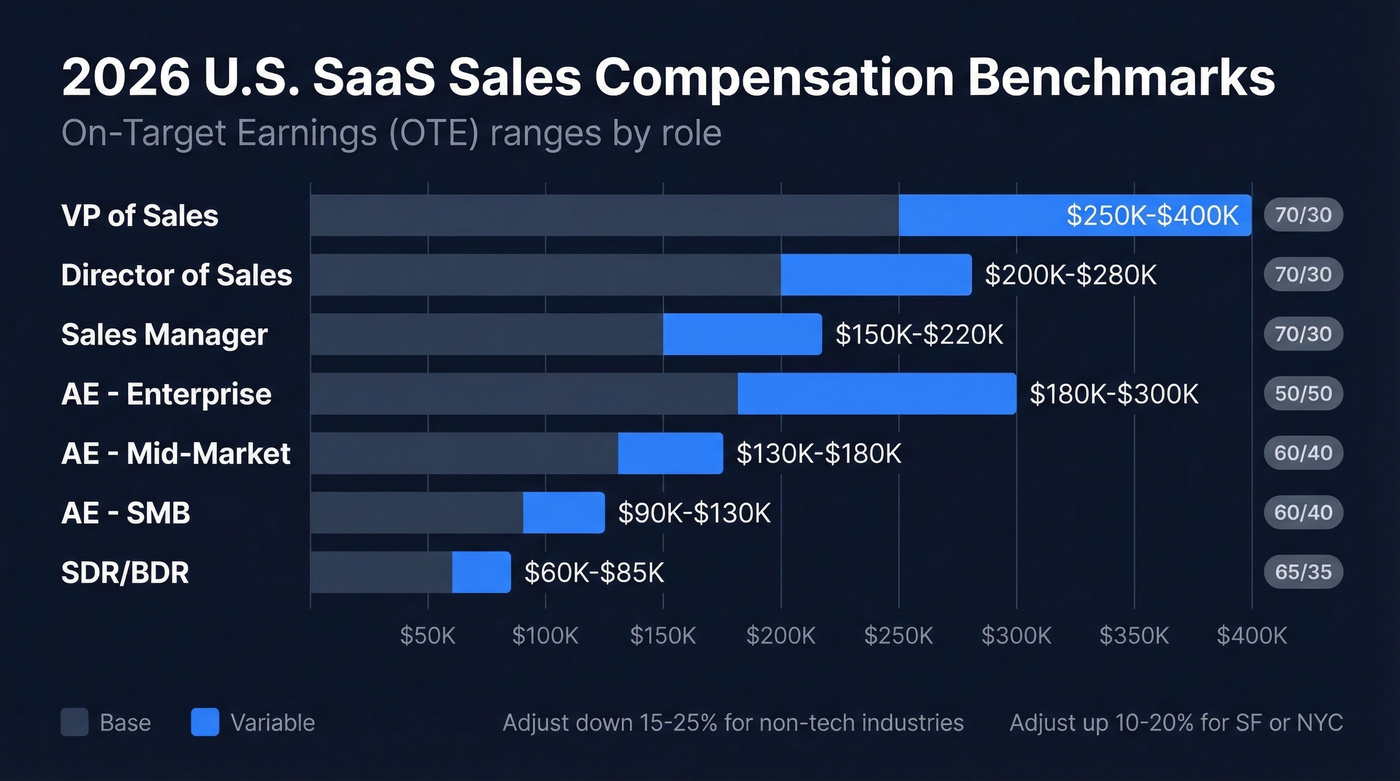
These are current U.S. SaaS ranges. Adjust down 15-25% for non-tech industries and up 10-20% for top-tier markets like SF or NYC.
Headcount Ratios
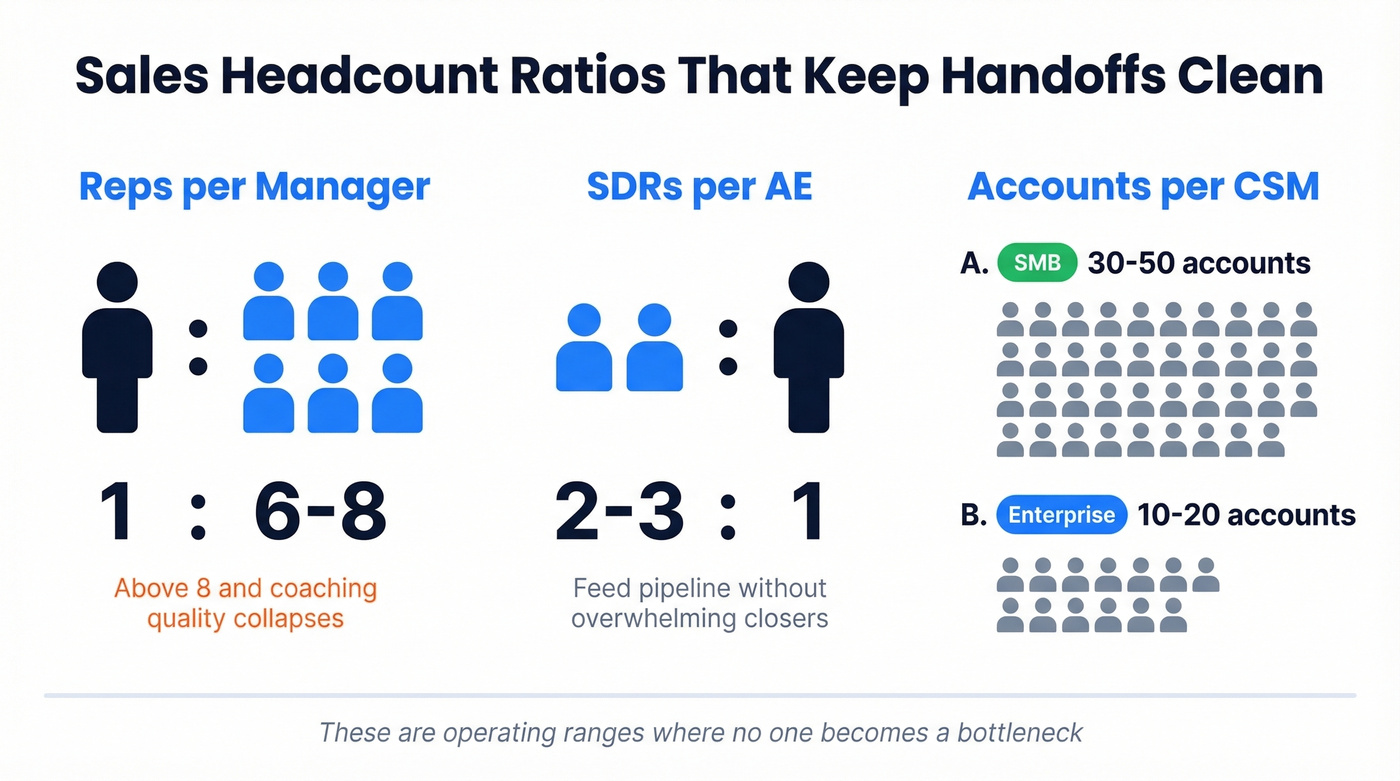
Staff 6-8 reps per frontline manager - go above 8 and coaching quality collapses. Run 2-3 SDRs per AE, and assign CSMs at roughly 30-50 accounts for SMB or 10-20 accounts for enterprise. These ratios aren't arbitrary; they're the operating ranges where handoffs stay clean and no one becomes a bottleneck.
Choosing the Right Org Structure
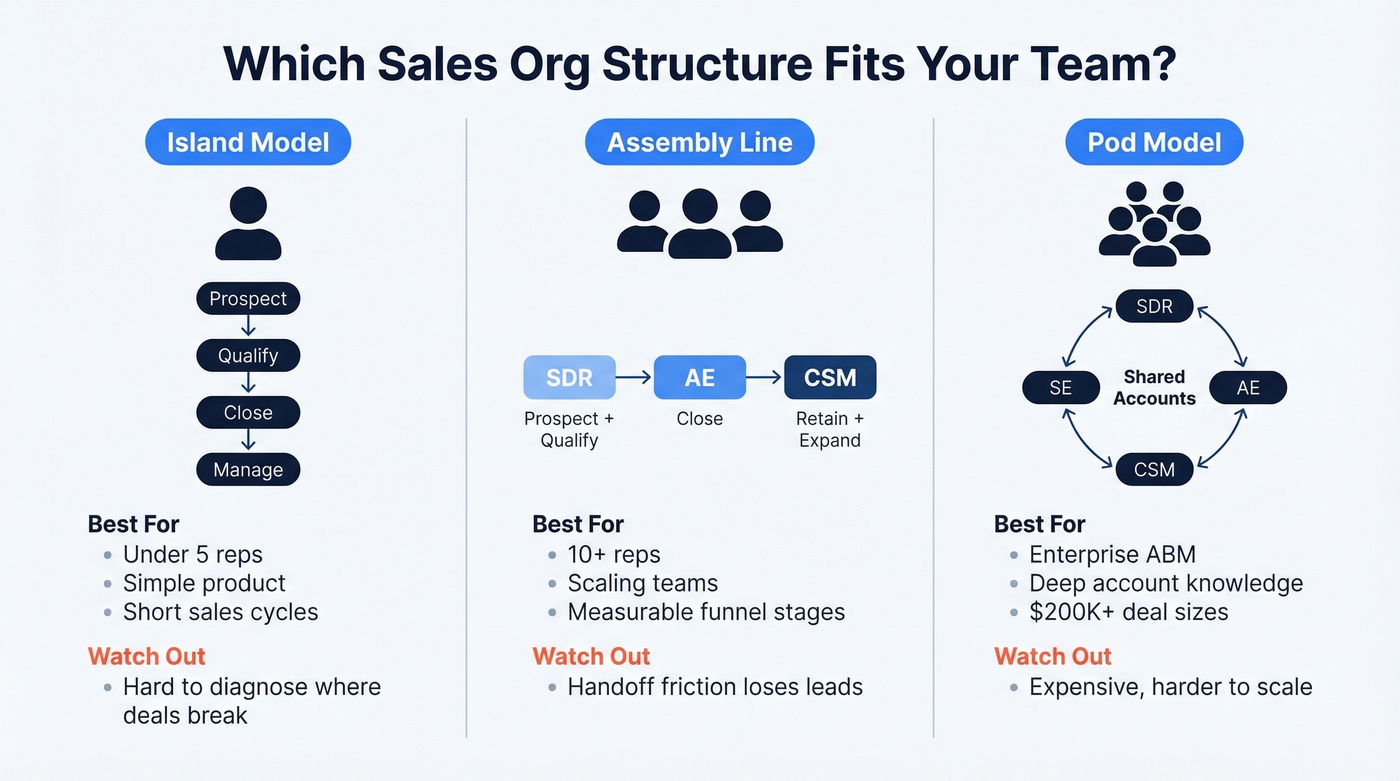
There's no universal org chart. The right structure depends on your stage, deal complexity, and how your buyers want to buy.
Island Model
Every rep handles the full cycle - prospecting, qualifying, closing, and sometimes even account management. This works when you have fewer than 5 reps, a straightforward product, and short sales cycles. Early-stage startups almost always start here because it's simple and you can't afford specialization yet. The downside: no rep can be great at every stage, and it's hard to diagnose where deals break down.
Assembly Line Model
SDRs prospect and qualify, AEs close, CSMs retain and expand. Clear handoffs, clear metrics at each stage. This is the default for scaling teams with 10+ reps and more complex sales motions.
The assembly line lets you measure conversion at every stage and identify exactly where the funnel leaks. The tradeoff is handoff friction - leads fall through the cracks between stages if your process isn't tight.
Pod Model
Cross-functional pods group an SDR, AE, and CSM - sometimes including a sales engineer - around a set of accounts. Each pod operates like a mini-business unit. This works best for mid-market and enterprise account-based selling where deep account knowledge matters more than volume.
Pods build stronger customer relationships but are harder to scale and more expensive to staff. The Korn Ferry principle applies here: start with how your buyers want to buy, then design the structure around that journey. A company selling $5K/year subscriptions to SMBs needs an assembly line. A company selling $200K enterprise contracts needs pods. Don't copy someone else's org chart - build one that matches your buyer.

You just read that SDRs fail when they're handed unverified contact lists. Prospeo's 5-step verification delivers 98% email accuracy and 125M+ verified mobile numbers - so your reps spend time selling, not bouncing.
Give your sales department the data infrastructure it deserves.
Building a Sales Team from Scratch
Stop hiring reps before you have a process. That's the single most common mistake founders make, and it's the one that costs the most to fix.
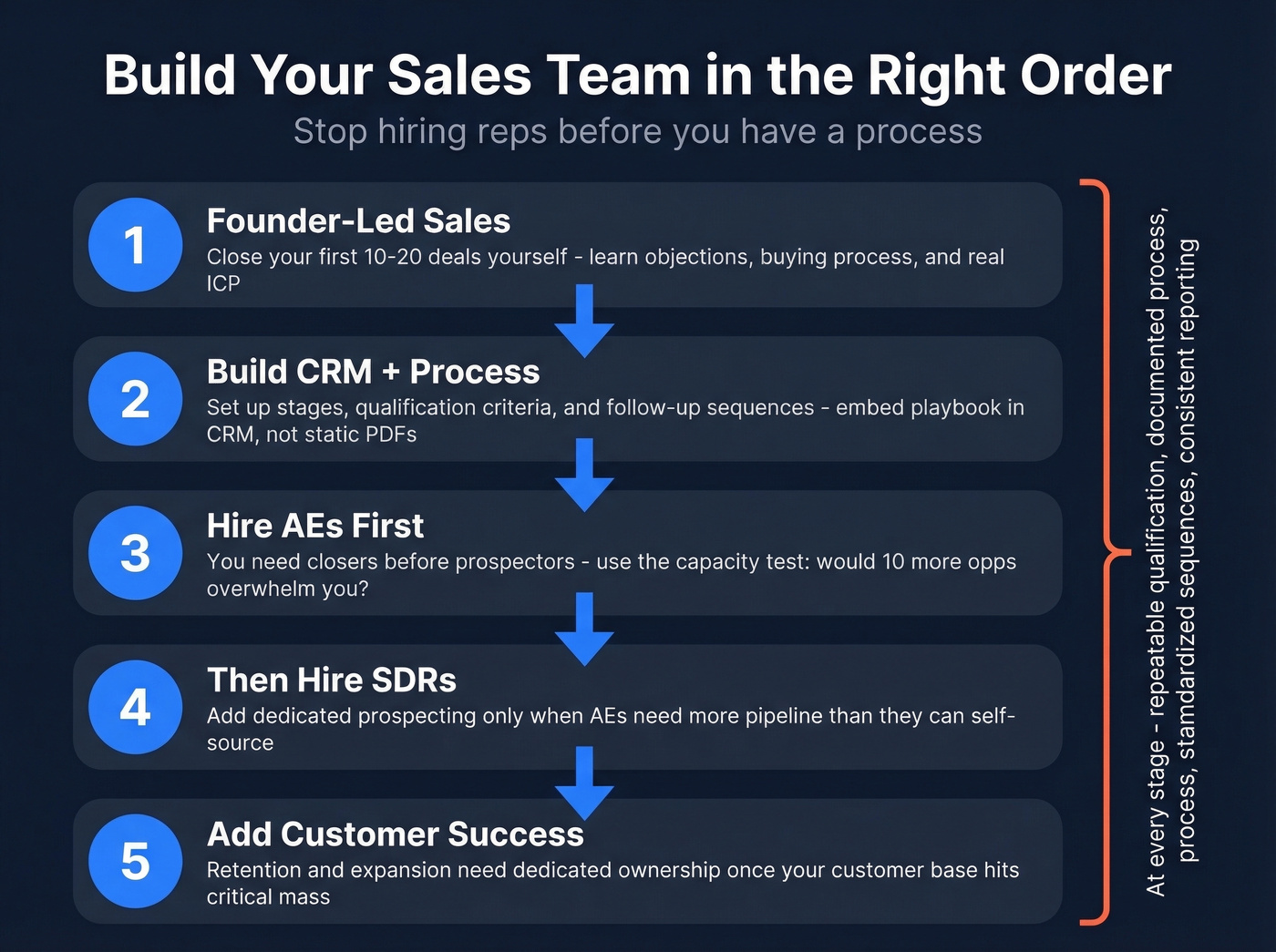
A practitioner framework from r/startup lays out the right sequence, and it matches what we've seen work across dozens of early-stage companies:
- Founder-led sales first. Close the first 10-20 deals yourself. You need to understand the objections, the buying process, and the real ICP before you can hand it off.
- Build CRM + process. Set up stages, decks, qualification criteria, and follow-up sequences in HubSpot or Salesforce. Embed your playbook directly in the CRM - static PDFs go stale; CRM-embedded guidance surfaces the right questions and assets by deal stage automatically.
- Hire AEs. Not SDRs - AEs. You need people who can close before you need people who can prospect. Use this capacity test: "If we got 10 more opportunities this month, how many would we drop the ball on?" If the answer is more than two, it's time.
- Hire SDRs. Once AEs are consistently closing and need more pipeline than they can self-source, add dedicated prospecting.
- Hire Customer Success. Retention and expansion revenue need dedicated ownership once your customer base hits critical mass.
Every new hire should have a 30-60-90 day plan with clear milestones. The scalable org checklist: repeatable lead qualification criteria, documented pipeline management process, standardized follow-up sequences, and consistent reporting. Without these, adding headcount just adds chaos.
The Reddit consensus on building sales teams is unanimous on one point - "If you ever say 'we're good on pipeline,' you've already sabotaged your growth."
KPIs That Actually Matter
KPIs aren't about tracking activity for its own sake. They're diagnostic tools. If a number is off, it should tell you exactly where to look.
| Metric | Target | Why It Matters |
|---|---|---|
| Speed-to-lead | <5 minutes | Conversion drops fast after 5 min |
| Pipeline coverage | 3-5x quota | Accounts for natural fallout |
| Selling time | 60-70% | Below 60% = process/tech problem |
| Win rate (SMB) | 20-30% | Healthy pipeline baseline |
| Win rate (Enterprise) | 10-20% | Longer cycles, more stakeholders |
Speed-to-lead is the most underrated metric. Industry benchmarks show that responding to inbound leads within 5 minutes dramatically improves conversion. Most teams don't even measure this.
Pipeline coverage at 3-5x quota sounds aggressive, but it accounts for the reality that deals fall out, slip, and shrink. If your coverage is below 3x, your reps are going to miss - it's math, not motivation.
Here's our hot take: pipeline coverage is the single most important metric in any sales department. If you only track one number, track this one. Coaching, comp plans, and tools are all irrelevant if there aren't enough qualified deals in the funnel. Everything else is optimization; pipeline coverage is survival.
On the activity side, track outbound metrics that actually matter: sales activities that actually matter: dials per day, emails per day, conversations per day, and dials-to-connection rate. But don't just count volume. A rep making 80 dials with a 2% connection rate has a different problem than a rep making 30 dials with a 10% connection rate. Personalization alone can bump reply rates by 40%.
The diagnostic framing matters most: if your reps spend more than 40% of their time on admin tasks, your tech stack has failed them. The ideal split is 60-70% selling time versus 30-40% administrative work. Measure it. If you're inverted, fix the tools and processes before blaming the reps.
Compensation Plans That Drive Results
Compensation is where strategy meets behavior. Get it right and reps do exactly what the business needs. Get it wrong and you'll watch your best people optimize for the wrong outcomes - or leave.
The uncomfortable stat: 39% of revenue leaders say their comp plans don't align with business goals. And most reps can't explain how they're paid in under 30 seconds. If your plan fails that simplicity test, it's too complicated.
Pay mix rules of thumb are straightforward. Closing roles like AEs run 50/50 base-to-variable. Prospecting roles like SDRs run 70/30 - higher base because they can't control close rates. Leadership roles run 65/35 to 70/30 because their impact is broader than any single deal.
For commission structures, there are roughly 10 common models: straight commission, base plus commission, tiered, revenue-based, gross margin commission, draw against commission, residual, product-based, territory volume, and multiplier. The one most teams overlook is gross margin commission - it stops reps from discounting every deal to the bone by tying their payout to profitability, not just revenue.
Accelerators and decelerators are the fine-tuning mechanism. Accelerators increase the commission rate above quota, typically 1.5-2x the base rate, rewarding overperformance. Decelerators reduce the rate below a threshold like 80% of quota, creating urgency. The key is keeping the math simple enough that reps can calculate their earnings on a napkin. If they can't, the incentive doesn't work.
Sales & Marketing Alignment
Let's be honest: nine out of ten sales and marketing professionals say they're misaligned on process, strategy, and culture. That's not a gap - it's a chasm.
The numbers get worse the deeper you look. 62% of sales leaders say sales and marketing define leads differently. 52.2% of sales professionals cite lost revenue as the biggest impact of misalignment. And teams that set interdepartmental KPIs are nearly 3x as likely to exceed customer acquisition targets.
Sales and marketing typically report to different leaders, have different timelines, and measure success differently. Marketing celebrates MQLs. Sales wants meetings that close. Without shared definitions and shared accountability, both teams optimize for their own metrics while the business suffers.
Here's a 5-step alignment playbook that works:
- Set shared revenue goals. Not marketing goals and sales goals - one number both teams own.
- Map the buyer journey together. Literally sit in a room and agree on what happens from first touch to closed deal.
- Centralize customer data. One CRM, one source of truth. No more "marketing's spreadsheet says X, sales says Y."
- Track joint metrics. Conversion rate from MQL to SQL, cycle length, pipeline velocity - metrics that span both teams.
- Start with quick wins. A lead handoff SLA where marketing delivers leads within X hours and sales follows up within Y minutes is the easiest first step and builds trust fast.
The Sales Tech Stack in 2026
Most sales departments run 8-12 tools. The majority overlap, half are underused, and nobody's audited the stack in two years. Audit twice a year and optimize for rep workflow, not tool adoption. If a tool doesn't make a rep's day easier, cut it.
| Tool | Category | Starting Price |
|---|---|---|
| Prospeo | Data & Prospecting | Free (75 emails/mo); ~$0.01/email |
| HubSpot | CRM | Free; Sales Hub from ~$15-20/user/mo |
| Salesforce | CRM | From ~$25/user/mo |
| Apollo | Data & Prospecting | Free; paid from ~$49/user/mo |
| ZoomInfo | Data & Prospecting | ~$15-40K/year |
| Gong | Conversation Intel | ~$100-150/user/mo |
| Outreach | Sales Engagement | ~$100-130/user/mo |
| Salesloft | Sales Engagement | ~$75-125/user/mo |
| Chili Piper | Scheduling/Routing | From $45/mo |
CRM is non-negotiable. HubSpot's free CRM is the right starting point for teams under 20 reps. Salesforce makes sense when you need complex workflows, CPQ, or heavy customization - but it comes with implementation overhead. Skip Salesforce until you actually need it; we've watched too many early-stage teams burn six figures on an implementation they didn't need yet.
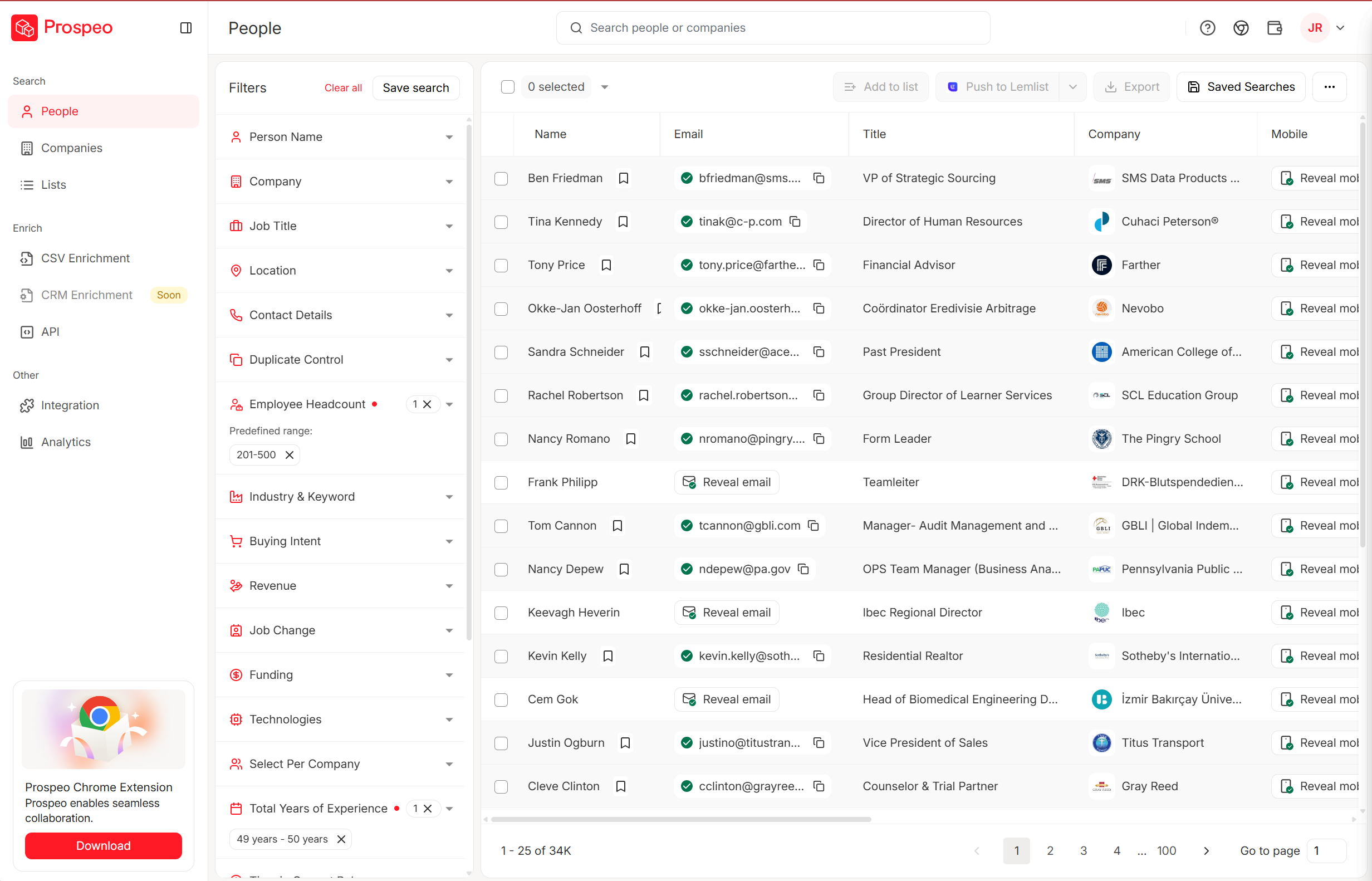
Data & Prospecting is where most teams get it wrong. They'll spend $30K+ on a data provider and then watch SDRs bounce 30% of their emails because the data's stale. Prospeo addresses this at a fraction of the cost: 300M+ professional profiles, 98% email accuracy, and a 7-day data refresh cycle versus the 6-week industry average. Pricing starts free at 75 emails per month, with paid plans at roughly $0.01 per email - no contracts, no annual commitments.
The proof point that matters: Snyk's 50-person AE team was running 35-40% bounce rates before switching their data layer. After the switch, bounce rates dropped under 5%, AE-sourced pipeline jumped 180%, and they're generating 200+ new opportunities per month.
Sales engagement tools like Outreach or Salesloft handle sequencing, while conversation intelligence platforms like Gong give managers coaching leverage. Add these as you scale past 10 reps - they're expensive and only pay off with enough volume to generate meaningful data.
AI is the emerging layer. In 2026, AI-powered email personalization, call summarization, and deal scoring are moving from novelty to necessity. Gong already uses AI for conversation analysis. Outreach and Salesloft are embedding AI into sequence optimization. Don't buy standalone AI tools yet - buy platforms that are building AI into workflows you already use.
Scaling from 3 reps to 15 breaks everything - especially data quality. Prospeo refreshes 300M+ profiles every 7 days, so your growing sales department never prospects with stale contacts. At $0.01 per email, it costs less than one bad hire's first coffee run.
Build the sales org right - start with data that actually connects.
Mistakes That Kill a Sales Department
Hiring before process. Adding headcount to a broken system just scales the dysfunction. Build repeatable processes first, then hire people to run them.
Bad data destroying outbound. If your SDRs get 30-40% bounce rates, the problem isn't their pitch - it's their data. Snyk proved this: switching to verified data dropped bounces from 35-40% to under 5% and lifted pipeline 180%. Bad data doesn't just waste time - it damages your sending domain, which compounds the problem over weeks and months.
Comp plans that incentivize the wrong behavior. If you pay AEs on revenue but want them to protect margins, you've built a discount machine. Align comp with what the business actually needs.
No coaching culture. The r/sales consensus is blunt: new reps get "tossed in with the wolves" and expected to figure it out. That's not a training program - it's a turnover factory. As one poster put it, "No demos = no money" - and reps without coaching never learn to book them.
Sales and marketing as separate kingdoms. When 62% of orgs can't even agree on what a "lead" means, deals die in the handoff. Shared goals, shared data, shared accountability - or shared failure.
FAQ
What does a sales department do?
A sales department handles five core functions: prospecting for new business, qualifying leads, closing deals, retaining existing customers, and expanding revenue within accounts. It's the team that turns market opportunity into actual bookings and is typically the largest revenue-generating function in a B2B company.
How many people do you need to start one?
You can start with 1-2 AEs after founder-led sales proves the model works - typically between $500K and $1M ARR. Add SDRs when your AEs can't self-source enough pipeline to stay busy, and layer in customer success once your account base hits critical mass.
What's the most important KPI to track?
Pipeline coverage at 3-5x quota. Without enough qualified pipeline, nothing else - coaching, comp plans, tools - matters. It's the foundation metric that makes every other KPI relevant and the first number any sales leader should check weekly.
How often should you restructure your sales team?
Every 2-3 years, per Korn Ferry's recommendation. Buyer behavior and market conditions shift constantly. The organizational structure that drove growth at one stage often becomes a bottleneck at the next - especially after crossing major ARR thresholds like $5M, $20M, and $50M.
What's a cost-effective alternative to ZoomInfo for sales data?
Prospeo offers 300M+ profiles with 98% email accuracy at roughly $0.01 per email. Its 7-day data refresh cycle keeps contact records current, and the free tier at 75 emails/month lets small teams validate the data before committing to anything.