

The Best Sales Email Sequence Software for 2026
Your sequencer didn't kill your deliverability. Your data did. Outreach's own benchmarks show a 2.8% average bounce rate across their customer base - roughly 47 bounces per 1,700 sends. That's enough to torch a domain's sender reputation in a single campaign. The tool that sends the email matters far less than the data feeding it, and most "best sales email sequence software" guides completely ignore that half of the stack.
Here's what's actually worth your money in 2026 - and the data layer that determines whether any of it works.
Our Picks (TL;DR)
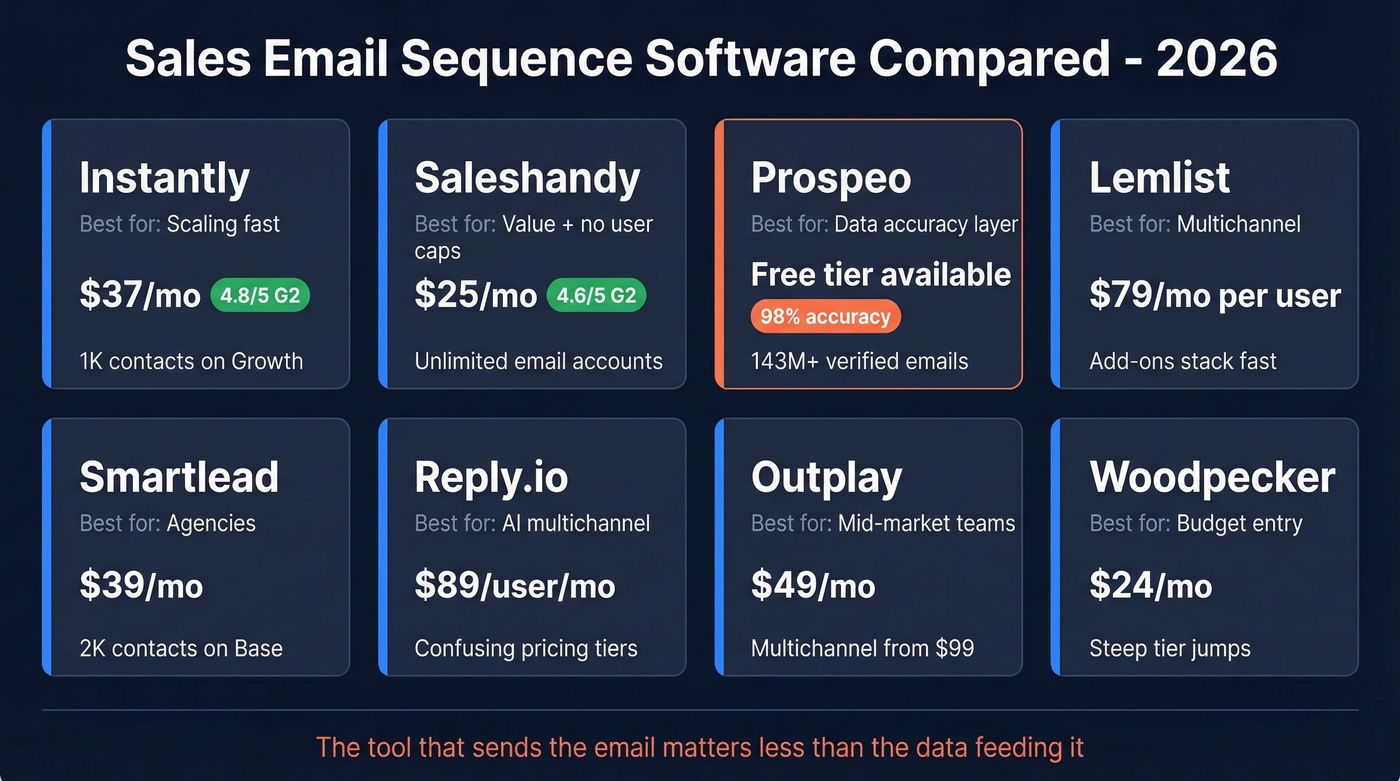
| Pick | Best For | Starting Price |
|---|---|---|
| Instantly | Solo reps scaling fast | $37/mo |
| Saleshandy | Best overall value | $25/mo |
| Prospeo | Clean data before you send | Free (75 emails/mo) |
Instantly is the simplest way to scale outbound from zero. Saleshandy gives you the most features per dollar without per-user gating. Prospeo makes sure your emails reach real people - 98% accuracy, native integrations with every major sequencer on this list.
Top Email Sequencing Tools Compared
| Tool | Best For | Starting Price | Key Limit | G2 Rating |
|---|---|---|---|---|
| Instantly | Scaling fast | $37/mo | 1,000 uploaded contacts/month (Growth) | 4.8/5 |
| Saleshandy | Value + no user caps | $25/mo | Email-first, limited multichannel | 4.6/5 |
| Prospeo | Data accuracy layer | Free | 75 emails/mo (free tier) | - |
| Lemlist | Multichannel | $79/mo/user | Add-on costs stack | - |
| Smartlead | Agencies | $39/mo | 2,000 contacts storage (Base) | - |
| Reply.io | AI-heavy multichannel | $89/user/mo | Add-ons push past $187+/rep | - |
| Outplay | Mid-market teams | $49/mo | Multichannel from $99 | - |
| Woodpecker | Budget entry | $24/mo | Steep tier jumps | - |
Instantly - Easiest to Scale
Instantly earned its 4.8/5 on G2 across 4,040 reviews for a reason: it's the fastest path from zero outbound to running sequences at volume. Unlimited email accounts and warmup on every Outreach plan means you spin up sending infrastructure without per-account fees. Reps can be sending within an hour of signing up. Pros:
- Growth plan at $37/mo includes unlimited accounts and warmup
- Hypergrowth ($97/mo) unlocks 25K contacts and 100K emails/month
- Dead-simple UI that doesn't require a week of onboarding
Cons:
- Growth caps you at 1,000 uploaded contacts and 5,000 emails/month - tight for any team running more than a couple campaigns
- G2 reviewers flag pricing and missing features once you outgrow Growth
- Lead Finder is a separate product ($47/mo+), so the "all-in-one" pitch gets expensive fast
Budget for Hypergrowth from the start if you're serious about scale. We've seen teams hit the 1,000-contact ceiling within their first week.
Saleshandy - Best Value
Saleshandy's Starter plan runs $25/mo on annual billing, Pro hits $69/mo, and Scale is $139/mo. Every tier includes unlimited email accounts. No surprise per-seat charges. The G2 rating sits at 4.6/5 across 773 reviews, with ease of use and email tracking as the most common praise.
It's not as polished as Instantly's UI, but the feature-to-dollar ratio is hard to beat - especially for teams of three or more where per-user pricing compounds fast. The AI Sequence Copilot functions as a built-in email sequence generator, helping newer reps build sequences without guessing at cadence or copy.
Skip this if you need multichannel sequences out of the box. Saleshandy is email-first. For multichannel, look at Lemlist or Reply.io below.
Prospeo - The Data Layer That Makes Sequencers Work
Every sequencer on this list sends emails. None of them verify whether those emails are real.
Prospeo sits upstream of your sequencer and solves the problem that actually kills campaigns: bad data. With 143M+ verified emails at 98% accuracy and a 7-day data refresh cycle (the industry average is six weeks), you're sending to addresses that existed this week - not last quarter. The 5-step verification process includes catch-all handling, spam-trap removal, and honeypot filtering, which are the checks that prevent the silent domain damage most teams don't notice until it's too late.
Native integrations with Instantly, Saleshandy, Lemlist, Smartlead, HubSpot, and Salesforce mean verified contacts flow directly into your sequences without manual exports. Stack Optimize built from $0 to $1M ARR running client campaigns on Prospeo data - 94%+ deliverability, bounce under 3%, zero domain flags across all clients. The free tier gives you 75 verified emails per month to test the difference clean data makes.
Lemlist - Multichannel Power
Lemlist handles email plus social steps and calling in one workflow, with WhatsApp automation available as an add-on. Email Pro runs $79/mo/user monthly ($63/mo annual) with 3 email senders and 200 enrichment credits. Multichannel Expert ($109/mo monthly, $87/mo annual) adds social automation and a built-in dialer.
Here's the thing: add-ons stack fast. Extra senders cost $9/mo each, and WhatsApp runs ~$20-29/mo per user. A 5-rep team easily crosses $550-750/mo before extras. The right tool if multichannel is non-negotiable, but for email-only campaigns, you're overpaying.
Smartlead - Built for Agencies
Use this if you're an agency managing multiple client accounts. Smartlead's white-label features and unlimited email accounts make it the default choice for outbound shops. Base plan starts at $39/mo with 2,000 contacts storage and 6,000 sends/month. Pro ($94/mo) jumps to 30,000 contacts and 90,000 sends.
Skip this if you're a single company running your own outbound. The contact caps on Base are restrictive, and the SmartDelivery add-on ($49/mo) for inbox placement monitoring adds up. Solo teams get better value from Instantly or Saleshandy.
Reply.io - AI-Heavy Multichannel
Reply.io is trying to be the AI-native sequencer with Jason AI SDR, an autonomous agent handling prospecting and follow-ups starting at $500/mo. The core Multichannel plan runs $89/user/mo on annual billing. Add social automation ($69/mo per account) and Calls/SMS ($29/mo per account), and a single rep's stack crosses $187/mo.
The pricing structure is genuinely confusing - lower tiers charge per user, higher tiers switch to flat pricing based on active contacts. If you want the AI SDR angle and don't mind the complexity, it's powerful. If you want clarity, look elsewhere.
Outplay - Mid-Market Option
Solid mid-market pick at $49/mo billed annually with 5,000 active prospects and 5 mailboxes. Multichannel kicks in at Growth ($99/user/mo annual), which adds a basic dialer and website tracking. AI SDR add-on available at $119/mo. Worth evaluating if you need a sequencer with Salesforce or Dynamics integrations at a reasonable price.
Woodpecker - Budget Entry
Budget entry point at $24/mo for the Starter tier on annual billing. The catch: Growth jumps to $126/mo - a steep cliff that makes Saleshandy's $25-69 range look far more reasonable. Fine for testing cold email with minimal investment, but plan your upgrade path before committing.

Every sequencer on this list sends emails. None of them guarantee those emails are real. Prospeo's 98% email accuracy and 7-day refresh cycle mean your sequences land in inboxes - not bounce logs that torch your domain. Stack Optimize built a $1M agency on it with under 3% bounce rates.
Stop feeding bad data into good sequencers. Fix the layer that matters.
How to Write Sequences That Get Replies
Outreach's benchmarks across their customer base show a 27.2% open rate, 2.9% reply rate, 2.8% bounce rate, and 1.1% opt-out rate. Those are averages - your results depend on list quality, copy, and targeting.
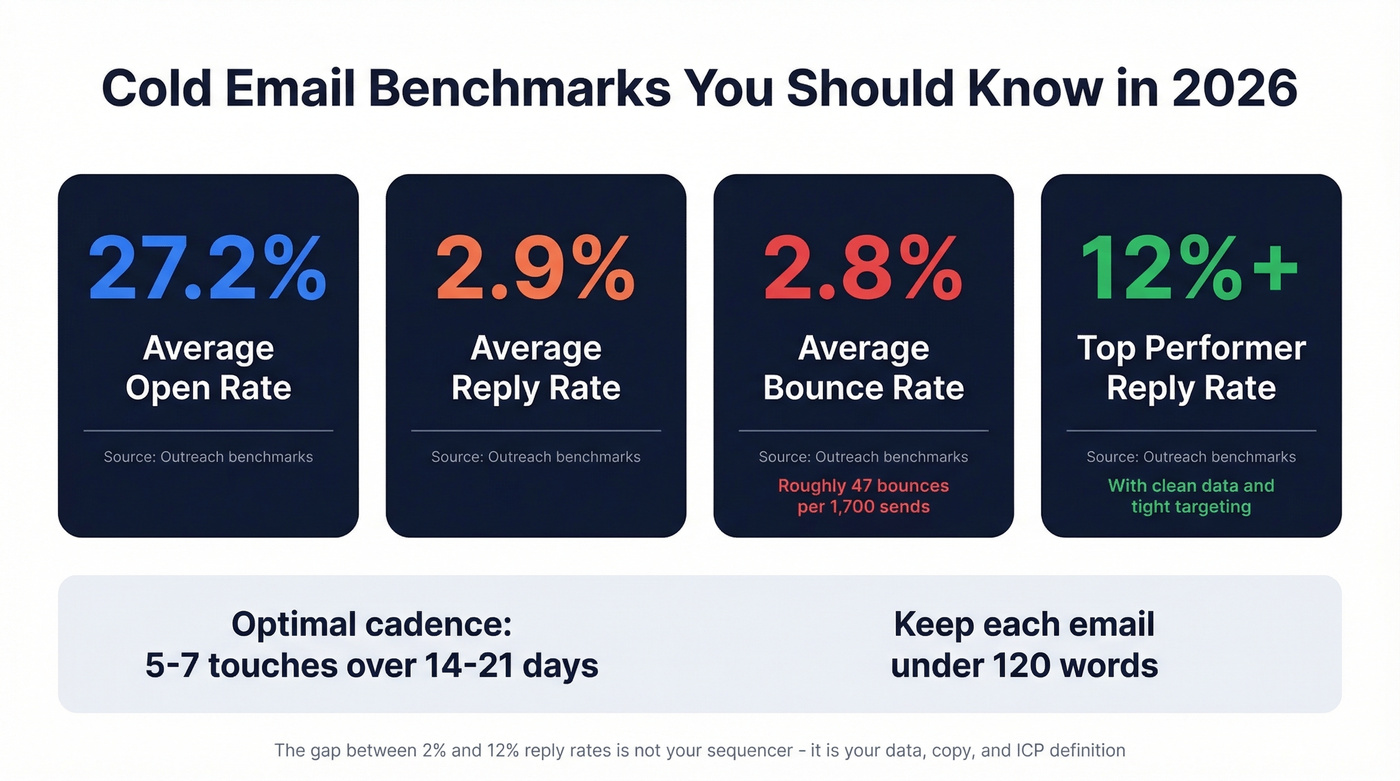
The consensus on r/coldemail is that a solid campaign at scale in 2026 delivers 2-4% reply rates. Warm, tightly targeted sequences can hit 12%+. The gap between 2% and 12% isn't your sequencer - it's your data, your copy, and your ICP definition. Most teams optimize the wrong variable.
Five to seven touches over 14-21 days is the standard cadence. Diminishing returns hit hard after step five, so don't build 12-step sequences hoping persistence beats relevance. Front-load your strongest value proposition in steps one through three, personalize the opening line to a specific trigger event, and keep each email under 120 words.
Let's be honest: if your average deal size is under $10K, you probably don't need a $100+/mo sequencer. Saleshandy at $25/mo with clean data will outperform a fully loaded Lemlist stack running on stale contacts every single time.
Cold Email Sequence Automation: Setup Before You Send
Get this infrastructure right before you write a single email.
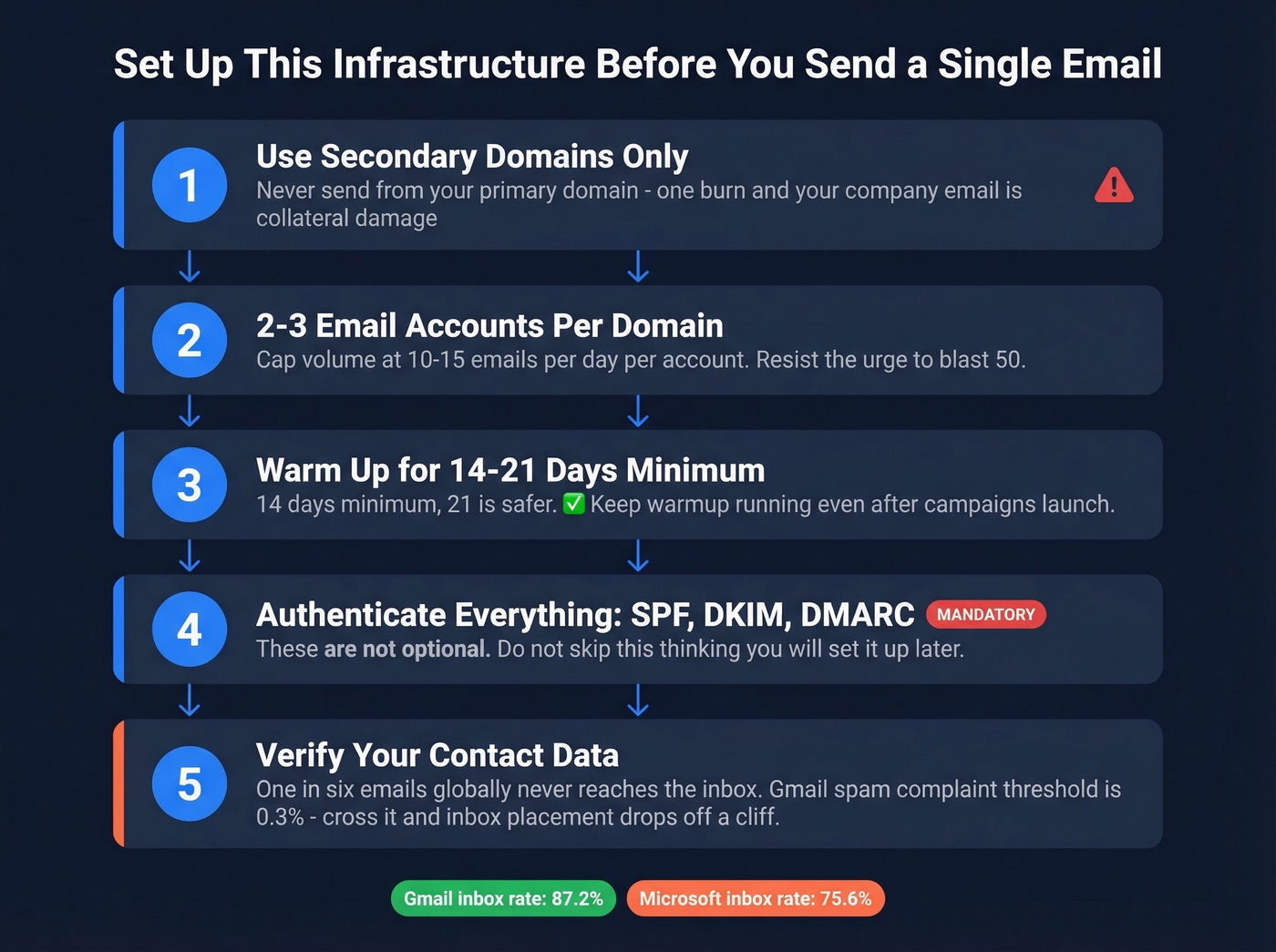
Send from secondary domains, never your primary - one domain burn and your company email is collateral damage. Run 2-3 email accounts per domain at most, capping volume at 10-15 emails per day per account. Resist the urge to blast 50. Warm every account for 14 days minimum (21 is safer), and keep warmup running after campaigns launch.
Authentication: SPF, DKIM, and DMARC aren't optional. They're mandatory. Don't skip this step thinking you'll "set it up later." If you need a quick checklist, start with this email deliverability guide and then validate your setup against SPF record examples.
ISP reality: Gmail delivers to inbox 87.2% of the time. Microsoft sits at 75.6%. A quarter of your Outlook-targeted emails may never arrive. Plan accordingly.
Your Sequence Is Only as Good as Your Data
One in six emails globally never reaches the inbox, and Gmail's spam complaint threshold sits at 0.3% - cross that line and your inbox placement drops off a cliff.

This is where data quality changes the math. A 7-day refresh cycle means you're sending to addresses that existed this week, not six weeks ago. Verification that includes catch-all handling, spam-trap removal, and honeypot filtering prevents the silent domain damage that accumulates over months of sending to stale lists. If you want to go deeper on list hygiene, use an AI email checker and track your email bounce rate by campaign.
You can pick any sequencer on this list and get results if your data is clean. Pick the best email sequence software in the world with dirty data and you'll burn domains faster than you can register new ones. We've watched it happen to teams running $200/mo stacks on $0 worth of verification. If you're building lists at scale, pair verification with data enrichment services so you aren't sequencing half-empty records.
You just compared eight sequencers. Now ask the question none of them answer: are you sending to real addresses? Prospeo plugs into Instantly, Saleshandy, Lemlist, and Smartlead natively - 143M+ verified emails at $0.01 each, refreshed every 7 days.
Integrate with your sequencer in one click and send with confidence.
FAQ
How many emails should a sales sequence have?
Five to seven emails over 14-21 days is the proven cadence. Reply rates drop significantly after the fifth touch, and longer sequences generate opt-outs that hurt sender reputation. Front-load your strongest copy in steps one through three.
What's a good reply rate for cold email in 2026?
At scale, 2-4% is solid - that's the practitioner consensus on r/coldemail. Outreach's platform average sits at 2.9%. Warm, targeted sequences can hit 12%+. Below 1% means your data or targeting needs work first.
Can an outbound email sequence generator replace manual prospecting?
Tools like Saleshandy's AI Copilot and Reply.io's Jason AI can draft and schedule entire sequences automatically, but they still need human oversight on targeting. An outbound email sequence generator handles cadence, follow-ups, and A/B variants - freeing reps to focus on personalization and list quality.
Do I need dedicated sequencing software or can my CRM handle it?
CRM-native sequencing in HubSpot or Salesforce works for low volume - maybe 10-15 emails per day. Beyond that, you need dedicated infrastructure: unlimited sending accounts, proper warmup, and deliverability monitoring. Verify your contact data before sending regardless of platform - bad emails tank sequences no matter what's sending them.