

Sales Enablement Change Management: The Playbook for Initiatives That Actually Stick
A RevOps lead we know launched a "transformative" enablement program last year. Executive buy-in, slick content library, the works. Three months later, reps were back to their old workflows and the platform had a sub-15% login rate. The program didn't fail at launch - it failed after launch, which is where most enablement initiatives go to die.
Here's the disconnect: 77% of enablement professionals say enablement is critical to business performance, yet only 18% of sales organizations rate their own training as effective. Reps report that internal meetings and trainings eat 20-25% of their week. That's not a training problem. It's a sales enablement change management problem - and most enablement teams aren't equipped to run one.
The Short Version
- Use ADKAR, not Kotter. ADKAR targets individual behavior, which is what enablement actually is - changing rep habits one person at a time.
- Start with listening, not launching. Shadow reps before you ship anything.
- Measure behavior change, not attendance. Win rate, ramp time, and deal size tell you if it's working. Completion certificates don't.
Why Enablement Initiatives Fail
60% of enablement functions don't have a formal charter or annual planning process. They're running on vibes and good intentions, which is how you end up in a cycle: launch a program, watch adoption decay, panic, launch another program. This reactive-vs-proactive gap is the root cause. Teams spend all their energy responding to fires instead of building durable systems.
The decay is predictable. People forget roughly 70% of new information within a week and 90% within a year without reinforcement. Forrester's research puts it bluntly: enablement initiatives "almost never" fail because of the tool. They fail because nobody plans for what happens after the kickoff call. As one rep vented on r/sales, mandatory training sessions feel like being sent back to high school - and reps respond accordingly, by tuning out.
Let's be honest: reps aren't resisting change. They're resisting being treated like students. When your "enablement" looks like mandatory hour-long video calls three times a week, you haven't enabled anyone. You've created resentment. Effective change management in sales starts with respecting how reps actually work.
The ADKAR Framework for Sales Teams
We recommend ADKAR over Kotter for enablement because it's built around individual change, not organizational transformation. Enablement is personal - you're changing how a specific rep runs discovery calls or uses a specific tool. ADKAR gives you five sequential building blocks.
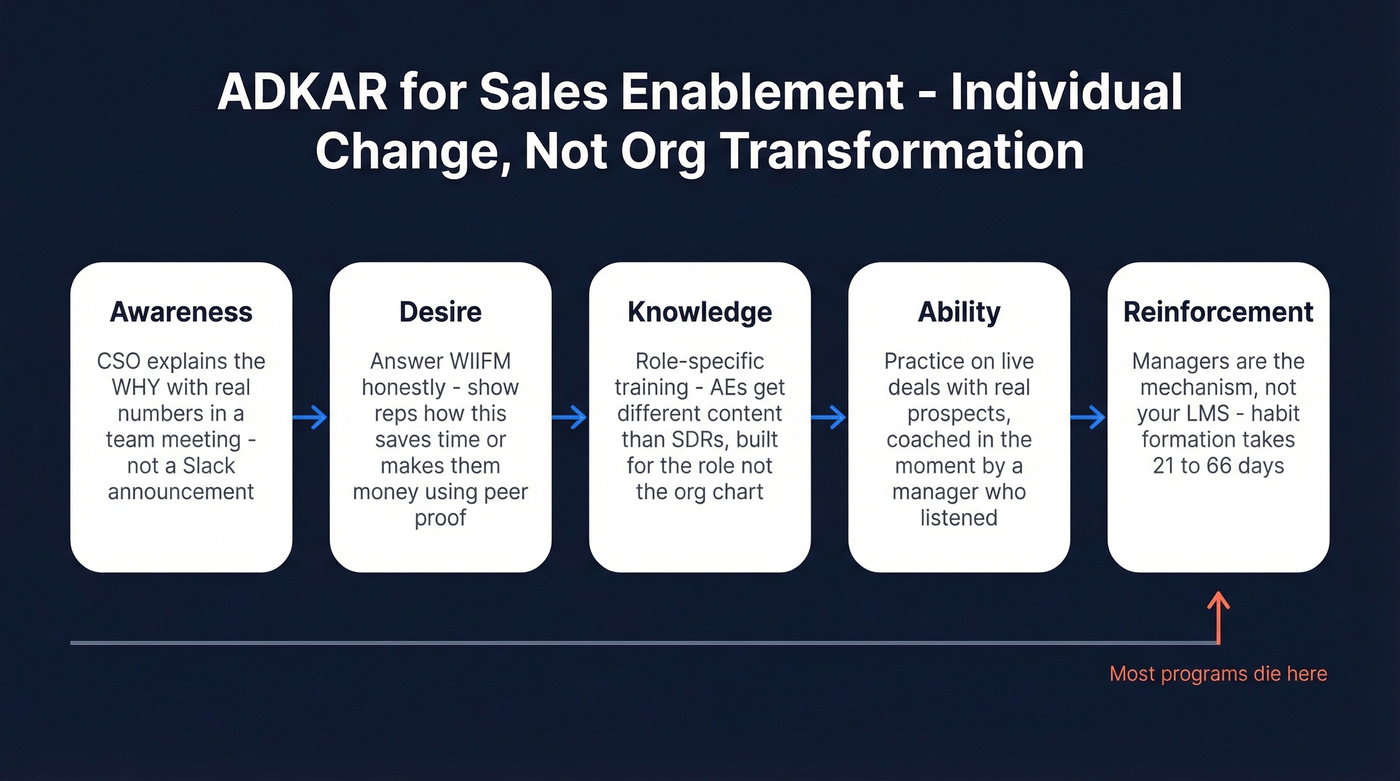
Awareness - Reps need to understand why something is changing before they'll care. This isn't a Slack announcement. It's your CSO standing up in a team meeting and explaining the business case with real numbers. If your CSO isn't sponsoring the initiative, don't launch it. Full stop.
Desire - Answer the WIIFM question honestly. "This will help you hit quota faster" lands. "This aligns with our strategic vision" doesn't. Show reps how the change saves them time or makes them money, using proof from their peers - not a vendor case study from 2019.
Knowledge - Targeted, role-specific training. An AE needs different enablement than an SDR. Build for the role, not the org chart. (If you're building a stack around SDR workflows, start with the right SDR tools.)
Ability - Practice in live deals, not classrooms. Real ability comes from applying new skills on actual calls with actual prospects, then getting coached in the moment by a manager who was listening. Simulations help. Real pipeline helps more.
Reinforcement - This is where most programs die. Habit formation takes anywhere from 21 to 66 days, and a study in Frontiers in Psychology analyzing 492 respondents found that coaching leadership significantly drives change-oriented behavior. Your managers are the reinforcement mechanism, not your LMS. Without sustained reinforcement, behavioral adoption flatlines within weeks.

The ADKAR framework falls apart at the Desire stage when reps don't trust the data. Prospeo's 98% email accuracy and 7-day refresh cycle eliminate the "garbage data" excuse that kills adoption. When contacts actually connect, reps stop building workarounds and start using the system.
Give reps data worth adopting - 98% accurate, refreshed weekly.
Your 30-60-90 Day Playbook
Stop launching programs. Start finishing them.
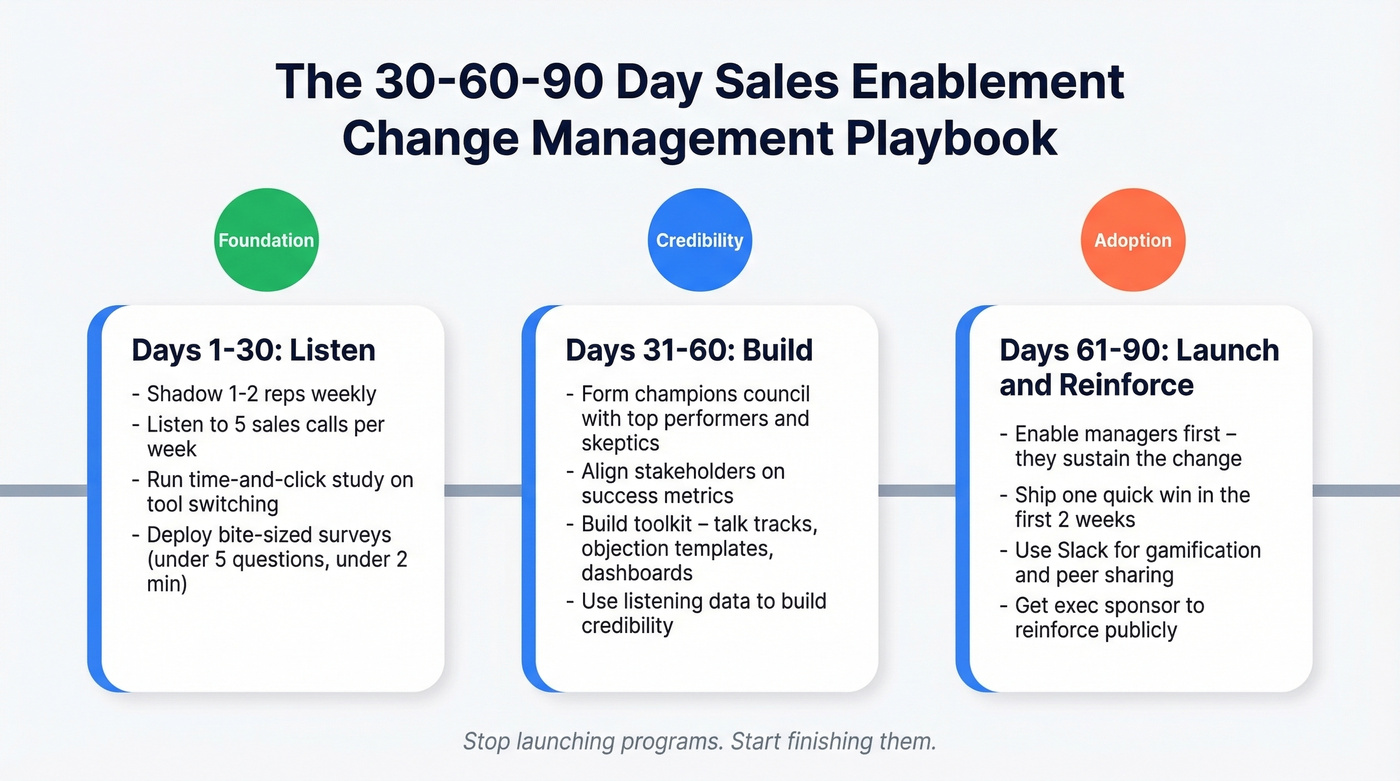
Days 1-30: Listen
Shadow one to two reps weekly. Listen to up to five sales calls per week and send trend emails to leadership covering objections, competitive intel, and enablement gaps. This phase isn't optional - it's the foundation everything else rests on, and skipping it is the single most common mistake we see enablement teams make.
Run a time-and-click study to quantify how much time reps waste context-switching between their 5-7 tools. Deploy bite-sized surveys - under five questions, under two minutes. Establish a training time budget upfront so reps know you respect their selling time. Some teams cap it at 10 hours per year. You're building a case with data, not assumptions.
Days 31-60: Build
Create a champions council that includes top performers, frontline managers, and - critically - skeptics. Skeptics who convert become your most credible evangelists. We've seen this play out repeatedly: the rep who pushed back hardest during the pilot becomes the one other reps actually listen to.
Align stakeholders on what success looks like before you build anything. This is also where you build influence without formal authority, because data-backed recommendations from the listening phase give you credibility that a title never will. Assemble resource packs: talk tracks, objection-handling templates, dashboards, cheat sheets. Not a content library. A toolkit.
Days 61-90: Launch and Reinforce
Enable the managers first. They're the ones who'll sustain this after you move on to the next initiative, so invest your coaching hours there before anywhere else. Use Slack channels for gamification and peer sharing.
Ship one quick win in the first two weeks of launch so reps see tangible value immediately. Get your exec sponsor to reinforce publicly. The goal isn't a big-bang launch. It's a quiet, steady drumbeat that becomes the new normal. If you're planning a "launch day" with balloons and swag, you've already lost the plot.
Measuring Enablement Change
49% of enablement professionals disagree with their leadership on which metrics they should be assessed on. Solve that disagreement before launch, not after - it's the fastest way to get your initiative killed by misaligned expectations.
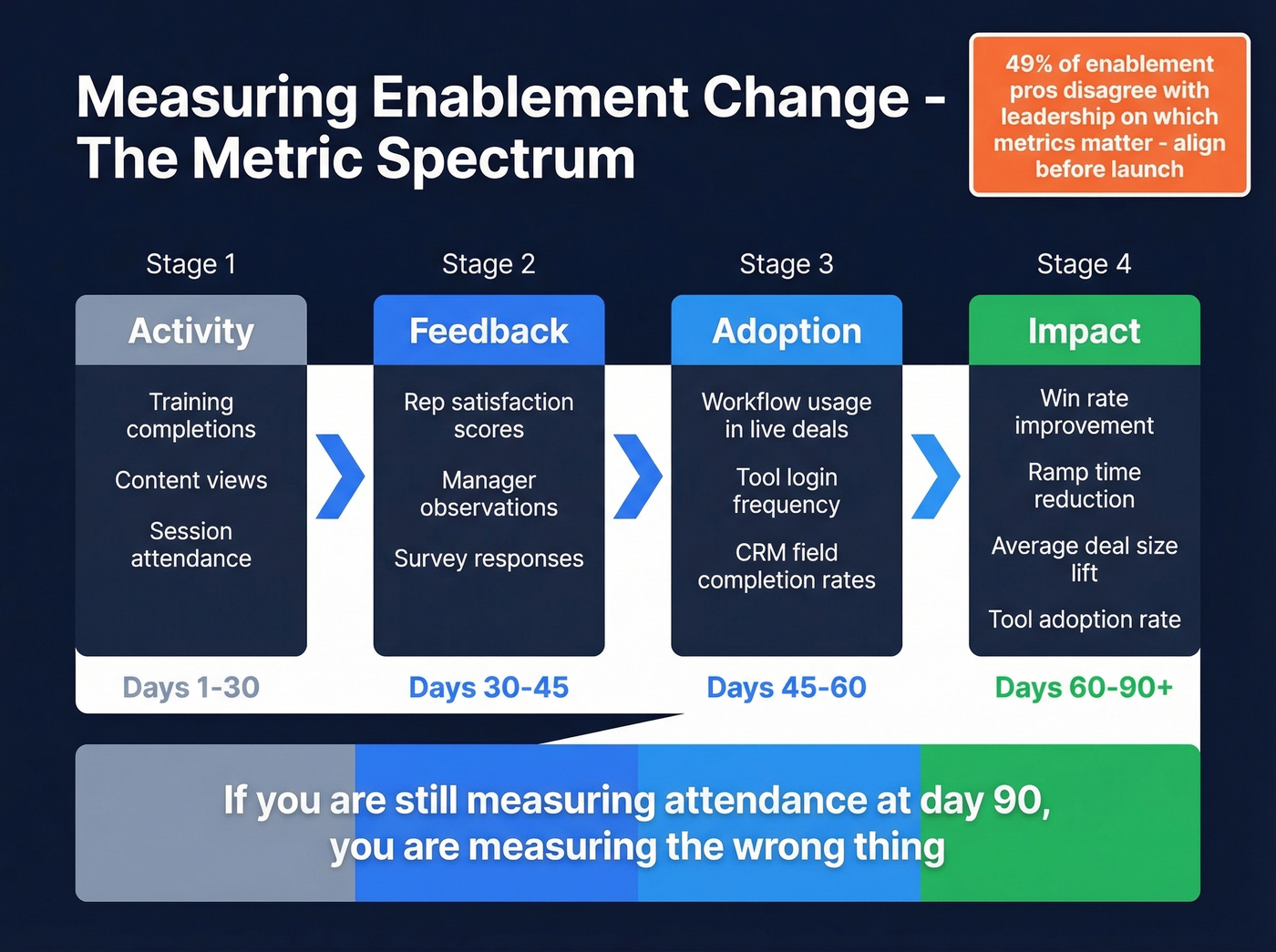
Think of measurement as a spectrum: activity -> feedback -> adoption -> impact. Early on, you're tracking activity and feedback. By day 60, you should be tracking adoption - are reps actually using the new workflow in live deals? By day 90, you're measuring impact: win rate, ramp time, average deal size, and tool adoption rate.
If you're still measuring attendance at day 90, you're measuring the wrong thing.
The Data Problem Nobody Talks About
Here's a pattern that keeps coming up: your top rep ignores half the CRM fields because "the data is garbage." They've been burned by bad phone numbers and bounced emails, so they build workarounds - personal spreadsheets, manual research, gut-feel prospecting. Now you're rolling out a new enablement workflow that depends on that same CRM data. Good luck getting adoption.
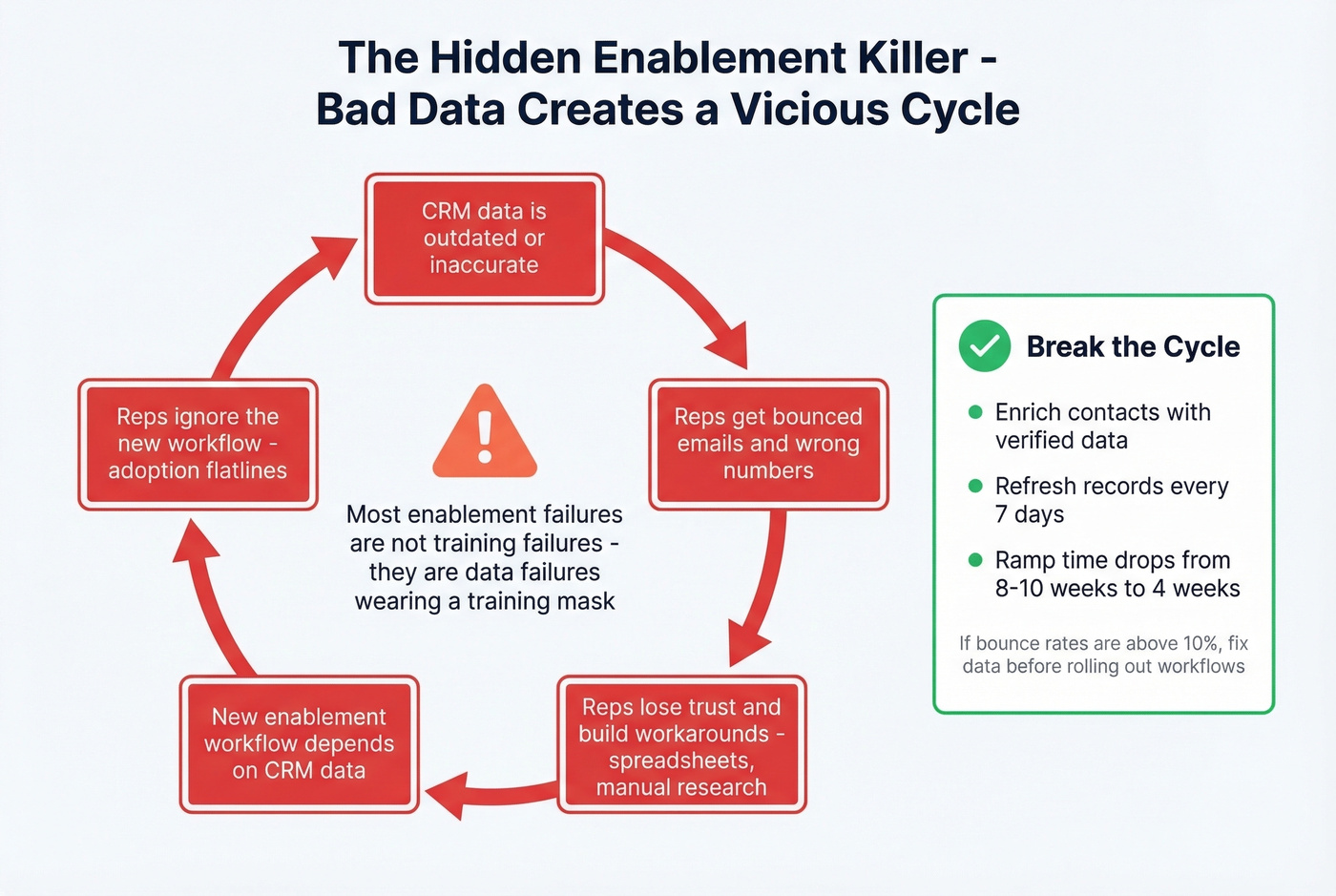
Most enablement failures aren't training failures. They're data failures wearing a training mask. Bad data is a change management problem in disguise. When GreyScout fixed their data foundation with Prospeo - 300M+ professional profiles, 98% email accuracy, records refreshed every 7 days - rep ramp time dropped from 8-10 weeks to 4 weeks. Reps trusted the data, so they trusted the tools built on top of it. That's the piece most enablement leaders miss: fix the data first, then roll out the workflow. (If you're evaluating vendors, start with a shortlist of data enrichment services.)
For teams where data quality isn't the bottleneck, skip this step and focus on the coaching cadence instead. But if your bounce rates are above 10%, you've got a data problem masquerading as a training problem.
Your 30-60-90 day playbook won't survive the data problem in your CRM. Prospeo enriches contacts with 50+ data points at a 92% match rate - so when reps open the tool, they find verified emails and direct dials, not dead ends. That's the quick win that makes enablement stick.
Solve the data trust problem before your next enablement launch.
FAQ
Which change framework works best for sales enablement?
ADKAR is the strongest fit because it targets individual behavior change, which is exactly what enablement requires. Unlike top-down models like Kotter's 8-step process, ADKAR maps directly to the adoption journey each rep goes through - from awareness of the problem to sustained reinforcement of new habits.
How long before an enablement initiative shows results?
Plan for 90 days minimum. Leading indicators like workflow adoption and content usage surface by day 60. Lagging indicators - win rate improvement, deal-size lift - typically appear between day 90 and 120. Tracking both prevents premature cancellation, which is the second-most-common way these programs die.
What's the biggest reason enablement rollouts fail?
Lack of reinforcement after launch, compounded by poor underlying data quality that erodes rep trust in new tools. Most teams treat sales enablement change management as a one-time event rather than an ongoing process, and that's exactly where adoption breaks down. The coaching cadence has to come from frontline managers - no platform or content library can substitute for a manager who actually follows up.