

How to Build a Sales Enablement Playbook That Reps Actually Use
Your new AE just started. It's week three. They're still asking the rep next to them how to handle the "we already use [competitor]" objection - because there's no playbook.
If your enablement team is taking orders from every VP with a pet project, you don't have a strategy. You have a to-do list. A sales enablement playbook fixes that, and if you're looking for the Cory Bray & Hilmon Sorey book, this isn't a summary - it's the operational guide you can start using today. Every enablement platform gates their "playbook template" behind a form. Here's the actual framework, no form required.
What a Sales Enablement Playbook Actually Is
It isn't a PDF someone made in 2023 and forgot about. It's a single source of truth spanning prospecting through closing - strategies, tools, training, and metrics in one living system. Highspot frames this around three pillars: making enablement a top priority, implementing a unified hub for customer-facing messaging, and building a fully integrated tech ecosystem.
Don't confuse plays with the playbook. A sales play is a repeatable tactic for a specific situation - the competitive displacement play, the expansion play. The playbook is the operating system that houses all of them, plus the governance and measurement framework that makes them stick.
Why Your Team Needs One in 2026
The enablement market is projected to hit $8.79B by 2029, and the companies investing are seeing results. A Brandon Hall Group study found that organizations with a well-defined enablement strategy report a 15% higher win rate than those without. Enablement programs cut onboarding time by 40-50%. That matters when average salesperson tenure is around 1.5 years - without a playbook, you're spending half their career getting them productive.
Here's the stat that should bother you: 50% of prospect engagement comes from just 10% of enablement content. Stop building more content. Audit what you have first.
What Goes Inside Your Playbook
Most teams nail the first five components below and skip the rest - especially competitor battlecards, objection handling, and sales methodology, which are the three that actually move deals.
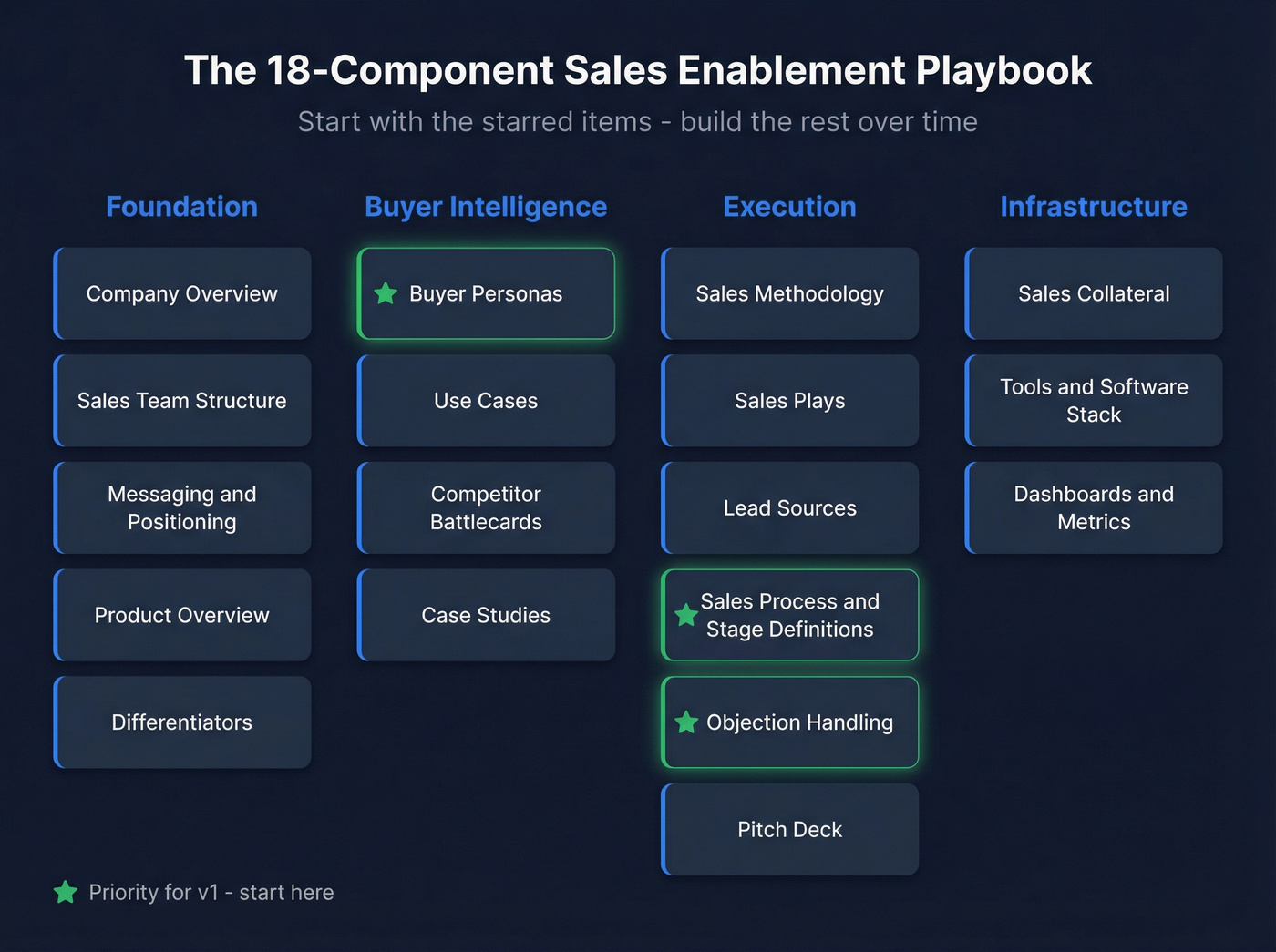
Foundation: Company overview, sales team structure, messaging and positioning, product overview, differentiators
Buyer Intelligence: Buyer personas, use cases, competitor battlecards, case studies
Execution: Sales methodology, sales plays, lead sources, sales process and stage definitions, objection handling, pitch deck
Infrastructure: Sales collateral, tools and software stack, dashboards and metrics
You don't need all 18 on day one. Start with buyer personas, sales process, objection handling, and your top three plays. Build decision points into each section so reps can adapt by industry, deal size, and persona. Iterate from there.

Every play in your enablement playbook depends on reaching the right person. If 30% of your emails bounce, your reps lose trust in the playbook itself. Prospeo delivers 98% email accuracy with a 7-day refresh cycle - so the contact data behind every play stays current.
Bad data kills good playbooks. Fix the foundation first.
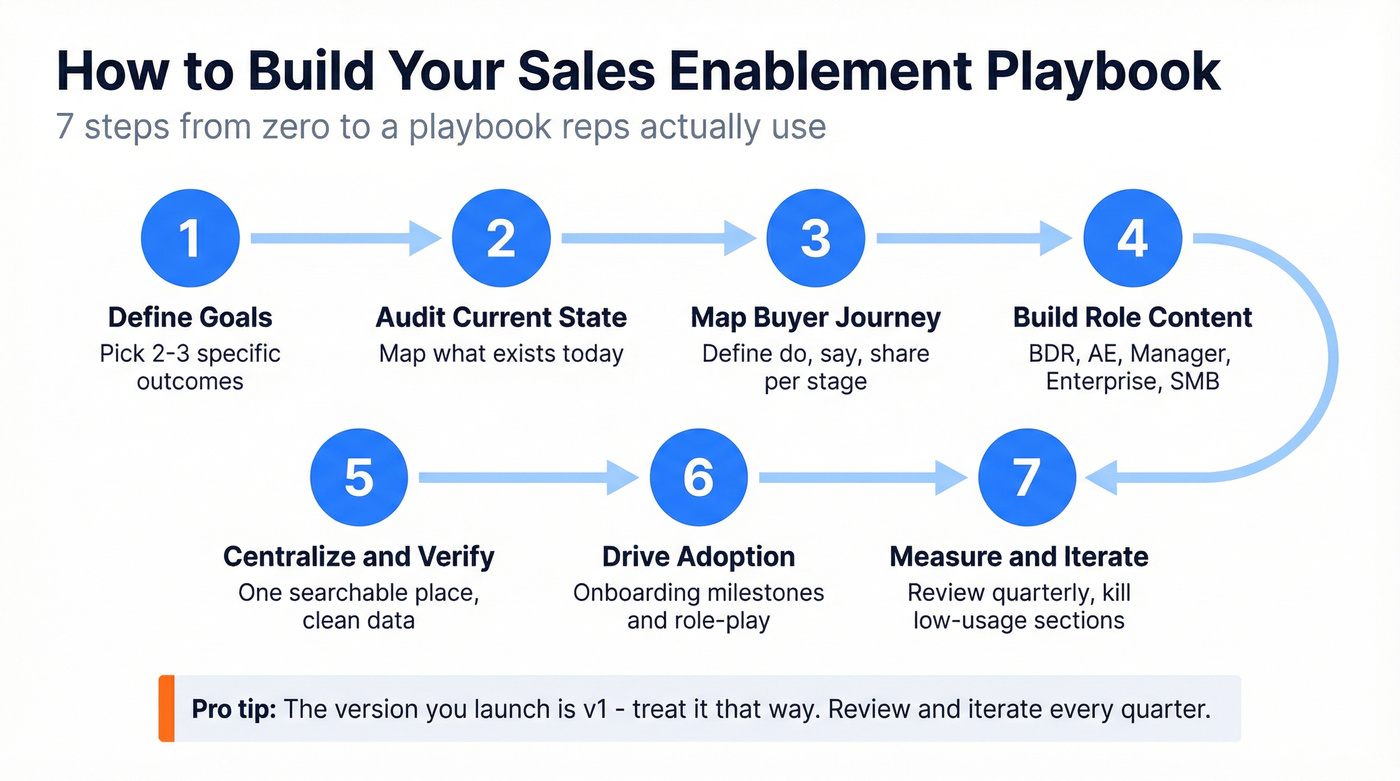
How to Build It: 7 Steps
Step 1: Define Goals and Future State
Pick two or three specific outcomes. Shorten the sales cycle? Improve win rate on competitive deals? Cut ramp time? "Better enablement" isn't a goal - it's a wish.
Run a pre-mortem before you start building. Define your current state, your proposed future state, and who owns each section. In our experience, teams that align on metrics and ownership before building ship faster and avoid the dreaded "who's maintaining this?" question at month three.
Step 2: Audit Your Current State
Map what exists. Most teams discover content scattered across Google Drive folders nobody maintains, Notion pages with conflicting versions, Slack threads that disappear after your retention window, and one senior rep's brain - the single point of failure. That's your starting point, not your playbook.
Step 3: Map the Buyer Journey
Walk through every stage - lead generation, engagement, presentation, negotiation, close. At each stage, define what the rep should do, say, and share. Highspot's framework calls this "in-the-moment guidance," and it's the difference between a playbook that gets used and one that gets bookmarked.
Step 4: Build Role-Specific Content
One-size-fits-all playbooks collect dust.
| Role | Core Content |
|---|---|
| BDRs | Cold outreach scripts, qualification frameworks |
| AEs | Discovery guides, competitive battlecards |
| Managers | Coaching templates, pipeline review checklists |
| Enterprise | Multi-stakeholder talk tracks |
| SMB | Speed-to-close sequences |
Notice that the manager row doubles as a sales coaching playbook - giving frontline leaders structured frameworks for 1:1s, call reviews, and deal inspections instead of leaving coaching quality to chance.
Step 5: Centralize and Verify Data
Scripts, templates, case studies, demo recordings - put them in one searchable place. But here's what most playbook guides skip: the foundation of any play is accurate contact data. If your reps are working off lists where 30% of emails bounce, no play works. No script matters.
This is where a data verification layer becomes non-negotiable. We've seen teams at GreyScout cut their bounce rate from 38% to under 4% and grow pipeline 140% just by cleaning up their contact data with Prospeo. Credit-based pricing starts free, no contract required.

Step 6: Drive Adoption
A playbook nobody uses is just a document. We've seen the best results when teams tie adoption to onboarding milestones - new reps don't get their full book of accounts until they've completed playbook certification. Think of this section as your sales onboarding playbook: a structured path from day-one orientation through full ramp, with the enablement playbook as the curriculum.
Make it practical. Role-play the top objections. Run deal-stage simulations from discovery through close. Require reps to find the right asset during live exercises. Add a short quiz so managers can coach to gaps, not vibes.
Step 7: Measure and Iterate
Review quarterly. Kill sections with under 10% rep usage. Promote sections correlated with closed deals. The version you launch is v1 - treat it that way.
Metrics That Prove It Works
Here's an uncomfortable reality: 49% of enablement professionals disagree with their leadership on which metrics they should even be measured on. Fix that alignment first, then track these:
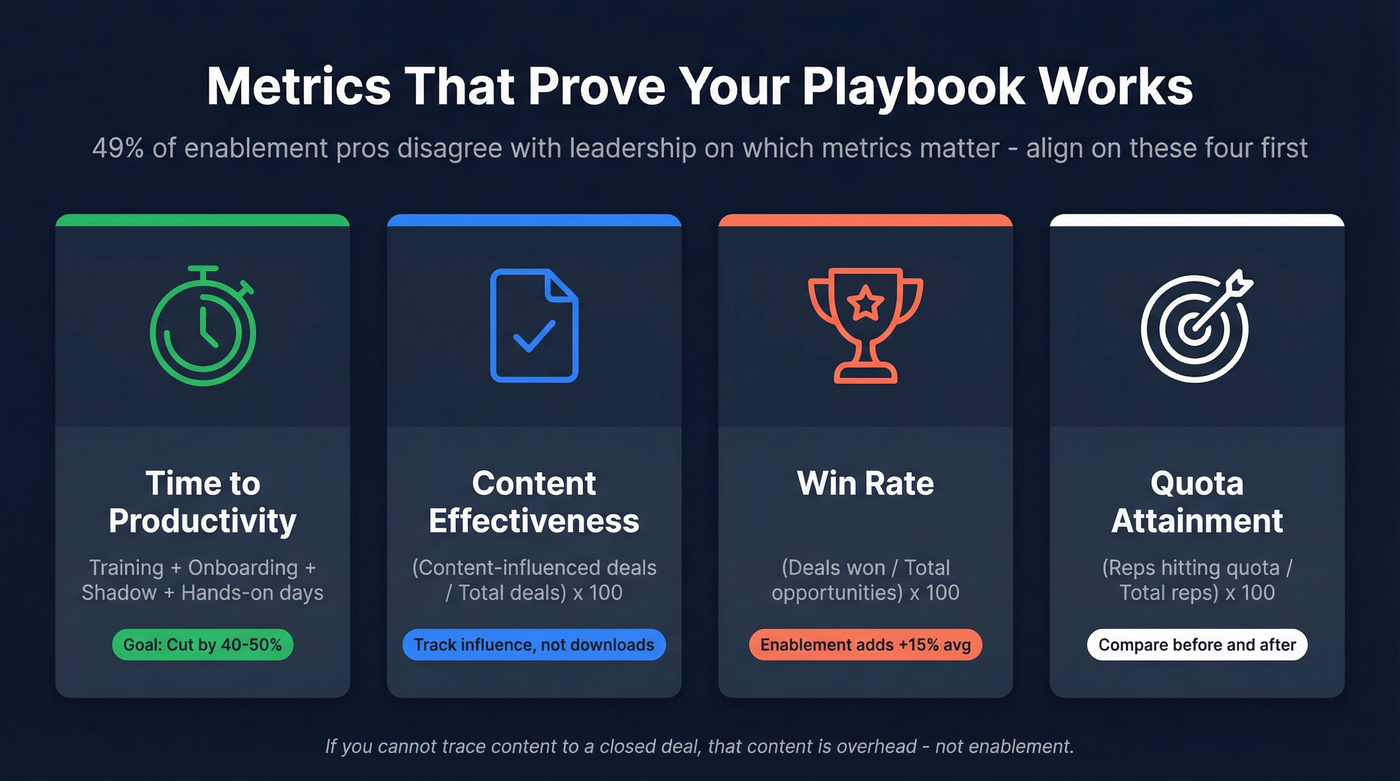
| Metric | Formula |
|---|---|
| Time to Productivity | Train + Onboard + Shadow + Hands-on days |
| Content Effectiveness | (Content-influenced deals / Total deals) x 100 |
| Win Rate | (Deals won / Total opportunities) x 100 |
| Quota Attainment | (Reps hitting quota / Total reps) x 100 |
Let's be honest: most teams obsess over content volume when they should obsess over content influence. If you can't trace a specific piece of content to a closed deal, that content is overhead, not enablement.
Mistakes That Kill Playbooks
Over-reliance on technology. Buying Highspot doesn't mean you have enablement. Tools without relevant content and training behind them are expensive filing cabinets.
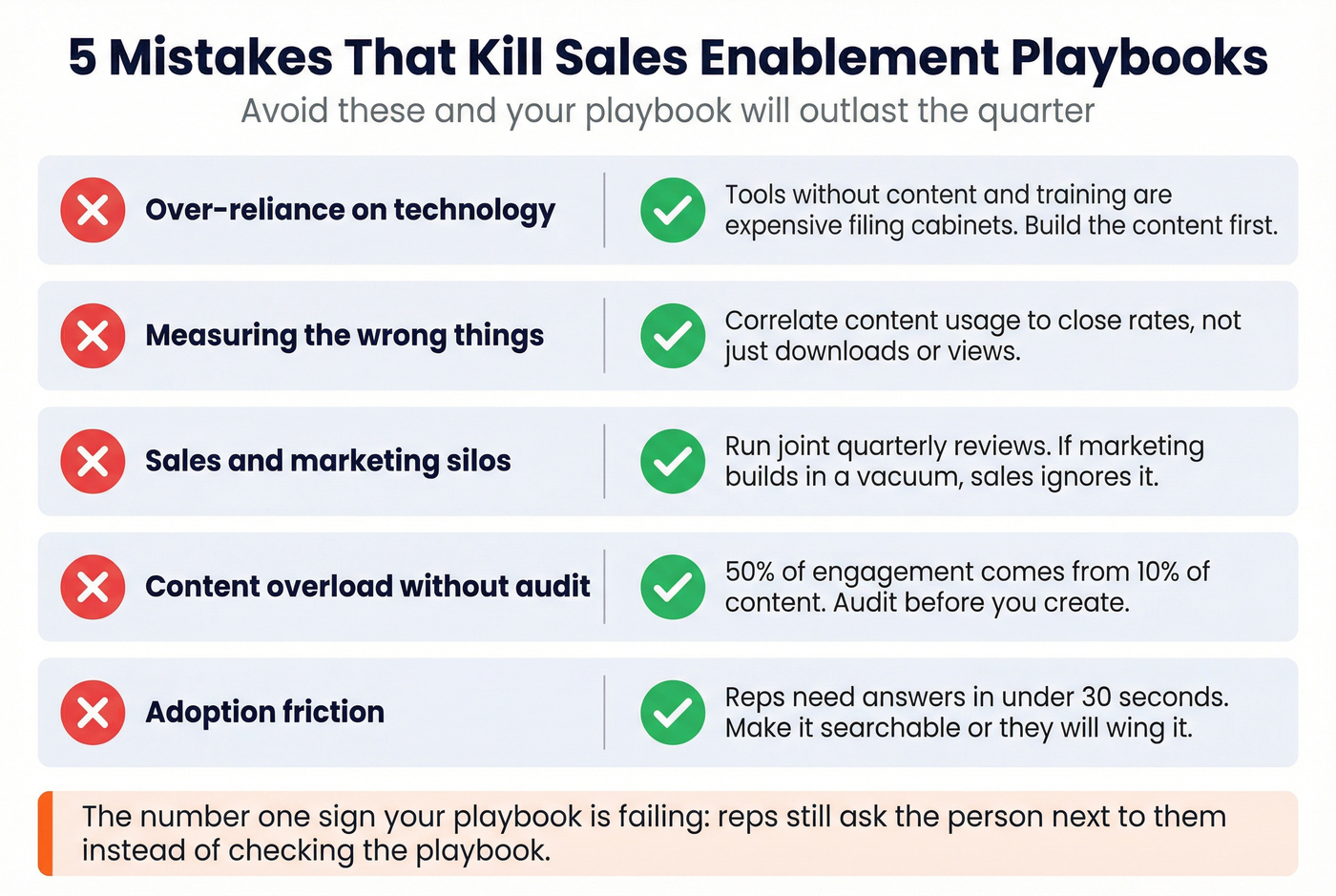
Measuring the wrong things. Track multiple metrics tied to different facets of performance. Compare before and after. Correlate content usage to close rates - not just downloads.
Sales and marketing working in silos. If marketing builds content in a vacuum and sales ignores it, you've wasted everyone's time. Joint quarterly reviews aren't optional.
Content overload without audit. Remember - 50% of engagement from 10% of content. Audit ruthlessly before creating anything new. Skip this step and you'll end up with a bloated playbook that reps treat like a junk drawer.
Adoption friction. Building the playbook isn't enough. If reps spend 20 minutes searching for the right case study, they'll stop looking. Combine structured onboarding with a centralized, searchable system and remove every barrier between the rep and the answer. The consensus on r/sales is that the best playbooks are the ones reps can search in under 30 seconds - anything slower and they'll just wing it.
GreyScout built their enablement playbook on verified data and cut bounce rates from 38% to under 4% - growing pipeline 140%. With 300M+ profiles, 30+ search filters including buyer intent and job changes, Prospeo gives your reps the accurate contacts that make every play executable.
Give your reps a playbook backed by data they can trust.
FAQ
How long does it take to build a sales enablement playbook?
Expect 2-6 weeks for a usable v1. Start with buyer personas, sales process, and objection handling - then iterate monthly. Trying to build all 18 components at once is how playbook projects stall indefinitely.
What's the difference between a sales playbook and an enablement playbook?
A sales playbook covers tactics and scripts - the "what to say and do." An enablement playbook adds training programs, tool guidance, metrics, governance, and adoption frameworks. It's the full operating system versus just the instruction manual.
What tools do I need to support my playbook?
At minimum: a centralized doc system like Notion or Confluence and a data verification tool for clean contact data. Enterprise teams layer on platforms like Highspot or Seismic (typically $30-$60/user/month on annual contracts) for content management and guided selling. On Reddit, practitioners also recommend digital sales rooms like Aligned for mutual action plans.