

The Sales Enablement Role: What You Do, What You Earn, and How to Get Hired
Your first week in the sales enablement role looks like this: 47 unread Slack messages from reps asking where the new battlecard lives, a VP of Sales who wants "something for the SKO by Friday," and a CRM full of contacts that bounce. Nobody handed you a playbook because the last person in the role quit after six months. Welcome to enablement.
55% of organizations can't effectively drive GTM initiatives. Most of that failure traces back to enablement being misunderstood, under-resourced, or both.
Here's the short version. The sales enablement role owns rep readiness - onboarding, coaching, content, tool adoption - not strategy decks nobody reads. Median pay sits at $125K globally, but "revenue enablement" titles earn $163.9K average for essentially the same work. If you're evaluating this career path, read the day-to-day section and salary tables below before making any moves.
What Enablement Actually Means
Sales enablement is the function responsible for making revenue teams effective. Not "informed." Not "trained." Effective - as in, they close more deals, faster, with less wasted motion.
Per the Seismic Forecast Report, 95% of companies now run a dedicated enablement team, and 79% call it strategic. That's a massive shift from five years ago, when enablement was a glorified content librarian role at most orgs. The shift happened because companies realized that hiring great reps isn't enough - you need systems that close the gap between your best performers and everyone else.
The cleanest way to think about it: enablement owns the knowledge flow. What reps need to know, when they need to know it, and how they access it in the moment that matters. Sales ops owns the processes and reporting. Enablement makes reps better. Ops makes the machine run.
Enablement vs. Sales Ops vs. RevOps
Three functions that constantly overlap. Here's who owns what.
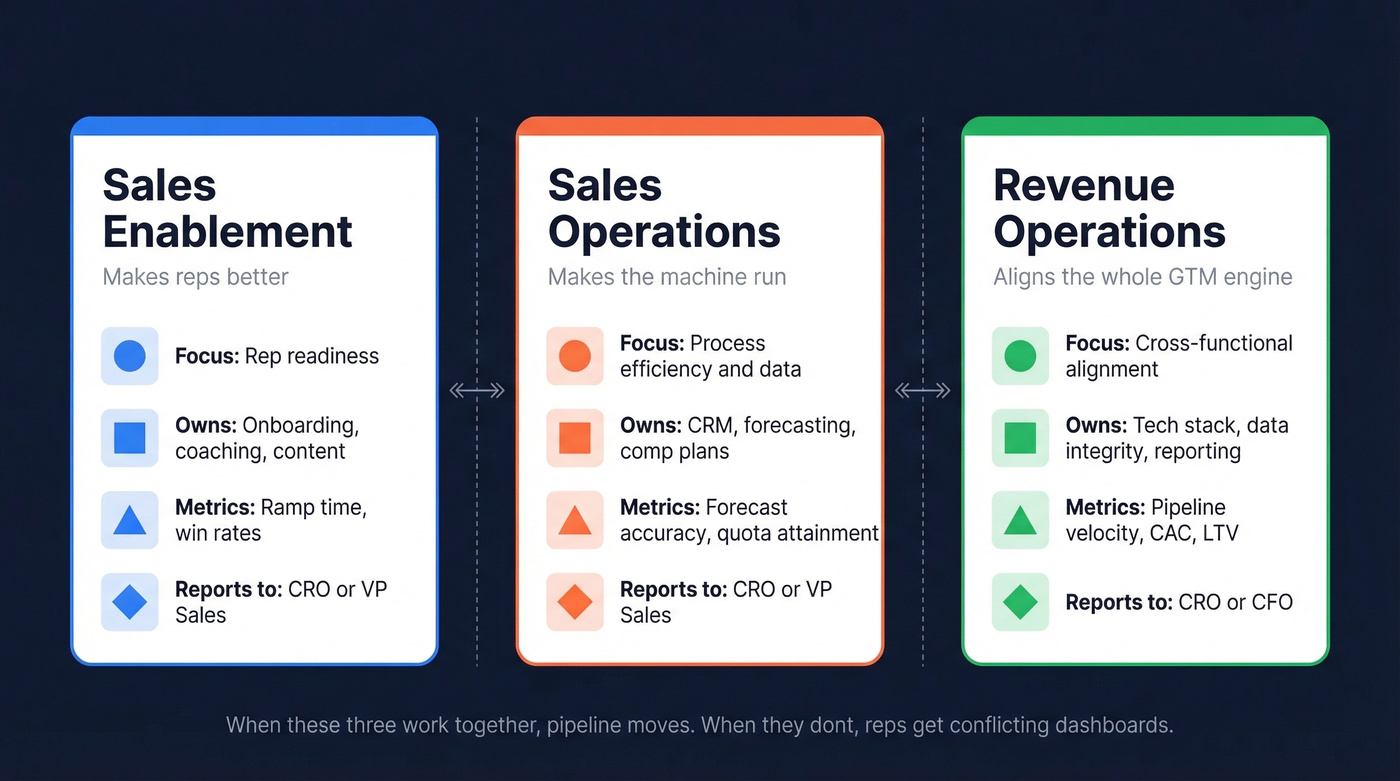
| Sales Enablement | Sales Operations | Revenue Operations | |
|---|---|---|---|
| Focus | Rep readiness & effectiveness | Process efficiency & data | Cross-functional alignment |
| Owns | Onboarding, coaching, content, tool adoption | CRM, forecasting, comp plans | Tech stack, data integrity, unified reporting |
| Metrics | Ramp time, win rates, content usage | Forecast accuracy, quota attainment | Pipeline velocity, CAC, LTV |
| Tools | Seismic, Highspot, Gong, LMS | Salesforce, Clari, CPQ | CRM + BI + integration layer |
| Reports to | CRO or VP Sales | CRO or VP Sales | CRO or CFO |
Enablement is about people. Ops is about process. RevOps is about systems. Revenue enablement - the newer title variant - extends enablement's scope beyond sales into marketing, CS, and product teams. RevOps does something similar but through data and tech rather than training and content.
When these three functions work together, pipeline moves. When they don't, reps get conflicting priorities and leadership gets conflicting dashboards.
Core Responsibilities
Here's the real checklist - not the job description version, but what you'll actually spend your weeks doing.
Onboarding new reps. Designing and running the 30/60/90-day program that gets new hires to first deal. This is the single highest-leverage thing enablement does. A week shaved off ramp time across 20 new hires per year is real money - we're talking hundreds of thousands in accelerated revenue.
Coaching and skill development. Building coaching frameworks that frontline managers actually use. Teams using AI-powered coaching are 36% more likely to report higher win rates.
Content management. Battlecards, case studies, one-pagers, competitive intel. The job isn't creating all of it - it's curating, organizing, and making sure reps can find the right asset fast. Buyers spend just 17% of their purchase journey talking to sales, which means the content enablement curates often does more selling than the reps themselves.
Tool adoption. You bought Gong. Nobody watches the calls. That's an enablement problem. Driving adoption of the tech stack is a constant, unglamorous responsibility that never really ends.
Marketing-sales alignment. Translating what marketing produces into what reps can actually use in a deal. This sounds simple. It isn't.
Performance analytics. Tracking what's working and connecting enablement programs to revenue outcomes. Only 45% of enablement teams track win rate to prove ROI - the rest default to vanity metrics like training completion.
What separates good enablement from bad? Enablement that sticks is workflow-embedded, not portal-based. If reps have to leave their CRM to find your content, they won't use it. Think battlecard notifications triggered in Salesforce when a rep logs a call with a competitor's customer - not a SharePoint folder they'll never open.
A Week in the Life
Here's what a solid enablement week looks like at a mid-market company with 40-80 reps.
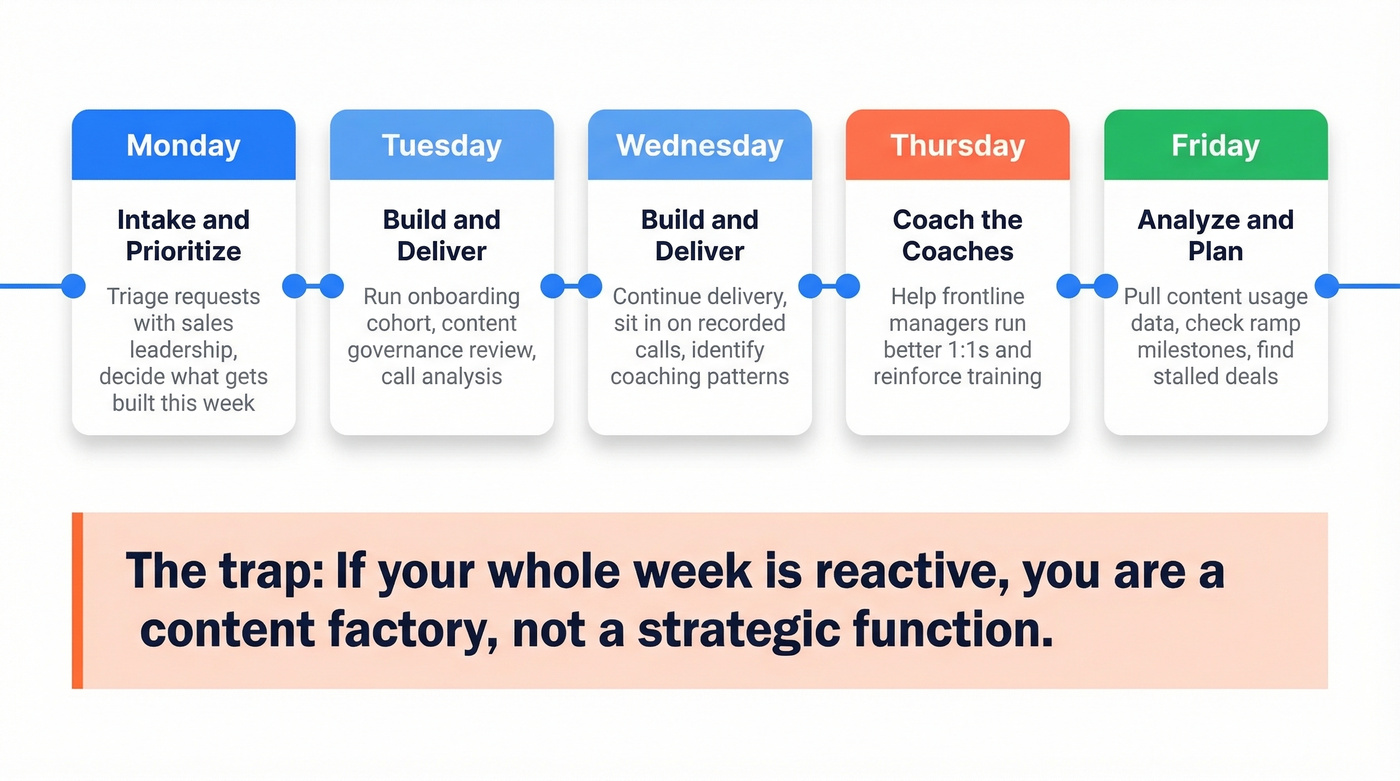
Monday is intake and prioritization. You're meeting with sales leadership to triage requests - the new product launch needs a battlecard, the EMEA team wants objection-handling training, and someone in marketing wants you to "enable" a webinar nobody asked for. You decide what gets built this week and what gets pushed.
Tuesday and Wednesday are delivery days. Running an onboarding cohort session in the morning, doing a content governance review after lunch, sitting in on recorded calls to identify coaching patterns. These are long days, and they're where the actual work happens.
Thursday is manager enablement - the most underinvested part of the role. You're coaching the coaches: helping frontline managers run better 1:1s, use call recordings effectively, and reinforce the skills you're teaching in formal training.
Friday is analytics and planning. Pull the numbers. What content got used this week? Which reps are falling behind on ramp milestones? Where are deals stalling?
The trap to avoid: letting your week become entirely reactive. If you're only responding to requests, you're a content factory, not a strategic function.
Titles, Team Structure, and Org Design
Common Titles
The title landscape has fragmented. You'll see Enablement Specialist, Sales Enablement Manager, Director of Enablement, VP of Sales Enablement, and - more rarely - Chief Enablement Officer at enterprise orgs. Adjacent titles include Instructional Designer, Sales Coach, and Revenue Enablement Manager.
The drift is real: "sales enablement" is becoming "revenue enablement" is becoming "GTM enablement." Each expansion reflects a broader scope and a bigger paycheck.
Org Design Models
Centralized: A single enablement hub owns standards, platforms, curriculum, analytics, and delivery. Best for companies with one primary sales motion and a small team. Clean governance, but can feel disconnected from the field.
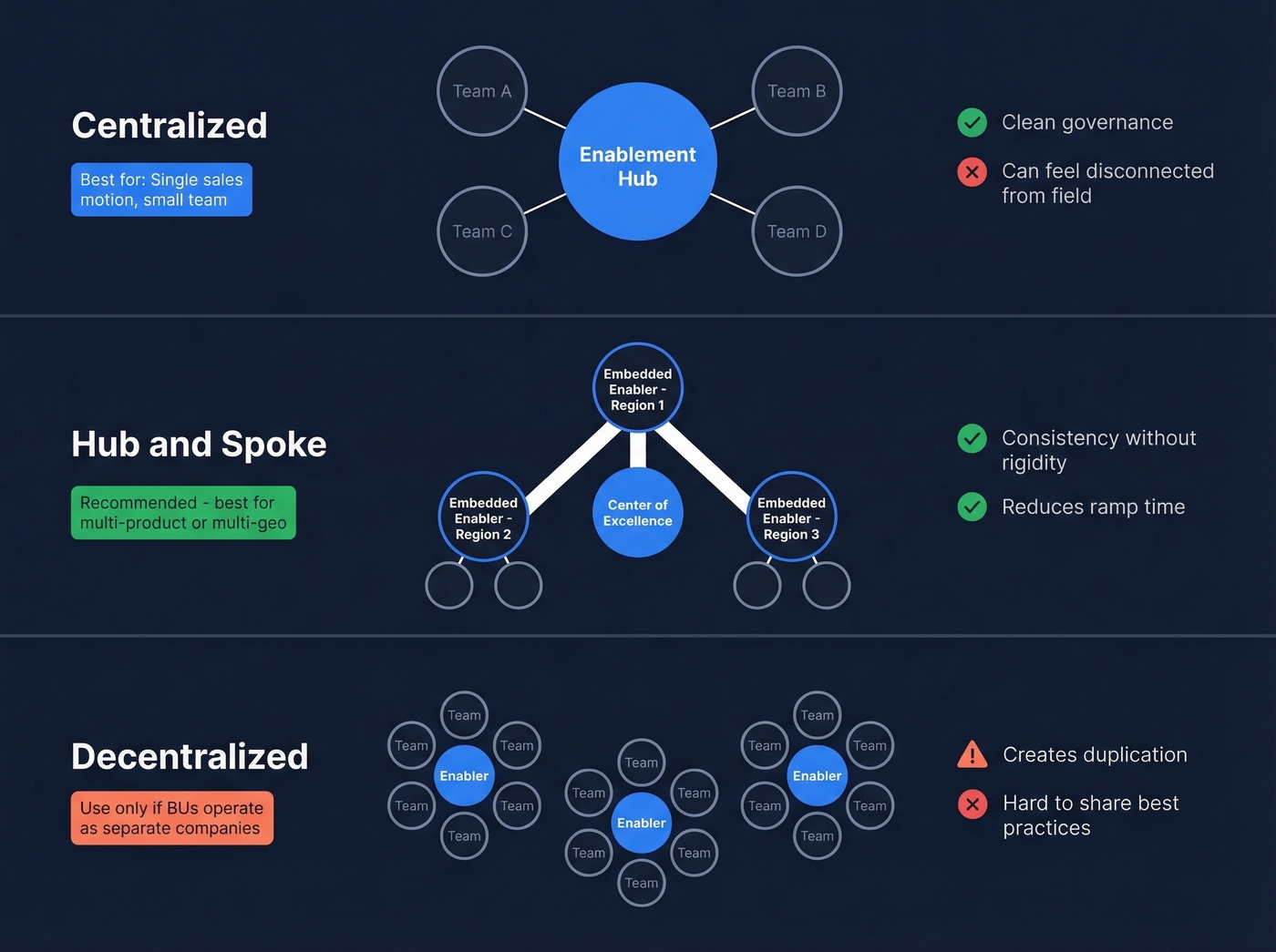
Hub-and-spoke: A central center of excellence sets standards and measurement, while embedded enablers sit with field teams and adapt programs locally. In our experience, this is the sweet spot for multi-product or multi-geo companies. You get consistency without rigidity - and it can materially reduce ramp time by getting reps productive faster through localized coaching paired with standardized curriculum.
Decentralized: Enablers report directly into sales regions or business units. Works when sales motions are genuinely different across segments, but creates duplication and makes it hard to share best practices. Skip this model unless your business units truly operate as separate companies.
The decision drivers go beyond headcount: sales complexity, number of sales motions, GTM scope, and geography all matter. Where enablement reports matters too. Under the CRO, it stays revenue-focused. Under the CMO, it drifts toward content production.
Staffing Ratios
| Scenario | Ratio | When It Fits |
|---|---|---|
| High-growth, fully remote, 40%+ YoY growth | 1:25 | New markets, new products |
| Multi-product, regional teams, active hiring | 1:50 | Mid-market scaling |
| Mature product, slow growth, co-located | 1:100 | Established orgs |
If you're at 1:150 or worse, you don't have an enablement function. You have a person writing decks.

You just read that a CRM full of bouncing contacts is the nightmare greeting every new enablement hire. That's not a content problem - it's a data problem. Prospeo delivers 98% email accuracy with a 7-day refresh cycle, so the contacts your reps work are verified before they ever hit send.
Stop enabling reps with data that bounces at 35%.
Salary and Compensation
Global Salary by Seniority
| Level | Average | Median |
|---|---|---|
| Entry-level / Junior | $75,500 | $69,000 |
| Manager | $116,800 | $122,000 |
| Head of Enablement | $147,000 | $150,000 |
| Director and above | $190,000 | $186,000 |
Global median across all levels: $125,000. Global average: $131,400 - actually down ~$5.6K YoY, likely a correction from inflated 2022-2023 hiring rather than a structural decline.
For US-specific manager comp, Glassdoor puts the median at $122K with a range of $98K-$155K based on 254 reported salaries. The highest-paying vertical is information technology at $155K median - no surprise given tech companies were early enablement adopters.
Geography and Title Pay Gaps
| Region | Average Comp |
|---|---|
| North America | $142,400 |
| Europe | $110,000 |
| Rest of World | $97,000 |
The gap is stark at the junior level - NA junior median is $85K versus $42K in Europe. At Director+, Europe closes the gap ($185K vs. $200K in NA), likely because those roles skew toward large multinationals with global pay bands.
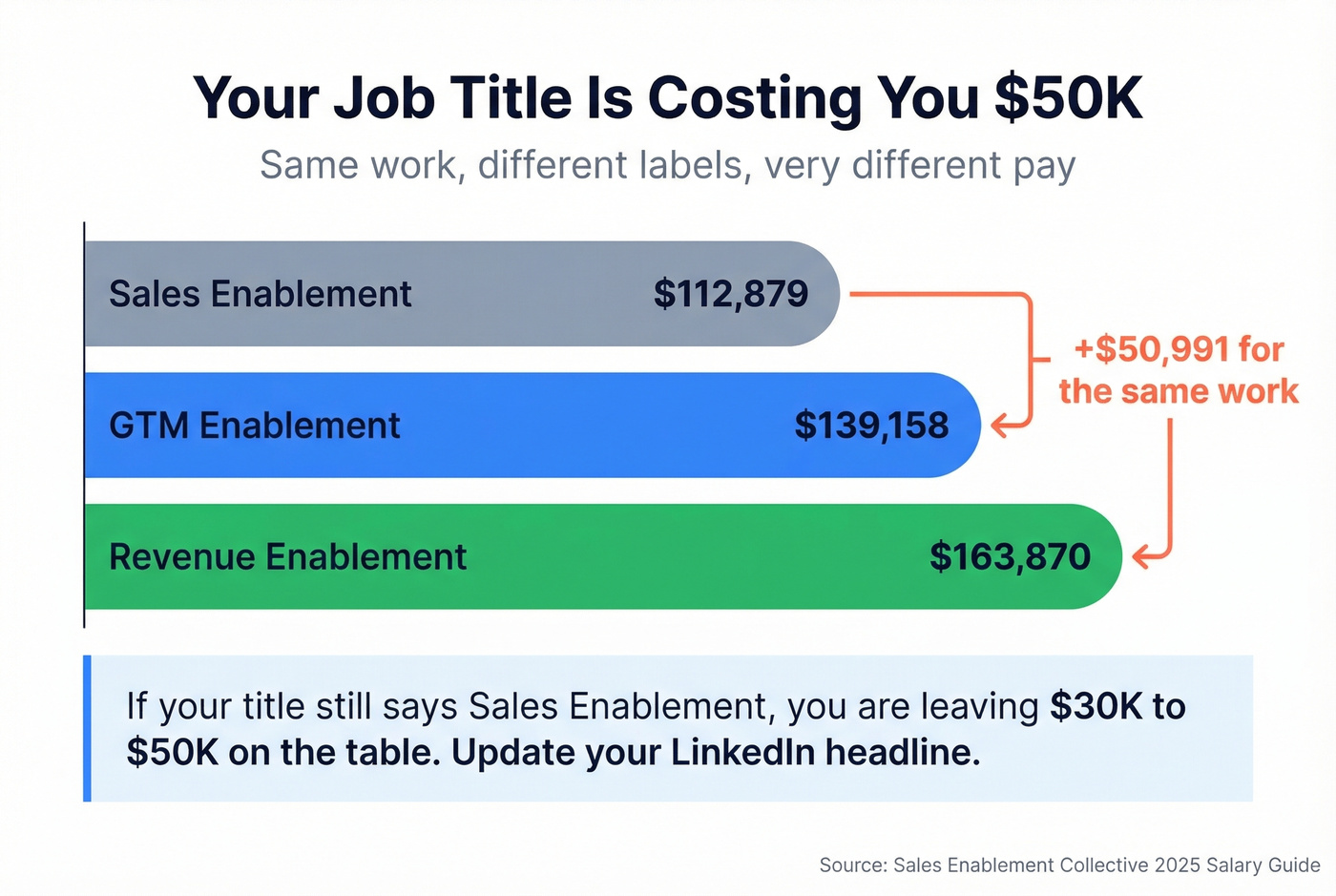
Now here's the number that should change your LinkedIn headline:
| Title Variant | Average Comp |
|---|---|
| "Sales Enablement" | $112,879 |
| "GTM Enablement" | $139,158 |
| "Revenue Enablement" | $163,870 |
If your title still says "sales enablement," you're leaving $30K-$50K on the table for the same work with a broader label. The gender pay gap sits at $15K (11%), narrowing slightly at Director+ but still persistent.
Variable Comp
73% of enablement professionals receive some form of bonus or commission. Those with variable comp earn a higher base too - $129K versus $112.9K average - which suggests companies that invest in variable comp also value the function more broadly. Each additional direct report adds roughly $8K-$15K to average compensation, another reason to push for team-building authority early.
Here's the frustrating part. Only 23% of enablement professionals feel their salary reflects the value they deliver. That tells you everything about how most companies treat this function - they'll call it "strategic" in the job description and compensate it like a support role.
Enablement Tools and Technology
The enablement tech landscape is consolidating fast. Seismic and Highspot announced a definitive merger in February 2026. Showpad completed its merger with Bigtincan in October 2025. Gong expanded into full revenue enablement in early 2026. The era of buying five point solutions is ending - and the data backs it up. Organizations using unified enablement platforms are 42% more likely to increase sales productivity and improve win rates.
Five capability buckets define the modern enablement stack:
- Content management - where assets live, how they're tagged, and whether reps can find them (Seismic, Highspot, Showpad)
- Learning management - onboarding programs, certifications, skill tracks (Mindtickle, Lessonly, WorkRamp)
- Sales intelligence - competitive intel, buyer signals, account research (Gong, Clari, 6sense)
- Deal rooms - shared spaces for buyer-seller collaboration (digital sales room tools like Dock, Aligned, Trumpet)
- AI coaching - call analysis, rep scoring, real-time guidance (Gong, Chorus, Second Nature)
If you're evaluating tools in 2026, buy something modular that plays well with your CRM. Start there. Add a dedicated platform when you hit 50+ reps. Mid-market enablement platforms often land around $10K-$50K/year; enterprise deployments commonly run $50K-$250K+/year depending on seats and modules.
Nothing kills tool trust faster than bad data. If reps bounce 20% of their emails on the first sequence, they blame the process you built - not the data provider. We've seen this play out dozens of times. Prospeo's 98% email accuracy and 7-day data refresh cycle solve this at the source, and pairing it with your enablement platform and CRM enrichment eliminates one of the most common adoption killers.
How AI Is Reshaping Enablement
90% of organizations are using AI for GTM efforts or plan to start. AI training usage is up 164% year-over-year. Teams using AI-powered training are 35% more likely to report increased deal size.
Here's what's automatable right now: content tagging and search, call scoring and pattern detection, onboarding quiz generation, competitive intel summarization, and basic coaching feedback on recorded calls. Managers spend 13 hours per week coaching reps - AI doesn't replace that time, but it makes it dramatically more targeted by surfacing exactly which skills each rep needs to develop.
What's not automatable: stakeholder management, executive alignment, culture change, and the political work of getting a VP of Sales to actually prioritize enablement in their team meetings. Let's be honest - that last one is half the job. The role is shifting from "build and deliver training" to "design systems and manage the AI that delivers training." If you're entering the field, get comfortable with AI tooling now.
How to Break Into Sales Enablement
Three paths work consistently.
From sales. You've carried a bag, you know the objections, and you have instant coaching credibility with reps. This is the strongest entry point. The risk is that you default to "what worked for me" instead of building scalable programs.
From marketing or L&D. You know how to create content and design learning experiences. Maybe you're the marketing manager who keeps getting pulled into sales onboarding because you're the only one who can explain the product clearly. The gap is understanding the selling motion deeply enough to prioritize what matters - track whether your battlecard changed win rates, not just whether reps downloaded it.
From teaching or coaching. Direct skill transfer. Classroom management, curriculum design, and the ability to hold attention are underrated enablement skills. The transition requires learning the business context - pipeline stages, deal mechanics, buyer personas - but the core competency is already there.
59% of enablement teams lost headcount or stayed flat during the 2023-2024 layoff wave. The market is recovering, but it's competitive. Certifications from the Sales Enablement Collective or HubSpot Academy can help career changers establish credibility fast.
Interview prep checklist:
- Articulate how you define enablement strategically, not just "training"
- Tie at least one past program to a revenue metric - win rate, cycle length, pipeline lift
- Demonstrate how you prioritize under constant urgency
- Show you can influence without authority
Real talk: if you can't articulate how your last program moved a revenue metric, you're not ready for a senior enablement role. 45% track win rate and 35% track sales-cycle length to prove ROI. Be in that group.
Mistakes That Kill Enablement Programs
Do this: Secure an executive sponsor before you build anything. In our experience, the #1 predictor of enablement success isn't budget or headcount - it's whether the CRO shows up to the quarterly review.
Skip this: Measuring success by training completion rates. If your leadership evaluates enablement by how many reps finished a course, they don't understand the function. Push for revenue-linked metrics from day one.
Do this: Embed content in the workflow. Battlecards inside the CRM, competitive intel surfaced during active deals, coaching prompts triggered by call patterns. If reps have to go find it, they won't.
Skip this if you value your sanity: Building a content portal and expecting adoption. The consensus on r/salesenablement is pretty clear - enablement devolves into "docs and trainings reps don't use" when distribution is an afterthought. That's a distribution problem, not a content problem.
Do this: Invest in manager enablement. Frontline managers are your force multiplier. If they're not reinforcing what you teach, nothing sticks.
Enablement teams are measured on ramp time, win rates, and pipeline velocity. None of that improves when reps waste hours chasing dead numbers. Prospeo gives your team 125M+ verified mobiles with a 30% pickup rate and 300M+ profiles - so coaching sticks because reps actually reach buyers.
Arm your reps with data that connects, not data that bounces.
FAQ
Is sales enablement a good career in 2026?
Yes. 57% of executives expect GTM teams to grow this year, the global median salary is $125K, and revenue enablement titles push past $160K average. The function is maturing, not shrinking. Companies that cut enablement during 2023-2024 layoffs are actively rebuilding those teams now.
What's the difference between enablement and sales training?
Training is one deliverable enablement owns. The broader function also covers content management, coaching frameworks, tool adoption, onboarding programs, and cross-functional alignment between sales and marketing. Training is a tactic; enablement is the strategy that decides which tactics matter.
Do you need quota-carrying experience to get hired?
It helps enormously for coaching credibility - reps trust someone who's carried a bag. But marketing, L&D, and teaching backgrounds work if you demonstrate outcome-driven thinking and genuinely understand the selling motion. You don't need to have been a top performer, but you need to understand why top performers win.
What tools do enablement teams rely on?
CRM platforms like Salesforce and HubSpot, enablement platforms like Seismic and Highspot, conversation intelligence tools like Gong, and data providers like Prospeo for verified contact data. The 2026 trend is consolidation - fewer tools, better integrated, with AI built in.
Where should enablement report in the org?
Under the CRO. When enablement reports to marketing, it becomes a content factory. When it reports to HR, it becomes a training department. Under the CRO, enablement stays a revenue function with direct access to pipeline data and the authority to influence how reps sell.