

Sales Force Optimization: The 5-Pillar Framework for 2026
84% of reps missed quota last year. Most companies respond by replacing reps or reconfiguring their CRM. Both miss the point entirely. Sales force optimization isn't a software problem - it's a systems design problem. Territories, headcount, process, incentives, and data quality form an interconnected machine, and when one pillar breaks, the others compensate poorly and expensively.
Here's the thing: most teams don't need better reps. They need fewer accounts per rep, honest capacity math, and contact data that doesn't bounce. Fix the system and the same reps start hitting numbers.
The Quick Version
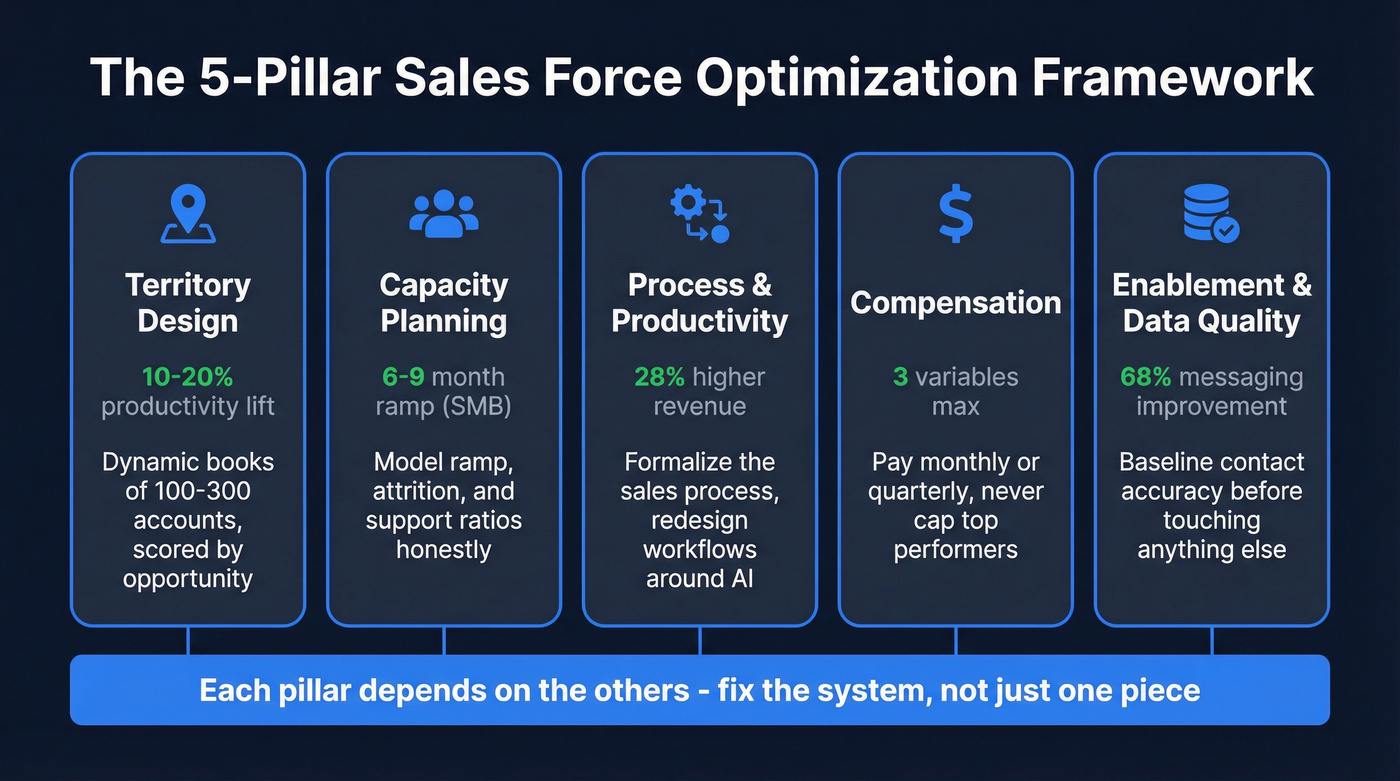
- Territory: Rebalance by revenue potential, not account count. Dynamic books of 100-300 active accounts beat static zip codes.
- Capacity: Model for ramp and attrition. "$5M target / $1M quota = 5 reps" is wrong math.
- Process: Formalize your sales process. Companies that do see up to 28% higher revenue.
- Comp: Cap your plan at 3 variables. More than 4 kills motivation.
- Data quality: Every pillar above fails if reps can't reach prospects. Baseline your contact accuracy before touching anything else.
What Does SFO Actually Mean?
Sales force optimization designs the system - territories, headcount, process, incentives, and enablement - so reps spend more of their limited selling time on winnable deals. McKinsey estimates generative AI alone could unlock $0.8-$1.2 trillion in sales and marketing productivity. But technology only amplifies the underlying structure. A bad system with great AI is still a bad system.
SFO should answer these questions for your executive team:
- What's the optimal size of our sales force?
- Are territories aligned to market potential or just geography?
- What's the next best action for each rep, each day?
- How do training, incentives, and comp changes impact revenue?
If your current "optimization" work doesn't touch these questions, you're optimizing the wrong thing.

Your reps spend a third of their time selling. Don't let bad contact data waste it. Prospeo delivers 98% email accuracy and 125M+ verified mobile numbers with a 30% pickup rate - refreshed every 7 days, not every 6 weeks. That's the data quality pillar solved at $0.01 per email.
Stop optimizing a system built on bounced emails.
Five Pillars of the Framework
| Pillar | What It Covers | Key Benchmark |
|---|---|---|
| Territory Design | Account assignment, balance, coverage | 10-20% productivity lift |
| Capacity Planning | Headcount, ramp, attrition modeling | 6-9 month ramp (SMB) |
| Process & Productivity | Workflow, automation, selling time | 28% higher revenue |
| Compensation | Variable design, payout frequency | 3 variables max |
| Enablement & Data | Training, coaching, contact accuracy | 68% messaging improvement |
Territory Design
Static territories are the silent killer of sales productivity. Field reps spend 35-39% of their time actually selling - the rest disappears into bad routing, ownership confusion, and low-fit accounts.
Samsung cut $8.8M in costs and increased customer visits by 50% after optimizing territory coverage. Box reduced rep books to 200-250 high-potential accounts, shifting from zip codes to opportunity scoring. As one RevOps leader at Box put it: "We used to hand reps zip codes. Now we hand them opportunity." Another team trimmed books to 300-400 accounts and watched win rates climb from 13% to 20%+ in under a year.
Balance territories by revenue potential, A-account density, and effort-to-convert. Refresh books every 30-60 days with updated account signals. Review quarterly, lock major changes semi-annually. When territories are clearly misaligned, reassigning accounts across reps can deliver immediate productivity gains without adding headcount.
Use dynamic books if your reps have 500+ accounts and most are untouched. Skip this if you're a 5-person team selling into a single vertical - keep it simple.
Capacity Planning and Headcount Math
Most teams fall into the same trap: $5M revenue target / $1M quota = 5 reps. Sounds clean. It's wrong.
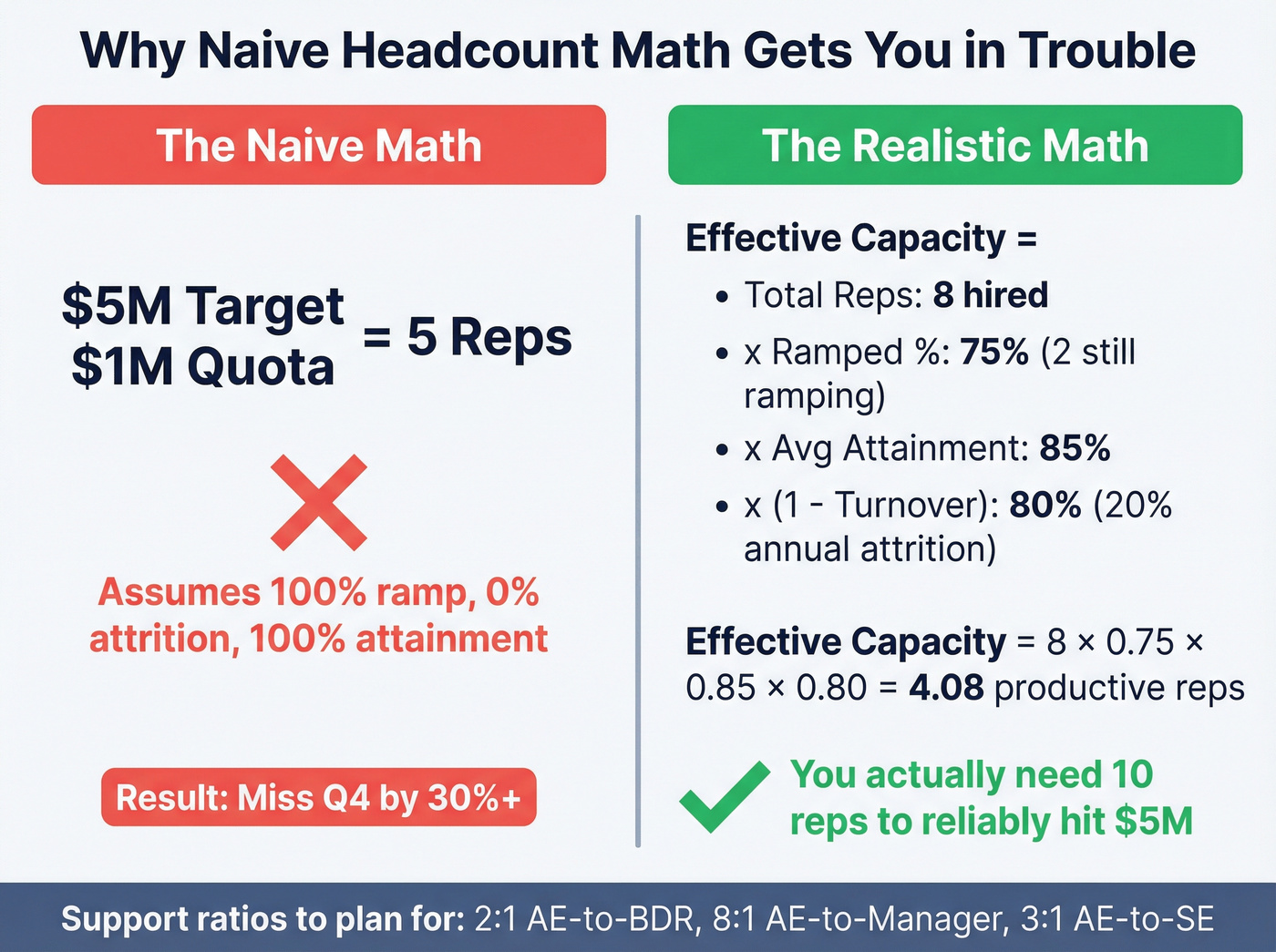
Effective Capacity = Total Reps x Ramped % x Avg Attainment x (1 - Turnover Rate)
Ramp benchmarks from Insight Partners: 6-9 months to full productivity in SMB/mid-market, 12 months in enterprise. Assume 20% annual attrition as your baseline - it's the industry average, and pretending your team is different is how you miss Q4. Dedicated capacity planning tools like Anaplan or Pigment can automate these models, but even a well-built spreadsheet beats gut-feel hiring.
Support ratios matter too. Plan for roughly 2:1 AE-to-BDR, 8:1 AE-to-manager, and 3:1 AE-to-sales-engineer. If you're at 15:1 AE-to-manager, you don't have managers. You have title-holders.
We've seen teams blow their hiring plan because they modeled zero attrition and assumed day-one productivity. Build the spreadsheet with honest inputs or don't build it at all.
Process & Productivity
Companies with a formalized sales process see up to 28% higher revenue than those winging it. The productivity problem is structural: salespeople spend roughly a third of their time actually selling. The rest goes to admin, internal meetings, CRM updates, and chasing bad leads.
AI is closing part of that gap. 81% of sales teams now use AI in some form - lead routing, forecasting, account scoring, rep coaching. Lobel Financial saw 4x sales volume in 8 months after a data-driven territory redesign. The teams getting real value aren't just buying AI tools; they're redesigning workflows around them. Automation alone typically delivers 10-15% efficiency gains. Workflow redesign is where the real lift comes from.
Compensation Design
Comp plans are where good intentions go to die.
Three variables, max. Reps perform best with three incentive levers. Past four, enthusiasm drops and reps stop trying to optimize. Pay monthly or quarterly - annual bonuses encourage deal-timing manipulation. Align incentives to actual goals; if the company targets profit but comp rewards revenue, reps will discount everything to close.
Don't cap top performers. Caps demotivate your best people. If the economics work, let them run. Stress-test every plan before launch - model what happens if a rep closes 3x quota or the market shifts mid-cycle. And never incent on untrusted data. If your CRM data is garbage, comp disputes will eat your ops team alive.
Platforms like Xactly and CaptivateIQ handle the mechanics, typically running $10k-$50k per year for mid-market teams. But no tool fixes a fundamentally misaligned plan.
Enablement & Data Quality
The numbers from AI-assisted coaching are hard to ignore. A global pharma company saw a 68% improvement in messaging quality and a 27% increase in win rate after deploying AI practice tools. Bayer ran 4,500+ practice sessions across 500 reps and hit a 97% mastery rate.
But none of that matters if reps can't reach prospects.
Bad emails and dead phone numbers waste the already-limited third of time reps spend selling. Ask any RevOps leader what kills outbound productivity and you'll hear the same answer: stale contact data. We've run audits for teams that looked great on paper - solid territories, clean process, competitive comp - and the whole thing was underperforming because 30%+ of their contact records were bouncing. Prospeo's 7-day data refresh cycle and 98% email accuracy exist specifically to close that gap, and at scale the difference between a 60% and 92% enrichment match rate is hundreds of hours of recovered selling time per quarter.
Territory redesign and capacity planning fall apart when reps can't reach the accounts you assign them. Prospeo's 30+ search filters - buyer intent, technographics, headcount growth, funding - let you build dynamic books of high-fit accounts with verified contact data attached. 83% enrichment match rate, 50+ data points per contact.
Give every rep a territory they can actually work.
Common Mistakes That Undermine Results
Hiring instead of optimizing. Adding headcount before fixing territory balance, process, or data quality just scales your problems. In our experience, the first audit almost always reveals bounce rates above 5% and territories that haven't been rebalanced in over a year. Cutting sales expenses starts with getting more from the reps you already have.
If you're seeing bounce rates creep up, start with email bounce rate benchmarks and root causes before you change anything else.
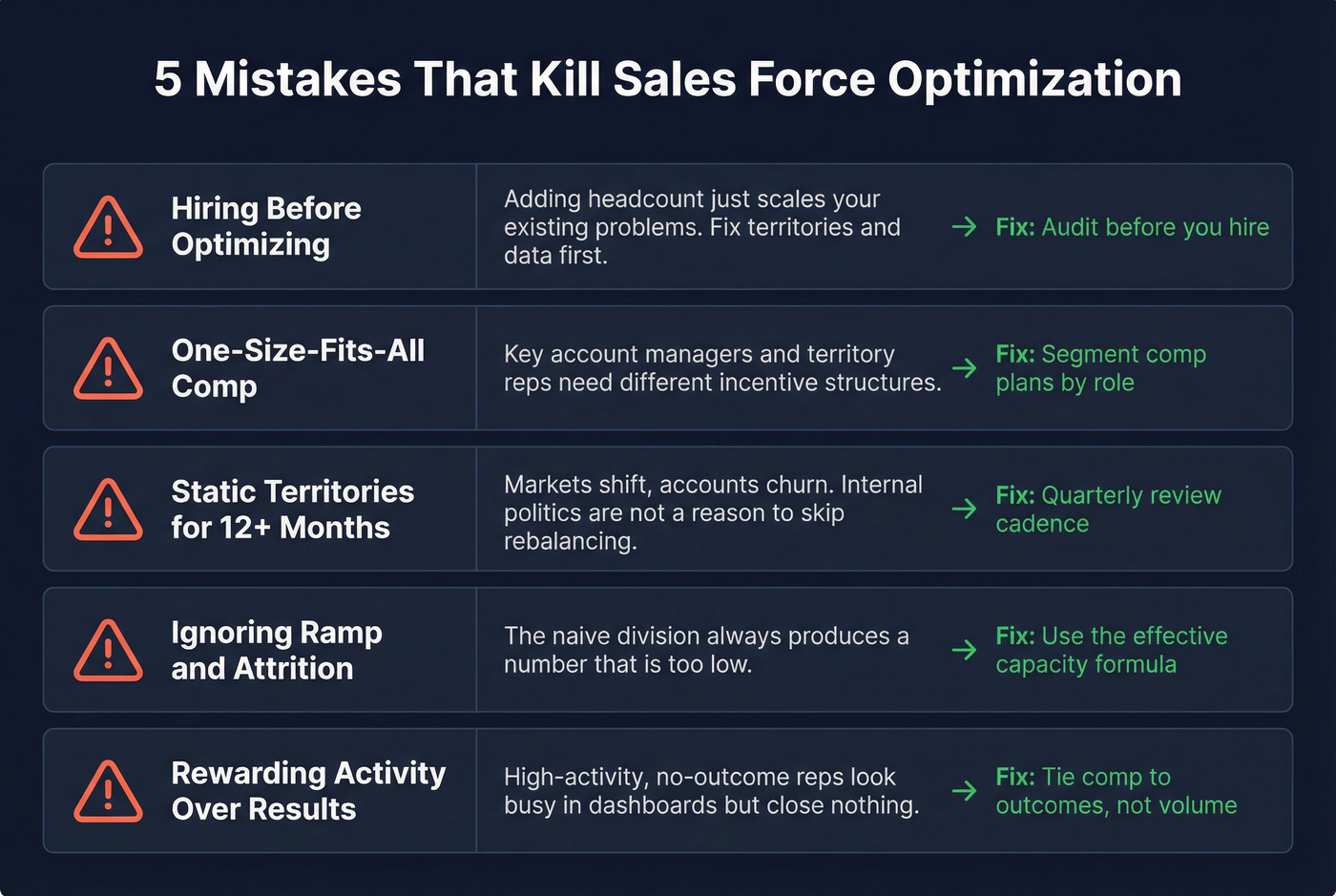
One-size-fits-all comp. A key account manager and a territory rep need different incentive structures. Period.
Static territories, never rebalanced. Markets shift. Accounts churn. If you haven't touched territories in 12 months, they're wrong. Let's be honest - most teams know this and still don't do it because the internal politics of reassigning accounts feel harder than just living with the inefficiency.
Ignoring ramp and attrition in headcount math. The naive division always produces a number that's too low. And rewarding activity over results creates the most expensive kind of underperformer - high-activity, no-outcome reps who look busy in your dashboards but aren't closing anything.
A 90-Day Starting Framework
Days 1-30: Audit. Measure how much time reps actually spend selling. Run your contact database through an enrichment API to baseline data quality - bounce rates above 5% mean you're bleeding productivity. Document your current territory model and comp plan structure. Think of this phase as a resource management review: you need to know exactly where time, money, and rep effort are going before you can redirect them.
If you need a broader vendor shortlist before you audit, start with data enrichment services and compare match rates and refresh cycles.
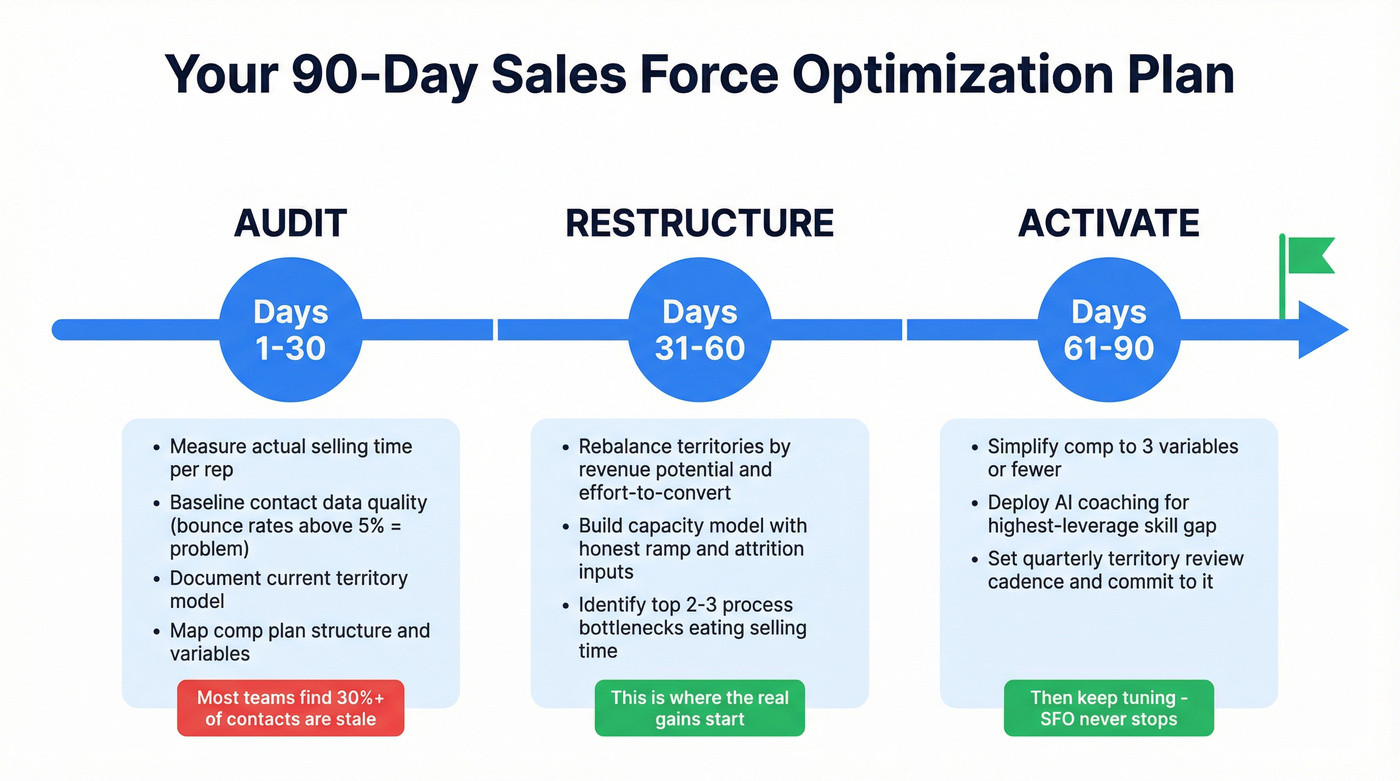
Days 31-60: Restructure. Rebalance territories using revenue potential and effort-to-convert. Build a capacity model with honest ramp and attrition assumptions. Identify the 2-3 process bottlenecks eating the most selling time.
Days 61-90: Activate. Simplify your comp plan to 3 variables or fewer. Implement AI-assisted coaching for the highest-leverage skill gap. Set a quarterly territory review cadence and stick to it.
If you're building this into onboarding, align it with a 30-60-90 day plan so managers can coach to the same milestones.
Sales force optimization isn't a project with a finish line. It's an operating system you tune continuously. The 90-day plan gets you from chaos to structure. Staying optimized is the ongoing work - and the teams that treat it that way are the ones consistently hitting number.
FAQ
What's the Difference Between SFO and Salesforce Optimization?
Sales force optimization improves your sales team's structure - territories, capacity, compensation, and enablement. Salesforce optimization configures the CRM platform itself (workflows, data hygiene, feature utilization). The terms sound identical but describe completely different disciplines.
How Often Should You Rebalance Territories?
Review quarterly, lock major changes semi-annually. Buying groups now include 11-15 stakeholders, so territory complexity increases faster than most teams realize. If your last major redesign was over a year ago, you're overdue.
What's the Fastest Way to Improve Sales Productivity?
Fix your contact data first. If bounce rates exceed 5%, reps waste their limited selling time on dead ends. Teams like Snyk cut bounce rates from 35-40% to under 5% and saw AE-sourced pipeline jump 180%. Then tackle process formalization and territory design - those two changes alone account for the largest productivity lifts in the research.