

Sales Force Structures: How to Choose, Build, and Evolve Your Sales Org
Your CRO just told the board you're restructuring - again. The average sales org has undergone four transformations per Gartner, and only 11% can execute one without tanking commercial results. Most guides hand you a menu of four sales force structures and wish you luck. What follows: benchmarks, modern operating models, and a decision framework that holds up when pipeline dips.
Why Structure Is a Revenue Lever
Structure isn't an org chart exercise. It's a revenue lever.
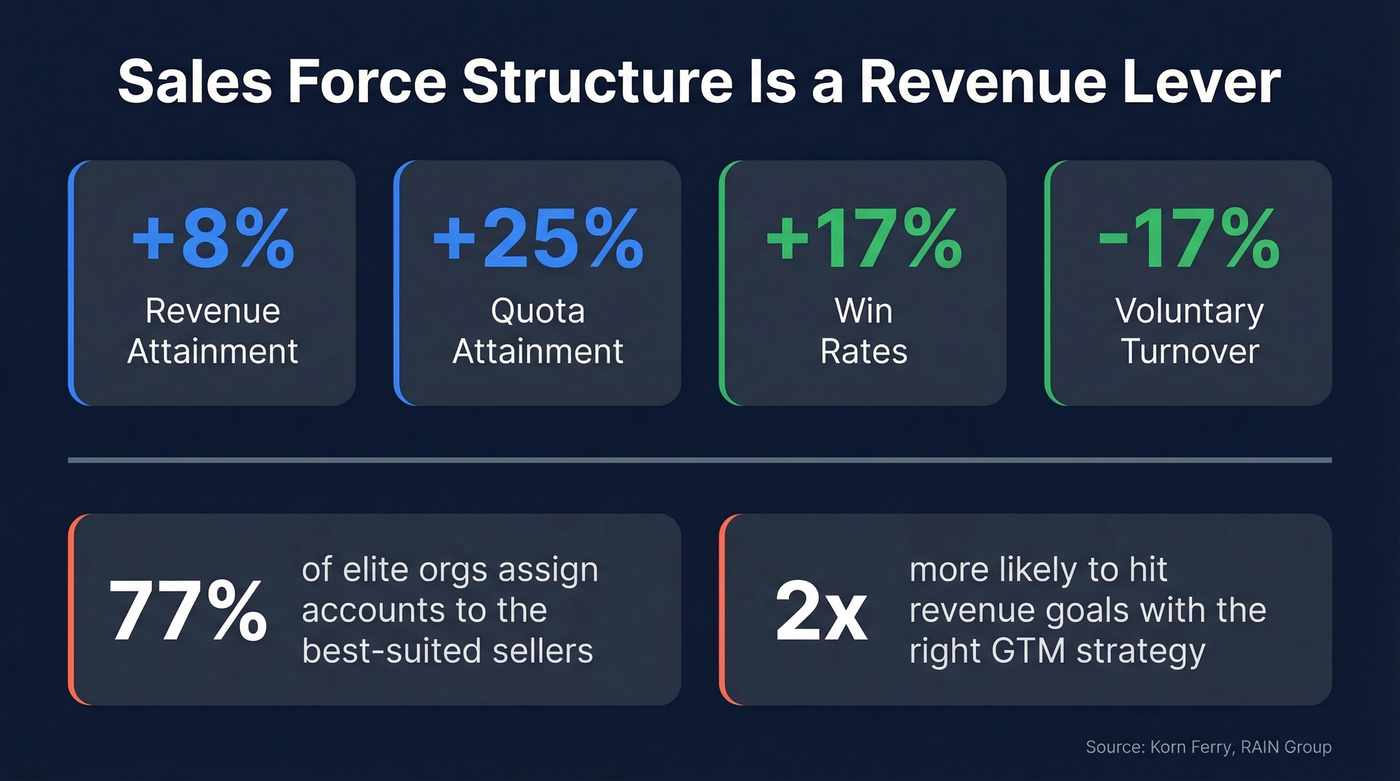
Korn Ferry found that teams with a clear definition of "role excellence" see +8% revenue attainment, +25% quota attainment, and +17% win rates compared to those winging it. They also see 17% lower voluntary turnover and 20% lower involuntary turnover. That's not marginal - it's the difference between a team that compounds and one that churns through reps every year.
Even something as granular as account assignment separates elite orgs from everyone else. RAIN Group's research shows 77% of elite-performing sales organizations agree that accounts are assigned to the sellers best suited to win them. Among the rest? Just 36%.
Korn Ferry documented a tech company where a single $1M deal required 20-40 internal people to coordinate. Without clear structure, that deal dies in committee. And companies that nail their go-to-market strategy are 2x more likely to meet or exceed revenue expectations, with 74% achieving or surpassing goals. Structure is the foundation that makes everything else - comp, enablement, tooling - actually work.
Six Classic Sales Organization Types
These six structures are well-documented, so let's keep this tight.
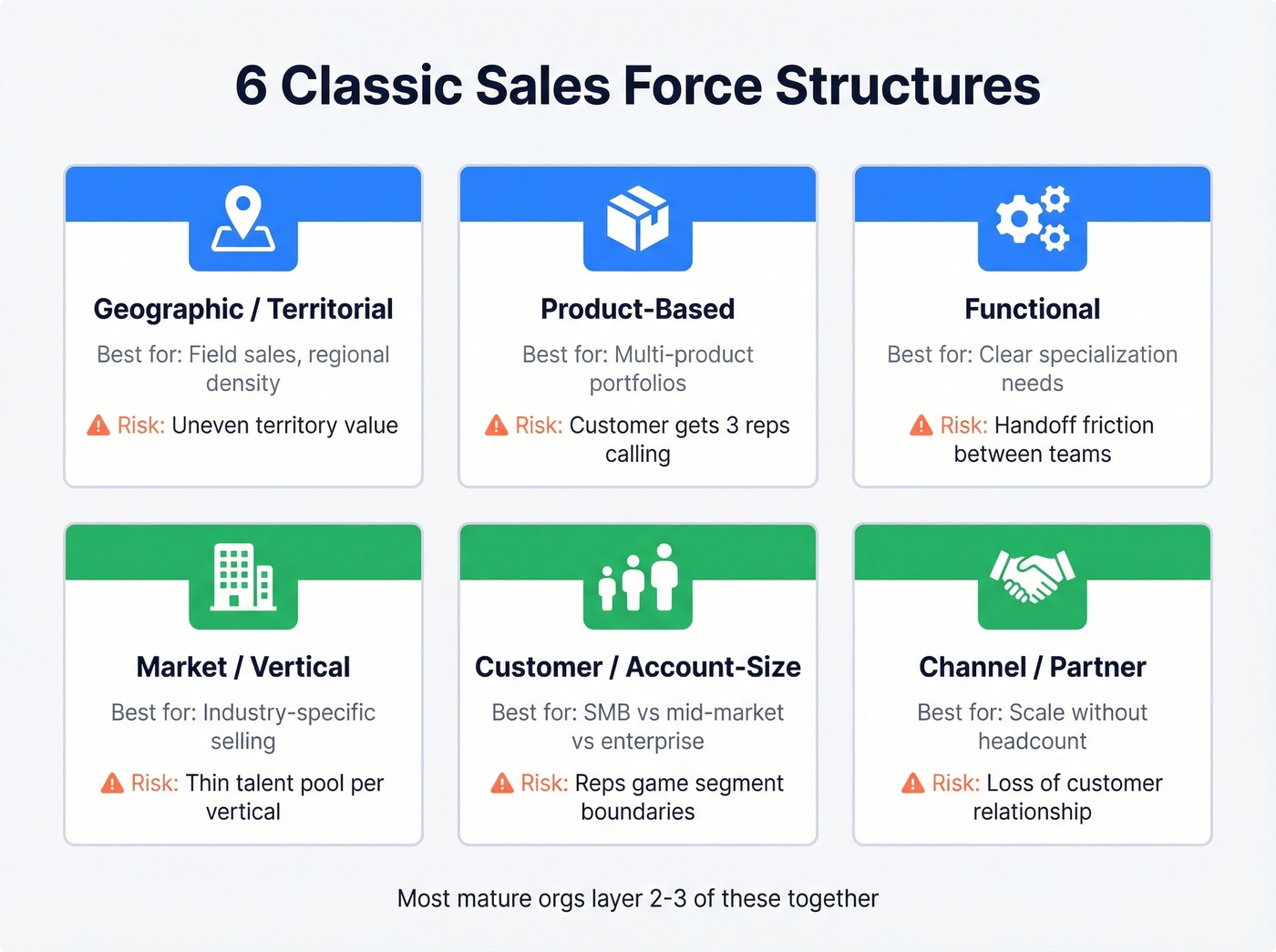
| Structure | Best For | Key Risk |
|---|---|---|
| Geographic / Territorial | Field sales, regional density | Uneven territory value |
| Product-Based | Multi-product portfolios | Customer gets 3 reps calling |
| Functional | Clear specialization needs | Handoff friction between teams |
| Market / Vertical | Industry-specific selling | Thin talent pool per vertical |
| Customer / Account-Size | SMB vs. mid-market vs. enterprise | Reps game segment boundaries |
| Channel / Partner | Scale without headcount | Loss of customer relationship |
A territorial structure works when physical presence matters - field sales, regional compliance, time-zone coverage. It's the oldest model in the book, and the risk is that some territories are inherently richer than others. Comp plans rarely account for that well enough.
Product-based makes sense when your products are complex enough that one rep can't credibly sell all of them. The downside is obvious: your customer gets called by three different people from the same company. Functional separates prospecting from closing from account management - the precursor to the assembly line model we'll cover next.
A market-based structure shines when buyers expect reps to speak their industry language - healthcare, financial services, manufacturing. Finding reps who know both the product and the vertical is hard, though, and that constraint limits how fast you can scale.
Customer/account-size segmentation (SMB, mid-market, enterprise) is the most common structure in SaaS. It works until reps start gaming which segment a deal falls into. Channel/partner structures let you scale without hiring, but you trade direct customer relationships for reach.
Most mature sales orgs don't pick one. They layer two or three - a market-based approach within an account-size segmentation, for example, with geographic territories for field reps. The real question isn't which structure to pick. It's which operating model runs underneath it.
Three Modern Operating Models
The classic structures describe how you segment. These three models describe how work flows through your team.
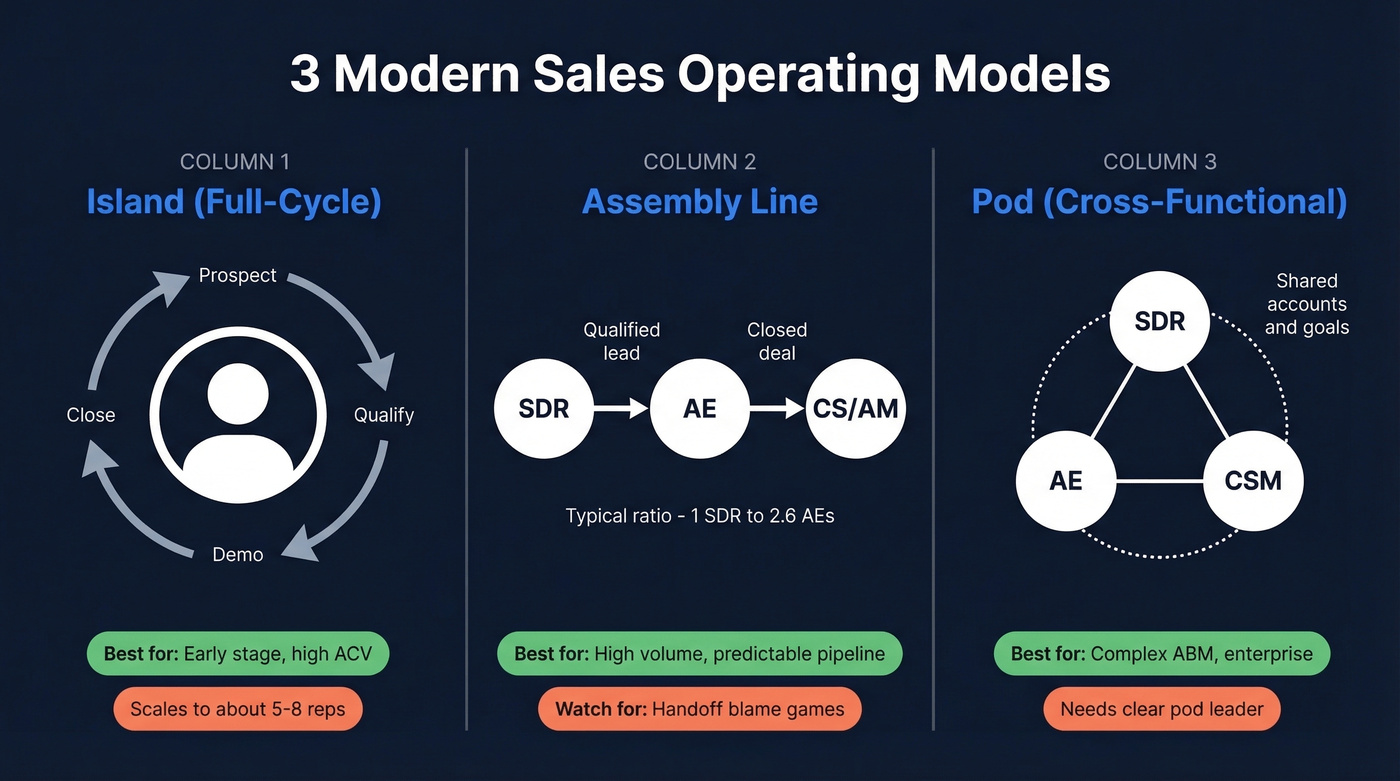
| Model | How It Works | Best For | Watch Out For |
|---|---|---|---|
| Island (Full-Cycle) | One rep owns prospect to close | Early-stage, high-ACV, relationship sales | Hard to scale, forecast |
| Assembly Line | SDR to AE to CS handoff | High-volume, predictable pipeline | Handoff friction, blame games |
| Pod (Cross-Functional) | SDR + AE + CSM per segment | Complex ABM, enterprise deals | Needs clear pod ownership |
Island (Full-Cycle)
One rep owns the entire cycle - prospecting, qualifying, demoing, closing, and sometimes managing the account post-sale. This is common for early-stage companies, and it's the right default. No handoff to fumble, decisions happen fast, and you learn exactly which reps can hunt.
The limitation is scalability. When a full-cycle rep spends 40% of their time prospecting, they're not closing. Forecasting gets messy because every rep runs their own pipeline with their own process. In our experience, this model works well up to about 5-8 reps. Beyond that, the cracks show.
Assembly Line (Hunter-Farmer)
The numbers tell the story. The average SDR:AE ratio is roughly 1:2.6 - one SDR for every 2.6 AEs. SDRs generate 46-73% of pipeline, and a typical SDR manages 75-125 accounts.
This is the Predictable Revenue model Aaron Ross popularized, and it's still the dominant structure in B2B SaaS. SDRs prospect and qualify, AEs close, CS/AMs manage the relationship post-sale. The failure mode is predictable: SDRs say AEs aren't following up on their meetings. AEs say the leads are garbage. Without tight SLAs and shared definitions of a qualified opportunity, the assembly line becomes a blame machine. The fix isn't structural - it's operational. Define handoff criteria, track them, hold both sides accountable.
Pod (Cross-Functional)
Imagine your enterprise team just lost a $400K deal because the SDR who sourced it, the AE who ran discovery, and the CSM who joined the security review had never spoken to each other before the final presentation. That's the problem pods solve.
A pod groups an SDR, AE, and CSM - sometimes a solutions engineer - around a shared segment, vertical, or account list. Everyone's accountable for the same number. Pods shine for complex, high-ACV deals where the buying committee is large and the sales cycle is long. Shared context means fewer dropped balls during handoffs. The risk is coordination overhead: without a clear pod leader, you get meetings about meetings.
The most effective hybrid we've seen is pods for enterprise accounts layered on top of an assembly line for the velocity segment. Specialization where it matters, efficiency where speed matters.
How to Choose the Right Structure
Your structure should follow four variables: ACV, sales cycle length, product complexity, and team size.
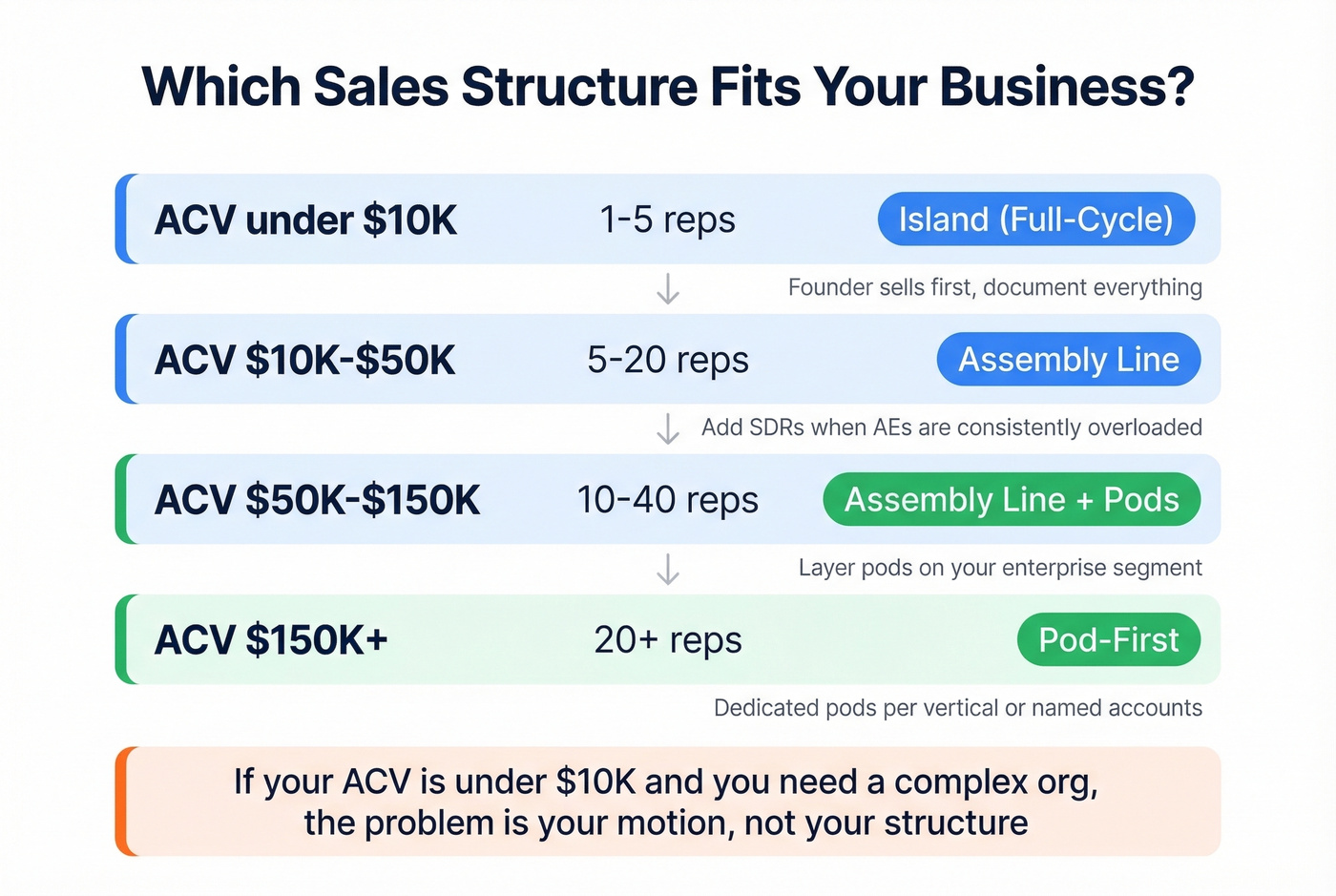
| ACV | Team Size | Recommended Model | Key Action |
|---|---|---|---|
| < $10K | 1-5 reps | Island (full-cycle) | Founder sells, document the motion |
| $10K-$50K | 5-20 reps | Assembly line | Add SDRs once AEs are overloaded |
| $50K-$150K | 10-40 reps | Assembly line + pods for top accounts | Layer pods on enterprise segment |
| $150K+ | 20+ reps | Pod-first | Dedicated pods per vertical or named accounts |
Here's the thing: if your average deal is under $10K, you don't need a complex org design. You need a tighter product and a shorter sales cycle. Structure won't fix a motion that requires too much human touch for the deal size.
The HBR life-cycle framework by Zoltners, Sinha, and Lorimer maps this evolution across four business stages. At startup, the key decisions are sales force size and whether to use partners. During growth, get specialization and sizing right. At maturity, reallocate resources and shift toward more generalist sellers. In decline, reduce headcount and lean on partners to extend the business.
Your structure should change as your business changes. The mistake is either changing too often - reactive restructuring every quarter - or never changing at all, running a startup structure with 80 reps.
For teams dealing with high rep attrition, simplify roles and shorten ramp time before restructuring. The problem is usually onboarding, not org design. If you just closed a Series B and need to 3x headcount in 12 months, lock in your assembly line process before hiring, or you'll scale chaos. And when more than a third of your team is underperforming on your top metrics, the problem is likely structural, not individual.

Your sales structure only performs when reps can reach the right buyers. Prospeo gives every SDR, AE, and pod 300M+ profiles with 98% email accuracy and 125M+ verified mobiles - so your assembly line never stalls on bad data.
Structure sets the ceiling. Data quality decides if you hit it.
Building a Sales Org from Scratch
The build order matters more than most founders realize.
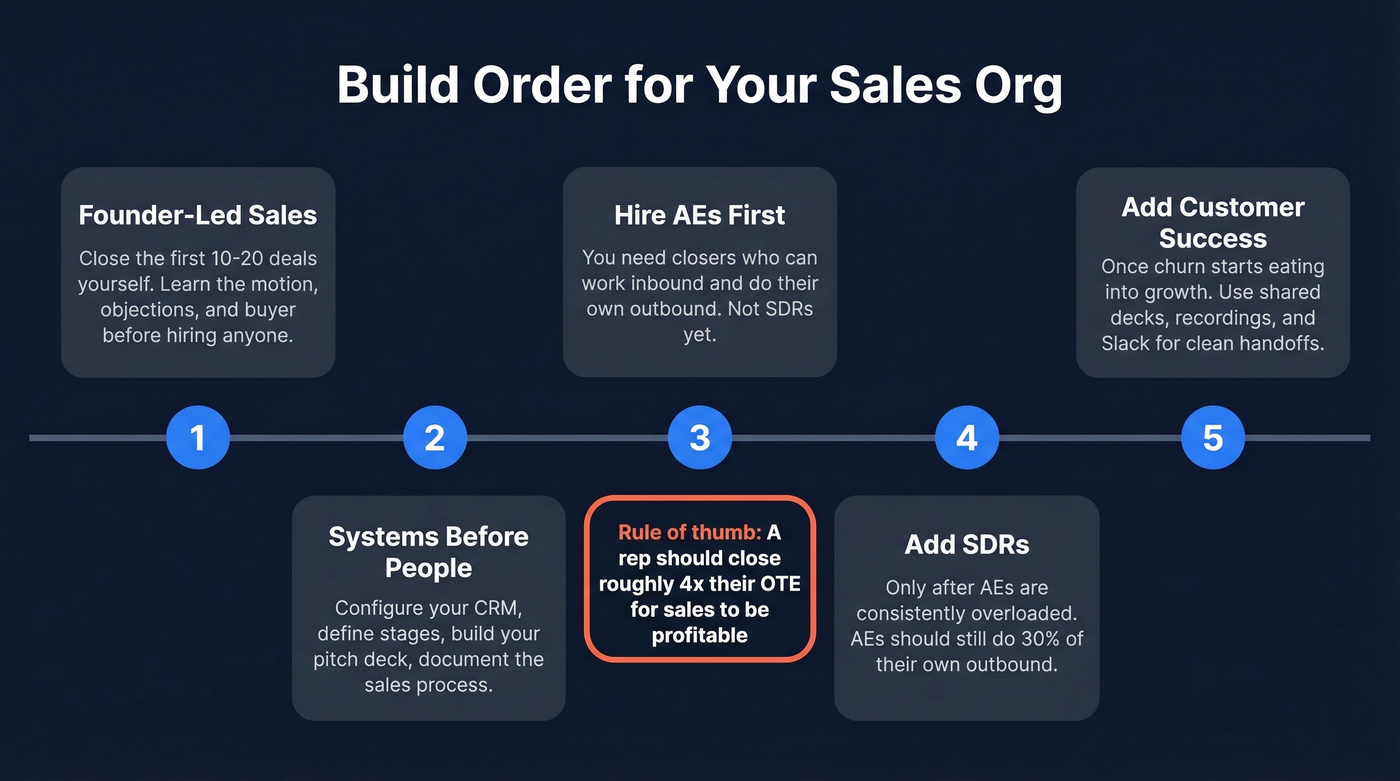
Start with founder-led sales. Close the first 10-20 deals yourself to understand the motion, the objections, and the buyer. Don't hire reps to figure out product-market fit for you.
Systems come before people. Get your CRM configured with defined stages, build your pitch deck, document your sales process. People without systems create chaos that's expensive to unwind later.
Hire AEs first - not SDRs. You need closers who can work inbound leads and do their own outbound. The capacity heuristic from practitioners on r/startup is simple: "If we got 10 more opportunities this month, how many would we drop the ball on?" When the answer is "most of them," it's time to hire.
SDRs come after AEs are consistently overloaded. Even then, AEs should still do about 30% of their own outbound - SDRs who handle 100% of pipeline creation become a single point of failure. Add Customer Success once churn starts eating into growth. Structured handoffs - shared decks, call recordings, Slack channels - keep the transition clean.
One hard rule on comp economics: a rep should close roughly 4x their OTE for sales to be profitable. A $120K OTE rep needs to close $480K at scale. If they can't, you have a structure or enablement problem, not a people problem.
Structure Beyond the Org Chart
Your org chart is only part of the equation. The rest is compensation design, territory planning, account assignment, and role definition.
71% of elite sales organizations agree their compensation drives top performance - versus just 33% of everyone else. That's a 38-point gap on something most leaders treat as an annual HR exercise.
Account assignment only works if reps have accurate contact data, though. You can design perfect territories and assign accounts strategically - and still fail if reps are calling dead numbers and emailing bounced addresses. Prospeo's 98% email accuracy and 7-day refresh cycle close that gap, so reps spend time selling into their assigned accounts instead of chasing bad data.
Korn Ferry recommends reviewing your structure every 2-3 years. Not every quarter when pipeline dips. Deliberate, data-informed reviews - not panic restructures.
Mistakes That Kill Sales Orgs
Hiring reps you wouldn't buy from
When the founder is the interim sales leader, every early hire reflects your standards. If you wouldn't take a meeting with this person, your prospects won't either.
Hiring a VP Sales who's never built
A VP from a company that hasn't been a startup in a decade won't know how to hire quota-hitting reps from scratch. Look for someone who's built a team from 2 to 20, not someone who inherited 200.
Over-complicating comp
Too many goals equals no goals. If your reps need a spreadsheet to calculate their commission, you've already lost.
Mis-sizing lead flow
Too few leads per rep and nobody earns. Too many and reps cherry-pick the easy ones while good opportunities rot. Neither is a people problem - both are structural.
Restructuring too often
Only 11% of sales orgs can execute a transformation without hurting commercial results. Every restructure costs months of productivity. Do it deliberately or don't do it at all.
Ignoring data quality
You can build the perfect pod structure, assign accounts with surgical precision, and design a comp plan that motivates - and still fail if reps work off stale data. Bad emails and disconnected numbers aren't a minor inconvenience. They're a structural leak.
Over-specializing too early
A 5-person sales team doesn't need an SDR, an AE, a solutions engineer, a CSM, and a manager. That's five roles and zero redundancy. Skip the org chart theater - start generalist, specialize as you scale.
2026 Trends Reshaping Sales Force Structures
The SDR function is evolving faster than any other role in sales. An Emergence Capital survey of 560+ B2B companies found that 36% cut SDR/BDR headcount in 2025. Only 19% increased it. The question isn't whether the SDR role is dying - it's whether your SDR function is structured to survive AI absorbing the repetitive prospecting tasks that justified the role in the first place.
The selling environment keeps getting harder, too. Buying committees now average 25 stakeholders, up from 16 in 2017. Average sales cycles have stretched to 6.5 months, up from 4.9 in 2019. Only 16% of reps hit quota. Buyers do 70-90% of their research before ever talking to a rep.
These trends don't argue for one structure over another. They argue for structures that are deliberately designed and regularly reviewed - not inherited from a playbook that worked in 2019. The companies that treat their sales force structures as a living system, not a one-time decision, are the ones that adapt.
Whether you run pods, an assembly line, or full-cycle reps, every model breaks when reps waste hours chasing dead contacts. Prospeo refreshes data every 7 days - not 6 weeks - so your team books 26% more meetings regardless of org design.
Give every seat in your sales org contacts that actually connect.
FAQ
What's the best structure for startups?
The island (full-cycle) model is the right starting point for nearly every startup. Don't hire SDRs until your AEs are consistently overloaded - use the "10 more opportunities" capacity test. Move to an assembly line once pipeline is predictable and your sales process is documented.
How often should you restructure?
Every 2-3 years. Only 11% of sales orgs can execute a transformation without hurting revenue. Restructure deliberately based on data - not reactively every quarter when pipeline dips. Each restructure costs months of productivity.
What tools support a well-designed sales org?
At minimum: a CRM like Salesforce or HubSpot, a B2B data platform for verified contact data, and a sales engagement tool for sequencing outreach (Outreach, Salesloft, or similar). Layer in intent data as you scale.
What are the main types of sales force structures?
The six classic types are geographic/territorial, product-based, functional, market/vertical, customer/account-size, and channel/partner. Most mature organizations layer two or three together - a vertical approach within an account-size segmentation, for example. The model you choose matters less than how deliberately you design the operating model underneath it.