

Best Sales Intelligence Tools in 2026: Pricing, Pitfalls, and Honest Picks
Your ZoomInfo contract is up for renewal and the quote came back 25% higher. The CFO wants to know why five reps need a $40k platform when they mostly use the search bar. You're not alone - the sales intelligence tools market hit $5.37B in 2026 and is racing toward $12.45B by 2034, which means vendors have every incentive to keep raising prices. Meanwhile, B2B contact data decays roughly 30% per year. You're paying more for data that's going stale faster than you can use it.
Here's our take after testing most of these platforms across real campaigns: ZoomInfo is still the deepest all-in-one platform. But most teams don't need all-in-one, and they're burning $30k/year to prove it.
Our Top Picks at a Glance
| Tool | Best For | Starting Price | Standout Stat |
|---|---|---|---|
| Prospeo | Email accuracy, data freshness | Free; ~$0.01/lead | 98% accuracy, 7-day refresh |
| Apollo.io | Free-tier prospecting + sequences | Free; $49/user/mo | 275M+ contacts, 10K free/mo |
| Cognism | EMEA cold-calling, GDPR compliance | ~$22,500/yr (5 seats) | Diamond Data: 2-3x pickups |
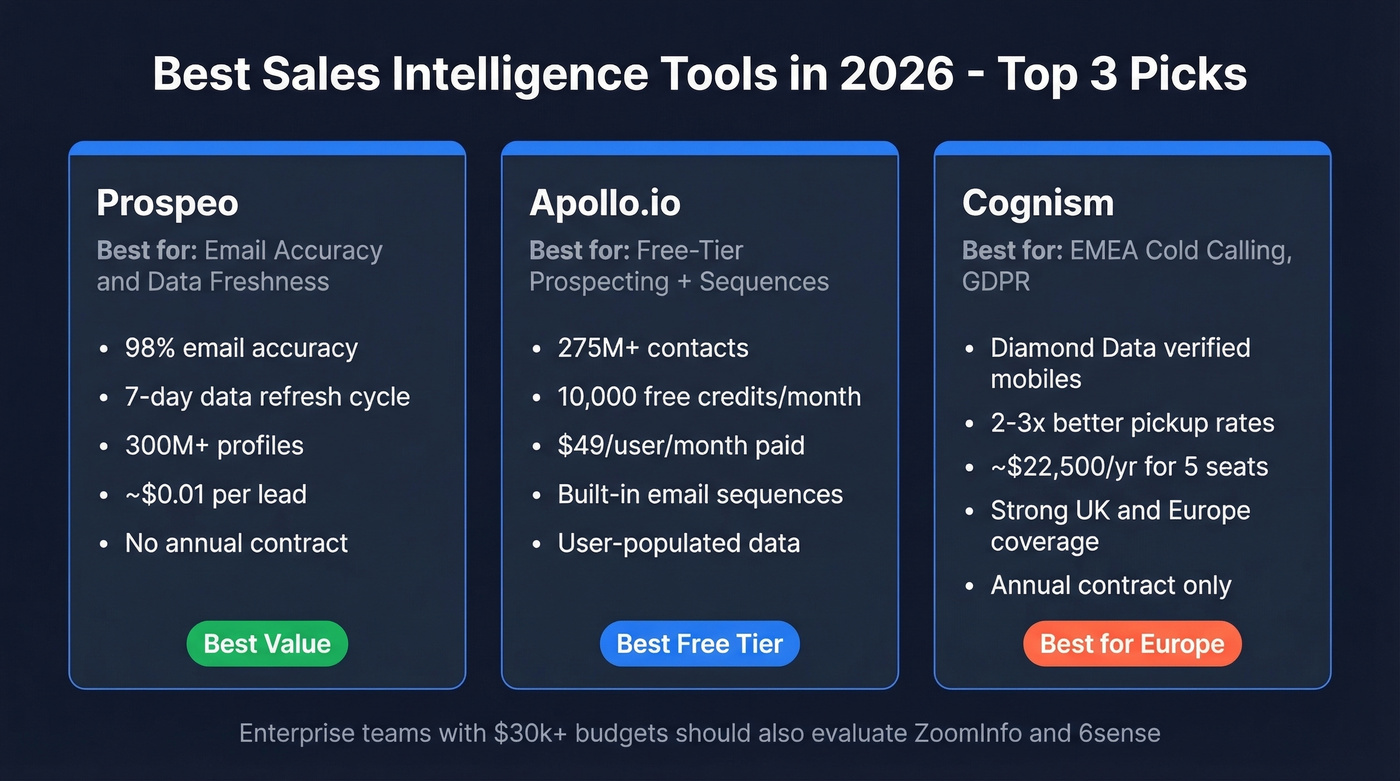
Enterprise teams with $30k+ budgets and complex ABM needs should look at ZoomInfo or 6sense. Everyone else is probably overpaying.
What Sales Intelligence Is (and Isn't)
Sales intelligence is the data layer that tells your reps who to call, when to call, and what to say. It isn't your CRM - your CRM stores relationship history. These platforms find new prospects and enrich existing records with five types of data:
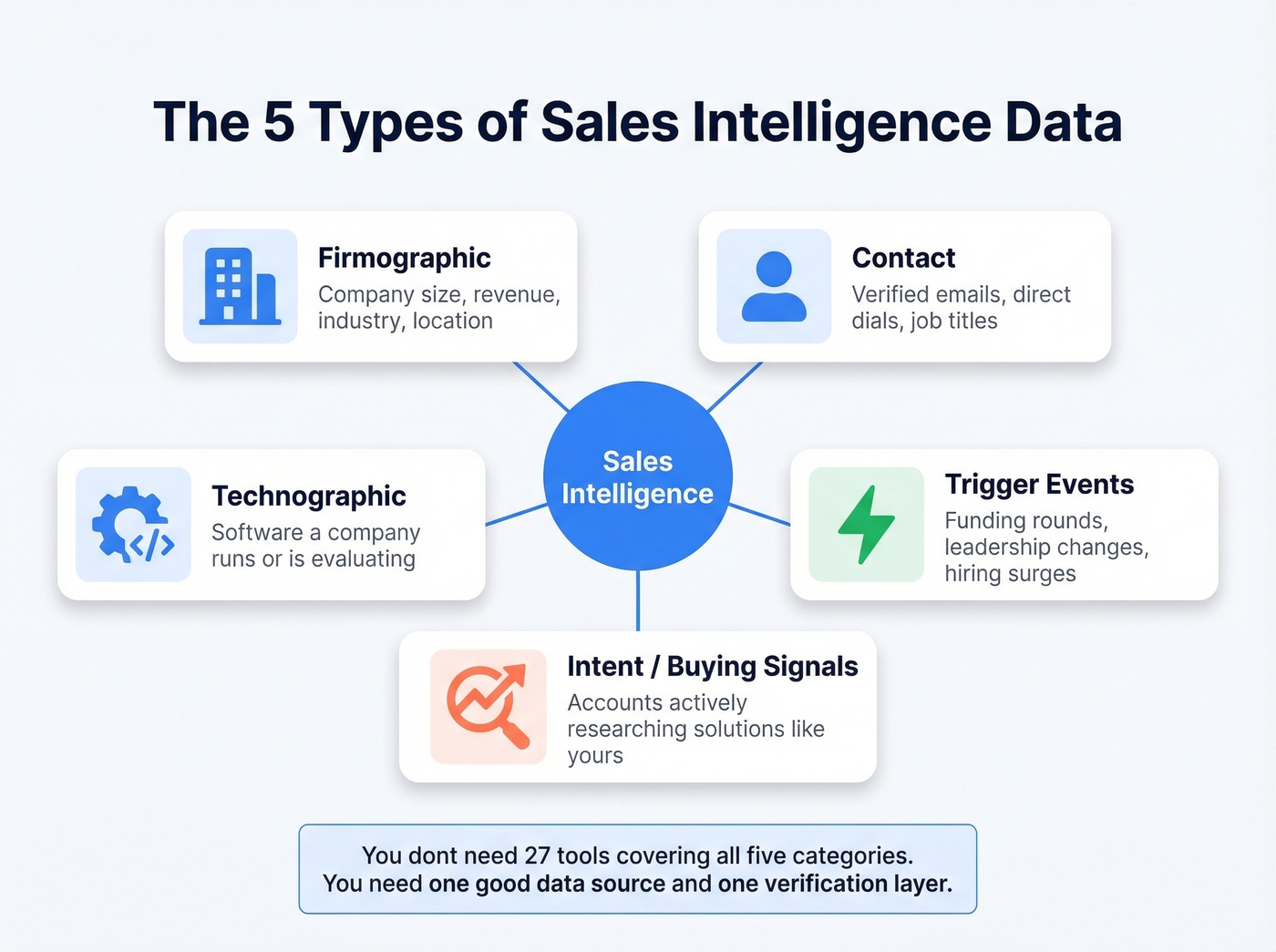
- Firmographic - company size, revenue, industry, location
- Contact - verified emails, direct dials, job titles
- Technographic - what software a company runs and what they're evaluating
- Intent / buying signals - which accounts are actively researching solutions like yours
- Trigger events - funding rounds, leadership changes, hiring surges, office moves
AI is increasingly layered on top for lead scoring, account summaries, and personalized outreach drafts. But the foundation is still data quality. You don't need 27 tools covering all five categories. You need one good data source and one verification layer. Most teams can get there with two platforms, not five.
What These Platforms Actually Cost
This is the section every competitor skips.
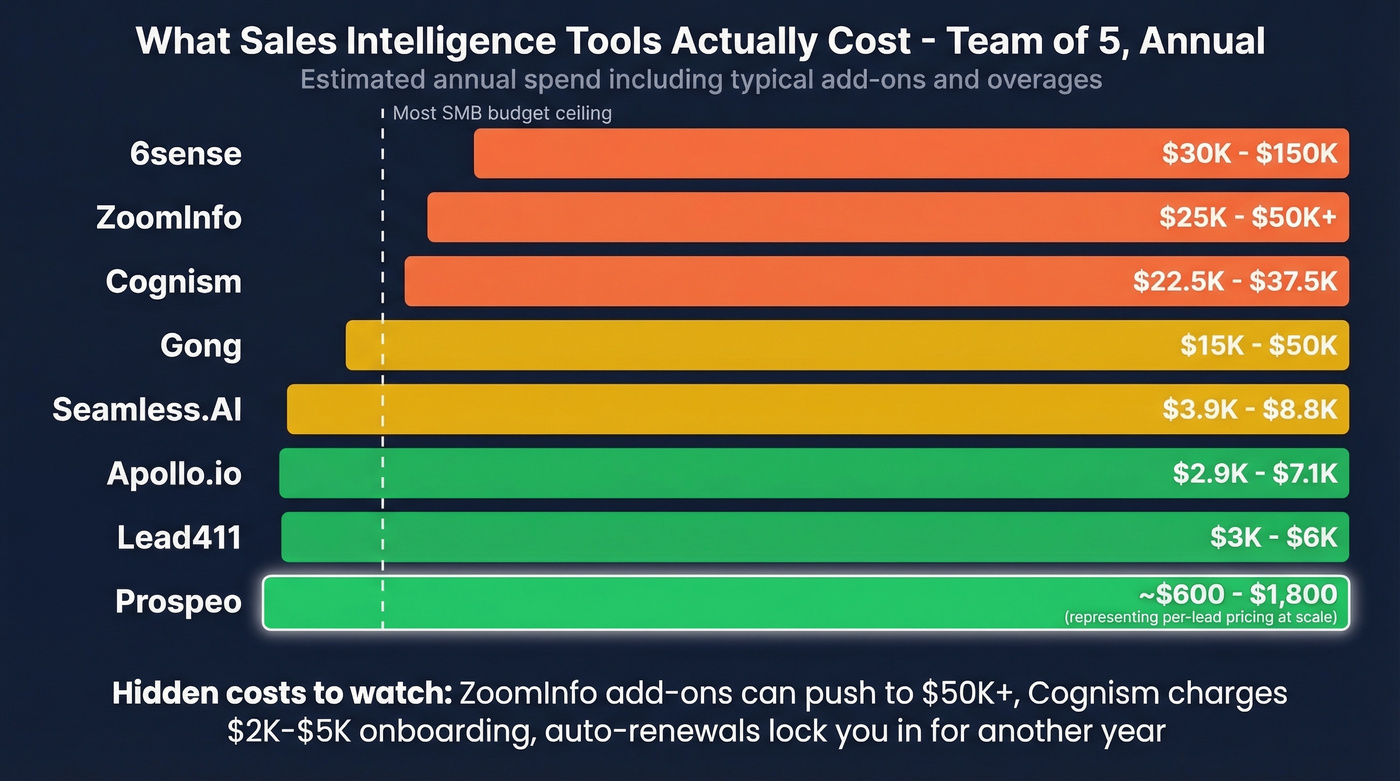
| Tool | Starting Price | Team of 5/Year | Credits? | Contract? |
|---|---|---|---|---|
| ZoomInfo | ~$15,000/yr | $25,000-$50,000+ | Yes, $0.20-$0.60/ea | Annual |
| Apollo.io | Free | ~$2,940-$7,140 | Yes, tiered | No |
| Cognism | ~$15,000/yr | $22,500-$37,500 | Fair-use caps | Annual |
| Lusha | Free (70 credits) | ~$1,800-$4,200 | Yes, 1-10/lookup | No (under 5 users) |
| 6sense | ~$30,000/yr | $30,000-$150,000 | Custom | Annual |
| Lead411 | $49/mo | ~$3,000-$6,000 | Varies by tier | No |
| Seamless.AI | Free trial | ~$3,900-$8,820 | Yes, complex tiers | Varies |
| Kaspr | Free | ~$2,940+ | Yes | No |
| Gong | ~$15,000/yr | $15,000-$50,000 | No | Annual |
| Breeze Intelligence | HubSpot add-on | Varies | Varies | HubSpot contract |
The hidden costs are what kill budgets. ZoomInfo add-ons push teams to $50,000/year once all fees land. Global Data alone costs $9,995. Extra credits run ~$3,000 per 5,000 batch. And auto-renewal windows are 60-90 days - miss the cancellation window and you're locked in for another year.
Cognism charges $2,000-$5,000 for onboarding and professional services. Apollo's mobile credits run out fast at 5 free per month. Let's be honest: if your sales intelligence software requires a separate tool just to figure out its pricing, something has gone wrong.

You just saw what sales intelligence tools actually cost. Prospeo gives you 300M+ profiles, 98% email accuracy, and a 7-day data refresh cycle - at ~$0.01 per lead with no annual contract. Teams book 26% more meetings than with ZoomInfo and 35% more than with Apollo.
Stop burning budget on data that's six weeks stale.
11 Best B2B Sales Intelligence Platforms in 2026
Prospeo
Best for: Email accuracy, data freshness, self-serve prospecting
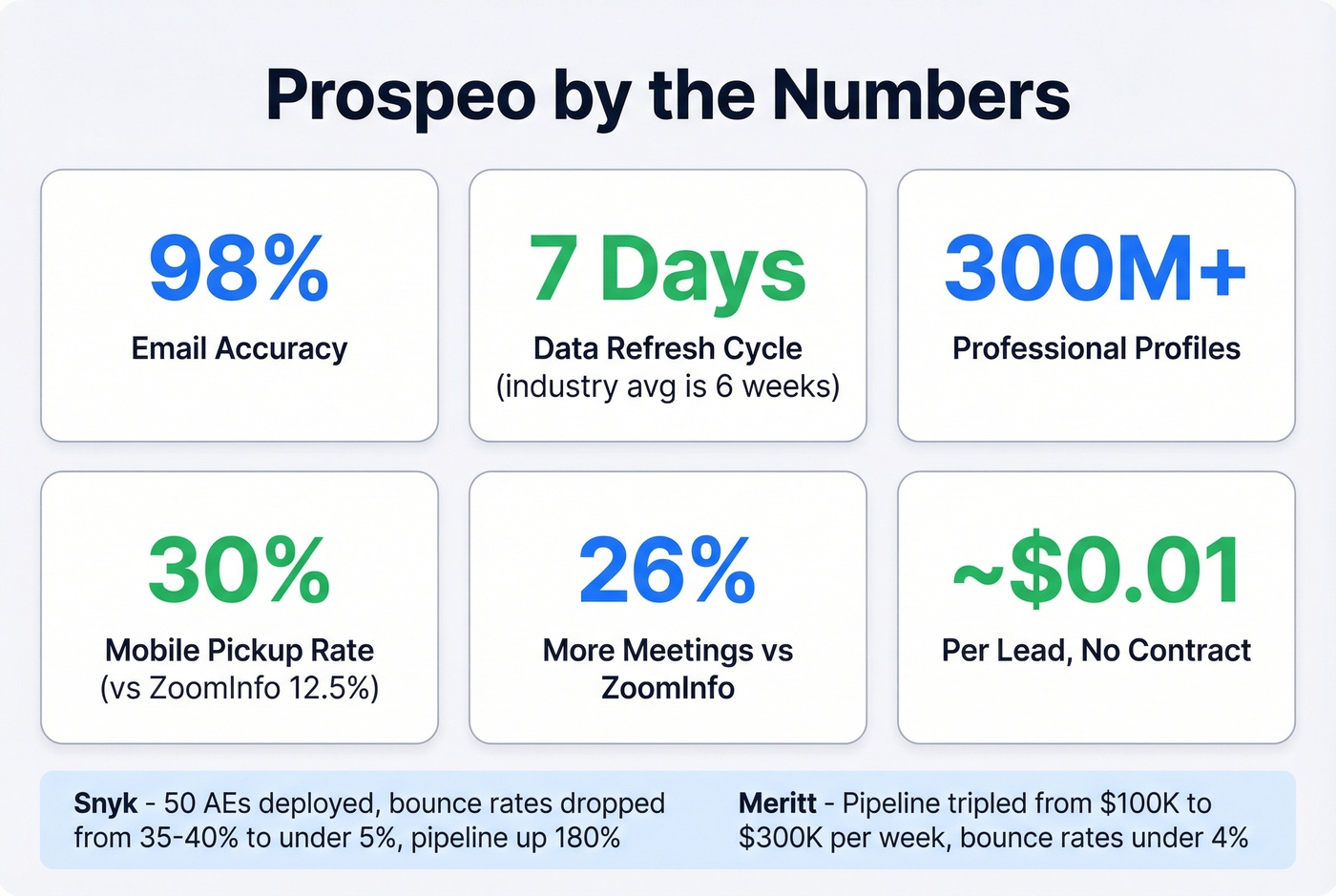
Prospeo's database covers 300M+ professional profiles, 143M+ verified emails, and 125M+ verified mobile numbers - all refreshed on a 7-day cycle. The industry average is six weeks. That means you're working with data that's roughly 6x fresher than what most competitors ship.

The 30+ search filters include buyer intent powered by 15,000 Bombora topics, technographic data, job changes, headcount growth, and funding signals. The Chrome extension has 40,000+ users and works across company websites, professional profiles, and CRMs. CRM enrichment returns 50+ data points per contact at a 92% API match rate, with native integrations into Salesforce, HubSpot, Smartlead, Instantly, Lemlist, Clay, Zapier, and Make.
The results we've seen from customers tell the story better than any feature list. Snyk deployed Prospeo across 50 AEs and watched bounce rates drop from 35-40% to under 5%, with AE-sourced pipeline jumping 180% and 200+ new opportunities per month. Meritt tripled pipeline from $100K to $300K/week after switching, with bounce rates dropping from 35% to under 4%.
Teams book 26% more meetings with Prospeo than with ZoomInfo, and 35% more than with Apollo. Mobile pickup rates hit 30% across all regions - more than double ZoomInfo's 12.5%. At ~$0.01 per lead with 98% email accuracy, there's no contract and no sales call required.
ZoomInfo
Best for: Enterprise teams needing the deepest US database and broadest integrations ecosystem
Where ZoomInfo wins over everyone: sheer database depth at 300M+ professionals across 100M companies, integration breadth, and the fact that every sales tool on earth connects to it natively. Its 9,031 G2 reviews at 4.5/5 aren't an accident - the product works.
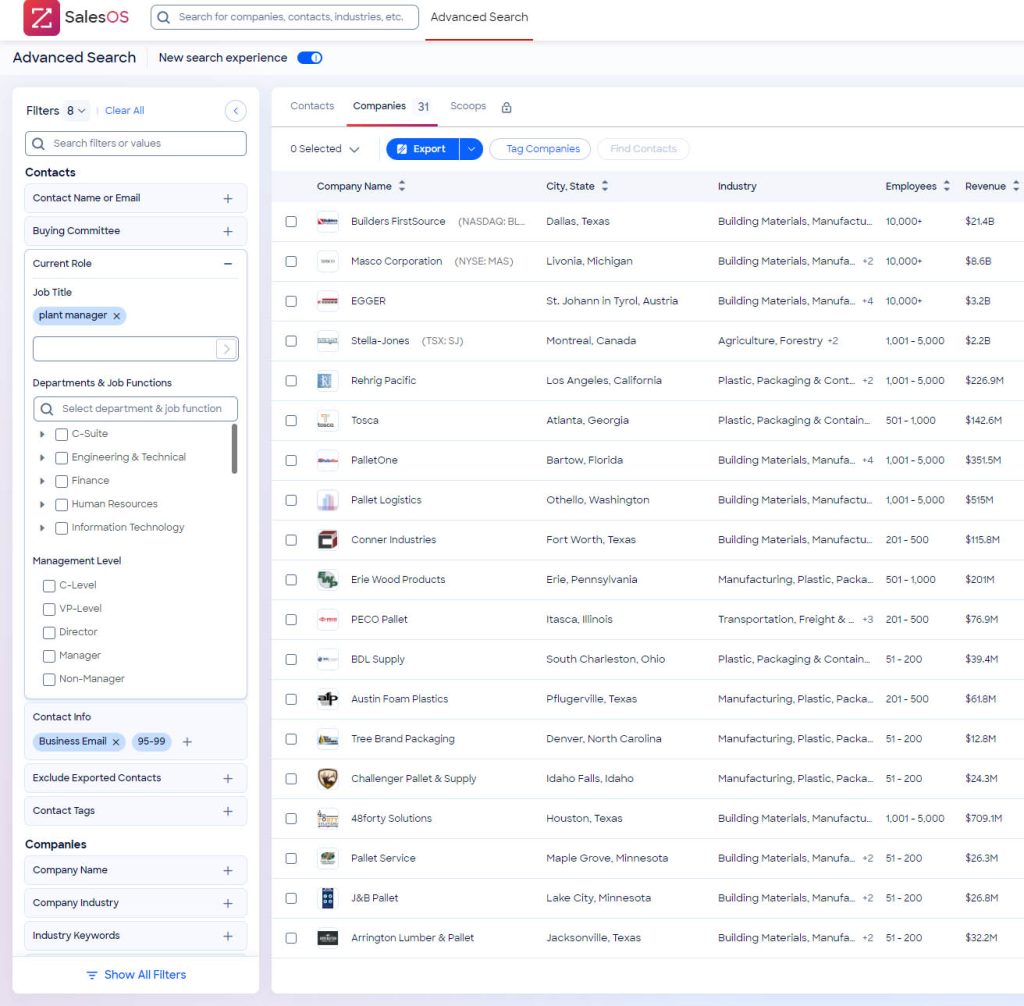
Where it loses: price and data freshness. List pricing starts at $14,995/year for Professional+ with 3 seats included, but most teams end up at $25,000-$50,000 after adding seats at $2,500 each, extra credits, and modules. Negotiation discounts of 30-65% are common, so always push back on the first quote.
The #1 complaint on G2? Pricing. The #2? Outdated contacts. Renewal quotes routinely jump 10-30%. On Reddit, the frustration runs even deeper - threads in r/sales regularly describe ZoomInfo as "overpriced for what you get" once teams audit how many reps actually use the full platform. We've heard the same from prospects who come to us mid-contract, frustrated that they're paying for a GTM suite when they really just needed accurate emails and phone numbers.
Use this if: You're a 50+ rep org running complex ABM with intent data, chat, and workflow automation from one platform. Skip this if: You're under 20 reps and don't need the full GTM suite. You're paying for features you won't activate.
Apollo.io
Best for: Budget-conscious teams wanting prospecting + sequences in one platform
Apollo is the obvious starting point for most SMB teams. The free tier gives you 10,000 email credits per month, 5 mobile credits, and 250 daily sends. Paid plans run $49-$119/user/month with annual billing. The database covers 275M+ contacts and 73M+ companies.
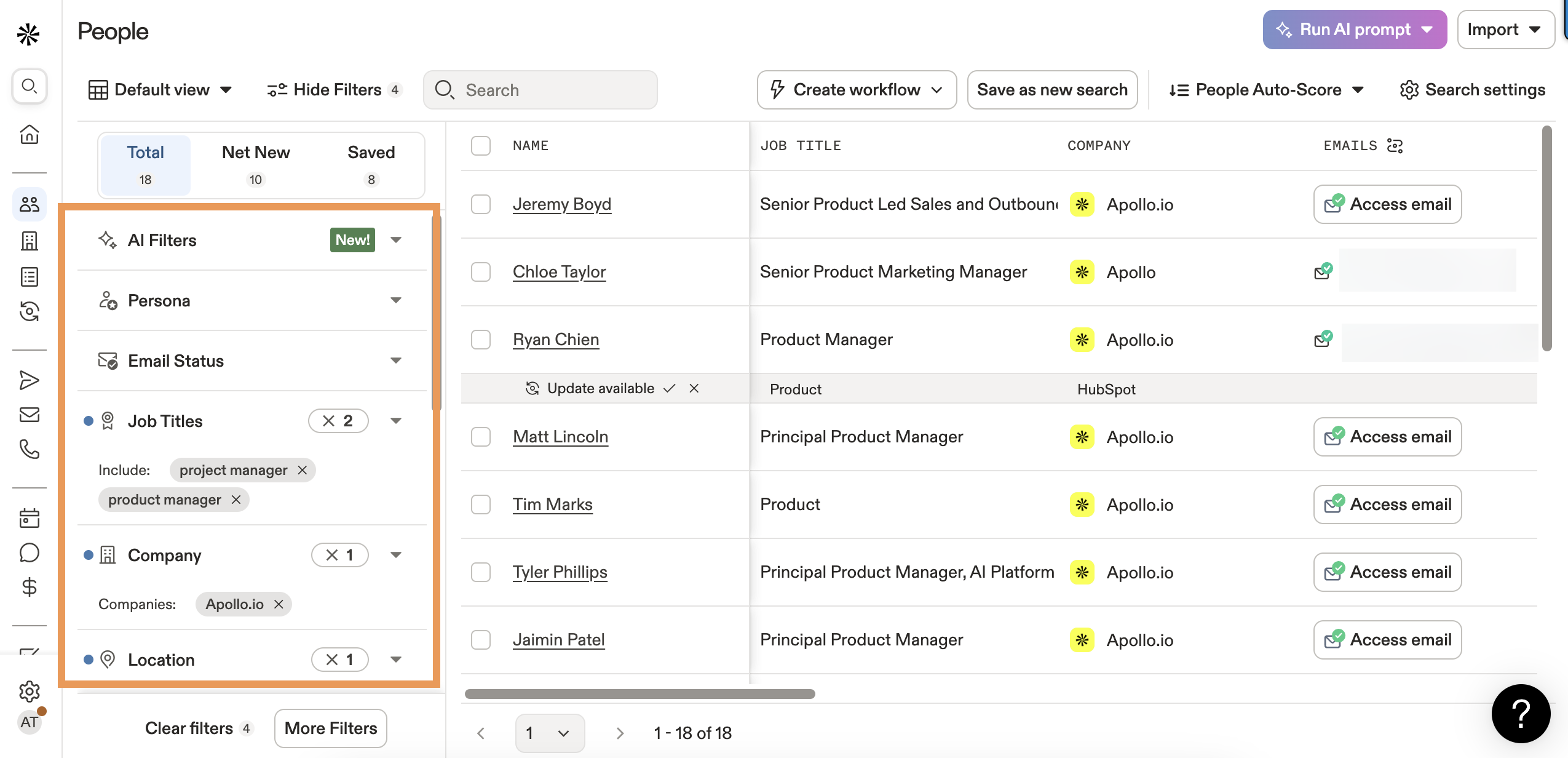
Here's where it gets complicated. Apollo's data is largely user-populated. As one practitioner on r/sales put it: it's a "jack of all trades, master of none" - and "they're not verifying anything by themselves." The same thread warns that Apollo's Twilio-based VoIP dialer gets flagged as spam, and its email infrastructure can hurt deliverability if you use open/click tracking.
The smart move: use Apollo for prospecting and sequencing, but verify every export through a dedicated verification tool before you send. Treat Apollo's data as a draft, not a final version.
Cognism
Why it wins: Diamond Data - manually phone-verified mobile numbers that deliver 2-3x better pickup rates than non-verified alternatives. If your team cold-calls into the UK and Europe, Cognism is the strongest option for GDPR-compliant, verified direct dials.
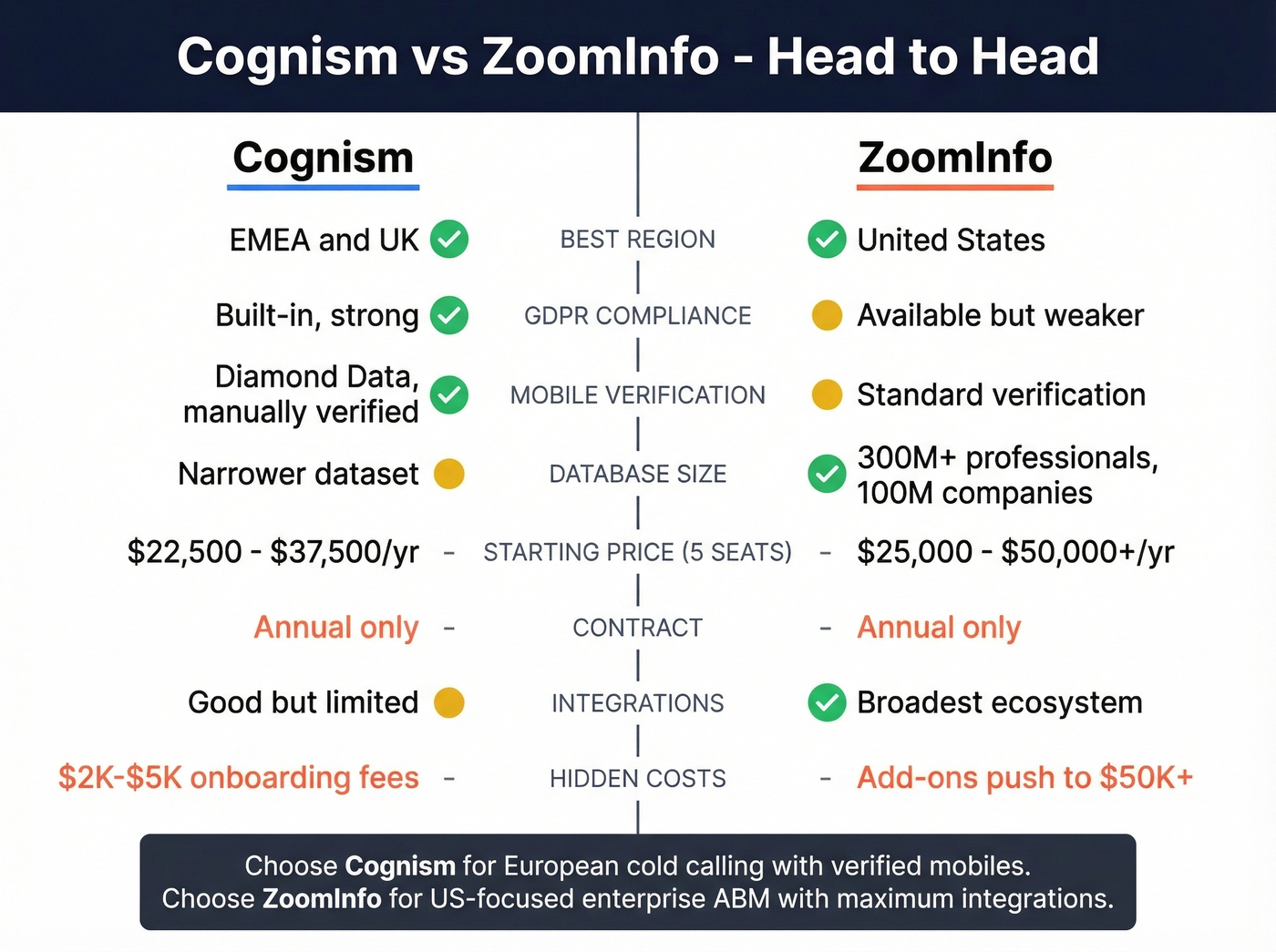
Key tradeoff: You're paying enterprise prices for a narrower dataset. A 5-person team runs $22,500-$37,500/year with platform fees plus per-seat licensing, annual contracts only. "Unlimited" exports come with fair-use caps around 2,000 records per user per month. North American coverage is noticeably weaker than European data, and onboarding fees range from $2,000-$5,000.
Pricing signal: Grow tier starts at ~$15,000/year platform + ~$1,500/seat. Elevate runs ~$25,000 platform + ~$2,500/seat. Expect 10-15% annual renewal increases.
Where Cognism wins over ZoomInfo: EMEA compliance and mobile verification. Where ZoomInfo still wins: US database depth and workflow breadth.
Lusha
Lusha's strength is speed. Install the Chrome extension, find a contact, reveal the number. The free plan gives you 70 credits per month, but phone lookups cost 10 credits each - so that's really 7 phone numbers. Pro runs $29.90/user/month for 250 credits, Premium $69.90/user/month for 600 credits. Teams over 5 users get pushed to custom pricing.
It's a solid enrichment layer for reps who need quick lookups, not a prospecting platform. Credit burn is the thing to watch - a heavy dialing team will blow through 600 credits in a week.
6sense
Enterprise ABM and intent data, full stop. 6sense maps buying committees, scores account-level intent, and orchestrates multi-channel plays. Pricing runs $30,000-$150,000/year depending on scope, and there's no self-serve option.
For teams running account-based plays with 50+ reps who need to know which accounts are in-market before anyone picks up the phone, 6sense is the platform. If you're a 10-person team, this isn't for you. The implementation alone takes months.
Lead411
Knowing a company just raised a Series B or hired a new VP of Sales is worth more than a slightly larger contact database. That's Lead411's whole thesis.
Starting at $49/month with a 7-day free trial, it offers trigger-based prospecting built around funding rounds, hiring surges, and tech installs. The database is smaller than Apollo or ZoomInfo, and the UI feels dated compared to newer platforms, but the timing signals are genuinely useful for outreach. Lead411 won't replace your primary data source, but it's an excellent trigger layer at a mid-market price.
Seamless.AI
Seamless.AI uses a real-time search engine model to find contact data on the fly rather than pulling from a static database. Free trial available, paid plans typically run $65-$150/user/month. The credit structure is complex and tier boundaries aren't transparent.
Practitioner reviews on data quality are inconsistent - some reps swear by it for phone numbers, others report high bounce rates on emails. Use it for phone prospecting if you verify every record before dialing.
Kaspr
Free plan available, paid from $49/user/month. Strong for European phone numbers via its Chrome extension. Think of it as Lusha's European cousin - lighter, cheaper, focused on quick lookups rather than platform-level prospecting.
Gong
Different category entirely. Gong is conversation and revenue intelligence - call recording, deal analytics, coaching insights - not a contact database. It typically runs $15,000-$50,000/year. It's complementary to everything else on this list, not a replacement. Pair it with a data tool; don't expect it to be one.
Breeze Intelligence
Now absorbed into HubSpot as "Breeze Intelligence." Best for HubSpot-native teams wanting enrichment without bolting on a separate platform. Limited as a standalone prospecting tool - if you aren't already in HubSpot's ecosystem, look elsewhere.
Skip dedicated platforms entirely if you're pre-product-market-fit with fewer than 100 target accounts. A manual search and a spreadsheet will do until you've validated your ICP.
Why Data Quality Beats Database Size
A 300M-record database refreshed weekly beats a 600M-record database refreshed monthly. That isn't opinion - it's math.
B2B contact data decays at roughly 2.1% per month, which compounds to 22-30% annually. People change jobs, companies get acquired, phone numbers rotate. A database that doesn't refresh aggressively is selling you yesterday's data at today's prices.
Outreach data shows deals closed within 50 days have a 47% win rate vs 20% after that threshold - stale data that delays outreach literally halves your close rate. U.S. companies lose roughly 27% of revenue annually due to incomplete or inaccurate customer data. Speed and accuracy aren't nice-to-haves. They're the difference between hitting quota and explaining to the board why you didn't.
We recommend running exports through at least two verification tools regardless of which provider you use. Even the best databases have gaps. And here's the uncomfortable stat: 60-70% of sales intelligence implementations fail to deliver promised value. The tool usually isn't the problem. Stale data and poor adoption are.
Matching the Right Tool to Your Team
| Team Type | Recommended Tool | Why | Annual Budget |
|---|---|---|---|
| Solo founder / SMB | Prospeo | Best accuracy per dollar, no contracts | $0-$2,400 |
| 5-person SDR team | Apollo.io + verification layer | Apollo for sequences, verify before sending | $3,000-$8,000 |
| Mid-market (10-30 reps) | ZoomInfo or Cognism | Depth + integrations (US) or compliance (EU) | $25,000-$50,000 |
| Enterprise (50+ reps) | ZoomInfo + 6sense | Full GTM stack + intent | $50,000-$150,000+ |
| European / GDPR-focused | Cognism | Diamond Data, GDPR-native | $22,500-$37,500 |
| Agency / multi-client | Prospeo | Per-credit pricing scales across clients | $1,200-$6,000 |
Don't overthink this. Match the tool to your team size, geography, and budget. A solo founder doesn't need ZoomInfo any more than an enterprise org needs to cobble together five point solutions.
Implementation Without Wasting $30K
76% of companies cite poor adoption of sales tools as a primary reason they miss quota. 56% of businesses report performance issues after choosing the wrong software tool. That's why starting with free tiers matters - the tool isn't the problem, the rollout is.
- Define your ICP before buying anything. If you can't describe your ideal customer in two sentences, no tool will help. Use an ideal customer scoring rubric.
- Start with free tiers. Apollo and Prospeo both offer enough free credits to validate data quality in your specific market. If you're still early, compare other free tiers before committing.
- Verify data quality in the first week. Send 200 emails. If bounce rates exceed 8%, the data isn't good enough (see bounce rate benchmarks).
- Integrate with your CRM before scaling. Reps won't use a tool that lives outside their workflow (use a CRM setup guide).
- Measure bounce rate and reply rate as leading indicators. These tell you more about data quality than any vendor's accuracy claim (track lead scoring alongside replies).
The best sales intelligence tool is the one with data you can actually trust. Snyk cut bounce rates from 40% to under 5% across 50 AEs. Meritt tripled pipeline to $300K/week. Both switched because accuracy and freshness beat feature bloat every time.
Get enterprise-grade sales intelligence without the enterprise contract.
FAQ
Is ZoomInfo worth the price?
For enterprise teams spending $30k+ annually on complex ABM workflows, ZoomInfo delivers unmatched database depth and integration breadth. Teams under 20 reps are almost certainly overpaying for features they won't activate. Mid-market orgs should evaluate Apollo or Cognism first and benchmark data quality before committing.
What's the difference between sales intelligence and a CRM?
A CRM stores data about existing relationships - deals, conversations, pipeline stages. Sales intelligence platforms find new prospects and enrich records with verified contact info, firmographics, technographics, and buying signals. They're complementary layers, not interchangeable systems.
How accurate is B2B contact data in 2026?
B2B data decays roughly 30% per year. Most providers refresh every four to six weeks, meaning up to 10% of records are stale at any given time. Platforms with weekly refresh cycles keep accuracy above 95%. Always verify emails before sending at scale, regardless of provider.
What features matter most when evaluating these platforms?
Focus on five areas: data accuracy and refresh frequency, database coverage for your target geography, native CRM integrations, credit or pricing transparency, and filtering depth across firmographic, technographic, and intent signals. Platforms that score well across all five consistently outperform those that excel in only one or two.