

Sales Leadership Strategies: The 2026 Playbook for Building a Team That Hits Quota
Week three in the new role. You've inherited eight reps, a CRM full of stale pipeline, and a quota that assumes last year's headcount plus 20% growth. Your VP wants a "plan" by Friday.
Here's what you're walking into: quota attainment sits around 43%, win rates hover at 20-21%, buying committees run 6-10+ stakeholders, and new rep ramp time has climbed to 5.7 months - up 32% since 2020. The margin for leadership error is razor-thin. Your sales leadership strategies are the difference between a team that compounds and one that churns.
Three highest-leverage moves you can make right now: protect your team's selling time ruthlessly, build a coaching cadence with specific questions, and own your team's data quality so reps sell instead of chasing dead leads. Everything below gives you the benchmarks, frameworks, and a 90-day plan to execute all three.
Leadership vs. Management
Most orgs blur this line. Sales leadership is vision, direction, and culture - the strategic layer. Sales management is day-to-day execution: coaching, pipeline reviews, accountability.
You need both. Most orgs over-index on management and under-invest in leadership. They'll promote a top closer and wonder why the team stalls - because closing deals and building a sales culture are fundamentally different skills. The best leaders toggle between both modes deliberately, applying strategic thinking rather than just reacting to the latest fire.
10 Strategies That Actually Move Revenue
1. Protect Your Team's Selling Time
The single highest-leverage thing a sales leader can do. Full stop. The thread on r/sales is damning: too many KPIs, too many internal meetings, too many "quick syncs" eating selling hours. TheSalesBlog calls it one of the biggest leadership failures - not protecting your team from the org.
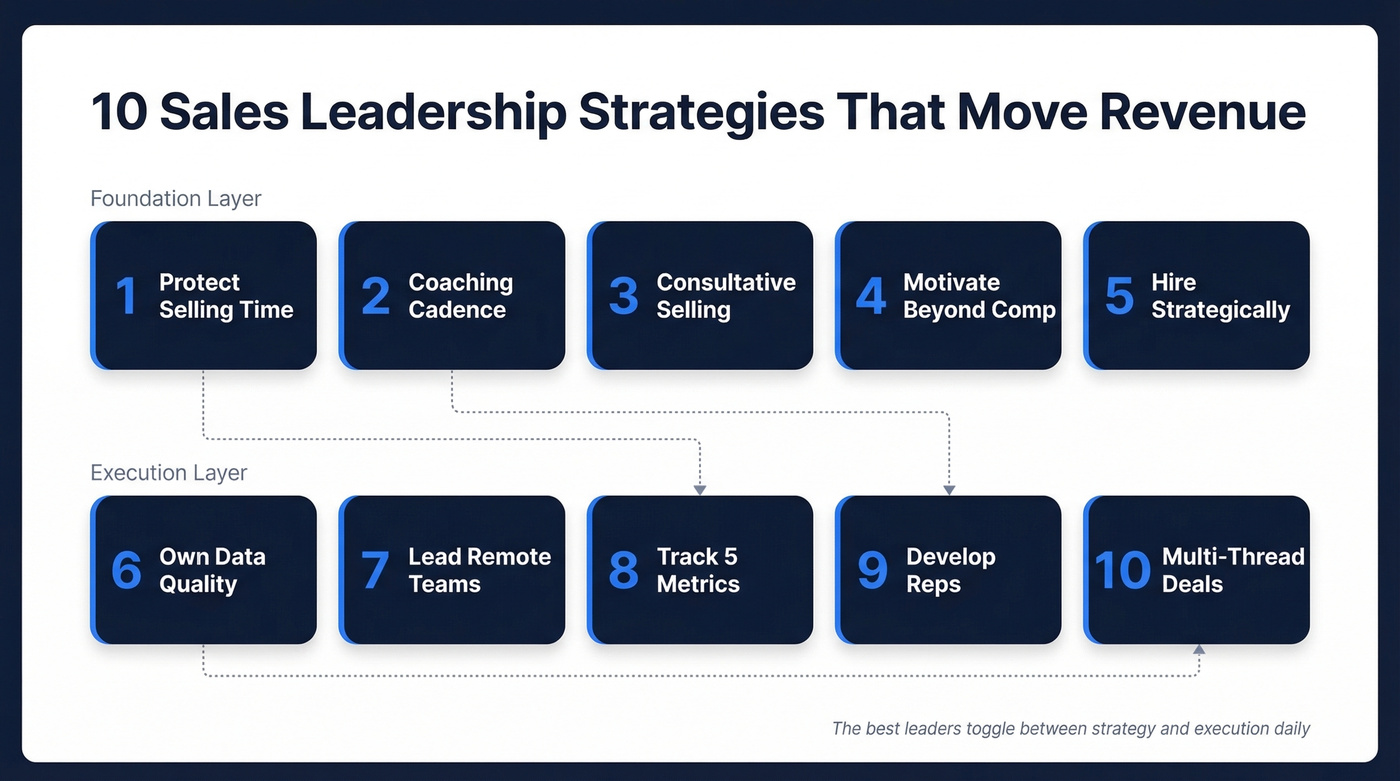
Audit your team's calendar for one week. If internal meetings exceed 30% of total hours, start cutting. Cancel the Monday forecast call that duplicates the CRM. Kill the Thursday "huddle" that's really a status-update email in disguise. Every hour you give back is an hour a rep can spend in a deal.
2. Build a Real Coaching Cadence
"Coach more" isn't a strategy. A cadence is.
- Weekly 30-minute 1:1s - developmental, not pipeline reviews. Ask: "What did you learn from the deal you lost?" "What would you do differently?" "Where are you stuck right now?"
- Weekly team pipeline review focused on stage movement and stuck deals
- Biweekly call reviews - listen to a recorded call together and debrief
SalesScreen's summary of performance research highlights that regular, developmental feedback can increase performance by up to 39%. That's not a marginal gain - it's the difference between a team that hits plan and one that doesn't. Among all the levers available to you, consistent coaching delivers the highest ROI.
3. Shift to Consultative Selling
When a team falls behind quota, survival mentality kicks in. Reps chase every lead. Managers demand more activity. The whole org shifts transactional - more calls, more emails, more demos for prospects who were never going to buy.
This is a leadership failure, not a rep failure. Model and enforce a consultative approach: qualify harder, go deeper on fewer deals, walk away from prospects who don't fit. It feels counterintuitive when you're behind, but chasing unqualified pipeline drives inefficiency and burnout. The best leaders pivot away from volume-first thinking and toward deal quality - even when the board is breathing down their neck.
4. Motivate Beyond the Comp Plan
Here's the thing: if your entire motivation strategy is comp plan plus President's Club, you're leaving 20%+ of your team's performance on the table. Self-Determination Theory identifies three durable motivators: autonomy, mastery, and purpose. Chester Elton and Adrian Gostick analyzed responses from more than 5,800 salespeople and found money didn't crack the top 20 motivators - their research maps effective leadership to a people-focus vs. goal-focus balance, where the best leaders score high on both.
High-engagement teams see 21% higher profitability. You need both the culture and the comp plan. Neither works alone.
5. Hire Like Your Pipeline Depends on It
Skip this if you aren't hiring in the next 6 months. Read twice if you've made a bad hire recently.
The true cost of a wrong sales hire runs $150K+ when you factor in ramp time, lost pipeline, and the morale hit. With ramp averaging 5.7 months, every mistake costs half a year of production. Use structured behavioral interviews. Test for coachability, not just closing instinct. Your team needs range - different selling styles for different buyer personas. We've seen teams transform after replacing one bad-fit hire with someone who actually matched the ICP's buying style, and the ripple effect on team morale was immediate.
6. Own Your Team's Data Quality
Bad data is a leadership failure, not a rep problem. Bounced emails and disconnected numbers don't just waste hours - they erode confidence. A rep who hits three dead numbers in a row stops picking up the phone.
This is where we've seen the biggest gap between leaders who "get it" and those who don't. When GreyScout switched to Prospeo, they cut rep ramp time from 8-10 weeks to 4 weeks - because new reps were actually reaching prospects instead of burning through stale lists. Data quality is a strategic decision that belongs on the leader's desk, not a rep-level problem to troubleshoot.

7. Lead Remote Teams Intentionally
Most advice on leading sales teams ignores this entirely, which is wild given how many teams are distributed now. A first-time leader on r/sales framed it well: build trust, avoid micromanagement, understand individual motivations.
A quick checklist for remote leadership:
- Set explicit standards for activity and quality - then give complete autonomy on execution
- Ask reps what's working in their territory before prescribing changes
- Replace status-check Slack messages with async updates
The leader who monitors Slack status indicators all day is the leader whose best reps start interviewing.
8. Track 5 Metrics, Not 15
Stop tracking 15 KPIs. Track 5. The rest is noise.
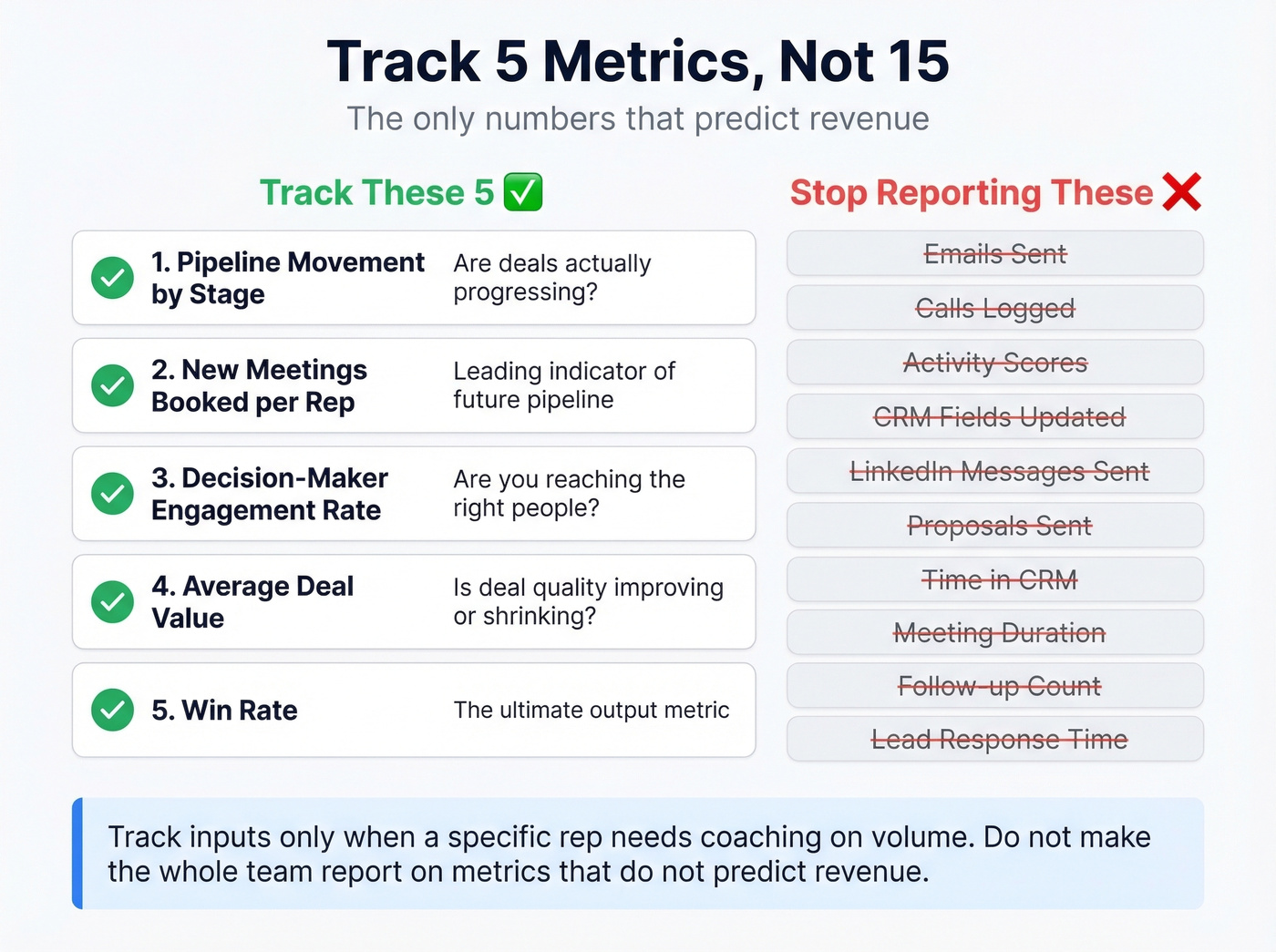
Pipeline movement by stage, new meetings booked per rep, decision-maker engagement rate, average deal value, and win rate. That's it. Everything else - emails sent, calls logged, activity scores - is input theater. Track inputs only when a specific rep needs coaching on volume. Don't make the whole team report on metrics that don't predict revenue.
9. Develop Reps, Don't Just Train Them
Training is the onboarding bootcamp. Development is everything after.
Most orgs fund training and starve development, then wonder why reps plateau after month six. We've seen top reps quit citing "lack of development" despite hitting 120% of quota. High performers don't just want a bigger check - they want to get better. If you're only developing underperformers, your best people will leave for a leader who invests in them.
10. Multi-Thread Every Deal Above $50K
Closed-won deals have roughly 2x the buyer contacts of closed-lost deals. For deals above $50K, multi-threading boosts win rates by 130%. With buying committees running 6-10+ stakeholders, single-threading is a death sentence.
This is a leadership strategy because reps won't multi-thread on their own - it's uncomfortable to go around your champion. Ask "Who else have you spoken to?" on every deal above your threshold. If the answer is one person, that deal isn't real yet.
The 90-Day Sales Leadership Playbook
New role, new team, no playbook. Here's the phased approach.
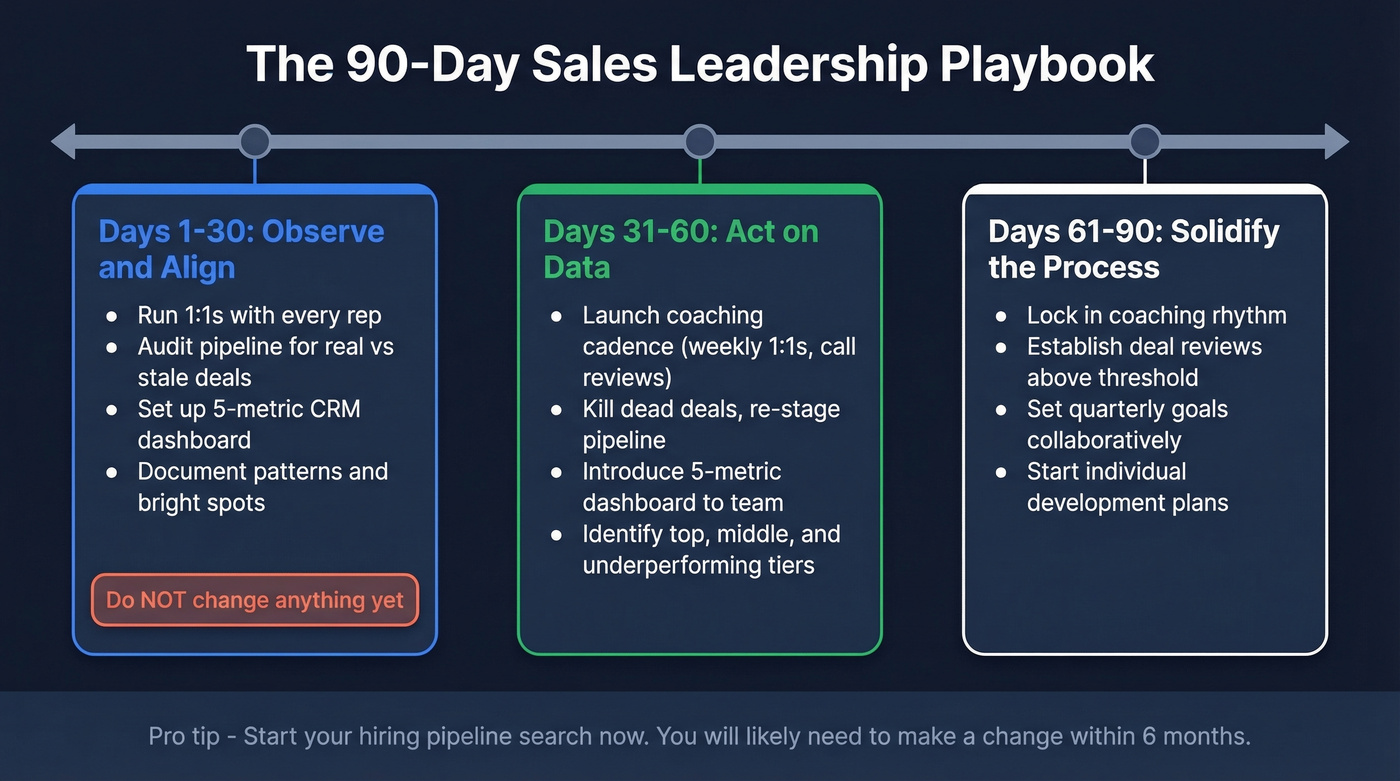
Days 1-30: Observe and Align
Don't change anything yet. Run 1:1s with every rep - ask about motivations, territory challenges, and barriers, not just pipeline. Audit pipeline data for what's real, what's stale, and where deals are stuck. Set up your CRM dashboard with the 5 core metrics. Document patterns, gaps, and bright spots.
The biggest mistake new leaders make is changing things in week two. You don't have enough context yet.
Days 31-60: Act on Data
Now you've got 30 days of observation. Implement your coaching cadence - weekly 1:1s, pipeline reviews, call reviews. Address pipeline hygiene by killing dead deals and re-staging misclassified ones. Introduce the 5-metric dashboard to the team and explain why each metric matters. Make one or two process changes that remove friction, and start identifying your top, middle, and underperforming tiers. Treat this phase as experimentation - test small changes, measure results, double down on what moves the needle.
Days 61-90: Solidify the Process
Lock in your coaching rhythm - it should feel routine by now. Establish deal reviews for opportunities above your threshold. Set quarterly goals with each rep collaboratively. Begin individual development plans: stretch assignments for top performers, skill-building for middle, performance improvement for underperformers.
Review your hiring pipeline now. You'll likely need to make a change within 6 months, and starting the search early gives you options instead of desperation.

You read it above: GreyScout cut rep ramp time in half by switching to Prospeo. When your reps dial verified numbers and send emails that land, coaching actually compounds. 98% email accuracy, 125M+ verified mobiles, refreshed every 7 days.
Stop coaching reps through bad data. Give them contacts that connect.
Common Mistakes That Kill Performance
Assuming everyone works like you did. You were a great rep. Your team isn't you. Set explicit standards for activity and process - don't assume they'll figure it out your way.
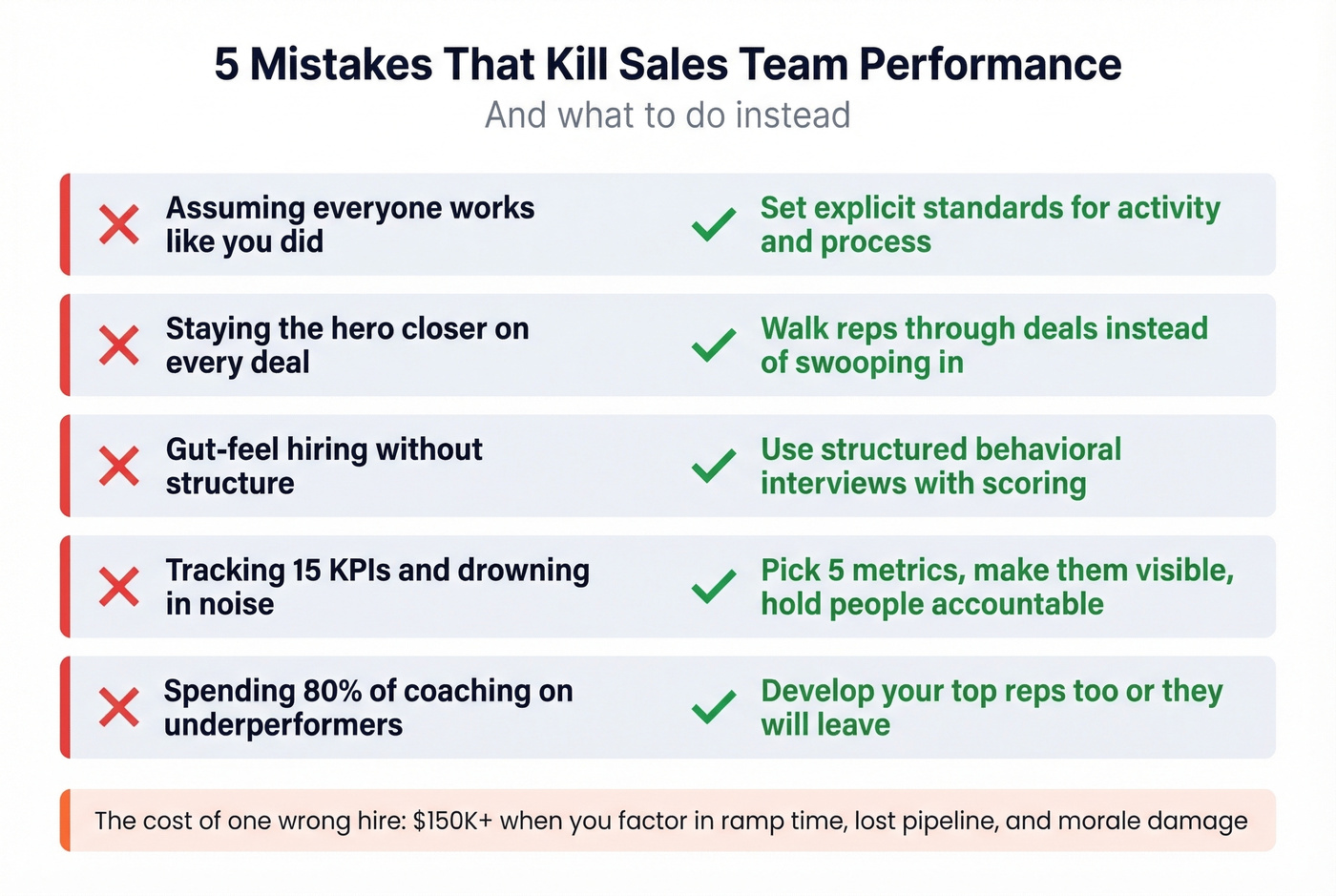
Staying the "hero closer." Every deal you close yourself is a coaching opportunity you wasted. Walk reps through deals instead of swooping in.
Gut-feel hiring. Use structured behavioral interviews with consistent scoring. Test for coachability and curiosity, not just confidence.
Tracking too many KPIs. Fifteen metrics means no metrics. Pick five, make them visible, hold people accountable.
Neglecting high performers. Most leaders spend 80% of coaching time on underperformers. Your top reps need development too - or they'll find a leader who provides it.
Why Strategic Initiatives Fail
Even strong sales leadership strategies fall apart in execution. The most common reason? A gap between the boardroom plan and the frontline reality.
Leadership announces a new methodology, a new ICP, or a new tech stack - but never adjusts quotas, territories, or coaching to support the change. Reps nod in the all-hands and go back to doing what they were doing before. If you're rolling out a strategic initiative, tie it to specific behavioral changes, measure those behaviors weekly, and give the initiative at least 90 days before declaring it dead. Let's be honest - most "failed" initiatives weren't given a real shot. They were announced, under-supported, and abandoned when Q2 got tough.
The Sales Leadership Bookshelf
Five books, ranked by impact. Read the first three this year.
- Sales Management. Simplified. (Mike Weinberg) - the operating cadence bible for teams that lack structure.
- Coaching Salespeople into Sales Champions (Keith Rosen) - the best framework for turning 1:1s into development sessions.
- The Challenger Sale (Dixon & Adamson) - what top-performing reps actually do differently. Essential for knowing what to coach toward.
- The Qualified Sales Leader (John McMahon) - enterprise deal management. Required reading for $100K+ deals.
- The Sales Acceleration Formula (Mark Roberge) - data-driven scaling. Best for leaders building a team from scratch.
If you want to pressure-test your operating cadence, map it to sales execution and the sales operations metrics your RevOps team actually trusts.
Tracking 5 metrics only works when the pipeline underneath is real. Prospeo's 5-step verification and 7-day data refresh mean your reps spend time selling - not chasing bounced emails and disconnected numbers. At $0.01 per email, data quality is no longer a budget conversation.
Make data quality a leadership decision, not a rep-level problem.
FAQ
What's the difference between sales leadership and sales management?
Leadership is vision, direction, and culture - the strategic layer that shapes how a team sells. Management is day-to-day execution: coaching, pipeline reviews, accountability. You need both, but most orgs over-index on management and under-invest in leadership.
What's the most important skill for a new sales leader?
Coaching. Not closing deals yourself - coaching reps through their own deals with specific, developmental feedback. Leaders who default to "hero closer" mode build dependent teams that stall the moment the leader is unavailable.
How many KPIs should a sales leader track?
Five: pipeline movement by stage, new meetings per rep, decision-maker engagement rate, average deal value, and win rate. Everything else is input theater that distracts from revenue-predicting signals.
What tools should a sales leader invest in first?
A CRM your team will actually use - HubSpot has a free tier, Salesforce starts around $25/user/month. A verified data platform like Prospeo for accurate contact data. And a conversation intelligence tool for coaching call reviews.
How long does it take a new sales leader to make an impact?
Expect 90 days to establish your coaching rhythm and operating cadence, then six months to see measurable pipeline impact. Rep ramp averages 5.7 months - your leadership ramp follows a similar curve.