

Sales Management: What It Actually Takes in 2026
You just got promoted. Or you're about to be. Yesterday you were closing deals and hitting quota. Today you're responsible for eight people hitting theirs - and you're staring at a dashboard full of pipeline numbers that may or may not be real.
Here's the uncomfortable truth: roughly 60% of sales teams are on track to meet or surpass revenue targets in a given year. That means 40% aren't. And buyers now do 70-90% of their research before they'll even take a call. Managing a sales team in 2026 is harder, more data-intensive, and more dependent on getting the fundamentals right than on any single tool or tactic.
What Is Sales Management?
Sales management is the discipline of building, coaching, and directing a team that generates revenue. It covers four things: people (hiring and developing reps), process (playbooks, cadences, deal stages), strategy (territories, go-to-market, pricing), and numbers (pipeline, forecasting, quota attainment).
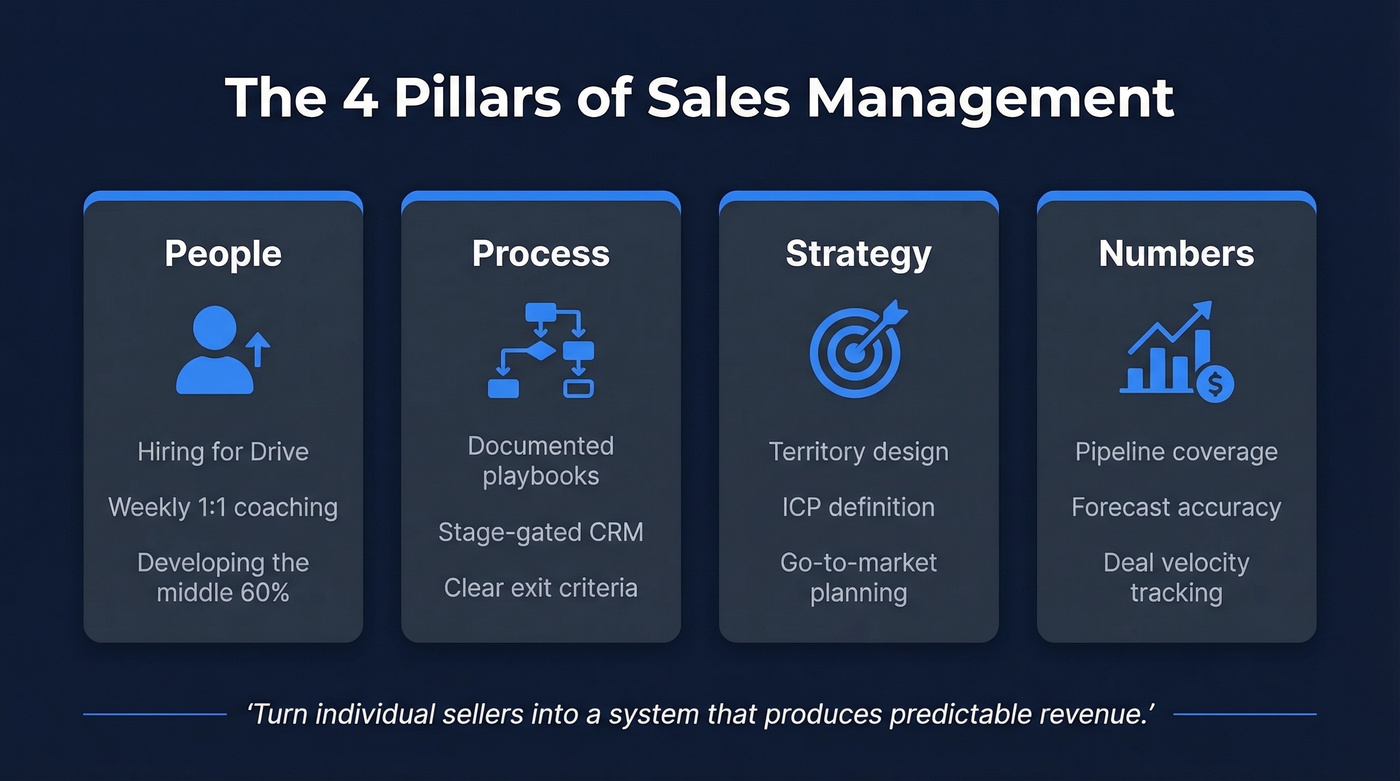
The mix shifts depending on context. B2B SaaS looks nothing like B2C retail. An enterprise team selling six-figure contracts needs different coaching, different metrics, and different hiring profiles than an SMB team running high-velocity demos. But the underlying job is the same everywhere: turn a group of individual sellers into a system that produces predictable revenue, quarter after quarter, regardless of who's on the roster.
Ali Newton-Temperley put it well: "The most successful sales managers are good at sales, but more than anything, they're good at people and processes." That's the whole game. If you're great at selling but terrible at developing others, management will eat you alive.
What You Need (Quick Version)
The 2026 sales manager's job boils down to three things:
- Coach reps, don't micromanage them. Weekly 1:1s focused on skill development, not activity policing. The best managers spend their time on the middle 60% of performers - that's where the biggest impact is.
- Build repeatable processes. If your top rep leaves and the playbook walks out the door with them, you don't have a process. You have a dependency.
- Keep your data clean so your pipeline isn't fiction. AI now handles forecasting better than gut instinct ever did, but only if the underlying data is accurate. Garbage in, garbage out - that hasn't changed.
If you only read one section of this guide, read the KPIs and benchmarks below. It's the part every other article on this topic skips.
The Sales Management Process
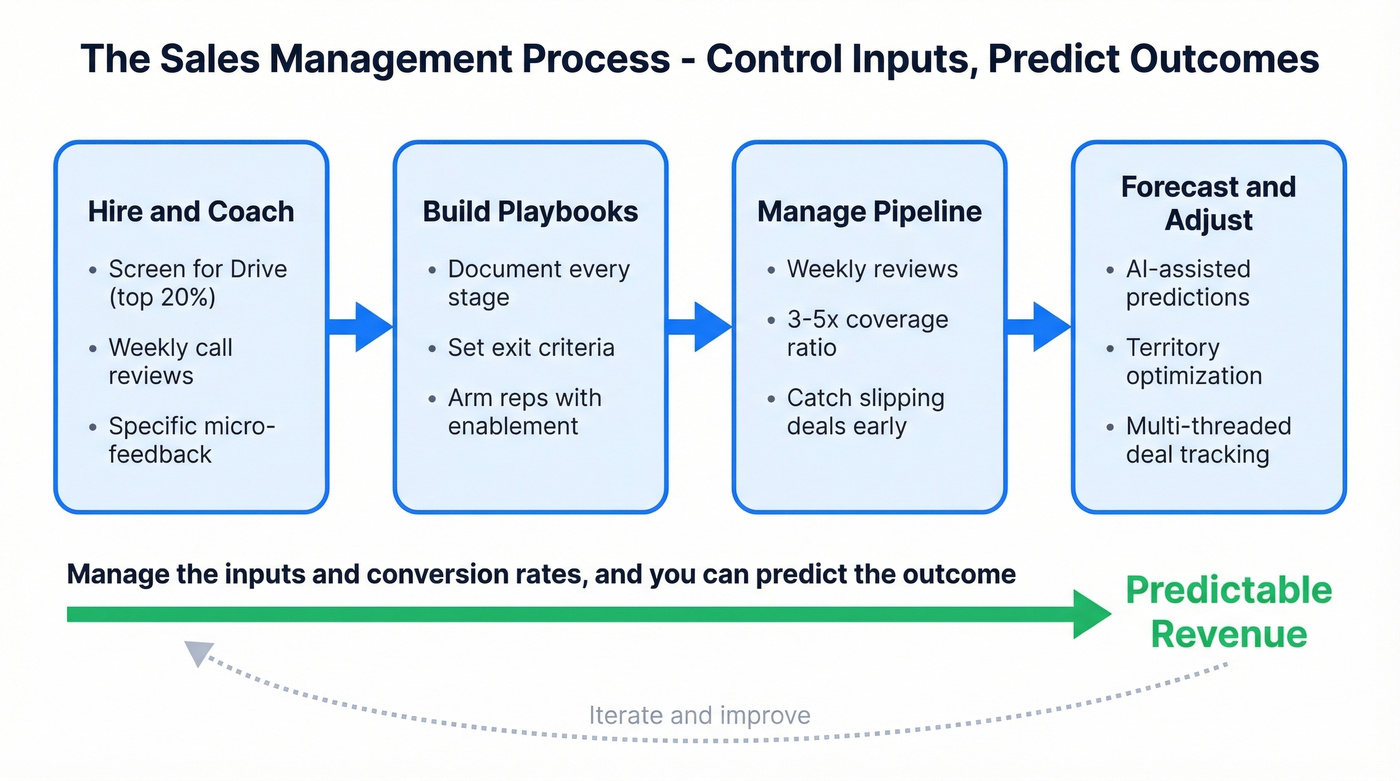
There's a quote from Cognism's sales leadership content that we keep coming back to: "If you manage the inputs and you know the conversion rate and average deal value, then you also will be able to predict what the outcome will be." That's the entire philosophy of the modern process in one sentence. Control the inputs. Measure the conversions. The output takes care of itself.
Hiring and Coaching
Hiring is the highest-leverage activity a sales manager does. Get it wrong and you're spending six months ramping someone who'll never close.
Only about 20% of the population scores high in "Drive" - the combination of achievement need, competitiveness, and optimism that separates quota-crushers from quota-missers. You can't coach Drive into someone past age 21-22. Screen for it early.
Once they're on the team, coaching is weekly. Listen to calls. Run role-plays. Give specific, actionable feedback - not "you need to be more consultative" but "on that discovery call, you asked about budget before you understood their pain. Flip the order next time." One micro-tip backed by Gong's research: successful SDRs use collaborative language - "we," "us," "our" - far more than "I" and "me." It's a small shift that signals partnership instead of pitch, and it's easy to coach.
Playbooks and Cadences
Your sales process should be documented, stage-gated, and enforced in your CRM. Every rep should know exactly what happens between "first meeting" and "closed-won" - what questions to ask, what materials to send, what approvals to get. Each stage needs clear exit criteria: specific conditions that must be met before a deal advances. Sales enablement - the function responsible for arming reps with the right content, training, and tools at the right time - has become a core strategic investment in 2026. We'll cover playbooks in detail below.
Pipeline and Forecasting
Pipeline reviews happen weekly. You're looking at coverage ratios (3-5x quota), deal velocity (how fast deals move through stages), and forecast accuracy. The goal is to catch slipping deals early, not to interrogate reps about why something didn't close.
Territory and Go-to-Market
Territory design, ICP definition, vertical focus, pricing strategy - this is where managing a sales org meets business strategy. 70% of reps report more complex sales processes than the prior year, driven by more stakeholders, stricter procurement, and higher risk aversion. Your go-to-market plan needs to account for longer cycles and multi-threaded deals.
KPIs and Benchmarks That Matter
Every guide tells you to "track your KPIs." Here are the actual numbers you should be benchmarking against.
| Metric | Benchmark | Context |
|---|---|---|
| Conversion rate | 2.46-3.26% | B2B average |
| Pipeline coverage | 3-5x quota | Per rep, per quarter |
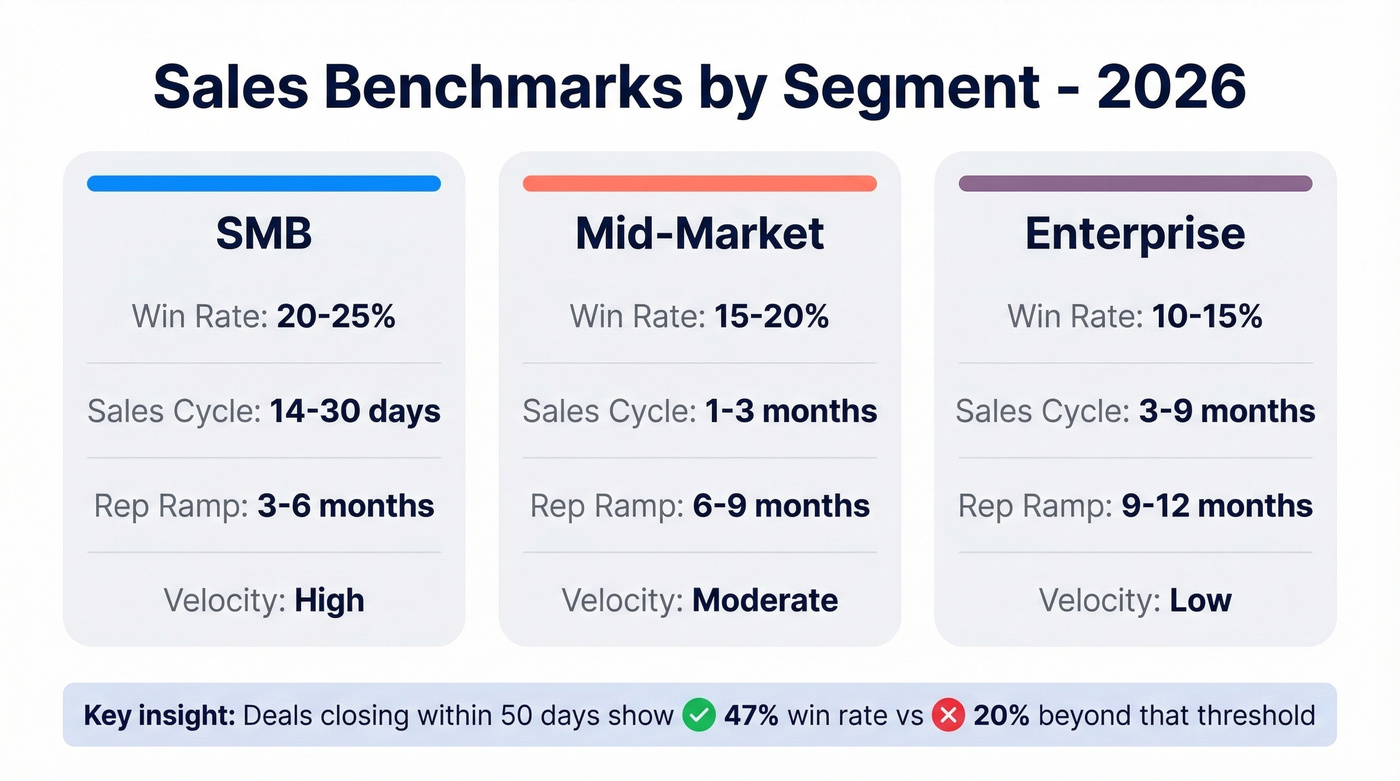
| Deal velocity | Close within 50 days | 47% win rate vs 20% beyond |
| Speed-to-lead | Under 5 minutes | Response time to inbound |
| Win rate (SMB) | ~20-25% | High-velocity deals |
| Win rate (mid-market) | ~15-20% | Moderate complexity |
| Win rate (enterprise) | ~10-15% | Long-cycle, multi-thread |
| Sales cycle (SMB) | 14-30 days | High-velocity |
| Sales cycle (mid-market) | 1-3 months | Moderate complexity |
| Sales cycle (enterprise) | 3-9 months | Multi-threaded |
| Rep ramp (SMB) | 3-6 months | To full productivity |
| Rep ramp (mid-market) | 6-9 months | To full productivity |
| Rep ramp (enterprise) | 9-12 months | To full productivity |
| Growth rate (established) | 5-7% | Baseline healthy |
| Growth rate (strong) | 15-20% | Strong execution |
| Growth rate (high-growth) | 25%+ | SaaS / venture-backed |
A few things worth calling out. 42% of sales leaders say ARR is their most important success metric - not pipeline coverage, not lead scoring, not activity metrics. The shift toward outcome metrics over activity metrics is real and accelerating. Fewer than 5% of leaders now prioritize pipeline coverage or sales linearity as their top metric.
Deal velocity matters more than most managers realize. Deals that close within 50 days show a 47% win rate. Push past that threshold and win rates drop to 20%. If a deal has been sitting in your pipeline for three months, it's probably not a deal - it's a hope.
The top deal-killers are surprisingly basic: 37% of lost deals die because there's no product fit, and 35% because of poor perceived value for money. Not competitor losses. Not pricing. Fit and value. If your reps aren't qualifying hard on those two dimensions in discovery, your pipeline is full of deals that were never going to close.
The good news? 91% of sales leaders report win rates are stable or improving, and 93% say average deal sizes are holding steady or growing. The market isn't getting worse - it's getting more selective. Teams that qualify well are winning more; teams that don't are losing faster.
That conversion rate benchmark of 2.46-3.26% is an average. Anything above 5% is strong. But context matters enormously - a team selling $500k enterprise contracts will have lower conversion rates and higher win values than a team running $5k self-serve deals. Compare yourself to your segment, not to a universal average.

You read it above: 42% of sales leaders say ARR is their most important metric. ARR comes from pipeline. Pipeline comes from reaching real buyers. Prospeo gives your team 300M+ profiles with 98% email accuracy and 125M+ verified mobiles - refreshed every 7 days, not every 6 weeks.
Stop managing a pipeline full of bounced emails and wrong numbers.
AI's Role in 2026
Look, AI in sales isn't coming. It's here, and the gap between teams using it and teams ignoring it is already measurable. 83% of sales teams using AI saw 1.3x revenue growth compared to teams that didn't. That's not a rounding error.
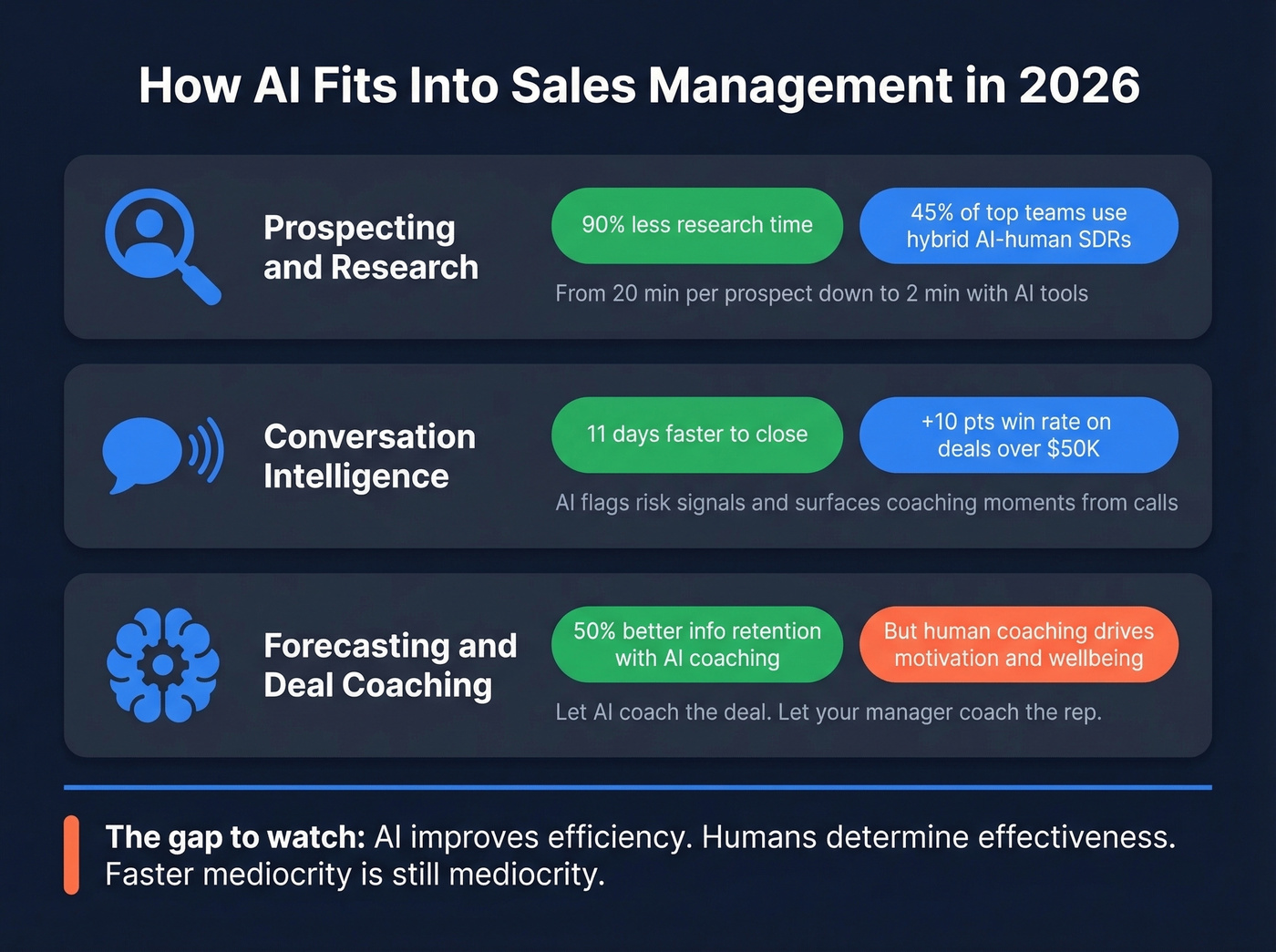
The practical applications break into three buckets.
Prospecting and research. Teams using AI-powered prospecting report up to a 90% reduction in research time. LivePerson saw research time drop from 20 minutes per prospect to 2 minutes after implementing AI tools. That's where a solid data layer matters - tools like Prospeo feed AI workflows with verified emails on a 7-day refresh cycle, so the AI isn't working with stale records. 45% of high-performing teams have adopted hybrid human-AI SDR models, and that number is climbing fast.
Conversation intelligence. Teams using conversation intelligence close deals 11 days faster on average, with a 10 percentage point improvement in win rates on deals over $50,000. The AI listens to calls, flags risk signals, and surfaces coaching moments. It's not replacing the manager - it's giving the manager better data to coach from.
Forecasting and deal coaching. A 2025 neuroscience study found that sellers who received AI coaching feedback remembered 50% more information after 48 hours than those who received human feedback. But sellers who expected human coaching experienced greater relaxation, motivation, and emotional wellbeing. Lauren Bailey, founder of Factor 8, nailed the distinction: "Let your AI coach the deal. Let your manager coach the rep."
Here's our hot take: about half of sales leaders say AI has improved efficiency or increased activity. A much smaller share say it's improved actual seller performance. That's the efficiency-vs-effectiveness gap, and it's the most important thing to understand about AI in sales right now. AI raises the floor by standardizing best practices. Humans determine outcomes. If your AI strategy is "automate everything," you'll get faster mediocrity. The winning strategy is using AI to free up time so managers can do more of what only humans can do: build trust, develop judgment, and coach through ambiguity.
One more trend worth watching: buyer-side AI agents are now screening vendors, evaluating proposals, and conducting preliminary due diligence before human decision-makers engage. Your outbound messaging isn't just being read by people anymore - it's being parsed by algorithms. Gartner predicts 80% of CSOs will require AI-augmented plans by 2030.
Building a Sales Playbook
42% of best-in-class companies use sales playbooks vs. just 14% of laggard firms. That stat alone should tell you everything.
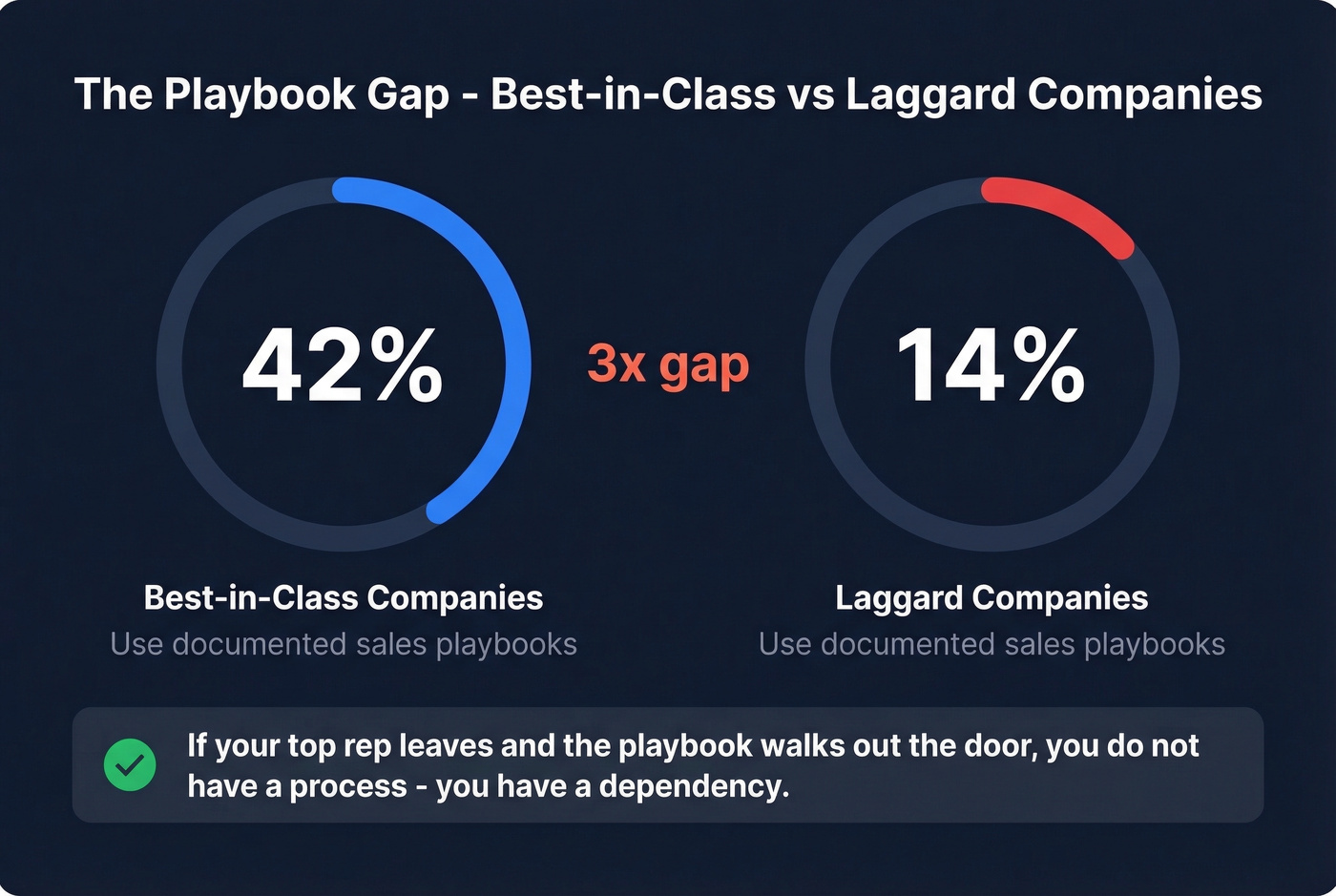
The core problem playbooks solve: success lives in people's heads instead of in a shared framework. When your best rep closes a complex enterprise deal, the lessons from that deal should be accessible to every other rep on the team. Without a playbook, those lessons evaporate.
There's an important distinction between static and dynamic playbooks. A static playbook is a PDF or Google Doc that gets updated quarterly if you're lucky. A dynamic playbook lives inside your CRM and surfaces contextual guidance based on deal stage, vertical, and persona - automatically. If you're still running a static playbook in 2026, you're sacrificing deal velocity for no good reason.
What goes in a strong playbook? Buyer personas with real objection patterns. Your sales process mapped to the buyer's buying process, not just your internal stages. Competitive intelligence updated monthly. Objection handling scripts that reflect actual objections, not the ones you wish prospects had. And plays - specific, repeatable sequences for common scenarios like "champion left the company" or "deal stalled after demo." Playbooks also cut ramp time by giving new reps a framework instead of forcing them to figure it out through trial and error.
Sales Team Management Tools
Sales reps spend just one-third of their day actually selling. The rest goes to searching for information, switching between tools, and manual data entry. That's an estimated $1 trillion in annual losses from missed leads, disorganized systems, and wasted time.
You don't need 10 tools. You need 3-4 that talk to each other.
| Tool | Best For | Starting Price | Key Strength |
|---|---|---|---|
| HubSpot Sales Hub | Most teams | Free / $15/user/mo | All-in-one CRM + sales tools |
| Prospeo | Data quality | Free / ~$0.01/email | 98% email accuracy, 7-day refresh |
| Pipedrive | Pipeline-focused | $14/user/mo | Visual pipeline management |
| Salesforce | Enterprise | $25/user/mo | Customization depth |
| Close | SMB / startup | $9/user/mo | Built-in calling |
| Zoho CRM | Budget teams | $14/user/mo | Value for features |
| Freshsales | Budget teams | $9/user/mo | AI lead scoring |
HubSpot Sales Hub is the obvious starting point for most teams under 50 reps. The free tier is genuinely useful - not a crippled demo - and Starter begins at $15/user/mo. The ecosystem is massive, the learning curve is gentle, and it plays nicely with almost everything.
Pipedrive is for teams that live and die by pipeline visibility. The visual deal board is the best in the category. Pricing runs $14-$99/user/mo across four tiers. Skip it if you need heavy reporting or marketing automation - that's not its strength.
Salesforce Sales Cloud starts at $25/user/mo, and enterprise deployments often land far higher once you add the modules and admin support you actually need. It's the right choice for complex organizations with dedicated admins. It's the wrong choice for a 10-person startup that just needs to track deals.
Close starts at $9/user/mo and includes built-in calling - solid for SMB teams that want everything in one place. Zoho CRM and Freshsales are both strong budget options starting at $14 and $9/user/mo respectively, with surprisingly capable feature sets.
Common Mistakes That Kill Performance
We've seen these patterns destroy team performance repeatedly. Here are the seven that come up most often.
1. Defaulting to micromanagement instead of coaching. The #1 complaint about sales managers on r/sales? "All they did was attend meetings and poorly micromanage." There's a massive difference between reviewing pipeline to coach and reviewing pipeline to interrogate. If your reps dread 1:1s, you're doing it wrong.
2. Hiring for "culture fit" instead of Drive. Only about 20% of the population is high in Drive - the combination of achievement need, competitiveness, and optimism that predicts sales success. Drive can't be taught. Hiring for "culture fit" is how you build a mediocre team that gets along great and misses quota together.
3. Spending disproportionate time on bottom performers. Most managers instinctively pour coaching hours into their worst reps. The math doesn't support this. Your middle 60% is where coaching has the highest ROI - moving a B-player to a B+ has more pipeline impact than moving a D to a C.
4. Ignoring data quality as a management problem. When reps spend a third of their day searching for information instead of selling, that's not a rep problem - it's a systems problem. Bad data compounds. Stale contacts lead to bounced emails, which tank domain reputation, which kills deliverability for the whole team. Data hygiene is a leadership responsibility.
5. Trusting gut over structured hiring. Drive is easy to fake in a 45-minute interview. Candidates who are great presenters often get hired over candidates who are great closers. Implement structured assessments. Gut-based hiring produces inconsistent results - the research is clear on this.
6. Assuming money is every rep's top motivator. External financial pressure is temporary motivation. Some reps are driven by competition. Some by recognition. Some by mastery. If your only lever is comp, you'll lose your best people to organizations that understand what actually drives them.
7. Resisting AI adoption. Only 52% of CEOs believe in their own growth plans. The ones who nail their go-to-market strategy are 2x more likely to hit revenue targets. In 2026, go-to-market strategy includes AI. Managers who resist it aren't being cautious - they're falling behind.
Navigating the IC-to-Manager Transition
Let's be honest: being a good seller doesn't make you a good manager. The skills that got you here - closing, negotiating, handling objections - are table stakes. The skills you need now - developing people, building systems, managing up, forecasting accurately - are completely different.
The day-to-day reality catches most new managers off guard. One Reddit thread captured it perfectly: an enterprise sales veteran questioning whether management is "really as much Excel, forecasting, and internal reporting as people say." The honest answer? Yes, partly. But the good managers find the coaching moments inside the spreadsheets.
Here's a problem nobody warns you about: frontline roles ask you to do more coaching than ever, but most new managers receive no formal training on how to coach. You're expected to develop eight people while learning the job yourself, often without a playbook for the manager role. Hybrid work makes this worse - sellers can't observe and learn from each other the way they could when everyone sat in the same bullpen. You have to create those learning moments deliberately now. Ride-alongs on Zoom calls. Shared call libraries. Peer coaching sessions. None of it happens by accident anymore.
The fear is real too. A new manager in r/sales wrote: "If I make one wrong move, it's going to send the team into a death spiral." That anxiety is normal. It's also mostly unfounded - teams are more resilient than you think, as long as you're transparent about what you're doing and why.
Here's a starting cadence that works: weekly 1:1s with every rep (30 minutes, focused on deals and development, not status updates). Monthly pipeline reviews with the full team. Monthly team meetings to share wins and best practices. Quarterly training sessions on specific skills. That's it. Don't overcomplicate it.
The book recommendation that comes up in every sales management thread on Reddit is "Sales Management Simplified" by Mike Weinberg. Read it before your first week. It won't make the transition painless, but it'll give you a framework when everything feels chaotic.
One last thing: management is lonely. You can't vent to your team. You can't always vent to your boss. Find a peer group - other first-line managers, a Slack community, a mentor. The emotional weight of the role is the part nobody warns you about.
Rep ramp time is 3-9 months depending on your segment. GreyScout cut theirs from 8-10 weeks to 4 by giving reps data that actually connects. With 30+ filters for intent, technographics, and headcount growth, your new hires prospect like veterans from week one.
Give every rep on your team enterprise-grade data at $0.01 per email.
FAQ
What does a sales manager do day-to-day?
A sales manager splits time between coaching 1:1s, pipeline reviews, forecasting updates, hiring activities, and cross-functional alignment with marketing and CS. The best managers spend the majority of their time developing reps and unblocking deals, compressing admin work into focused blocks. Prioritize people development over spreadsheet management.
What's a good B2B conversion rate?
The average B2B conversion rate runs 2.46-3.26%, and anything above 5% is strong. Enterprise teams closing $200k+ deals will convert at lower rates than SMB teams running high-velocity demos. Benchmark against your segment, not a universal average.
How long should it take to ramp a new rep?
SMB reps typically ramp in 3-6 months, mid-market in 6-9 months, and enterprise in 9-12 months. Teams with documented playbooks cut these timelines significantly. Track ramp via time-to-first-meeting, first-opportunity, and first-closed-deal milestones.
How does AI change sales management in 2026?
AI handles prospecting research, lead scoring, conversation analysis, and forecast modeling - freeing managers to focus on coaching reps rather than coaching deals. Gartner predicts 80% of CSOs will require AI-augmented plans by 2030. AI raises the floor on rep performance, but human coaching still determines the ceiling.
How do I fix bad data in my pipeline?
Start with a verified data source that refreshes weekly - a 7-day cycle catches job changes and bounces that monthly-refresh tools miss. Layer in CRM hygiene rules: deduplicate monthly, flag contacts that bounce, and enrich records automatically. Clean data means reps sell instead of researching dead leads.