

The Sales Negotiation Playbook: Scripts, Frameworks, and Tactics That Protect Your Margin
It's Thursday afternoon. Procurement sends a "quick call" invite for 4:30 PM. You've spent six weeks building a business case with the VP of Operations, and now someone you've never met opens with "We need your best and final offer by end of day." Your champion goes quiet. Your six-week deal is suddenly a 30-minute sales negotiation - and you're not ready.
Buyers receive discounts 88% of the time. Not because sellers are bad at their jobs, but because most walk into negotiations without a system. The negotiation doesn't start when procurement sends the calendar invite - it starts the moment you quote a number or discuss scope. Preparation beats talent every time.
If you only take three things from this article:
- Anchor first - the first number shapes the entire deal.
- Trade every concession - never give without getting.
- Verify you're negotiating with the actual decision-maker before you concede anything.
Below: the scripts, the prep template, and the buyer-tactic counters that make these three rules work.
The Psychology Behind Every Deal
Sales negotiation is behavioral science in action. Three principles change how you approach every conversation at the table.
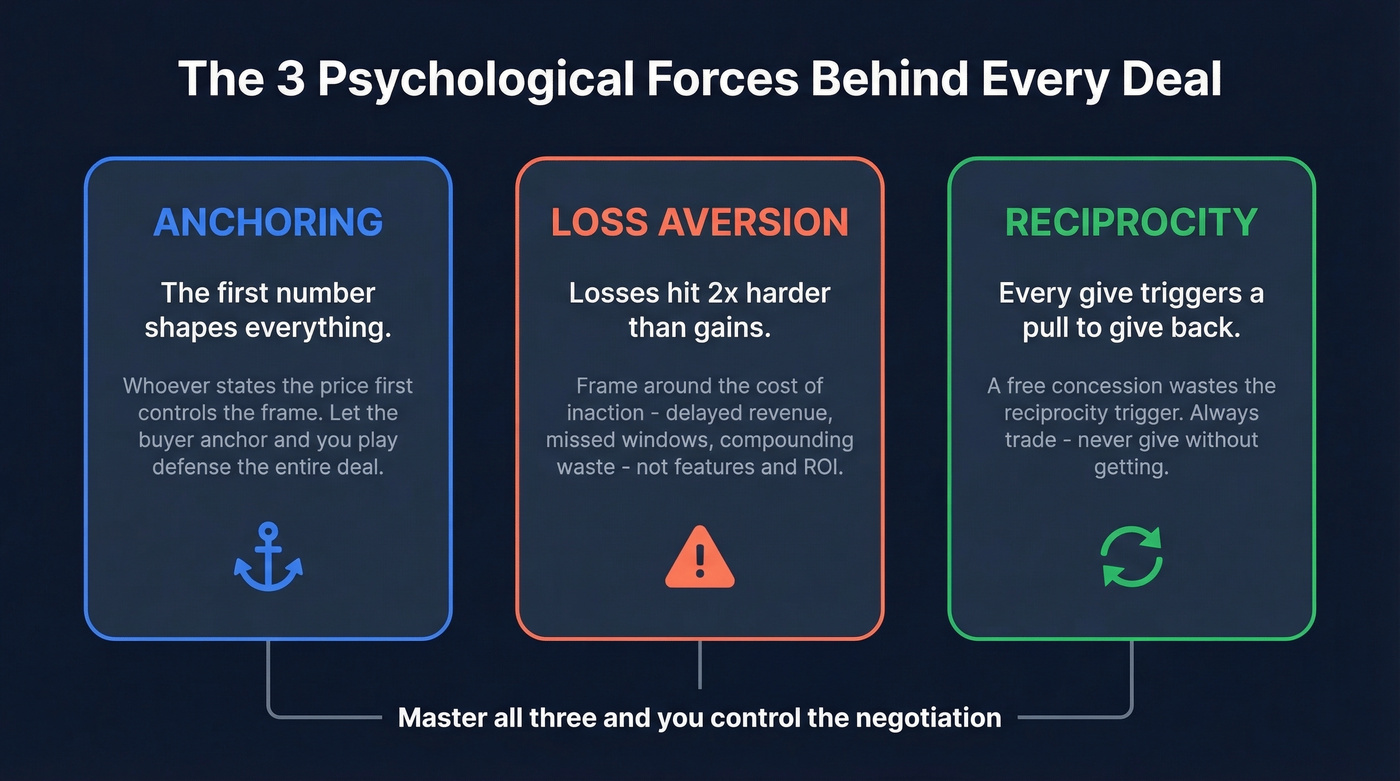
Anchoring is one of the most powerful forces in any negotiation. The first number shapes everything that follows. When you let the buyer anchor first, you're playing defense for the rest of the conversation - and defense doesn't protect margin.
Loss aversion, the foundational insight from Kahneman and Tversky's prospect theory, explains why "what you'll lose without this" is more persuasive than "what you'll gain with this." Humans feel losses roughly twice as intensely as equivalent gains. Frame your price around the cost of inaction - delayed revenue, missed market windows, compounding inefficiency - not features and ROI.
Reciprocity is Cialdini's principle at work in every concession exchange. When you give something, the other party feels a psychological pull to give something back. A free concession doesn't just cost you margin. It wastes the reciprocity trigger that could've earned you something in return.
There's also a neurological dimension worth understanding. The FBI's Crisis Negotiation Unit developed the Behavioral Change Stairway: Active Listening, then Empathy, then Rapport, then Influence, then Behavioral Change. You can't skip steps. Sellers who jump straight to "influence" - pitching, persuading, closing - without building rapport first trigger the brain's risk-avoidance center. Collaborative framing activates the reward center instead. People concede more when they feel heard.
9 Strategies That Protect Your Margin
Most guides give you 10+ strategies. That's the problem. You need a prep checklist, three scripts you've practiced, and the discipline to shut up after you state your price. Here are nine strategies ranked by impact - master the first five and you'll outperform most sellers.
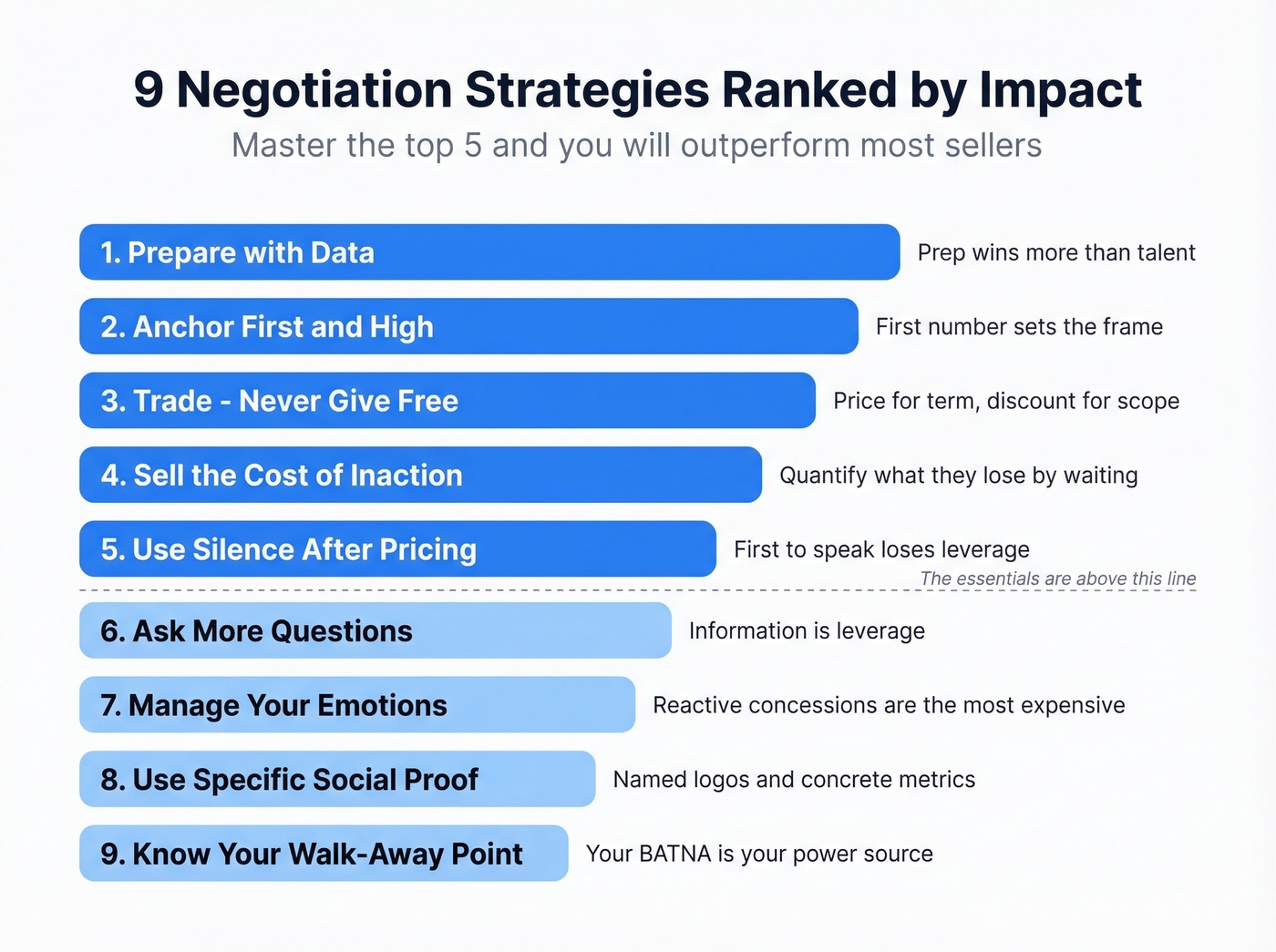
1. Prepare with Data, Not Instinct
Experienced negotiators consistently attribute the vast majority of their success to preparation, not in-the-moment tactics. The negotiation is won or lost before the call starts. Know the deal size, the stakeholders, the buyer's alternatives, and your own walk-away point. The full prep checklist is below - use it before every deal over $10k.
2. Anchor First and Anchor High
The first number on the table sets the anchor point of the entire conversation. Letting the buyer go first is one of the most expensive mistakes you can make. State your price confidently, tie it to a clear rationale, and let the number sit. Don't apologize for it. Don't explain it to death.
3. Trade - Never Concede for Free
Every concession should buy something. This is the single most violated rule in B2B sales, and we've watched it happen on hundreds of recorded calls. When a buyer asks for 15% off, don't say "let me see what I can do." Say "If we can move to annual billing and a two-year term, I can look at adjusting the price." Price for term length, discount for expanded scope, payment terms for a case study commitment.
4. Sell the Cost of Inaction, Not the Discount
Loss aversion is your friend. Instead of defending your price, quantify what the buyer loses by doing nothing. "Every month you delay, your team spends 40 hours on manual processes that this platform eliminates. That's $12,000/month in fully loaded labor costs - before we talk about the deals you're missing." This reframes the conversation from "is your product worth $X?" to "can we afford to keep losing $Y?"
5. Use Silence After Stating Your Price
The first person who speaks after a price is stated loses leverage. State your number. Tie it to value. Stop talking.
The silence feels uncomfortable - that's the point. Buyers will often fill it by negotiating against themselves, offering a counter higher than what they'd planned. We've seen reps lose thousands of dollars in margin because they couldn't tolerate five seconds of quiet.
6. Ask More Questions Than You Answer
Negotiators who gather more information consistently close larger deals. Questions like "What would need to be true for you to move forward this quarter?" give you leverage that no amount of pitching can match. People value offers they help construct more than offers they simply receive - getting the buyer to propose terms often leads to deals they're more committed to.
7. Manage Your Emotions Before They Manage You
Reactive concessions are the most expensive kind. When a buyer gets aggressive, your instinct is to de-escalate by giving something away. Resist it. Janice Nadler's research found that even five minutes of rapport-building before a negotiation made counterparts more cooperative and more willing to share information. Invest in the relationship early so you have emotional reserves when the pressure comes.
8. Use Specific Social Proof at the Table
When a buyer pushes back on price, abstract ROI claims don't move the needle. Specific proof does. "Three companies in your space implemented this last quarter and saw a 30% reduction in cycle time within 60 days." Named customers, concrete metrics, and relevant case studies are your best ammunition. Bring them to every call.
9. Know Your Walk-Away Point - and Mean It
Your BATNA (Best Alternative to a Negotiated Agreement) is your power source. If you don't have a clear walk-away point, you'll concede under pressure every time. But your BATNA is only useful if you translate it to comparable terms. A "cheaper alternative" that doesn't cover the same scope isn't a real alternative. Define your BATNA honestly, and be willing to use it.
Scripts for the 5 Toughest Moments
Discounting is a skill problem, not a market problem. Practice these out loud - reading them once isn't enough.
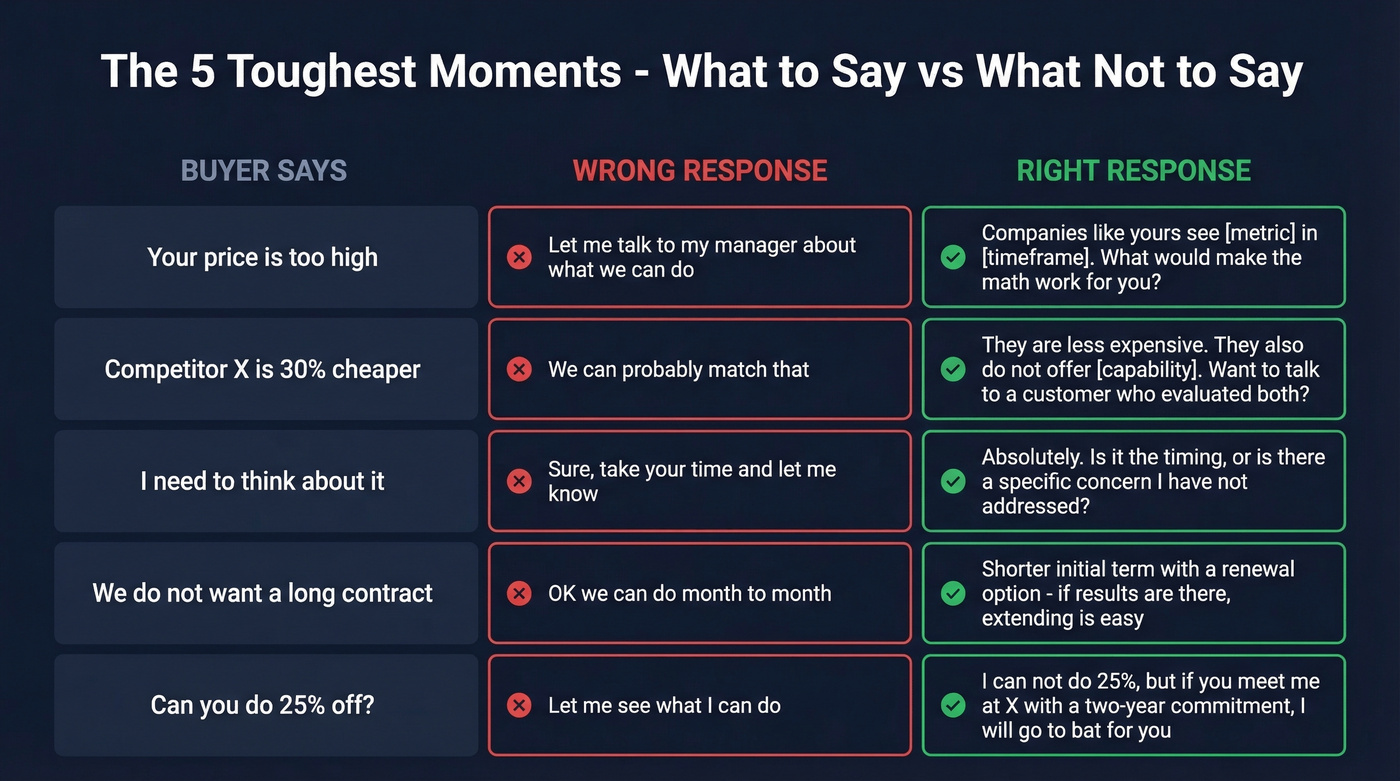
"Your Price Is Too High"
What NOT to say: "I understand - let me talk to my manager about what we can do." This signals your list price is negotiable and hands over all leverage.
Say this instead: "I hear you. Companies similar to yours see [specific metric] within [timeframe]. If we hit even half of that, the investment pays for itself in [X months]. What would make the math work for you?"
"Competitor X Is Cheaper"
Buyer: "We're also looking at [Competitor], and they're 30% less."
You: "They are less expensive. They also don't offer [specific capability]. Our customers who evaluated both - including [named logo] - chose us because [specific outcome]. Want me to connect you with their team?"
Feature gaps and social proof together are more powerful than either alone.
"I Need to Think About It"
This is rarely the actual objection. One line handles it: "Absolutely. Is it the timing, or is there a specific concern I haven't addressed?" Then wait. The real blocker surfaces in the silence.
"We Don't Want a Long Contract"
You: "That's fair. We can look at a shorter initial term with a renewal option - if the results are there, extending becomes an easy decision."
Flexibility on terms is one of the cheapest concessions you can make. It often unlocks deals that would otherwise stall.
"Can You Do 25% Off?"
Here's the thing: a "meet me halfway" framing is a realistic baseline when you can discount, because it signals willingness while anchoring the counter higher than the buyer's ask.
You: "I can't do 25%, but I want to make this work. If you can meet me at [X] - say, a two-year commitment with quarterly billing - I'll go to bat for you internally."
Always trade the discount for something concrete.
The Negotiation Prep Checklist
If your negotiations feel inconsistent, it's a preparation structure problem. Fill this out before every deal worth negotiating. Start with the BATNA section - it's the one most reps skip, and it's the one that matters most when procurement applies pressure.
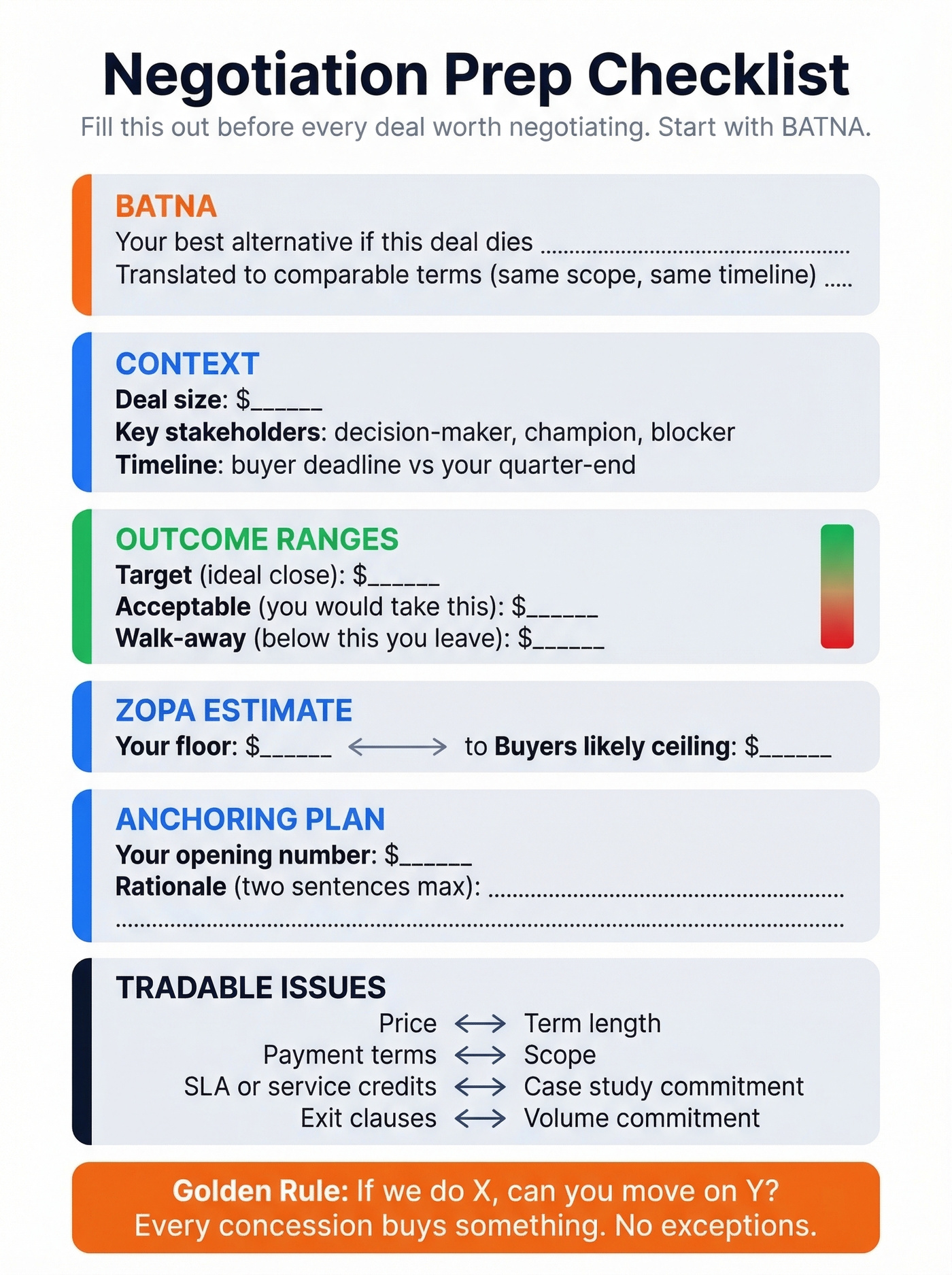
BATNA
- Your best alternative if this deal dies: ______
- Translated to comparable terms (same scope, same timeline): ______
Context
- Deal size: $______
- Key stakeholders: ______ (decision-maker, champion, blocker)
- Timeline: buyer's deadline vs. your quarter-end
Outcome Ranges
- Target outcome: $______ (your ideal close)
- Acceptable outcome: $______ (you'd take this and feel fine)
- Walk-away point: $______ (below this, you leave)
ZOPA Estimate
- Your floor: $______ → Buyer's likely ceiling: $______
Anchoring Plan
- Your opening number: $______
- Rationale (keep it to two sentences): ______
Tradable Issues
- Price ↔ Term length
- Payment terms ↔ Scope
- SLA/service credits ↔ Case study commitment
- Exit clauses ↔ Volume commitment
Concession Rules
- "If we do X, can you move on Y?"
- Every concession buys something. No exceptions.
Before filling this out, verify you have the direct email and mobile for the actual decision-maker. Prospeo gives you 98% verified emails and direct dials across 300M+ professional profiles - refreshed every 7 days - so your prep doesn't go to waste on a champion who can't sign.

Strategy #3 says verify you're negotiating with the actual decision-maker before you concede anything. Prospeo gives you direct emails and mobile numbers for 300M+ professionals - so you skip procurement gatekeepers and reach the person who signs the deal. 98% email accuracy. 125M+ verified mobiles.
Stop negotiating with the wrong person. Find the real decision-maker first.
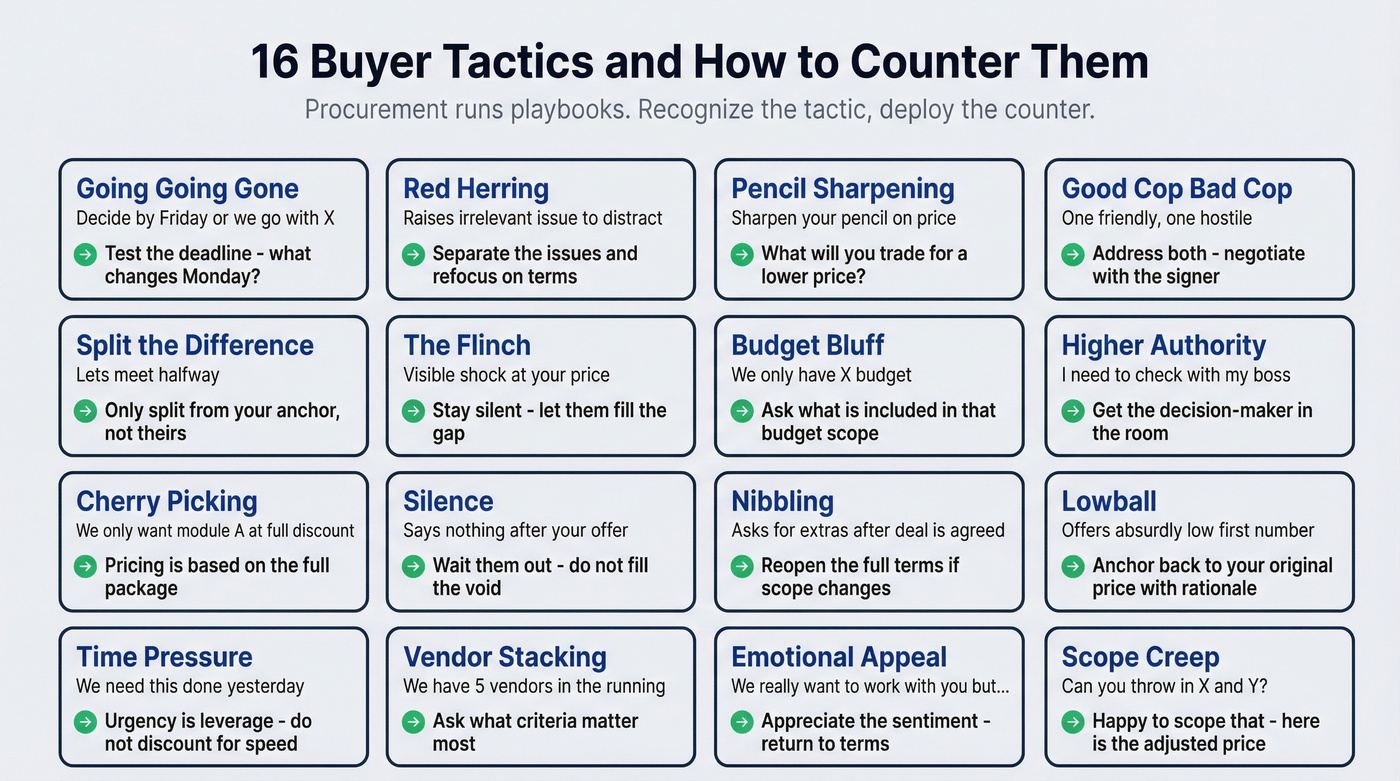
16 Buyer Tactics and How to Counter Them
Procurement teams don't improvise. They run playbooks - and if you don't recognize the tactics, you'll concede without realizing it. Here are the 16 most common buyer tactics and how to counter each one.
| Tactic | What It Looks Like | Your Counter |
|---|---|---|
| Going, Going, Gone | "Decide by Friday or we go with X" | Test the deadline. What changes Monday? |
| Red Herring | Raises irrelevant issue to distract | Separate the issues. Refocus on terms. |
| Pencil Sharpening | "Sharpen your pencil on price" | "What will you trade for a lower price?" |
| Good Cop / Bad Cop | One friendly, one hostile | Address both. Negotiate with the signer. |
| Split the Difference | "Let's meet in the middle" | Only if the middle favors you. Trade instead. |
| One Last Thing | Adds a demand after agreement | Reopen the full deal. Nothing is free. |
| Cherry Picking | Takes best terms from multiple vendors | Bundle your offer. Don't let them unbundle. |
| "We're Done" | Threatens to walk away | Let them. If your BATNA is solid, call it. |
| Anchoring | Opens with an absurdly low number | Re-anchor with your rationale. Don't react. |
| Temper Tantrum | Gets emotional or aggressive | "I see this matters. Let's focus on terms." |
| Outlast | Delays to wear you down | Set your own deadlines. Don't chase. |
| Selective Memory | "I thought we agreed to X" | Document everything. Confirm in writing. |
| Closing Window | "Budget expires end of month" | Verify independently. Often manufactured. |
| Whack Back | Rejects every proposal aggressively | "What would you propose instead?" |
| Theater of the Absurd | Makes outrageous demands | Don't engage. Restate your position calmly. |
| Sticker Shock | Acts shocked at your price | Silence. Then walk through the value. |
The counter-principle that runs through all 16: trade, don't cave. Keep your BATNA in mind, deal with issues separately, and be willing to walk.
What Procurement Trades Besides Price
Procurement has more levers than price. Understanding what they can trade gives you room to negotiate without touching your rate card.
Financial: Volume and multi-year commitments, payment terms and early-pay discounts, indexation clauses, penalties and incentives.
Operational: Additional services and SLAs, substitution or spec optimization, process digitalization.
Strategic: Pooling across subsidiaries, joint innovation commitments, sustainability and CSR requirements.
When a buyer says "we need a better price," they often mean "we need to show our CFO we negotiated hard." Giving them a win on payment terms or SLA credits satisfies that need without cutting your margin.
7 Negotiation Mistakes That Kill Deals
Discounting Too Early
Offering a discount before the buyer asks signals your product isn't worth list price. It also sets a new anchor - every future conversation starts from the discounted number. Hold your price through discovery and demo. If you need to discount, do it late and trade for something.
Talking After Stating Your Price
State your price, tie it to value, and stop. Reps who fill the silence with "but we can be flexible" or "I know that's a lot" undercut themselves before the buyer even responds.
Negotiating with the Wrong Person
If you're negotiating with someone who can't sign, you've already lost. Every concession you make to a champion gets passed up to the economic buyer - who then asks for more. Verify the economic buyer's direct contact before you start negotiating. Skip this step and you'll negotiate the same deal twice.
Letting Emotions Drive Concessions
When a buyer gets aggressive, your instinct is to de-escalate by giving something away. That's a reactive concession, and it's the most expensive kind. Pause. Acknowledge the emotion. Redirect to the substance.
Failing to Document Terms
The "selective memory" tactic exploits verbal agreements. Send a summary email after every negotiation conversation. Every time. No exceptions.
Over-Negotiating
Winning every point is a pyrrhic victory. The buyer signs resentfully, implementation starts on a sour note, and renewal becomes a battle. Leave something on the table intentionally - the relationship matters more than the last $500.
Bluffing with a Fake BATNA
A BATNA that looks strong on the surface but doesn't hold up under scrutiny will collapse when tested. If your "alternative" doesn't cover the same scope or timeline, it's not a real alternative. Translate your BATNA to comparable terms before you lean on it.
Tools That Give You an Edge
CRM
Salesforce (Sales Cloud starts around ~$25/user/month) or HubSpot (free CRM; Sales Hub starts around ~$20-$25/user/month). What matters for negotiation isn't the CRM itself but how you use it: log every concession, track what the buyer has already agreed to, and maintain deal context so you're never starting from scratch. If your team isn't logging concession history, no CRM will save you.
Conversation Intelligence
Gong or Chorus (often ~$100-$200+/user/month on enterprise plans) let you review past negotiation calls for patterns. Where did you concede? Where did the buyer push hardest? What language preceded a successful close? In our experience, the patterns in your own calls are more valuable than any negotiation book.
Contact Verification
Your prep checklist is useless if you're working with bad data. Prospeo covers 300M+ professional profiles with 98% email accuracy and a 30% mobile pickup rate - refreshed every 7 days. The free tier gives you 75 emails plus 100 Chrome extension credits per month, enough to prep for every deal in your pipeline. Native integrations with Salesforce, HubSpot, Instantly, Lemlist, Smartlead, Clay, Zapier, and Make mean verified data flows straight into your workflow.
CPQ
DealHub or Salesforce CPQ (~$50-$150+/user/month depending on edition) standardize your pricing and discount guardrails. When reps can't offer more than 10% without manager approval, you eliminate the "I'll see what I can do" reflex that bleeds margin.
Preparation beats talent - and the best prep starts with knowing exactly who's in the deal. Prospeo's 30+ filters surface buyer intent, org charts, and verified contact data so you walk into every negotiation with leverage, not guesswork. At $0.01 per email, bad data is no longer an excuse.
Win the negotiation before it starts - with data your buyer can't argue with.
The Business Case for Negotiation Training
The negotiation training market hit $2B in 2025 and is growing at 7% CAGR toward ~$3.5B by 2033. Companies are investing because the returns are hard to argue with.
RED BEAR Negotiation reports an average return of $54 for every $1 invested. Accenture pegs general sales training ROI at 353% - roughly $4.53 back for every dollar spent. The speed payoff is real too: deals closed within 50 days show a 47% win rate versus 20% or lower after that threshold. Better negotiation skills compress cycles.
Here's the uncomfortable context: win rates are trending down. The largest bracket in recent data was 21-25%, down from 31-40% the year prior. When win rates shrink, negotiation skill becomes the margin difference between a good quarter and a bad one.
Let's be honest - formal training runs $1,500-3,000 per seat, and most of it is worth the money. But if your team won't do the pre-call prep, no amount of training fixes the problem. This article, a prep checklist your team actually fills out, and verified decision-maker data will outperform a $50k training engagement that nobody applies. The ROI math works at every budget level, but only if the reps do the work.
FAQ
What's the most important sales negotiation skill?
Preparation. Define your BATNA, anchoring plan, and tradable issues before the call - it takes 15 minutes and accounts for the majority of outcomes. The prep checklist above covers every element you need.
How do you negotiate price without discounting?
Trade instead of concede: offer longer terms, expanded scope, or faster payment in exchange for holding price. Buyers often accept non-price concessions because they still get to show their CFO they negotiated hard.
What's BATNA and why does it matter?
BATNA stands for Best Alternative to a Negotiated Agreement - what you'll do if this deal falls through. It sets your walk-away point and prevents panic concessions. Translate it to comparable terms (same scope, same timeline) or it won't hold under pressure.
How do you find the right person to negotiate with?
Use a B2B data platform like Prospeo to verify the economic buyer's direct email and mobile before engaging. Negotiating with a champion who can't sign means every concession gets passed up - and the actual signer asks for more.
Is negotiation training worth the investment in 2026?
RED BEAR reports $54 return per $1 invested, and deals close faster when reps negotiate with discipline. Even free resources - like this playbook paired with consistent pre-call prep - produce measurable margin improvements.