

Sales Negotiation Training: The 2026 Buyer's Guide Your Vendor Won't Write
A rep gives away 15% on a $200K deal because the buyer said "we're looking at two other vendors." That's $30,000 gone - not because the product wasn't worth it, but because nobody taught the rep how to hold the line. Multiply that kind of discounting across a 20-person team running 50 deals a quarter, and you're hemorrhaging margin at a pace that makes your CFO's eye twitch. Sales negotiation training exists to fix this, but the market's full of vendors selling $3K/seat programs with vague ROI promises and zero post-training accountability.
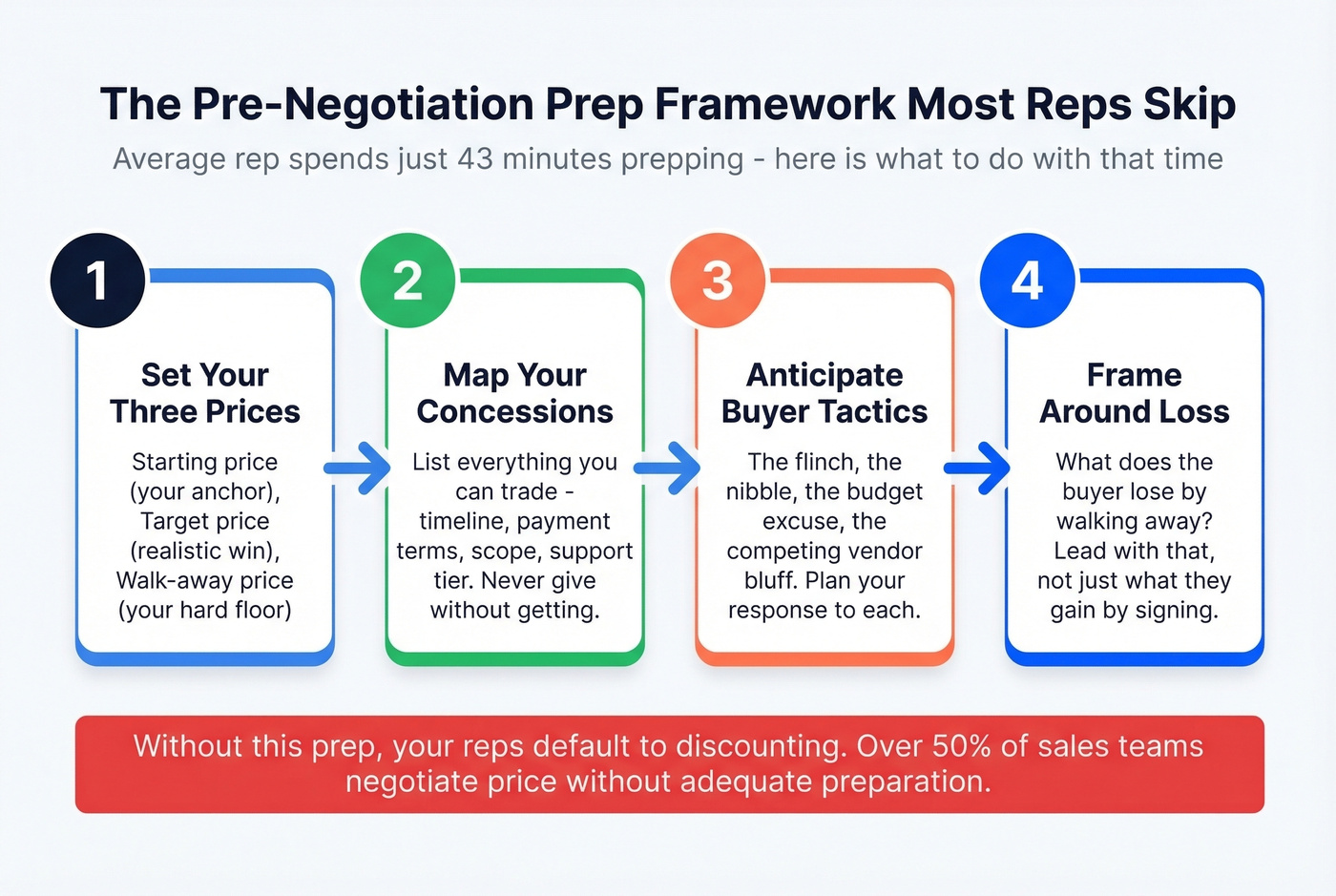
Over 50% of sales teams negotiate price without adequate preparation, and the average rep spends just 43 minutes prepping for a negotiation. That's less time than most people spend choosing a restaurant.
Our Top Picks
- Best for measurable outcomes: Negotiation Experts - $1,732-$2,552/seat, simulation scoring, scored post-assessment at 3 months
- Best methodology-driven program: Sandler Negotiating Mastery - 4.8/5 on G2 across 105 reviews, repeatable framework that sticks
- Best for individual contributors on a budget: AMA Strategic Sales Negotiations - $2,345-$2,645/seat, CEU credits, fully transparent pricing
Here's the thing: the vendor you pick matters less than what happens the week after training ends. Teams that build negotiation practice into weekly pipeline reviews see dramatically better retention than those who treat a $3K workshop as a one-and-done event. If your enablement plan doesn't include post-training reinforcement, save your money.
Why Negotiation Training Pays for Itself
The negotiation training market hit roughly $2 billion in 2025 and is projected to reach ~$3.5 billion by 2033 at about 7% CAGR. Companies aren't spending that kind of money on feel-good workshops. The math works.
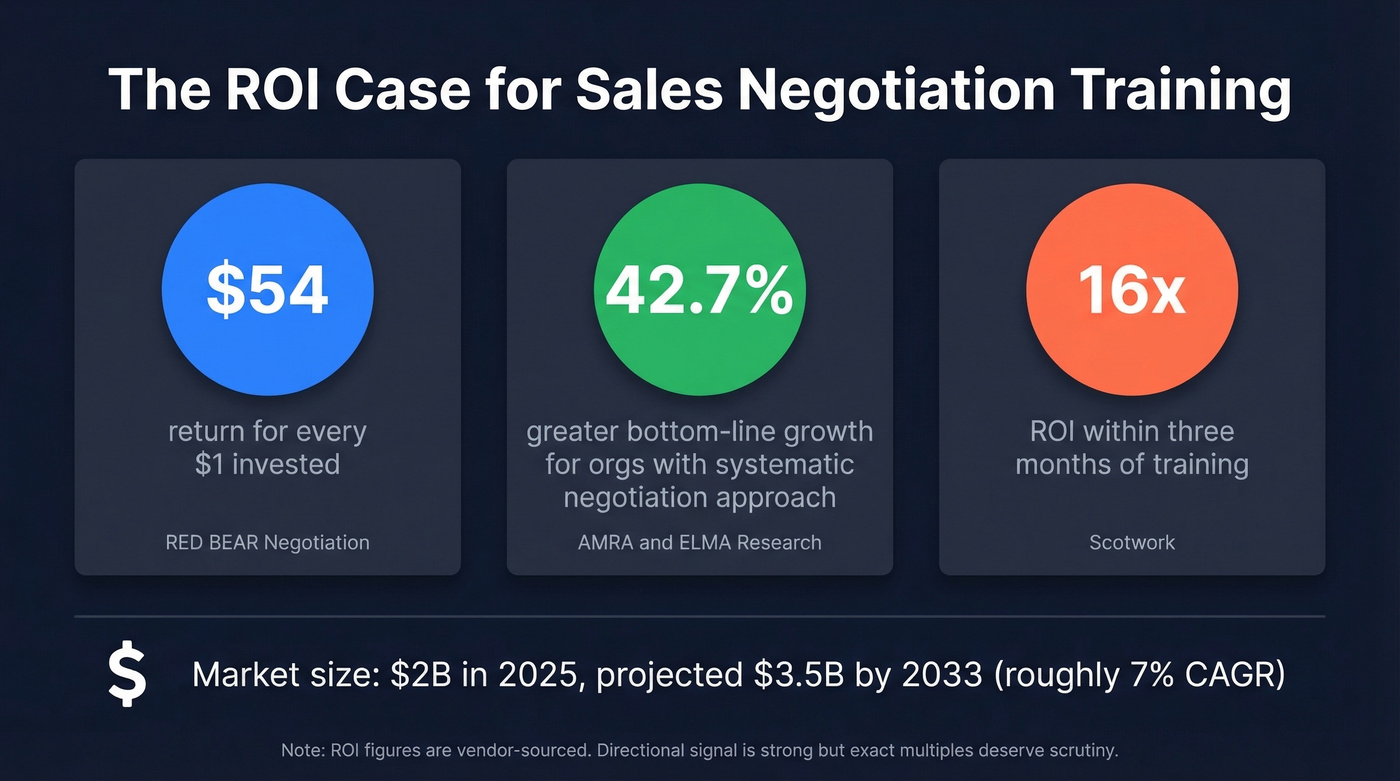
RED BEAR Negotiation reports $54 in return for every $1 invested in their programs. Scotwork claims 16x ROI within three months. Organizations with a systematic negotiation approach see 42.7% greater bottom-line growth than those winging it.
These are vendor-sourced numbers, so the exact multiples deserve scrutiny. But the directional signal is overwhelming - even a conservative read says this is one of the highest-ROI investments a revenue team can make. APQC's benchmark data reinforces this from the procurement side: a 1% reduction in direct-material costs correlates with a 0.8% EBITDA margin gain. The same principle applies in reverse. Every unnecessary discount your reps give away erodes margin at a compounding rate.
The ROI isn't automatic, though. It depends entirely on whether reps actually change behavior after the workshop ends.
What Good Programs Teach
The best negotiation courses share a common curriculum backbone, even if they package it differently. Here's what separates real training from motivational fluff.
Anchoring and First-Offer Strategy
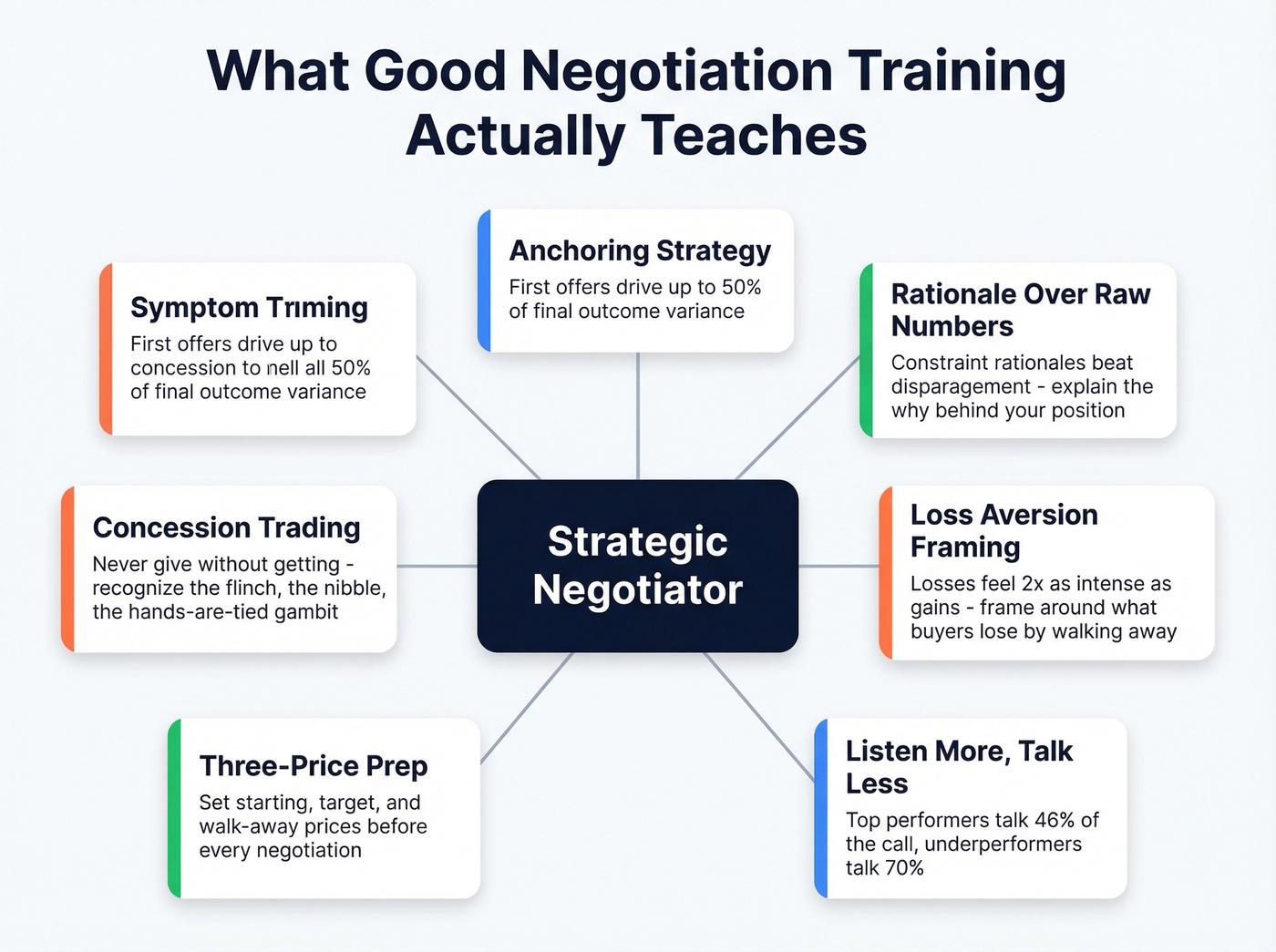
The initial offer can account for up to 50% of the variance in final negotiation outcomes. Good programs teach reps when to anchor first and how to set that anchor credibly - not just "go high." (If you want to go deeper on the mechanics, start with anchoring.)
Rationale Over Raw Numbers
Picture this: a buyer pushes back on price, and your rep says "that's not reasonable." Game over. A Columbia study by Alice J. Lee and Daniel R. Ames found that buyers using constraint rationales - "we can't go higher because of X budget structure" - were significantly more persuasive than those using disparagement rationales. Harvard's Program on Negotiation breaks this down further: pairing a counteroffer with the right type of reasoning dramatically changes acceptance rates. But don't over-explain. Research shows weak justifications actually backfire on large asks.
Loss Aversion Framing
Kahneman and Tversky's foundational work shows people feel losses roughly twice as intensely as equivalent gains. Trained negotiators learn to frame proposals around what the buyer stands to lose by walking away, not just what they gain by signing.
Talk Less, Listen More
Gong's data shows top-performing salespeople speak about 46% of a sales call, while underperformers talk roughly 70% of the time. Every negotiation program worth its fee teaches reps to shut up and listen - but the good ones give you a framework for what to listen for. (This pairs well with tighter sales communication standards across the team.)
Simon-Kucher's preparation framework recommends establishing three prices before any negotiation: starting, target, and walk-away. Most reps have a vague target and no walk-away. That's how 15% discounts happen. Layer in concession trading discipline - never give without getting - and recognition of common buyer tactics like the flinch, the nibble, and the "my hands are tied" gambit, and you've turned reactive reps into strategic negotiators who protect margin instead of surrendering it. (To formalize this, document your walk-away criteria.)

Negotiation training is wasted if your reps are pitching the wrong people. Prospeo gives your team 98% verified emails and 125M+ direct dials so every trained negotiator reaches the actual decision-maker - not a gatekeeper who can't approve the deal.
Stop training reps to negotiate with people who can't sign the contract.
Top Programs Compared
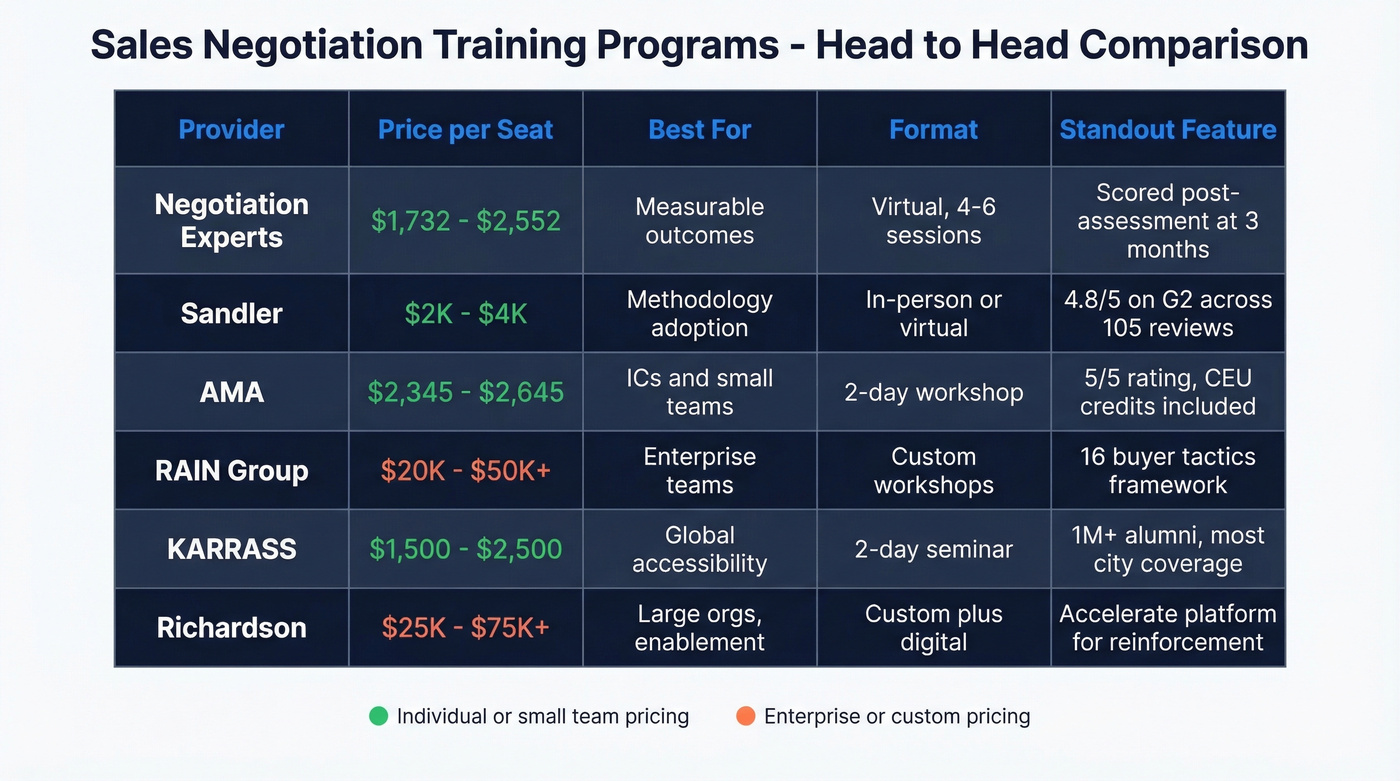
| Provider | Format | Duration | Price/Seat | Best For |
|---|---|---|---|---|
| Negotiation Experts | Virtual/classroom | 4-6 sessions | $1,732-$2,552 | Measurable outcomes |
| Sandler | In-person/virtual | Varies | ~$2K-$4K | Methodology adoption (4.8/5 G2) |
| AMA | 2-day workshop | 2 days | $2,345-$2,645 | ICs, CEU credits (5/5, 113 reviews) |
| RAIN Group | Custom workshops | Custom | ~$20K-$50K+ | Enterprise teams |
| KARRASS | 2-day seminar | 2 days | ~$1,500-$2,500 | Global accessibility |
| Richardson | Custom + digital | Ongoing | ~$25K-$75K+ | Large orgs, enablement |
Negotiation Experts
Use this if: You want hard numbers on whether training actually worked. Their simulation game platform scores reps during training, and they run a scored post-training assessment roughly three months later - with individual and leadership reports. That accountability loop is rare. Virtual delivery runs four to six 4.5-hour sessions, and pricing is transparent: $1,732/seat for Essential Negotiator and $2,552/seat for Competent Negotiator. Reps get a graduation certificate and personalized report.
Skip this if: You need in-person energy for your team culture, or you're looking for an ongoing methodology that extends beyond negotiation into the full sales cycle. This program is focused, not broad.
Sandler Negotiating Mastery
Use this if: Your org wants a repeatable methodology that reps internalize and reference long after the workshop ends. Sandler's 4.8/5 on G2 across 105 reviews reflects genuine stickiness - reviewers consistently praise the hands-on workshops and the process they build around them. It's methodology-first, which means it changes how reps think, not just what they say.
Skip this if: Your team needs broad non-US coverage or multilingual delivery. TrustRadius reviewers flag that live sessions are difficult to access outside the UK and US, content is English-only, and certifications cost extra. Teams in Latin America or APAC often feel underserved. Expect ~$2,000-$4,000/seat.
AMA Strategic Sales Negotiations
The AMA 2-day program earns a 5/5 rating based on 113 reviews by delivering a tightly structured curriculum covering settlement ranges, negotiating chips, concession planning, four primary negotiating styles, and handling aggressive buyer demands - all for $2,345-$2,645/seat with 1.2 CEU and 12 PMU credits included. For individual contributors or small team leaders who want recognized credentials without enterprise pricing, this is the strongest value play on the list.
The tradeoff: it's a standardized program, so teams selling complex enterprise deals with unique procurement structures won't get the customization they need.
RAIN Group
RAIN Group plays at the enterprise end. Their private workshops run $20K-$50K+ depending on customization, team size, and duration. The standout is their 16 buyer tactics framework - a structured way to recognize and counter the specific moves procurement teams use. Their Center for Sales Research publishes benchmarks showing top-performing sellers are 105% more likely to know when to walk away, which is useful for building internal buy-in with leadership. They also offer negotiation simulations plus AI tools across the RAIN Sales AI suite. Best for large teams with budget for a fully customized program. Not practical for sub-20-person orgs.
KARRASS
KARRASS has trained over 1 million alumni, which gives them massive brand recognition and broad seminar availability. Their Both-Win methodology emphasizes collaborative negotiation. Expect $1,500-$2,500/seat for a 2-day public seminar. The materials feel dated compared to simulation-heavy competitors, but the core framework is solid and the accessibility is hard to beat - they run seminars in more cities than almost anyone else.
Richardson
Richardson targets large enterprises wanting ongoing digital enablement, not just a one-time workshop. Their Accelerate platform provides post-training reinforcement through digital modules, which addresses the biggest failure point in training: reps forgetting everything within 60-90 days. Custom pricing runs $25K-$75K+ depending on scope. Best for organizations that want negotiation skills woven into a broader sales enablement ecosystem.
Quick Mentions: Scotwork, Corporate Visions, eCornell, Korn Ferry
Scotwork is a global negotiation specialist running programs at $2,000-$4,000/seat with structured deal-shaping methodology. They're one of the few providers positioned for true global delivery.
Corporate Visions focuses on custom enterprise programs at $20K-$60K. Strong on messaging and positioning within negotiations, less focused on tactical deal mechanics.
eCornell offers an online negotiation certificate backed by the Cornell brand for $1,500-$2,500. Good for self-paced learners who want an academic credential without flying to a workshop.
Korn Ferry bundles negotiation training into broader sales methodology engagements at $30K-$80K+. You're buying an ecosystem, not a standalone course.
How to Choose the Right Program
| Your Situation | Best Fit |
|---|---|
| 5-person startup, tight budget | AMA or Negotiation Experts |
| 50-person global team | Richardson or RAIN Group |
| Methodology-first org | Sandler |
| Individual contributor | AMA or eCornell |
| Enterprise with complex procurement | RAIN Group or Corporate Visions |
Beyond the table, three criteria matter most.
Format preference is more important than people admit. Virtual programs offer flexibility, but some teams genuinely learn better in a room together. We've seen this firsthand - the format matters less than the follow-up. Teams that build negotiation role-plays into weekly pipeline reviews see far better retention than those who treat training as a one-time event, regardless of whether the original workshop was virtual or in-person.
Post-training reinforcement separates programs that change behavior from expensive team-building exercises. Programs without follow-up assessments or digital reinforcement see skill decay within 60-90 days. Richardson and Negotiation Experts lead here.
Geographic and language needs are an underrated filter. For teams spanning multiple regions, Sandler's English-only limitation is a real constraint, while KARRASS's broad seminar footprint and Scotwork's global delivery become genuine advantages.
Let's be honest: don't overthink the vendor choice. The biggest variable in training ROI isn't which program you pick - it's whether reps practice the skills on real deals with real decision-makers afterward.
Before You Train, Fix Your Data
You're about to spend $2,000-$3,000 per rep on negotiation skills. But if those reps are negotiating with the wrong person - a mid-level champion who can't actually approve the deal, or a gatekeeper whose email bounced twice - the training ROI evaporates before anyone opens a slide deck.
Simon-Kucher's framework emphasizes that negotiations are influenced by multiple internal decision-makers beyond the purchaser. Your reps need to map every stakeholder and reach the actual economic buyer. That starts with data. (If you need a clean process for this, use a MEDDPICC lens.)
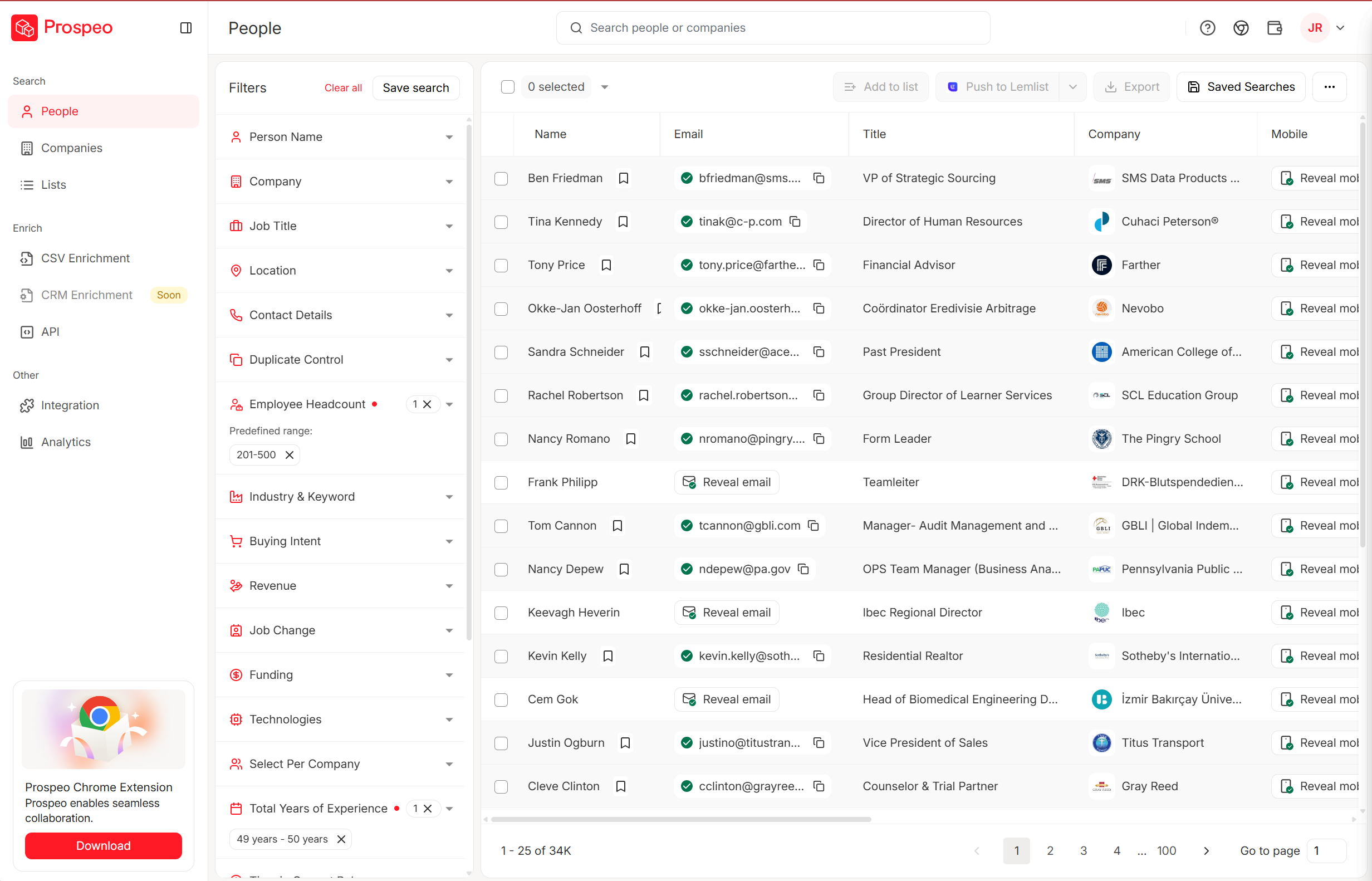
Prospeo's B2B database covers 300M+ professional profiles with 98% email accuracy and 125M+ verified mobile numbers. The 7-day data refresh cycle means your reps aren't calling numbers that went stale six weeks ago. Use the 30+ search filters to find the VP of Procurement or CFO who actually signs off on the deal, verify their contact in seconds, and push it straight to Salesforce or HubSpot. Training teaches reps how to negotiate. Verified data ensures they're negotiating with the person who can say yes.
You're investing $2K-$4K per seat on negotiation skills. Make sure those reps walk into calls prepared. Prospeo's 30+ filters - buyer intent, funding, headcount growth - arm your team with the leverage they need before the negotiation even starts.
The best negotiators don't wing prep. Give them real buyer intelligence.
FAQ
How much does negotiation training cost?
Public workshops typically run $1,500-$3,500 per seat for a 1-2 day program. Negotiation Experts charges $1,732-$2,552 and AMA charges $2,345-$2,645 - both fully transparent. Private team programs range from $15K-$75K+ depending on customization and provider. Enterprise engagements with Richardson or Korn Ferry can exceed $75K.
Is online negotiation training effective?
Hybrid programs with reinforcement outperform one-off in-person workshops. Simulation-based platforms like Negotiation Experts close the gap between virtual and classroom by forcing reps into scored practice scenarios. AI-powered practice tools from providers like RAIN Group add another repetition layer between live sessions.
How long until you see ROI?
Scotwork reports 16x ROI within three months, and RED BEAR cites $54 return per $1 invested - both vendor-sourced but directionally consistent. The key variable is post-training reinforcement: programs with scored assessments compress the timeline. Without reinforcement, expect skill decay within 60-90 days.
What's the difference between sales training and negotiation training?
Sales training covers the full cycle - prospecting, discovery, demos, objection handling, closing. Negotiation training focuses on the deal-shaping conversation: pricing strategy, concession trading, BATNA discipline, and countering buyer tactics. Most teams need both, but negotiation programs target the exact moment where margin is won or lost.
How do you make sure reps apply what they learned?
Choose programs with scored post-assessments - Negotiation Experts runs one at three months. Layer in AI simulations and CRM-integrated reinforcement workflows. Most critically, make sure reps practice on actual economic buyers, not gatekeepers with dead numbers. Verified contact data with direct dials means your reps apply new skills on the people who control the deal, not the people who forward emails.